The Cannibal by I.V. Ophelia Summary, Characters and Themes
The Cannibal by I.V. Ophelia is a dark gothic romance that combines supernatural horror, scientific experimentation, political intrigue, and an obsessive love story.
Set within a society controlled by powerful beings known as Vipera, the novel follows Alina Lis, a gifted poisoner who awakens after death to discover that she has become something terrifyingly different. As she struggles with an unnatural hunger and the consequences of her transformation, she becomes entangled in a dangerous conflict involving her lover, his powerful father, and the secrets of her own family. The story explores love, identity, betrayal, bodily autonomy, and the frightening cost of survival. It’s the 3rd book of the Poisoner series.
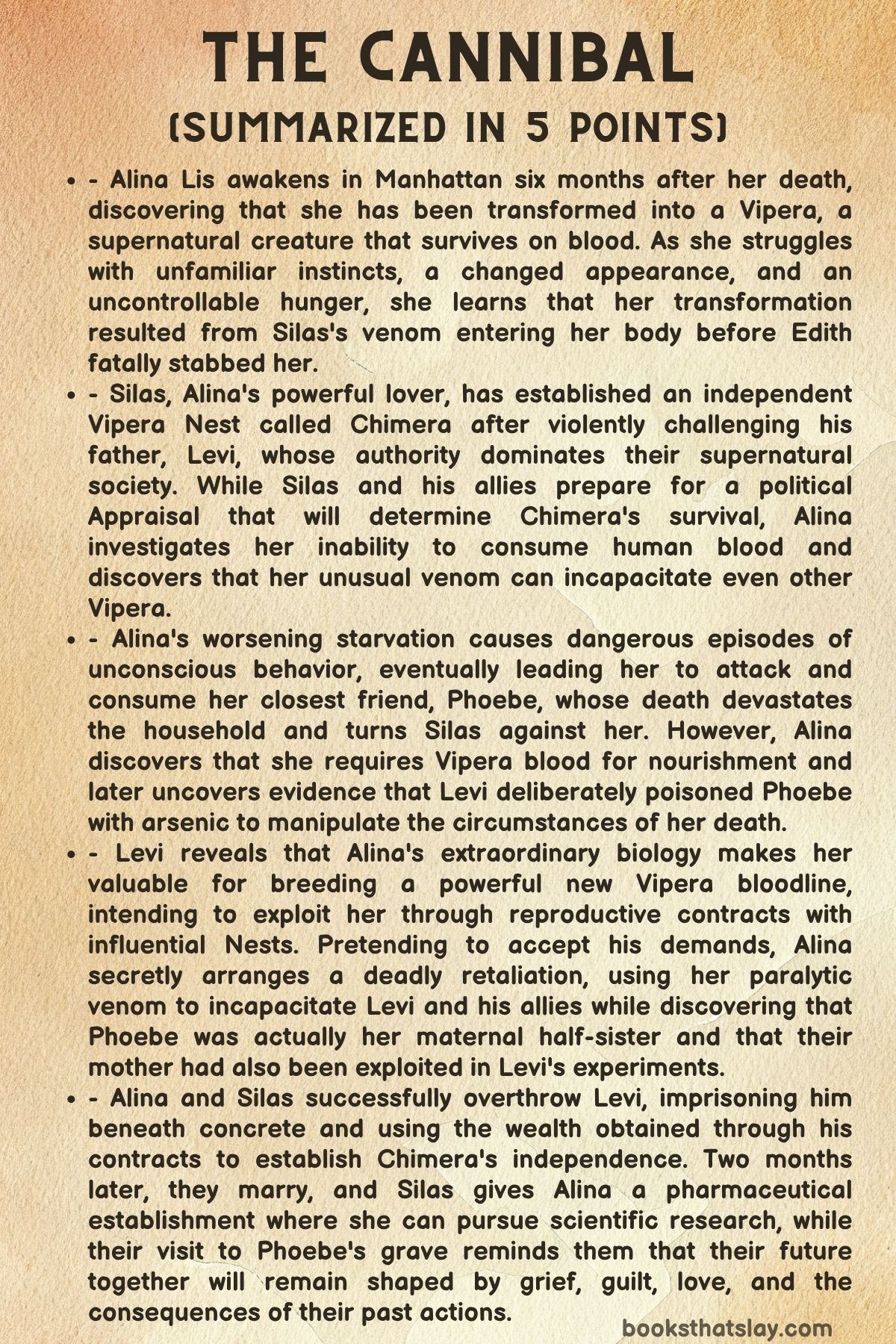
Summary
Alina Lis awakens in an unfamiliar bedroom in Manhattan, surrounded by flowers that resemble funeral arrangements. Her body feels painfully weak, her memories are incomplete, and her appearance has changed beyond recognition, leaving her with unnaturally pale skin and completely black eyes.
Searching for answers, she discovers that she is inside a Vipera Nest and eventually encounters her closest friend, Phoebe. Their emotional reunion brings a devastating revelation: Alina died six months earlier and has returned to life as a Vipera, a supernatural predator whose survival depends upon blood.
Phoebe tries to help Alina adjust to her transformed existence, introducing her to unfamiliar sensations, altered tastes, and the complicated society she must now inhabit. Alina soon discovers that ordinary food is repulsive, human heartbeats are painfully distracting, and her body experiences a hunger that threatens to overwhelm her judgment.
Although Phoebe initially conceals the circumstances of her death, Alina eventually learns that Edith stabbed her with a knife intended for Phoebe. Luka killed Edith afterward, while Silas, Alina’s lover, had unknowingly made her transformation possible because his venom was already present in her body.
Alina is reunited with several women from her former household in Buffalo, including Rebecca and John, while Mary has remained behind to protect the others. Their survival provides some comfort, but Alina recognizes that her previous responsibilities and relationships have changed during her absence.
Meanwhile, a political crisis threatens everyone connected to Silas. After poisoning the bloodwine consumed by members of his father Levi’s former Nest, Silas has challenged the established Vipera hierarchy and created an independent organization called Chimera.
Under Vipera law, killing members of one’s own species is a serious offense, and Silas must defend his actions through a formal proceeding known as an Appraisal. If representatives from other powerful Nests accept his challenge to Levi’s authority, Chimera can gain recognition; otherwise, the entire household faces possible destruction.
Silas and Luka travel abroad to secure political support, leaving Phoebe responsible for maintaining the household and helping Alina recover. Their absence also allows Levi to approach Alina, exploiting his connection to her deceased father, Jacek Lis, and returning the engagement ring Silas once gave her.
Levi presents himself as a concerned family acquaintance, but his calculated affection conceals a willingness to manipulate everyone around him. Alina suspects that he possesses important information about her father’s death and the scientific experiments involving Vipera reproduction.
As her hunger intensifies, Alina desperately attempts to feed, first attacking an unsuspecting man at the botanical gardens and later visiting a Guild where human Hosts provide blood to Vipera clients. Both experiences end in violent sickness, revealing that she cannot tolerate the very substance supposedly necessary for her survival.
Luka becomes increasingly concerned because her inability to feed may cause permanent neurological damage or transform her into a corrupted creature. Seeking an explanation, Alina begins working in a laboratory Silas prepared during her unconsciousness, returning to the scientific investigations that once defined her life.
The reunion between Alina and Silas proves more complicated than either imagined. Silas has spent months grieving her death, struggling with emotional instability and the responsibilities of leadership, while Alina feels hurt by his anger and the secrecy surrounding her recovery.
Their relationship becomes strained by his possessiveness, her determination to retain independence, and their shared fear of losing each other again. However, they gradually recognize that their emotional injuries cannot be resolved through control, avoidance, or declarations of devotion alone.
Alina also discovers that Silas suffers from feeding difficulties of his own, having become unusually dependent on her blood. Their biological needs appear increasingly connected, suggesting that their attachment involves more than ordinary romantic desire.
When John offers his blood to help Alina, she again becomes violently ill, but the encounter exposes another extraordinary feature of her transformation. Her venom possesses unusually powerful paralytic properties capable of harming even other Vipera, and John’s worsening condition forces her to acknowledge how dangerous she has become.
Alina’s emotional distress deepens when the women from Buffalo return and appear resentful toward her. Believing that she abandoned them, they remain unaware of the circumstances surrounding her death, leaving her feeling isolated from the community she once struggled to protect.
During a storm, Silas discovers Alina on a rooftop ledge, overwhelmed by despair and contemplating death. His intervention leads to an emotional reconciliation in which both acknowledge their love and their determination to face the future together.
Their renewed intimacy temporarily restores some stability, and Silas attempts to help Alina embrace her transformed body through private excursions and moments away from political pressures. Yet her starvation continues, while her scientific experiments reveal no reliable solution.
Phoebe is simultaneously confronting the truth about Levi, whose affectionate behavior has concealed his extraordinary cruelty. After she questions his beliefs about weakness and survival, he drives a fork through her hand, finally revealing the violence behind his apparent paternal kindness.
As the Appraisal approaches, international representatives arrive at Chimera, bringing old rivalries, political ambitions, and dangerous negotiations. Silas struggles to control his hatred of Levi, eventually attacking him in front of the assembled guests and knocking out one of his gold-covered fangs.
Alina is forced to treat Levi’s injury, exposing herself to his unsettling familiarity with her family history. His observation that she resembles her mother raises further questions about the reproductive experiments conducted by her father.
Meanwhile, Alina’s condition deteriorates dramatically, and she begins experiencing episodes of unconscious predatory behavior. Phoebe witnesses her wandering through the residence in a terrifying, animalistic state, suggesting that starvation is beginning to destroy her conscious control.
Alina subsequently falls from the rooftop while apparently sleepwalking, suffering severe injuries that leave her confined to bed. Although her supernatural body can repair broken bones, Luka fears that her mind may not survive continued starvation.
Silas refuses to accept the possibility that her transformation is failing, even when Luka suggests that allowing her to die might eventually become the only merciful option. Their disagreement exposes the conflict between Silas’s desperate devotion and the reality of Alina’s worsening condition.
The tragedy reaches its peak when Alina experiences what seems to be a comforting dream about Phoebe. Overwhelmed by an extraordinary sweetness, she awakens to discover herself covered in black blood, with Phoebe’s mutilated body lying nearby.
Luka realizes that Alina has consumed Phoebe’s blood and flesh, but he also notices an astonishing physical change. Alina is no longer starving, revealing that she was never rejecting her transformation: her unique physiology requires the blood of other Vipera rather than humans.
Phoebe’s death devastates the household, particularly Silas, who initially turns his grief and fury against Alina. Luka intervenes to protect her, but the tragedy destroys the fragile trust that had developed among Chimera’s members.
Accused of killing Phoebe, Alina faces formal proceedings before the gathered Vipera representatives. Although the evidence appears overwhelming, she questions why Phoebe died when Vipera saliva normally possesses regenerative and clotting properties that should have limited the injuries.
With Luka and Mary’s assistance, Alina secretly examines Phoebe’s preserved body and discovers arsenic in her stomach. The finding indicates that Phoebe was poisoned before Alina attacked her, suggesting that the fatal outcome was deliberately engineered.
During a private meeting at the botanical gardens, Levi openly admits that he poisoned his daughter to destroy her and implicate Alina. He then reveals that Alina’s extraordinary biology makes her valuable as the foundation of a new Vipera bloodline.
Levi offers an elaborate breeding contract through which powerful Nests would gain reproductive access to Alina in exchange for wealth, protection, and political security. Recognizing that the arrangement would reduce her to property, Alina begins developing a plan to exploit Levi’s ambitions rather than surrender to them.
After explaining the poisoning to Silas, she recruits his cooperation and makes preparations involving her unusual venom. Their strategy depends upon convincing Levi that she has accepted his demands while secretly arranging the destruction of those who intend to control her.
Before the plan can unfold, Rebecca and Pierce Soros lure Alina into a trap with Mary’s assistance. However, Alina’s recovered strength and extraordinary venom allow her to overpower and kill both attackers, demonstrating how dramatically her position has changed.
At the resumed Appraisal, Alina apparently accepts Levi’s breeding contract, stunning Silas and satisfying the assembled representatives. Her apparent submission secures Chimera’s protection and places considerable resources under her control, but the agreement is actually part of her larger deception.
During a celebratory banquet, Levi reveals that Alina’s mother, Katarzyna Lis, was exploited in his reproductive experiments and transformed into a Vipera after childbirth. He also reveals that Phoebe shared Katarzyna as her mother, meaning Alina’s closest friend was actually her maternal half-sister.
The discovery makes Phoebe’s death even more devastating, exposing the extent to which Levi manipulated Alina’s family across generations. Nevertheless, Alina proceeds with her carefully prepared retaliation.
The bloodwine served to the powerful representatives contains her paralytic venom, allowing Silas and their allies to overpower the guests. While Silas kills their enemies, Alina administers concentrated venom to Levi, ultimately having him and the surviving defeated representatives entombed beneath freshly poured concrete.
Levi’s wealth, transferred through the contracts he expected to use against her, becomes the foundation of Chimera’s independence. Alina has turned his obsession with reproduction, ownership, and inherited power into the means of his destruction.
Two months later, Alina and Silas celebrate their marriage in Manhattan, surrounded by the surviving members of their household. Silas gives her a pharmaceutical establishment named Lis & Co. Pharmaceuticals, allowing her to continue the scientific work that remains central to her identity.
Before beginning their new life together, the couple travel to Warsaw, where Alina visits the graves of Phoebe and Katarzyna. Although she remains burdened by guilt, Silas reminds her that immortality does not eliminate suffering or responsibility, and they reaffirm their commitment to remain together through whatever eternity brings.
Characters
Alina Lis
Alina Lis is the central protagonist of The Cannibal, a brilliant poisoner whose transformation from human to Vipera forces her to reconsider everything she believes about herself. Her scientific intelligence, fierce independence, and determination to protect those she loves remain essential parts of her personality even as her body develops terrifying new instincts.
Her greatest struggle involves reconciling her former humanity with the predatory hunger that now governs her existence. She fears becoming a monster, particularly after attacking an innocent man and accidentally poisoning John with her unusual venom.
Alina’s inability to consume human blood makes her transformation especially difficult because the very substance necessary for ordinary Vipera survival causes her physical suffering. Instead of accepting defeat, she applies her scientific knowledge to investigate her condition, demonstrating intellectual courage even when her emotional stability begins deteriorating.
Her relationship with Silas exposes another dimension of her character, revealing a woman capable of intense devotion without entirely surrendering her individuality. Although their love is sometimes possessive and destructive, Alina repeatedly challenges Silas’s authority and insists upon making decisions for herself.
Phoebe’s death represents Alina’s deepest emotional crisis, particularly because she eventually discovers that her closest friend was also her half-sister. Her determination to expose Levi’s poisoning demonstrates that grief and guilt have not destroyed her capacity for rational investigation.
By the conclusion, Alina transforms her extraordinary biology into a weapon against the aristocracy that intended to exploit her. Her victory establishes her as a powerful and morally complicated figure who secures her freedom through intelligence, calculated deception, and violence.
Silas
Silas is one of the most psychologically complicated figures in The Cannibal, combining extraordinary physical power with profound emotional vulnerability. As the leader of Chimera and Levi’s rebellious son, he must navigate the demands of political leadership while struggling with the consequences of his attachment to Alina.
His decision to poison his father’s former Nest reveals his willingness to challenge established authority through extreme measures. Although his actions are motivated partly by liberation from Levi’s control, they also expose the brutality that Silas has inherited from the society he seeks to change.
His relationship with Alina becomes the defining emotional force in his existence. Her death and prolonged unconsciousness leave him overwhelmed by grief, guilt, and an increasingly unstable emotional state that threatens his responsibilities as Sire.
Silas’s possessiveness frequently conflicts with Alina’s independence, particularly when he discovers that Luka and Phoebe concealed her awakening. His violent reaction demonstrates how easily his fear of abandonment can become aggression directed toward the people closest to him.
Nevertheless, Silas gradually recognizes that loving Alina requires more than protecting or possessing her. Their reconciliation reveals his capacity for vulnerability, especially when he discusses his family history and the damage inflicted by Levi.
Phoebe’s death creates an almost unbearable conflict between his love for Alina and his grief for his sister. His eventual willingness to cooperate with Alina’s plan against Levi demonstrates that he can transform his anger into purposeful action, even though forgiveness remains difficult.
Phoebe
Phoebe is one of the most emotionally significant characters in The Cannibal, serving as Alina’s closest companion, protector, and connection to her former life. Her affectionate personality and social intelligence contrast with the ruthlessness of the Vipera world, although she is far from innocent of its manipulative practices.
Throughout Alina’s recovery, Phoebe attempts to recreate the comforts of their earlier friendship through shopping, familiar routines, companionship, and emotional reassurance. These efforts reveal genuine devotion, but they also expose her desire to control circumstances that might threaten Alina again.
Phoebe’s guilt over Alina’s death makes her increasingly protective, sometimes encouraging her to conceal important information. She struggles to distinguish responsible care from possessiveness, particularly when Alina begins asserting independence.
Her relationship with Levi represents a separate tragedy because she initially believes that the loving father she remembers can be reconciled with the ruthless political leader Silas describes. Levi’s violent punishment forces her to recognize that her childhood memories concealed a much darker reality.
Despite her vulnerability, Phoebe demonstrates considerable political ability during negotiations with New York’s Nests and Guilds. Her argument against inherited privilege and exploitative breeding practices establishes her as someone capable of imagining a more independent future for Vipera society.
Her death becomes especially devastating when Alina discovers that Levi poisoned her and that they shared the same mother. Phoebe ultimately represents both the possibility of enduring devotion and the terrible vulnerability of people who continue seeking affection from those determined to control them.
Luka
Luka is the practical strategist and trusted fixer whose judgment repeatedly determines whether Chimera can survive its internal and external crises. In The Cannibal, he occupies a difficult position between political responsibility, personal loyalty, and the emotional instability of those he protects.
His relationship with Silas combines deep familiarity with constant conflict, especially when Luka decides to conceal Alina’s awakening. Although this decision provokes Silas’s violence, Luka believes that protecting their political preparations is essential to preventing the destruction of the household.
Luka’s damaged face and persistent headaches reveal that his responsibilities are accompanied by lasting physical suffering. Nevertheless, he continues managing security, diplomatic negotiations, medical emergencies, and the unpredictable behavior of powerful Vipera.
His treatment of Alina demonstrates a more compassionate side beneath his cynical manner. He gives her access to scientific resources, encourages her research, and ultimately protects her from Silas after Phoebe’s death.
His relationships with Mary and Phoebe also reveal emotional complexity that he often prefers to disguise through humor or detachment. Although he presents himself as an independent enforcer, his growing commitment to Chimera demonstrates that he has become deeply invested in the lives of others.
Luka’s importance lies in his capacity to act when stronger personalities become overwhelmed by emotion. He provides the practical stability necessary for Alina and Silas to confront Levi, even when the decisions required place him in personal danger.
Levi
Levi is the principal antagonist of The Cannibal, representing the violence, exploitation, and inherited privilege that sustain the established Vipera hierarchy. His ancient status as a powerful Sire gives him extraordinary influence, which he exercises through intimidation, calculated affection, and ruthless political maneuvering.
His relationships with Silas and Phoebe demonstrate different forms of psychological control. Silas openly recognizes his father’s cruelty, while Phoebe initially struggles to abandon the comforting image of the affectionate parent she remembers.
Levi understands that emotional attachments can be exploited more effectively than physical weaknesses. His use of Alina’s childhood nickname, his references to her deceased father, and his knowledge of her mother reveal how carefully he manipulates grief and family connections.
His murder of Phoebe exposes the full extent of his moral corruption. Rather than regard his daughter as someone deserving protection, he poisons her to achieve a political objective and uses Alina’s uncontrolled hunger to strengthen the accusation against her.
Levi’s reproductive ambitions provide another disturbing aspect of his character because he regards women primarily according to their biological usefulness. His exploitation of Katarzyna and attempt to establish breeding contracts involving Alina demonstrate how thoroughly his understanding of power depends upon ownership.
His downfall results from the same arrogance that has sustained his authority for generations. By transferring resources to Alina through the contracts, he unknowingly supplies her with the means to destroy his political influence and secure Chimera’s independence.
Mary
Mary is a resilient member of Alina’s former Buffalo household who gradually assumes greater responsibility after Alina’s disappearance. Her decision to remain behind and protect the women, particularly Addie, demonstrates her independence and willingness to lead during difficult circumstances.
Her relationship with Luka reveals a more intimate and emotionally perceptive side of her personality. She recognizes the vulnerability beneath his detached behavior and challenges his tendency to avoid meaningful emotional commitments.
Mary’s complicated relationship with Rebecca also influences her loyalties, particularly after Phoebe’s death creates resentment toward Alina. Her participation in the trap organized by Rebecca and Pierce exposes how grief and divided allegiances can lead her into serious moral error.
However, Alina’s decision to spare Mary creates the possibility of reconciliation. By the conclusion, Mary remains connected to the household, demonstrating that betrayal does not necessarily eliminate the possibility of rebuilding trust.
Rebecca
Rebecca begins as a familiar member of Alina’s former household, representing the community Alina once struggled to protect. Her survival initially reassures Alina that her sacrifices were not meaningless, but their relationship deteriorates as misunderstandings and resentment accumulate.
Rebecca’s anger is influenced by her belief that Alina abandoned the Buffalo women and, later, by Phoebe’s violent death. Her grief becomes increasingly destructive as she begins regarding Alina not as a former protector but as a dangerous creature responsible for the household’s suffering.
Her alliance with Pierce Soros marks her transition into an active antagonist. By attempting to murder Alina outside the official proceedings, she chooses revenge over investigation or reconciliation.
Rebecca’s death demonstrates the consequences of allowing hatred to replace judgment. Her fate is particularly tragic because her opposition emerges from relationships that were once built upon trust and mutual survival.
John
John is a compassionate and dependable figure whose kindness provides an important contrast to the cruelty surrounding the Vipera. He repeatedly treats Alina as a person deserving dignity, even when she regards herself as monstrous.
His willingness to offer his blood demonstrates his trust in her and his desire to alleviate her suffering. Unfortunately, Alina’s unusual venom causes serious medical complications, turning his generous act into another source of guilt for her.
John’s role becomes especially important because he refuses to define Alina exclusively through her worst actions. His reassurance after the botanical gardens attack helps her recognize that an uncontrolled act does not automatically erase everything she once valued.
He survives the household’s many crises and later accompanies Alina during her wedding ceremony. His continued presence symbolizes the enduring importance of loyalty, friendship, and compassion in her transformed existence.
Sidney Henderson
Sidney Henderson is an unconventional Irishman whose humor, directness, and practical knowledge make him a valuable presence within Chimera. He introduces Alina to important aspects of Vipera physiology and society without treating her unfamiliarity as something shameful.
His willingness to explain Mellifluous Hosts and unusual feeding responses helps Alina begin understanding the instincts that initially terrify her. This supportive approach distinguishes him from other characters who attempt to manage her through secrecy or restrictions.
As political tensions increase, Sidney becomes responsible for Alina’s protection. His participation in the final operation against Levi demonstrates his loyalty to Chimera and his willingness to act when the household’s future is threatened.
Amelia
Amelia is a young household servant whose practical intelligence and familiarity with Vipera customs make her unexpectedly valuable to Alina. Their early interactions establish a connection based partly on curiosity, experimentation, and the everyday difficulties of adapting to a transformed body.
She helps Alina understand how to extend her fangs and experiment with unfamiliar flavors. Later, her preparation of blood-based soup offers Alina one of the few temporary improvements in her ability to consume nourishment.
Amelia also contributes to the secret preparations for Levi’s downfall. Her importance demonstrates that servants and other individuals without aristocratic authority can influence events through knowledge, reliability, and cooperation.
Edith
Edith is a destructive figure whose betrayal causes the catastrophe that begins Alina’s transformed existence. Her decision to attack Phoebe with a knife results in Alina being stabbed instead, establishing the circumstances that lead to Alina’s death and subsequent rebirth.
Although Edith dies before the principal events unfold, her actions continue shaping the relationships among the surviving characters. Alina must confront the consequences of her betrayal, while Luka carries complicated memories of killing her.
Edith’s significance lies in the lasting damage caused by violence within supposedly trusted relationships. Her actions contribute to the atmosphere of secrecy, grief, and suspicion that threatens the household long after her death.
Pierce Soros
Pierce Soros is an influential representative of New York’s Vipera establishment who questions Chimera’s legitimacy and resents its challenge to established interests. His confrontational behavior toward Alina exposes his hostility to individuals who threaten existing political arrangements.
He attempts to embarrass Alina by invoking her history as a poisoner and questioning the destruction associated with her scientific abilities. His behavior also intensifies tensions with Silas, whose protective instincts make diplomatic encounters especially volatile.
Although Pierce initially considers supporting Chimera under certain conditions, he later participates in Rebecca’s attempt to murder Alina. His death demonstrates the danger of underestimating someone whose apparent vulnerability conceals extraordinary power.
Jacek Aleksander Lis
Jacek Aleksander Lis is Alina’s deceased father, whose scientific research continues influencing events long after his death. His work on Vipera reproduction and desirable biological characteristics provides essential background to Levi’s ambitions.
Alina initially remembers him through personal affection and childhood associations, but the discovery of his research forces her to question the nature of his professional activities. His association with Levi raises troubling uncertainties about what he understood and whether his investigations contributed to the exploitation of others.
Jacek’s importance rests partly in the contrast between scientific discovery and ethical responsibility. His legacy becomes especially complicated because Alina inherits his intellectual abilities while confronting the consequences of the research he helped produce.
Katarzyna Lis
Katarzyna Lis is Alina’s mother, whose history reveals the disturbing extent of Levi’s reproductive experiments. Although she is absent from the principal action, the revelation of her suffering changes Alina’s understanding of her family and origins.
After childbirth left Katarzyna gravely ill, Levi transformed her into a Vipera and continued exploiting her for his breeding ambitions. Her treatment demonstrates the systematic violence inflicted upon women whose bodies possess characteristics valued by powerful Nests.
The discovery that Katarzyna was also Phoebe’s mother makes her central to one of the novel’s most devastating revelations. Her burial alongside Phoebe in Warsaw allows Alina to acknowledge the family relationships that were deliberately concealed from her.
Ilya
Ilya is an old acquaintance of Luka whose arrival during the Appraisal provides a connection to relationships established before Chimera’s formation. His presence demonstrates that Luka’s influence extends beyond Silas’s immediate household.
Ilya later participates in the coordinated operation against Levi and the assembled representatives. Although his personal history receives limited attention, his assistance reinforces the importance of alliances in overcoming the power of established Nests.
Isabella
Isabella is another figure associated with Luka’s earlier life who appears among the visitors arriving for the Appraisal. Her familiarity offers him a brief sense of comfort amid the growing pressures of political negotiations and security responsibilities.
Her role is comparatively limited, but her presence suggests that Luka possesses personal attachments beyond the responsibilities that currently define him. She contributes to the impression of a broader Vipera society shaped by longstanding relationships and shifting loyalties.
Elijah
Elijah is one of the allies who participates in the final coordinated attack against Levi and the visiting representatives. His involvement demonstrates that the operation depends upon cooperation among several individuals rather than the abilities of Alina and Silas alone.
Although the supplied account provides little information about his personal history, Elijah contributes to the collective effort that secures Chimera’s freedom. His participation reinforces the importance of organized resistance against an opponent whose power would be difficult to challenge individually.
Addie
Addie is a member of the Buffalo household whose continued presence influences Mary’s decision to remain behind after Alina’s death. Although she has little direct involvement in the principal conflict, her importance lies in the responsibilities and attachments that unite the women.
Mary’s refusal to abandon Addie demonstrates that the household functions as a community rather than simply a group dependent upon Alina. Addie therefore represents the vulnerable individuals whose safety remains an important consideration throughout the struggle for independence.
Themes
Identity, Transformation, and the Fear of Becoming a Monster
Alina’s transformation challenges the assumption that identity remains stable when the body changes beyond recognition. Her awakening as a Vipera forces her to confront unfamiliar instincts, altered sensory experiences, and an appetite that contradicts the moral principles governing her earlier life.
In The Cannibal, the distinction between humanity and monstrosity becomes increasingly uncertain because supernatural biology does not provide a reliable measure of moral character. Alina’s frightening physical changes contrast with the cruelty of Levi, whose sophisticated manners and political authority conceal behavior far more deliberately destructive than her uncontrolled hunger.
Her inability to tolerate human blood makes this crisis particularly painful. She believes that her new body is defective, and every unsuccessful attempt to feed strengthens her fear that she no longer possesses a meaningful place among humans or Vipera.
The discovery that she requires Vipera blood changes the meaning of her apparent abnormality. Rather than representing a failed transformation, her physiology introduces an entirely different form of existence with possibilities that ordinary members of her species cannot easily understand.
However, this revelation does not resolve her moral concerns because discovering how to survive also means recognizing the danger she poses to others. Phoebe’s death establishes that accepting her biological nature cannot eliminate responsibility for the suffering associated with it.
Alina’s scientific work becomes essential to preserving her identity because it allows her to respond to terrifying experiences through observation and reason. Even when her body develops predatory instincts, she remains capable of investigating problems, making independent decisions, and challenging the authority of those who seek to define her.
Her eventual acceptance of her transformed appearance and extraordinary abilities demonstrates that identity involves more than physical continuity. The woman who survives Levi’s ambitions is neither identical to the person who died nor entirely separated from her former self.
The novel ultimately presents identity as something that must be continually reconstructed through memory, relationships, ethical choices, and the willingness to acknowledge uncomfortable truths about oneself.
Love, Possession, and the Destructive Consequences of Grief
Love frequently exists alongside jealousy, manipulation, fear, and violence, complicating the idea that devotion necessarily produces protection or emotional security. The relationships among Alina, Silas, Phoebe, and Levi demonstrate how affection can become destructive when individuals attempt to control the people they cannot bear to lose.
Silas’s devotion to Alina provides emotional purpose, but it also exposes his vulnerability to possessiveness and extreme reactions. His grief during her unconsciousness becomes so overwhelming that her eventual awakening does not immediately restore his stability.
Instead, his anger toward Luka and Phoebe reveals his difficulty accepting that decisions concerning Alina might occur without his involvement. His behavior suggests that loving another person does not automatically grant someone the ability to respect that person’s autonomy.
Phoebe experiences a related conflict through her determination to protect Alina after witnessing her death. Her attempts to supervise Alina’s recovery emerge from genuine care, but they also demonstrate how guilt can encourage excessive control.
Levi represents the most destructive expression of possessive affection because he treats family relationships as extensions of his authority. His murder of Phoebe reveals that his apparent love depends upon obedience, and he willingly destroys his daughter when she becomes inconvenient.
The contrast between these relationships raises questions about whether love can survive without freedom. Alina and Silas move toward a more sustainable partnership only when they begin acknowledging their fears and allowing one another to confront difficult decisions.
Phoebe’s death prevents the story from presenting reconciliation as a universal solution. Some injuries cannot be undone, and even Alina’s eventual victory cannot restore the relationship she has lost.
Grief remains part of the characters’ identities rather than disappearing when their circumstances improve. Alina’s visit to Phoebe’s grave demonstrates that enduring love involves accepting absence, remembering the dead, and carrying responsibility for actions that cannot be reversed.
The novel ultimately suggests that devotion becomes meaningful through accountability and mutual recognition, while possession turns affection into another instrument of domination.
Power, Inherited Privilege, and Bodily Autonomy
Vipera society operates through a rigid structure in which inherited authority, reproductive value, and control over resources determine political influence. Powerful Nests preserve their dominance by treating bloodlines as evidence of superiority, creating a hierarchy that rewards ancestry rather than moral judgment or demonstrated competence.
In The Cannibal, Levi embodies this system because his authority depends upon accumulated wealth, extraordinary age, and the belief that he possesses a natural right to control others. His understanding of leadership leaves little room for consent, personal independence, or challenges to inherited privilege.
The reproductive contracts reveal the most disturbing consequences of this ideology. Women whose biology possesses desirable characteristics become valuable primarily as instruments for creating new generations, reducing their individuality to their perceived usefulness.
Katarzyna’s exploitation establishes that this system operates across generations, while Levi’s attempt to control Alina demonstrates his intention to continue the same practices. Both women become targets because their bodies possess characteristics that powerful individuals wish to appropriate.
Alina’s resistance transforms the conflict from a private family dispute into a broader struggle over political authority and bodily autonomy. By refusing to regard herself as reproductive property, she challenges the assumption that biological difference justifies ownership.
Silas’s creation of Chimera offers a competing model of power, although his violent behavior reveals that abandoning inherited institutions does not automatically eliminate authoritarian instincts. His struggle demonstrates how difficult it can be to reject a system while carrying the habits and beliefs it has produced.
Phoebe’s negotiations with the New York establishments further challenge traditional assumptions about legitimacy. Her arguments suggest that the survival of Vipera society should depend upon cooperation and changing institutions rather than unquestioning obedience to ancient bloodlines.
The conclusion reverses Levi’s expectations by allowing Alina to exploit the contracts through which he intended to possess her. The resources accumulated through exploitation become instruments of independence, demonstrating how an oppressive structure can sometimes be defeated through its own mechanisms.
Nevertheless, the victory remains morally complicated because Alina secures freedom through lethal force. The novel therefore presents liberation not as an uncomplicated moral triumph but as a struggle in which resistance can reproduce some of the violence it seeks to overcome.
Science, Hunger, and the Ethics of Survival
Scientific investigation operates as both a source of liberation and a means of exploitation, depending upon who controls knowledge and how discoveries are applied. Alina’s experiments seek to understand suffering and preserve life, while Levi’s reproductive projects transform biological research into a system of coercion.
This contrast becomes particularly important when Alina discovers that her transformation does not follow established Vipera expectations. The assumption that every member of her species must survive through human blood nearly destroys her because those responsible for her care interpret biological difference as evidence of failure.
Her repeated experiments demonstrate the danger of treating incomplete scientific knowledge as unquestionable truth. Luka’s concern about corruption is understandable, but the eventual discovery of Alina’s dietary requirements reveals how severely accepted explanations can misrepresent an unfamiliar condition.
Alina’s intellectual persistence makes her survival possible, yet scientific inquiry also carries ethical consequences. Her experiments with venom expose John to serious danger, forcing her to confront the distinction between possessing the ability to conduct an experiment and having the moral justification to do so.
Her disagreement with Phoebe over John’s condition reinforces this responsibility. Alina believes that the person harmed by an experiment deserves honesty, even when disclosure may threaten the political standing or reputation of those involved.
Hunger adds another dimension because Alina’s desperate need for nourishment gradually overwhelms her conscious judgment. Her attack on Phoebe demonstrates the frightening possibility that survival instincts can produce actions fundamentally opposed to an individual’s intentions and emotional commitments.
Levi exploits this vulnerability by poisoning Phoebe and allowing Alina’s hunger to create the appearance of a straightforward murder. His manipulation exposes the danger of combining scientific knowledge with a complete disregard for human or supernatural suffering.
The discovery of arsenic illustrates how careful investigation can challenge an apparently undeniable conclusion. By examining physical evidence rather than surrendering to guilt or public accusation, Alina uncovers the deliberate cruelty hidden beneath the tragedy.
Her final use of paralytic venom against Levi and his allies complicates the ethical distinction between research and weaponry. The same biological discovery that gives her control over her survival also enables her to incapacitate and destroy others.
The novel ultimately treats knowledge as a form of power whose moral value depends upon its application. Alina’s future as a pharmaceutical researcher suggests the possibility of using her abilities constructively, but her experiences demonstrate that discovery, survival, and responsibility cannot be separated from the consequences of the choices made in their name.