The French Illusion Summary, Characters and Themes
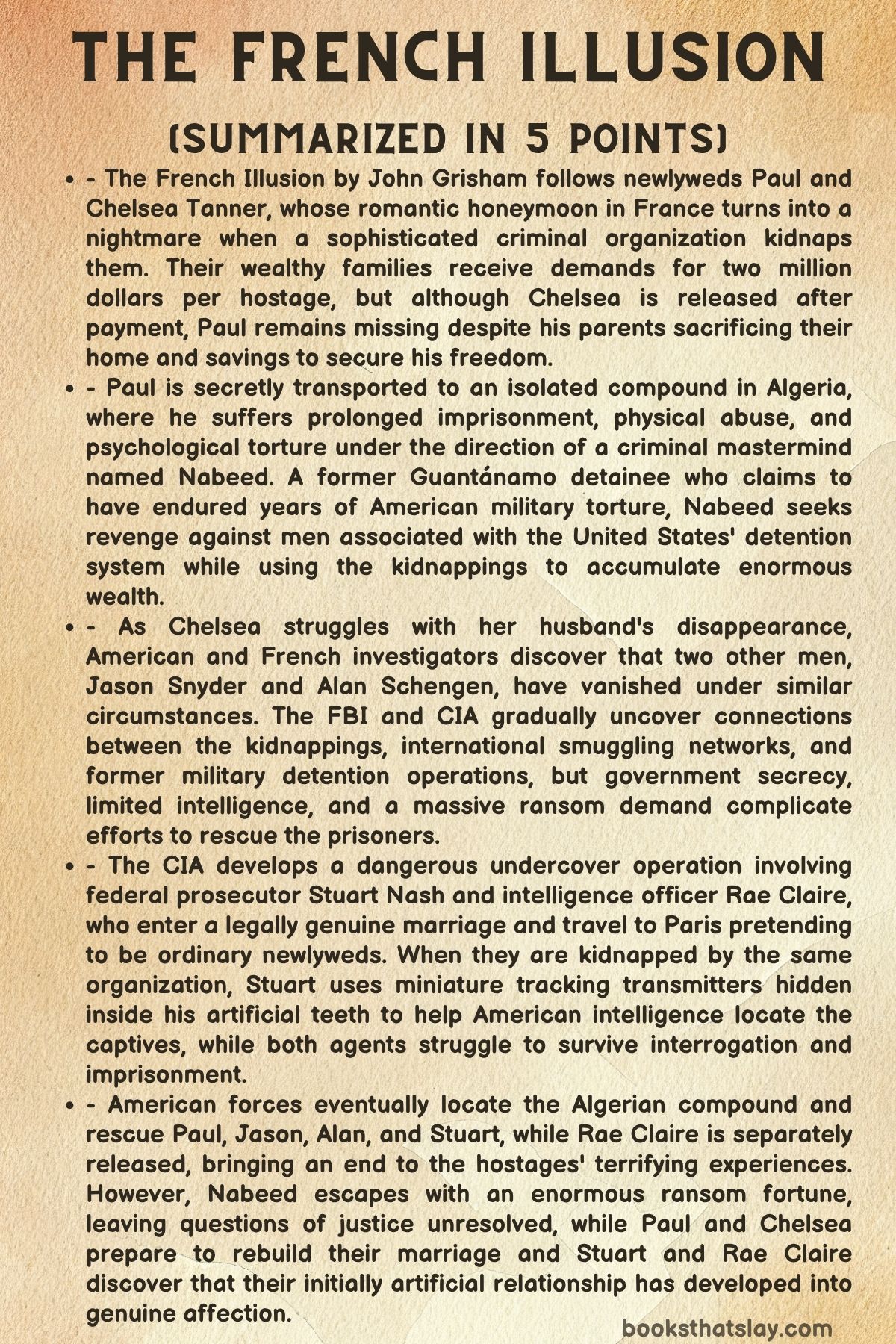
The French Illusion by John Grisham is a political and legal thriller that explores international kidnapping, government secrecy, personal revenge, and the lasting consequences of American military detention practices.
The novel begins with a newlywed couple whose romantic honeymoon in France becomes a terrifying ordeal, eventually exposing a sophisticated criminal organization operating across international borders. As American intelligence agencies struggle to locate missing citizens, the story expands into an examination of torture, morality, and the difficult choices governments make when innocent lives are threatened. Through its interconnected characters, the book questions whether revenge can ever deliver justice and how far individuals should go to protect those they love.
Summary
Paul and Chelsea Tanner begin their married life with an extravagant honeymoon in Paris, expecting eight days of sightseeing, relaxation, and romantic adventures. Their carefully planned vacation takes a horrifying turn during an excursion to Normandy, where a criminal organization has been monitoring their movements through Chelsea’s frequent social media updates.
The couple travels with a professional chauffeur named Malik, unaware that their abductors have organized an elaborate deception. While the newlyweds enjoy lunch in Bayeux, a red-haired woman and her accomplice stage a bicycle accident, creating an opportunity to drug Malik and steal his vehicle keys.
A man calling himself Laurent replaces the chauffeur and claims that Malik has departed because of a family emergency. Once Paul and Chelsea enter the vehicle, Laurent releases anesthetic gas, rendering them unconscious and beginning a kidnapping operation intended to extract millions of dollars from their families.
Back in Maryland, Chelsea’s parents, Lowell and Justine Clayburn, become concerned when their daughter unexpectedly stops communicating. Chelsea has been constantly posting photographs and updates, making her sudden silence particularly alarming.
Their fears become reality when the kidnappers send a video showing Chelsea restrained and frightened. They demand two million dollars for her release, threatening to kill her if authorities become involved.
The Clayburns turn to their son, Sam, who helps establish confidential communications and organize the ransom payment. Lowell, a successful orthopedic surgeon, possesses sufficient financial resources to satisfy the demand, but the family struggles with the criminals’ insistence that they avoid contacting law enforcement.
Meanwhile, Paul’s parents, Fritz and Linzy Tanner, learn that their son has also been abducted. Unlike the wealthy Clayburns, they cannot easily produce the two-million-dollar ransom demanded for Paul’s freedom.
The Tanners consider selling their longtime family home in Alexandria, sacrificing their retirement security to rescue their son. With assistance from Fritz’s brother Hudson, a discreet property consultant, and the Clayburn family, they eventually raise the required amount.
Lowell travels to France under the kidnappers’ instructions, moving between Paris and Chantilly while awaiting contact. In Chantilly, Chelsea’s captors arrange a brief telephone conversation during which she can see her father from a nearby vehicle, proving that she remains alive.
After the Clayburns transfer the ransom money, Chelsea is released inside a church and reunited with Lowell. Although relieved to escape captivity, she remains deeply distressed because Paul is still missing.
Chelsea refuses to abandon her husband, but the kidnappers fail to honor their promise to release him after receiving his family’s payment. A planned reunion at Saint-Sulpice in Paris ends in disappointment when Paul never appears.
Chelsea and Lowell return to America, where the FBI begins investigating the disappearance. The authorities soon discover that Paul is not the first American with a military and legal background to vanish under similar circumstances.
Two other men, Alan Schengen and Jason Snyder, disappeared during European vacations, while their wives survived kidnapping experiences involving ransom payments. The similarities suggest a criminal organization deliberately targeting American men connected to military detention operations.
Unknown to investigators, Paul has already been transported across the Mediterranean to Algeria. Hidden inside shipping cargo and repeatedly sedated, he arrives at an isolated desert compound known as Camp Echo.
There, his captors subject him to brutal physical and psychological abuse, including beatings, sleep deprivation, sensory assaults, and waterboarding. Paul cannot understand why the criminals continue torturing him after his family has paid their ransom.
The operation is controlled by Nabeed, an Algerian businessman who publicly appears to be a successful florist. Behind this respectable identity, he operates a concealed detention facility staffed by armed guards and supported by an international smuggling network.
Nabeed’s motivation emerges from his own imprisonment by American authorities. He claims that he was detained without justification, tortured at Abu Ghraib, transferred to a secret CIA facility, and imprisoned at Guantánamo Bay for eight years.
His younger brother, Yusuf, also died after suffering abuse while in American military custody. These experiences have transformed Nabeed’s anger into an organized campaign against men associated with the American detention system.
He views his treatment of the prisoners as retaliation for the suffering inflicted upon him and his family. The kidnappings also produce considerable financial rewards, combining his personal desire for revenge with a profitable criminal enterprise.
Paul learns that Nabeed intends to reproduce specific forms of torture used against him, including fourteen waterboarding sessions. Although Paul insists that he never personally participated in such abuses, Nabeed refuses to distinguish between individual responsibility and institutional association.
Eventually, the worst physical torture ends, and Paul’s living conditions improve slightly. He receives food, clothing, and a small cell, allowing him to begin rebuilding his strength through exercise and mental discipline.
A young guard whom Paul nicknames Alfie becomes an unexpected source of companionship. Paul teaches him English, and their exchanges help him retain a sense of time, identity, and human connection.
During occasional visits to an outdoor enclosure, Paul discovers that two other Americans are imprisoned nearby. He eventually communicates with Jason Snyder and confirms that Alan Schengen is also alive.
While the hostages struggle to survive, American investigators face mounting pressure to discover their location. FBI officials, the CIA, French police, and intelligence agencies cooperate, but encrypted communications and sophisticated smuggling arrangements make the organization difficult to identify.
The investigation eventually produces an important lead when French authorities arrest a smuggler named Benoit. He reveals that he transported concealed American prisoners from Marseille to Algeria, confirming suspicions that the missing men were taken to North Africa.
CIA Director Trevor Keefe authorizes an extraordinary undercover mission to locate the prisoners. Rather than continue relying exclusively on conventional intelligence gathering, the agency decides to create another newlywed couple who might attract the kidnappers.
Stuart Nash, a young federal prosecutor with military and legal experience connected to Guantánamo Bay, becomes the proposed target. His background closely resembles those of the missing men, making him particularly suitable for the operation.
He is approached by CIA operative Rae Claire and her colleague Webb McBride during a professional conference. They explain that Stuart must legally marry Rae Claire, travel to Paris, and deliberately expose himself to the possibility of abduction.
Initially, Stuart questions the dangerous proposal and the government’s ability to protect him. After examining the victims’ cases and reflecting on his military service, however, he agrees to participate, ultimately rejecting the substantial financial reward initially offered.
Stuart and Rae Claire begin constructing a convincing romantic relationship. They introduce each other to their families, establish misleading professional identities, increase their social media activity, and undergo extensive preparation for possible captivity.
Their training includes simulated kidnappings, interrogation resistance, and survival techniques. Most importantly, the CIA implants miniature electronic transmitters inside Stuart’s artificial teeth, allowing him to activate tracking signals without carrying conventional surveillance equipment.
As the operation develops, the government confronts a separate crisis involving Cully Pratt, a prominent human rights lawyer. Pratt has represented numerous former Guantánamo detainees and now serves as an intermediary for the kidnappers.
He announces that the organization will release the three American hostages in exchange for one hundred million dollars. Washington hesitates because paying such an enormous ransom would conflict with its official position against negotiating with terrorists.
Frustrated by the government’s silence, Pratt provides information to journalists, exposing the kidnappings to international attention. Chelsea and the other victims’ families suddenly face intense publicity after spending months maintaining false stories about their missing relatives.
The revelations place additional pressure on American intelligence agencies but fail to stop the undercover operation. Stuart and Rae Claire proceed with their December wedding, creating a genuine legal marriage for an entirely strategic purpose.
Although their relationship begins as an elaborate deception, they gradually develop real affection. Their differences become less important as they face the dangers of their shared assignment.
After arriving in Paris, the couple follows a carefully publicized sightseeing itinerary designed to attract attention. They visit restaurants, explore the city, and undertake a countryside excursion, believing that CIA surveillance teams can monitor any attempted kidnapping.
Nabeed and his associates, Edouard and Christine, have already identified the couple but suspect that something about their marriage may be unusual. Instead of abducting them during a public excursion, the criminals secretly enter their hotel arrangements and use anesthetic gas to incapacitate them.
Stuart and Rae Claire disappear from their room without triggering the expected surveillance response. The CIA discovers the abduction only after Rae Claire fails to send a scheduled security message.
The hostages are separated, with Rae Claire confined in France while Stuart is transported toward the Mediterranean coast. Nabeed interrogates Stuart about Guantánamo and subjects him to waterboarding, but Stuart refuses to admit that he is participating in an intelligence operation.
Despite repeated searches, the kidnappers fail to discover the transmitters hidden inside his teeth. Stuart activates the devices whenever possible, sending signals that eventually allow American forces to follow his journey toward Algeria.
The kidnappers escalate their ransom demand to two hundred million dollars and threaten to execute Rae Claire. Faced with the prospect of losing five American citizens, the president finally authorizes payment while military forces prepare a rescue mission.
American intelligence locates the desert compound through Stuart’s signals and aerial surveillance. Meanwhile, Stuart is reunited with Paul, Alan, and Jason, and all four men are transported away from the facility.
Instead of being executed, they are unexpectedly released in the desert by their guards, including Alfie. The prisoners hide among the dunes until American military helicopters arrive and rescue them.
The recovery ends months and years of captivity for the three original hostages. Chelsea receives confirmation that Paul is alive and safe, allowing the couple to anticipate their long-awaited reunion.
Rae Claire remains missing briefly after the other prisoners are recovered, but her captors eventually release her near a French village. All five Americans survive, although their experiences leave substantial emotional and physical consequences.
The operation does not result in Nabeed’s arrest. He escapes with his associates and their enormous ransom fortune, establishing a heavily protected residence on the Turkish island of Bozcaada.
Nabeed hopes to leave behind his criminal operations and enjoy a peaceful future, although he remains concerned that American authorities may eventually pursue him. His successful escape leaves unresolved questions about accountability and the consequences of his revenge.
In Washington, Stuart and Rae Claire reunite and discuss their experiences. They recognize that their marriage, originally created as a professional deception, has developed into something unexpectedly meaningful.
Rather than immediately separating, they consider spending Christmas together in Barbados and experiencing a genuine honeymoon. The ending contrasts their possibility of a shared future with Nabeed’s freedom, suggesting that rescue and survival do not necessarily produce complete justice.
Characters
Chelsea Tanner
Chelsea Tanner is one of the central emotional figures in The French Illusion, representing the psychological consequences of kidnapping and the extraordinary determination required to survive prolonged uncertainty. At the beginning of the novel, she is an enthusiastic newlywed who loves traveling, documenting her experiences, and sharing her happiness through social media.
Her carefree behavior unintentionally makes her vulnerable because the kidnappers use her online activity to track the couple’s movements. This establishes an important contrast between her initial confidence in the world and the fear that dominates her life after the abduction.
During captivity, Chelsea experiences helplessness, isolation, and the constant threat of violence. Although her imprisonment ends after the ransom payment, her emotional suffering continues because Paul remains missing.
Her refusal to leave France without him demonstrates the importance of their marriage and her commitment to their shared future. Even after returning to America, she struggles to resume an ordinary existence while concealing the truth from friends and colleagues.
Chelsea’s relationships with Justine, Sam, and the Tanner family reveal her dependence on emotional support without diminishing her independence. Her determination to remain connected to Paul’s family emphasizes that marriage has expanded her understanding of responsibility and loyalty.
As the months pass, Chelsea becomes increasingly frustrated with the government’s secrecy and inability to provide reassuring information. Her eventual reunion with Paul represents both personal relief and the beginning of recovery from experiences that cannot simply be forgotten.
Paul Tanner
Paul Tanner is a central figure in The French Illusion, embodying physical endurance, psychological resistance, and the struggle to preserve humanity under extreme conditions. His background in military service gives him discipline and familiarity with dangerous situations, but it cannot fully prepare him for the calculated cruelty of his imprisonment.
Initially, Paul believes that his captors are primarily motivated by financial gain. This assumption becomes increasingly difficult to maintain when the ransom is paid and the torture continues.
His imprisonment in Algeria subjects him to prolonged deprivation, beatings, waterboarding, and sensory manipulation. These experiences gradually weaken his body and threaten his ability to maintain a coherent sense of identity.
Paul’s encounters with Nabeed force him to confront the consequences of American military detention policies. Although he insists that he did not personally participate in the abuses suffered by Nabeed, his captor holds him responsible through his association with the American military establishment.
His decision to avoid surrendering completely to hatred becomes an important part of his moral identity. He recognizes that revenge would not restore what he has lost or necessarily prevent further suffering.
His relationship with Alfie provides a limited opportunity to exercise compassion and intellectual discipline. Teaching the young guard English allows Paul to contribute something constructive even while living under the control of his captors.
His eventual contact with Jason Snyder and Alan Schengen strengthens his determination to survive. Paul’s rescue restores his freedom, but his experiences also expose the lasting damage caused when human beings are reduced to instruments of political revenge.
Nabeed
Nabeed is the principal antagonist of The French Illusion, but his characterization extends beyond that of a conventional criminal mastermind. He is presented as an educated Algerian businessman whose outwardly peaceful occupation as a florist conceals a sophisticated international kidnapping operation.
His love of flowers and carefully maintained greenhouses contrasts sharply with the violence he supervises at Camp Echo. This division between his public and private identities illustrates how someone capable of appreciating beauty can also participate in extreme cruelty.
Nabeed claims that American authorities imprisoned him without justification and tortured him at several detention facilities. His experiences at Abu Ghraib, a secret CIA prison, and Guantánamo Bay have left him consumed by resentment.
The death of his younger brother Yusuf intensifies his desire for retaliation. Instead of pursuing accountability through legal channels, Nabeed constructs a system in which American men associated with military detention policies become substitutes for those who harmed him.
His treatment of Paul demonstrates the contradictions in his understanding of justice. He condemns torture when inflicted upon himself but considers the same conduct acceptable when directed against people he holds collectively responsible.
Nabeed also profits enormously from the kidnappings, complicating any suggestion that his actions arise exclusively from moral outrage. His pursuit of ransom money reveals ambition, calculation, and a willingness to exploit innocent families.
His eventual escape with the ransom fortune makes him particularly disturbing because he avoids immediate accountability. By establishing a luxurious new residence, he demonstrates that personal vengeance and financial success can coexist without producing genuine moral resolution.
Stuart Nash
Stuart Nash becomes one of the principal protagonists in The French Illusion when the CIA recruits him for an exceptionally dangerous undercover operation. A federal prosecutor with military experience, he possesses the professional background and personal history that make him a convincing target for the kidnappers.
Initially, Stuart responds to the proposal with skepticism and understandable fear. He recognizes that volunteering to become a hostage could expose him to prolonged torture or death, regardless of the government’s promises.
His decision to participate follows considerable reflection on military service, public duty, and the suffering of the missing Americans. His willingness to reject the promised financial compensation suggests that his motivations have developed beyond personal reward.
Stuart’s transformation into an undercover participant requires him to surrender much of his ordinary independence. He must fabricate a romantic relationship, alter his professional circumstances, undergo survival training, and accept extensive surveillance.
His interactions with Rae Claire reveal both his weaknesses and his capacity for growth. He sometimes behaves carelessly, particularly during social occasions, but gradually recognizes the seriousness of their partnership.
During his abduction, Stuart uses the training he has received to resist interrogation and activate the transmitters concealed inside his teeth. His endurance becomes essential to locating the prisoners in Algeria.
By the conclusion, Stuart has helped accomplish something that conventional intelligence operations failed to achieve. His developing affection for Rae Claire also suggests that an experience founded upon deception can unexpectedly create a meaningful personal connection.
Rae Claire
Rae Claire is a capable and ambitious CIA operative whose role in The French Illusion connects the intelligence operation with the novel’s exploration of trust and emotional vulnerability. She initially approaches Stuart as part of a carefully designed recruitment strategy, presenting herself as an attractive professional attending the same conference.
Her ability to manage appearances reveals her intelligence, professional discipline, and understanding of human behavior. She recognizes that the success of the mission depends on convincing observers that her relationship with Stuart is authentic.
Rae Claire is more accustomed than Stuart to secrecy and operational planning, yet the assignment challenges her in unfamiliar ways. Marrying someone for professional purposes creates circumstances in which ordinary emotional boundaries become difficult to maintain.
Her ambition also influences her decision to participate. After spending considerable time in less glamorous intelligence assignments, she hopes to demonstrate that she can succeed in a dangerous field operation.
Her reaction to Stuart’s encounter with Carmen reveals a conflict between professional detachment and emerging personal attachment. Although she understands that their marriage is artificial, she cannot entirely prevent herself from feeling jealousy.
During the Paris operation, Rae Claire balances the appearance of romantic enthusiasm with constant awareness of danger. Her eventual kidnapping demonstrates that even experienced operatives can become vulnerable when criminals abandon predictable methods.
Her survival and release allow her to reconsider the meaning of her relationship with Stuart. By the conclusion, her willingness to consider a genuine honeymoon indicates that emotional honesty may become possible after months of carefully maintained deception.
Lowell Clayburn
Lowell Clayburn is Chelsea’s father, a financially successful orthopedic surgeon whose life changes abruptly when his daughter is kidnapped. His wealth initially appears to offer an advantage because he can assemble the ransom without destroying his family’s financial stability.
However, Lowell quickly discovers that money cannot provide certainty or guarantee another person’s safety. Despite paying the kidnappers, he must accept their instructions without knowing whether they intend to honor their promises.
His journey to Paris and Chantilly demonstrates his determination to participate personally in rescuing Chelsea. He willingly places himself under the criminals’ surveillance because the possibility of seeing his daughter again matters more than his own comfort.
Lowell’s experiences also prompt him to reconsider the priorities that have shaped his professional life. His reflections on medicine, wealth, and family suggest a growing awareness that success has limited value when the people he loves are endangered.
His relationship with Chelsea becomes particularly meaningful after her release. He offers support while recognizing that he cannot eliminate her fear for Paul.
Lowell represents a parent forced to accept the limits of his influence. His development shows how a crisis can expose the difference between financial power and genuine control over human circumstances.
Justine Clayburn
Justine Clayburn is Chelsea’s mother and one of the first people to recognize that something is wrong during the honeymoon. Her familiarity with Chelsea’s habits allows her to notice the sudden absence of messages and photographs that others initially dismiss.
Her concerns demonstrate the importance of maternal intuition, but the story does not portray her as acting on emotion alone. She participates in difficult financial decisions, maintains communication with the kidnappers, and helps protect the family’s confidential arrangements.
Justine experiences considerable distress while Chelsea is imprisoned, yet she continues functioning because her daughter depends on her. Her willingness to conceal information from friends and relatives reveals the painful responsibilities created by the kidnappers’ threats.
She also demonstrates generosity toward the Tanner family when they struggle to assemble Paul’s ransom. Her offer of financial assistance reflects an understanding that Chelsea’s happiness remains inseparable from Paul’s survival.
After Chelsea returns home, Justine provides practical and emotional support without expecting her daughter to recover immediately. Their trip to Bermuda demonstrates her effort to create temporary distance from the intense publicity surrounding the case.
Justine’s character represents parental devotion expressed through persistence, generosity, and emotional steadiness during extraordinary circumstances.
Sam Clayburn
Sam Clayburn is Chelsea’s brother and an important source of practical assistance throughout the crisis. Unlike his parents, who initially struggle to comprehend the kidnapping, Sam quickly recognizes the need for secure communication and careful financial planning.
He obtains disposable phones, investigates travel arrangements, and helps coordinate communication between the two families. His willingness to meet Fritz Tanner secretly demonstrates initiative and a recognition that withholding information indefinitely could damage their chances of recovering the hostages.
Sam also provides Chelsea with companionship after her release. He accompanies her on errands, helps her return to the apartment she shares with Paul, and supports her attempts to regain independence.
Their road trip through the American South becomes particularly significant because it allows Chelsea to escape familiar surroundings and meet Beth Snyder. Sam’s presence offers reassurance without requiring Chelsea to explain every aspect of her distress.
His characterization emphasizes sibling loyalty and the value of dependable assistance during emotional emergencies. Although he cannot solve the international kidnapping, his practical judgment helps the family endure its consequences.
Fritz Tanner
Fritz Tanner is Paul’s father, whose financial and emotional sacrifices reveal the devastating effects of kidnapping upon families. When he learns that Paul has been abducted, his immediate response is to question the decision to avoid involving the FBI.
His disagreement with the Clayburns emerges from genuine concern rather than hostility. He believes professional investigators possess resources that ordinary families cannot provide, but he also fears that disobeying the criminals could endanger his son.
The demand for two million dollars places Fritz in an especially painful position. Most of his wealth is tied to the family home, forcing him to consider surrendering the property that represents decades of financial effort.
His willingness to accept an unfavorable sale demonstrates that his son’s life outweighs material security. Nevertheless, his insistence that financial assistance from the Clayburns be recorded as a loan reveals his pride and desire to preserve personal dignity.
Fritz becomes increasingly frustrated with government secrecy as the investigation progresses. His anger reflects the suffering of a parent who has sacrificed almost everything while receiving little concrete reassurance.
He represents the financial vulnerability, emotional exhaustion, and moral determination of ordinary families confronted by extraordinary criminal demands.
Linzy Tanner
Linzy Tanner is Paul’s mother, whose experiences emphasize the emotional burden placed upon families of missing persons. Her initial response to the kidnapping combines disbelief, terror, and concern about the family’s inability to satisfy the ransom demand.
Although she shares Fritz’s determination to rescue Paul, she must also cope with the possibility of losing their longtime home. The financial crisis threatens the security and stability she has spent years helping to establish.
Linzy’s relationships with Rick and Eva reveal her continuing responsibilities as a parent. She attempts to protect them from unnecessary distress while recognizing that the truth cannot remain hidden indefinitely.
Her insistence that Rick attend his law school graduation demonstrates her determination to prevent the kidnapping from destroying every positive moment in the family’s life. She understands that celebrating one child’s achievement does not diminish concern for another.
Linzy also maintains a supportive relationship with Chelsea, recognizing that they share the same uncertainty about Paul’s survival. Her strength emerges through consistency and emotional commitment rather than dramatic actions.
Her character illustrates the endurance required of families who must continue living while someone they love remains absent.
Hudson Tanner
Hudson Tanner is Fritz’s younger brother and an important figure in the family’s efforts to obtain ransom money. His professional experience in real estate development makes him especially valuable when Fritz and Linzy must consider selling their home quickly.
Hudson approaches the crisis through practical action, contacting property specialists and investigating financing arrangements. His connections help identify potential buyers, even though the urgency of the transaction significantly weakens the family’s bargaining position.
He also obtains a substantial loan from his company and contributes it toward the ransom. His participation demonstrates that family responsibility extends beyond immediate parents and siblings.
Hudson’s ability to remain focused on financial arrangements provides Fritz and Linzy with assistance during a period of considerable emotional distress. He represents the importance of professional knowledge and extended family cooperation during emergencies.
Rick Tanner
Rick Tanner is Paul’s younger brother, a law student whose graduation occurs during the ongoing hostage crisis. His achievement should represent a joyful transition into professional adulthood, but Paul’s disappearance makes celebration emotionally difficult.
Rick considers abandoning the graduation ceremony because he cannot separate his personal success from his family’s suffering. Linzy persuades him to participate, emphasizing that the family must continue recognizing meaningful achievements.
His uncertainty about moving to California and preparing for the bar examination reveals how dramatically the kidnapping changes his priorities. Rick represents younger family members whose futures become overshadowed by tragedies they cannot control.
Eva Tanner
Eva Tanner is Paul’s younger sister and an observant member of the family who notices inconsistencies in the explanations surrounding the newlyweds’ disappearance. Her questions about Chelsea’s social media silence demonstrate that the adults’ attempts to conceal the crisis cannot eliminate suspicion.
As the investigation continues, Eva becomes frustrated by the secrecy imposed upon the family. She questions why trusted friends cannot be told the truth and struggles to understand how publicity might threaten the hostages.
Eva’s character highlights the emotional consequences of withholding information from loved ones. Her desire for openness contrasts with the caution practiced by older family members and government officials.
Nabeed’s Brother Yusuf
Yusuf is Nabeed’s younger brother, whose death becomes a central influence on the antagonist’s behavior. Although he does not participate directly in the present-day events, his suffering during American military detention shapes the criminal operation that follows.
Nabeed believes that Yusuf was abused and killed by American soldiers, and this loss transforms his resentment into a personal mission of retaliation. His attachment to his brother’s memory reveals the emotional foundations of his violence.
Yusuf’s importance lies in the moral questions surrounding inherited guilt and collective punishment. His death represents an injustice that Nabeed believes demands retribution, although that belief ultimately produces further suffering for people who were not responsible.
Alfie
Alfie is a young guard at Camp Echo whose behavior differs considerably from that of the more violent prisoners’ attendants. Initially responsible for delivering meals, he gradually develops a limited but meaningful relationship with Paul.
Paul offers to teach him English, and Alfie responds with curiosity and interest. Their conversations create an unusual connection between prisoner and guard, allowing both men to experience an exchange that is not entirely controlled by violence.
Alfie’s willingness to provide reading materials and occasional outdoor access improves Paul’s ability to withstand captivity. Although he remains part of the organization imprisoning the Americans, his behavior suggests that individual conscience can survive inside a corrupt institution.
His participation in releasing the prisoners becomes especially important at the climax. Alfie demonstrates that compassion can produce meaningful action even among those associated with a violent system.
Ninja
Ninja is one of the guards responsible for carrying out Nabeed’s torture program. Paul gives him this nickname because his captors conceal their identities and refuse to establish ordinary personal relationships with their prisoners.
His conduct is characterized by physical intimidation, obedience, and an apparent absence of sympathy. He participates in beatings, waterboarding, and other forms of punishment without questioning the morality of his instructions.
Ninja represents the machinery of organized cruelty. His importance lies in showing how violent institutions depend upon individuals willing to transform another person’s suffering into routine work.
Franco
Franco is another guard at the desert compound who works alongside Ninja in maintaining the prisoners’ confinement. His behavior is similarly harsh, and he participates in the repeated physical and psychological abuse inflicted upon Paul.
The partnership between Franco and Ninja demonstrates how torture can become systematic rather than spontaneous. Their actions follow established procedures designed to weaken prisoners physically while preventing them from maintaining independence or communication.
Franco is significant because he embodies the danger of unquestioning participation in institutional violence. The absence of visible remorse makes him an example of how cruelty becomes normalized inside an environment without accountability.
Edouard
Edouard is an experienced criminal operative who helps organize the kidnappings in France. His understanding of surveillance, transportation, false identities, and covert movements makes him essential to the organization’s success.
Unlike Nabeed, whose involvement is driven partly by revenge, Edouard appears primarily concerned with operational effectiveness. He evaluates targets, manages logistical arrangements, and adapts strategies when circumstances change.
His participation in Stuart and Rae Claire’s abduction demonstrates his resourcefulness. Recognizing that the newlyweds may be under surveillance, he avoids the organization’s previous roadside tactics and helps arrange their kidnapping inside the hotel.
Edouard’s eventual escape with Nabeed illustrates the difficulty of dismantling criminal networks even after their victims have been recovered. He represents professionalized criminality supported by planning, secrecy, and international mobility.
Christine
Christine is Edouard’s partner and a trusted participant in the French kidnapping network. Her role demonstrates that the organization’s operations depend upon coordinated deception rather than physical force alone.
She contributes to surveillance, impersonation, and the preparation of secure environments for abduction. Her ability to appear ordinary allows the criminals to approach potential victims without attracting immediate suspicion.
Her involvement in kidnapping Stuart and Rae Claire illustrates the effectiveness of criminals who understand their targets’ expectations. Rather than relying on obvious threats, Christine helps create circumstances in which the victims become vulnerable without recognizing the danger.
Her escape to Turkey alongside Edouard and Nabeed reinforces the novel’s unresolved questions about accountability. Christine remains part of a criminal enterprise that profits from violence while successfully avoiding immediate punishment.
Laurent
Laurent is the identity used by the substitute driver during Paul and Chelsea’s abduction. His brief but decisive appearance demonstrates how the criminals exploit ordinary expectations of professional service.
By claiming that Malik has departed because of a family emergency, he provides an explanation that sounds reasonable enough to prevent immediate suspicion. His ability to reassure the newlyweds allows him to gain control of their movements.
Laurent’s importance lies in the ease with which trust can be manipulated. The character shows that dangerous situations do not always begin with visible violence but may develop through carefully constructed appearances of normality.
Malik Farro
Malik Farro is the professional chauffeur originally assigned to transport Paul and Chelsea during their Normandy excursion. His sudden incapacitation allows the kidnapping operation to proceed.
Unlike the criminals, Malik performs an ordinary professional responsibility and becomes an unsuspecting victim of their planning. The disguised woman’s ability to drug him demonstrates the vulnerabilities surrounding even well-organized travel arrangements.
His later cooperation with French investigators provides important information about the circumstances preceding the abduction. Although his testimony cannot immediately identify the criminals, it contributes to reconstructing their methods.
Malik represents the innocent bystanders whose lives become entangled in criminal operations through circumstances beyond their control.
Jason Snyder
Jason Snyder is one of the American men kidnapped before Paul, and his continued imprisonment establishes that the criminal organization has been operating successfully for an extended period. His background resembles Paul’s in ways that eventually help investigators identify a possible pattern.
Jason’s experiences remain largely hidden until Paul discovers him at Camp Echo. Their brief communication provides both prisoners with an important psychological connection.
His ability to identify himself and explain his circumstances demonstrates that he has retained a sense of identity despite prolonged detention. His subsequent beating also shows the severity with which the guards suppress solidarity among prisoners.
Jason’s rescue represents the recovery of a life that his family has spent months fearing might already have ended.
Beth Snyder
Beth Snyder is Jason’s wife and one of the few people capable of fully understanding Chelsea’s experience. Like Chelsea, she survives a kidnapping during a European vacation while her husband remains in captivity.
Her meeting with Chelsea provides an important perspective on the psychological consequences of prolonged uncertainty. Beth explains how hope becomes more difficult to sustain when months pass without meaningful progress.
She is particularly frustrated by official assurances that produce little concrete information. Her experiences expose the emotional distance between institutional promises and the everyday suffering of affected families.
Beth also introduces Chelsea to the circumstances surrounding another missing American, Alan Schengen. Through her character, the story expands beyond one marriage to reveal a broader community of people living with unresolved loss.
Alan Schengen
Alan Schengen is the longest-held American prisoner associated with Nabeed’s operation. His captivity has lasted approximately three years, making his experiences especially significant in demonstrating the organization’s ability to avoid detection.
Although Alan receives less direct attention than Paul, his continued survival suggests extraordinary endurance. His prolonged absence has also created severe difficulties for his wife and family.
His presence at Camp Echo confirms that the three kidnappings are connected. Alan’s eventual rescue offers hope to families who have been forced to live without reliable information for years.
His character represents the devastating passage of time during captivity and the uncertainty surrounding people who disappear without clear explanations.
Milly Schengen
Milly Schengen is Alan’s wife, whose circumstances reveal the long-term consequences of disappearance for those left behind. Unlike Chelsea, who initially struggles with a separation lasting several months, Milly has endured years without her husband.
Her responsibilities include caring for a young child with serious medical difficulties. These circumstances make her husband’s absence particularly damaging because emotional suffering is accompanied by demanding practical responsibilities.
Milly represents the families whose lives cannot simply be suspended while investigators search for missing relatives. Her situation emphasizes how prolonged captivity affects children, finances, healthcare, and the ordinary structure of family life.
Cully Pratt
Cully Pratt is a prominent human rights lawyer and founder of Clemency International. His professional career has been devoted to representing prisoners facing wrongful detention, harsh punishment, and serious violations of legal protections.
His involvement in the kidnapping crisis creates one of the novel’s most complicated moral situations. As an intermediary for the kidnappers, he possesses access to information that American intelligence agencies desperately need.
Pratt insists that the United States consider the ransom demand because he believes the hostages’ lives depend upon negotiations. His position places him in direct conflict with the government’s refusal to reward kidnapping through financial concessions.
His decision to reveal information to journalists raises further ethical questions. Publicity may pressure officials to act, but it also exposes the victims’ families and potentially increases the dangers facing the prisoners.
Pratt represents the tension between legal idealism, humanitarian concern, and the practical consequences of controversial decisions. His actions demonstrate that attempting to protect human rights does not automatically produce uncomplicated moral choices.
Pascal Goff
Pascal Goff is an experienced FBI agent stationed in Paris who helps coordinate the American investigation with French authorities. His international background, language abilities, and professional connections make him valuable in a case involving several jurisdictions.
He approaches the investigation through cooperation rather than dramatic individual action. His relationship with French investigators allows American authorities to obtain information about witnesses, smuggling routes, and possible criminal networks.
Pascal also becomes involved in the negotiations conducted through Cully Pratt. His position requires him to manage conflicting interests while maintaining communication with officials who control the final decisions.
His character illustrates the importance of diplomacy and cross-border cooperation in modern criminal investigations. He also demonstrates the frustrations experienced by competent professionals whose effectiveness depends upon incomplete information and political approval.
Jean-Pierre Chalamet
Jean-Pierre Chalamet is a senior French investigator responsible for examining the disappearances and coordinating efforts within France. His work includes collecting surveillance footage, interviewing witnesses, and investigating criminal organizations connected to international smuggling.
Jean-Pierre’s investigation is complicated by the kidnappers’ careful planning and their ability to remove evidence. The stolen vehicles, false identities, and encrypted communications repeatedly frustrate conventional methods.
His partnership with Pascal Goff reflects the necessity of cooperation between national authorities. However, he also operates within a political environment concerned about France’s reputation and the possible effects of publicity on tourism.
Jean-Pierre represents professional determination under institutional pressure. His role demonstrates that international investigations require patience and collaboration even when meaningful discoveries are slow to emerge.
Lon Dyer
Lon Dyer is an FBI agent who becomes an important point of contact for the Clayburn and Tanner families. His responsibilities include interviewing Chelsea, examining evidence, and providing updates as the investigation develops.
He must balance professional caution with the families’ urgent desire for information. This creates difficulties because intelligence agencies often possess incomplete evidence or cannot disclose operational details.
Lon’s reassurances sometimes offer limited comfort, particularly when Paul remains missing despite the ransom payment. Nevertheless, his continuing involvement provides the families with a recognizable source of official assistance.
His announcement of Paul’s rescue becomes one of the story’s most significant moments. Through Lon, the novel portrays the human responsibilities of law enforcement officers working in emotionally demanding cases.
Andrew Strong
Andrew Strong is a senior American official who becomes involved in coordinating the response to Paul’s disappearance. He helps organize the official cover story and recognizes the importance of preventing uncontrolled publicity.
His decisions reflect the difficult relationship between immediate security concerns and the public’s right to truthful information. By supporting the false explanation that Paul is recovering from food poisoning, he participates in a deception intended to protect the hostage.
Andrew also recognizes that the similarities between the disappearances may require intelligence resources beyond ordinary criminal investigation. His involvement helps move the case toward greater federal attention.
He represents the bureaucratic challenges of responding to crimes that overlap with national security.
Dexter Maceas
Dexter Maceas is a senior CIA official who plays an important role in the international investigation and undercover operation. His responsibilities place him between intelligence planning, negotiations, and the political decisions affecting the hostages.
Dexter recognizes the dangers of paying enormous ransoms but also understands the practical limitations of conducting a rescue without reliable intelligence. His interactions with Cully Pratt demonstrate his willingness to consider difficult alternatives.
He also questions whether Stuart and Rae Claire should be kept uninformed about the escalating ransom negotiations. This concern reveals an awareness that operational secrecy can undermine the informed consent of those placed in danger.
Dexter’s character illustrates the ethical responsibilities of officials who design dangerous missions while remaining physically removed from their consequences.
Trevor Keefe
Trevor Keefe is the CIA director who oversees the intelligence response to the kidnappings. His position gives him considerable authority, but it also makes him responsible for decisions that could cost American citizens their lives.
Keefe recognizes that conventional investigations have produced insufficient results and supports an ambitious undercover operation. His willingness to approve the use of Stuart and Rae Claire reflects both strategic creativity and a high tolerance for risk.
As the mission develops, he must respond to political pressure, operational uncertainty, and disagreements among intelligence officials. The disappearance of the undercover couple exposes the limitations of the surveillance systems intended to protect them.
His support for paying the ransom demonstrates a pragmatic response to a crisis that has become increasingly dangerous. Keefe represents leadership under conditions where every available option carries substantial moral and political consequences.
Webb McBride
Webb McBride is a CIA operative involved in recruiting Stuart for the undercover mission. He initially approaches Stuart during a professional conference, presenting himself as an ordinary participant and gradually establishing a friendly relationship.
His easygoing manner and social confidence help create the impression that his acquaintance with Stuart has developed naturally. This ability to manipulate ordinary interactions reveals his experience with intelligence work.
Webb’s role demonstrates the extent to which the CIA carefully designs its operations before revealing their true purpose. His involvement also introduces Stuart to a world in which personal relationships may be constructed for strategic reasons.
Nyall Leblanc
Nyall Leblanc is a CIA official closely associated with Stuart’s preparation and operational support. He helps coordinate specialized technology, training arrangements, and communications connected to the undercover mission.
His involvement in testing Stuart’s dental transmitters emphasizes the importance of technological innovation in locating the hostages. He also provides information following the rescue, helping Stuart understand the broader outcome of the operation.
Nyall represents the intelligence professionals whose technical and organizational work supports dangerous field assignments. His character demonstrates that successful missions depend upon teams rather than individual courage alone.
Amy Rowe
Amy Rowe is an investigative journalist who becomes suspicious of the explanations surrounding Paul’s disappearance. Her determination to uncover the truth places her in conflict with government officials seeking to preserve secrecy.
She recognizes inconsistencies in the story about Paul’s prolonged hospitalization and continues investigating despite resistance. Her persistence reflects the traditional journalistic responsibility to question official accounts.
However, the possibility that publication could endanger hostages complicates her position. Amy’s frustration intensifies when another newspaper exposes information that her own publication had withheld.
Her character raises questions about press freedom, censorship, and the responsibilities of journalists reporting on sensitive security matters.
Ben Baxter
Ben Baxter is a discreet property consultant who helps the Tanner family sell their Alexandria home. His experience with confidential real estate transactions makes him useful when Fritz and Linzy urgently need substantial funds.
Although he does not fully understand the circumstances behind the sale, he recognizes the importance of confidentiality. His ability to locate a buyer quickly provides a solution to the family’s immediate financial crisis.
However, the reduced selling price also reflects the disadvantages faced by people negotiating under extreme pressure. Ben’s role demonstrates how extraordinary emergencies can force families into financially damaging decisions.
Cade Garrett
Cade Garrett is a former American military policeman whose involvement in detention operations makes him a target of Nabeed’s revenge. His troubled civilian life suggests that his military experiences have left lasting personal consequences.
Nabeed associates Garrett with the abuse and death of his younger brother, Yusuf. Rather than seeking prosecution, he arranges Garrett’s assassination through a professional killer.
Garrett’s death demonstrates that Nabeed’s retaliation extends beyond kidnapping and imprisonment. It also illustrates the danger of replacing legal accountability with private punishment.
His character is significant because he represents a direct link between earlier detention abuses and the violence occurring during the novel’s present events.
Carmen
Carmen is a woman living in Stuart’s apartment building who becomes involved in testing his vulnerability to romantic temptation. Although she initially appears to be an ordinary neighbor, she is secretly working for the CIA.
Her seduction of Stuart reveals the organization’s willingness to manipulate intimate situations for operational purposes. The encounter also exposes Stuart’s imperfections and the difficulty of maintaining the appearance of a committed marriage.
Carmen’s report to Rae Claire creates an unexpected emotional complication. Her role demonstrates that intelligence operations can blur the boundaries between professional evaluation, deception, and personal privacy.
Jenn Russo
Jenn Russo is Rae Claire’s mother, whose involvement helps establish the credibility of the undercover marriage. She meets Stuart under the impression that he is genuinely romantically involved with her daughter.
Her curiosity about the relationship provides an opportunity for Stuart and Rae Claire to demonstrate their ability to maintain the deception under personal scrutiny. She represents the innocent relatives whose trust becomes part of the operational strategy.
Her eventual discovery that Rae Claire has been kidnapped also exposes the emotional consequences of involving families indirectly in intelligence work.
Sharon
Sharon is Rae Claire’s younger sister and another participant in the family interactions surrounding the fabricated relationship. Her interest in Stuart contributes to the ordinary family atmosphere the couple must create.
Although her role is limited, she demonstrates the social expectations associated with courtship and marriage. Her acceptance of the relationship reinforces how effectively the two operatives have constructed their public identities.
Mindy Nash
Mindy Nash is Stuart’s sister, whose friendliness helps create a comfortable atmosphere when Rae Claire meets his family. She provides an important contrast to the complications within the Nash family’s relationships.
Her welcoming attitude helps the fictional romance appear credible. Mindy’s character also emphasizes the personal cost of the undercover operation because Stuart must deceive people who genuinely care about him.
Harold Nash
Harold Nash is Stuart’s father and one of the relatives affected by the secrecy surrounding the CIA mission. He initially understands his son’s rapid marriage within the ordinary expectations of family life.
His later notification about the kidnapping reveals how dangerous intelligence operations can affect people who have no knowledge of their true circumstances. Harold represents the emotional vulnerability of relatives who are excluded from decisions that could permanently change their lives.
Benoit
Benoit is a Mediterranean smuggler whose cooperation produces an important breakthrough in the investigation. After being arrested by French authorities, he agrees to provide information in exchange for possible leniency.
He reveals that his vessel transported concealed American prisoners from France to Algeria. His testimony offers investigators their first substantial evidence connecting the kidnappings to North African smuggling routes.
Benoit’s cooperation demonstrates how criminal investigations sometimes depend upon information obtained from people involved in other illegal activities. His role is essential because it helps narrow the search that eventually leads toward Camp Echo.
Themes
Revenge, Justice, and the Cycle of Violence
The conflict between justice and revenge defines the moral tensions surrounding Nabeed’s criminal operation. His history of detention and torture provides the foundation for understanding why he becomes determined to punish individuals associated with the American military establishment.
In The French Illusion, Nabeed believes that the suffering he experienced grants him the moral authority to inflict similar treatment upon others. His imprisonment without charges and the death of his younger brother contribute to his conviction that conventional systems of justice have failed him.
The distinction between legitimate accountability and personal retaliation becomes increasingly important as his actions unfold. Nabeed does not attempt to identify every individual directly responsible for his suffering but instead targets men whose professional backgrounds connect them to the institutions he despises.
Paul’s torture demonstrates the injustice inherent in this approach. Even though he denies personally participating in the abuses described by Nabeed, he is forced to endure punishments intended to reproduce another person’s traumatic experiences.
The deliberate repetition of waterboarding illustrates how revenge can preserve the methods of the original injustice. Rather than rejecting torture because of what it did to him, Nabeed adopts it as an instrument of power.
His decision to arrange Cade Garrett’s assassination extends this pattern beyond the prisoners at Camp Echo. The killing provides personal satisfaction but does not restore Yusuf’s life or undo the years Nabeed spent in detention.
The novel also complicates Nabeed’s moral position by revealing the enormous financial benefits of his operation. His desire for revenge increasingly exists alongside greed, suggesting that a claim of justice can become a justification for exploitation.
Paul offers a contrasting response by attempting to survive without surrendering entirely to hatred. His determination to retain self-control suggests that breaking the cycle of violence requires refusing to reproduce the cruelty one has experienced.
Nabeed’s escape leaves the broader moral problem unresolved. The story ultimately questions whether justice can exist when powerful institutions avoid accountability and their victims respond through further violence.
Love, Family, and Personal Sacrifice
The kidnapping crisis transforms love from an ordinary emotional commitment into a series of difficult decisions involving money, security, loyalty, and personal freedom. Each affected family must determine what it is willing to surrender to protect someone whose survival cannot be guaranteed.
Lowell and Justine demonstrate parental devotion through their immediate willingness to arrange Chelsea’s ransom. Although they possess considerable financial resources, their experiences reveal that wealth does not eliminate fear or provide control over the people threatening their daughter.
The Tanner family faces an even greater material sacrifice. Fritz and Linzy sell their longtime home, surrender accumulated savings, and disrupt their retirement plans because they consider Paul’s survival more important than financial stability.
Their decision also exposes how crimes against individuals produce lasting consequences for entire families. Even after Paul is rescued, the Tanners cannot immediately recover the home and security they were forced to abandon.
Chelsea’s commitment to Paul provides the emotional center of this theme. Her release does not restore her happiness because the person with whom she intended to build her future remains imprisoned.
Her determination to support Paul’s family and continue waiting for him demonstrates that love involves responsibility beyond moments of comfort. She must preserve hope while facing the possibility that her marriage could remain permanently interrupted.
The relationship between Stuart and Rae Claire offers a contrasting perspective. Their marriage begins as a professional arrangement, but shared danger gradually creates affection that neither initially expects.
Their experiences suggest that genuine intimacy can develop through vulnerability, trust, and mutual dependence rather than conventional romantic circumstances.
The extended families also reveal the importance of smaller acts of support. Sam’s practical assistance, Hudson’s financial contribution, and Linzy’s insistence on celebrating Rick’s graduation demonstrate how ordinary gestures can sustain people during prolonged uncertainty.
Together, these relationships present love as an active commitment expressed through endurance, sacrifice, and the willingness to protect others despite personal loss.
Government Secrecy, Deception, and Moral Responsibility
The demands of national security repeatedly conflict with honesty, transparency, and individual freedom throughout The French Illusion. Government officials argue that secrecy is essential to protecting the hostages, but the resulting deception creates considerable suffering for families and raises questions about institutional accountability.
The fabricated explanation surrounding Paul’s disappearance becomes one of the clearest examples. Chelsea must repeatedly claim that her husband is recovering from a serious illness, even while knowing that he is imprisoned somewhere beyond the reach of American authorities.
Maintaining this false story damages her relationships and prevents her from receiving ordinary emotional support. Friends and colleagues eventually question her honesty, unaware that the deception originated from official security advice.
The government also withholds information about earlier kidnappings, partly because revealing the pattern could create public alarm. French authorities express concern that publicity might damage the country’s reputation and tourism industry.
These considerations expose the possibility that institutional interests may influence decisions presented as necessary for public safety. Protecting government credibility can become difficult to distinguish from protecting vulnerable individuals.
The undercover operation involving Stuart and Rae Claire introduces another dimension of deception. Their relationship, wedding, professional identities, and public activities are carefully constructed to manipulate the criminals’ expectations.
Although they voluntarily participate, the CIA’s reluctance to disclose the full extent of the ransom negotiations complicates the ethical legitimacy of their consent. Individuals cannot fully evaluate dangerous assignments when important information remains concealed from them.
Amy Rowe and Cully Pratt challenge governmental control over information from different perspectives. Their actions raise questions about whether public disclosure promotes accountability or creates additional danger.
The story does not suggest that complete transparency is always possible during sensitive investigations. Instead, it examines the responsibilities of powerful institutions when secrecy protects operations but also isolates victims, distorts public understanding, and limits meaningful scrutiny.
Survival, Human Resilience, and the Limits of Justice
Paul’s imprisonment demonstrates how survival depends upon more than physical strength. Although his military background provides useful discipline, the repeated violence and isolation eventually leave him physically weakened and psychologically disoriented.
His decision to establish an exercise routine becomes an important means of regaining control. By concentrating on small achievable goals, he resists the captors’ efforts to reduce his existence to pain and helplessness.
His relationship with Alfie also becomes essential to maintaining his sense of humanity. Teaching English allows Paul to participate in an activity associated with learning and cooperation rather than punishment.
The discovery of Jason and Alan introduces another source of psychological strength. Knowing that other prisoners are alive does not end Paul’s suffering, but it reduces his isolation and creates a shared possibility of eventual freedom.
Stuart’s experiences offer a different understanding of resilience. His specialized training prepares him for confinement, interrogation, and physical discomfort, yet the actual kidnapping demonstrates the limitations of preparation.
His determination to activate the hidden transmitters despite fear, sedation, and repeated mistreatment becomes essential to the rescue operation. His survival results from personal courage combined with technological assistance and the coordinated efforts of others.
Chelsea, Beth, and Milly reveal that resilience is equally important for people who are not physically imprisoned. Their suffering involves uncertainty, isolation, and the repeated disappointment of waiting for information that may never arrive.
The final rescue provides a measure of justice by restoring the prisoners’ freedom and reuniting them with their families. However, survival does not automatically erase psychological injuries, financial losses, or the consequences of prolonged separation.
Nabeed’s successful escape further complicates the meaning of victory. Although the hostages are recovered, their captor retains his freedom and enormous financial resources.
The ending therefore distinguishes survival from complete justice. The characters regain opportunities to rebuild their lives, but the institutions and individuals responsible for their suffering have not all been held accountable, leaving the moral consequences of the conflict unresolved.