The Getaway Summary, Characters and Themes
The Getaway by Kieran Scott is a psychological suspense novel that examines the dangerous consequences of betrayal, ambition, jealousy, and long-buried secrets within a wealthy circle of friends. Set at an extravagant Hamptons estate during a devastating hurricane, the story follows several families whose luxurious vacation becomes a nightmare after their billionaire host is discovered dead.
Anonymous messages exposing private scandals create suspicion among the guests, while the violent storm prevents them from escaping. As further deaths occur, friendships collapse, marriages face serious challenges, and unexpected alliances emerge. The novel explores how desperation and resentment can transform ordinary people into dangerous individuals.
Summary
The story begins at the luxurious Hamptons estate of billionaire Lincoln Foster, a wealthy businessman whose personal relationships have become increasingly complicated. During a violent storm, Lincoln steps outside to retrieve an expensive speaker from beside his swimming pool, still furious after a confrontation inside the house.
Someone suddenly pushes him from behind, causing him to strike his head against the pool’s edge and lose consciousness. Before everything goes dark, Lincoln suspects that his former wife, Lily, is responsible.
The events leading to his death begin when several longtime friends arrive at Lincoln’s estate for their annual vacation. Although the gathering has traditionally been a cherished occasion, this year’s visit is overshadowed by his divorce from Lily and subsequent marriage to Hazel, the woman with whom he had an affair.
Marley Foster, Lincoln’s sister-in-law and Lily’s closest friend, feels particularly uncomfortable attending. She resents Lincoln for devastating Lily’s life and struggles with problems in her own marriage to his brother, Marshall.
Marley and Marshall have spent years attempting to adopt a child, enduring repeated disappointments that have left Marley emotionally exhausted. Marshall has recently announced that he wants to abandon their efforts, a decision Marley cannot accept.
Their friends Suzy and Sean McTeague arrive with their own difficulties. Sean works as chief legal counsel for Lincoln’s hotel company, Home Team Hotels, while Suzy suspects that her husband is concealing serious professional concerns.
Another couple, Juliet and Josh, also attends the gathering, bringing their complicated marriage and troubling secrets. Meanwhile, Gemma Sutherland arrives with her husband, Grant, and their teenage twin daughters, Vienna and Florence.
Grant’s legal career has collapsed following a financial scandal involving his former business partner. Hoping to rebuild his professional reputation, he believes Lincoln may offer him a prestigious position at Home Team Hotels.
The atmosphere changes when Marley, Suzy, and Juliet discover mysterious blue envelopes resembling the personalized welcome notes Lily once prepared for guests. Instead of friendly greetings, the cards contain disturbing revelations about their private lives.
Marley’s message claims that Lincoln influenced Marshall’s decision to abandon adoption. Suzy’s reveals that Lincoln intends to stop paying her blackmail money, while Juliet discovers that Lincoln secretly investigated the paternity of her infant son, Beckham.
Juliet had a brief affair with Lincoln, and the message suggests that Beckham is his biological child. When her husband discovers the affair, their marriage erupts into a frightening confrontation.
Sean also receives a threatening note claiming that Lincoln intends to replace him and that he may eventually face imprisonment. Marshall receives another suggesting that Lincoln influenced their wealthy parents’ decision to disinherit him.
As Hurricane Sarah approaches, the guests become increasingly suspicious of one another. Their fears intensify when Lincoln hosts an extravagant carnival celebration despite warnings about the dangerous weather.
During the party, Sean discovers that Grant is being considered for his position at Home Team Hotels. Their disagreement exposes professional rivalries that Lincoln has allowed to develop.
Meanwhile, Josh publicly attacks Lincoln after learning about his affair with Juliet. He threatens to kill him, creating a convincing motive for murder.
Marley becomes physically ill during the celebration and retreats upstairs, where she confronts Marshall about their marriage. He reveals that his parents have disinherited him and that Lincoln may have influenced their decision.
The following morning, Suzy awakens Marley with terrible news: Lincoln has been found dead in the swimming pool. Hazel discovered his body, and attempts to revive him were unsuccessful.
Initially, the guests consider whether intoxication, dangerous weather, or an accidental fall caused Lincoln’s death. However, his recent confrontations and the anonymous notes make murder increasingly likely.
The situation becomes more alarming when Josh cannot be located. Because he threatened Lincoln during the party, many guests immediately consider him the principal suspect.
The hurricane prevents the police from reaching the estate, leaving the occupants isolated with a possible murderer. Marshall takes responsibility for organizing the investigation and preserving his brother’s body.
Meanwhile, Marley learns that Lily secretly left her rehabilitation facility several days earlier. Suzy remembers seeing a blonde woman resembling Lily at the carnival, raising suspicions that Lincoln’s former wife may have returned for revenge.
The mystery deepens when Gemma’s daughters discover an unfamiliar man watching their guesthouse. The stranger, Cole Shang, claims to have attended the party and accidentally remained behind.
However, the girls insist that another person was hiding nearby. During a subsequent search, Suzy and Sean discover a concealed sleeping area containing a distinctive pink sequined jacket.
Their discovery suggests that someone has secretly remained inside the mansion. Marley and Marshall also find disturbed outdoor speakers and fresh-looking blood inside the pool storage room, strengthening their belief that Lincoln was murdered.
Before the guests can identify the killer, another death occurs. Candice, a household employee, discovers Trevor, a recently hired staff member, dead inside the unfinished ballroom.
Trevor’s head has been crushed by construction machinery, and Suzy recognizes that the circumstances strongly suggest deliberate murder. The guests now understand that someone may be eliminating people who know too much.
Hazel subsequently discovers colorful beads in Lincoln’s hand, apparently connected to Juliet’s broken necklace. Suspicion briefly turns toward Juliet, whose affair with Lincoln has already destroyed her marriage.
The mysterious blonde eventually reveals herself as Daisy Fitzmore, Lily’s younger sister. Daisy admits that she secretly attended the party to confront Lincoln about his continued emotional manipulation of Lily.
She also reveals that Lincoln went outside during the storm to retrieve expensive speakers. Her account provides further evidence about his final movements but does not establish how he died.
Daisy unexpectedly recognizes Gemma as Lily’s oldest friend, exposing a connection Gemma has deliberately concealed. Under questioning, Gemma admits that she distributed the anonymous blue envelopes at Lily’s request.
Gemma insists that she never read the messages and believed she was participating in an unpleasant but harmless prank. She explains that Lily helped arrange the family’s invitation after Gemma sought assistance with Grant’s career.
Lily’s motive for distributing the notes becomes clearer when Hazel admits receiving one herself. Her message claimed that Lincoln never changed his will after divorcing Lily, potentially leaving his former wife in control of his fortune.
The revelations create further hostility, especially as the hurricane damages the mansion and cuts off electricity. With escape routes blocked and communication unreliable, the survivors remain trapped.
Suzy and Sean attempt to flee but discover that fallen trees obstruct the roads. During their unsuccessful escape, Suzy finds firearms inside Lincoln’s vehicle and secretly takes a handgun.
Back at the mansion, Juliet discovers evidence that Suzy has been blackmailing Lincoln using knowledge of her affair. The women argue on an upper balcony over the incriminating notes.
During their struggle, Juliet loses her balance and falls to her death. Suzy attempts to catch her but fails, then flees because she fears being blamed.
The following morning, Vienna and Florence reveal that they recorded the confrontation while filming the storm. Their footage establishes Suzy’s involvement in Juliet’s death, although the incident appears accidental.
Before this evidence emerges, Lily and Josh unexpectedly return to the mansion together. Josh explains that he left the party with a musical performer and became stranded elsewhere during the hurricane.
His explanation weakens suspicions that he murdered Lincoln, although his aggressive behavior and troubled marriage remain disturbing. Lily’s return also exposes the consequences of her campaign to reveal her former husband’s secrets.
When the group confronts Suzy with the recording, she insists that Juliet’s death was accidental. Sean attempts to protect his wife by threatening Marshall with the handgun she brought into the house.
The gun accidentally discharges, striking Marshall in the leg. Hazel reveals that she previously worked as a registered nurse and takes charge of his emergency treatment.
Marley enters the storage room to retrieve additional medical supplies and discovers a half-empty bottle of Shizzy’s Hard Fruit Punch. She remembers Grant repeatedly drinking the beverage during the party and realizes that he may have confronted Lincoln near the pool.
Grant suddenly appears and attacks Marley to prevent her from revealing her suspicions. He then returns to the others, conceals the evidence, and insists that his family leave immediately.
Suzy discovers Marley unconscious and raises the alarm. As Grant drives away with Gemma and their daughters, Gemma receives a message explaining that her husband is suspected of attacking Marley.
Realizing that Grant may be responsible for the deaths, Gemma demands that he stop the vehicle. When he refuses and attempts to evade approaching police, she deliberately grabs the steering wheel and causes a crash to protect her daughters.
Grant survives with serious injuries and is taken into police custody. Two days later, Gemma visits him in the hospital and demands the truth.
Grant confesses that Lincoln never genuinely offered him employment. Desperate to restore his financial security and professional standing, Grant had arranged the family’s visit himself and attempted to pressure Lincoln into hiring him.
During their final confrontation, Grant struck Lincoln inside the storage room and pushed him into the swimming pool. After Lincoln hit his head, Grant deliberately threw an electrical speaker into the water, killing him.
Trevor witnessed the incident and subsequently attempted to blackmail Grant. To prevent exposure, Grant murdered him using the machinery in the unfinished ballroom.
Horrified by her husband’s actions, Gemma rejects his attempts to justify the killings as necessary for their family’s survival. She leaves him to face the consequences of his crimes.
After the hurricane, the surviving characters begin rebuilding their lives. Marley cares for Beckham when Josh refuses to assume responsibility following Juliet’s death.
A DNA test confirms that Lincoln was Beckham’s biological father, and Josh relinquishes his parental rights. Three months later, Marley and Marshall officially adopt Beckham, fulfilling their longstanding dream of becoming parents.
Lily inherits Lincoln’s fortune and controlling interest in Home Team Hotels but transfers ownership of the estate to Hazel. Suzy seeks professional help to address her guilt, while Marley develops a more compassionate relationship with Lincoln’s widow.
The novel concludes with Beckham’s first birthday celebration, where the survivors gather in a peaceful setting far removed from the destructive weekend. Although their losses remain permanent, Marley and Marshall embrace their unexpected family and the possibility of a more hopeful future.
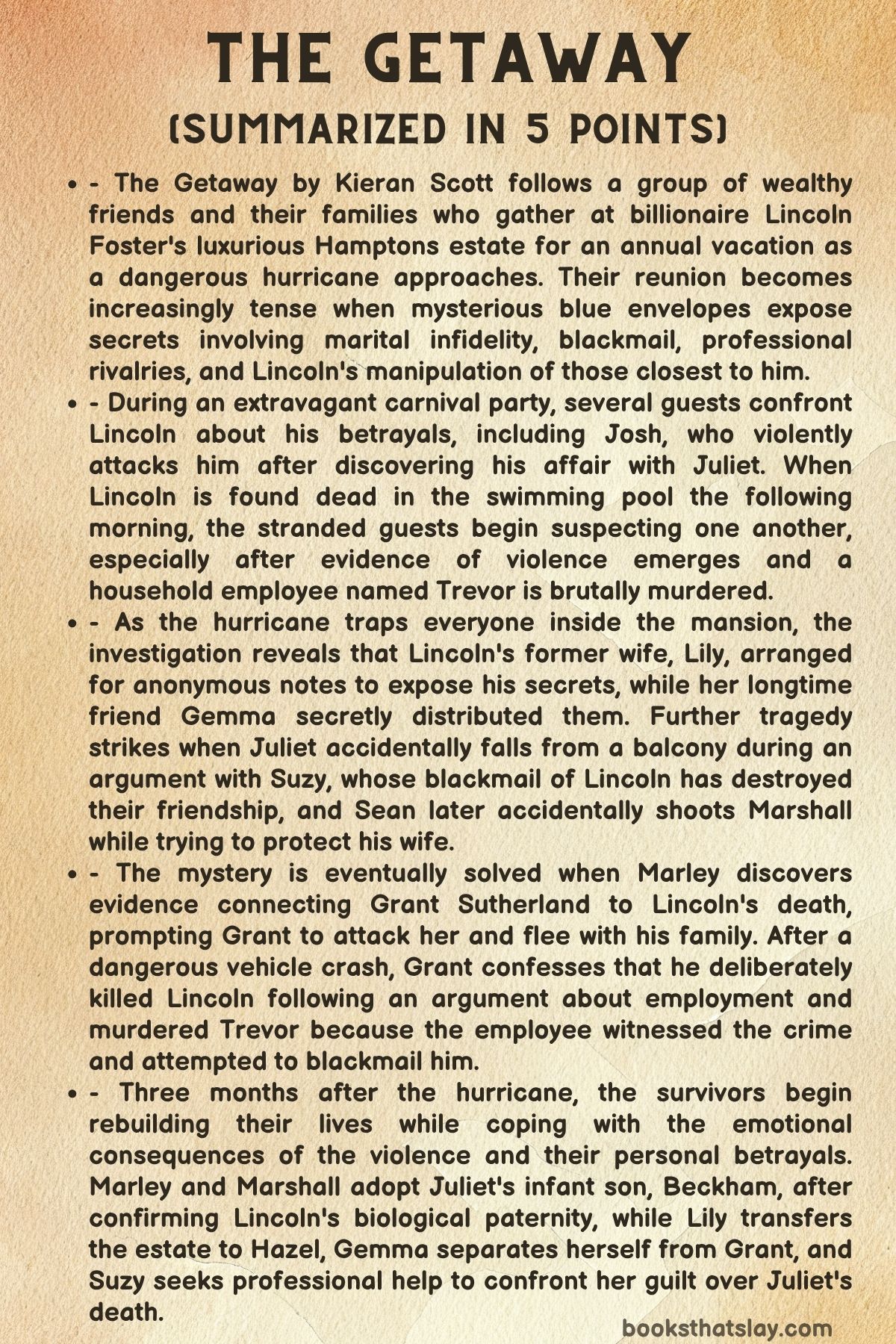
Characters
Marley Foster
Marley Foster is the emotional center of The Getaway, representing compassion, resilience, and the desire to build a meaningful family despite repeated disappointments. Her experiences reveal how personal suffering can strengthen an individual’s understanding of other people’s needs.
Marley’s most significant struggle concerns her inability to become a mother through adoption. After several heartbreaking failures, she remains determined to pursue parenthood even when her husband, Marshall, decides that they should abandon the process.
Her persistence reflects her deep longing for familial stability, partly influenced by losing her parents during childhood. Having experienced the importance of being raised by caring relatives, Marley understands that family relationships are defined by commitment rather than biology alone.
Her loyalty to Lily creates another significant conflict. Marley deeply resents Lincoln for betraying her friend, yet her relationship with Marshall requires her to maintain connections with the very man she holds responsible for Lily’s suffering.
Throughout the novel, Marley demonstrates remarkable sensitivity toward vulnerable people. She comforts frightened children during the hurricane, supports distressed friends, and later assumes responsibility for Beckham when his remaining legal parent refuses to care for him.
Her relationship with Marshall develops as they confront their disagreements about adoption and the influence Lincoln has exercised over their marriage. Rather than allowing their shared disappointments to separate them permanently, Marley gradually recognizes the importance of understanding Marshall’s fears.
Marley’s discovery of evidence connecting Grant to Lincoln’s death also demonstrates her observational abilities and courage. Although she is physically weakened and emotionally exhausted, she recognizes the significance of the abandoned beverage bottle.
Her eventual adoption of Beckham completes her character’s development. She emerges from the tragedy with a renewed appreciation for marriage, family, and the unexpected ways life can fulfill long-held dreams.
Marshall Foster
Marshall Foster is Lincoln’s younger brother and Marley’s husband, a man whose loyalty to his family frequently conflicts with his responsibilities toward his wife. His character illustrates how affection and dependence can create complicated relationships between siblings.
Marshall initially appears emotionally distant because he has decided to discontinue the adoption process that means so much to Marley. Although she interprets his decision as a rejection of their shared future, he believes he is protecting her from further emotional devastation.
His difficulties are intensified by the revelation that his wealthy parents have disinherited him. The possibility that Lincoln influenced their decision raises questions about the power his older brother possesses within the family.
Following Lincoln’s death, Marshall assumes a leadership role among the stranded guests. He examines suspicious evidence, attempts to establish the circumstances surrounding the death, and contacts emergency authorities despite the hurricane.
His determination to identify the murderer reveals both his devotion to Lincoln and his desire for justice. However, his emotional reactions sometimes undermine his judgment, particularly when he repeatedly accuses Josh without conclusive evidence.
Marshall’s relationship with Marley becomes more open as the crisis develops. He explains that Lincoln’s concerns about adoption arose partly from watching Marley suffer, allowing the couple to reconsider the motivations behind his advice.
When Sean accidentally shoots him, Marshall becomes dependent on the care of those around him. His vulnerability reinforces the importance of the relationships he previously struggled to manage.
By the conclusion, Marshall embraces the adoption of Beckham alongside Marley. His transformation demonstrates that parental love can develop through unexpected circumstances and that protecting a marriage sometimes requires revising previously fixed beliefs.
Lincoln Foster
Lincoln Foster is the wealthy businessman whose death initiates the central mystery of The Getaway. Although he dies early in the novel, his decisions continue influencing nearly every character and provide the foundation for the conflicts surrounding the murders.
As the owner of Home Team Hotels and an extravagant Hamptons estate, Lincoln represents financial power and the social authority it provides. He regularly uses his wealth and professional influence to shape the opportunities and expectations of those around him.
His greatest personal failure involves his treatment of Lily, whom he divorces after beginning an affair with Hazel. Despite marrying Hazel, Lincoln continues contacting Lily, maintaining an emotional connection that prevents her from recovering fully from their separation.
Lincoln’s relationships with his friends are similarly compromised by concealed affairs, professional threats, and private arrangements. His encounter with Juliet results in the birth of Beckham, while his payments to Suzy reveal his willingness to use money to prevent exposure.
His conduct toward Sean and Grant demonstrates his dismissive attitude toward people whose livelihoods depend on him. By considering Grant as Sean’s replacement while showing Grant little genuine respect, Lincoln intensifies an already volatile professional rivalry.
Nevertheless, Lincoln is not entirely without sympathetic qualities. His concerns about Marley’s repeated adoption disappointments suggest that he sometimes recognizes the suffering of those closest to him, even when his interventions create resentment.
The discovery that he planned to return Lily’s artwork also complicates his characterization. His actions suggest lingering attachment and occasional consideration beneath his selfish behavior.
Lincoln ultimately becomes a victim of Grant’s desperation and violence. His death exposes the instability of a social world sustained by financial dependence, personal secrets, and unresolved grievances.
Lily Fitzmore
Lily Fitzmore is Lincoln’s former wife and one of the principal forces shaping the novel’s events, even during her physical absence from much of the story. Her character combines emotional vulnerability, resentment, loyalty, and a desire to regain control after experiencing profound betrayal.
Before the divorce, Lily had established many of the traditions associated with the Hamptons vacations. Her personalized welcome notes, artwork, and distinctive decorations made the estate a place of warmth and familiarity for the friendship group.
Lincoln’s affair with Hazel destroys that stability. Lily subsequently struggles with emotional distress and enters rehabilitation, yet she remains attached to her former husband because he continues contacting her.
Her decision to distribute threatening blue notes through Gemma reveals a more calculating side of her personality. Rather than confront Lincoln directly about every betrayal, she arranges for his secrets to become known among the people whose opinions matter to him.
Although Lily may have intended to expose his misconduct, her actions create dangerous consequences she does not fully control. The notes damage marriages, threaten livelihoods, and contribute to the atmosphere of suspicion preceding Lincoln’s murder.
Lily’s relationship with Gemma also demonstrates her capacity for manipulation. She encourages Gemma to believe that she has helped Grant obtain an employment opportunity, even though her actual intervention was limited.
Despite these faults, Lily is not revealed as Lincoln’s murderer. Her grief following his death establishes that her attachment to him remains complicated and emotionally significant.
Her inheritance of Lincoln’s fortune and subsequent decision to transfer the Villa to Hazel indicate a movement toward acceptance. By surrendering the estate rather than preserving it as a monument to her former marriage, Lily demonstrates a willingness to move beyond the life she has lost.
Hazel Foster
Hazel Foster initially appears to be an outsider in The Getaway, a woman whose marriage to Lincoln has displaced Lily and disrupted an established social circle. Her development challenges the assumptions made about her by the other guests, particularly Marley.
As Lincoln’s second wife, Hazel inherits both his luxurious lifestyle and the resentment surrounding his divorce. The longtime friends associate her presence with Lily’s suffering and view the changes she makes to the estate as an attempt to erase its former mistress.
Her extensive renovations reflect her desire to establish a place for herself within Lincoln’s world. However, the replacement of Lily’s belongings and familiar gathering spaces creates additional hostility among the visitors.
Lincoln’s death exposes Hazel’s vulnerability. She experiences genuine distress after discovering his body and must confront the possibility that someone among their guests murdered her husband.
The revelation that Lincoln never updated his will further complicates her circumstances. Although she is his current wife, she may not inherit the property and wealth that appear to define her social position.
Hazel becomes increasingly assertive as evidence accumulates. She examines Lincoln’s body, discovers suspicious beads, and insists that the guests remain available for questioning when the authorities arrive.
Her most significant moment occurs when Sean shoots Marshall. Revealing that she is a trained registered nurse with substantial hospital experience, Hazel calmly organizes his treatment and helps prevent a potentially fatal outcome.
This revelation forces Marley to reconsider her prejudices. Hazel proves herself capable, compassionate, and resourceful, demonstrating that her identity cannot be reduced to the circumstances of her marriage.
By the conclusion, Hazel establishes a more respectful relationship with Marley and receives ownership of the estate from Lily. Her journey illustrates the importance of recognizing individuals beyond the roles assigned to them by social judgment.
Suzy McTeague
Suzy McTeague is one of the most morally complicated characters in The Getaway, combining genuine affection for her friends with dishonesty, selfishness, and a powerful instinct for self-preservation. Her choices demonstrate how seemingly manageable secrets can produce devastating consequences.
Suzy initially appears as a wealthy mother whose principal concerns involve her children, her husband’s increasing emotional distance, and the approaching hurricane. Her constant attention to weather warnings makes her one of the few guests who fully appreciates the danger of remaining at the estate.
Beneath her comfortable lifestyle, however, Suzy is secretly blackmailing Lincoln. After learning about his affair with Juliet, she demands money to finance extensive repairs to her Nantucket property.
Her decision reflects both financial insecurity and an unwillingness to acknowledge mistakes to Sean. Rather than confront their disagreement about the property, she exploits another person’s misconduct to preserve her preferred lifestyle.
The anonymous notes threaten to expose her arrangement and destroy her relationships. Suzy becomes increasingly suspicious, fearing that someone knows more about her private affairs than she previously imagined.
Her friendship with Juliet provides the clearest example of her contradictory nature. Although she genuinely cares about Juliet, she has used knowledge of Juliet’s infidelity for financial advantage without considering the potential consequences.
Their confrontation over the blue notes results in Juliet’s accidental death. Suzy attempts to prevent the fall but flees afterward, placing her own protection above immediate honesty.
Her desperate behavior also contributes indirectly to Sean’s accidental shooting of Marshall. By concealing a handgun and attempting to escape accountability, she places others in danger.
Suzy nevertheless demonstrates courage when she investigates Marley’s disappearance and discovers her unconscious in the storage room. Her actions help expose Grant’s attempt to conceal his crimes.
At the novel’s conclusion, Suzy begins receiving professional assistance to confront her guilt. Her development suggests that genuine remorse requires more than regret; it demands acknowledging responsibility for the harm caused by personal choices.
Sean McTeague
Sean McTeague is Suzy’s husband and Lincoln’s longtime legal adviser, whose professional loyalty becomes increasingly difficult to maintain as his employer’s behavior threatens his future. His character explores the pressure created when financial security depends on protecting a powerful and morally unreliable individual.
Sean has built a successful career through his position at Home Team Hotels. However, his professional responsibilities have apparently required him to manage or conceal questionable situations involving Lincoln.
His anxiety intensifies when an anonymous note suggests that Lincoln intends to replace him and that his past actions could lead to imprisonment. Although Sean denies wrongdoing, his reactions reveal how vulnerable he feels.
His marriage to Suzy is strained by his professional preoccupations and limited participation in their children’s lives. Suzy resents having to manage most family responsibilities while Sean remains emotionally distant.
During the hurricane, Sean frequently minimizes Suzy’s warnings and initially resists abandoning the estate. His judgment reflects both professional concerns and an unwillingness to acknowledge dangers that might disrupt his obligations.
The revelation that Grant could replace him makes Sean a plausible suspect in Lincoln’s death. His threatened livelihood creates a motive that appears convincing until Grant’s responsibility is established.
Sean’s most serious mistake occurs when he attempts to protect Suzy from the consequences of Juliet’s death. By drawing a handgun and threatening Marshall, he allows fear and misplaced loyalty to override his judgment.
The accidental shooting exposes the destructive potential of his decision. Although his intention is to defend his wife, he creates another medical emergency during an already dangerous situation.
Sean’s character ultimately demonstrates the difference between loyalty and responsible behavior. His willingness to protect Suzy becomes harmful when it involves intimidation, secrecy, and disregard for other people’s safety.
Juliet
Juliet is an energetic and socially connected member of the friendship group whose outward confidence conceals a deeply troubled personal life. Her experiences reveal the dangers of secrecy, emotional dependency, and relationships sustained by volatility rather than mutual respect.
As the founder of the environmental nonprofit Green Warriors, Juliet presents herself as a capable and socially engaged woman. Her professional commitments and connections suggest independence, yet her private circumstances reveal significant instability.
Her marriage to Josh is characterized by intense emotions and conflict. Although she describes their relationship as passionate, his aggressive behavior raises serious concerns about intimidation and physical abuse.
Gemma witnesses the aftermath of one confrontation and recognizes signs that Juliet has been harmed. Juliet’s attempts to excuse Josh’s behavior demonstrate how individuals may normalize dangerous relationships.
Her brief affair with Lincoln creates another source of vulnerability. Although the encounter occurs only once, it results in the birth of Beckham, whose biological parentage threatens both her marriage and her social standing.
The anonymous notes expose this secret and force Juliet to confront the consequences of her decisions. She becomes increasingly isolated as her friends and Hazel react to the revelation.
Juliet’s discovery that Suzy has exploited the affair for money represents a particularly painful betrayal. She realizes that someone she trusted has used her most damaging secret for personal financial benefit.
Their argument on the balcony ends in tragedy when Juliet falls during a struggle over the notes. Her death is accidental, but it results from a situation intensified by dishonesty, fear, and broken trust.
Juliet’s fate also shapes the novel’s resolution through Beckham. Her child eventually finds stability with Marley and Marshall, providing a measure of hope following her death.
Josh
Josh is Juliet’s husband and a music-industry professional whose jealousy, aggression, and emotional volatility make him one of the earliest suspects in Lincoln’s murder. His behavior demonstrates the dangers of possessiveness and the destructive consequences of refusing to manage anger responsibly.
When Josh discovers Juliet’s affair with Lincoln, he reacts with public violence. His attack on Lincoln during the carnival and subsequent death threats provide a convincing explanation for why someone might want the billionaire dead.
His treatment of Juliet is equally troubling. Gemma encounters Juliet crying after a confrontation and suspects that Josh has struck her, while Juliet attempts to explain away the evidence.
Josh’s disappearance after the party strengthens suspicions against him. However, he eventually explains that he accompanied Coco P. and her entourage away from the estate before becoming stranded by the hurricane.
His return with Lily establishes that the assumptions surrounding his movements were incomplete. Although his aggression makes him frightening, he is not responsible for Lincoln’s death.
Juliet’s death exposes another aspect of Josh’s character. He experiences shock and anger upon discovering her body, yet his subsequent behavior toward Beckham reveals a profound unwillingness to accept parental responsibility.
Rather than care for the infant, Josh attempts to leave him with Tini while pursuing professional and personal obligations. Later, after a DNA test confirms Lincoln’s biological relationship to Beckham, Josh relinquishes his parental rights.
His decision allows Marley and Marshall to adopt the child. Josh therefore serves as a contrast to the couple, illustrating how biological and legal relationships do not automatically create genuine parental commitment.
Gemma Sutherland
Gemma Sutherland is one of the principal viewpoint characters in The Getaway, providing an outsider’s perspective on the wealthy friendship group while carrying secrets of her own. Her development centers on loyalty, guilt, financial insecurity, and the difficult realization that the person she trusts most is capable of terrible violence.
Gemma initially appears reserved and uncomfortable in unfamiliar social environments. Unlike the established guests, she does not enjoy the group’s effortless displays of wealth or its complicated social rituals.
Her attendance is motivated by concern for Grant, whose legal career has collapsed following a scandal involving his former business partner. Gemma hopes that Lincoln can offer him employment and restore the family’s financial stability.
Her desperation leads her to contact Lily, a longtime college friend. Believing Lily can influence Lincoln, Gemma agrees to distribute sealed welcome notes without investigating their contents.
This decision becomes a source of profound guilt once the notes expose damaging secrets and contribute to the growing hostility among the guests. Gemma gradually recognizes that good intentions cannot eliminate responsibility for careless choices.
Her protective nature is evident in her relationship with Vienna and Florence. She attempts to establish boundaries around their filming activities and becomes fiercely defensive when she believes someone is threatening them.
Gemma also demonstrates moral courage when she intervenes during Josh’s confrontation with Juliet. Her childhood experiences of witnessing domestic violence allow her to recognize signs of abuse that others overlook.
The greatest challenge to her judgment comes when she discovers Grant’s involvement in the murders. The husband she believed was struggling to protect their family has instead become a violent criminal willing to endanger them.
Her decision to seize the steering wheel during their escape represents a decisive rejection of his control. Although the resulting crash injures them, she acts to protect her daughters from a greater danger.
By confronting Grant in the hospital and refusing to accept his justifications, Gemma establishes clear moral boundaries. Her transformation demonstrates that loyalty loses its value when it requires tolerating cruelty, deception, or violence.
Grant Sutherland
Grant Sutherland is the novel’s principal antagonist, a financially desperate lawyer whose determination to recover his former status develops into violence and murder. His character illustrates how wounded pride, professional ambition, and resentment can overwhelm ethical judgment.
Grant’s career has been destroyed by the collapse of his law firm after his business partner, Victor Hollow, misappropriated company funds. Although Grant was not presented as the architect of that scandal, its consequences leave him financially vulnerable and professionally humiliated.
He views Lincoln as a possible solution to his difficulties. The prospect of becoming chief legal counsel at Home Team Hotels offers a chance to recover the prestige and security he has lost.
However, Grant’s expectations are largely based on his own manipulation. He eventually admits that Lincoln never invited his family and that he arranged their attendance himself, hoping social pressure would make Lincoln consider hiring him.
His attempts to attract investors for Shizzy’s Hard Fruit Punch also demonstrate his desperation. When Lincoln publicly insults the drink, Grant experiences another humiliation before people whose approval he desperately seeks.
Grant’s resentment reaches its breaking point during a confrontation with Lincoln near the pool. After striking and pushing him, he deliberately electrocutes the injured man rather than attempt to save him.
This decision transforms a violent confrontation into intentional murder. His later killing of Trevor, who witnessed the incident and attempted to blackmail him, demonstrates how quickly his criminal behavior escalates.
Grant’s attack on Marley reveals that he remains willing to harm additional people to avoid accountability. His attempt to flee with Gemma and their daughters further exposes the contradiction between his claims of protecting his family and his actual conduct.
During his hospital confession, Grant attempts to justify his crimes through the financial suffering and professional humiliation he has endured. However, his refusal to accept responsibility demonstrates the moral corruption underlying his choices.
Grant ultimately destroys the family and reputation he claims to have been trying to preserve. His fate illustrates the catastrophic consequences of placing ambition and wounded pride above human life.
Vienna Sutherland
Vienna Sutherland is one of Gemma and Grant’s sixteen-year-old twin daughters, a talented social media personality whose interest in filmmaking becomes unexpectedly important to the investigation. Her character represents observation, youthful independence, and courage in circumstances that overwhelm many adults.
Alongside Florence, Vienna manages the successful Twins Winning Life social media account. Her experience with recording equipment and visual storytelling makes her particularly attentive to events happening around her.
Although Gemma worries about the girls filming wealthy guests without permission, Vienna’s habit of documenting her surroundings eventually provides crucial evidence. The footage she captures becomes central to establishing the circumstances of Juliet’s death.
Vienna and Florence secretly record the hurricane and accidentally film Suzy’s confrontation with Juliet on the balcony. Their recording reveals that Juliet fell during a struggle rather than disappearing under entirely mysterious circumstances.
The experience frightens Vienna and demonstrates that witnessing violence can impose a heavy emotional burden on young people. Nevertheless, she eventually shares the footage with her parents, allowing the truth to emerge.
During Grant’s dangerous escape, Vienna also demonstrates courage by protecting Florence when their vehicle crashes. Her actions reinforce her loyalty to her sister and reveal a maturity extending beyond her online identity.
Vienna contributes significantly to the novel by showing how modern technology can unexpectedly expose hidden truths. Her character also emphasizes the emotional consequences of forcing children to witness the failures and crimes of adults.
Florence Sutherland
Florence Sutherland is Vienna’s twin sister and an important part of Gemma’s family life. Like Vienna, she is comfortable with social media, yet her experiences during the hurricane reveal her vulnerability and capacity for moral judgment.
Florence initially participates in the ordinary disagreements and activities expected of a teenager on an uncomfortable family vacation. Her relationship with Vienna includes sibling rivalry, shared interests, and strong mutual affection.
She becomes involved in the investigation when she notices suspicious activity near the guesthouse. Her insistence that another person fled before Cole was discovered challenges his explanation and encourages the adults to continue searching.
Florence also helps reveal the balcony recording that establishes what happened to Juliet. Although the sisters are frightened by the implications of the footage, their eventual decision to share it demonstrates an understanding of the importance of truth.
Her affection for Wintour becomes significant when she and Vienna take the dog during their family’s attempted escape. Their decision reflects concern for the animal and distrust of Suzy’s ability to care for it.
During the vehicle crash, Florence benefits from Vienna’s protective actions. Their survival reinforces the importance of their close relationship and highlights the consequences of Grant’s reckless attempt to evade justice.
Florence’s role emphasizes that young people can demonstrate greater honesty and sensitivity than adults whose behavior is dominated by secrecy and self-interest.
Daisy Fitzmore
Daisy Fitzmore is Lily’s younger sister, whose unexpected appearance at the estate creates one of the novel’s significant moments of misdirection. Her resemblance to Lily initially makes other guests suspect that Lincoln’s former wife has secretly returned to seek revenge.
Daisy attends Lincoln’s carnival after meeting Cole Shang, who invites her to the celebration. Although her presence is partly connected to a professional photo shoot, she also wants to confront Lincoln about his treatment of Lily.
Her anger arises from watching her sister remain emotionally dependent on a man who betrayed her. Daisy believes Lincoln’s continued telephone calls are preventing Lily from recovering from their failed marriage.
During their confrontation, Daisy demands that Lincoln stop contacting Lily. His angry response confirms the hostility between them and places Daisy among the people who encountered him shortly before his death.
Daisy also provides valuable information about Lincoln’s final movements. She remembers seeing him prepare to retrieve outdoor speakers during the storm and advising him to take precautions against electrocution.
Her recognition of Gemma as Lily’s longtime friend subsequently exposes a connection that Gemma has concealed. This revelation leads to the discovery of Lily’s role in distributing the threatening notes.
Daisy’s character demonstrates protective family loyalty while also contributing essential information to the investigation. Unlike several other characters, her determination to defend a loved one does not develop into a willingness to commit violence.
Trevor
Trevor is a recently hired employee at the Villa whose suspicious behavior and eventual murder contribute significantly to the novel’s atmosphere of fear. Although he occupies a relatively small position within the household, his actions make him central to the murder investigation.
Early in the gathering, Trevor appears unusually interested in private conversations among the guests. His tendency to appear near sensitive discussions makes Marley, Suzy, and their friends uncomfortable.
His most important involvement occurs when he witnesses Grant’s confrontation with Lincoln near the swimming pool. Rather than immediately report what he has seen, Trevor recognizes an opportunity for personal financial gain.
He attempts to blackmail Grant using knowledge of Lincoln’s murder. This decision places him in direct danger because Grant is already willing to kill to protect his reputation and freedom.
Grant subsequently murders Trevor using machinery inside the unfinished ballroom. The brutality of the killing demonstrates the lengths to which Grant will go to prevent his crimes from becoming known.
Trevor therefore functions as both a witness and a secondary victim whose opportunism proves fatal. His character illustrates how the pursuit of money can distort judgment, especially when someone attempts to profit from the desperation of a dangerous individual.
Candice
Candice is a young household employee whose experiences reveal the vulnerability of staff members working within the luxurious environment of Lincoln’s estate. Although she has little social power compared with the guests, she becomes directly affected by their carelessness and violence.
During the opening gathering, Candice suffers an embarrassing incident when Lincoln spits out Grant’s unpleasant alcoholic beverage and it lands on her. The episode illustrates how casually wealthy employers may humiliate workers, even without deliberately intending to harm them.
After Lincoln’s death, Candice is visibly distressed. Her grief suggests that the household staff have emotional relationships with the people they serve, despite the distance created by wealth and employment.
Her most significant involvement comes when she discovers Trevor’s mutilated body. She emerges covered in blood and struggles to explain what has happened, emphasizing the psychological shock of encountering such violence.
Candice helps bring Trevor’s death to the attention of the surviving guests. Her frightened condition makes it impossible for the others to dismiss the danger as an isolated accident involving Lincoln.
Her character demonstrates how innocent employees can become caught in conflicts created by powerful individuals. She also contributes to the novel’s depiction of the estate as a workplace rather than merely a luxurious vacation destination.
Cole Shang
Cole Shang is a music promoter associated with Blue Dragon Records whose unexpected presence at the Villa initially makes him appear suspicious. His character functions partly as a source of uncertainty surrounding the unidentified people hiding on Lincoln’s property.
Cole claims that he attended the carnival, became intoxicated, and accidentally remained at the estate after his companions departed. When Gemma’s daughters notice him near their guesthouse, his explanation does not immediately satisfy the adults.
His connection to Josh’s record company and his apparent association with another hidden person increase the group’s suspicions. The fact that Vienna and Florence have recorded unusual activity makes his account particularly important.
Cole eventually returns with Daisy, resolving part of the mystery surrounding the woman seen at the party. His appearance helps establish that the suspected intruder is not necessarily connected to Lincoln’s murder.
Although Cole’s actions create confusion, he is not revealed as the killer. His presence illustrates how incomplete information can transform unusual but relatively harmless behavior into apparent evidence of criminal wrongdoing.
Magdelena
Magdelena is Lincoln’s longtime chef and an important connection to the estate’s history before Hazel became its mistress. Her character represents loyalty, familiarity, and the uncertainty experienced by employees when wealthy households undergo major personal changes.
Magdelena has served the family for years and understands many of the traditions that Lily established. Her relationship with the earlier occupants of the mansion makes her especially sensitive to the emotional consequences of the divorce.
When Marley questions her about Lily, Magdelena’s responses appear somewhat evasive. This creates uncertainty about whether she knows more concerning Lily’s movements than she is willing to reveal.
Magdelena is also concerned about her employment prospects following Lincoln’s death. Because Hazel has already changed much of the household, the chef fears that her position may no longer be secure.
Despite these anxieties, Magdelena continues preparing food and supporting the guests during the emergency. Her work provides a small sense of normality as the mansion becomes increasingly dangerous.
Marley’s memories of Magdelena’s kindness during earlier vacations also highlight the chef’s compassionate nature. Through Magdelena, the novel acknowledges the people whose labor and personal relationships sustain the comfortable lives enjoyed by the wealthy characters.
Tini
Tini is a caregiver responsible for looking after the young children at the Villa, particularly during the dangerous conditions created by the hurricane. Her character reflects the practical importance of attentive childcare and the responsibility adults owe to vulnerable dependents.
When a tree damages the nursery, Tini participates in rescuing the infants and ensuring that they are moved away from danger. Her actions contribute to the group’s effort to protect children while the building itself becomes unsafe.
Tini’s most significant role emerges following Juliet’s death. As Beckham’s caregiver, she continues looking after the infant while the surviving adults struggle with grief, suspicion, and their own personal crises.
When Josh announces that he cannot assume responsibility for Beckham, he attempts to leave the child in Tini’s care by offering additional payment. The situation reveals the emotional burden that can be placed on professional caregivers when parents refuse their responsibilities.
Tini’s willingness to care for Beckham provides temporary stability, but Marley’s immediate offer to assume responsibility demonstrates the difference between professional care and a permanent parental commitment.
Through Tini, the novel emphasizes that children require consistent attention regardless of the conflicts affecting the adults around them.
Beckham
Beckham is Juliet’s infant son, whose biological parentage becomes one of the central secrets exposed by the anonymous messages. Although he is too young to influence events through deliberate choices, his existence significantly affects several characters and ultimately determines the novel’s hopeful conclusion.
Initially believed to be Josh’s son, Beckham is revealed to be Lincoln’s biological child following Juliet’s affair with the billionaire. The discovery destabilizes Juliet’s marriage and creates another conflict involving Lincoln’s complicated personal life.
Beckham becomes particularly vulnerable after Juliet dies. His legal father’s unwillingness to assume responsibility leaves his future uncertain at a time when the adults are already struggling with grief and trauma.
Marley instinctively comforts and protects Beckham, demonstrating the maternal qualities that have shaped her desire to adopt. The child’s presence also helps Marshall recognize the possibility of becoming a parent through circumstances neither of them anticipated.
After the DNA test confirms Lincoln’s paternity and Josh relinquishes his rights, Marley and Marshall are able to adopt Beckham. His first birthday celebration becomes the final gathering of the surviving characters.
Beckham symbolizes renewal without erasing the suffering that preceded his adoption. His new family emerges from tragedy, emphasizing that love and commitment can provide stability even after profound loss.
Wintour
Wintour is Suzy’s Chihuahua, whose presence provides occasional moments of humor and tenderness during the increasingly frightening events at the Villa. Although the dog initially appears to be a minor detail of Suzy’s luxurious lifestyle, Wintour eventually contributes to the confrontation with Grant.
Suzy’s attachment to Wintour reflects her affectionate side and offers insight into her behavior beyond the blackmail scheme. The dog also attracts the attention of Vienna and Florence, helping establish connections between the younger guests and the adults.
During Grant’s attempt to escape, the twins secretly bring Wintour with them because they fear Suzy is not capable of caring for the animal properly. Their decision places Wintour inside the vehicle during one of the most dangerous moments in the story.
When Grant refuses to stop for the police, Wintour bites his arm and briefly distracts him. This interruption contributes to the circumstances in which Gemma manages to seize control of the steering wheel.
After the crash, Wintour disappears temporarily, creating further anxiety for Gemma and the twins. The dog’s eventual reappearance unharmed brings relief during an otherwise devastating situation.
Wintour’s survival provides a modest but meaningful reminder that not every vulnerable creature caught in the violence must become another victim.
Olivia and Benjamin
Olivia and Benjamin are Hazel’s older children, whose presence emphasizes the responsibilities she must manage alongside the crisis surrounding Lincoln’s death. Although they remain secondary characters, their vulnerability becomes particularly important when the hurricane damages the nursery.
When a large tree crashes through the building, the children become frightened and cannot immediately leave their bunk bed. Hazel is emotionally overwhelmed, leaving Marley to approach them with patience and reassurance.
Marley eventually persuades the children to leave by promising them ice cream. The incident demonstrates her natural ability to communicate with frightened children and reinforces her desire to become a mother.
Olivia and Benjamin also complicate the audience’s initial understanding of Hazel. Her identity as a mother and her concern for the children place her within a broader family context beyond her controversial marriage to Lincoln.
Their role reminds readers that the adults’ conflicts place innocent children in danger, both physically and emotionally.
Kasie and Elton McTeague
Kasie and Elton are Suzy and Sean’s children, who are away at summer camp during the events at Lincoln’s estate. Their physical absence allows the novel to concentrate on the adult characters while maintaining an important connection to Suzy’s responsibilities as a mother.
Kasie’s video call about cobwebs around her bunk demonstrates Suzy’s anxious, protective parenting style. Suzy immediately attempts to resolve the problem, although her intervention creates additional difficulties for the children.
Elton is mentioned when Suzy attempts to obtain an autograph from a musical performer at Lincoln’s carnival. Her desire to bring him something special indicates that she continues thinking about her children despite her increasingly complicated personal circumstances.
As the hurricane intensifies, Suzy becomes worried about their safety and her inability to return to them. These concerns contrast sharply with her willingness to take serious risks to protect her financial secrets.
Kasie and Elton therefore reveal both Suzy’s genuine maternal affection and the contradictions in her judgment. Their absence also demonstrates that the consequences of the adults’ decisions extend beyond those physically present at the Villa.
Victor Hollow
Victor Hollow is Grant’s former law partner, whose misconduct contributes to the financial crisis that precedes the murders. Although Victor does not participate directly in the events at the Villa, his earlier actions form an important part of Grant’s background.
Victor secretly misuses money from their law firm to support his drug addiction and subsequently becomes involved in a serious boating incident. The resulting legal and financial consequences destroy Hollow and Sutherland, leaving Grant’s professional reputation severely damaged.
Victor’s behavior establishes the circumstances through which Grant loses his financial security and confidence. His actions help explain why Grant becomes desperate to secure a position with Lincoln.
However, Victor’s misconduct does not excuse Grant’s later decisions. The distinction between suffering from another person’s wrongdoing and choosing to commit violence is essential to understanding Grant’s responsibility.
Victor functions as an indirect catalyst for the story’s central conflict. His professional betrayal begins a chain of financial problems, but Grant ultimately determines how he responds to those problems.
Themes
Secrets, Betrayal, and the Destruction of Trust
Secrets create an atmosphere of suspicion in The Getaway, transforming a familiar gathering of longtime friends into a dangerous confrontation with hidden truths. Nearly every important relationship contains information that could destroy the trust on which it depends.
Lincoln’s affairs, Suzy’s blackmail, Juliet’s infidelity, and the professional threats facing Sean demonstrate how extensively deception has become embedded in the group’s social relationships. Although the characters present themselves as successful and respectable, their private conduct frequently contradicts those public identities.
Lily’s anonymous notes transform concealed wrongdoing into a collective crisis. By exposing information that Lincoln has kept hidden, she forces the recipients to reconsider their relationships with him and one another.
However, the revelations do not necessarily produce honesty or understanding. Instead, they often encourage anger, self-protection, and additional deception because the individuals involved are more concerned about preserving their reputations than acknowledging their mistakes.
Suzy and Juliet’s relationship provides a particularly destructive example of betrayed friendship. Juliet believes Suzy is someone she can trust, only to discover that her friend has exploited knowledge of her affair with Lincoln for financial gain.
Their confrontation ends in Juliet’s accidental death, demonstrating how years of dishonesty can create situations in which a single impulsive action has irreversible consequences. Suzy’s decision to flee afterward continues the pattern of concealment that contributed to the tragedy.
Gemma’s involvement in distributing the notes introduces another dimension to the theme. Although she does not understand their contents, her willingness to participate in Lily’s scheme illustrates how personal loyalty can encourage people to ignore the possible consequences of their actions.
Grant represents the most extreme form of deception because he conceals not merely embarrassing secrets but deliberate murder. His carefully maintained identity as a respectable husband and lawyer collapses when the truth about his actions emerges.
The novel ultimately suggests that trust cannot survive indefinitely when relationships depend upon manipulation and secrecy. Revealing the truth may be painful, but continued dishonesty creates the possibility of even greater destruction.
Wealth, Power, and Moral Corruption
Lincoln’s enormous fortune gives him influence over the professional and personal lives of nearly everyone who attends his Hamptons gathering. His luxurious estate represents privilege and security, yet the events within its walls reveal the instability created when power becomes concentrated in one individual.
Lincoln’s financial authority allows him to influence careers, maintain private arrangements, and shape the circumstances of those who depend on him. Sean’s employment, Grant’s professional ambitions, and Suzy’s blackmail payments all connect their personal security to Lincoln’s decisions.
This dependence creates resentment beneath the apparently harmonious relationships of the wealthy social group. People who publicly flatter Lincoln privately fear losing his favor, revealing the emotional costs of unequal power.
Grant’s desperation demonstrates how professional status can become dangerously connected to personal identity. After the collapse of his law firm, he views employment with Lincoln as the means of recovering not only financial security but also the respect he believes he deserves.
Lincoln’s dismissive behavior intensifies Grant’s humiliation, especially when he publicly insults the beverage Grant hopes to market. The incident illustrates how casually an influential person can damage someone else’s confidence without recognizing the depth of the resentment being created.
However, the novel does not portray financial hardship as a justification for murder. Grant’s choice to kill Lincoln reflects his own moral failure, exposing the danger of allowing ambition and injured pride to become more important than human life.
Suzy’s blackmail reveals a less violent but similarly troubling relationship with money. Rather than accept the financial limitations surrounding her Nantucket property, she exploits another person’s secret to maintain her preferred standard of living.
The household employees provide a contrast to these wealthy characters. Candice, Magdelena, and Trevor occupy positions in which their security depends on employers whose personal conflicts can suddenly disrupt or threaten their lives.
The hurricane ultimately strips away much of the protection associated with wealth. Expensive vehicles cannot guarantee escape, professional status cannot prevent suspicion, and Lincoln’s magnificent mansion becomes a dangerous place of confinement.
Through these events, the story challenges the assumption that wealth provides genuine control over life. Financial power may influence circumstances, but it cannot replace ethical judgment, human connection, or responsibility.
Marriage, Parenthood, and the Meaning of Family
Family relationships provide the emotional foundation of The Getaway, particularly through the contrasting experiences of Marley, Marshall, Juliet, Josh, and Lincoln. Their stories explore the difference between biological connections, legal obligations, and the deliberate commitment required to care for another person.
Marley and Marshall’s struggle to adopt a child establishes parenthood as a deeply desired but emotionally difficult goal. Repeated disappointments threaten their marriage because the couple responds to grief in different ways.
Marley believes continuing the adoption process is essential to fulfilling their shared dream, while Marshall fears that further failures will cause additional suffering. Their disagreement demonstrates how people who love one another can interpret protection and commitment differently.
Lincoln’s interference complicates their marriage by introducing another person’s judgment into a deeply personal decision. Although he apparently believes that ending the adoption attempts might protect Marley, his involvement creates resentment because the decision belongs to the couple.
Juliet and Josh’s marriage offers a darker contrast. Their relationship contains passion and emotional intensity, but Josh’s aggression and Juliet’s attempts to excuse his behavior reveal the absence of mutual safety and respect.
The discovery of Beckham’s biological parentage exposes further weaknesses in their marriage. Josh’s eventual refusal to care for the infant demonstrates that parenthood cannot be measured solely through social expectations or established family roles.
Lincoln’s biological connection to Beckham also complicates traditional ideas of fatherhood. Although the child is confirmed to be his son, Lincoln dies before that relationship can develop into meaningful parental care.
Marley and Marshall ultimately become Beckham’s parents through their willingness to provide love, protection, and stability. Their decision emerges not from biological necessity but from an active commitment to a child who needs them.
Gemma’s actions provide another example of protective parenting. When Grant’s behavior threatens their daughters, she refuses to preserve her marriage at the expense of their safety.
The novel presents family as something sustained through responsibility rather than appearance. Its conclusion suggests that the strongest family relationships are built by people who consistently choose to protect and support one another.
Guilt, Accountability, and the Possibility of Renewal
The surviving characters must confront the consequences of decisions that cannot simply be reversed or forgotten. Their responses to guilt reveal an important distinction between experiencing regret and accepting responsibility for causing harm.
Suzy’s involvement in Juliet’s death provides one of the clearest examples of this conflict. Although the fatal fall is accidental, the confrontation emerges from Suzy’s blackmail and her determination to protect herself from exposure.
Her decision to flee rather than immediately explain what happened demonstrates how fear of punishment can prevent an individual from responding responsibly. Even after the truth emerges, she cannot undo the loss of her friend.
Suzy’s eventual decision to seek professional help suggests that accountability begins with acknowledging wrongdoing. Her recovery is not presented as an immediate transformation but as an ongoing process of confronting grief and guilt.
Gemma experiences a different form of responsibility because she unknowingly participates in Lily’s scheme to distribute the threatening notes. Although her intentions are connected to helping Grant, she recognizes that her willingness to act without questioning the consequences has contributed to the group’s suffering.
Her greatest moral challenge comes when she discovers that Grant is responsible for murder. Rather than excuse his behavior through loyalty to their marriage, she rejects his justifications and prioritizes the safety of her daughters.
Grant’s reaction provides a sharp contrast. He repeatedly describes his crimes as consequences of financial desperation and his desire to protect his family, refusing to acknowledge that his deliberate choices caused the destruction he feared.
His inability to accept responsibility prevents the possibility of meaningful reconciliation. Gemma’s departure from his hospital room demonstrates that forgiveness cannot be demanded by someone unwilling to confront the seriousness of their actions.
Lily’s decision to transfer the Villa to Hazel offers another example of moving beyond resentment. Although Lily inherits the estate legally, she recognizes that preserving ownership is not necessary for rebuilding her life.
Marley’s developing friendship with Hazel similarly demonstrates how individuals can reconsider past judgments. By recognizing Hazel’s compassion and professional competence, Marley moves beyond the resentment created by Lincoln’s second marriage.
The final adoption of Beckham represents renewal in its clearest form. Although the deaths of Lincoln and Juliet remain permanent losses, their child receives the possibility of a secure and loving future.
The novel concludes by suggesting that recovery does not require forgetting suffering or pretending that terrible events never occurred. Instead, renewal becomes possible when people acknowledge the past, accept responsibility where necessary, and make choices that protect and improve the lives of others.