The Gods Will Sing Our Song Summary, Characters and Themes
The Gods Will Sing Our Song by Autumn Krause is a historical fantasy novel set during World War II, when Japanese Americans were forcibly removed from their homes and imprisoned in government detention camps.
The story follows Ren Hamada and Violet Aratani, two teenagers whose developing romance becomes connected to ancient Japanese magic and a mysterious imprisoned deity. Against the harsh realities of Manzanar, their experiences reveal the consequences of racial prejudice, family separation, political injustice, and personal loss. Combining supernatural elements with historical events, the novel explores how love, creativity, cultural identity, and courage can help people preserve their humanity when their freedom has been taken away.
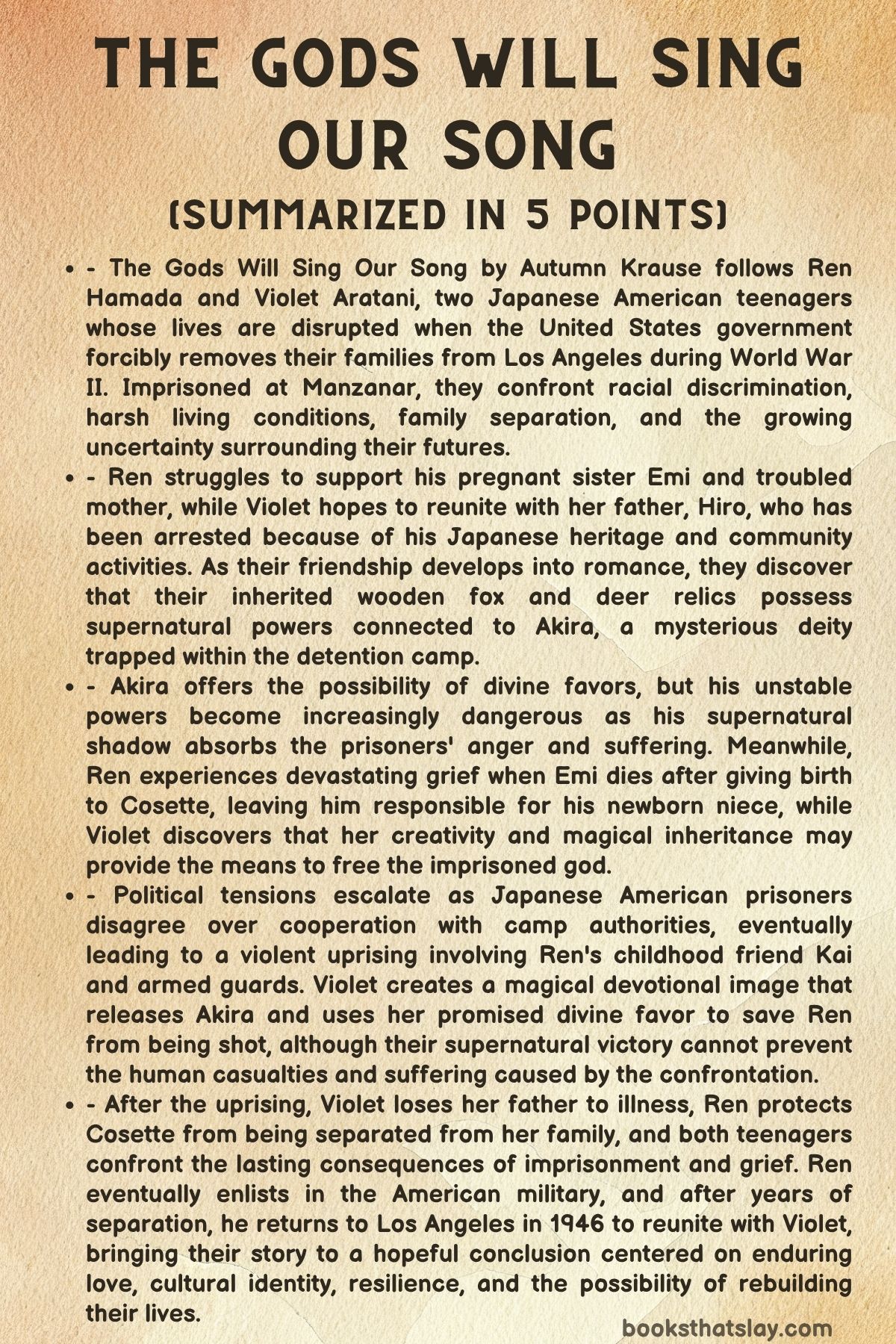
Summary
In April 1942, seventeen-year-old Ren Hamada lives in Los Angeles with his troubled family as hostility toward Japanese Americans intensifies following the attack on Pearl Harbor. His father disappeared when he was four, leaving behind a mysterious wooden fox pendant, while his alcoholic mother and pregnant older sister, Emi, depend on Ren’s earnings from unloading produce.
Ren has abandoned many of his personal ambitions because he feels responsible for supporting his family. His wealthy childhood friend Kai Suzuki encourages him to resume playing baseball, but Ren believes recreation is a luxury he can no longer afford.
As the government imposes restrictions on Japanese Americans, Ren watches his community become increasingly frightened and isolated. His mother responds by destroying photographs, letters, and possessions associated with their Japanese heritage, believing that eliminating evidence of their ancestry might protect them from persecution.
When she attempts to take Ren’s fox pendant, he refuses because it represents his only meaningful connection to his missing father. Their confrontation reveals the emotional damage already present within the family, even before the government forces them from their home.
Elsewhere in Los Angeles, Violet Aratani enjoys a more stable upbringing with her parents, who operate a family printing business. She dreams of becoming an artist and frequently draws supernatural creatures inspired by Japanese folklore, although her mother prefers that she pursue a conventional career in teaching.
Violet’s father, Hiro, encourages her artistic interests and shares stories about their family’s magical wooden deer figurine. Their happiness is shattered when FBI agents arrest him after treating his Japanese-language printing activities, community associations, and family possessions as evidence of suspicious behavior.
Before the agents take him away, Hiro secretly entrusts the deer relic to Violet. She recognizes the importance of his gesture without fully understanding the magical inheritance she has received.
The government soon orders Japanese Americans to leave their homes, and Ren’s family is confined at the Santa Anita Racetrack before being transferred to Manzanar. Conditions are degrading, with families housed in former horse stalls and denied basic privacy, while Ren becomes increasingly concerned about Emi’s pregnancy.
During their transfer, Ren witnesses soldiers attacking a mysterious stranger dressed in traditional Japanese clothing. Although others perceive the man as elderly, Ren sees someone much younger and discovers that his fox pendant responds strangely to the stranger’s presence.
Ren risks punishment to retrieve a wooden box the man drops, suffering a dislocated shoulder when guards intervene. During the commotion, he briefly notices a beautiful girl who captures his attention, not realizing how important she will become to him.
That girl is Violet, who eventually arrives at Manzanar with her mother. They have lost their printing business and most of their possessions, and Violet struggles to adapt to the camp’s crowded barracks, dust-filled surroundings, inadequate facilities, and constant restrictions.
Determined to maintain communication with her father, Violet approaches the camp administration and encounters Ronald Boser, an official whose inappropriate fascination with Japanese women makes her uncomfortable. Although he initially presents himself as helpful, his behavior gradually reveals a willingness to exploit the authority he holds over imprisoned families.
Violet soon meets Ren properly, and their conversation establishes an immediate attraction between them. Ren is drawn to her intelligence and confidence, while Violet appreciates his humor, independence, and willingness to question the restrictions governing their lives.
Ren eventually reveals that he has discovered a place where someone can crawl beneath the camp’s barbed-wire fence. Against her usual cautious instincts, Violet agrees to accompany him outside, and the pair secretly visit a nearby creek under cover of darkness.
Their brief escape gives them an opportunity to experience freedom away from the barracks. They discuss their families, ambitions, and uncertain futures, with Violet describing her artistic dreams and Ren expressing his desire to move to Santa Fe once his family is safe.
During their conversation, their inherited wooden relics mysteriously move toward one another and briefly unite in a supernatural glow. Their astonishment turns to terror when they witness the stranger from the bus performing impossible acts beside the creek, including summoning a fish and consuming it with unnatural teeth.
Back inside Manzanar, Ren struggles to secure employment and better medical treatment for Emi, whose condition is becoming dangerous. He reconnects with Kai, whose father, Dr. Suzuki, works at the camp hospital, but discovers that his friend has become involved with a rebellious group led by a young man named James.
The group believes Japanese Americans must openly resist their imprisonment, while Ren fears that violent confrontation will expose innocent people to retaliation. Their disagreement begins damaging a friendship that has survived significant differences in wealth and family circumstances.
Meanwhile, Boser’s attention toward Violet becomes increasingly threatening. During an encounter behind a warehouse, he attempts to force unwanted physical contact upon her, but Ren intervenes and protects her despite being struck by the official.
Their growing relationship encounters another complication when Violet learns that Ren has a criminal record. Although he insists that he is not involved with gangs, his reluctance to discuss his past temporarily unsettles her.
The mysterious stranger eventually introduces himself as Akira, a vain and demanding deity who appears trapped within Manzanar. He recognizes the significance of Ren and Violet’s magical relics and invites them to visit his barrack, where he transforms an ordinary room into a magnificent supernatural residence.
Akira explains that he can grant divine favors in exchange for sufficiently powerful offerings. Ren immediately hopes to save Emi from her dangerous pregnancy, while Violet imagines using the god’s abilities to reunite her family.
However, Akira’s powers are unstable, and his shadow increasingly behaves like an independent, threatening entity. His attempts to use the teenagers’ relics fail because neither object possesses enough energy to release him from his imprisonment.
Ren learns that a relic’s full power passes to its next owner only when its previous owner dies. Since his fox has already acknowledged him, he realizes that his long-absent father must be dead, destroying a hope he has carried since childhood.
His grief complicates his relationship with Violet, which is already strained by her mother’s disapproval. Nevertheless, they gradually repair their connection during a Tanabata celebration, where their growing attraction finally leads to a passionate kiss.
Violet’s mother discovers them and orders her daughter to stay away from Ren. Violet begins questioning whether protecting her family’s expectations should require abandoning someone who has consistently treated her with kindness and respect.
At the same time, Violet receives encouraging news that her father has been cleared for release, although his deteriorating health prevents him from returning immediately. Her hopes of family reunion remain alive, even as she becomes increasingly aware that government imprisonment has already caused damage that cannot easily be repaired.
Ren eventually tells Violet more about his previous imprisonment and the shame associated with his past. Her understanding helps him recognize that his worst mistakes do not have to define his entire identity, and their relationship develops into a deeper emotional partnership.
Violet meanwhile investigates Akira’s supernatural condition through books about Japanese mythology. She discovers an account of the Nameless Faceless God, a deity who cannot ordinarily appear to humans and whose trapped spiritual energy absorbs the anger and suffering surrounding him.
According to the legend, this accumulated darkness can eventually erupt into destructive supernatural fire. Violet realizes that the growing hostility within Manzanar is strengthening Akira’s dangerous shadow and that a powerful magical offering may be necessary to release him.
Before she can devise a solution, Emi’s pregnancy becomes a medical emergency. Dr. Suzuki struggles to save her as severe bleeding overwhelms the camp’s limited resources, and Ren desperately volunteers blood, even demanding that doctors take more than he can safely give.
Kai also donates blood, and Violet’s mother rushes to the hospital because her blood is compatible with Emi’s. Despite their efforts, Emi dies shortly after delivering a daughter, leaving Ren devastated and unable to accept that his sacrifices have failed to save the person who protected him throughout his childhood.
Emi’s surviving daughter is named Cosette, after a character in her favorite novel, Les Misérables. Ren becomes responsible for helping raise the infant while struggling with grief, exhaustion, financial uncertainty, and the practical difficulties of caring for a newborn inside an inadequately supplied detention camp.
His mother remains emotionally distant, but Violet, Nurse Rose, Mr. Nomura, and neighboring families provide essential assistance. Ren also develops an unexpected connection with Akira, who acknowledges the limits of divine intervention and offers a gentle musical expression of sympathy for Emi’s death.
As the months pass, Ren and Violet confess their love for each other, finding comfort amid their increasing responsibilities. Violet begins contributing illustrations to the camp newspaper, while Ren attempts to secure enough canned milk for Cosette, whose health is endangered by insufficient nutrition.
Boser continues manipulating Ren, confiscating his fox pendant and threatening consequences for his family unless he reveals supernatural knowledge. Ren recognizes that the official’s interest in Japanese traditions has less to do with cultural respect than with his desire to possess extraordinary power.
Meanwhile, political disagreements intensify following debates about Japanese American military service and cooperation with the government. James and Kai increasingly condemn community representatives such as Mr. Nomura, whom they accuse of betraying fellow prisoners by negotiating with the authorities.
The approaching crisis becomes unmistakable when an angry crowd threatens Mr. Nomura, forcing him to seek protection at the hospital. Ren brings the dangerously ill Cosette there and then ventures back into the escalating unrest because he fears that Kai may be caught in the violence.
Violet recognizes that Akira’s enormous shadow is nearing its destructive limit. She decides to create an offering by placing her drawing of the god on a wooden devotional plaque and incorporating a tiny fragment from her inherited deer relic.
Her creation represents more than an ordinary sacrifice because it gives the Nameless Faceless God a recognizable image. Guided by the deer, she reaches Akira’s barrack while protesters confront armed officers and tear gas fills the surrounding streets.
Inside, Akira’s shadow attacks Violet with overwhelming rage and destructive impulses. She fights through the supernatural darkness and succeeds in placing her icon inside his wooden box, where brilliant blue light begins reversing the god’s deterioration.
Akira recognizes that Violet has given him the acknowledgment he has always desired. When he combines her offering with Ren’s fox pendant, he is finally released from imprisonment, and his supernatural form becomes a powerful wind that disperses the threatening darkness above Manzanar.
As a reward, Akira promises Violet a divine favor. She soon hears gunfire from the uprising and remembers that Ren is somewhere among the protesters, prompting her to use her reward to protect him rather than request anything for herself.
Meanwhile, Ren has found Kai near a vehicle that protesters intend to push toward the police post. After witnessing the violence and remembering the suffering inflicted on his family, Ren abandons his earlier restraint and agrees to help his friend confront the authorities.
An officer aims directly at Ren and pulls the trigger, but the rifle mysteriously jams. Ren escapes into the vehicle with Kai as bullets strike its windshield, and both boys eventually flee before reuniting with Violet.
Although Violet’s intervention has prevented supernatural destruction, the uprising has still caused deaths and injuries. The survivors confront the painful reality that magic cannot erase the consequences of human violence, prejudice, or political injustice.
In the aftermath, Kai’s family is transferred to Tule Lake, while Mr. Nomura also leaves Manzanar. Ren learns that Cosette is recovering, but another difficult choice arises when Mrs. Ross, the wealthy mother of the man who fathered Emi’s child, offers to take the baby into her household.
Ren refuses to surrender Cosette, believing that she belongs with the family that loves her. His mother eventually supports his decision, and Mrs. Ross agrees to continue supplying milk without separating the child from her relatives.
Violet subsequently receives devastating news that her father has died after months of illness and separation. Her deer relic allows her to recognize his passing, and she later experiences a final spiritual encounter with him that provides a measure of comfort without removing the injustice of his death.
The government then introduces controversial loyalty questionnaires requiring imprisoned Japanese Americans to declare allegiance and answer questions about military service. Ren decides to enlist, believing that serving his country may help challenge the accusations against his community and secure a better future for those he loves.
Before departing, Ren confronts Boser’s continuing demands for supernatural power. Following instructions secretly left by Akira, he performs a ritual that summons dangerous dream spirits, which turn against Boser when he attempts to command them.
The experience leaves Boser psychologically shattered and ends his ability to intimidate Ren. Violet, meanwhile, convinces her mother that her love for Ren reflects his demonstrated loyalty and character rather than the social prejudices associated with his troubled background.
As Ren prepares to travel to Camp Shelby for military training, members of the community give him practical supplies and personal gifts. His mother expresses her affection through handmade clothing and protective objects, while Violet exchanges treasured keepsakes with him before their separation.
Their final farewell is painful because neither knows whether Ren will survive the war. Nevertheless, he boards the bus with a new understanding that courage includes accepting uncertainty and trusting the people he loves.
In August 1946, Ren returns to Los Angeles after serving overseas. He carries a military medal, Violet’s deer relic, and a ring intended for the woman whose love sustained him through years of separation.
Violet has continued pursuing education and work, preserving her artistic interests despite everything she has lost. When they finally see each other on an ordinary city street, they rush into an embrace, recognizing that their commitment has survived imprisonment, bereavement, violence, and war.
A mysterious wind surrounds them, suggesting that Akira continues watching over their lives. Their reunion brings the novel to a hopeful conclusion, showing that although the past cannot be undone, Ren and Violet now possess the freedom to create a future together.
Characters
Ren Hamada
Ren Hamada is one of the two central protagonists of The Gods Will Sing Our Song, and his development reflects the emotional consequences of discrimination, family responsibility, and personal loss. At the beginning of the novel, he is a teenager who has been forced to assume adult responsibilities long before he is emotionally prepared for them.
His father’s abandonment, his mother’s alcoholism, and Emi’s vulnerable circumstances have convinced him that his value depends on his ability to protect others. Consequently, he sacrifices his interest in baseball and his personal ambitions to support his family financially.
Ren initially presents himself as independent, sarcastic, and emotionally guarded, but these qualities conceal considerable insecurity. His criminal record and troubled family circumstances contribute to his belief that respectable people, particularly Violet’s family, will always consider him inferior.
His devotion to Emi becomes one of his defining characteristics, especially when her pregnancy threatens her life. Her death forces him to confront the limits of personal sacrifice, teaching him that determination cannot prevent every tragedy.
Caring for Cosette introduces a different form of responsibility, requiring patience, tenderness, and the willingness to accept help from others. Through this experience, Ren gradually learns that protecting someone does not mean controlling every aspect of their future.
His relationship with Violet also transforms his understanding of himself. Her affection allows him to recognize that he deserves love despite his mistakes, while her confidence in his character helps him overcome feelings of inadequacy.
Ren’s changing position regarding resistance reflects another significant internal conflict. Although he initially fears political confrontation, the violence at Manzanar exposes the full force of his suppressed anger and demonstrates how oppression can drive even cautious individuals toward desperate action.
His eventual decision to enlist represents a complicated attempt to reclaim dignity and create opportunities for his community. By the conclusion, Ren has developed from a frightened, defensive teenager into a man capable of accepting responsibility, expressing affection, and facing uncertainty without abandoning hope.
Violet Aratani
Violet Aratani serves as the second protagonist of The Gods Will Sing Our Song, bringing artistic imagination, intellectual curiosity, and emotional independence to the narrative. Her experiences demonstrate how creativity and compassion can become powerful responses to injustice.
Before her imprisonment, Violet enjoys a relatively stable family life and dreams of studying art. Her mother, however, considers teaching a more practical profession, creating an early conflict between Violet’s ambitions and the expectations placed upon her.
The arrest of her father fundamentally changes her circumstances, forcing her to confront government authority and the fragility of the security she once took for granted. Rather than surrendering her interests, she gradually discovers that artistic expression can provide both personal purpose and meaningful service to her community.
Her relationship with Ren challenges the social assumptions she has inherited from her family. Although she initially worries about his criminal past and her mother’s disapproval, she learns to judge him through his actions rather than his reputation.
Violet’s greatest contribution emerges from her ability to understand Akira’s supernatural predicament. Where others see magical objects primarily as sources of power, she recognizes that an image created through imagination and devotion might provide the god with the identity he lacks.
Her decision to sacrifice part of the family deer relic demonstrates growing confidence in her judgment. By creating an offering that frees Akira, Violet proves that inherited traditions can gain renewed significance through individual creativity.
Her emotional maturity becomes especially evident when she uses her promised divine favor to save Ren instead of attempting to restore her lost family life. The choice reflects her acceptance that love sometimes involves protecting the future rather than recovering the past.
By the conclusion, Violet has become a more independent woman who preserves her compassion without surrendering her ambitions. Her development establishes artistic creativity as a source of courage, cultural continuity, and personal freedom.
Akira
Akira is the mysterious supernatural figure whose imprisonment creates the central magical conflict in The Gods Will Sing Our Song. Known through folklore as the Nameless Faceless God, he exists between the spiritual world and human society, longing for recognition while struggling with the destructive consequences of his confinement.
His personality initially appears vain, theatrical, and demanding. He delights in admiration, creates extravagant magical surroundings, and repeatedly complains about the indignities of living among humans.
However, his behavior conceals an existence defined by loneliness and dependence upon human acknowledgment. Although he possesses extraordinary powers, he cannot escape his circumstances without receiving an offering capable of establishing a lasting connection with worshippers.
His supernatural shadow embodies the dangerous relationship between divine energy and human suffering. As resentment intensifies throughout Manzanar, the darkness absorbs the prisoners’ anger and threatens to release catastrophic destruction.
Akira gradually reveals unexpected compassion through his interactions with Ren. Following Emi’s death, his gentle musical response suggests that even a self-absorbed deity can recognize suffering and offer genuine comfort.
His relationship with Violet ultimately transforms his existence because she understands his need for an identity rather than merely his appetite for magical power. The devotional image she creates gives him a recognizable form and allows him to escape his imprisonment.
His final acts, including saving Ren through Violet’s request and providing a way to confront Boser, demonstrate that gratitude can replace vanity when recognition is freely given. Akira becomes an unusual representation of how power gains meaning through relationships rather than domination.
Emi Hamada
Emi Hamada is one of the most emotionally significant characters in The Gods Will Sing Our Song, particularly because her relationship with Ren establishes the foundation of his personality. As his older sister, she has frequently protected him from the instability of their household and provided the emotional security their parents could not consistently offer.
Her pregnancy places her in an especially vulnerable position because the father of her child is a married white man whose family enjoys greater financial and political influence. The judgment directed toward Emi reveals the unequal standards imposed upon women and the racial divisions that shape her circumstances.
Despite her difficulties, Emi remains a source of affection and familiarity for Ren. Their shared memories, conversations, and love of books preserve something of their former family life even within the harsh environment of Manzanar.
Her deteriorating health exposes the devastating consequences of inadequate medical care during imprisonment. Although Ren, Kai, Dr. Suzuki, and others desperately attempt to save her, she dies after giving birth to Cosette.
Emi’s death becomes a defining turning point for Ren because it destroys his belief that sufficient sacrifice can protect every loved one. Nevertheless, her influence survives through her daughter, her treasured books, and the emotional responsibilities she leaves behind.
Cosette Hamada
Cosette, Emi’s surviving daughter, represents innocence, continuity, and the possibility of a future beyond the suffering experienced by her family. Her name, inspired by Emi’s beloved novel Les Misérables, creates a literary connection between hardship and hope.
Born during the family’s imprisonment, Cosette enters a world already marked by injustice and deprivation. Her fragile health and feeding difficulties expose how detention conditions endanger even infants who have no connection to the political accusations surrounding their families.
For Ren, Cosette becomes both a reminder of Emi’s death and a reason to continue living with purpose. His efforts to obtain nourishment, arrange medical care, and protect her from separation reveal his increasing capacity for patient, unconditional love.
The attempt by Mrs. Ross to take Cosette into a wealthier household creates another significant test. Ren’s refusal establishes that family belonging cannot be measured only by material security, while his mother’s eventual support suggests the possibility of healing within their damaged household.
Ren’s Mother
Ren’s mother is a complicated figure whose emotional instability reflects years of abandonment, financial insecurity, shame, and fear. Her alcoholism and harsh treatment of her children have created serious damage within the family, particularly in her relationship with Ren.
Her attempt to destroy Japanese photographs and possessions demonstrates how racial persecution can encourage individuals to reject visible aspects of their own identities. She believes that abandoning these reminders of her heritage might protect her children, even though the government’s actions are beyond her control.
Throughout the family’s imprisonment, she frequently struggles to express affection directly. Her reactions to Emi’s death reveal profound grief, but she often responds through silence, practical arrangements, or emotional withdrawal rather than open communication.
Cosette’s arrival gradually offers her an opportunity to reconnect with her family. Her eventual agreement that the child should remain with Ren represents an important acknowledgment of both family loyalty and her son’s maturity.
Before Ren leaves for military training, she gives him handmade clothing and protective items. These gestures demonstrate that her love has survived beneath years of resentment and fear, even if she cannot easily communicate it through words.
Mrs. Aratani
Violet’s mother is a protective and practical woman whose experiences reveal the difficulties of preserving family stability under extraordinary pressure. Unlike Violet’s more openly encouraging father, she emphasizes caution, respectable behavior, and conventional expectations.
Her desire for Violet to become a teacher rather than an artist reflects concern about financial security and social acceptance. These priorities become more understandable after the family loses its business, possessions, and freedom.
She initially opposes Violet’s relationship with Ren because of his troubled background and the possibility that their association could expose her daughter to further hardship. However, her judgment also reveals how social prejudice can survive within communities already suffering from discrimination.
Her affection often appears through practical actions, such as making Violet a coat from surplus materials or helping provide blood during Emi’s medical emergency. These gestures establish that her guarded personality does not indicate an absence of love.
Following Hiro’s death, mother and daughter become more emotionally dependent upon one another. Their shared grief allows Violet to understand her mother’s vulnerability, while Mrs. Aratani gradually recognizes her daughter’s growing independence.
Her eventual willingness to accept Ren reflects an important change in perspective. She comes to understand that character is better measured through kindness, loyalty, and responsibility than through family reputation.
Hiro Aratani
Hiro Aratani, Violet’s father, represents cultural pride, artistic encouragement, and the dignity of individuals unjustly accused by their government. His printing business serves the Japanese American community, yet these ordinary activities become grounds for federal suspicion.
His relationship with Violet is characterized by intellectual companionship and affection. He encourages her drawings, shares his interest in mythology, and treats her imagination as a valuable part of her identity.
Hiro’s arrest reveals the arbitrary nature of wartime persecution. Despite being unable to identify genuine wrongdoing, the authorities treat his Japanese-language materials, associations, and inherited possessions as possible evidence of disloyalty.
His decision to entrust the magical deer to Violet symbolizes both paternal confidence and the passing of cultural responsibility between generations. Through this gift, he allows her to preserve something meaningful that the government cannot easily confiscate.
Although he is eventually cleared for release, his health deteriorates before he can reunite with his family. His death becomes one of the novel’s clearest demonstrations that official exoneration cannot reverse the consequences of unjust imprisonment.
His final spiritual encounter with Violet provides emotional reassurance rather than undoing the tragedy. Through his continuing influence, Hiro demonstrates how parental love and cultural inheritance can survive physical separation and death.
Kai Suzuki
Kai Suzuki is Ren’s closest childhood friend and one of the most politically conflicted characters in The Gods Will Sing Our Song. His privileged upbringing and playful personality initially contrast with Ren’s financial struggles and unusually serious attitude toward responsibility.
Before their imprisonment, Kai encourages Ren to enjoy baseball and maintain some connection with the life they once shared. His enthusiasm for automobiles and mechanical work also reveals a practical intelligence and an interest in possibilities beyond the camp.
As conditions at Manzanar deteriorate, Kai becomes increasingly involved with James and the younger prisoners who advocate direct resistance. His political anger arises from an understandable refusal to accept humiliation, but his willingness to embrace confrontation places him in growing danger.
His friendship with Ren becomes strained because the two approach oppression differently. Kai considers resistance necessary for maintaining dignity, while Ren fears that aggressive action will provoke the armed authorities and endanger vulnerable families.
Nevertheless, Kai repeatedly demonstrates loyalty through his efforts to help Ren find employment and through his willingness to donate blood during Emi’s medical emergency. These actions prevent his political radicalization from reducing him to a simple representation of recklessness.
During the uprising, Kai’s participation brings him dangerously close to death. Ren’s determination to rescue him reinforces the strength of their friendship, even though neither can completely resolve their ideological differences.
Kai’s subsequent transfer to Tule Lake demonstrates how incarceration damages social relationships and separates people who have depended upon one another for years.
James
James represents the uncompromising anger developing among younger Japanese American prisoners who believe that negotiation with the authorities has produced little meaningful change. His leadership attracts teenagers who feel humiliated by their imprisonment and frustrated with community representatives who appear willing to cooperate with the government.
He interprets political disagreements in sharply moral terms, frequently describing more moderate prisoners as traitors or collaborators. This attitude creates divisions within a community that is already suffering under external oppression.
His influence upon Kai becomes particularly important because it contributes to the deterioration of Kai’s friendship with Ren. James demands clear expressions of loyalty and treats hesitation as evidence of cowardice or betrayal.
Although his anger originates in genuine injustice, his behavior also demonstrates the dangers of allowing political frustration to eliminate compassion for people who share the same suffering. Through James, the novel examines how resistance can become destructive when ideological certainty replaces concern for human consequences.
Mr. Nomura
Mr. Nomura is an elderly veteran and respected community figure whose relationship with Ren develops from criticism into meaningful guidance. At first, his stern manner makes him appear judgmental, particularly toward Ren’s behavior and troubled reputation.
As the story progresses, his actions reveal a strong commitment to protecting the dignity and welfare of Japanese Americans. He participates in community meetings, advocates political engagement, and supports efforts to improve conditions within Manzanar.
His belief in organized negotiation places him in conflict with younger prisoners who consider cooperation with officials a betrayal. As tensions escalate, he becomes a target of threats and eventually seeks refuge at the hospital.
Beyond his political role, Mr. Nomura contributes to the emotional survival of Ren’s family. His origami-making, practical assistance, and efforts to improve living conditions provide small but meaningful forms of stability.
For Ren, he gradually becomes an important elder whose guidance challenges the belief that strength must always be demonstrated through defiance. His eventual departure emphasizes the repeated disruption of family and community connections under incarceration.
Ronald Boser
Ronald Boser is the principal human antagonist, representing the corruption that develops when institutional authority operates without adequate accountability. As a War Relocation Authority official, he possesses significant power over people who cannot freely leave the environment he controls.
His behavior toward Violet reveals his willingness to exploit that imbalance of power for personal gratification. He uses apparently friendly attention to conceal intimidation, sexual harassment, and attempts at unwanted physical contact.
Boser’s treatment of Ren is equally manipulative. He withholds assistance, uses Ren’s criminal record against him, intercepts correspondence, and threatens the family with further punishment whenever he believes such pressure might benefit him.
His fascination with Japanese supernatural traditions is especially revealing because it contrasts sharply with his contempt for the people who preserve those traditions. Rather than seeking cultural understanding, he views magical knowledge as something that can be seized and controlled.
His confiscation of Ren’s fox pendant becomes another expression of this possessive attitude. The object carries deep emotional and ancestral meaning for Ren, but Boser recognizes only its possible usefulness.
Boser’s downfall occurs when he attempts to command the dream spirits summoned through Akira’s ritual. His inability to control the beings exposes the limits of his authority and leaves him psychologically shattered.
The character ultimately illustrates how power without empathy encourages exploitation and how an obsession with control can become a source of self-destruction.
Dr. Suzuki
Dr. Suzuki, Kai’s father, provides essential medical care at Manzanar and represents the professional dedication of individuals attempting to preserve lives within an inadequate system. His position gives him responsibility for patients whose suffering is frequently intensified by the conditions of their confinement.
His attempts to save Emi are particularly significant because they demonstrate both his medical commitment and the limitations imposed by scarce resources. Despite organizing blood donations and responding urgently to her deterioration, he cannot prevent her death.
He later treats Cosette when inadequate nutrition threatens her survival. Through these experiences, Dr. Suzuki becomes an important source of reassurance for Ren, even as the hospital itself reminds the young man of profound loss.
His gratitude when Ren protects Kai also strengthens Ren’s developing sense of self-worth. Dr. Suzuki recognizes the young man’s courage and loyalty rather than defining him through his past mistakes.
Nurse Rose
Nurse Rose represents everyday compassion and professional responsibility in a setting where both are desperately needed. She participates in the attempts to save Emi and continues providing assistance to Ren’s family after the tragedy.
Her willingness to help protect patients during the uprising demonstrates moral courage under dangerous circumstances. Although she does not possess the authority to change the larger system, she refuses to abandon those who depend upon her care.
Her support for Ren extends beyond medical emergencies, including practical assistance as he prepares for military service. These modest actions contribute to the novel’s portrayal of solidarity as something sustained through consistent attention to other people’s needs.
Mrs. Hata
Mrs. Hata serves as an intellectual guide and mentor to Violet, encouraging her to examine political injustice with greater independence. Through their conversations, Violet begins to recognize that resistance can take different forms and that preserving cultural knowledge is itself a meaningful response to oppression.
Her connection with the camp library establishes the importance of education during forced confinement. Books and discussion provide opportunities for personal development even when physical freedom has been removed.
Mrs. Hata also embodies the dangers faced by community members during periods of political unrest. Her departure after the uprising becomes an important personal loss for Violet, who has already experienced repeated separations.
Before leaving, she emphasizes that people can preserve an inner sense of freedom despite external restrictions. Her guidance strengthens Violet’s determination to remain intellectually and emotionally independent.
Mrs. Ross
Mrs. Ross belongs to the wealthy white family connected to Emi’s pregnancy, making her Cosette’s paternal grandmother. Her financial position and political connections contrast sharply with the vulnerability of Ren’s family.
Her initial discomfort about Emi’s circumstances suggests that racial prejudice and concern for social reputation influence her behavior. Although Ren hopes she might help obtain appropriate medical attention, she does not become the reliable protector he desperately needs.
Following Emi’s death, Mrs. Ross offers to take Cosette to live with her family in Pasadena. Her proposal raises the difficult question of whether economic comfort should outweigh a child’s existing emotional and familial bonds.
Ren’s refusal challenges the assumption that wealth necessarily provides a better definition of family. Mrs. Ross eventually agrees to supply canned milk without separating Cosette from her relatives, suggesting that practical assistance can be offered without demanding control.
The Wozumi Family and Ethan
The Wozumi family represents the wider community that helps sustain hope and ordinary human connection within Manzanar. Their participation in small projects and acts of kindness demonstrates how imprisoned families create shared spaces of comfort despite the restrictions surrounding them.
The children’s developing fish pond carries particular significance because it transforms an ordinary communal activity into an expression of imagination and hope. Rather than accepting the camp solely as a place of deprivation, the residents attempt to introduce beauty into their surroundings.
Ethan’s question to Violet about what she would place in the pond gives her an opportunity to express how her experiences have changed her. Her answer, that she would fill it with hope, captures the resilience she has developed through suffering, love, and artistic creation.
The family’s encouragement during Ren’s departure further emphasizes that his sense of belonging has expanded beyond his immediate relatives. Their presence demonstrates the importance of community solidarity in surviving isolation and uncertainty.
Themes
Racial Injustice and the Fragility of Citizenship
Racial discrimination shapes nearly every aspect of the characters’ lives, transforming ordinary families into targets of government suspicion and punishment. In The Gods Will Sing Our Song, the forced imprisonment of Japanese Americans demonstrates how quickly constitutional protections and social acceptance can disappear when fear becomes a justification for political action.
Ren and Violet begin the novel with different family circumstances, but the government’s exclusion policies ultimately expose them to the same injustice. Regardless of their citizenship, economic position, education, or personal conduct, their ancestry becomes sufficient grounds for treating them as potential enemies.
The destruction of the Aratani printing business and Hiro’s arrest reveal how cultural practices can be deliberately misinterpreted as threatening. His Japanese-language publications, community involvement, and inherited possessions are presented as suspicious despite their ordinary significance.
Ren’s mother responds to persecution by burning reminders of her family’s Japanese identity. Her actions reveal the psychological consequences of discrimination, particularly when marginalized individuals begin to believe that survival requires concealing or rejecting their heritage.
Conditions at Manzanar further expose the gap between democratic ideals and government practices. Families are denied privacy, adequate resources, freedom of movement, and opportunities to make decisions about their own lives, while officials such as Boser exploit the prisoners’ vulnerability.
The deaths of Emi and Hiro demonstrate that institutional injustice creates consequences beyond the immediate loss of liberty. Inadequate medical care, family separation, emotional distress, and prolonged confinement produce injuries that cannot be repaired through eventual release or official acknowledgment.
The controversial military service question introduces another contradiction because Japanese Americans are asked to demonstrate allegiance to a nation that has imprisoned them. Ren’s enlistment reflects the difficult position of individuals who wish to claim their citizenship while confronting a government that has failed to honor it.
Through these experiences, the novel shows that prejudice is not simply a matter of individual hostility. It can become embedded within institutions, legal decisions, and administrative practices, producing widespread suffering even when those responsible claim to be protecting national security.
Family Responsibility, Love, and Grief
Family relationships repeatedly force the characters to confront the difference between caring for someone and attempting to control their future. Ren’s understanding of love initially depends upon his belief that he must personally protect everyone close to him, regardless of the sacrifices required.
His difficult childhood has encouraged him to assume responsibilities that ordinarily belong to adults. Rather than pursuing education, recreation, or personal ambitions, he concentrates on earning money and protecting Emi from the consequences of her vulnerable circumstances.
Emi’s death transforms this understanding because Ren discovers that personal dedication cannot guarantee another person’s survival. His repeated attempts to donate blood reveal the desperation of someone who measures his worth through his usefulness to others.
Cosette’s birth creates a new responsibility, but it gradually teaches Ren a healthier form of devotion. He learns to accept assistance from Violet, medical professionals, neighbors, and his mother instead of believing that every burden must be carried alone.
The relationship between Violet and her mother presents a different conflict involving protection and independence. Mrs. Aratani’s objections to her daughter’s artistic ambitions and romantic relationship arise partly from genuine concern, yet her efforts to control Violet also threaten the young woman’s ability to make meaningful choices.
Their reconciliation develops through shared hardship and grief following Hiro’s death. As Violet matures, she recognizes the fears underlying her mother’s behavior, while Mrs. Aratani gradually understands that loving her daughter requires respecting her judgment.
Romantic love similarly becomes a source of growth rather than merely emotional comfort. Violet accepts Ren despite his troubled past, and Ren gradually learns that being worthy of affection does not depend upon achieving perfection.
The decision to protect Cosette from separation and Violet’s use of her divine favor to save Ren both demonstrate love expressed through action. By the conclusion, the characters understand that meaningful relationships require loyalty, trust, patience, and the acceptance of circumstances beyond individual control.
Cultural Heritage, Art, and the Power of Recognition
Cultural traditions provide the characters with a sense of identity that survives the government’s attempts to separate them from their homes and communities. In The Gods Will Sing Our Song, Japanese mythology, inherited objects, artistic expression, and traditional celebrations become essential sources of continuity during forced imprisonment.
The fox and deer relics are especially significant because they connect Ren and Violet with earlier generations of their families. Although their supernatural abilities initially appear mysterious, the objects also possess emotional value independent of the magical powers they contain.
For Ren, the fox represents his absent father and the unanswered questions surrounding his childhood. For Violet, the deer preserves her relationship with Hiro and reminds her of the trust he placed in her when he was taken away.
These objects contrast with the actions of government officials who treat Japanese possessions as evidence of disloyalty. The same cultural heritage that authorities regard with suspicion becomes a source of comfort, knowledge, and spiritual strength for those who preserve it.
Violet’s artistic development extends this connection between identity and cultural survival. Before arriving at Manzanar, she considers drawing primarily a personal ambition, but her work eventually contributes to the camp newspaper and provides the community with moments of beauty and shared recognition.
Her creation of Akira’s devotional image represents the strongest expression of art’s transformative possibilities. Rather than obtaining a powerful offering through wealth or coercion, Violet combines her imagination with a small piece of inherited magic to give the forgotten deity a recognizable identity.
Akira’s liberation suggests that recognition possesses a power greater than domination. His suffering originates partly from being unable to establish a meaningful relationship with humans, and Violet resolves his predicament by acknowledging his existence through an act of creative devotion.
This idea also reflects the experiences of Japanese Americans whose humanity has been disregarded by the government. Their efforts to preserve cultural celebrations, community gardens, books, artwork, and traditional knowledge resist the attempt to reduce them to prisoners without individual identities.
By presenting creativity as both personal expression and collective resistance, the novel emphasizes that cultural survival requires more than preserving objects from the past. Traditions remain meaningful when succeeding generations reinterpret them, maintain their emotional significance, and use them to create new possibilities.
Anger, Resistance, and the Meaning of Freedom
Anger develops throughout the story as an understandable response to humiliation, discrimination, and prolonged confinement. The prisoners’ increasing frustration reveals what happens when people are denied meaningful control over their lives while being expected to demonstrate obedience toward those responsible for their suffering.
Ren and Kai represent contrasting responses to this injustice. Kai increasingly embraces confrontation because he believes resistance is necessary to preserve dignity, while Ren initially concentrates on protecting his family and avoiding actions that could provoke the armed authorities.
Their disagreement becomes more complicated as government restrictions continue and attempts at organized negotiation produce limited progress. Community representatives such as Mr. Nomura believe that political engagement offers a possible path toward change, but younger protesters interpret such cooperation as surrender.
James demonstrates how anger can develop into rigid ideological judgment. By treating anyone who questions his tactics as a traitor, he reproduces forms of exclusion and hostility within a community already harmed by outside prejudice.
The supernatural shadow surrounding Akira transforms this emotional conflict into a visible threat. As hostility increases, the darkness expands and approaches a destructive condition, reflecting the danger of suffering that has been allowed to accumulate without relief.
Ren’s participation in the uprising complicates any simple distinction between reasonable caution and reckless defiance. After witnessing gunfire and remembering Emi’s death, he becomes overwhelmed by the realization that protecting his family through obedience has never guaranteed their safety.
Nevertheless, the resulting violence demonstrates that justified anger does not automatically produce beneficial consequences. Protesters are killed and injured, friendships are disrupted, and the community experiences further trauma even after Violet prevents the supernatural catastrophe.
Mrs. Hata offers a different understanding of resistance by emphasizing the importance of retaining control over one’s inner life. Her perspective suggests that intellectual independence, cultural preservation, and personal dignity can remain meaningful even when physical freedom has been taken away.
Ren’s eventual departure for military service and Violet’s commitment to her artistic future demonstrate their attempts to reclaim agency through difficult personal choices. Their reunion after the war ultimately presents freedom not as the ability to escape suffering entirely, but as the opportunity to determine one’s own relationships, preserve one’s identity, and build a future without surrendering to the injustices of the past.