The Heart Trials Summary, Characters and Themes
The Heart Trials by J. Elle is a young adult romantic fantasy novel set in Ethyria, an island where love is treated as a privilege reserved for the wealthy and emotional freedom is denied to ordinary citizens.
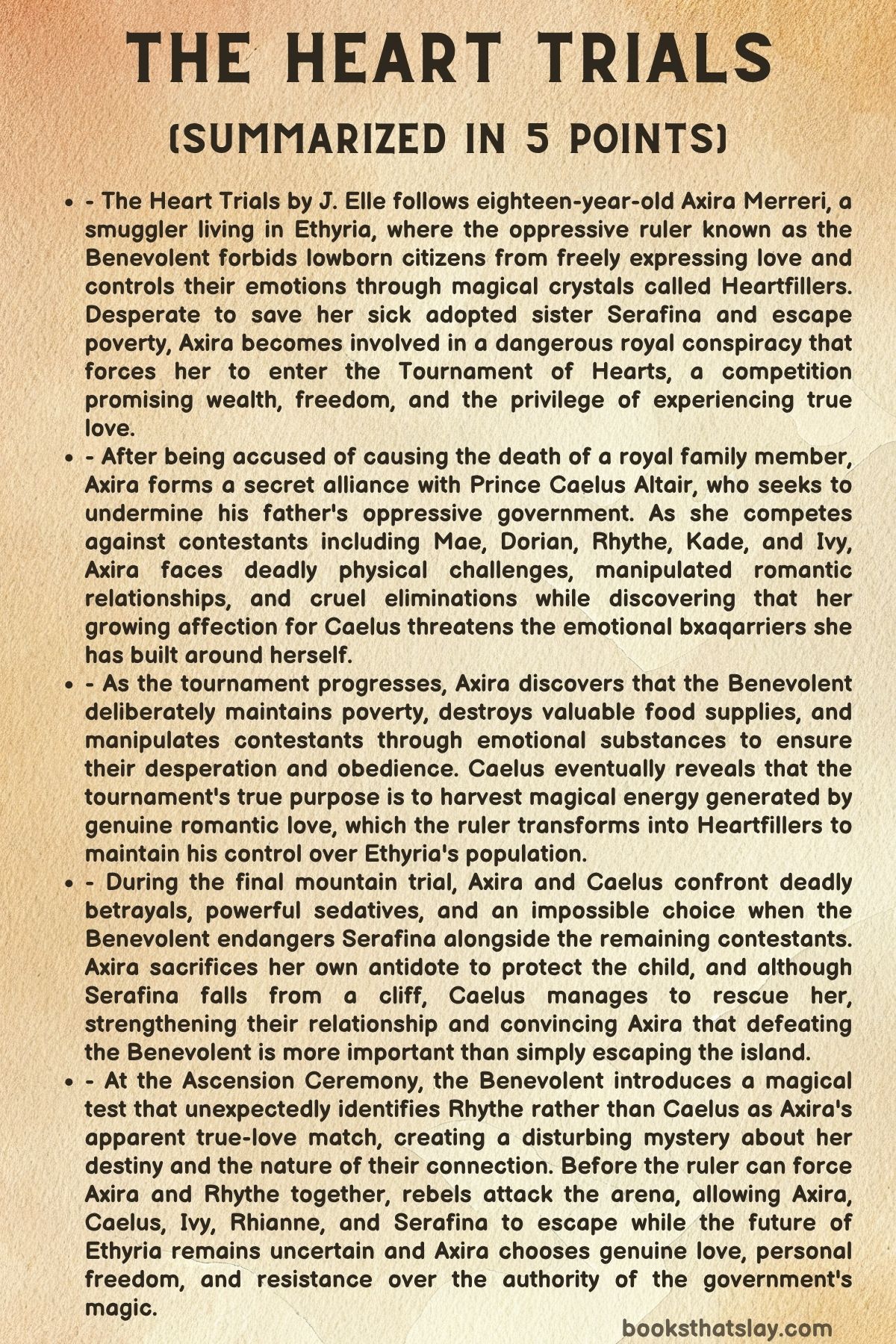
The story follows Axira Merreri, an eighteen-year-old smuggler who enters a dangerous competition to protect her adopted family and escape an oppressive government. What begins as a desperate attempt to survive gradually becomes a struggle against a political system that exploits human emotions for magical power. Through forbidden romance, betrayal, rebellion, and personal sacrifice, the novel examines freedom, emotional vulnerability, class inequality, and the courage required to challenge injustice.
Summary
In the divided island kingdom of Ethyria, love is not a fundamental human right but a privilege controlled by a powerful ruler known as the Benevolent. Wealthy Skyborn citizens enjoy affection and luxury, while the impoverished lowborn population must wear restrictive gloves and mouth chains, preventing them from openly expressing physical affection.
Eighteen-year-old Axira Merreri lives in Saltblood, one of Ethyria’s poorest districts, where she survives by illegally smuggling magical substances called Heartfillers. These crystals manipulate emotions, creating artificial happiness, suppressing unwanted feelings, and maintaining the population’s dependence on the government.
Axira has spent months secretly accumulating money to escape the island with the family she has found at Miss Omon’s orphanage. Her greatest concern is Serafina, an eight-year-old girl whose worsening illness threatens her life, especially because medicine and adequate food are nearly impossible to obtain.
During the mandatory Census Day gathering, Axira witnesses the cruelty of the authorities when a Mercyenforcer catches Serafina stealing an apple. She manages to save the child through bribery, but the incident reinforces her determination to abandon Ethyria before the government destroys everyone she loves.
A mysterious smuggling request promises Axira ten thousand gold coins, enough to secure passage away from the island and provide medical treatment for Serafina. Although the arrangement appears suspicious, she accepts the dangerous assignment because it offers her family an opportunity for permanent freedom.
Traveling from Saltblood to the wealthy district of Skyhaven, Axira witnesses the extraordinary differences between the lives of rich and poor citizens. She eventually meets Lucent, a member of the royal family who has secretly ordered a large quantity of Heartfillers for reasons connected to Prince Caelus Altair.
The transaction initially proceeds successfully, but Lucent suddenly dies after consuming another powerful Heartfiller despite already showing signs of dangerous intoxication. Axira is immediately arrested and accused of murdering him, discovering that her innocence means very little when the authorities consider her an expendable lowborn criminal.
While attempting to escape imprisonment, Axira encounters a young man disguised as a palace servant who offers assistance in exchange for money. She soon discovers that he is Prince Caelus, the Benevolent’s son, and that he and Lucent had been secretly planning to interfere with the government’s Tournament of Hearts.
Caelus reveals that the tournament conceals an important secret involving magical power, although he initially refuses to explain the entire scheme. He offers Axira protection and possible freedom if she helps obtain the magic, but their fragile arrangement becomes complicated when she is arrested again.
Brought before the Benevolent, Axira faces execution or permanent servitude for injuring a Mercyenforcer during her escape. Instead of accepting either punishment, she boldly requests admission into the Tournament of Hearts, a competition that supposedly allows lowborn citizens to win Skyborn status and unrestricted romantic freedom.
The Benevolent accepts her proposal, believing that her participation will demonstrate the generosity of his rule. Axira secretly negotiates with Caelus, promising to reach the final Ascension Ceremony and steal the magical substance he requires in exchange for a ship, money, and new identities for her family.
Before entering the tournament, Axira briefly returns to Saltblood, where she reunites with Miss Omon, Serafina, and her childhood acquaintance Dorian Marsh. Her farewell is painful because Serafina fears abandonment, and Axira must conceal the dangerous circumstances surrounding her unexpected opportunity.
Upon arriving at the Citadel, Axira encounters extravagant accommodations that contrast sharply with the deprivation she has known throughout her life. She also meets Syra, a strict highborn attendant, and receives a calculated reminder of her father’s execution when the Benevolent presents a document identifying Geof Merreri as a convicted rebel.
Among the contestants, Axira forms an unlikely friendship with Mae, a cheerful Grainfolk girl who genuinely believes that the tournament will provide happiness and romance. Other participants include Dorian, the intimidating Kade, the calculating Rhythe, and several competitors whose personal ambitions soon create dangerous rivalries.
During the opening ceremony, the Benevolent announces that contestants must prove their romantic compatibility while surviving physical and emotional trials. He also introduces surprise eliminations and reveals that Caelus himself will participate, alarming Axira because his involvement threatens their secret mission.
The contestants begin collecting fingerprints, attending social gatherings, and establishing possible romantic connections under constant supervision. Axira struggles with physical intimacy and distrusts the competition, while Mae embraces its promises and gradually develops a genuine relationship with Dorian.
Axira also meets Ronan, a young man hoping to secure a better future for his baby brother, Teddy. His circumstances remind her that many contestants have entered not because they believe in the Benevolent’s romantic ideals but because poverty has left them with few alternatives.
The first major challenge, the Trial of Courage, requires contestants to leap from a high cliff into the ocean and swim through dangerous currents toward a distant shore. Axira initially trusts her experience as a Saltblood swimmer, but memories of her mother’s death overwhelm her, and Caelus must rescue her from drowning.
Although she survives, numerous contestants are injured or killed, including Ronan, whose death devastates those who understood his responsibilities at home. The authorities respond with indifference, making Axira increasingly suspicious that the tournament is designed to exploit desperation rather than reward courage.
As the survivors continue competing, Rhythe approaches Axira about joining an alliance that intends to steal from the Benevolent during the final ceremony. His proposals initially seem useful, but she discovers that his group plans to eliminate Dorian because his genuine relationship with Mae makes them formidable competitors.
Meanwhile, the tournament authorities manipulate contestants through emotional scents and carefully designed social humiliations. During one elimination, a substance that intensifies anger triggers a violent confrontation in which Orrick kills Finn, exposing how readily the government transforms human suffering into entertainment for Skyborn spectators.
Axira becomes particularly suspicious of Kade, whose knowledge and behavior suggest connections with powerful officials. Determined to protect Dorian while maintaining her position, she begins pretending to pursue Kade romantically, even though she finds him repulsive.
Her connection with Caelus develops differently, especially when he takes her on a private visit to the Hollow, an underground sanctuary established with the help of his mother. There, Axira discovers a community where people can openly love, grieve, dance, and express themselves without government interference.
The experience challenges her belief that emotional attachment inevitably leads to weakness and suffering. Caelus gradually earns her trust by revealing his opposition to his father, his concern for ordinary citizens, and his willingness to obtain medicine for Serafina.
Their growing closeness is interrupted when Rhythe’s conspiracy places Dorian in danger through a fabricated accusation of involvement in the Redwake rebellion. Axira and Caelus intervene, preventing his execution, while Mae demonstrates her devotion by publicly kissing him to satisfy the tournament’s requirements.
The next challenge, the Trial of Loyalty, takes the contestants to Grainfolk, where they must package food before destroying enormous quantities of surplus crops. Axira is horrified to discover that the Benevolent deliberately maintains hunger while allowing perfectly edible food to burn, ensuring that impoverished citizens remain dependent on his supposed generosity.
The trial becomes more dangerous when contestants are secretly exposed to memory Heartfillers that produce terrifying hallucinations. Axira sees an imagined version of Serafina accusing her of abandonment, while other competitors attack one another or succumb to poisoned food and emotional manipulation.
After surviving these horrors, Axira finally learns the tournament’s true purpose from Caelus. A genuine romantic connection between the winning couple produces powerful magical crystals during the Ascension Ceremony, and the Benevolent uses this extracted energy to manufacture Heartfillers that sustain his political control.
Because the magic depends on sincere love intensified by desperation, the government deliberately creates conditions of poverty, isolation, and suffering. Axira realizes that the tournament turns the emotional needs of oppressed citizens into the very resource used to maintain their oppression.
Caelus hopes to steal the newly produced crystals, preventing his father from continuing the cycle of exploitation. However, his secret activities attract suspicion, and the Benevolent has him arrested and physically punished, revealing that even the prince is not safe from his father’s cruelty.
As the tournament continues, Axira witnesses further betrayal and bloodshed, including the mysterious deaths of Lira and Orrick. Her growing grief becomes unbearable, yet she refuses the artificial comfort offered through specialized Heartfillers, gradually recognizing that genuine emotional pain cannot be separated from genuine love.
The Benevolent personally attempts to manipulate her by creating a customized crystal containing memories and sensations associated with her childhood home. Axira finds the substance tempting but understands that accepting manufactured happiness would surrender another part of her independence.
When Caelus secretly visits her, their affection finally develops into a passionate kiss, although both fear that their feelings could jeopardize their mission. Their relationship becomes even more dangerous when Axira publicly chooses him as her romantic partner during an elimination, forcing the Benevolent to recognize their connection.
The final major challenge, the Trial of Strength, takes the remaining contestants into the freezing Stonebound mountains, where they must climb toward antidotes while sedative Heartfillers gradually disable them. The authorities deliberately provide insufficient medicine, encouraging betrayal, violence, and competition between people who should be helping one another.
During the ascent, Axira and Caelus form an alliance with Ivy, who admits that Rhythe’s possessiveness has made her increasingly afraid of him. Their attempt to protect Ivy leads to a violent confrontation with Rhythe and Kade, after which Rhythe forcibly takes her away.
As Axira and Caelus struggle onward, they discover connections between her father’s past and the underground rebellion. Caelus also reveals that his mother was originally a Saltblood woman and that his father’s persecution ultimately contributed to her death.
Fearing that Axira will suffer a similar fate, Caelus confesses his love and proposes abandoning their revolutionary mission in favor of securing her escape. Axira refuses to accept safety purchased through continued injustice, increasingly convinced that protecting Serafina requires confronting the system that threatens every child in Ethyria.
The mountain trial becomes catastrophic when the Benevolent reveals that contestants’ loved ones have also been drugged and brought to the summit. Axira discovers Serafina among them, forcing her to choose between protecting the child and securing enough antidotes for herself and Caelus.
Axira sacrifices her own antidote to save Serafina, but the sedative gradually overwhelms her during their descent. When the child’s harness fails and Serafina falls from the cliff, Axira believes that everything she has sacrificed has ended in tragedy.
She later awakens in Caelus’s chambers and learns that he managed to rescue Serafina, who survived the fall and is receiving medical treatment. Although Caelus has arranged a ship through Lucent’s former fiancée, Rhianne, Axira refuses to abandon their mission, finally acknowledging that she loves him and wants to fight beside him.
During the Ascension Ceremony, the Benevolent unexpectedly introduces the Trial of Judgment, requiring couples to consume an elixir that supposedly reveals genuine romantic compatibility. Kade is exposed as a secret servant of the government, Dorian admits that he betrayed information about Axira and Serafina, and Kade murders him when he reacts violently to the injustice.
Rhythe and Ivy also fail the magical compatibility test, with Ivy openly rejecting Rhythe’s claim that he loves her. Axira and Caelus are then tested, but the results produce a devastating surprise: although Axira’s chest glows with magical light, Caelus shows no corresponding reaction.
Instead, Rhythe begins glowing in perfect synchronization with Axira, suggesting an inexplicable magical bond between them. The revelation shocks Axira and devastates Caelus because it contradicts everything they believe about their genuine relationship.
Before the Benevolent can force Axira and Rhythe to kiss, armed rebels attack the arena, triggering explosions and widespread chaos. Axira rejects the implication that magic should determine her romantic choices, openly declaring her love for Caelus and insisting that their relationship is real.
The couple escapes toward a hidden royal passage, accompanied by Ivy, who refuses to return to Rhythe’s control. Syra silently allows them to pass, and Rhianne waits in the underground tunnel with Serafina, providing the fugitives with an opportunity to leave the palace.
The novel ends with Axira, Caelus, Serafina, Ivy, and Rhianne escaping while the rebellion continues behind them. Although the Benevolent’s ultimate fate and the mystery surrounding Axira’s magical connection to Rhythe remain unresolved, she has transformed from someone who feared love into someone willing to embrace it as a source of courage, solidarity, and freedom.
Characters
Axira Merreri
Axira Merreri is the central protagonist of The Heart Trials, an eighteen-year-old Saltblood smuggler whose determination to protect her family drives the novel’s central conflict. Having lost both parents to the Benevolent’s oppressive government, she has developed a fierce independence and an instinctive distrust of authority.
Her experiences have convinced her that love creates vulnerabilities that powerful people can exploit. Although she is deeply devoted to Miss Omon and the children at the orphanage, she attempts to conceal the extent of her affection behind sarcasm, practical decisions, and emotional restraint.
Axira’s most defining characteristic is her willingness to risk her own safety for others. Her illegal smuggling, dangerous negotiations with royalty, and eventual participation in the Tournament of Hearts are motivated primarily by her determination to save Serafina and secure a better future for her adopted family.
However, her protective instincts sometimes become a source of internal conflict. She initially believes that rescuing the people closest to her is more important than confronting the wider injustices of Ethyria, but the tournament forces her to reconsider that position.
Her relationship with Caelus challenges her understanding of emotional vulnerability. What begins as a strategic partnership gradually becomes genuine affection, teaching her that trusting another person does not necessarily mean surrendering independence.
Axira’s emotional development is particularly evident in her changing attitude toward grief. After repeatedly witnessing death and betrayal, she refuses to rely on Heartfillers to suppress her suffering, recognizing that emotional pain is inseparable from the capacity to love.
By the conclusion, Axira has become more than a survivor seeking personal freedom. She recognizes her responsibility toward others suffering under the same oppressive system and embraces love as a source of moral courage rather than a weakness.
Prince Caelus Altair
Prince Caelus Altair is one of the most emotionally complex figures in The Heart Trials, occupying a privileged position within the political system he secretly opposes. As the Benevolent’s son, he possesses extraordinary social power, yet his father’s cruelty has left him deeply dissatisfied with the society he is expected to inherit.
His opposition to the government originates partly from the influence of his mother, the Beloved, who introduced him to the Hollow and taught him to value compassion and personal freedom. Her death becomes a defining experience, leaving him suspicious of his father’s authority and fearful of losing anyone he loves.
Caelus initially approaches Axira because her smuggling skills could help him acquire the magical crystals necessary to undermine the Benevolent. However, his willingness to provide medicine for Serafina and protect Axira from prosecution reveals a compassion that extends beyond political convenience.
His relationship with Axira gradually exposes his emotional vulnerabilities. Although he repeatedly encourages her to concentrate on their mission, he becomes increasingly protective as their affection develops.
Caelus’s greatest internal conflict emerges when his love for Axira threatens his commitment to rebellion. Having already experienced the consequences of his father’s violence, he fears that continuing their mission will result in her death.
His decision to arrange an escape for Axira and Serafina demonstrates that he values their lives more than achieving a political victory. Nevertheless, his willingness to support Axira’s ultimate decision reflects his growing recognition that love requires respecting another person’s choices.
The mysterious magical test at the Ascension Ceremony leaves Caelus devastated because it appears to contradict his understanding of his relationship. His decision to trust Axira despite the apparent contradiction establishes him as a character whose emotional integrity matters more than the authority of magical institutions.
The Benevolent
The Benevolent functions as the principal antagonist of The Heart Trials, representing a form of authoritarian power that disguises exploitation beneath promises of happiness and protection. His title creates a deliberate contradiction between his carefully maintained public image and the brutality of his government.
He exercises control over Ethyria through emotional restrictions, economic deprivation, public punishment, and the widespread distribution of Heartfillers. By denying ordinary citizens natural emotional freedom, he creates a population that depends on manufactured happiness.
His manipulation reaches its most disturbing expression through the Tournament of Hearts. Rather than offering genuine opportunities for social advancement, the competition exploits desperate citizens to generate magical energy that sustains his political authority.
The Benevolent understands that hope can be an effective instrument of domination. He encourages lowborn people to imagine that exceptional obedience or success might allow them to escape poverty, while deliberately maintaining the conditions that make such rewards desirable.
His treatment of Axira demonstrates his psychological sophistication. Instead of relying exclusively on threats, he offers personalized Heartfillers that imitate comforting childhood memories, attempting to make emotional surrender appear beneficial.
His relationship with Caelus reveals the destructive consequences of his desire for absolute control. He cannot tolerate independent judgment even from his own son, resorting to humiliation and physical violence when Caelus challenges his authority.
Although he presents himself as a protector who eliminates suffering, his policies depend upon deliberately producing that suffering. He embodies a political system in which kindness becomes a calculated performance and human emotions are treated as resources belonging to the state.
Rhythe
Rhythe is a morally troubling character in The Heart Trials, combining strategic intelligence, political ambition, and a controlling attachment to Ivy. His involvement in the tournament initially suggests that he may be a valuable ally against the Benevolent, but his methods increasingly resemble those of the government he seeks to overthrow.
He builds alliances among contestants by promising protection and access to opportunities that would otherwise remain unavailable. However, his leadership depends heavily on intimidation, manipulation, and the expectation that others will sacrifice their interests for his plans.
His treatment of Dorian demonstrates how quickly his political ambitions override compassion. Rather than recognizing Dorian and Mae’s relationship as something worth protecting, Rhythe regards their genuine affection as an obstacle that must be removed.
His relationship with Ivy exposes the possessive qualities underlying his understanding of love. Although their connection originates in a shared childhood marked by loss, he treats her loyalty as an obligation rather than something she must freely choose.
Rhythe’s actions repeatedly undermine his claims of revolutionary purpose. He appears willing to cooperate with violent individuals such as Kade when their actions advance his goals, even when those arrangements threaten innocent people.
The revelation that his magical connection corresponds with Axira’s introduces an unresolved contradiction. The novel does not establish whether this connection represents destiny, magical manipulation, or another hidden relationship, leaving his significance deliberately uncertain.
Ivy
Ivy is a Saltblood contestant whose development centers on the struggle to escape a controlling relationship. Her history with Rhythe begins in childhood, when shared experiences of abandonment and loss establish an attachment that eventually becomes restrictive.
Having lost her biological parents and been raised by two adoptive mothers, Ivy understands the importance of belonging. However, this need for emotional security makes it difficult for her to challenge Rhythe’s possessiveness.
At first, she appears loyal to his alliance, despite growing evidence that its methods are dangerous. Her hesitation to oppose him reflects the psychological difficulty of rejecting someone who has exercised influence over her for much of her life.
Axira’s offer of protection provides Ivy with an opportunity to make an independent decision. Although Rhythe temporarily regains control during the mountain trial, Ivy ultimately refuses to accept his definition of their relationship.
Her rejection of him during the Trial of Judgment is particularly significant because it challenges the assumption that longstanding attachment automatically constitutes love. By choosing to escape with Axira and Caelus, Ivy begins establishing a future based on personal agency rather than obligation.
Kade
Kade serves as one of the novel’s most dangerous secondary antagonists, initially appearing to be a ruthless competitor willing to manipulate anyone who threatens his survival. His intimidating behavior and apparent familiarity with government officials make him a source of suspicion almost immediately.
Unlike contestants primarily motivated by poverty or romantic hopes, Kade possesses connections that give him unusual advantages. His secret interactions with a highborn woman and his cooperation with Mercyenforcers suggest that his participation serves interests beyond winning the tournament.
His involvement in accusations, assaults, and suspicious deaths reveals a willingness to use extreme violence. He contributes to an environment in which personal relationships become opportunities for betrayal rather than sources of protection.
Kade’s ultimate exposure as a servant of the Benevolent confirms that he has been helping manipulate the tournament from within. His reward of Skyborn citizenship demonstrates that the government prizes obedience and brutality over the romantic sincerity it publicly celebrates.
His murder of Dorian at the Ascension Ceremony represents the culmination of his loyalty to authoritarian power. Kade illustrates how individuals may willingly become instruments of oppression when the system promises them personal advancement.
Dorian Marsh
Dorian Marsh is an important supporting character in The Heart Trials, representing the complicated relationship between genuine affection, social conformity, and misplaced trust in authority. Having known Axira before the tournament, he initially hopes that their familiarity will develop into marriage.
His romantic interest in Axira is sincere, but she does not share his feelings. Rather than becoming permanently resentful, Dorian gradually develops a meaningful relationship with Mae, revealing his capacity for tenderness and emotional commitment.
Their relationship stands apart from the calculated partnerships formed by other contestants. Dorian repeatedly demonstrates his willingness to protect Mae, even when doing so places him in physical danger.
However, Dorian’s character contains a troubling contradiction. Although he is compassionate toward individuals, he retains considerable faith in institutions that systematically exploit people like himself.
His decision to provide information about Axira and Serafina to the authorities reveals the consequences of that misplaced loyalty. Believing cooperation might earn protection or favorable treatment, he fails to recognize that the government regards ordinary citizens as disposable.
Mae’s death devastates him and destroys much of his remaining faith in the tournament. When he finally protests the Benevolent’s injustice, his desperate resistance leads to his murder by Kade.
Dorian’s tragedy lies in his delayed recognition of the system’s cruelty. He possesses genuine goodness but trusts political authority long after the evidence should have forced him to question it.
Mae
Mae is a cheerful Grainfolk contestant whose optimism initially provides a strong contrast to Axira’s suspicion and emotional restraint. She enters the tournament convinced that the Benevolent genuinely wishes to reward ordinary people with love and happiness.
Her enthusiasm reflects the effectiveness of government propaganda. Having been denied unrestricted romantic freedom, she treats the competition as an extraordinary opportunity rather than recognizing its exploitative purpose.
Despite her innocence, Mae possesses considerable emotional courage. She quickly forms friendships, openly expresses affection, and approaches other contestants with a generosity that contrasts with their growing hostility.
Her relationship with Dorian becomes one of the novel’s clearest examples of sincere romantic attachment. Their feelings develop naturally, without the calculated manipulation that characterizes many competing partnerships.
As the tournament becomes increasingly violent, Mae struggles to reconcile her idealistic expectations with the suffering around her. Nevertheless, she continues supporting Dorian, even when their relationship makes them targets.
Her apparent death during the final mountain trial, later treated as confirmed, demonstrates that genuine love offers no guaranteed protection within the Benevolent’s system. Through Mae, the novel shows how innocent hopes can be exploited by institutions that promise happiness while creating suffering.
Serafina
Serafina is an eight-year-old orphan whose vulnerability provides the emotional foundation for Axira’s decisions. Having been discovered beside her deceased mother, she becomes part of the family formed around Miss Omon’s orphanage.
Her worsening illness emphasizes the devastating consequences of Ethyria’s unequal distribution of medicine and food. Although she is too young to understand the full political system, her everyday suffering illustrates its effects on children.
Serafina’s relationship with Axira is affectionate but complicated by her fear of abandonment. She admires Axira and depends upon her protection, yet becomes distressed when Axira leaves for the tournament.
Her imagined appearance during the hallucination trial reveals Axira’s deepest anxieties. The accusations made by the false Serafina are especially painful because they resemble the fears Axira already carries about failing her family.
When the Benevolent brings the real Serafina to the mountain trial, he transforms Axira’s strongest emotional attachment into an instrument of coercion. The child’s fall and eventual rescue become crucial moments in Axira and Caelus’s relationship.
Serafina represents the innocent lives endangered by the government’s policies. Her survival preserves the possibility of a different future, one in which children need not depend on extraordinary sacrifice to receive ordinary care.
Miss Omon
Miss Omon is the caretaker of the Saltblood orphanage and serves as a maternal figure for Axira and the other children. By providing shelter and stability to those who have lost their families, she offers a rare source of compassion within Ethyria’s oppressive society.
Her relationship with Axira is rooted in mutual responsibility and affection. Although Axira frequently acts independently, Miss Omon remains an important emotional connection to the home she is trying to protect.
Miss Omon’s attitude toward the tournament reveals the complicated choices imposed by poverty. When she visits Axira at the Citadel, she encourages her to consider the security and comfort that Skyborn status might provide.
Her position is understandable because years of hardship have taught her to value material safety. However, she initially underestimates the cost of accepting privileges from a government that denies freedom to others.
The powerful Heartfiller administered to her further complicates her judgment, demonstrating how emotional manipulation can influence even caring individuals. Her eventual willingness to trust Axira suggests that genuine affection can survive disagreement and governmental pressure.
Lucent
Lucent is a member of the royal family whose mysterious arrangement with Axira initiates the chain of events leading to the tournament. Although he enjoys considerable privilege, his secret involvement with Heartfillers reveals that wealth does not guarantee emotional stability.
His connection to Caelus suggests that he has become involved in plans to undermine the Benevolent’s control over magical power. However, his dependence on powerful crystals makes him increasingly unpredictable.
Lucent’s fatal overdose transforms Axira’s anticipated financial rescue into a crisis that nearly costs her life. His death also affects Caelus, who loses a trusted relative and collaborator.
His relationship with Rhianne adds another dimension to his character. Their engagement suggests that private affection can create serious complications even among members of the ruling class.
Lucent’s brief presence therefore has lasting consequences, illustrating both the dangers of Heartfiller dependence and the political risks of challenging the Benevolent from within his own family.
Rhianne
Rhianne is a palace maid who was secretly engaged to Lucent before his death. Her relationship with a member of the royal family places her in a vulnerable social position, particularly because the Benevolent disapproves of their connection.
Although she receives relatively little direct attention during the earlier events, Rhianne becomes increasingly important to the characters’ survival. Her willingness to assist Caelus demonstrates that Lucent’s death has not destroyed every connection associated with his political intentions.
She helps arrange a ship that could carry Axira and Serafina away from Ethyria, providing a practical alternative to the dangerous revolutionary mission. During the rebellion, she also plays a crucial role in helping the fugitives escape through the palace tunnels.
Rhianne represents quiet resistance carried out through loyalty, discretion, and practical action. Unlike characters who challenge authority openly, she contributes through carefully arranged assistance at decisive moments.
Syra
Syra is a highborn attendant responsible for preparing Axira for the tournament and instructing her in the expectations of Skyborn society. Initially, she appears severe, judgmental, and deeply influenced by the prejudices of the ruling class.
Her treatment of Axira exposes the everyday discrimination that supports Ethyria’s political hierarchy. She regards lowborn behavior as inferior and attempts to impose the manners and emotional discipline expected within the Citadel.
Nevertheless, Syra is not presented as entirely incapable of compassion. Her interactions with Axira gradually reveal a more complicated relationship between personal duty and individual judgment.
She repeatedly offers Heartfillers designed to alter Axira’s feelings, illustrating how thoroughly emotional manipulation has become normalized within palace life. However, when Axira attempts to escape during the rebellion, Syra chooses not to alert the guards.
That decision suggests a quiet shift in loyalty. By allowing Axira to leave, she demonstrates that even individuals accustomed to serving oppressive institutions may eventually refuse to enforce their demands.
Dreth
Dreth is a senior Mercyenforcer who embodies the government’s authority over lowborn citizens and tournament participants. His responsibilities include overseeing arrests, enforcing punishments, and supervising competitions designed to maintain the Benevolent’s power.
He treats contestants with little concern for their dignity or suffering. His actions demonstrate how government violence becomes normalized when officials regard cruelty as an ordinary responsibility.
Dreth’s treatment of Axira following Lucent’s death establishes him as an immediate threat. By supervising her humiliation and imprisonment, he reinforces the message that lowborn citizens possess few protections against arbitrary punishment.
Throughout the tournament, he delivers instructions that force contestants into morally impossible situations. His authority depends less on personal persuasion than on the knowledge that disobedience may result in imprisonment or death.
Dreth represents the institutional machinery that allows the Benevolent’s policies to function. His character illustrates how oppression depends not only on powerful rulers but also on officials who repeatedly carry out their commands.
Lira
Lira is a tournament contestant associated with Rhythe’s alliance and the increasingly dangerous rivalries among its members. Her participation demonstrates how competitive pressure can push individuals toward decisions they might otherwise reject.
She becomes entangled in relationships shaped by fear, romantic jealousy, and the desire to survive. Although Axira attempts to persuade her to challenge Kade’s behavior, Lira remains reluctant because opposing him could create additional danger.
Her connection with Orrick becomes especially significant after he kills Finn under the influence of the Rage Scent. By encouraging physical affection between them, she helps Orrick satisfy the tournament’s romantic requirements despite his overwhelming guilt.
Lira’s death, discovered alongside Orrick’s body, contributes to the growing realization that the tournament’s alliances offer little genuine security. Her fate demonstrates how people who rely on dangerous relationships for protection may become victims of the same violence they hoped to escape.
Talia
Talia is an assertive contestant whose personality is shaped by competitiveness, loyalty, and increasingly intense emotional reactions. She becomes involved with Rhythe’s alliance while developing a romantic relationship with Jace.
Her affection for Jace appears sincere, but her participation in dangerous schemes complicates her moral position. She struggles to distinguish loyalty to her associates from obedience to individuals whose decisions endanger others.
Lira’s death profoundly affects Talia, intensifying her hostility and emotional instability. During the mountain trial, she attacks Ivy and refuses to accept Axira’s accusations about Rhythe’s manipulation.
Her behavior demonstrates how grief can become destructive when it is combined with misinformation and the desire for revenge. Rather than directing her anger toward the oppressive system, she increasingly turns against other contestants.
Talia’s failure during the Trial of Judgment exposes the instability of relationships formed under coercive conditions. Her character illustrates the difficulty of preserving independent judgment when fear, loss, and competition dominate everyday life.
Jace
Jace is a tournament contestant who demonstrates courage and compassion despite the competition’s increasingly brutal atmosphere. During the ocean trial, he attempts to help struggling swimmers rather than concentrating exclusively on his own survival.
His relationship with Talia becomes an important influence on his decisions. Although he participates in alliances involving morally questionable individuals, his concern for her safety eventually motivates him to challenge Rhythe’s authority.
Jace’s disagreement with Rhythe over the distribution of antidotes reveals his unwillingness to accept loyalty as sufficient justification for sacrificing others. His priorities gradually shift from strategic cooperation toward personal responsibility.
Although his ultimate fate is not fully established in the supplied account, his role highlights the possibility of moral resistance within a system designed to reward selfishness.
Orrick
Orrick is a tragic contestant whose involvement in Finn’s death becomes one of the clearest examples of the tournament’s destructive psychological manipulation. Under the influence of a substance designed to intensify aggression, he fatally wounds Finn during a violent confrontation.
The killing leaves Orrick burdened by considerable guilt. Unlike contestants who treat violence as a necessary strategy, he struggles to reconcile his actions with his understanding of himself.
His growing emotional isolation reveals the inadequacy of the government’s promise that artificial emotional control can produce lasting happiness. Although Heartfillers and coercive experiences influence his behavior, they cannot erase the consequences of what he has done.
Orrick’s relationship with Lira offers him a temporary connection, but it does not provide lasting safety. His eventual death by apparent poisoning demonstrates the escalating violence surrounding the competition.
Through Orrick, the novel examines the psychological damage caused when individuals are manipulated into harming others and subsequently abandoned to endure the consequences.
Finn
Finn is a contestant whose experiences highlight the importance of loyalty and the devastating consequences of institutional cruelty. His connection with Ronan becomes especially significant after the Trial of Courage, when Ronan fails to return from the ocean.
Finn refuses to abandon the search, demonstrating compassion in an environment that encourages survivors to disregard those who have fallen behind. His grief contrasts with the indifference of the Mercyenforcers.
Later, Finn becomes a target of emotional manipulation during the elimination involving the Rage Scent. His anger and frustration are artificially intensified until he attacks Caelus, creating the confrontation that ends in his death.
Finn’s fate illustrates how the tournament manufactures conflict among individuals who are already suffering. Rather than addressing their desperation, the authorities encourage it to become violence that benefits the ruling class.
Ronan
Ronan is a Grainfolk contestant whose principal motivation is securing a better future for his younger brother, Teddy. Like Axira, he enters the competition because economic hardship has made extraordinary personal risk appear necessary.
His conversations with Axira establish an immediate emotional connection between their circumstances. Both understand the responsibility of caring for vulnerable children in a society where essential resources are deliberately restricted.
Ronan’s apparent death during the Trial of Courage becomes a turning point in Axira’s understanding of the tournament. His loss demonstrates that the Benevolent’s promises offer no meaningful protection to the families who depend upon contestants.
The tragedy surrounding Ronan emphasizes how institutional violence extends beyond its immediate victims. His younger brother must live with the consequences of a competition that exploited his family’s desperation.
Callie
Callie is a quiet Stonebound contestant whose role becomes significant through the tournament’s romantic selection procedures. Although she receives less attention than several other competitors, her interactions contribute to the emotional uncertainty surrounding Axira and Caelus.
Caelus unexpectedly kisses Callie during an elimination, creating confusion and jealousy for Axira. Later, Kade selects Callie as his preferred partner, demonstrating how contestants may be drawn into strategic arrangements shaped by others.
Because Callie’s private motivations are not explored extensively, her character remains comparatively enigmatic. Her presence nevertheless reinforces the idea that tournament participants often become involved in relationships influenced by survival requirements rather than personal choice.
Geof Merreri
Geof Merreri is Axira’s deceased father, whose memory continues influencing her understanding of love, loyalty, and political authority. He was executed after expressing affection toward his dead wife, an act that reveals the extraordinary cruelty of Ethyria’s restrictions.
Axira remembers him as a caring parent rather than the dangerous criminal described by the government. The Benevolent’s accusation that Geof participated in rebellion initially appears to be another attempt to manipulate her through painful memories.
However, later discoveries involving a journal and language familiar from her childhood suggest that his connection to the resistance may have been more substantial than she realized. These revelations complicate Axira’s understanding of her family history.
Geof’s importance extends beyond his death because his values continue shaping Axira’s actions. His willingness to express love despite the threat of punishment becomes part of the moral inheritance that ultimately inspires her resistance.
The Beloved
The Beloved, Caelus’s deceased mother, is a crucial figure whose influence survives through her son’s decisions. Although she belonged to the royal household, she was secretly a Saltblood woman whose compassion challenged the values of the society surrounding her.
Her involvement in establishing the Hollow demonstrates a commitment to protecting people denied emotional freedom. By creating a sanctuary where affection and individuality could exist without official approval, she provided an alternative to the Benevolent’s political order.
The Beloved also shaped Caelus’s moral understanding during childhood. His respect for personal freedom, sympathy toward impoverished citizens, and willingness to oppose his father can be traced to her example.
Her death represents the devastating personal consequences of resisting authoritarian power. Through her influence, the novel demonstrates how compassionate values can survive political violence and inspire later generations to continue unfinished struggles.
Nichol and Sam
Nichol and Sam are children associated with Miss Omon’s orphanage who help establish Axira’s longstanding responsibility toward vulnerable members of her community. Their earlier illness forced Axira to steal medicine, showing that her willingness to break the law predates the tournament.
Although their individual personalities are not examined extensively, they contribute to the portrayal of the orphanage as a family built through shared hardship. Their presence also demonstrates that Serafina is not the only child endangered by Ethyria’s shortages.
Through these children, the novel emphasizes the ordinary lives affected by the Benevolent’s policies. Axira’s commitment to protecting them helps explain why material security and escape remain central to her original plans.
Teddy
Teddy is Ronan’s baby brother and one of the novel’s youngest representations of the people whose futures depend on the tournament. Although he does not participate directly, his vulnerability motivates Ronan to risk his life.
His role is largely symbolic, emphasizing the family responsibilities concealed beneath the competition’s romantic promises. Ronan’s death leaves Teddy facing an uncertain future and demonstrates how the government’s exploitation can destroy entire households.
Ferdin
Ferdin is a Saltblood fisherman whose behavior illustrates the psychological effects of Heartfiller dependence. His unnatural happiness provides an early indication that the emotions displayed by Ethyria’s citizens may not reflect their genuine experiences.
Although he occupies a relatively minor role, his presence contributes to the novel’s depiction of everyday political control. Ferdin demonstrates how artificial emotional satisfaction can conceal deprivation and discourage people from questioning their circumstances.
His character also establishes the difference between happiness that arises naturally and happiness chemically imposed by the government. This distinction becomes increasingly important as Axira discovers the true purpose of the tournament.
Titus
Titus is a minor contestant whose death during the Trial of Loyalty contributes to the growing evidence of deliberate violence within the competition. Axira notices circumstances suggesting that Kade may have murdered him, increasing her suspicion that certain participants are operating with unusual freedom from punishment.
Although Titus receives limited individual development, his death reinforces the atmosphere of fear surrounding the tournament. He represents contestants whose lives are treated as expendable within a political spectacle that claims to celebrate love.
Themes
Love as Freedom, Vulnerability, and Personal Choice
Love exists at the center of Ethyria’s political and emotional conflicts because the government has transformed a natural human experience into a regulated privilege. Ordinary citizens are denied unrestricted affection, while the wealthy enjoy relationships without the humiliating physical restraints imposed on the lower classes.
In The Heart Trials, this restriction creates a society where emotional intimacy becomes both a source of personal longing and a potential act of rebellion. The authorities attempt to determine who may love, how affection may be expressed, and which relationships deserve official recognition.
Axira initially responds to these conditions by treating emotional vulnerability as dangerous. Having witnessed her father’s execution and experienced her mother’s death, she associates attachment with the possibility of unbearable loss.
Her relationship with Caelus gradually challenges this belief. As they confront violence, uncertainty, and political betrayal, she discovers that emotional closeness can strengthen her determination rather than undermine it.
The Hollow provides an important alternative to the restrictions governing Ethyria. Its inhabitants openly express affection, suggesting that freedom is not simply the absence of punishment but the ability to experience human relationships without external control.
The contrast between genuine affection and coerced relationships becomes particularly apparent during the tournament. Dorian and Mae develop sincere feelings, while Kade manipulates romantic expectations and Rhythe attempts to control Ivy through possessiveness.
The final magical test introduces another challenge by suggesting that even supernatural institutions may attempt to define which relationships are legitimate. Axira’s apparent connection to Rhythe contradicts her chosen relationship with Caelus, raising questions about whether destiny should possess authority over individual emotions.
Her refusal to abandon Caelus demonstrates the novel’s central distinction between love freely given and attachment imposed by others. Genuine love is ultimately presented as an experience grounded in choice, mutual respect, trust, and the willingness to protect another person’s independence.
Political Oppression, Economic Inequality, and Manufactured Scarcity
Ethyria’s social hierarchy depends on maintaining sharp divisions between privileged Skyborn citizens and impoverished lowborn communities. The government presents these differences as part of a stable political order, but the experiences of ordinary citizens reveal systematic deprivation maintained through deliberate policy.
The contrast between Saltblood and Skyhaven makes the inequality particularly visible. While children in the poorer districts suffer from hunger and treatable illnesses, the wealthy enjoy elaborate celebrations, luxurious residences, and unrestricted access to resources.
The Benevolent maintains his authority partly by convincing people that their suffering results from unavoidable circumstances. In reality, the Trial of Loyalty reveals that substantial quantities of food are deliberately destroyed rather than distributed to hungry communities.
This discovery changes Axira’s understanding of poverty. What initially appears to be a shortage of resources becomes evidence of a calculated political strategy designed to produce desperation.
The Tournament of Hearts extends this manipulation by offering desperate citizens a supposedly achievable path toward privilege. Participants are encouraged to believe that courage, loyalty, and romantic compatibility can earn them the security denied to their families.
However, the competition’s concealed purpose demonstrates that the ruling class benefits directly from the suffering it claims to alleviate. The magical energy generated through genuine love becomes more valuable when contestants have endured intense deprivation.
The government therefore creates a self-sustaining cycle in which poverty increases desperation, desperation produces magical power, and that power strengthens the institutions responsible for maintaining poverty.
The novel also examines the role of collaboration in preserving injustice. Characters such as Kade receive rewards for supporting the government, while officials such as Dreth transform cruelty into an ordinary administrative responsibility.
Through these relationships, political oppression is presented as more than the actions of a single ruler. It operates through economic structures, social expectations, institutional rewards, and the manipulation of people’s hopes for a better future.
Emotional Manipulation, Grief, and the Meaning of Genuine Happiness
The widespread use of Heartfillers creates a society in which emotional experiences are treated as conditions that can be chemically adjusted according to political convenience. Happiness, grief, fear, affection, and memory become targets of manipulation rather than experiences people are allowed to understand independently.
Throughout The Heart Trials, these substances provide apparent relief while concealing the deeper causes of suffering. Citizens who feel artificially content may become less likely to challenge the deprivation and injustice surrounding them.
Axira’s resistance to Heartfillers establishes her desire to preserve control over her own mind. Although she occasionally experiences their effects, she increasingly recognizes the difference between genuine emotional recovery and artificially imposed satisfaction.
The tournament demonstrates the dangers of emotional manipulation through substances that provoke rage, produce hallucinations, and intensify romantic attraction. These experiences reveal how easily people can be encouraged to behave against their values when their emotional responses are deliberately altered.
The hallucination involving Serafina becomes particularly disturbing because it exploits Axira’s existing guilt and fear of abandonment. Rather than creating an entirely unfamiliar emotion, the memory Heartfiller transforms her deepest vulnerabilities into instruments of psychological punishment.
Grief emerges as an equally significant experience after the deaths of numerous contestants. Axira initially struggles with the intensity of her suffering and occasionally considers escaping it through substances designed to suppress painful memories.
The Benevolent attempts to exploit this temptation by offering her a personalized crystal associated with childhood comfort. His approach demonstrates that manipulation can appear compassionate when it promises to remove suffering without addressing its causes.
Axira’s eventual rejection of artificial comfort represents a significant change in her emotional understanding. She realizes that mourning the dead and fearing for the living are not weaknesses that must be eliminated.
The novel suggests that genuine happiness requires the freedom to experience sadness, uncertainty, anger, and love without external coercion. Emotional independence becomes a form of resistance because it allows individuals to recognize injustice, preserve meaningful memories, and make decisions grounded in their authentic experiences.
Resistance, Sacrifice, and the Moral Responsibility to Others
Resistance develops through the recognition that personal survival cannot always be separated from the suffering of an entire community. Axira initially intends to escape Ethyria with her adopted family, believing that leaving the island offers the only realistic means of protecting the people she loves.
Her early decisions are practical rather than revolutionary. She smuggles Heartfillers, bribes officials, and negotiates with powerful individuals because these actions offer immediate solutions to hunger, illness, and insecurity.
The tournament gradually forces her to confront the limitations of this approach. As she witnesses innocent contestants being killed and discovers that the government deliberately maintains poverty, she realizes that escaping alone would leave the underlying system unchanged.
Caelus introduces an alternative through his plan to steal the magical crystals sustaining the Benevolent’s power. His willingness to challenge his father demonstrates that resistance may require individuals to reject privileges that benefit them personally.
However, the novel does not present every form of rebellion as morally equivalent. Rhythe’s willingness to manipulate, intimidate, and sacrifice others reveals how political resistance can become corrupted when achieving victory takes precedence over respecting human life.
Axira’s opposition to Rhythe is therefore especially significant. Although they share an interest in weakening the Benevolent, she refuses to accept that innocent people should be treated as expendable obstacles.
Her efforts to protect Dorian, Mae, Ivy, and Serafina demonstrate an understanding of resistance grounded in solidarity rather than domination. She repeatedly risks her own survival because she recognizes obligations extending beyond strategic advantage.
Sacrifice nevertheless remains morally complicated. During the mountain trial, Axira gives her antidote to Serafina, making a decision that places her own life in danger without guaranteeing the child’s safety.
The novel’s conclusion preserves this uncertainty by allowing the principal characters to escape without establishing that the entire political system has been defeated. Their survival represents an opportunity to continue resisting rather than a complete resolution of Ethyria’s problems.
Ultimately, courage is presented not merely as the willingness to confront danger but as the refusal to abandon compassion under pressure. The possibility of lasting change depends upon people who recognize the humanity of others and remain committed to protecting freedom even when doing so demands personal sacrifice.