The Oxford Guide to Scandal and Lies Summary, Characters and Themes
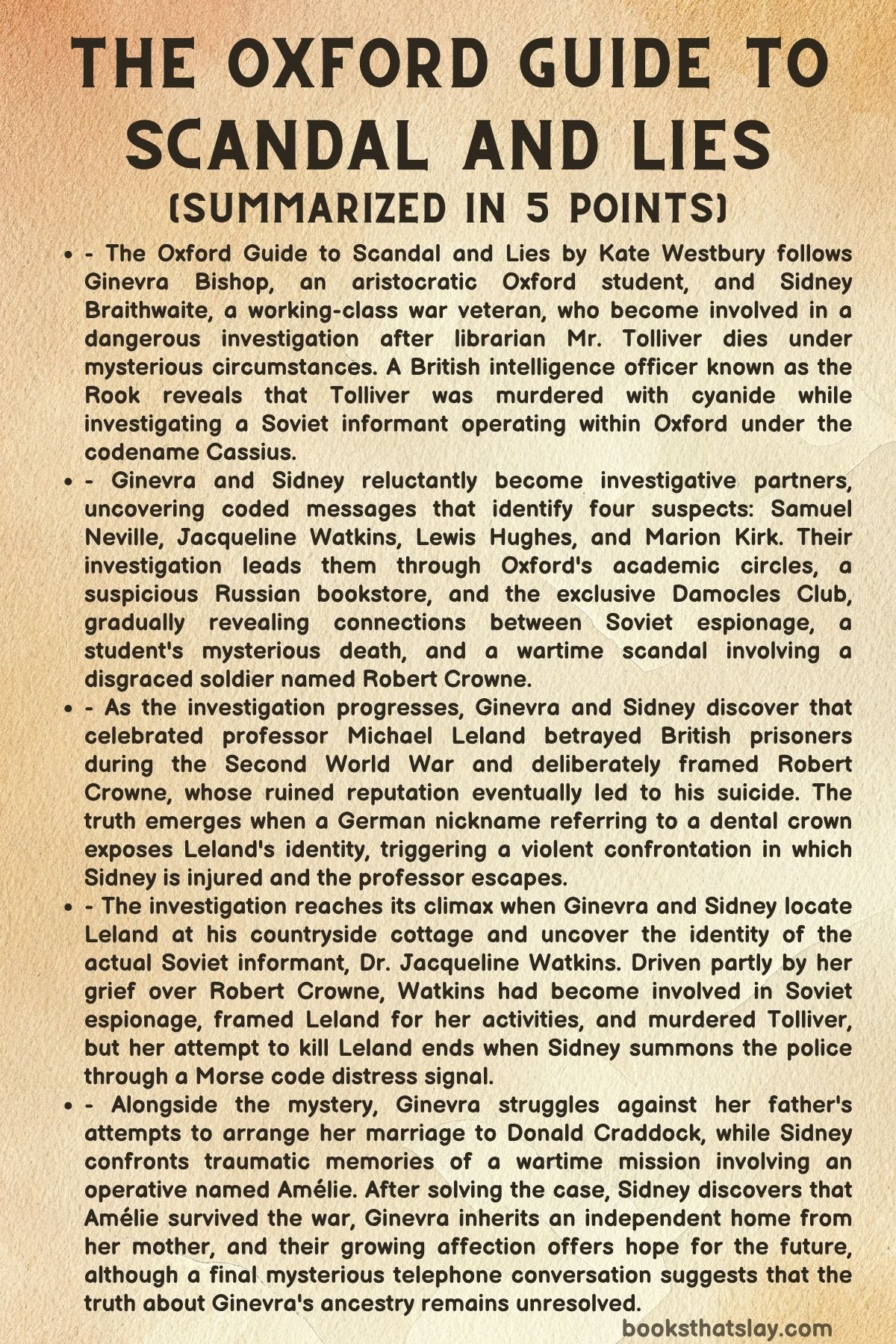
The Oxford Guide to Scandal and Lies by Kate Westbury is a historical mystery set against the academic traditions and social divisions of postwar Oxford University. The novel follows Ginevra Bishop, an aristocratic student determined to secure her independence, and Sidney Braithwaite, a working-class war veteran struggling with painful memories of the Second World War.
When a respected librarian dies under suspicious circumstances, the two students become involved in an investigation involving Soviet espionage, secret societies, and long-buried wartime betrayals. Combining mystery, romance, and historical intrigue, the story examines social inequality, personal freedom, loyalty, and the destructive consequences of deception.
Summary
In November 1950, twenty-two-year-old Ginevra Bishop is studying Modern Languages at Oxford University, where she enjoys an independence largely absent from her aristocratic upbringing. Her first encounter with Sidney Braithwaite, a Classics student and former soldier, occurs during an argument over a table in the Bodleian Library.
Their disagreement immediately establishes the differences between them, as Ginevra comes from a wealthy family while Sidney supports his education through manual work. During this encounter, Professor Michael Leland introduces himself as an acquaintance of Ginevra’s family and makes condescending remarks that embarrass her.
Ginevra subsequently speaks with Mr. Tolliver, a helpful librarian who has been assisting her research. His unexpected distress during their conversation troubles her, although he insists that nothing serious is wrong.
Several months later, Sidney encounters Tolliver while performing maintenance work at Swithun College. The librarian appears frightened of someone attending a university gathering and asks Sidney to help him remain unnoticed.
That evening, Sidney and Ginevra argue again after discussing the influential Damocles Club, an exclusive organization associated with Oxford’s privileged students. Their disagreement ends when they hear a cry and discover Tolliver suffering terrible pain on a garden bench.
Although they attempt to help him, Tolliver dies after uttering mysterious German words. The official explanation attributes his death to a heart attack, but Ginevra remains troubled by his final moments and blames herself for failing to save him.
Following the funeral, Ginevra receives a German dictionary that Tolliver had arranged for her before his death. Her grief is compounded by another unwanted marriage proposal from Donald Craddock, the wealthy son of the Duke of Allingham.
Donald reveals that Ginevra’s father has accumulated substantial debts and that marriage between their families could determine the future of Chiseldon Park, her ancestral home. Furious at the possibility of being treated as part of a financial arrangement, Ginevra becomes increasingly determined to achieve independence.
Soon afterward, an intelligence officer known as the Rook approaches Ginevra and Sidney with shocking information. Tolliver was secretly working for Britain’s Security Service and had been investigating a Soviet informant operating within Oxford under the name Cassius.
A medical examination has established that Tolliver died from cyanide poisoning rather than natural causes. The Rook believes his final German words, which Ginevra remembers as “die Krone,” may provide a clue to the murderer’s identity.
He recruits the students to investigate Grigor Olenev, a Russian bookseller suspected of facilitating communications with Soviet intelligence. Ginevra enthusiastically accepts, but Sidney is reluctant because his previous intelligence work during the war ended in tragedy.
Sidney had participated in a mission involving a French operative named Amélie, who was captured while helping him escape German soldiers. Believing that she was subsequently killed, he has carried guilt and resentment toward the Rook for years.
Despite these reservations, Sidney agrees to assist Ginevra. Their first surveillance assignment leads them to a property adjoining Olenev’s bookstore, where Ginevra discovers suspicious equipment, Communist literature, and a notebook belonging to Tolliver.
The notebook contains apparently meaningless sentences that the pair eventually decipher using a variation of the Caesar cipher. The message identifies four people associated with Oxford’s Classics community: Samuel Neville, Jacqueline Watkins, Lewis Hughes, and Marion Kirk.
Recognizing the importance of this discovery, the Rook instructs them to investigate the suspects discreetly. Ginevra concentrates on Neville and Marion, while Sidney investigates Watkins and Hughes.
Their investigations expose different aspects of Oxford society. Marion, an ambitious journalist working for the student newspaper The Blue, resents the influence of wealthy students and appears determined to expose the Damocles Club.
Samuel Neville, a respected academic and skilled chess player, becomes suspicious when Ginevra discovers that he previously traveled to Moscow and reacts nervously to questions about Soviet authorities. She also learns that he knew her late mother, Anne Aster, through Oxford’s chess club.
Meanwhile, Sidney notices Dr. Watkins visiting Olenev’s bookstore and discovers Lewis Hughes outside Tolliver’s former cottage. These observations suggest that several people on the librarian’s list may have connections to his secret activities.
Ginevra’s investigation into Marion uncovers an extensive collection of newspaper clippings concerning the Damocles Club and the death of a former Oxford student named Quintin Jones. When she and Sidney independently break into Tolliver’s cottage, they discover additional records connecting the same individuals and incidents.
The evidence increasingly suggests that Tolliver’s murder may be linked to a scandal extending back many years. Their partnership, however, remains troubled by Sidney’s insistence on caution and Ginevra’s willingness to take personal risks.
Matters become more dangerous during a reception celebrating Professor Leland’s wartime memoir. Ginevra learns about Robert Crowne, a disgraced former Oxford student accused of betraying British prisoners while held at Vosburg Castle during the Second World War.
During a speech, Neville refers to Crowne using the German expression “die Krone,” which matches Tolliver’s dying words. Before Ginevra can investigate further, masked demonstrators attack the gathering in protest against the Damocles Club.
Amid the resulting confusion, someone attempts to strangle Ginevra with her scarf. Sidney intervenes, rescues her from the attacker, and carries her to safety after discovering that she has injured her leg.
The frightening incident produces an important change in their relationship. Sidney apologizes for his harshness, acknowledges Ginevra’s investigative abilities, and agrees to treat her as an equal partner.
Ginevra also recognizes the value of Sidney’s experience and careful judgment. Their developing trust allows them to connect the murder investigation with Crowne’s disgrace and the circumstances surrounding the Damocles Club.
Further investigation reveals that Robert Crowne had been expelled from Oxford after Quintin Jones died following a drinking punishment associated with the Damocles Club. During the war, Crowne served as Neville’s orderly and was accused of passing information to German officers, an allegation that ruined his reputation and eventually contributed to his suicide.
Ginevra and Sidney search Neville’s office during a university production of Julius Caesar, in which Neville plays Cassius. They discover evidence that he intends to leave Britain for the Soviet Union, while Sidney notices Watkins secretly removing a book from the professor’s shelves.
Meanwhile, Marion is expelled from Oxford for organizing the protest against the Damocles Club. Ginevra discovers that Marion is staying with Patricia Crowne, suggesting a family connection to the disgraced soldier.
The investigation eventually leads to Foxley Hall, the Craddock family estate, where the Damocles Club is holding a centennial celebration. Ginevra attends as Donald’s companion while Sidney and undercover intelligence officers monitor the gathering for another attack.
During a private card game, Ginevra defeats Donald and discovers that he intends to sell Chiseldon Park if their proposed marriage secures it for him. This admission finally convinces her that neither Donald nor her father values her happiness as much as the family’s financial interests.
Elsewhere, Sidney encounters Marion, who reveals that Robert Crowne was her beloved uncle and insists that he was falsely accused. As the discussion turns toward Vosburg Castle, Donald remembers that the Germans actually used the expression “die Zahnkrone,” meaning a dental crown.
This distinction exposes Professor Leland, whose gold-crowned molar matches the description. When confronted, Leland panics, draws a pistol, and attempts to escape.
During the struggle, Sidney is injured by a gunshot and a blow to his head. Leland escapes, leaving the others to confront the possibility that the celebrated wartime hero was responsible for the betrayal attributed to Crowne.
Ginevra takes Sidney to Chiseldon Park to recover. There, he finally describes the wartime mission involving Amélie, and their growing emotional intimacy becomes impossible to ignore.
Ginevra’s own life changes dramatically when her father reveals that she is not his biological daughter. According to the viscount, her mother was already pregnant when they married, and he has resented the deception throughout Ginevra’s childhood.
Refusing to accept responsibility for circumstances beyond her control, Ginevra resolves to leave the estate permanently. When the Rook reports that Leland has disappeared, she remembers a nearby cottage belonging to the professor and travels there with Sidney.
They discover Leland hiding inside and manage to restrain him, only to find that Marion has also entered the property and been captured. Neville and Watkins subsequently arrive with recording equipment, intending to obtain a confession.
Under questioning, Leland admits that he was the German informant at Vosburg and deliberately framed Robert Crowne by planting evidence among his belongings. However, his confusion concerning the modern Soviet espionage operation suggests that he is not Cassius.
Sidney notices that a suspicious handwritten message connected to Leland was written by a left-handed person. Combining this clue with the earlier evidence, Ginevra identifies Jacqueline Watkins as the real Soviet informant.
Watkins confesses that she once loved Robert Crowne and was devastated by his destruction. After becoming involved in selling valuable books through Olenev, she entered Soviet intelligence work and eventually exploited Leland’s old crime to frame him for her own activities.
When Watkins threatens Leland with Ginevra’s pistol, the confrontation becomes dangerous. Fortunately, Sidney sends a Morse code distress signal that brings Hughes and the police to the cottage, resulting in Watkins’s arrest.
Watkins subsequently admits that she murdered Tolliver by poisoning his snuffbox contents and then offering him cyanide-contaminated water when the initial dose failed to kill him quickly. With this confession, the mystery surrounding the librarian’s death is finally resolved.
After the investigation, the Rook rewards both students with unexpected gifts. Sidney receives a letter revealing that Amélie survived the war and is actually an English intelligence operative named Amelia, while Ginevra receives the deed to an Oxford cottage inherited from her mother.
These discoveries give both characters a chance to construct futures beyond the tragedies and restrictions of their pasts. Yet the novel closes with a conversation between the Rook and an unidentified person who objects to Ginevra’s involvement in intelligence work.
The caller’s personal interest in her family suggests that the mystery surrounding Ginevra’s ancestry is not entirely resolved. Although Tolliver’s murder and the espionage conspiracy have been exposed, new questions remain about her origins and the powerful people determined to influence her life.
Characters
Ginevra Bishop
Ginevra Bishop is the central female protagonist of The Oxford Guide to Scandal and Lies, a twenty-two-year-old Modern Languages student whose privileged upbringing contrasts with her fierce desire for personal freedom. Intelligent, observant, socially confident, and occasionally impulsive, she refuses to accept the limited future that her aristocratic family expects her to embrace.
Her investigative abilities emerge through her linguistic knowledge, chess skills, social awareness, and willingness to challenge people who underestimate her. Although her methods can be reckless, she frequently notices connections that more experienced investigators overlook.
Ginevra’s determination is closely connected to her troubled family history. Her mother’s death left her emotionally isolated, while her father’s coldness and efforts to arrange her marriage have made her deeply suspicious of relationships built around power or financial convenience.
Her struggle to preserve Chiseldon Park initially reflects her attachment to the memory of her mother. However, when she discovers Donald intends to sell the estate and learns the truth about her parentage, she begins separating her identity from the property and the family that controlled her.
Her relationship with Sidney develops through conflict, shared danger, and increasing respect. She gradually understands that accepting assistance does not mean surrendering independence, just as trusting another person does not require sacrificing her ambitions.
By the conclusion, Ginevra has rejected an unwanted marriage and gained a home of her own. Her development reflects the transition from seeking freedom within her inherited social position to establishing independence on her own terms.
Sidney Braithwaite
Sidney Braithwaite is the principal male protagonist of The Oxford Guide to Scandal and Lies, a former soldier whose life has been deeply affected by wartime violence and personal loss. Unlike many of his wealthy Oxford classmates, he comes from a working-class background and supports his education through physically demanding employment.
Sidney’s intelligence and perseverance have allowed him to enter an academic environment where he frequently encounters class prejudice. His experiences in the Cumberland mines and military service have given him practical skills, discipline, and a strong awareness of social injustice.
His most serious internal struggle concerns Amélie, the intelligence operative he believes died while helping him escape during the war. The memories of her capture have produced recurring nightmares, guilt, emotional withdrawal, and distrust of the Rook.
Consequently, Sidney approaches intelligence work with considerable reluctance and often responds to Ginevra’s enthusiasm with excessive criticism. His protective instincts are genuine, but his fear of another tragedy sometimes prevents him from treating her as an equal.
As their relationship develops, Sidney becomes more willing to communicate and acknowledge his vulnerabilities. His confession about Amélie represents a decisive moment because he allows another person to understand the experiences he has spent years concealing.
The discovery that Amelia is alive transforms his understanding of the past, although it does not automatically erase his trauma. Sidney’s development emphasizes emotional recovery, mutual trust, and the possibility of moving forward without denying painful experiences.
Mr. Tolliver
Mr. Tolliver is the Bodleian librarian whose murder initiates the central investigation. His gentle manners, scholarly interests, and willingness to assist Ginevra conceal an extraordinary history of intelligence service.
Having worked as a codebreaker during both world wars, Tolliver possesses considerable experience in secrecy and cryptography. His investigation into Soviet espionage demonstrates that his apparently ordinary academic position provides valuable access to information and university personnel.
His increasing nervousness suggests that he understands the danger surrounding his discoveries. The coded notebook, appointment diary, and hidden evidence reveal a methodical investigator who has attempted to preserve crucial information even while fearing for his safety.
Tolliver’s final words eventually expose the connection between the present murder and the earlier betrayal at Vosburg Castle. Although he dies relatively early in the story, his research guides the protagonists toward the truth.
His character also illustrates the vulnerability of individuals who confront powerful conspiracies without sufficient protection. His death is particularly significant because Ginevra remembers him not simply as an intelligence officer but as a kind man who took a genuine interest in her education.
The Rook
The Rook is a senior intelligence officer whose recruitment of Ginevra and Sidney drives much of the investigation. Experienced, calculating, and comfortable operating through secrecy, he prioritizes the successful completion of his missions.
His relationship with Sidney is complicated by the disastrous wartime operation involving Amélie. Sidney regards the Rook’s apparently indifferent response to her capture as evidence that the officer values intelligence objectives more than the people carrying them out.
Nevertheless, the Rook recognizes Sidney’s abilities and deliberately brings him back into intelligence work. He also appreciates Ginevra’s intelligence, linguistic knowledge, and social connections, even when her unconventional methods create difficulties.
The rewards he provides at the end demonstrate that he possesses information about both students that extends beyond the immediate investigation. His decision to arrange the delivery of Amelia’s letter and Ginevra’s inherited property suggests a more complicated concern for their welfare.
The final telephone conversation also establishes that the Rook knows more about Ginevra’s family background than he has revealed. He remains morally ambiguous because his assistance is substantial, but his intentions and private loyalties are not completely transparent.
Dr. Jacqueline Watkins
Dr. Jacqueline Watkins is one of the most psychologically complicated characters in The Oxford Guide to Scandal and Lies, initially appearing as a respected Classics tutor whose academic authority conceals criminal activities. Her professional composure and intellectual sophistication make her an effective participant in a conspiracy that few people would immediately associate with her.
Watkins’s motivations are rooted partly in her love for Robert Crowne and the devastation caused by his disgrace. Her knowledge that an innocent man suffered because of other people’s dishonesty gradually becomes connected to her own willingness to manipulate evidence and destroy reputations.
Her involvement in selling valuable books introduces her to Grigor Olenev, who recruits her into Soviet espionage. What begins as criminal association develops into a dangerous betrayal of confidential information.
Watkins exploits Leland’s wartime guilt by manufacturing evidence that makes him appear responsible for the modern intelligence leak. Her plan demonstrates patience, calculation, and an intimate understanding of how existing suspicions can be manipulated.
Her murder of Tolliver exposes the most disturbing aspect of her character. Although she has personally experienced the consequences of injustice, she is willing to kill an innocent man to protect herself.
Watkins’s eventual attempt to shoot Leland reveals that her unresolved anger has become inseparable from her criminal decisions. She represents the danger of allowing legitimate grievances to develop into a justification for deception, revenge, and violence.
Professor Michael Leland
Professor Michael Leland is a celebrated Oxford academic whose public reputation rests heavily on his supposed wartime heroism. In The Oxford Guide to Scandal and Lies, he embodies the contrast between social respectability and private corruption.
Leland enjoys recognition among influential families and university officials, using his position to reinforce his prestige. His memoir presents a flattering version of his imprisonment at Vosburg Castle, allowing him to profit socially from a story built upon deception.
His treatment of Sidney also reveals a condescending attitude toward those without inherited status. This behavior reflects his belief that established authority and public admiration provide protection from criticism.
The investigation ultimately exposes Leland as the German informant who betrayed his fellow prisoners and framed Robert Crowne. His willingness to sacrifice an innocent man demonstrates a profound lack of moral responsibility.
Rather than confessing when confronted, Leland threatens the investigators with a pistol and attempts to escape. His actions establish that his concern for preserving his reputation remains stronger than any remorse for the consequences of his betrayal.
His downfall is significant because the admiration surrounding him has prevented others from questioning the official wartime narrative. Through Leland, the novel shows how prestigious institutions can protect individuals whose celebrated achievements conceal serious wrongdoing.
Marion Kirk
Marion Kirk is an ambitious student journalist whose political activism, determination, and personal grief make her a central figure in The Oxford Guide to Scandal and Lies. Initially considered a possible Soviet informant, she eventually emerges as someone seeking to expose the injustice committed against her family.
Her dissatisfaction with The Blue reflects her opposition to the privileged students who dominate Oxford’s institutions. She resents Oliver Whitby’s control over the newspaper and his unwillingness to publish material challenging established authority.
Her investigation of the Damocles Club is motivated partly by the death of Quintin Jones and the disgrace of her uncle, Robert Crowne. Having known Robert as a caring and intelligent man, she refuses to accept the accusations that ruined his life.
Marion’s decision to organize a disruptive protest demonstrates both courage and poor judgment. Her determination to confront influential individuals leads to her expulsion and exposes innocent people to considerable danger.
Nevertheless, her willingness to pursue the truth is ultimately justified when Robert’s innocence is established. She refuses to allow his reputation to be defined permanently by accusations that powerful men were unwilling to reconsider.
Her character presents activism as a complicated force that can challenge injustice while also producing harmful consequences when anger overrides caution. By the conclusion, Ginevra encourages Marion to rebuild her future through journalism and education.
Dr. Samuel Neville
Dr. Samuel Neville is a Classics tutor and accomplished chess player whose suspicious associations initially make him a leading candidate for the Soviet informant. His visit to Moscow, Russian correspondence, and apparent plans to leave Britain create an atmosphere of uncertainty around his behavior.
Neville also possesses an important connection to Ginevra’s past because he knew her mother through the university chess club. This detail becomes particularly interesting after the revelation that Ginevra’s biological father was possibly a red-haired member of the same circle, although the novel does not confirm Neville’s involvement.
His relationship with the Russian woman Liliya eventually provides a personal explanation for much of his apparent secrecy. The authorities’ interest in her family makes his situation complicated without necessarily establishing that he is an intelligence traitor.
Neville’s greatest moral failure concerns his acceptance of the evidence used to condemn Robert Crowne. His testimony was influenced by Leland’s manipulation, making him partly responsible for an innocent man’s destruction despite his lack of knowledge about the deception.
When the truth emerges, Neville’s desire to record Leland’s confession suggests that he recognizes the seriousness of his earlier mistake. He becomes a figure through whom the story examines the responsibility to reconsider beliefs when new evidence challenges established assumptions.
Donald Craddock
Donald Craddock is the aristocratic son of the Duke of Allingham and one of the novel’s clearest examples of inherited entitlement. His repeated proposals to Ginevra demonstrate a possessive attitude toward marriage and a lack of concern for her wishes.
Donald regards his social position as sufficient justification for demanding Ginevra’s attention. His hostility toward Sidney arises partly from class prejudice and partly from jealousy when he notices their developing closeness.
His association with the Damocles Club reinforces his attachment to organizations that preserve wealth and social influence. He frequently acts as though family connections should protect him from accountability.
His financial intentions become clear when he admits that he plans to sell Chiseldon Park after acquiring it through marriage. This revelation destroys any remaining possibility that Ginevra might regard their union as a means of preserving her mother’s home.
Nevertheless, Donald contributes an essential clue when he remembers the correct German nickname used at Vosburg Castle. His recollection of “die Zahnkrone” exposes the error that concealed Leland’s guilt, demonstrating that useful evidence can emerge even from an otherwise unsympathetic character.
Lewis Hughes
Lewis Hughes is an American postgraduate student whose friendly manner and academic interests initially conceal his involvement in intelligence work. His association with the Classics community makes him one of the four suspects identified through Tolliver’s coded notebook.
His movements around Tolliver’s cottage and his apparent recognition of Ginevra increase the investigators’ suspicions. His ability to remain composed during their interactions makes his actual intentions difficult to determine.
Hughes eventually reveals that he worked for American intelligence during the Second World War and has been conducting an unofficial investigation into the Soviet information leak. This disclosure transforms him from a suspicious figure into an important ally.
His assistance during the confrontation at Foxley Hall and the final operation against Leland demonstrates his practical abilities. By helping coordinate the police response, he contributes directly to preventing further violence.
Hughes also represents the international dimensions of the Cold War, showing how British and American intelligence interests intersect within an apparently ordinary university community.
Robert Crowne
Robert Crowne is a tragic figure whose reputation and death influence many of the novel’s central events despite his absence from the present-day action. Once an Oxford student associated with the Damocles Club, his academic future was damaged after Quintin Jones died during a drinking punishment.
During the Second World War, Crowne served as Neville’s orderly while imprisoned at Vosburg Castle. Leland subsequently framed him as a German informant by placing incriminating documents among his possessions.
The accusations ruined Crowne’s remaining reputation and contributed to his suicide. His suffering demonstrates the devastating effect of powerful individuals manipulating evidence to protect themselves.
Marion’s memories reveal that Robert was also a loving uncle whose kindness contrasted sharply with the public accusations against him. Watkins’s attachment to him further establishes that his downfall affected several lives.
The eventual confession does not restore Robert’s life, but it establishes the truth about his innocence. His character remains central to the novel’s examination of justice, memory, and the lasting consequences of false accusations.
The Viscount Walsingdon
The Viscount Walsingdon is Ginevra’s legal father and the controlling aristocrat responsible for much of her emotional suffering. His management of the family estate has led to serious financial difficulties, yet he expects his daughter to participate in repairing the situation through marriage.
His willingness to negotiate with the Craddock family demonstrates how thoroughly he regards marriage as a matter of property and social survival. Ginevra’s personal ambitions receive little consideration.
His behavior becomes more understandable, though not excusable, when he reveals that Anne was already pregnant before their marriage. He has carried resentment over the deception for years and directed much of that bitterness toward Ginevra.
His confession exposes the emotional damage created by family secrets and the expectation that appearances must be maintained at any cost. Rather than recognizing Ginevra as an individual, he has treated her as a reminder of his humiliation.
The viscount’s character is defined by his inability to separate his daughter’s worth from the circumstances of her birth. His cruelty ultimately encourages Ginevra to reject the authority he has exercised over her life.
Anne Aster
Anne Aster is Ginevra’s deceased mother, whose influence remains substantial throughout the novel. Her memory is closely associated with Chiseldon Park, which Ginevra initially wants to preserve because it represents their emotional connection.
Anne appears to have been an unconventional and intellectually accomplished woman. Her involvement in Oxford’s chess club and her practical lessons in subjects such as firearms suggest interests that exceeded traditional expectations of aristocratic femininity.
The revelation about Ginevra’s biological father complicates Anne’s position in the family history. Her marriage concealed a significant secret, and the viscount’s account suggests that maintaining social appearances came at considerable emotional cost.
However, Anne’s motives and the complete circumstances surrounding Ginevra’s birth remain uncertain. Her continuing influence is most clearly demonstrated through the cottage she owned, which eventually allows her daughter to establish an independent home.
Iris Finchley
Iris Finchley is one of Ginevra’s closest friends and an important source of companionship during her university years. Her involvement with The Blue places her near several developments connected to Marion Kirk and the investigation.
Iris helps Ginevra gain information about Marion’s sudden departure and the political tensions surrounding the student newspaper. Her familiarity with Oxford’s journalistic community provides opportunities that formal intelligence methods might not easily create.
Her relationship with Harold Webb also connects her to the social ambitions surrounding the Damocles Club. While she does not know the full extent of the espionage investigation, her presence at Foxley Hall increases Ginevra’s concern about protecting innocent people.
Iris also shows emotional sensitivity when she notices Ginevra’s growing closeness to Sidney. Her friendship demonstrates the importance of personal loyalty in an environment increasingly dominated by secrecy and suspicion.
Sarita DeSilva
Sarita DeSilva is another of Ginevra’s closest friends, initially appearing as a university student whose private activities become increasingly mysterious. Her unexplained absences and secretive behavior lead Ginevra to suspect that she may be involved in something dangerous.
The discovery that Sarita possesses clothing resembling the protesters’ outfits further complicates these suspicions. Her reluctance to explain her movements reflects her need to protect activities that could attract political attention.
Sarita eventually reveals that she has been helping Goan refugees and supporting efforts to end Portuguese colonial rule in Goa. Her secrecy arises from concern about political consequences and her family’s connections rather than involvement in Soviet espionage.
During the aftermath of the shooting at Foxley Hall, Sarita also assists with Sidney’s immediate medical care. Her actions demonstrate practical courage and loyalty.
Through Sarita, the novel broadens its historical setting beyond European Cold War politics. Her character introduces the experiences of people confronting colonial rule and the difficult decisions involved in political resistance.
Harold Webb
Harold Webb is Sidney’s wealthy classmate, whose desire to join the Damocles Club exposes the emotional power of elite social organizations. Despite possessing financial advantages, Harold is deeply insecure about his position among Oxford’s aristocratic students.
His repeated attempts to gain acceptance make him vulnerable to humiliation. He places considerable importance on recognition from people whose values and behavior do not necessarily deserve his admiration.
At Foxley Hall, Harold is drawn into a private gambling session where wealthy club members appear prepared to exploit his eagerness for approval. Ginevra’s intervention protects him from the situation and demonstrates her concern for Sidney’s friend.
Harold also provides emotional support to Sidney during his recovery at Chiseldon Park. His friendship illustrates that genuine loyalty can exist independently of the exclusive social status he spends much of the novel pursuing.
Grigor Olenev
Grigor Olenev is a Russian bookseller whose Oxford establishment operates as an intermediary point for Soviet intelligence activities. His apparently respectable business provides an effective setting for suspicious meetings and concealed communications.
The equipment and political materials discovered near his shop establish the importance of his location to the investigation. His association with Watkins eventually reveals how criminal dealings in valuable books can develop into international espionage.
Olenev functions primarily as a facilitator rather than the central villain. His character illustrates how ordinary commercial activities can conceal organized intelligence networks.
Oliver Whitby
Oliver Whitby is the influential editor of The Blue, whose leadership reflects the dominance of privileged students within Oxford’s institutions. His preference for socially acceptable material frustrates Marion Kirk’s ambition to expose political misconduct.
His treatment of Marion demonstrates how editorial control can limit criticism of powerful organizations. By dismissing her writing as excessively radical, he helps preserve the social order she wants to challenge.
Whitby also participates in the exclusive social activities surrounding the Damocles Club, including the private gambling session at Foxley Hall. His character represents the connection between student influence, social privilege, and the ability to control public narratives.
Amélie / Amelia
Amélie is the intelligence operative whose apparent death has shaped Sidney’s emotional life since the Second World War. During their mission, she helped him escape danger but was captured by German forces, leaving Sidney convinced that she had sacrificed her life for him.
Her presumed death becomes the source of his recurring guilt and distrust of intelligence authorities. Sidney’s inability to move beyond the incident affects his relationships and willingness to undertake dangerous assignments.
The letter discovered at the conclusion reveals that Amélie survived through a prisoner exchange and is actually an English operative named Amelia. Her survival dramatically changes Sidney’s understanding of his wartime experiences.
Although she does not return directly to his life during the main investigation, this revelation provides an opportunity for him to reconsider the guilt that has dominated his postwar existence.
Felix Braithwaite
Felix Braithwaite is Sidney’s younger brother, whose appearances offer glimpses into Sidney’s personal life beyond university and intelligence work. Their time together early in the novel establishes a familiar relationship that contrasts with Sidney’s emotionally guarded behavior elsewhere.
Felix’s presence also reinforces Sidney’s continuing connection to his family despite the psychological distance created by wartime trauma. His unexpected appearance during the university theatrical production provides a moment of awkward interruption amid the investigation.
Audrey Tuttle
Audrey Tuttle is a former acquaintance of Ginevra from finishing school who reappears as a resident of Marion Kirk’s boardinghouse. Her familiarity with Ginevra helps the investigators gain access to Marion’s private room.
Audrey provides useful information about Marion’s disappearance and later reveals that rat poison has gone missing from the house. This discovery temporarily strengthens suspicions that Marion may have murdered Tolliver.
Although Audrey plays a relatively limited role, she demonstrates how everyday social relationships can provide crucial information during an investigation.
Quintin Jones
Quintin Jones is a former Christ Church student whose death during a punishment associated with the Damocles Club becomes an important part of the historical mystery. His death contributes to Robert Crowne’s expulsion and provides another example of the organization’s troubling past.
The circumstances surrounding Quintin’s death attract Marion’s attention and connect the club’s privileged members to a history of abuse and concealed responsibility. Although the available account provides little information about his personality, his fate remains an important warning about the consequences of unchecked institutional power.
Patricia Crowne
Patricia Crowne is connected to Robert Crowne’s family and provides Marion with a place to stay in Shropshire following her expulsion from Oxford. Her association with Marion alerts Ginevra to the possibility that the journalist has a personal reason for investigating Robert’s disgrace.
The available account does not explore Patricia’s personality or motivations extensively. Her significance lies in helping connect Marion’s political activities with the older family tragedy.
Professor Dickinson
Dickinson is Sidney’s academic adviser, who notices his exhaustion and distraction as the investigation begins interfering with his university responsibilities. His concern reflects the academic pressures Sidney faces while attempting to maintain his studies and pursue dangerous intelligence work.
His warnings about Sidney’s additional involvement in Watkins’s seminar also create practical difficulties for the investigation. Although he remains outside the espionage plot, Dickinson represents the ordinary institutional responsibilities that continue alongside the extraordinary events.
Trixie
Trixie is Professor Leland’s fiancée, introduced to Ginevra during the reception celebrating his memoir. Her father’s connections to the Foreign Office establish Leland’s access to influential political and social circles.
The available material does not establish whether Trixie knows anything about Leland’s criminal past. Her role chiefly reinforces the respectable public image that allows him to conceal his wartime betrayal.
Abbott
Abbott is the family butler at Chiseldon Park, whose appearance during Ginevra and Sidney’s private conversation interrupts a moment of growing emotional intimacy. He announces the viscount’s unexpected return, setting in motion the confrontation that reveals Ginevra’s parentage.
Although his role is minor, his presence reflects the formal household environment in which Ginevra has grown up. He also serves as a reminder that the authority of her father continues to influence her life even when she attempts to act independently.
Themes
Class Privilege and Institutional Power
The unequal distribution of social power shapes nearly every aspect of Oxford society in The Oxford Guide to Scandal and Lies. The university may be associated with scholarship and intellectual achievement, but its institutions also preserve distinctions based on wealth, family background, and inherited influence.
Sidney’s experiences expose these divisions particularly clearly. Although he possesses considerable academic ability, his working-class origins and need to perform maintenance work place him at a disadvantage among students who enjoy financial security and influential family connections.
The Damocles Club represents the concentration of this privileged authority. Its selective membership practices encourage ambitious students such as Harold Webb to seek acceptance, even when doing so requires tolerating humiliation and compromising their judgment.
The circumstances surrounding Quintin Jones’s death demonstrate the potentially dangerous consequences of such organizations. When powerful individuals believe their social standing protects them from accountability, misconduct can remain concealed for years.
Professor Leland’s reputation provides another example of institutional protection. His academic achievements, aristocratic connections, and celebrated wartime experiences allow him to maintain public admiration despite having committed serious acts of betrayal.
Ginevra occupies a complicated position within this structure because her privileged background provides opportunities while simultaneously restricting her freedom. Her father’s financial arrangements reveal that inherited status can become a mechanism of control, particularly when marriage and property determine personal choices.
Marion’s political activism challenges this system directly, although her methods sometimes create additional dangers. Her treatment by university authorities illustrates how established institutions can punish those who question their practices.
Through these contrasting experiences, the novel presents social privilege as a force that influences whose testimony receives attention, whose mistakes are forgiven, and whose suffering is dismissed. Justice becomes possible only when characters question authority rather than assuming that prestige guarantees integrity.
Truth, Deception, and the Destruction of Reputation
The distinction between public appearances and concealed realities drives the central mystery. Characters repeatedly discover that respected individuals may be dishonest, while those condemned by society may have suffered because others manipulated the available evidence.
Robert Crowne’s history demonstrates the terrible consequences of false accusations. His reputation is destroyed first through association with the Damocles Club scandal and later through fabricated evidence that identifies him as a wartime traitor.
Leland’s deception becomes particularly damaging because it extends beyond a single accusation. By presenting himself as a courageous prisoner of war, he transforms another man’s suffering into a foundation for his own professional success.
Neville’s involvement demonstrates how misinformation can influence people who do not knowingly participate in a conspiracy. His willingness to accept Leland’s manufactured evidence contributes to Crowne’s downfall, revealing the importance of questioning even apparently credible testimony.
Watkins introduces another dimension to the theme because her desire to expose historical wrongdoing does not prevent her from committing serious crimes. Instead of pursuing justice through honest disclosure, she manipulates evidence, conducts espionage, and murders Tolliver to protect herself.
The mystery’s resolution depends on recognizing the significance of small discrepancies between accepted stories and observable facts. The distinction between two German expressions, the existence of a dental crown, and the handwriting on a suspicious note eventually expose decades of deception.
Ginevra’s family history reinforces the same theme in a more personal setting. The viscount’s revelation about her biological father shows how a family can preserve its public identity while concealing truths that profoundly affect its members.
The novel ultimately distinguishes truth from reputation, suggesting that social acceptance does not establish moral innocence. Recovering the truth cannot reverse every consequence of deception, but it can restore dignity to those who have been unfairly condemned.
War Trauma, Grief, and Emotional Recovery
The psychological consequences of the Second World War remain central to the characters’ experiences in The Oxford Guide to Scandal and Lies. Although the fighting has ended, the memories of imprisonment, betrayal, loss, and failed operations continue shaping the decisions of those who survived.
Sidney’s experiences demonstrate the persistent nature of wartime trauma. His nightmares, reluctance to resume intelligence work, and difficulty trusting the Rook arise from his belief that Amélie died because of a mission in which he participated.
His distress becomes particularly visible when the garden maze at Chiseldon Park triggers memories of his wartime experiences. The episode illustrates how apparently harmless surroundings can provoke painful reactions when they resemble circumstances associated with earlier danger.
Ginevra plays an important role in Sidney’s gradual emotional recovery because she encourages him to speak without demanding that he immediately overcome his suffering. Their relationship develops through a growing ability to acknowledge fear, grief, and vulnerability.
Ginevra also carries unresolved emotional pain connected to her mother’s death and her father’s rejection. Although her experiences differ from Sidney’s, their shared understanding of loss allows them to recognize the importance of compassion and emotional honesty.
Marion’s determination to defend Robert Crowne reflects another form of grief. Her devotion to her uncle keeps his memory alive, but her anger also encourages confrontational decisions that threaten her education and safety.
The revelation that Amelia survived does not erase Sidney’s wartime experiences, but it fundamentally changes the story he has told himself about his responsibility. He discovers that the tragedy around which much of his guilt developed was not what he believed it to be.
Emotional recovery is therefore presented as a continuing process rather than a sudden transformation. The characters begin to move forward when they gain reliable knowledge, accept support, and recognize that their past experiences need not determine every future choice.
Women’s Independence, Identity, and Resistance to Expectations
Ginevra’s struggle for independence exposes the restrictions imposed upon women by family expectations and inherited social traditions. Her intelligence and educational ambitions conflict with a system that considers marriage, property, and family reputation more important than her personal aspirations.
Her father’s arrangement with the Craddock family demonstrates how easily a woman’s future can become part of a financial negotiation. Ginevra’s consent is treated as less significant than the preservation of aristocratic wealth and social standing.
Donald reinforces this attitude through his possessive behavior and repeated proposals. He assumes that his position and family connections should make him an acceptable husband, regardless of Ginevra’s repeated refusals.
Her investigation provides an alternative means of defining herself. Through linguistic research, chess, observation, and practical courage, she demonstrates abilities that cannot be reduced to her family background or potential usefulness in marriage.
Marion’s experiences reveal another form of resistance against established expectations. As a woman seeking influence through journalism and political activism, she struggles against editors and university officials who prefer that criticism of powerful organizations remain limited.
Dr. Watkins provides a darker contrast because her intelligence and professional authority do not prevent her from making destructive decisions. Her character shows that independence and competence do not automatically guarantee moral responsibility.
Sarita’s secret political work introduces an additional perspective on women’s agency. Her efforts to assist Goan refugees and challenge Portuguese colonial rule demonstrate a willingness to act according to her convictions despite possible consequences for her family.
The revelation about Ginevra’s parentage becomes a decisive moment in her understanding of identity. Rather than accepting responsibility for the circumstances of her birth, she rejects her father’s judgment and chooses to establish a life beyond his control.
Her inheritance of her mother’s Oxford cottage gives this decision a practical foundation. The property represents more than financial security because it offers her a home that does not depend upon an unwanted marriage or obedience to her father’s wishes.
By the conclusion, independence is presented not as freedom from every relationship or responsibility, but as the ability to make meaningful choices. Ginevra’s growing affection for Sidney exists alongside her determination to retain control over her future, demonstrating that mutual respect and personal autonomy can strengthen rather than oppose one another.