The Exorcism of Faeries Summary, Characters and Themes
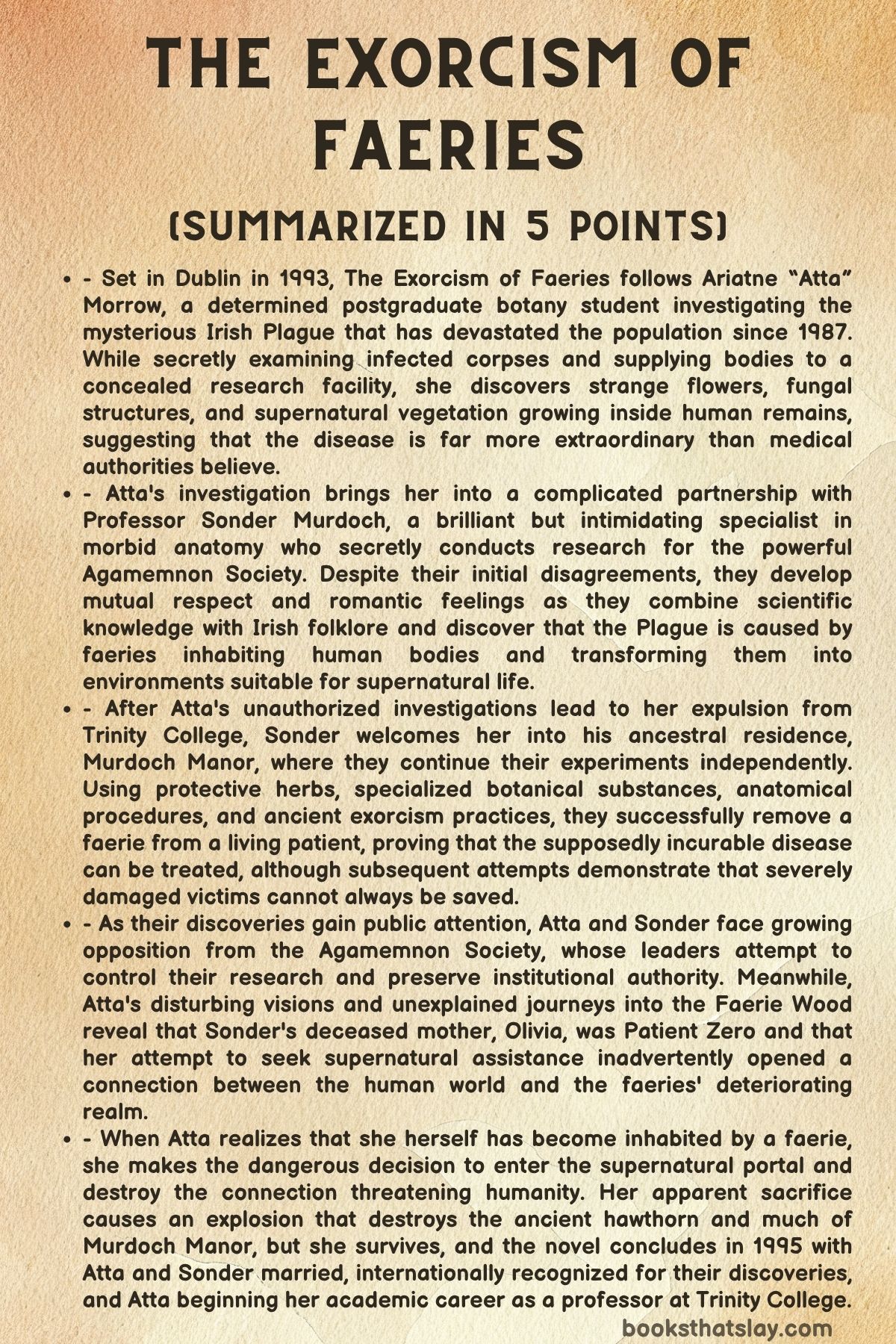
The Exorcism of Faeries by J. L. Vampa is a gothic fantasy romance that combines supernatural horror, medical investigation, Irish folklore, and academic rivalry. Set in Dublin during the early 1990s, the novel follows Ariatne Morrow, an ambitious botanist determined to uncover the truth behind a mysterious plague that has devastated Ireland.
Her investigation brings her into contact with Sonder Murdoch, a brilliant but difficult professor whose private research conceals extraordinary discoveries. As the two investigate an illness connected to ancient faeries, they discover that scientific knowledge alone may not be enough to save humanity. Their growing relationship becomes inseparable from a dangerous struggle against supernatural forces and institutional corruption. It’s the 1st book in the Morbid Realities series.
Summary
In September 1993, Dublin remains under the shadow of the Irish Plague, a mysterious illness that has killed countless people since its emergence in 1987. Ariatne Morrow, known as Atta, is a postgraduate botany student at Trinity College who also works at Gallaghers’ Morgue, where her fascination with the disease has led her into unauthorized anatomical investigations.
Desperate to finance her education and obtain research equipment, Atta secretly supplies unidentified corpses to Achilles House, a concealed medical research institution. During one examination, she discovers a strange flower growing inside an infected man’s lungs, providing her first significant evidence that the Plague involves an unidentified botanical organism.
At Achilles House, Atta repeatedly encounters an intimidating researcher whose mask bears distinctive gold stitching. Unknown to her, this individual is Professor Sonder Murdoch, a respected authority on morbid anatomy who conducts independent experiments involving infected bodies.
Sonder has discovered that the disease progresses through several stages, producing vines, flowers, fungal structures, and other unnatural growths inside human organs. Although his findings suggest that the Plague is unlike any conventional infection, the influential Agamemnon Society controls access to research materials and discourages unauthorized investigations.
Atta’s financial difficulties intensify when Trinity rejects most of her scholarship applications. Her academic advisor, Mariana O’Sullivan, offers her a teaching assistant position under Sonder, whose intimidating personality initially makes their professional relationship difficult.
Their early encounters are marked by arguments over Atta’s qualifications and Sonder’s unwillingness to recognize her practical experience. However, after she demonstrates her anatomical knowledge through an examination and an autopsy, he begins appreciating her intelligence and recognizes the value of combining botanical expertise with medical science.
Atta moves into Briseis House, where she forms friendships with Bernard Fitzgibbon, commonly called Gibbs, and a fellow student named Emmy. She remains unaware that Gibbs works for the Agamemnon Society and that Sonder is the masked researcher receiving her illegally obtained corpses.
Meanwhile, strange hallucinations begin troubling Atta whenever she touches infected botanical specimens or certain mysterious objects. She experiences visions of decaying woodland, supernatural creatures, and unfamiliar people, although she initially attributes these disturbances to migraines and exhaustion.
The death of Lauren Kennedy, a young botany student whose body develops extraordinary vegetation, strengthens Atta’s suspicions about the Plague. Sonder secretly takes her into the underground laboratories of the Agamemnon Society, where she examines Lauren’s remains and discovers fungal structures that appear to connect different parts of the infected body.
Using these observations, Atta develops a theory that spores, mushrooms, and mycelium operate together to transform their human hosts. Her findings impress Sonder, and their professional respect gradually develops into emotional attraction despite their continued disagreements and mutual secrecy.
Atta eventually recognizes that Sonder and the gold-masked researcher are the same person. Their relationship changes after an investigation at Trinity Cemetery, where Lauren’s grave lies beneath a hawthorn tree, a symbol associated with strange coins and recurring supernatural visions.
Sonder subsequently invites Atta to Murdoch Manor, his ancestral residence, where he reveals his private greenhouse containing extraordinary vegetation growing around his deceased parents’ skeletal remains. Both died from the Plague, and Sonder’s inability to save his mother, Olivia, explains much of his obsession with understanding the disease.
While examining the greenhouse, Atta discovers that a mysterious substance called the Tears of the Grieved can destroy unnatural vegetation. The discovery suggests that apparently supernatural organisms possess weaknesses that can be investigated through scientific experimentation.
As their research progresses, Atta and Sonder begin suspecting that the Plague represents an invasion rather than an ordinary disease. They theorize that faeries from a deteriorating supernatural realm are occupying human bodies and transforming them into environments capable of sustaining their existence.
Their collaboration attracts increasing attention from Finneas Lynch, a powerful member of the Agamemnon Society who fears losing institutional control over the investigation. After Atta is accused of trespassing in Trinity Cemetery, Lynch arranges her dismissal from Trinity and forces her to leave university accommodation.
Devastated by the destruction of her academic ambitions, Atta seeks refuge at Murdoch Manor. Sonder welcomes her, provides access to his scientific resources, and reassures her that the loss of her university position does not invalidate her abilities or prevent her from continuing her research.
Their next breakthrough comes when they identify Pam McDonough, a living woman suffering from the Plague. Combining protective herbs, traditional exorcism practices, anatomical knowledge, and experimental equipment, they manage to force a terrifying faerie from her body and imprison it inside a specially prepared lantern.
Pam survives, and her blood returns to its normal appearance, confirming that supernatural inhabitation can be reversed. The discovery offers hope that thousands of infected people might be saved before the disease causes irreversible damage.
However, their triumph is complicated when the captured faerie escapes by changing into a vaporous form and injures Atta. Sonder’s concern for her safety brings their suppressed romantic feelings into the open, and their growing affection develops into a committed relationship.
News of Pam’s recovery spreads rapidly, attracting public attention and placing the mysterious masked healers under scrutiny. Assisted by Gibbs, Atta and Sonder begin treating additional patients, although their experimental methods remain dangerous and cannot guarantee survival.
A later exorcism involving Mr. Byrne demonstrates these limitations when they successfully destroy the invading faerie but cannot save the severely damaged human host. Other treatments, including the rescue of Mr. Whelan, produce better outcomes while revealing the increasingly disturbing abilities of different faerie species.
Atta also experiences a mysterious connection with Olivia Murdoch and an enchanted book titled Into the Faerie Wood. Through visions and unexplained journeys, she discovers that the supernatural woodland is a real place and that an ancient hawthorn tree provides a connection between the human world and the faeries’ realm.
As their work expands, the Agamemnon Society demands control over their discoveries. Its council offers to restore Atta’s academic position if she joins the organization and surrenders her research, but she refuses because she believes that scientific knowledge capable of saving lives should not become an instrument of institutional power.
Atta and Sonder instead establish a larger independent operation with assistance from Gibbs, Emmy, and Marguerite Vasilios. Their treatments become increasingly successful, and the team develops procedures that can be taught to others, allowing them to confront the supernatural epidemic more effectively.
Yet Atta’s own condition begins deteriorating as her visions intensify and unexplained memory lapses become more frequent. She also discovers that her former roommate Imogen faces an advanced supernatural infection, prompting the group to bring her to Murdoch Manor for protection.
When Imogen begins suffering violent convulsions, Atta experiences a revelation involving Olivia Murdoch. She discovers that Olivia was Patient Zero and had approached the faeries seeking magical assistance and a better world for her son, inadvertently creating the connection responsible for the catastrophe.
Atta realizes that Sonder’s decision to bury Olivia beneath the wrong hawthorn tree prevented the supernatural portal from opening completely. She also recognizes that she herself has become inhabited and that her connection to the faeries may offer the only opportunity to close the passage permanently.
Determined to protect Sonder and everyone threatened by the invasion, Atta enters the Faerie Wood carrying the enchanted book and a vial of embalming fluid. After activating the doorway, she consumes the dangerous substance while crossing the portal, hoping to destroy the faerie inside her and sever the connection between the worlds.
The resulting explosion destroys the ancient hawthorn and much of Murdoch Manor. Sonder discovers Atta apparently lifeless beneath the wreckage and believes that she has sacrificed herself, but she unexpectedly regains consciousness and reveals that the portal has been permanently closed.
Despite the destruction, Gibbs, Emmy, and Imogen also survive, allowing the survivors to celebrate the end of the supernatural threat. By September 1995, Atta and Sonder are married, their discoveries have received international recognition, and Trinity has invited Atta to return as a professor.
The novel concludes with Atta beginning her first lecture as Professor Morrow-Murdoch, teaching a course titled The History of the Fae Plague. Her transformation from a financially struggling student into a celebrated scholar completes a journey defined by intellectual courage, scientific discovery, personal sacrifice, and love.
Characters
Ariatne “Atta” Morrow
Ariatne Morrow, commonly known as Atta, is the central protagonist of The Exorcism of Faeries, representing intellectual determination, independence, and the willingness to challenge accepted explanations. Her ambition to understand the Irish Plague emerges from a genuine fascination with biological mysteries, but her determination also reflects her struggle to reclaim an academic future interrupted by family responsibilities and financial hardship.
Atta possesses an unusual combination of botanical knowledge and practical anatomical experience acquired through her family’s mortuary business. This background allows her to recognize connections between the Plague’s physical symptoms and supernatural vegetation that established medical researchers have overlooked.
Her independence frequently creates conflict with authority figures, particularly Sonder Murdoch and Finneas Lynch. She refuses to accept intellectual dismissal simply because she is a student, demonstrating that her commitment to scientific discovery matters more than maintaining the approval of powerful academics.
Her character also reveals a compassionate understanding of death that contrasts with the emotional detachment of conventional anatomical research. While examining corpses, she frequently considers the people behind the remains, recognizing that every deceased individual possessed relationships, experiences, and personal struggles.
Atta’s growing connection with the Faerie Wood becomes one of her most significant challenges because it threatens both her physical safety and her confidence in her own perceptions. Her hallucinations, unexplained injuries, and memory lapses gradually force her to confront the possibility that she is personally connected to the supernatural invasion.
Her relationship with Sonder provides emotional support without diminishing her intellectual independence. Their partnership develops through disagreement, mutual recognition, and shared determination, allowing her to experience affection while retaining control over her ambitions.
Her ultimate decision to enter the supernatural portal demonstrates extraordinary courage because she knowingly risks her life to protect humanity. By the conclusion, Atta has transformed from a financially insecure student into an internationally recognized scholar whose achievements challenge traditional distinctions between science and folklore.
Professor Sonder Murdoch
Sonder Murdoch is the male protagonist and one of the most psychologically complicated characters in The Exorcism of Faeries. A brilliant professor of morbid anatomy, he initially appears arrogant, emotionally distant, and intolerant of anyone who fails to meet his demanding intellectual standards.
His difficult personality conceals profound grief originating from the deaths of his parents during the Irish Plague. The loss of his mother, Olivia, particularly damages his confidence in his medical abilities, contributing to his rejection of the professional title of doctor.
Sonder’s scientific dedication gradually becomes inseparable from his desire to understand the disease responsible for destroying his family. By preserving his parents’ remains inside the greenhouse at Murdoch Manor, he reveals an inability to separate personal grief from scientific investigation.
His association with the Agamemnon Society introduces another aspect of his character: his resistance to institutional restrictions. Although he operates within the Society’s research structure, he increasingly recognizes that its leaders value secrecy, influence, and professional authority over unrestricted scientific progress.
His relationship with Atta challenges his emotional isolation and intellectual arrogance. Initially dismissive of her qualifications, he comes to recognize her extraordinary intelligence and eventually treats her as a scientific equal whose expertise complements his own.
Sonder’s protective instincts sometimes become excessive, particularly when Atta exposes herself to dangerous supernatural forces. Nevertheless, his development involves accepting that love cannot depend upon controlling another person’s decisions.
His transformation becomes especially apparent when he welcomes Atta into his home after her expulsion and openly defends her against the Society. By the conclusion, he has become more emotionally expressive, willing to share his scientific work, and capable of building a life beyond the grief that once defined his existence.
Bernard “Gibbs” Fitzgibbon
Bernard Fitzgibbon, known as Gibbs, serves as an essential supporting character in The Exorcism of Faeries, contributing humor, loyalty, and practical intelligence to the increasingly dangerous investigation. Initially introduced as a friendly postgraduate student at Briseis House, he also secretly works within the Agamemnon Society.
His involvement with Achilles House creates a complicated relationship with both Atta and Sonder. Although he initially conceals his institutional connections, his actions reveal that his loyalty is directed more toward protecting individuals than maintaining the Society’s authority.
Gibbs frequently challenges Sonder’s intimidating personality through sarcasm and casual observations. Their relationship gradually resembles that of a difficult mentor and a younger colleague who has become confident enough to question his superior.
His organizational abilities become increasingly valuable as reports of successful exorcisms generate public attention and requests for treatment. He manages correspondence, coordinates appointments, assists with research, and eventually learns techniques for confronting supernatural creatures.
Gibbs also recognizes the developing attraction between Atta and Sonder before they openly acknowledge their feelings. His playful comments provide moments of relief while demonstrating his awareness of the emotional changes occurring within the group.
His development illustrates the importance of cooperation in confronting a crisis that no single scientist can resolve. Although he does not possess the same specialized expertise as the protagonists, his reliability and willingness to learn make him indispensable.
Emmy
Emmy provides Atta with friendship, encouragement, and emotional stability during periods of considerable uncertainty. Her welcoming personality contrasts with the hostility and academic competitiveness Atta frequently encounters at Trinity College.
Their relationship begins at Briseis House, where Emmy helps Atta adjust to her new accommodation and professional responsibilities. She also becomes someone Atta can approach when conflicts with Sonder leave her frustrated or fearful about her academic future.
Emmy’s friendship is especially significant after Atta loses her teaching assistant position. By helping her pack and offering emotional reassurance, she demonstrates loyalty that extends beyond their shared university environment.
When she eventually learns the truth about the Fae Plague, her initial disbelief reflects the difficulty ordinary people face when confronted with evidence that contradicts their understanding of reality. Nevertheless, she adapts quickly and becomes an active participant in the expanded exorcism operation.
Her successful participation in capturing a supernatural creature proves that specialized methods can be taught to individuals who are willing to confront unfamiliar dangers. Emmy represents the importance of friendship, emotional resilience, and collective responsibility during extraordinary circumstances.
Imogen
Imogen is Atta’s former roommate, whose carefree attitude initially creates tension between the two women. She frequently prioritizes parties and social activities while dismissing Atta’s warnings about the mysterious disease threatening Dublin.
Her personality contrasts sharply with Atta’s cautious, research-oriented approach to life. However, her behavior also reflects the understandable desire of ordinary young people to preserve some normality during a prolonged public health disaster.
Imogen becomes more important when Atta receives a supernatural vision suggesting that she is approaching an advanced stage of faerie inhabitation. Her refusal to accept the danger creates difficulties for the researchers attempting to protect her.
Her resistance reveals the psychological challenges of confronting a threat that cannot easily be understood through conventional reasoning. Even when surrounded by evidence, she struggles to relinquish personal freedom and accept the restrictions imposed for her safety.
Gradually, Imogen becomes more cooperative and begins helping organize scientific materials at Murdoch Manor. Her survival after the destruction of the supernatural portal reinforces the significance of Atta’s determination to protect people regardless of their previous disagreements.
Dr. Finneas Lynch
Finneas Lynch functions as one of the principal human antagonists of The Exorcism of Faeries, representing institutional secrecy, authoritarian control, and the misuse of professional influence. His position within the Agamemnon Society allows him to supervise scientific activities while restricting independent investigations that might threaten the organization’s authority.
His conflicts with Sonder reveal an individual more concerned with maintaining institutional control than encouraging unrestricted scientific cooperation. Although the Society possesses extensive resources, Lynch’s approach repeatedly obstructs researchers attempting to understand the disease.
His treatment of Atta becomes particularly severe after he discovers her unauthorized presence in Trinity Cemetery. Rather than recognizing the scientific importance of her work, he uses disciplinary regulations to destroy her academic position and remove her from university accommodation.
Lynch also attempts to intimidate Sonder through threats involving his research and personal relationship with Atta. These actions expose his willingness to exploit professional regulations for personal and institutional advantage.
His character demonstrates how scientific organizations can become obstacles to discovery when protecting authority becomes more important than investigating the truth. Through Lynch, the novel presents the danger of confusing institutional prestige with genuine intellectual responsibility.
Professor Marguerite Vasilios
Marguerite Vasilios is an influential academic whose involvement with the Agamemnon Society places her between institutional authority and independent scientific investigation. She possesses considerable knowledge of the Society’s internal politics and understands the consequences of challenging its leadership.
Her previous romantic relationship with Sonder introduces emotional tension after Atta becomes increasingly involved in his life. However, Marguerite’s significance extends beyond this personal connection because she also acts as an important source of information and assistance.
She recognizes that Sonder’s successful exorcisms threaten the Society’s control over scientific discoveries. Her warnings reflect an understanding of how political interests influence decisions within supposedly objective research institutions.
Although she initially approaches the situation cautiously, she eventually becomes involved in the expanded operation against the Fae Plague. Her participation demonstrates the possibility of using institutional experience to support independent research rather than obstruct it.
Marguerite represents a more complicated response to authority than the outright resistance shown by Atta and Sonder. She understands the practical dangers of opposing powerful organizations but gradually recognizes that protecting human lives requires greater cooperation and flexibility.
Olivia Murdoch
Olivia Murdoch is one of the most influential figures in The Exorcism of Faeries, despite having died before the main events of the story. Her relationship with the supernatural world ultimately provides the explanation for the Irish Plague and its devastating consequences.
As Sonder’s mother, Olivia occupies an important emotional position in his life. Her death shapes his professional ambitions, his emotional isolation, and his determination to discover why conventional medicine could not save her.
Initially, Olivia appears primarily through Sonder’s memories and the extraordinary botanical growth surrounding her remains. Her connection to the mysterious book and the Faerie Wood gradually suggests that her involvement with the supernatural realm began long before the disease became widely recognized.
The revelation that Olivia was Patient Zero fundamentally changes the understanding of the catastrophe. Her decision to seek supernatural assistance originated in maternal concern and a desire to provide a better future for her son.
However, her actions created an opening through which dangerous faeries could begin entering human bodies. This outcome demonstrates how understandable emotional desires can produce devastating consequences when individuals underestimate the intentions of forces they do not comprehend.
Olivia’s character is therefore neither a conventional villain nor a purely innocent victim. She represents the tragic consequences of desperate hope, misplaced trust, and the human temptation to accept extraordinary promises without understanding their cost.
Mariana O’Sullivan
Mariana O’Sullivan serves as an important academic advisor and mediator throughout Atta’s difficult relationship with Trinity College. Her initial intervention provides Atta with an opportunity to preserve her postgraduate education despite the loss of scholarships and financial assistance.
By arranging the teaching assistant position under Sonder, Mariana indirectly creates the partnership that eventually leads to the discovery of a successful treatment for the Plague. Her ability to recognize Atta’s potential contrasts with the university’s restrictive approach to academic qualifications.
Mariana also understands Sonder’s difficult temperament and recognizes that his intellectual strengths can make professional relationships challenging. Her interactions with him demonstrate considerable patience and an ability to approach institutional conflicts pragmatically.
Later, when Sonder confronts the Agamemnon Council over Atta’s treatment, Mariana encourages him to respect Atta’s independence. She recognizes that reinstatement should remain Atta’s decision rather than become another situation in which powerful individuals determine her future.
Her character represents the constructive possibilities of academic authority when it is exercised through fairness, encouragement, and respect for individual choice.
Domhnall
Domhnall is one of Atta’s fellow residents at Briseis House and initially appears as part of the welcoming social community surrounding her new university life. His involvement in gatherings with Emmy and Gibbs helps establish the sense of friendship and belonging that Atta had previously lacked.
However, his character becomes more troubling when his behavior toward Atta turns threatening outside a pub. The confrontation reveals that familiar social environments can contain dangers unrelated to the supernatural crisis.
Sonder’s intervention prevents the situation from escalating and demonstrates his increasing concern for Atta’s safety. The incident also contributes to Atta’s discomfort about returning to Briseis House.
Domhnall’s role highlights the distinction between outward friendliness and genuine respect for personal boundaries. His behavior provides a smaller but meaningful example of the vulnerability Atta experiences while attempting to establish independence.
Provost Nial Rochford
Nial Rochford is an influential figure within Trinity College and the Agamemnon Society whose authority shapes the institutional response to the Fae Plague. His position allows him to influence the distribution of resources, the treatment of researchers, and the conditions attached to official recognition.
He becomes particularly significant when the Society confronts Sonder over his independent experiments. Rather than simply acknowledging the extraordinary achievements of Atta and Sonder, Rochford proposes a compromise designed to bring their discoveries under institutional supervision.
His offer to restore Atta’s academic position depends upon her joining the Society and surrendering control over her research. The proposal exposes the conflict between recognizing individual accomplishments and maintaining organizational authority.
Rochford represents a calculated form of institutional power that operates through negotiation rather than open hostility alone. His actions demonstrate how professional advancement can become conditional upon obedience to powerful organizations.
Nolan Kelleher
Nolan Kelleher is a fellow academic whose rivalry with Sonder exposes the competitive environment surrounding the Agamemnon Society. His resentment originates partly from the rejection of his own research proposal while Sonder receives institutional support.
Kelleher’s interactions with Sonder reveal how professional jealousy can influence scientific relationships. Rather than concentrating exclusively on the urgency of the Plague, he becomes involved in disputes concerning status, recognition, and the distribution of institutional resources.
His warnings about Rochford’s dissatisfaction also establish the pressure placed upon researchers who fail to deliver results according to official expectations. Through Kelleher, the novel illustrates how academic ambition can become entangled with resentment and political maneuvering.
Lauren Kennedy
Lauren Kennedy is a young botany student whose death becomes an important turning point in the investigation of the Plague. The extraordinary vegetation associated with her remains provides evidence that the disease involves processes far beyond conventional infection.
Her advanced condition allows Atta and Sonder to investigate Stage Four inhabitation and collect fungal structures that contribute to their understanding of the disease. Her body also becomes central to their unauthorized investigations in the underground laboratories and Trinity Cemetery.
Although Lauren has little opportunity to develop as an active character, her death represents the human cost of the epidemic. Her experience also demonstrates the ethical importance of examining victims as individuals rather than merely treating their bodies as research specimens.
Pam McDonough
Pam McDonough represents the first major demonstration that the Fae Plague can be treated successfully in a living human being. Her condition gives Atta and Sonder an opportunity to test their developing theories through an experimental exorcism.
Her difficult family circumstances, particularly her strained relationship with her son, Lisle, introduce questions about whether emotional experiences influence the selection of human hosts. Atta’s supernatural visions during the treatment provide additional insight into Pam’s personal history.
The successful removal of the faerie from Pam’s body transforms the investigation from an examination of mysterious deaths into a practical effort to save lives. Her survival becomes a symbol of hope for an increasingly frightened population.
Pam’s recovery also creates unexpected consequences when public reports of the treatment attract attention to the unidentified researchers. Her character demonstrates that a single successful medical intervention can change the direction of a much larger public crisis.
Lisle McDonough
Lisle is Pam McDonough’s son, whose difficult relationship with his mother complicates the circumstances surrounding her treatment. His bitterness and willingness to accept payment for granting access to Pam reveal emotional distance and unresolved family conflict.
After his mother survives, Lisle becomes an important source of information for journalists investigating the mysterious masked healers. His public account contributes to the growing attention surrounding Atta and Sonder’s work.
His character illustrates the complicated relationship between private family difficulties and public events. Although his role is limited, his actions help transform an isolated medical breakthrough into a widely discussed discovery.
Mr. Byrne and Mrs. Byrne
Mr. Byrne is an infected patient whose deteriorating condition demonstrates the limitations of the experimental treatment developed by Atta and Sonder. Although they manage to destroy the faerie inhabiting his body, the physical damage has progressed too far for him to survive.
His death profoundly affects Atta, who struggles with guilt and questions whether she could have prevented the outcome through faster intervention. The experience forces her to recognize that understanding the supernatural infection does not guarantee the recovery of every patient.
Mrs. Byrne represents the families devastated by the disease and the uncertainty surrounding attempts to cure it. Her desperate hope and eventual bereavement reinforce the emotional responsibilities accompanying scientific experimentation.
Together, the characters remind readers that medical progress involves individual suffering and that unsuccessful treatments carry consequences beyond the laboratory.
Mr. Whelan
Mr. Whelan is another infected patient whose condition reveals the extraordinary dangers posed by advanced faerie inhabitation. The presence of supernatural hornets within his eyes demonstrates that the creatures can manipulate other organisms and cause extensive physical damage.
His treatment forces Atta and Sonder to adapt their methods to the specific abilities of the invading faerie. Although they successfully capture the creature and save his life, Mr. Whelan permanently loses his eyes.
The outcome illustrates the difference between defeating a supernatural invader and completely restoring the person it has harmed. His relationship with his younger brother also emphasizes the importance of family connections when the researchers confront suffering and irreversible injury.
Siobhan and Seamus Gallagher
Siobhan and Seamus Gallagher operate the mortuary where Atta works while pursuing her academic ambitions. Their establishment provides the practical environment in which she encounters numerous victims of the Irish Plague and develops her understanding of its unusual physical characteristics.
Although they remain unaware of her unauthorized experiments and corpse deliveries, their business becomes essential to the early stages of her investigation. The contrast between their legitimate mortuary operations and Atta’s concealed activities illustrates the questionable decisions she makes in pursuit of scientific knowledge.
Siobhan’s growing anxiety about the disease also reflects the fear spreading through ordinary communities. The Gallaghers represent individuals whose professional lives become increasingly difficult as an unexplained public health disaster continues.
Tom Walsh
Tom Walsh is a student in Sonder’s morbid anatomy classes who also works at Achilles House. His repeated willingness to answer difficult academic questions demonstrates familiarity with the subject and distinguishes him from less engaged students.
His presence establishes a connection between Sonder’s university responsibilities and the concealed research activities taking place outside ordinary academic supervision. Although Tom remains a minor figure, he contributes to the portrayal of Trinity as an institution where education, professional ambition, and secret scientific work frequently overlap.
Themes
The Conflict and Cooperation Between Science and Supernatural Belief
Scientific investigation and traditional folklore initially appear to offer incompatible explanations for the Irish Plague. Medical authorities concentrate on biological symptoms, while ancient Irish traditions suggest that supernatural beings may influence illness, vegetation, and human behavior.
In The Exorcism of Faeries, this apparent contradiction gradually disappears as Atta recognizes that established scientific methods can investigate phenomena traditionally dismissed as superstition. Her discovery of flowers, spores, and fungal networks inside infected bodies provides tangible evidence of extraordinary processes that conventional medicine cannot adequately explain.
Her botanical knowledge becomes particularly valuable because the faeries use vegetation as a means of transforming their human hosts. By studying the structure and behavior of these organisms, she identifies biological patterns that establish connections between physical infection and supernatural inhabitation.
Traditional protective practices also become important when Atta discovers that certain herbs, smoke, salt, and symbolic objects can weaken or restrain faeries. Their effectiveness does not eliminate the need for scientific investigation; instead, it encourages controlled experimentation to identify which substances produce reliable results.
Sonder initially approaches the disease through anatomy, pathology, and practical medical observation. His willingness to consider Atta’s folkloric knowledge marks an important intellectual change because he begins recognizing that scientific confidence can become restrictive when researchers dismiss unfamiliar possibilities without examining them.
The resulting exorcism procedures combine empirical observations with traditional protective practices. This combination demonstrates that apparently contradictory systems of knowledge may contribute valuable insights when investigators remain open to evidence.
The novel ultimately presents intellectual flexibility as essential to meaningful discovery. Science becomes most effective not when it automatically rejects supernatural explanations, but when it develops methods capable of examining extraordinary claims and establishing which ones accurately describe reality.
Institutional Power, Academic Independence, and the Control of Knowledge
Trinity College and the Agamemnon Society represent organizations possessing the resources necessary to investigate a devastating public health crisis. However, their control over scientific information frequently becomes an obstacle to the individuals most capable of discovering an effective treatment.
Atta’s early difficulties demonstrate how academic institutions can exclude talented individuals through rigid requirements and financial restrictions. Despite her excellent undergraduate performance and extensive anatomical experience, her interrupted educational history prevents her from receiving the funding necessary to pursue postgraduate research.
Her dependence on a teaching assistant position reveals the vulnerability of researchers who lack wealth or institutional influence. Although she possesses exceptional intellectual abilities, her continued education depends upon decisions made by administrators who do not fully appreciate her qualifications.
The Agamemnon Society provides an even more troubling example of institutional authority. Its leaders supervise important investigations but increasingly prioritize secrecy, political influence, and organizational prestige over the unrestricted exchange of potentially lifesaving information.
Finneas Lynch’s decision to dismiss Atta exposes how disciplinary regulations can become instruments of retaliation. Her unauthorized research threatens the Society’s control, and her removal from Trinity demonstrates the consequences faced by individuals who challenge established power.
The Council’s later offer to restore her academic position introduces another form of coercion. By making reinstatement conditional upon joining the Society and surrendering her discoveries, its leaders attempt to transform recognition into a mechanism for controlling independent research.
Atta’s refusal demonstrates that intellectual independence can possess greater value than institutional approval. She understands that scientific discoveries intended to save human lives should not be restricted merely to preserve organizational authority.
The conclusion reinforces this position when Trinity eventually recognizes her achievements and invites her to return as a professor. Her success demonstrates that intellectual legitimacy ultimately depends upon the quality and significance of scientific work rather than the approval of powerful institutions.
Love, Grief, and the Meaning of Sacrifice
Grief influences some of the most consequential decisions made by the characters, transforming personal suffering into actions with effects far beyond individual relationships. Sonder’s determination to understand the Plague originates from his inability to save his parents, particularly his mother, whose death damages his confidence in medicine.
His decision to preserve their remains inside the greenhouse reveals the extent to which unresolved grief controls his life. Rather than accepting their deaths, he continues searching for explanations through anatomical research, turning his ancestral home into a physical expression of mourning.
Olivia Murdoch demonstrates another aspect of love when she seeks supernatural assistance to create a better future for her son. Her intentions originate in maternal devotion, yet her failure to understand the faeries’ motives produces consequences that threaten humanity.
The contrast between Olivia and Atta becomes increasingly meaningful as the supernatural mystery develops. Both women make dangerous decisions motivated by love, but Olivia attempts to obtain extraordinary power, while Atta ultimately chooses to relinquish her own safety to prevent further destruction.
Atta and Sonder’s relationship also challenges their existing understandings of emotional attachment. Sonder has spent years protecting himself through intellectual arrogance and isolation, while Atta has concentrated so intensely on her academic ambitions that personal relationships often receive less attention.
Their partnership allows them to recognize that affection need not undermine scientific achievement. Instead, mutual respect and emotional support strengthen their determination to confront dangers that would be overwhelming individually.
Atta’s decision to enter the supernatural portal becomes the clearest expression of sacrifice because she accepts the possibility of dying to protect Sonder and others. Her willingness to act despite her fear demonstrates love as an active moral responsibility rather than merely a source of personal happiness.
The conclusion allows both protagonists to move beyond the suffering that previously shaped their identities. Their marriage and professional achievements represent a future in which love supports individual growth without requiring either person to abandon personal ambitions.
Bodily Autonomy, Ecological Destruction, and the Fear of Invasion
The transformation of human bodies into supernatural environments introduces disturbing questions about ownership, identity, and the vulnerability of physical existence. The faeries do not simply infect their victims; they use human bodies as biological foundations for the creation of a habitat capable of sustaining their species.
In The Exorcism of Faeries, this process becomes increasingly disturbing as botanical growth spreads through vital organs and eventually reshapes entire bodies. Flowers emerging from lungs, vines surrounding bones, and fungal networks extending through tissue illustrate the destruction of individual identity through involuntary transformation.
The victims lose control over physical processes that ordinarily distinguish their bodies as their own. Their suffering becomes particularly frightening because the invaders appear capable of manipulating perception, memory, and consciousness alongside anatomical structures.
Atta’s supernatural experiences extend this concern beyond physical possession. Her hallucinations, unexplained journeys, and increasing memory lapses gradually threaten her ability to distinguish personal decisions from the influence of another consciousness.
Her eventual discovery that she has become inhabited forces her to confront the same violation experienced by the patients she has spent months attempting to save. The revelation gives personal urgency to her decision to eliminate the connection between humanity and the supernatural realm.
The faeries’ ecological motivations complicate their role as antagonists. Their own world appears to be deteriorating, and their invasion may represent an attempt to create a replacement environment before their original habitat becomes uninhabitable.
However, the desire for survival does not justify their destruction of unwilling human hosts. The creatures’ transformation of people into resources demonstrates the ethical danger of treating another form of life as expendable material.
The novel also suggests that environmental collapse can generate conflicts between species competing for survival. The deteriorating Faerie Wood and the transformation of human bodies create a disturbing relationship between ecological desperation and exploitation.
By closing the supernatural portal, Atta protects humanity from becoming the foundation of another species’ survival. Her decision reinforces the principle that preserving life cannot justify the violation of bodily autonomy, personal identity, and the fundamental right of individuals to control their own existence.