Hide and Seek Summary, Characters and Themes
Hide and Seek by Sheridan Anne is a dark romantic suspense novel built around forensic pathology, forbidden attraction, psychological instability, and the terrifying uncertainty of whether danger is real or imagined. Harper-Rayn Madden is a confident young doctor whose orderly night-shift life begins collapsing after she believes a masked stalker has turned murder into a personal game.
The story combines Harper’s growing relationship with SWAT officer Knight Slater with a mystery that repeatedly challenges her perception of reality. What begins as a stalking story gradually becomes an examination of trust, fear, desire, mental illness, and vulnerability before ending with a final reversal that changes the meaning of Harper’s entire ordeal.
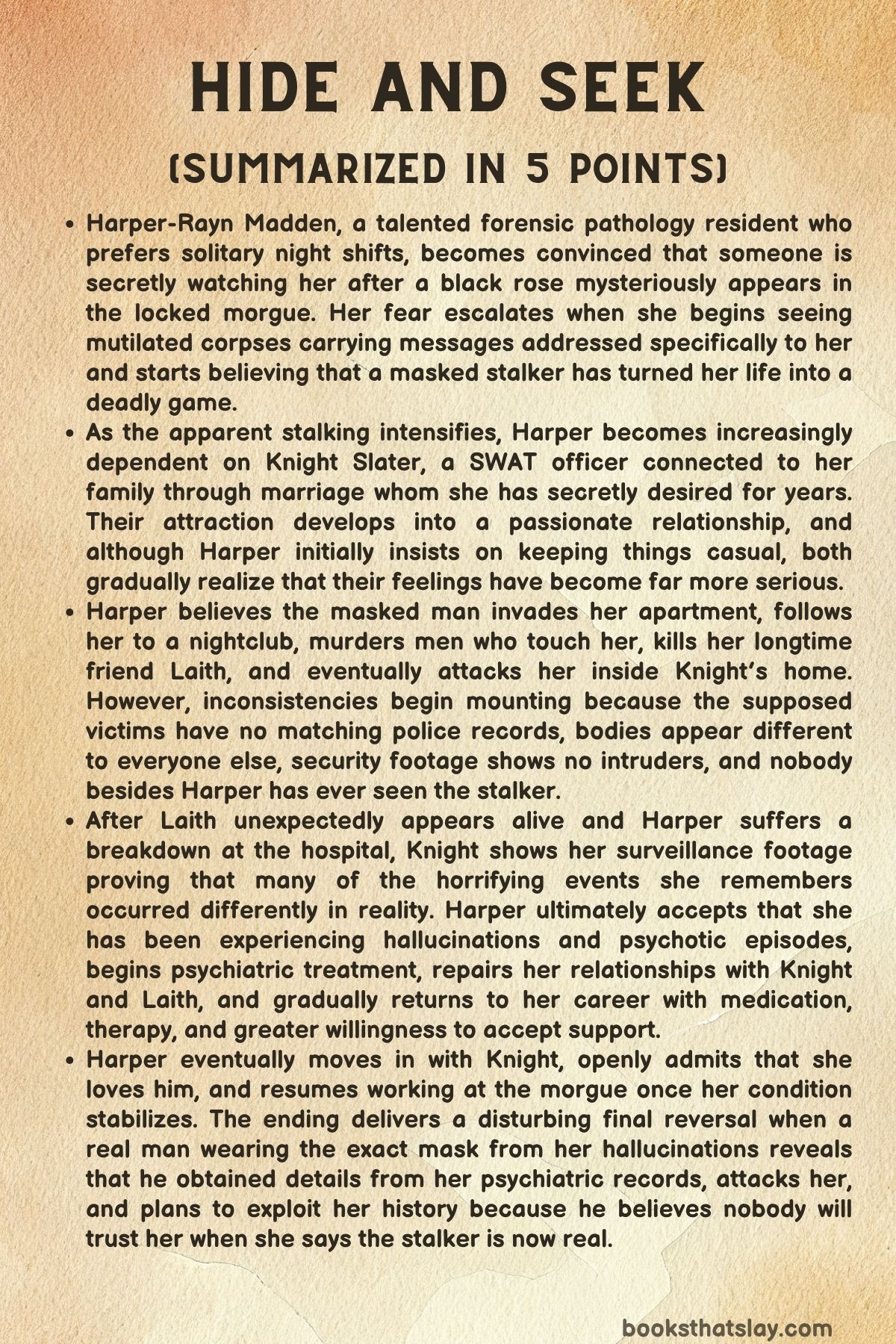
Summary
Harper-Rayn Madden is a twenty-eight-year-old forensic pathology resident at Blackstone Private Hospital who prefers the quiet isolation of night shifts. She is ambitious, independent, and capable, although her mother Mae constantly treats her career as inferior to the prestigious medical future she imagined for her daughter.
Harper’s personal life is equally unconventional. For three years she has maintained a casual relationship with criminal lawyer Laith Mitchell, valuing companionship and physical intimacy without commitment, while her closest friend Izzy provides the emotional loyalty Harper rarely receives from her family.
One night in the morgue, Harper suddenly becomes convinced that someone is watching her. She searches the locked room and finds nobody, but after briefly leaving she returns to discover a single black rose sitting on an autopsy table, proving to her that an intruder must somehow have entered.
Frightened, Harper leaves the hospital and avoids her car when she notices its interior lights glowing. She does not initially tell anyone the full story, partly because she does not want to appear irrational and partly because she refuses to allow fear to interfere with the job she loves.
Soon afterward Harper attends an anniversary dinner for Mae and her wealthy husband, Elias Slater. There she reconnects with her older brother Jonah and encounters Elias’s younger brother Knight, a SWAT officer Harper has secretly desired for years despite the awkward fact that their family connection makes the attraction socially complicated.
When Mae publicly criticizes Harper’s career, Harper finally explodes and leaves. Knight follows, comforts her, validates her anger toward Mae, and becomes concerned when Harper admits that someone entered the morgue and left the black rose.
Knight takes the threat seriously, gives Harper his number, activates location sharing, and makes her promise to contact him whenever she feels unsafe. His protective behavior strengthens the attraction between them, and Harper begins seeing him not simply as a forbidden fantasy but as someone dependable enough to trust.
Back at work, another corpse arrives for examination. Harper discovers extreme postmortem mutilation, words apparently carved into the body, her own name written across the victim’s fingers, and another black rose hidden inside the corpse, convincing her that the killer is deliberately communicating with her.
The messages transform the stalking into a violent game. Harper goes to Knight’s house, where he promises to investigate, and the emotional closeness between them quickly intensifies the attraction both have been trying to suppress.
Their relationship crosses increasingly intimate boundaries until Harper and Knight finally begin sleeping together. Harper insists that she does not want commitment or exclusivity, while Knight accepts her rules even though his private thoughts reveal that he already wants far more from her than a casual arrangement.
Meanwhile, the stalker’s behavior appears to escalate. Harper believes someone deliberately traps her inside the morgue refrigeration unit, though surveillance later shows that janitor Vincent accidentally caused the incident while Harper was hiding from him.
That explanation resolves one frightening event but leaves the larger mystery untouched. Detective Gray denies delivering the mutilated corpse Harper remembers examining, official records contain no matching murder, and the body itself has apparently disappeared.
Harper’s terror deepens when she finds another black rose in her bedroom and encounters a masked man who calls her “kitten.” He establishes a hide-and-seek game based on obedience, possession, and fear, while Harper becomes disturbed by the way danger, control, and attraction begin becoming confused inside her own reactions.
Instead of immediately revealing everything to Knight, Harper repeatedly hides important encounters from him. Her need to preserve independence becomes increasingly dangerous because she starts believing she can understand the stalker’s rules and regain control by manipulating them.
At a nightclub she believes the masked man is watching her, and she deliberately provokes him by dancing with other men. Soon afterward two bodies arrive at the morgue that Harper recognizes as those same men, apparently murdered and mutilated as punishment for touching someone the stalker considers his property.
Harper finally tells Knight much more of the truth. Knight is furious that she has repeatedly placed herself in danger, but he does not condemn her reactions and instead focuses on the possibility that the killer is deliberately controlling her through fear, uncertainty, and secrecy.
At the same time, Harper’s relationship with Knight is becoming increasingly serious. Laith recognizes the change and voluntarily steps away from their casual arrangement, understanding that Harper’s feelings for Knight are becoming something she cannot dismiss.
Family conflict also reaches a breaking point. Mae again humiliates Harper, but this time Jonah openly defends his sister and acknowledges that their mother has spent years diminishing Harper’s achievements while favoring him.
Knight also warns Harper about Elias, revealing that his brother has a controlling and unfaithful nature and has begun looking at Harper sexually. Knight’s hostility toward Elias further demonstrates that his feelings have moved far beyond the supposedly casual arrangement Harper originally demanded.
The horror intensifies when Harper opens another body bag and believes she sees Laith’s corpse. The body appears to carry another message threatening Knight, and Harper becomes convinced the stalker has murdered one of her closest friends and stolen his phone.
Later, while alone at Knight’s house, Harper again encounters the masked man. She believes he attacks her, restrains her, and cuts the word “MINE” into her ribs, leaving her traumatized and convinced that even Knight’s home is no longer safe.
Knight rushes back and cares for her injuries, but details trouble him. The rope Harper remembers does not exist, there are no expected marks on her wrists, and security systems show no convincing evidence that anyone entered his house.
Before those questions can be resolved, Harper is brutally attacked outside a tattoo studio by the hostile replacement janitor and several other men. While badly injured, she believes the masked stalker rescues her and drives her to the hospital.
Knight soon begins assembling all the contradictions surrounding Harper’s experiences. The supposed murder victims have no proper police cases, the bodies later become unrelated people, his security system shows no intruder, and nobody except Harper has ever seen the masked stalker.
When Harper wakes after surgery, Knight carefully suggests that the stalker may not exist outside her perception. Harper experiences his doubt as betrayal and pushes him away, convinced that he has abandoned her precisely when she most needs him.
Determined to prove herself right, Harper tries to lure the stalker using Laith’s phone. Instead, Laith himself appears alive at her apartment, leaving Harper terrified because she clearly remembers performing an examination on his corpse.
She races to the hospital and searches the morgue, but the locker where she remembers placing Laith contains someone else. Dr. McKullan confirms that Laith’s body was never admitted and that the other strange murder cases Harper remembers never existed in the way she describes them.
Harper suffers an acute breakdown and is moved into psychiatric care. Knight allows doctors to sedate her when she becomes impossible to calm, even though doing so temporarily destroys what remains of her trust in him.
Once Harper wakes, Knight shows her surveillance evidence. Cameras reveal that the black rose she saw never appeared, the mutilated bodies were ordinary corpses, and the masked man she remembers at the nightclub was actually an unmasked stranger.
Even the injury carved into Harper’s ribs appears to have been self-inflicted during an episode. Knight believes Harper used one of his kitchen knives and mentally transformed shredded bedding into restraints and an attacker.
Harper initially struggles to accept this explanation until the masked stalker appears again inside her psychiatric room. She sees him clearly and believes he is preparing to kill both her and Knight, yet everyone else sees empty space.
After another sedative is administered, Harper watches the figure lose substance and disappear before her eyes. For the first time she fully accepts that the stalker was a hallucination and that her mind had altered real people, ordinary corpses, and everyday events into an elaborate narrative of obsession and murder.
Psychiatric treatment begins giving Harper a way forward. Medication, therapy, and professional support help her understand that experiencing psychosis does not erase her intelligence or competence, although she remains frightened by how completely her perceptions had once convinced her.
Laith visits and reveals that he was actually the person who found Harper after the alley attack and drove her to the hospital. During the drive Harper had transformed him into the imaginary masked stalker, resolving another event she had previously considered proof that the stalker was real.
Harper also acknowledges that she loves Knight. Their reconciliation gradually becomes possible because Knight never treated her illness as a reason to abandon her, even when believing him meant accepting something terrifying about her own mind.
Knight eventually tells Harper that he loves her and wants her to move into his home. She resists his controlling methods but ultimately admits that she loves him too, and with help from Izzy, Ace, and Diesel, she begins building a shared life with him.
After weeks of treatment, Harper finally returns to the morgue. She completes her first night shift successfully, feels mentally clear, and begins believing that the fear surrounding her workplace has finally ended.
As she approaches her car, however, the familiar sensation of being watched returns. A man wearing the exact mask from Harper’s hallucinations steps into view, but this time he confirms that he is real.
The stranger reveals that he obtained Harper’s psychiatric notes and drawing of the imaginary stalker. Because her documented history makes her easy to discredit, he has decided to recreate the nightmare she invented, knowing that future claims about him may be dismissed as another episode.
He attacks Harper, stabbing her before leaving her bleeding in the parking garage. The ending transforms the story’s central question one final time: Harper spent much of the novel learning that the monster she feared was imaginary, only for another person to deliberately turn that imaginary monster into a real one.
Characters
Harper-Rayn Madden
Harper is the emotional and psychological center of Hide and Seek, and nearly everything in the book is filtered through the tension between her confidence and the increasing unreliability of her perceptions. She begins as a highly competent forensic pathology resident who takes pride in succeeding within a demanding medical field and strongly resists being controlled by family, lovers, or fear.
Her independence is both one of her greatest strengths and one of the qualities that repeatedly places her in danger. Harper dislikes admitting vulnerability, so she hides important details about the stalker from Izzy, Knight, and her colleagues even when the situation appears increasingly serious.
Her relationship with Mae has deeply shaped this determination to prove herself. Years of criticism have taught Harper to defend her choices aggressively, especially her career, appearance, sexuality, and refusal to follow traditional expectations.
Harper’s hallucinations become powerful because they attach themselves to real parts of her personality. Her attraction to dominance, fascination with danger, professional exposure to corpses, fear of losing control, and growing emotional dependence on Knight all become material her mind reshapes into the masked stalker.
Her greatest crisis therefore is not simply discovering that the stalker is imaginary. It is recognizing that her own senses can construct experiences so convincing that she cannot distinguish them from objective reality.
Harper’s recovery shows considerable courage because accepting treatment requires her to surrender the certainty she previously depended upon. By returning to work, continuing therapy, taking medication, and rebuilding trust with Knight, she gradually develops a more flexible kind of strength based on accepting support rather than proving she needs nobody.
Knight Slater
Knight is the principal romantic figure in Hide and Seek, but his importance extends well beyond physical attraction. As a SWAT officer accustomed to danger, rapid decisions, and protecting others, he initially appears perfectly equipped to defend Harper from an external threat.
His confidence becomes far less useful once the problem may exist inside Harper’s perception rather than in a criminal he can locate. The shift forces Knight to move from conventional protection toward a much harder form of care in which helping Harper may require contradicting her.
Knight is intensely possessive and often overprotective. He investigates Laith, worries constantly about Harper’s safety, dislikes her refusal to disclose dangerous encounters, and sometimes makes decisions for her rather than with her.
Those tendencies are deliberately balanced by his loyalty. He repeatedly answers Harper’s calls, gives her shelter without making her feel weak, refuses to shame her reactions to coercion, and remains emotionally present after realizing her experiences may be hallucinations.
His most difficult decision comes when Harper breaks down in the morgue. Authorizing sedation guarantees that she will feel betrayed, yet Knight chooses immediate safety over preserving her approval because he believes she cannot properly protect herself in that moment.
Knight’s relationship with Harper ultimately reveals a softer future he rarely admits wanting. Beneath his dominant personality and dangerous profession is a man who imagines domestic stability, openly declares love, and wants Harper beside him not because she needs supervision but because he considers her his partner.
Laith Mitchell
Laith begins as Harper’s long-term casual partner, but his role quickly proves more emotionally significant than that description suggests. Their relationship demonstrates that Harper is capable of deep loyalty even when she avoids traditional romantic commitment.
He understands Harper unusually well and recognizes that her connection with Knight is becoming serious before she is willing to admit it herself. Rather than competing possessively, Laith voluntarily ends the physical side of their relationship while preserving their friendship.
His supposed murder becomes one of the most devastating moments in Harper’s hallucinated reality. Because she knows his body and loves him as a friend, believing she has personally examined his corpse pushes her fear and guilt to a much more intimate level.
Laith’s later reappearance becomes a decisive crack in Harper’s constructed reality. His confusion shows how completely her perception has replaced an ordinary series of events with a murder narrative.
The revelation that Laith actually rescued Harper after the alley attack is especially important. Her mind had transformed a trusted friend into the masked stalker, proving that the hallucination could overwrite even someone she knew intimately.
Izzy
Izzy provides Harper with the kind of unconditional friendship that is largely absent from her family life. She is energetic, irreverent, affectionate, and often serves as a source of humor when Harper’s circumstances become increasingly frightening.
As a successful fashion designer, Izzy also helps Harper see herself differently. Before Mae’s anniversary dinner, she dresses Harper in a way that allows her friend to recognize the confident professional woman beneath years of maternal criticism.
Harper’s decision to hide the stalking from Izzy demonstrates one of the central flaws in Harper’s approach to fear. She wants to protect her friend and avoid appearing vulnerable, but secrecy removes one of the strongest sources of support available to her.
Once Izzy finally learns the truth, she remains loyal rather than withdrawing. Her continued presence during Harper’s hospitalization and recovery shows that friendship survives even after Harper’s perception of reality collapses.
Izzy also helps normalize Harper’s return to ordinary life. By eventually joining Ace and Diesel in moving Harper into Knight’s home, she becomes part of the informal family Harper creates after distancing herself from Mae’s destructive expectations.
Mae
Mae represents one of the strongest sources of emotional conflict in Hide and Seek because her influence explains much of Harper’s defensiveness long before the psychological crisis begins. She repeatedly treats Harper’s achievements as inadequate because they do not match the prestigious life Mae believes her daughter should want.
Her favoritism toward Jonah intensifies Harper’s resentment. Harper grows up believing that every success will be judged against an impossible standard while Jonah is held up as the example she can never equal.
Mae’s behavior is particularly damaging because she disguises control as concern. She criticizes Harper’s appearance, career, manners, and choices while portraying Harper’s resistance as ingratitude.
The confrontation in which Harper finally explains the accumulated damage marks an important shift. For once, Harper refuses to ask for validation and instead states clearly that she respects her own career regardless of Mae’s opinion.
Jonah’s intervention is equally significant because it removes Mae’s ability to portray the conflict as Harper being unusually difficult. When her favored son acknowledges the same pattern of cruelty, Mae is forced to face the possibility that her behavior is driving away both children.
Mae does show concern after Harper is hospitalized, suggesting that she is not emotionally indifferent. However, that late presence does not erase the years of criticism that helped shape Harper’s fear of dependence and her determination to handle problems alone.
Jonah Madden
Jonah initially exists in Harper’s mind as the favored sibling who always satisfied Mae’s expectations. Harper resents him, yet their reunion reveals that his position within the family was more complicated than she allowed herself to recognize.
He also suffered under Mae’s expectations, though in a different way. Being the successful child required constant performance, making him both beneficiary and victim of the same family structure that harmed Harper.
Their renewed relationship becomes valuable because Jonah eventually stops remaining neutral. When Mae attacks Harper again, Jonah openly supports his sister and refuses to allow his own daughters to witness their grandmother humiliating their aunt.
That decision repairs something important between the siblings. Harper realizes that Jonah is not responsible for their mother’s favoritism and that the two of them can form a relationship independent of Mae.
Jonah therefore represents the possibility of rebuilding family bonds once old roles are rejected. His support helps Harper move from seeing herself as isolated within her family toward recognizing that Mae’s judgment does not represent everyone’s opinion of her.
Elias Slater
Elias initially appears as Mae’s wealthy, socially polished husband, but Knight’s perspective exposes a far more disturbing personality. He is unfaithful, controlling, entitled, and increasingly similar to the abusive father Knight remembers.
His interest in Harper becomes particularly unsettling because he is married to her mother. Elias treats family boundaries as obstacles rather than moral limits, and his comments reveal a willingness to pursue Harper if he believes he can get away with it.
Knight’s reaction shows that his conflict with Elias extends beyond sibling rivalry. He recognizes familiar patterns of entitlement and objectification in his brother and is determined to stop Harper from becoming another person Elias exploits.
Elias also reinforces Mae’s obsession with appearances. Their marriage appears wealthy and impressive from outside, yet underneath the luxury sits manipulation, infidelity, humiliation, and emotional dysfunction.
His role therefore contrasts sharply with Knight’s. Both men can be dominant and possessive, but Knight’s bond with Harper gradually develops toward mutual trust, while Elias treats possession primarily as entitlement.
Dr. McKullan
Dr. McKullan represents professional stability within Harper’s increasingly unstable world. As her supervisor, he recognizes her talent, gives her meaningful responsibility, and offers professional validation that stands in direct contrast to Mae’s constant criticism.
His ordinary behavior also becomes important evidence against Harper’s interpretation of events. While Harper believes extraordinary mutilated bodies are repeatedly entering and disappearing from the morgue, Dr. McKullan behaves as though the workplace remains routine.
When Harper desperately searches for Laith’s supposed corpse, McKullan does not mock or accuse her. Instead, he recognizes that she is in serious distress and seeks psychiatric assistance when it becomes clear she cannot reconcile her memories with hospital reality.
Later, he allows Harper to return to work after consultation with psychiatric professionals. His cautious support signals that her illness does not automatically destroy her medical career or erase the competence she demonstrated before the crisis.
Vincent
Vincent initially appears suspicious only because Harper has become frightened inside the morgue. In reality, he is an ordinary night janitor whose conversations with Harper reveal warmth, family devotion, and lingering grief for his late wife.
The refrigeration incident demonstrates how Harper’s fear changes neutral events. She hides from Vincent believing a dangerous intruder has entered, and when he accidentally triggers the lock she interprets the experience as a deliberate attempt by the stalker to kill her.
Surveillance later reveals the truth. Vincent never knowingly trapped Harper, making the incident one of the earliest clear examples of a real event being transformed by her assumptions.
His character therefore matters less because of individual development and more because of what he reveals about perception. The facts of the night remain real, but Harper’s interpretation gives them a completely different meaning.
Trystin Black
Trystin is the replacement night janitor whose hostility immediately makes Harper uncomfortable. Unlike several dangers Harper imagines, Trystin becomes part of a very real act of violence.
After Harper encounters him outside the tattoo studio, he and his companions brutally attack her. Their assault causes severe internal injuries and requires emergency surgery, proving that Harper remains vulnerable to actual human cruelty even while some of the threats she perceives are hallucinations.
Trystin is also important because the real assault becomes absorbed into Harper’s distorted perception. Laith rescues her, but she remembers the masked stalker driving her to safety and threatening revenge on the attackers.
Knight’s retaliation against Trystin shows another side of his protectiveness. His professional restraint gives way to personal fury, emphasizing how emotionally invested he has become in Harper’s safety.
Ace and Diesel
Ace and Diesel are Knight’s SWAT teammates and function as part of his chosen family. Their teasing initially exposes how unusual Harper is within Knight’s life because they quickly recognize that he cares about her differently from previous women.
They also demonstrate loyalty without requiring detailed explanations. When Knight tells them Harper has been seriously assaulted, they immediately help him confront the attackers and recover her stolen property.
Their later visit to Harper in the hospital is especially meaningful because Diesel tells her she can consider them family regardless of what happens with Knight. That promise broadens Harper’s support system beyond romance.
By helping move Harper into Knight’s house, Ace and Diesel participate in the transition from crisis toward stability. Along with Izzy, they create a social circle that offers Harper connection without the judgment she associates with Mae.
The Masked Stalker
The masked stalker is the most unusual figure in Hide and Seek because he first functions as a psychological creation and then becomes the model for a genuine attacker. For most of the story, Harper experiences him as an external predator who understands her desires, fears, routines, and weaknesses with impossible precision.
His apparent obsession reflects Harper’s own internal conflicts. He combines danger with attraction, possession with desire, punishment with excitement, and terror with the fantasy of being intensely wanted.
Because he is created by Harper’s hallucinations, the stalker can appear wherever her fear requires him to appear. He can seemingly bypass locked rooms, erase evidence, manipulate corpses, impersonate other people, and enter secure houses because he is not obeying the physical limitations of a real person.
The psychiatric-room scene finally exposes his nature. Harper can see him threatening Knight even while everyone else sees nothing, and sedation causes the figure to disappear before her eyes.
The final appearance radically changes his significance. A real man gains access to Harper’s psychiatric information, copies the mask she drew, and deliberately reconstructs the hallucinated predator because he knows her history will make future accusations easier to dismiss.
The stalker therefore becomes both imaginary and real without those ideas canceling each other out. Harper’s original monster comes from her mind, but another person later weaponizes that history and turns her private nightmare into a real method of victimization.
Dr. Carzy and Dr. Preston
Dr. Carzy represents the beginning of Harper’s formal psychiatric treatment. Rather than portraying Harper as hopeless or dangerous by nature, she treats the episodes as a condition that can potentially respond to medication, therapy, structure, and ongoing support.
Her evaluation also helps Harper describe experiences she previously treated only as evidence of external danger. Speaking openly about the black roses, masked man, altered corpses, and sexualized elements gives Harper a framework for understanding how stress and subconscious material may have shaped the hallucinations.
Dr. Preston continues that process after Harper leaves the hospital. Regular therapy becomes part of her recovery alongside medication, giving her a structured way to examine thoughts without automatically trusting or rejecting them.
Together, the psychiatrists represent treatment rather than punishment. Their involvement helps separate Harper’s psychological crisis from shame and allows her eventually to return to both professional work and an intimate relationship.
Themes
Perception, Reality, and the Fragility of Certainty
Hide and Seek repeatedly asks what happens when personal experience feels completely real but conflicts with external evidence. Harper does not merely suspect that she is being followed; she sees roses, reads messages carved into bodies, recognizes dead friends, feels attacks, hears voices, and remembers encounters with extraordinary clarity.
Because those experiences contain genuine sensory detail, Harper has no obvious internal reason to doubt them. The reader is placed close to her perspective, meaning the apparent evidence supporting the stalker initially feels persuasive rather than absurd.
The novel gradually introduces contradictions through missing police cases, disappearing bodies, surveillance recordings, security systems, and the testimony of people Harper trusts. These details expose the uncomfortable difference between sincerity and accuracy: Harper is never deliberately lying, yet some of her most certain memories are false.
That distinction gives the psychological twist its emotional force. Knight’s suggestion that she may be hallucinating feels like betrayal because accepting his reasoning requires Harper to distrust the very senses she has always relied upon professionally.
Her work makes this especially significant. Forensic pathology is built on physical evidence, observable facts, and careful interpretation, so Harper’s crisis attacks the foundations of how she understands both her career and herself.
The final scene complicates the theme again by proving that skepticism can also become dangerous. After Harper learns not to trust every frightening perception, a real predator exploits that history, meaning neither blind certainty nor automatic self-doubt offers complete safety.
Independence, Vulnerability, and Accepting Support
Harper has constructed much of her adult identity around independence. She chooses a career Mae dislikes, rejects conventional romantic expectations, works alone at night, maintains casual relationships, and repeatedly insists that she can handle frightening situations without surrendering control.
That independence is partly genuine confidence and partly emotional armor. Growing up with Mae’s criticism has taught Harper that vulnerability can be used against her, so asking for help feels dangerously close to admitting weakness.
The stalking crisis exposes the limits of that philosophy. Harper repeatedly withholds information from Knight and Izzy because she wants to remain in charge, but secrecy leaves her more isolated and prevents people who care about her from understanding the seriousness of what she believes is happening.
Knight initially challenges this pattern through physical protection. He gives Harper somewhere safe to stay, investigates the supposed murders, checks security footage, answers her calls, and makes himself available whenever she is frightened.
The deeper challenge comes later when support requires Harper to hear something she desperately does not want to hear. Knight cannot truly help her by validating every perception, so caring for her eventually means questioning the stalker’s existence and allowing doctors to intervene.
Recovery therefore changes Harper’s definition of strength. Medication, therapy, friendship, romantic commitment, and professional supervision do not eliminate her independence; they allow her to preserve it without pretending she can survive every crisis alone.
Moving in with Knight symbolizes that change. Harper does not stop being stubborn or autonomous, but she finally accepts that depending on another person can coexist with self-respect.
Control, Desire, and the Difference Between Fantasy and Harm
Control appears throughout Harper’s relationships, fears, and sexuality. She is strongly attracted to dominant personalities, particularly Knight, but she also fiercely resists anyone making decisions about her life.
This contradiction becomes central to the imaginary stalker. The figure embodies an extreme version of possession, combining the fantasy of total attention with violence, coercion, punishment, and fear.
Harper’s responses disturb her because physical reaction and emotional consent do not always align. She sometimes experiences attraction within frightening situations, leaving her ashamed and confused even though Knight later reminds her that involuntary physical responses do not mean she chose or approved of what happened.
Her relationship with Knight provides the contrast necessary to understand the difference. Their intimacy may involve dominance, challenges, and contests over control, but the underlying relationship contains affection, mutual participation, trust, and the possibility of refusal.
The hallucinated stalker removes those safeguards. He turns possession into ownership and treats Harper’s autonomy as something that must be defeated.
After recovery, Harper can revisit some of the same dynamics with Knight without allowing fear to define them. The external similarities remain, but their meaning changes because they occur inside a consensual relationship.
The theme ultimately separates fantasy from abuse rather than treating them as equivalent. Desire can contain darkness, power exchange, and risk within imagination, while real harm begins when choice and personal boundaries are taken away.
Mental Illness, Trust, and the Fear of Not Being Believed
Harper’s psychological crisis changes not only what she sees but also how she interprets trust. Before treatment, believing her means accepting the stalker as real, while questioning him appears to mean questioning Harper’s intelligence, honesty, and competence.
Knight slowly recognizes that those ideas are not the same. He can believe that Harper is genuinely experiencing terror without believing that every object or person she describes objectively exists.
That distinction becomes one of the most painful emotional conflicts in the story. Harper interprets Knight’s doubt as abandonment because she has trusted him with experiences she has hidden from everyone else.
The psychiatric evidence eventually forces her to reconsider. Surveillance footage, Laith’s survival, ordinary morgue records, and the disappearing hallucination in the psychiatric room prove that seeking treatment is necessary rather than humiliating.
Hide and Seek avoids ending that theme with the simple message that doubting frightening perceptions is always correct. Instead, the final attacker exploits Harper’s medical history specifically because he expects other people to dismiss her future claims.
That ending exposes a disturbing danger surrounding psychiatric credibility. Once someone has experienced hallucinations, genuine future threats may be judged through the lens of that history.
Harper therefore faces a new challenge beyond recovery. She must learn to evaluate her perceptions carefully without assuming that every fear is false, while the people around her must avoid using her diagnosis as an excuse to dismiss her automatically.
The result is an unsettling tension between responsible skepticism and genuine belief. Trust becomes neither unquestioning acceptance nor permanent doubt, but the harder process of examining evidence while continuing to treat Harper’s fear and safety as real concerns.