Sacred Ruin Summary, Characters and Themes
Sacred Ruin by Mila Kane is a dark romance thriller built around captivity, revenge, trauma, and the difficult meaning of freedom.
The story follows Katarina, a woman stolen from her ordinary life and imprisoned inside Hallow Hall, a corrupt religious institution hiding crimes behind spiritual authority and medical abuse. Her path crosses with Massimo, an assassin disguised as a priest, who enters the institution for a contract but discovers that his own past is tied to the same network that destroyed hers. The book is intense, violent, and emotional, centering on two damaged people who find connection while confronting the men who used faith, money, and power as weapons. It’s the 3rd book of the Original Sin series.
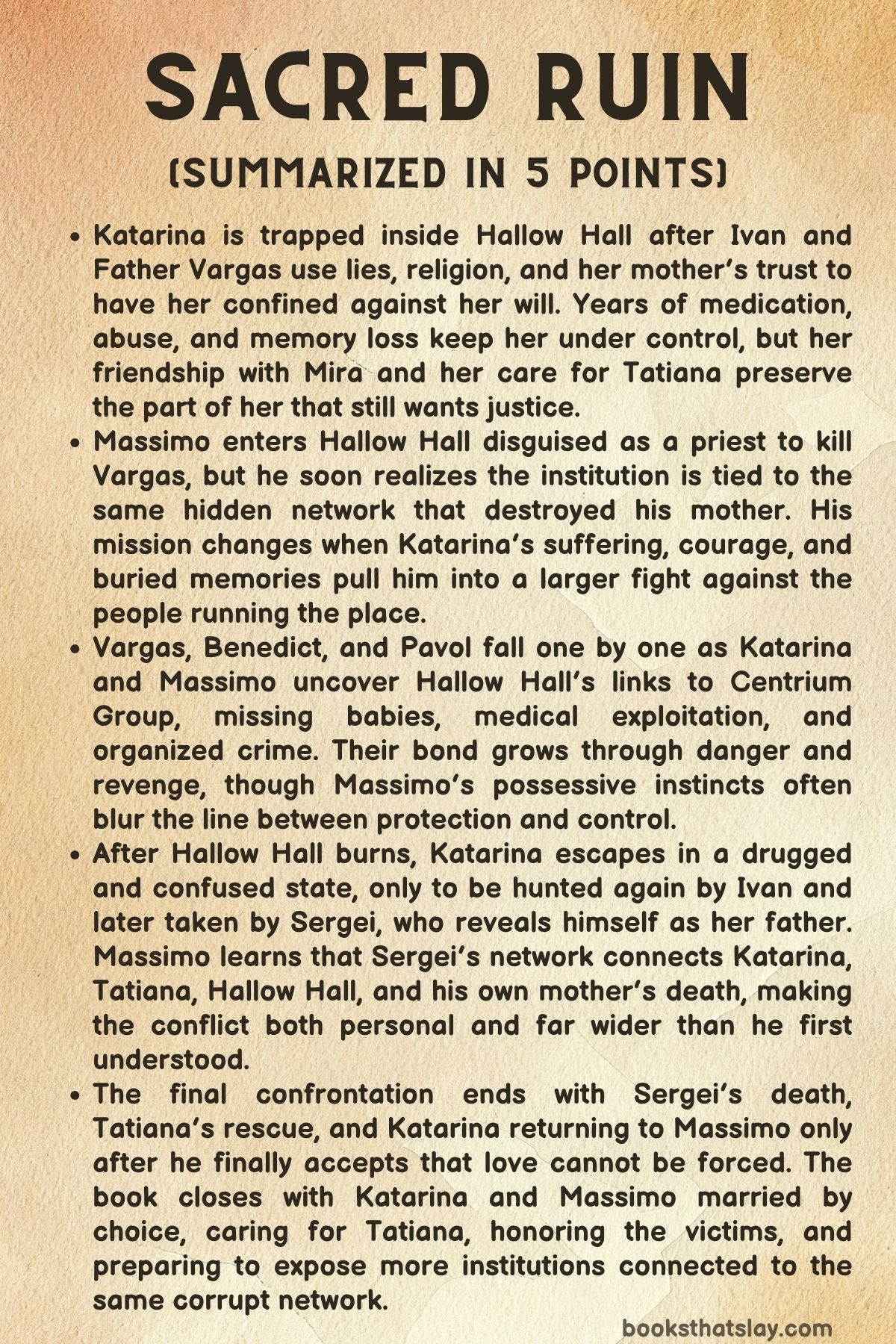
Summary
Katarina’s life is destroyed when Ivan Markovic, a controlling man she barely knows, refuses to accept her rejection. She is a young woman studying to become a teacher, with ordinary hopes and a future still open before her, but Ivan twists her private worries into proof that she needs help.
With the aid of his uncle, Father Vargas, he convinces Katarina’s religious mother that she must be taken somewhere for treatment. Katarina is forced into Hallow Hall, a supposed religious and medical institution that quickly reveals itself to be closer to a prison than a place of healing.
Inside Hallow Hall, Katarina is drugged, threatened, and conditioned into obedience. The people in charge use faith as a tool of control, turning guilt and fear into methods of punishment.
Her closest friend is Mira, a pregnant young woman trapped in the same place. Mira gives Katarina a reason to keep caring, and together they imagine escape, freedom, and a life near the sea where they might raise Mira’s baby away from the institution.
That fragile hope is destroyed when Mira dies and her baby disappears. Katarina witnesses enough to understand that Hallow Hall is hiding something terrible, but when she tries to call the police, Father Vargas proves that the institution is protected.
He threatens Katarina’s mother and forces Katarina back into silence. Medication then dulls Katarina’s memories, leaving her with only broken flashes of the truth, nightmares, and an instinctive fear of the men who control her.
Years later, Massimo arrives at Hallow Hall under a false identity. He is a professional killer who has accepted a contract to kill Father Vargas, but the job connects to his personal search for answers about his mother.
Massimo’s mother was also sent away to a mysterious institution after becoming pregnant, and she died during childbirth. He has spent years searching for the people responsible, and the fragments he has uncovered point toward the same kind of hidden system that now surrounds Hallow Hall.
Disguised as a priest, Massimo enters the institution and immediately sees that something is deeply wrong. Father Benedict and Father Pavol present their work as treatment, but their actions reveal abuse, corruption, and profit.
Katarina notices Massimo at once. He is frightening, tattooed, and unlike the other priests, and she senses danger in him even through the fog of medication.
Massimo first tries to stay focused on his mission. He tells himself that he is there to kill Vargas and leave, not to rescue anyone or become involved in Hallow Hall’s victims.
But Katarina unsettles him. She reminds him of his mother, not only because of her suffering, but because the drugs used on her suggest that his mother may also have been harmed and misrepresented by the people who controlled her.
Katarina slowly regains clarity when Massimo prevents her from taking her medication. Hidden notes she once wrote to herself confirm that the drugs are suppressing her memory.
As her mind clears, she remembers Mira more vividly and begins looking for evidence. Her office work allows her to notice invoices and names connected to Centrium Group, a private organization that appears to fund Hallow Hall.
Massimo also investigates the institution from within. He learns that many pregnant women have passed through Hallow Hall and that the patients are treated as resources.
Pavol, Benedict, Vargas, and others are not simply cruel individuals; they are part of a wider operation built around money, secrecy, medical control, and the exploitation of vulnerable women and children.
When Father Vargas arrives, Massimo prepares to complete his contract. He traps Vargas and stages the death to look like suicide, but before he can finish, he discovers Katarina hidden in a wardrobe, injured and terrified.
Vargas has attacked and threatened her, and Katarina’s buried rage finally breaks through. When Vargas wakes and Massimo hesitates, Katarina knocks away the stool beneath him, causing his death.
She tells him it is for Mira. In that moment, Massimo sees Katarina not only as a victim but as someone capable of vengeance, courage, and judgment.
After Vargas dies, Katarina makes Massimo a dangerous offer. She wants to hire him to kill Pavol and Benedict too.
She promises him whatever money is hidden in the institute safe, but Massimo demands something more personal as part of the bargain. Their agreement becomes the beginning of an intense alliance, one built on danger, attraction, and mutual need.
As the institution grows unstable, Katarina continues to fight for herself and for others. She protects Tatiana, a little girl born inside Hallow Hall, and challenges Sister Vera when the nun mistreats her.
For this defiance, Katarina is sent to solitary confinement. Massimo cannot openly save her without exposing himself, but he gives her snowdrops, small flowers that become a sign of hope inside the empty room.
Massimo’s feelings deepen as he investigates Katarina’s life. He discovers that her mother, Elena, is already dead, meaning Hallow Hall used a dead woman as leverage to keep Katarina obedient for years.
This cruelty wounds him because it echoes his own loss. He leaves snowdrops at Elena’s grave, silently promising that Katarina’s love for her mother has not been erased.
Meanwhile, Massimo begins poisoning Pavol and Benedict with the same medication used against Katarina. He wants them to feel confusion, weakness, and fear before he kills them.
Benedict becomes suspicious and unstable. When he holds Katarina at gunpoint and tries to force Massimo to help test a new drug on her, Massimo finally acts.
He kills Benedict and hides the evidence, then takes Katarina to his room. For Katarina, Massimo’s presence becomes both frightening and safe.
He is violent and possessive, yet he repeatedly refuses to exploit her when she is drugged or confused. That difference matters to her because Hallow Hall has spent years taking away her consent, her memory, and her sense of self.
Their bond becomes more intimate, but the danger continues to grow. Police attention begins to build after Vargas’s death and Benedict’s disappearance.
Massimo anonymously brings authorities toward Hallow Hall and plants evidence so the institution’s crimes cannot be ignored. He now understands that revenge alone is not enough; Hallow Hall must be exposed.
Just when escape seems close, Pavol and Dr. Blackwood strike back. Blackwood injects Katarina with a strong drug, damaging the clarity she has fought so hard to regain.
A fire breaks out, and chaos spreads through Hallow Hall. Blackwood kills Pavol, claiming he is protecting Katarina, but she flees in terror.
Massimo is outside saving people, including Tatiana, but Katarina’s memory is too broken to trust what she sees. She recognizes him only as the frightening figure she once called Lucifer and runs away.
At a train station, Katarina meets Lucy, a kind stranger who notices that she is lost, injured, and confused. Lucy takes her to a hotel suite, gives her food and warmth, and patiently helps her through her memory problems.
Through Lucy’s connections, Giada realizes Katarina is the woman Massimo is searching for. Help is coming, but Katarina is not safe yet.
Blackwood finds her at the hotel, forcing her to run again. She is eventually captured by men connected to Ivan Markovic, who has returned to finish what he started years before.
Drugged and disoriented, Katarina is taken to a religious room and dressed in a white lace gown. Ivan plans to force her into marriage, believing that claiming her will give him access to wealth and power.
At the ceremony, Massimo arrives in burned, torn priestly clothes and stops him. Ivan threatens Katarina, and Massimo kills him.
Massimo then makes one of his darkest choices. He takes Katarina to a trusted doctor, Filippa, who confirms that the drugs used on Katarina can cause memory loss, confusion, and hallucination-like symptoms when misused.
Afterward, believing marriage will protect her, Massimo has Father Vittorio marry them while Katarina is unconscious. Vittorio objects, but Massimo insists.
The act is rooted in fear and possessiveness as much as protection. Massimo wants to keep Katarina safe, but he repeats the same central violation that has defined her suffering: he makes a life-changing decision without her consent.
He brings her to his Gothic townhouse in Turin, where his housekeeper Paolo cares for her. The house is beautiful, dark, and secure, but to Katarina it still feels like another locked place.
She is safe from Hallow Hall, Ivan, and Blackwood, yet she is still not free. When she realizes Massimo has hidden her mother’s death and married her while she was drugged, she confronts him.
Katarina loves Massimo, but she refuses to accept protection that removes her choices. She decides to leave with Lucy and go to Florence, returning Massimo’s dog tags and her cross as a rejection of his claim over her.
Before she can leave, Sergei arrives with Tatiana. He reveals that he is Katarina’s father and that Tatiana is her half-sister.
Katarina is shocked, but when Tatiana is involved, she refuses to abandon the child. She goes with Sergei, only to discover that his idea of safety is another form of control.
Massimo learns from Blackwood that Katarina and Tatiana are Sergei Stoyanov’s illegitimate daughters. Ivan wanted Katarina because of her connection to Sergei’s wealth and power.
Blackwood also reveals that Sergei’s family controls multiple institutions like Hallow Hall. Massimo realizes the network that harmed Katarina also destroyed his mother, Sara.
With help from Vittorio and Elio, Massimo attacks Sergei’s compound. Katarina escapes her room, fights Sister Vera, and finds Tatiana.
When she encounters Vittorio in disguise, she realizes Massimo has come for her. Massimo reaches her, apologizes, and tells her he loves her.
This time, when Katarina insists on staying for the final confrontation, he listens. He wants to protect her by removing her from danger, but he lets her choose.
Sergei tries to flee by helicopter, using people as shields and bargaining with power. Massimo asks him about Sara, and Sergei barely remembers her, proving how little his victims ever mattered to him.
Massimo and Elio shoot down the helicopter, and Sergei dies in the crash. His death closes one part of the nightmare, though the larger network remains.
Afterward, Massimo brings Katarina and Tatiana home. Katarina finally grieves her mother fully, and Massimo holds her through it.
He also accepts that love cannot mean ownership. He tells Katarina she is free to go to Florence if she wants, returns her necklace and ring, and promises to wait.
Katarina chooses to stay, not because she is trapped, but because she wants him. Their marriage becomes real only when she claims it by choice.
In the spring, Katarina and Massimo visit the ruins of the hospital where Sara died. Excavation has begun, and evidence from Hallow Hall and connected institutions is reaching the authorities.
Tatiana now lives with them in Turin, safe and cared for. Katarina imagines turning ruined land into a cat rescue, replacing suffering with shelter.
Their work is not finished. Giada brings information about another location in Palermo, possibly tied to Tatiana’s mother and more victims.
Katarina and Massimo prepare to face the next dark place together, not only as lovers and spouses, but as partners in justice, vengeance, and survival.
Characters
Katarina
Katarina is the emotional center of the book, a woman whose life has been stolen through lies, religious pressure, medical abuse, and calculated isolation. Her tragedy begins not because she is weak, but because she says no to Ivan and is punished by a system powerful enough to turn her refusal into a supposed illness.
Inside Hallow Hall, Katarina is stripped of memory, dignity, and choice, yet the story never presents her as merely helpless. Even when drugged and frightened, she protects Tatiana, mourns Mira, feeds the stray cat Gravy, hides notes for herself, and keeps searching for proof that the institution is corrupt.
Her relationship with Massimo is complicated because he is both rescuer and danger. He restores her clarity and treats her pain seriously, but he also tries to possess her, especially when he marries her without consent and locks her inside his home.
Katarina’s strongest development comes when she refuses to confuse safety with freedom. She loves Massimo, but she still leaves him when he takes away her choices, proving that survival has not erased her moral strength.
By the end of Sacred Ruin, Katarina’s choice to stay with Massimo matters because it is finally her own. She is no longer a patient, prisoner, bargain, daughter, or hidden heir first; she is a woman reclaiming her life while carrying grief, anger, tenderness, and a fierce need to protect others.
Massimo
Massimo is a violent, damaged, and deeply controlled man whose life has been shaped by the death of his mother and the belief that he was born from ruin. He enters Hallow Hall as an assassin with a specific contract, but the institution forces him to face a truth larger than his original mission.
His disguise as a priest creates a sharp contrast with his real nature. He wears religious clothing while acting as a killer, yet many of the official holy men around him are far more corrupt than he is.
Massimo’s moral code is dark but not empty. He kills without hesitation, manipulates people, and often responds to fear with control, but he also recognizes consent in moments when other men ignore it, especially when Katarina is drugged or vulnerable.
His love for Katarina exposes both the best and worst parts of him. He protects her, investigates for her, avenges her, and risks himself for Tatiana, but he also tries to bind Katarina to him through marriage and locked doors.
His character arc is not about becoming gentle in a simple way. It is about learning that love cannot be treated like a target, a contract, or a possession.
By the end, Massimo understands that if Katarina is to be his wife in any real sense, she must be free to reject him. That lesson changes him more than revenge ever could.
Mira
Mira is present mostly through memory, but her role shapes Katarina’s entire fight against Hallow Hall. She is a young pregnant girl who becomes Katarina’s closest friend inside the institution, giving her companionship in a place designed to isolate and break people.
Mira represents the hidden victims whose names powerful men try to erase. Her death and the disappearance of her baby reveal that Hallow Hall is involved in something far worse than ordinary mistreatment.
For Katarina, Mira becomes both grief and purpose. The dream of escaping with Mira and raising the baby near the sea shows Katarina’s capacity for hope, even inside a place built on fear.
When Katarina helps cause Vargas’s death and says it is for Mira, the moment gives Mira a form of justice that the official world denied her. Mira’s memory pushes Katarina from frightened survival into active resistance.
Tatiana
Tatiana is one of the clearest symbols of innocence in the story. Born inside Hallow Hall, she has never known the freedom, family, or safety that a child should have.
Katarina’s care for Tatiana reveals the nurturing part of her personality that the institution could not destroy. Teaching the child colors, defending her from Sister Vera, and refusing to leave her behind all show that Katarina’s love survives even under extreme pressure.
Tatiana also deepens the mystery of Hallow Hall. Her existence raises questions about the children born there, their parents, and the way the institution has hidden or reassigned lives for profit and control.
When Sergei reveals that Tatiana is Katarina’s half-sister, the child becomes part of Katarina’s family as well as her responsibility. Her safety after the final confrontation gives the ending a sense of renewal, because one child who began life inside a corrupt system is finally given a home.
Ivan Markovic
Ivan is the first visible source of Katarina’s imprisonment, and his cruelty comes from entitlement rather than passion. He cannot accept rejection, so he decides Katarina must be controlled, corrected, and eventually claimed.
His use of her private medical worries shows how dangerous he is. He does not need love, truth, or evidence; he only needs enough influence to twist concern into captivity.
Ivan’s later attempt to force Katarina into marriage proves that his original motive has not changed. He still sees her as property, but the revelation of her connection to Sergei adds greed to his obsession.
His death at Massimo’s hands ends the immediate threat he poses, but his role in the novel is larger than one villain. He represents the kind of man who uses institutions, family pressure, and religious authority to punish a woman for refusing him.
Father Vargas
Father Vargas is one of the most important architects of Katarina’s suffering. As Ivan’s uncle and a powerful religious figure, he gives institutional weight to Ivan’s lies and helps turn Katarina’s independence into a reason for confinement.
His authority is especially dangerous because he hides behind respectability. He knows how to speak the language of care, faith, and protection while participating in threats, cover-ups, and abuse.
Vargas also represents the link between Hallow Hall and outside power. His ability to silence Katarina after she tries to call the police shows that the institution survives because it has protection beyond its walls.
His death is one of the story’s first major acts of revenge. Katarina’s role in it matters because Vargas once helped trap her, and in the end she refuses to remain only his victim.
Father Benedict
Father Benedict embodies the psychological and medical cruelty of Hallow Hall. His sessions with Katarina are framed as treatment, but they are actually rituals of fear, shame, and control.
He uses religious language to make Katarina doubt herself, then relies on medication to keep her confused and obedient. His work shows how abuse becomes harder to fight when it is dressed up as therapy.
Benedict’s interest in experimental drugs reveals the cold, practical side of the institution. He does not merely want patients subdued; he wants them easier to control, easier to manipulate, and easier to erase.
His downfall comes when he tries to force Massimo to harm Katarina. At that point, his belief in his own power collapses, and Massimo kills him as both punishment and protection.
Father Pavol
Father Pavol is another corrupt figure within Hallow Hall, and his cruelty is rooted in both appetite and cowardice. He enjoys the power the institution gives him over vulnerable women, but once Vargas dies and the system begins to shake, he becomes unstable.
His conversations with Massimo expose the financial and criminal logic behind Hallow Hall. Pavol speaks of patients in a way that removes their humanity, making it clear that the institution profits from suffering.
For Katarina, Pavol is tied to terror and bodily memory. Even when her conscious mind cannot fully remember, her fear of him shows how deeply his actions have harmed her.
His death at Blackwood’s hands is not heroic or redemptive. It is the collapse of one corrupt man at the hands of another, showing how little loyalty exists among the people who built Hallow Hall.
Dr. Blackwood
Dr. Blackwood is one of the coldest villains in the book because his violence is clinical. He understands drugs, memory, and fear, and he uses that knowledge to manipulate patients while pretending to act as a doctor.
His treatment of Katarina is especially disturbing because he studies her reactions and tests her memory as if she is an experiment. He represents the medical side of Hallow Hall’s corruption, where science is stripped of ethics and turned into a tool of control.
Blackwood is also important because he reveals the larger truth about Katarina’s identity, Sergei’s network, and the institutions connected to Massimo’s mother. He knows enough to connect the personal stories into one criminal structure.
His death gives Massimo answers, but it does not erase the damage he helped cause. Blackwood’s real horror lies in how ordinary and professional he can appear while participating in monstrous acts.
Sergei Stoyanov
Sergei is the most powerful villain in the novel because he sits above the visible cruelty of Hallow Hall. He presents himself as a father, protector, and businessman, but his idea of protection is inseparable from ownership.
His claim that he wanted to keep Katarina and Tatiana safe is deeply flawed because safety, for him, means confinement, secrecy, and control. He may not personally perform every act of cruelty, but he benefits from and maintains the system that allows those acts to happen.
Sergei’s connection to Katarina and Tatiana adds emotional complexity without making him sympathetic. He is their father, but fatherhood does not soften him into a caring figure; instead, it becomes another way for him to claim authority.
His careless reaction to Sara Lucciano’s name reveals the emptiness at the center of his power. The lives ruined by his network barely register to him, which makes his death feel like the fall of a man who treated human beings as disposable.
Lucy
Lucy enters the story at a crucial moment, when Katarina has escaped Hallow Hall but has no memory stable enough to protect herself. Her kindness is striking because it is ordinary, immediate, and freely given.
Unlike many people in the novel, Lucy does not try to own Katarina’s choices. She offers food, shelter, patience, and practical help, giving Katarina a brief experience of care without control.
Her wealth and confidence contrast with Katarina’s fear and isolation, but Lucy never uses that difference to make herself superior. Instead, she becomes a bridge between Katarina and the outside world.
Lucy’s invitation to Florence is especially important. It gives Katarina a real alternative to Massimo, making Katarina’s final choice more meaningful because she is not choosing him out of having nowhere else to go.
Paolo
Paolo, Massimo’s housekeeper, brings warmth and moral clarity into Massimo’s dark household. He cares for Katarina with food, patience, and gentleness, but he also understands that kindness cannot replace freedom.
His role becomes most important when he challenges Massimo after Katarina leaves. Paolo tells him the truth that Massimo does not want to hear: keeping Katarina locked away would make him another jailer.
This makes Paolo more than a domestic side character. He acts as one of the few people willing to confront Massimo directly and remind him that love without choice becomes another form of captivity.
In the final domestic scenes, Paolo helps make Massimo’s townhouse feel like a home rather than a fortress. His presence supports the story’s movement from imprisonment toward chosen family.
Father Vittorio
Father Vittorio is a rare religious figure in Sacred Ruin who is not defined by corruption. His faith is imperfectly placed within a violent world, but he still carries a sense of conscience that separates him from Vargas, Benedict, and Pavol.
He helps Massimo with the priest disguise, later objects to Massimo marrying Katarina while she is unconscious, and eventually joins the rescue mission at Sergei’s compound. These actions show both loyalty and moral tension.
Vittorio’s importance lies in the contrast he provides. The book contains many men who use religion as a mask, but Vittorio shows that faith itself is not the villain; the villain is the use of faith to control, shame, and hide abuse.
His friendship with Massimo also gives Massimo one of his few human anchors. He sees the man beneath the killer and continues trying to pull him toward something better.
Giada
Giada is the intelligence force behind much of the investigation. Her technical skill allows Massimo to connect Centrium Group, Hallow Hall, Blackwood, Sergei, and the wider network of institutions.
She also functions as one of Massimo’s sharpest truth-tellers. She understands his violent instincts but refuses to romanticize them, especially when Katarina’s freedom is at stake.
Her advice that Massimo must kill the monster inside himself is one of the clearest statements of his emotional challenge. She knows that saving Katarina from outside enemies will mean little if he becomes another man who controls her.
By the end, Giada’s information continues to drive the larger fight. She helps turn private revenge into exposure, evidence, and action against the remaining parts of the network.
Elio
Elio represents Massimo’s past as a soldier and the possibility that Massimo is not as alone as he believes. As a former commander and Giada’s brother, he arrives at a moment when Massimo is preparing to attack Sergei by himself.
His willingness to join the mission shows that Massimo still has people who value him, even after years of violence and isolation. This matters because Massimo’s loneliness has helped shape his belief that he can only solve problems through killing and control.
During the assault, Elio brings discipline and support. He helps turn Massimo’s rescue attempt into a coordinated operation rather than a suicidal act of rage.
His offer of future work as a consultant also suggests a possible path beyond assassination. For Massimo, Elio quietly represents the chance to use his skills without remaining trapped in the same life forever.
Sister Vera
Sister Vera is a smaller but significant face of Hallow Hall’s everyday cruelty. She may not hold the same rank as Vargas, Benedict, or Pavol, but she helps enforce the system through obedience, suspicion, and harsh treatment of patients.
Her cruelty toward Tatiana shows how deeply the institution’s values have infected daily life. Even a child is not treated with gentleness unless someone like Katarina intervenes.
Vera’s later presence at Sergei’s house confirms that she knows more than she once pretended. She is not merely a passive servant inside a bad institution; she is part of the machinery that keeps vulnerable people contained.
Katarina’s fight with Vera during the escape is satisfying because it shows Katarina physically resisting one of the women who helped maintain her imprisonment. Vera represents complicity, and Katarina’s victory over her becomes part of her larger reclaiming of power.
Themes
Freedom Must Include Choice
Katarina’s journey makes it clear that being moved from a dangerous place to a safer one is not the same as being free. Hallow Hall steals her choices through drugs, locked rooms, religious fear, and lies about her mother, but the pattern does not fully end when Massimo rescues her.
Massimo’s townhouse is beautiful, protective, and far kinder than the institution, yet Katarina still recognizes the locked doors as another form of captivity. The story treats this distinction seriously: safety offered without consent can become another cage.
This theme becomes most powerful when Katarina leaves Massimo after learning he married her while she was unconscious. She loves him, but love does not erase the violation of being claimed without permission.
Her final decision to stay matters because it is not forced by fear, drugs, family pressure, or lack of options. Lucy offers her Florence, Massimo offers to wait, and Katarina chooses her own future.
In Sacred Ruin, freedom is not presented as rescue alone. It is the right to say yes or no and have that answer respected.
Power Hides Behind Respectable Masks
The most dangerous people in the novel are not obvious monsters at first glance. They are priests, doctors, businessmen, directors, and family men who hide violence behind titles that should suggest care, wisdom, or authority.
Hallow Hall survives because its cruelty is disguised as treatment and spiritual guidance. The language of sin, illness, protection, and obedience allows the people in charge to make abuse appear official.
Father Vargas uses religion to validate Ivan’s lies. Benedict uses therapy as a stage for fear. Blackwood uses medicine to destroy memory. Sergei uses fatherhood and wealth to present control as protection.
The horror comes from how organized this power is. Patients cannot simply run to the police or appeal to the Church because the people harming them have connections beyond the institution’s walls.
This theme also explains why exposure matters as much as revenge. Killing individual men ends immediate threats, but records, evidence, public attention, and investigation are needed to challenge the larger system that protected them.
Trauma Lives in the Body and Memory
Katarina’s suffering is not limited to what she consciously remembers. Even when medication damages her mind, her body reacts with terror to certain rooms, men, voices, and situations before she can explain why.
The novel shows trauma as fragmented and unstable. Katarina’s memories return in dreams, flashes, hidden notes, emotional reactions, and sudden realizations that can feel almost as frightening as ignorance.
The drugs used at Hallow Hall deepen this damage by making her doubt herself. If she cannot trust her own memory, then the institution gains more power over her.
Massimo’s history mirrors this theme in a different way. His life has been shaped by his mother’s death, but the truth has been buried under missing records, lies, and the shame attached to her institutionalization.
Healing does not arrive as simple peace. Katarina still grieves, panics, and feels anger, but she slowly learns to separate her own desires from the fear imposed on her.
Memory becomes a form of justice. To remember Mira, Elena, Sara, and the unnamed victims is to resist the system that tried to erase them.
Love and Possession Are Not the Same
Massimo’s love for Katarina is intense, protective, and transformative, but the novel does not ignore how dangerous it can become. His instinct is to keep what he loves by force, especially because loss has shaped his entire life.
He saves Katarina from terrible men, but he also harms her trust when he decides that his protection gives him the right to marry her and lock her away. This contradiction is central to his character.
Katarina’s response forces the emotional conflict into the open. She does not deny that Massimo has protected her, and she does not pretend she feels nothing for him.
Instead, she insists that love without freedom is only another form of control. That demand becomes the test Massimo must pass.
His growth comes when he allows her to leave and accepts the possibility that she may not return. Only then can Katarina’s return become meaningful.
Their ending works because possession gives way to choice. Massimo does not win Katarina by keeping her; he receives her because she decides, with full awareness of his darkness and devotion, that she wants to stay.