Truly Madly Deeply Summary, Characters and Themes
Truly Madly Deeply by L.J. Shen is a second-chance romance built around grief, buried trauma, and a connection that refuses to fade. At its center is Calla Litvin, who returns to her hometown after years away and is forced to face the people and memories she left behind.
The story pairs sharp humor and emotional confrontation with a messy, long-buried love story between Calla and Row Casablancas, the brother of her former best friend. As old wounds reopen, the novel follows both of them through family loss, damaged trust, small-town tensions, and the slow work of choosing honesty over fear. It’s the 1st book of the Forbidden Love series.
Summary
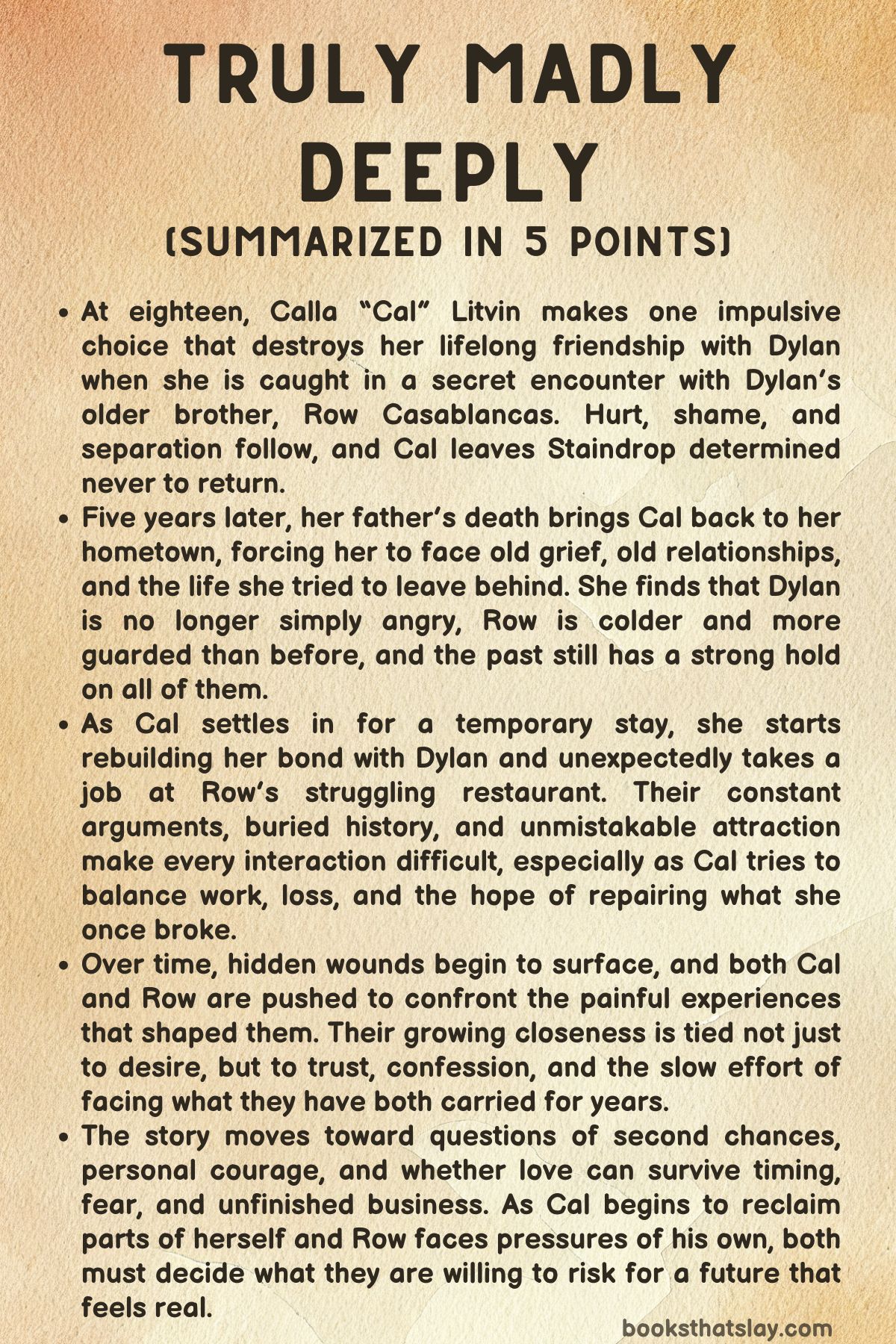
At eighteen, Calla “Cal” Litvin makes a reckless and deeply emotional choice that changes the course of her life. She has been secretly attracted for years to Row Casablancas, the older brother of her best friend Dylan.
After a senior bonfire, Row drives her to a cliff overlooking the ocean before she leaves for college in New York. Their teasing chemistry turns physical, and Calla, trusting him more than anyone else, asks him to take her virginity.
Though Row checks again and again that she is certain, the experience is painful, awkward, and nothing like the romantic moment she had imagined. In the middle of it, Dylan arrives and catches them together.
She is devastated that her best friend and her brother crossed a boundary that mattered deeply to her. Calla panics and insists it meant nothing, hoping to soften the damage, but Dylan sees only betrayal.
Their fourteen-year friendship ends that night, and Calla leaves for New York carrying shame, heartbreak, and the conviction that she should never return to Staindrop, Maine.
Five years later, Calla is forced back when her beloved father, Artem, dies of cancer. At the funeral gathering, she is surrounded by neighbors, awkward sympathy, and the ache of losing the parent who made her feel understood.
Her mother admits that mixed with grief is relief that Artem is no longer suffering. Wanting to comfort her, Calla promises to stay in town until January, even though her own life in New York is unstable and this means facing the people she has avoided for years.
Almost immediately, Dylan and Row walk into her family home. Dylan is now heavily pregnant, and Calla is stunned to learn she is with Tucker Reid, a boy who once bullied them in school.
Calla braces for anger, but Dylan surprises her with warmth and compassion over Artem’s death. Their first conversation is tense, but it hints that their broken bond might not be beyond repair.
Dylan admits that part of her had long feared Calla would leave her eventually anyway. The old hurt is still there, but so is affection.
Then Calla faces Row. He is more successful, more intimidating, and just as impossible to ignore.
He tells her he visited Artem before he died and passes along Artem’s final jokes and messages, which move her deeply. Yet he is cold in a way he never used to be.
She learns that he has returned to Staindrop, built a successful restaurant called Descartes, and become the target of local hostility. Later, when they end up alone in her kitchen, their argument turns physical in the same rough, charged pattern that has always existed between them.
Their fight nearly becomes another sexual moment before a phone call pulls Row away, leaving Calla shaken by grief, confusion, and the fact that her feelings for him are still alive.
At the same time, Calla continues her long-running anonymous friendship on an androphobia forum, where she posts as oBITCHuary and chats with a man called McMonster. They joke, flirt, and confide in each other.
Calla explains that she fears men in intimate situations and cannot trust them romantically, though she can function around them in daily life. McMonster admits he also carries damage from an abusive man in his past.
Their bond has grown over years of anonymous honesty.
The story then shifts to Row’s world at Descartes. Two employees quit just before service, and the restaurant is already under pressure.
Row’s manager and best friend, Rhyland, tries to keep him steady, but Row is clearly rattled after seeing Calla again. That night everything goes wrong.
The restaurant is understaffed, mistakes pile up, and then Kieran Carmichael, one of Row’s old tormentors, arrives as a guest. Row throws him out in front of customers.
A reporter from Cook’s Illustrated also tries to interview him, and Row behaves badly enough that Rhyland has to smooth things over. The chaos peaks when the grill station catches fire.
Row’s life looks polished on the outside, but in reality he is furious, overworked, and increasingly unbalanced.
Back at home, Calla struggles with grief, nostalgia, and the stale feeling of being trapped in her old life. Looking through old notes and mementos from her childhood friendship with Dylan, she becomes determined to fix what was broken.
She goes to Dylan’s house with gifts and an apology. Dylan makes her wait in the rain before finally letting her in, but once they begin talking, their old banter starts to return.
Calla learns Dylan is pregnant, engaged, and quietly unhappy. Dylan feels boxed in by other people’s plans for her future.
Calla comforts her, and the two reconnect through honest conversation, cupcakes, and laughter.
Their reunion is interrupted when Row and Rhyland arrive. During the conversation, Calla learns Descartes urgently needs servers.
Because she needs money to save her New York apartment, she offers to work there. Row strongly resists, not wanting her in his restaurant or anywhere near him, but under pressure from Dylan, Zeta, and Rhyland, he gives in.
He hires her with strict warnings and obvious resentment.
As Calla begins working at Descartes, proximity forces her and Row into constant conflict and attraction. After she gets injured at work and receives stitches, Row insists on walking her home instead of allowing Kieran to drive her.
On that walk, in falling snow, they stop at an old playground. There Calla finally tells Row the truth about the trauma that shaped her life.
She describes years of bullying because of her background, habits, and difference from other children. Dylan had been her main protector.
Then she explains what happened when she was fourteen. She had been secretly involved with Franco, an older boy who made her feel chosen.
When another girl, Allison Murray, discovered them, things escalated brutally. Allison and other girls chased Calla into the woods, beat her, broke her ankle, and even started burying her alive before panicking and digging her out.
Franco later threatened her into silence and shared her nude photos. The entire experience shattered Calla’s trust in men and left deep emotional scars.
Row is horrified, especially when he learns Allison was responsible because Allison is his ex. In response, he reveals his own history.
His father was a violent alcoholic who abused Row and his mother for years. He shows Calla scars on his back and tells her how he once protected both her and Dylan by taking blame for stolen vodka, only to be beaten savagely for it.
Eventually he fought back, and his father later died after years of damage. Row admits that opening Descartes was tied to his father’s unrealized dream and his own anger.
By sharing these truths, Calla and Row move closer than they ever have before. He confesses he never stopped wanting her, and she admits she wants him too.
They kiss in the snow and agree, at least outwardly, to keep things casual.
But larger problems are building. Row travels to London and meets Tate Blackthorn, a wealthy business associate pressuring him to sign a development contract involving Staindrop.
Row hesitates because he knows the plan will hurt the town and because his feelings for Calla are making everything harder. When he returns, he finds Descartes vandalized, and the local sheriff dismisses it as petty crime, making it clear that Row is not welcome.
Eventually Calla confronts Allison and demands the truth. Allison confesses that the harassment against Row was organized to derail his land deal because her father was desperate and wanted another buyer to succeed.
She also admits that her cruelty toward Calla began years earlier when she was involved with Franco, became pregnant, and was forced by her father to have an abortion. She redirected her pain and rage onto Calla.
The confession does not excuse anything, but it finally exposes the truth.
At a town charity 10K, Calla faces the same public space where she was once humiliated. With support from Dylan, her mother, and others, she runs and wins.
At the finish line, she sees Row waiting with a ridiculous handmade sign. She tells him she confronted Allison, only to learn Allison has already confessed to him as well.
Soon after, the sheriff arrests Allison in public.
Even after the truth comes out, Calla and Row remain stuck at an emotional crossroads. On New Year’s Day they head to the airport together, both leaving Maine.
Calla suggests they get coffee, but Row refuses to keep pretending a casual arrangement is enough. He tells her plainly that he loves her more than cooking, travel, or money, but he cannot accept half measures.
Unless she can choose him fully, he wants nothing. He gives her a goodbye gift and walks away.
Back in New York, Calla tries to return to routine, but everything feels empty. Then she opens Row’s gift.
Inside is a key and an address that leads her to a recording studio he secretly rented and prepared for her dream of starting a true crime podcast. He has set it up with care, proving that he sees her future clearly.
Calla records her first episode there, and through that process she understands that the opinion she values most is Row’s because she has always loved him.
She flies to London to find him at the opening of his new restaurant. In front of a crowd, she presents a series of saved mementos from their shared history and declares that she has loved him for years.
Before she can finish by proposing herself, Row drops to one knee and asks her to marry him. She says yes.
A year later, they are married and living in London. Calla’s podcast is thriving, her mother’s business is doing well, and their circle has found new stability.
At Christmas, Row surprises Calla with a home recording studio, and she surprises him with an ultrasound image revealing that she is pregnant. The story closes with both of them settled at last into a life they actively chose together.
Characters
Calla “Cal” Litvin
Calla is the emotional center of the story, and much of the character work depends on the contrast between who she appears to be and what she is carrying internally. On the surface, she is witty, impulsive, awkward, and often self-deprecating, someone who uses humor and deflection to survive discomfort.
Under that surface, however, she is deeply marked by grief, betrayal, bullying, and sexual humiliation. Her fear of men is not presented as a simple personality trait but as the long aftermath of trauma that reshaped her sense of safety, intimacy, and self-worth.
Even when she acts bold, there is usually pain beneath it. Her decision to sleep with Row at eighteen shows both desire and confusion: she is drawn to the one man she trusts, yet she is also using the moment to solve wounds that cannot be solved that way.
That contradiction defines her for much of the story.
What makes Calla compelling is that her growth is not about becoming an entirely different person, but about becoming more honest and more courageous within the self she already has. Returning to Staindrop forces her to face every part of her past at once: her father’s death, her broken friendship with Dylan, her unresolved feelings for Row, and the violence that shaped her adolescence.
At first she is still avoidant, still tempted to escape, still uncertain whether she deserves repair or happiness. But over time she starts choosing confrontation instead of silence.
She reaches out to Dylan, tells Row the truth about what happened to her, stands up to Allison, runs publicly in the same town where she was once degraded, and finally admits what she wants instead of settling for emotional half-measures. Her arc is about reclaiming authorship over her own life.
By the end, she is no longer simply surviving old damage. She is creating, choosing, loving, and allowing herself to be fully seen.
Row Casablancas
Row is introduced first as dangerous, magnetic, and hard to read, but his character gradually becomes one of the most layered in the story. He has the outward shape of a classic difficult man: sarcastic, confrontational, physically intense, emotionally guarded, and often cruel when he feels cornered.
Yet that hardness is not empty style. It comes from years of violence, fear, and emotional deprivation inside his own home.
His father’s abuse left him with scars that are both literal and psychological, and much of his adult personality has been built around control, endurance, and refusal to appear vulnerable. He is someone who learned early that love and pain could exist side by side, which helps explain why he is protective to the point of aggression and tender only in flashes he cannot fully sustain.
At the same time, Row is not reduced to trauma. He is ambitious, highly competent, and fiercely driven, as seen in the way he builds Descartes and plans for expansion.
His anger often damages his judgment, but his intensity also fuels his talent and loyalty. One of the strongest aspects of his characterization is the difference between what the town thinks of him and what he actually is.
He is treated as arrogant, corrupt, and destructive, yet again and again his actions reveal devotion: he visits Artem before death, remembers exact final messages, protects Calla even when he insists he wants distance, and supports her creative dream in a way that is thoughtful rather than showy. His love is practical, observant, and sacrificial.
His central conflict is that he wants total honesty and total commitment, but he does not believe he can safely ask for either. He tries casual distance, hostility, and control, yet none of them work because Calla matters too much.
What makes him effective as a romantic lead is that his emotional truth eventually becomes simple. Beneath the bravado, he wants to be chosen.
His final refusal to accept only part of Calla is not cruelty but self-respect. By the end, he evolves from a man shaped by damage into a man capable of building a future without fear being the foundation of it.
Dylan Casablancas
Dylan is much more than the betrayed best friend in the backstory of Truly Madly Deeply. She represents one of the story’s deepest emotional wounds, but she also becomes one of its clearest examples of emotional complexity.
In the early timeline, her reaction to discovering Calla and Row together is explosive, and understandably so. From her perspective, two people central to her world have crossed a boundary she trusted them to honor.
Her anger is not only about the act itself but about humiliation, abandonment, and the collapse of certainty. Yet the later story complicates that moment by showing Dylan as someone who has always expected loss.
Her admission that she may have been waiting for Calla to leave her anyway reveals a person whose defensiveness comes from fear, not just pride.
As an adult, Dylan is one of the most interesting supporting characters because she embodies both warmth and entrapment. She is funny, sharp, and still capable of the easy rhythm she once shared with Calla, which makes the repair of their friendship feel believable rather than forced.
At the same time, she is struggling. Her pregnancy, engagement, and life circumstances have left her feeling cornered by choices that no longer feel fully hers.
This gives her character a quiet sadness beneath the humor. She is not simply the stable hometown counterpart to Calla’s chaotic return.
She is also a woman negotiating disappointment, compromise, and the pressure of becoming someone others expect her to be.
Her role in the story is vital because she preserves emotional truth. She does not erase the past just because reconciliation is convenient.
Instead, her renewed bond with Calla feels earned through honesty, vulnerability, and shared memory. Dylan also functions as a mirror for both Calla and Row, since she knows versions of them from before they fully knew themselves.
Her presence keeps the story grounded in history, loyalty, and consequence, and her eventual support gives the romance moral and emotional legitimacy.
Artem Litvin
Artem, though dead for much of the present-day plot, remains one of the most powerful presences in the story. His importance lies in the fact that he shaped Calla’s emotional world in a positive way when so many other forces shaped it through cruelty.
He is remembered as eccentric, loving, warm, and imaginative, and those qualities explain much about why Calla has survived with so much humor and sensitivity still intact. He seems to have given her a sense of wonder that sits beside her trauma rather than being erased by it.
His love was not abstract; it was practical, playful, and enduring, the kind that gave her a home even when the outside world made her feel strange or unwanted.
His death is the event that brings Calla back, but his role is larger than that of plot catalyst. Through memory and through Row’s delivery of his final messages, Artem becomes a bridge between past and future.
He is one of the few figures who seems to have understood both Calla’s fragility and her strength. The story uses him to show that grief is not only sorrow but inheritance: the living carry forward what the dead taught them.
Calla’s reflections on snow, imagination, and remembrance all connect back to him, and these moments soften the story’s harsher edges.
Artem also matters because other characters’ feelings toward him reveal their own depth. Row’s visit to him before death shows devotion and respect.
Calla’s mother’s complicated grief shows how illness changes love. Even in absence, Artem helps define the emotional truth of the people around him.
He stands as a symbol of kindness that was real, not naive, and his presence reminds the reader that Calla did not come from emptiness. She came from love, which is one reason she is eventually able to choose it.
Calla’s Mother
Calla’s mother is portrayed with a quieter complexity than the more dramatic central figures, but she plays an important role in establishing the domestic and emotional reality Calla returns to. She is grieving her husband, yet she is honest enough to admit relief that he is no longer suffering.
That admission immediately gives her texture. She is not idealized as the noble mourner or reduced to background support.
Instead, she feels like a real person exhausted by caregiving, loss, and practical survival. Her relationship with Calla contains affection, pressure, and misunderstanding in believable proportions.
She often pushes Calla toward work, reconnection, and movement, which can feel insensitive at moments, but it also reflects a generational instinct toward action rather than emotional lingering. She does not always know how to hold Calla’s pain, yet she still wants her daughter to re-enter life.
That makes her an imperfect but recognizably loving parent. The promise Calla makes to stay in Staindrop is partly for her, which shows that their bond, while not the most emotionally fluent, still carries weight.
By the end, her success with the mitten business suggests resilience and adaptation. She is one of the quieter examples in the story of what it means to keep living after loss.
Her character helps anchor the narrative outside the central romance, reminding the reader that family is not only a source of pain or trauma. It can also be a source of obligation, endurance, and muted but steady care.
Rhyland
Rhyland serves several functions at once: best friend, manager, comic relief, emotional translator, and stabilizing force in Row’s life. He understands Row well enough to challenge him without sentimentality, which is a valuable trait given how defensive and volatile Row can be.
In the restaurant scenes especially, Rhyland comes across as the person who keeps things from completely collapsing. He has social intelligence where Row has abrasiveness, and diplomatic skill where Row has instinctive confrontation.
This makes him more than a sidekick; he is essential to the functioning of Row’s world.
What makes Rhyland effective is that his support never feels passive. He teases, pushes, smooths over conflict, and makes practical decisions under pressure.
He is one of the few characters who can openly name what Row refuses to admit, especially when it comes to Calla. That gives him a truth-telling role in the narrative.
At the same time, he does not exist only to serve Row’s development. His competence and presence suggest a full life and personality beyond the immediate plot.
He also helps humanize Row by showing that Row is capable of sustaining long-term male friendship built on trust. Given Row’s history with violence and betrayal, that matters.
Rhyland’s continued loyalty signals that Row’s harder qualities do not define the totality of how he moves through the world. Through Rhyland, the story shows that even deeply damaged people can still inspire steadiness and love in others.
Allison Murray
Allison is one of the clearest antagonistic figures, but the story complicates her without excusing her. In Calla’s past, Allison embodies cruelty sharpened by social power.
She is part of the machinery that turns bullying into something brutal and lasting, and her actions against Calla are not momentary meanness but organized humiliation and violence. She functions as the face of the harm that destroyed Calla’s sense of safety.
Because of that, she carries enormous moral weight in the story, and her eventual confrontation with Calla becomes one of the most important scenes of personal reckoning.
What makes Allison more than a flat villain is the later revelation of her own history: her involvement with Franco, her pregnancy, her forced abortion, and her father’s pressure. These details explain the emotional chaos behind her rage, especially the way she redirected her suffering onto someone more vulnerable.
But the story is careful not to turn explanation into absolution. Allison’s pain may clarify her choices, yet it never erases the damage she inflicted.
That balance makes her characterization effective. She becomes a person whose life has also been shaped by control, misogyny, and family dysfunction, but who still made devastating choices.
Her confession is therefore significant not because it redeems her fully, but because it restores truth to the public and private record. She is important less as a person the reader must forgive and more as someone the protagonists must finally stop fearing.
In that sense, Allison represents the end of secrecy. Once she speaks, the old story loses its power to define everyone else.
Kieran Carmichael
Kieran works primarily as a disruptive force and a reminder of old rivalries. His presence immediately brings out Row’s most territorial and reactive instincts, which makes him useful in revealing character rather than merely advancing plot.
He represents an old social order built on provocation, humiliation, and masculine competition. Even when he is not deeply explored, the tension around him suggests unfinished history and class or status-based antagonism.
For Calla, Kieran also serves as a contrast point. Row frames him as unsafe, though jealousy clearly motivates that judgment.
This dynamic helps expose how Row’s protectiveness can blur into control. Kieran’s importance lies partly in the fact that he is not Row, and the comparison makes Row’s emotional investment obvious.
He also adds pressure to the restaurant and hometown settings by carrying the past into the present in a way that keeps wounds open.
Though not among the most emotionally layered figures, Kieran is effective because he intensifies existing conflict simply by appearing. He is a reminder that the past is populated not only by intimate betrayals but also by the wider ecosystem of people who reinforced power, rivalry, and humiliation.
Zeta Casablancas
Zeta represents continuity, memory, and the strange mixture of judgment and warmth that often exists in long-standing family friendships. As Dylan and Row’s mother, she stands at the threshold between past and present, and her interactions with Calla carry the weight of years.
She does not instantly make things easy, as seen when she leaves Calla outside waiting, but that delay feels meaningful rather than petty. It reflects the fact that pain has history, and reentry into a damaged relationship should not be effortless.
At the same time, Zeta is not portrayed as cold. She supports the idea of Calla working at Descartes, recognizes practical reality, and seems able to see beyond temporary bitterness.
Her role suggests an older generation that has witnessed the mess from a wider angle than the younger characters have. She understands the family ties, the old loyalties, and the ways people remain bound to one another even after major betrayals.
She is especially useful in giving the story a sense of social texture. The Casablancas family home is not just a location but a site of accumulated memory, and Zeta helps maintain that feeling.
Through her, the story shows that reconciliation does not happen only between two individuals. It also ripples through families, households, and the spaces where people once belonged.
Tucker Reid
Tucker is initially surprising because he is revealed to be Dylan’s partner after having been one of the boys associated with past bullying. That fact creates immediate tension and discomfort, which is important because it shows that adulthood has not neatly sorted people into heroes and villains.
Tucker’s presence complicates Dylan’s life and makes her choices feel more difficult and morally tangled. He is part of the reality she now inhabits, one that is far less ideal than what she may have imagined for herself.
He is not developed as deeply as the central cast, but his narrative role matters. He symbolizes compromise and the uneasy process of building a future out of imperfect circumstances.
His relationship with Dylan reflects her sense of being trapped by momentum, expectation, and limited options. Because of that, Tucker is less important as an individually vivid figure and more important as part of Dylan’s emotional landscape.
Still, his existence in the story reinforces a central idea: people do not always end up with the lives that seem to match their younger selves. The hometown has not preserved anyone in the way memory might suggest.
Tucker is one more sign that time has rearranged loyalties, identities, and desires.
McMonster
McMonster is a fascinating character because for much of the story he exists through anonymity and conversation rather than physical presence. He functions as Calla’s emotional safe space before the romantic narrative fully clarifies itself.
Through him, Calla is able to be candid, darkly funny, vulnerable, and thoughtful in ways she often cannot manage face to face. Their online bond reveals how much she needs connection that feels low-risk, chosen, and free from immediate physical threat.
That alone makes him important, because he is part of how the story explores trust in the aftermath of trauma.
His own admission that an abusive man shaped his wariness gives him unexpected emotional symmetry with Calla. He is not simply a listener or device for exposition.
He understands fear from the inside, even if his version of it differs from hers. That mutual recognition makes their conversations feel intimate and earned.
He represents the possibility that safety can begin in emotional honesty before it becomes anything else.
McMonster also highlights Calla’s capacity for attachment. Even while damaged and guarded, she has sustained a meaningful connection for years.
That matters because it shows she has never been incapable of love or trust; she has only needed the right conditions for them. Whether read mainly as a support figure or as part of the story’s deeper romantic architecture, McMonster plays a key role in revealing Calla’s inner life.
Allison’s Father, Franco, and Other Past Figures
Several secondary figures from Calla’s past are crucial not because they receive long page time, but because they explain the emotional architecture of the present. Franco is one of the most destructive.
He offered young Calla a false sense of being chosen, then abandoned and exploited her the moment protecting her would have cost him something. His cruelty is intimate and formative.
He is the kind of person who turns adolescent vulnerability into lifelong damage, and his shadow lingers long after his death. The fact that Row still reacts strongly to his memory shows how deep the wound remains.
Allison’s father matters because he demonstrates how older systems of power shape younger people’s violence. His pressure regarding Allison’s pregnancy and his role in the later land conflict show a man willing to manipulate, control, and sacrifice others for self-interest.
He helps explain, though not excuse, the damage Allison causes. Sheriff Menchin similarly represents corrupted authority.
His refusal to seriously investigate the vandalism against Row suggests that local institutions are not neutral, and that reputation, politics, and resentment influence justice in Staindrop.
Rebecca Stanton and the other girls involved in Calla’s assault are also significant as a collective force. They turn social exclusion into outright brutality, showing how cruelty can become communal.
These figures deepen the story’s moral landscape by making clear that the protagonists are not only fighting personal demons. They are also dealing with the long afterlife of a town that allowed certain harms to happen.
In that sense, even minor characters contribute to the emotional seriousness of Truly Madly Deeply.
Themes
Love as Something Chosen, Not Avoided
What gives the central relationship its force is not just attraction, but the long process of moving from fear, denial, and half-measures toward full emotional choice. Calla and Row are tied together from the beginning by familiarity, longing, and physical chemistry, yet both spend years refusing to name what exists between them.
Their early encounter is shaped by confusion, guilt, and secrecy, and that pattern continues when they meet again as adults. Even after they reconnect, Calla tries to keep things casual, while Row acts guarded and combative because he wants more than she is ready to offer.
This creates a repeated tension between what they feel and what they are willing to risk. The story keeps returning to the idea that love cannot survive in a reduced form forever.
Affection without commitment, desire without honesty, and closeness without trust all become painful dead ends. The emotional turning point comes when both characters stop treating love as a danger to manage and begin treating it as a truth to accept.
By the end, choosing each other means choosing openness, vulnerability, and a shared future rather than hiding behind distance or fear.
Trauma and the Struggle to Reclaim the Self
Pain from the past does not remain sealed away here; it continues shaping identity, relationships, and self-worth long after the original harm is over. Calla’s fear of men, her difficulty with trust, and her deep instinct to brace for humiliation all grow out of brutal experiences that left her feeling unsafe in her own body and community.
What happened to her in adolescence was not a brief wound but a lasting violation of dignity, privacy, and security. Row carries a different kind of damage, marked by domestic violence, physical scars, and years of rage built in a home ruled by fear.
Their connection deepens because each recognizes suffering in the other without mocking or minimizing it. The story treats trauma as something that can distort a life for years, but it also refuses to define healing as neat or instant.
Recovery happens through confession, belief, confrontation, and the slow rebuilding of agency. Calla standing up to Allison and Row refusing to keep living under the shadow of old violence both show that healing involves action as much as reflection.
The past is not erased, but it stops having absolute power over who they are.
Friendship, Betrayal, and the Possibility of Repair
The emotional world of the story depends as much on friendship as romance, especially through the bond between Calla and Dylan. Their falling-out is not treated as a small misunderstanding.
It carries the weight of shared childhood, loyalty, dependence, and the deep pain that comes when someone trusted crosses a line that cannot easily be undone. Dylan’s anger at eighteen is fierce because the betrayal touches both family and friendship, but the reunion years later reveals that the break was never about one moment alone.
Beneath it sat insecurity, abandonment anxiety, and the belief that separation was inevitable anyway. This gives their relationship more depth, because reconciliation is not presented as instant forgiveness.
Instead, it grows through awkward conversations, emotional honesty, familiar humor, and the rediscovery of ease between them. Their renewed bond suggests that damaged relationships can sometimes be rebuilt, but only when both people stop protecting themselves through distance and begin speaking truthfully.
The story also shows that friendship can be a place of rescue and recognition. Dylan once defended Calla when others hurt her, and later the two women again become sources of strength for each other.
Repair is shown as messy, imperfect, and deeply meaningful.
Belonging, Home, and the Weight of Returning
Returning to Staindrop forces nearly every buried conflict to rise, making home feel both comforting and threatening at once. For Calla, the town is full of grief, memory, humiliation, and attachment.
It holds her father’s love, her childhood friendship, and the people who once made her feel safe, but it also contains the site of betrayal, violence, and years of avoidance. Because of that, coming back is not simply a change of location; it is a confrontation with every version of herself she tried to leave behind.
The story treats home as emotionally unstable, something made not just of place but of memory and relationship. Row’s situation reflects this too.
He is deeply tied to the town through family history, old resentment, and his restaurant, yet he is also treated as an outsider and target. Both characters must decide whether home is somewhere they escape, endure, rebuild, or carry with them.
By the end, belonging is no longer limited to Staindrop itself. It becomes something they create through chosen connection, shared purpose, and mutual devotion.
The movement from Maine to New York to London suggests that home is less about geography than about where a person is finally seen, trusted, and fully welcomed.