Two Can Play Summary, Characters and Themes
Two Can Play by Ali Hazelwood is a contemporary romance set inside the high-pressure world of video game development. At its center is Viola Bowen, a talented designer who gets the chance to work on a project tied to one of the most meaningful stories of her life: Limerence.
What begins as a dream opportunity becomes complicated by an unwanted studio collaboration and by Jesse Andrews, the man she has secretly wanted for years. The book combines workplace rivalry, old misunderstandings, forced proximity, and emotional vulnerability, building a love story that grows out of creative partnership, personal honesty, and the slow correction of years of mistaken assumptions.
Summary
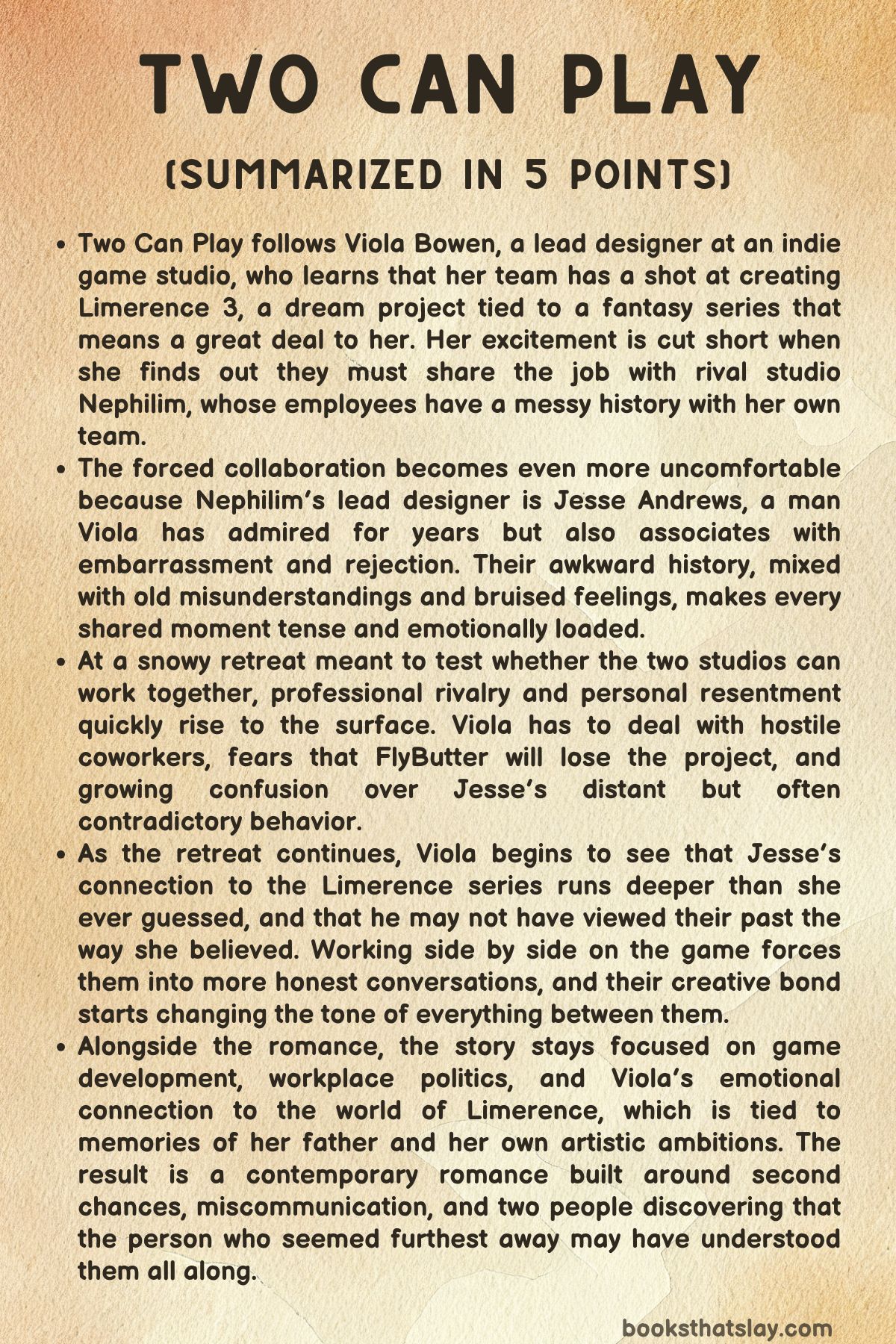
Viola Bowen enters a meeting with her boss, Mike, braced for terrible news about FlyButter Studios. Instead, she learns that StarPlay wants FlyButter to develop Limerence 3, a game based on the fantasy series that shaped her childhood and still carries deep emotional meaning because of her late father.
Viola is ecstatic, especially because she and her friend Ethan worked hard on the pitch. But Mike immediately reveals the problem: StarPlay wants more combat in the game, and since FlyButter is stronger at narrative and role-play than combat systems, StarPlay wants them to collaborate with Nephilim, their longtime rival.
The idea shocks everyone. The two studios have years of bad blood, and Mike announces that both teams will attend a retreat together at a mountain lodge to determine whether they can work together without destroying the project.
For Viola, the collaboration is especially difficult because Nephilim’s lead designer is Jesse Andrews. Years earlier, during one of her first job interviews, Jesse had stepped in after his sexist boss insulted her work and belittled her interest in games.
Jesse had followed her out afterward, checked on her, and encouraged her to apply to FlyButter instead. That moment stayed with her.
Over time, as she continued seeing him at conventions and industry events, her admiration became a crush. But every later interaction left her confused.
Jesse was never openly unkind, yet he always behaved with chilly politeness, keeping a distance that made Viola feel unwanted and embarrassed.
Her hurt became much sharper at a family engagement party the previous winter. Jesse happened to be there because he knew the groom, and during the party they ended up standing beneath mistletoe while her relatives loudly pushed them to kiss.
Viola thought they could laugh it off, but Jesse reacted with obvious discomfort and refused. Later she overheard him saying he wanted nothing to do with her.
The humiliation stayed with her, and by the time the retreat begins, she is already carrying resentment as well as the pain of years of confusion.
Mike pressures Viola into riding to the lodge with Nephilim because parking is limited and she is considered the least combative member of her team. She expects to travel with Otto, but the car belongs to Jesse.
The trip is miserable. Otto is rude, Ashley is dismissive, and Jesse barely speaks to her.
Worse, Viola watches him laugh and chat easily with the others, especially Ashley, while seeming not to notice her at all. She wonders whether Jesse and Ashley are involved, and the thought adds jealousy to her discomfort.
At the snowy luxury lodge, Viola swaps room assignments with Ethan so he can be closer to Shannon, whom he is secretly dating. The change leaves Viola in the quiet loft section of the building, only to discover that Jesse’s room is next to hers.
When she tries to make light conversation, Jesse only says he will do his best to stay out of her way. That answer reinforces her belief that he wants distance from her.
That night, after a strained dinner filled with awkwardness between the studios, Viola wanders into the library carrying The Sunken Heart, the first Limerence novel. The series matters to her not only because she loves it, but because it connects her to memories of her father reading it to her and her later reading it back to him when he became ill.
Before reaching the library, however, she overhears John from Nephilim saying that if the collaboration fails, StarPlay will likely hand the project to Nephilim anyway, since Jesse is strong at both combat and story while Viola only excels at story. Furious, Viola enters the library and finds Jesse there reading the same novel.
Certain he is part of the plan to undermine FlyButter, she confronts him. Jesse seems sincerely confused and denies that she did anything wrong to him.
When she tries to physically stop him from leaving, he pulls away sharply and exits. After he is gone, Viola notices that the copy of The Sunken Heart he left behind is old, heavily worn, and filled with tabs, proving that his connection to the series is deep and genuine.
The next morning Viola wakes upset and anxious that FlyButter may lose the project. At breakfast, the division between the two studios is even clearer.
Then Jesse unexpectedly stands up and addresses everyone. In a cold, commanding speech, he shuts down any attempt to sabotage the partnership.
He says that neither studio can handle Limerence 3 alone, and he makes it clear that he personally wants the collaboration to succeed. Anyone trying to destroy it can leave.
Viola is inspired by his honesty and publicly backs him, saying the goal is not simply to win but to make the best possible game. Mike supports her, and even Otto reluctantly agrees.
That public moment finally changes the atmosphere and pushes both teams toward cooperation.
The following day goes better. Ethan and Shannon help smooth relations, and Viola spends time with members of Nephilim in a more relaxed way.
That evening, though, Ashley asks Viola and Mike for help with Otto and Jesse, who have become extremely drunk during a gaming session. Mike takes Otto, leaving Viola to get Jesse to his room.
Jesse is sleepy and compliant, and she helps him into bed. As she prepares to leave, he catches her wrist and drunkenly confesses that she is the most beautiful thing he has ever seen and that he has thought about nothing but her since the first time he saw her.
Then he promptly falls asleep, leaving Viola shaken and unable to dismiss what he said.
The next day Ethan reveals that Jesse confronted him because he thought Ethan was cheating on Viola with Shannon, assuming Ethan and Viola were together. Ethan had to explain that he and Viola were never a couple.
This makes Viola wonder whether Jesse’s drunken confession was true. Later, during a design meeting, she sees clearly how deeply Jesse understands Limerence.
He speaks passionately about preserving the emotional core of the story, especially the importance of both Aqualuna and Noham. Viola finds herself completing his thoughts, and their creative connection becomes unmistakable.
Afterward, Viola confronts Jesse directly and asks if he likes her. He cannot deny it, though the conversation is interrupted before he can explain everything.
Still, his behavior changes. He starts helping her openly, warming her hands in the cold and acting with quiet tenderness.
At last he explains the misunderstanding that shaped years of distance. At her old interview, he had actually tried to ask her out for coffee.
Because Viola, nervous and confused, mentioned another man who would not leave her alone after rejection, Jesse took it as a sign that she wanted him to stay away too. Believing he was respecting her boundaries, he kept his distance ever since.
Viola is horrified and relieved at once to realize that their entire history of awkwardness grew from a misunderstanding.
Once that truth is known, the wall between them collapses. They spend time together in a hot tub, talking more openly, and the attraction between them becomes impossible to ignore.
Later Viola goes to his room on a flimsy excuse, and they finally speak honestly. She admits she has had feelings for him for years.
Jesse admits that his own feelings never disappeared and that he cannot approach her casually because she matters too much. Viola suggests they spend the rest of the retreat together, learning what this could become.
Jesse agrees, and they share their first real kiss.
From there, their relationship deepens quickly but not carelessly. They share breakfast alone, talk about past relationships, and clear up Viola’s fears about Ashley.
Jesse explains that he once dated someone for six months, but ended that relationship after the mistletoe incident because staying in it no longer felt fair. Their private conversations become more intimate, and once they are alone in his room, their emotional closeness turns physical.
The encounter is intense not just because of attraction, but because both understand how long this has been building. Afterward they stay together under the shower and then in bed, talking and touching with a sense of ease that surprises them both.
The days that follow only strengthen their bond. Jesse reveals how carefully he has remembered small details about Viola over the years, from how she braided her hair at an old conference to what dresses she wore.
Viola realizes that while she thought herself alone in her fixation, Jesse had been quietly carrying his own version of it all along. They also continue discussing Limerence 3, and Jesse confirms that he was the one who picked her résumé years ago because he immediately saw how talented she was.
Eventually Viola opens up about why the books matter so much to her. Her father introduced her to the series when she was young, and after he became sick she read the books back to him.
She admits that while designing Aqualuna for the game, she has been unconsciously minimizing Noham’s role because she wanted to protect Aqualuna from pain. Talking it through with Jesse, she realizes that this instinct has weakened the character, because loving Noham and risking heartbreak are essential parts of who Aqualuna is.
Jesse understands immediately, and together they arrive at a clearer vision for the adaptation.
Their time at the lodge ends when Mike announces that the roads have cleared and everyone will leave that evening. On the drive back, Viola feels content watching Jesse, even as she dreads returning to ordinary life.
Then Mike tells her that StarPlay called during the drive: the retreat worked, and she and Jesse will be the lead designers on Limerence 3. The news overwhelms her, especially because of what the project would have meant to her father.
Back in the parking lot, Viola and Jesse realize they never even exchanged numbers. Instead of giving her his phone number, Jesse gives her his address, making it clear that he wants something close, real, and immediate.
They also discover that they independently reached the same creative conclusion for the game: one path should allow Aqualuna and Noham to break the curse and end up together. The shared idea proves how fully they understand each other.
Smiling and already falling hard, Viola steps into his arms and tells him to take her with him.
A final chapter from Jesse’s point of view returns to their first meeting. Reading job applications, he had been struck at once by Viola’s portfolio and then by Viola herself, imagining an entire future in a single instant.
When his boss mistreated her, Jesse tried to help, even though it meant sending her toward FlyButter instead of keeping her near him. His attempt to ask her out failed, and he watched her leave believing he had lost something almost before it began.
That chapter reveals that from the very start, Viola was never invisible to him at all.
Characters
Viola Bowen
Viola is the emotional center of the story, and much of the character work depends on how deeply she feels things while trying not to let those feelings control her. She is talented, thoughtful, and clearly respected in her field, but she is also someone whose inner life is crowded with second-guessing, old embarrassment, and private longing.
Her connection to Two Can Play is shaped by both work and memory, because the Limerence series is tied to her father, her childhood, and the creative instincts that made her a designer in the first place. That history gives her a strong emotional core, but it also makes her vulnerable.
She is not simply competing for a project; she is trying to protect something deeply personal from being mishandled or taken away.
One of the most appealing things about Viola is the contrast between her professional competence and her emotional uncertainty. In meetings and creative discussions, she is sharp, perceptive, and brave enough to speak up when it matters.
In her personal life, however, she can become trapped inside assumptions. Her long fixation on Jesse grows out of small encounters, silences, and misunderstandings that she turns over in her mind for years.
Because she never fully understands his distance, she fills in the gaps with self-doubt and humiliation. That makes her reactions at the retreat feel believable.
Her anger is not just about one rude moment or one bad drive; it is the result of accumulated confusion and hurt.
She also has a stubborn dignity that becomes clearer as the story progresses. Even when she feels rejected, excluded, or threatened by Nephilim’s attitude, she does not collapse.
She becomes defensive, irritated, and sometimes impulsive, but she keeps choosing engagement over retreat. She backs Jesse publicly when it counts, tries to build peace between the teams, and continues searching for the best creative answer even while her personal emotions are in turmoil.
Her openness to growth is one of her strongest qualities. Once she learns the truth about the misunderstanding between her and Jesse, she does not cling to pride for its own sake.
She is embarrassed, but she also allows herself to be honest, vulnerable, and hopeful. That willingness to step toward clarity rather than away from it defines her as someone emotionally brave, not merely romantic.
Jesse Andrews
Jesse is built first as a mystery and only later revealed as one of the most emotionally intense characters in the story. From Viola’s perspective, he appears cold, remote, and almost impossible to read.
He is courteous but distant, never openly cruel but often so reserved that his behavior feels cutting anyway. That early presentation makes him seem arrogant or indifferent, especially because he is clearly admired, talented, and socially comfortable with other people.
Yet the deeper the story goes, the more that image is dismantled. What first looks like emotional detachment is eventually shown to be restraint, awkwardness, and an almost painful effort to respect what he thought were Viola’s boundaries.
What makes Jesse compelling is the scale of feeling hidden under that restraint. He is not casual by nature.
He notices details, remembers them for years, and attaches deep meaning to people and stories that matter to him. His worn copy of The Sunken Heart becomes one of the clearest windows into him because it reveals a private passion he has never advertised.
That detail changes him from a frustrating love interest into a fully dimensional person whose silence has always concealed intensity rather than emptiness. His speech at breakfast, where he forcefully shuts down sabotage and makes his own team fall in line, also shows another side of him: leadership rooted in seriousness and conviction.
He is not loud by habit, but when something matters, he is decisive.
Romantically, Jesse is defined by earnestness. Once he begins speaking honestly, it becomes clear that he has never treated Viola as a passing attraction.
His feelings have been longstanding, overwhelming, and tied to genuine admiration for her mind and talent as much as her beauty. This is why he struggles with the idea of keeping things light or casual.
He is a controlled person until emotion finally breaks through, and then the depth of it is unmistakable. At the same time, he is not idealized into perfection.
He handles misunderstanding badly by withdrawing instead of clarifying, and his silence causes years of unnecessary pain. That flaw matters, because it keeps him human.
He is not a fantasy of effortless emotional intelligence; he is a man who feels deeply, misreads a situation, and hides too much. The eventual revelation of his point of view makes him one of the richest characters in Two Can Play, because it reframes almost every earlier interaction without erasing the damage his distance caused.
Ethan
Ethan plays an important supporting role as Viola’s closest friend and emotional ally at FlyButter. He brings warmth and steadiness to the story, especially during the retreat, where tensions could easily have become unbearable.
Their friendship feels secure because it is built on trust, shared work, and a level of comfort that allows practical favors, quiet honesty, and mutual support without drama. He is one of the few people around Viola who seems to understand her well enough to notice what she needs even when she does not fully say it.
His hidden relationship with Shannon adds another layer to his character. It shows that he has his own emotional life and vulnerabilities, rather than existing only to support the heroine.
The secrecy around that relationship suggests caution, but not dishonesty in a malicious sense. Instead, it reflects the broader workplace environment, where personal entanglements can become complicated quickly.
Ethan’s role in helping ease tensions between the studios also highlights his social intelligence. He is a connector, someone who can soften awkwardness and make cooperation more possible.
He does not dominate the narrative, but he strengthens it by showing what healthy loyalty looks like. He is funny, useful, and discreet, and he gives Viola a sense of stability when other relationships feel uncertain.
Mike
Mike begins as the boss everyone fears may be about to announce catastrophe, which immediately places him in the familiar role of the corporate superior who controls other people’s futures. Yet he turns out to be more complex than that.
He is practical, sometimes manipulative in small ways, and willing to pressure employees when he thinks a goal matters, as seen when he maneuvers Viola into riding with Nephilim. But he also believes in her talent and gives her real space to shape events.
His leadership style combines calculation with support. He may not always be gentle, but he is invested in outcomes that go beyond politics.
He is especially effective as a character because he helps define the professional stakes of the story. He understands that collaboration can fail if people are allowed to indulge grudges, and once the retreat begins slipping toward hostility, he is willing to back public accountability.
His support of Viola during the breakfast confrontation matters because it shows he trusts her judgment and wants the project to succeed on creative terms, not just strategic ones. He is not written as a sentimental mentor, but as someone who recognizes value, expects maturity, and acts decisively when needed.
That makes him feel believable within the workplace setting.
Ashley
Ashley initially appears through Viola’s anxious and suspicious perspective, which makes her seem like a possible romantic rival and part of the closed social world that excludes Viola. She is competent, self-possessed, and clearly comfortable around Jesse, which naturally heightens Viola’s insecurity.
Her presence during the drive and early retreat scenes helps sharpen Viola’s sense of being left out, but Ashley is not ultimately reduced to a stereotype of the glamorous rival. As the story unfolds, it becomes clear that much of Viola’s discomfort is driven by assumption rather than fact.
Ashley’s more functional role is to help reveal the atmosphere inside Nephilim. She is close enough to the core group to see their habits, deal with their messes, and navigate tense moments.
When she asks for help with Jesse and Otto after they get drunk, she comes across as practical rather than dramatic. That moment shifts her image.
She becomes less a symbol of Viola’s jealousy and more a real coworker trying to manage ridiculous circumstances. Her character works because she contributes to early misunderstanding without being villainized for it.
Otto
Otto is one of the main carriers of hostility between the two studios. He is rude, combative, and resistant to collaboration, especially at the beginning of the retreat.
Through him, the reader sees how entrenched the resentment is between FlyButter and Nephilim. He does not hide his contempt, and that makes him useful as an external obstacle when so much of the central conflict is based on miscommunication and private feeling.
Otto makes the rivalry concrete.
At the same time, he is not entirely static. Though his support at the public breakfast reckoning is reluctant, it still matters.
He recognizes Jesse’s authority and eventually falls into line, which suggests he is not acting out of independent malice so much as team loyalty and habit. His drunken behavior later also adds some comic absurdity to his presence, softening him slightly without fully transforming him.
He remains abrasive, but he helps show that even the loudest antagonism can be redirected once leadership and purpose become clear.
Clara
Clara serves as one of the first signs that genuine cooperation between the studios may be possible. Viola’s attempt to be friendly with her is important because it breaks the pattern of total opposition, and Clara responds in a way that makes that effort feel worthwhile.
Her presence during the skiing scenes and team interactions helps open social space that is not dominated by Jesse, Otto, or old tension. She represents the possibility that the feud between the companies is not absolute.
Because she is not overloaded with drama, Clara’s character has a stabilizing effect. She helps the retreat feel less like a battlefield and more like a place where ordinary human connection can still happen.
In that sense, she supports one of the story’s broader ideas: that hostility often survives through momentum, and that small acts of friendliness can begin to interrupt it.
Shannon
Shannon is not one of the most heavily explored characters, but she is still important because of how she fits into Ethan’s storyline and the retreat’s shifting emotional balance. Her secret relationship with Ethan introduces a quiet parallel to the main romance: another bond being kept private in a workplace environment where personal and professional lines can blur.
That detail adds texture to the group dynamic and helps explain some of Ethan’s motivations during the retreat.
She also contributes to the growing sense that not everything is what Viola first assumes. Just as Viola misreads Jesse’s feelings, Jesse misreads Ethan and Shannon.
Their relationship becomes part of the chain of mistaken impressions that gradually gets corrected, allowing buried truths to surface. Shannon’s role may be smaller, but she helps hold together that larger structure of misunderstanding and revelation.
John
John functions mainly as a voice of cynical self-interest inside Nephilim. His comments about letting collaboration fail so that Nephilim might win the contract alone are what trigger one of the most important turning points in the story.
Through him, the threat to Viola’s hopes becomes explicit. He says aloud what she fears others may be thinking: that FlyButter is expendable and that she herself is less valuable than Jesse in key areas.
This makes him an instigator more than a rounded emotional figure, but it is an effective role.
His significance lies in what he exposes. He brings hidden sabotage into the open, forcing Viola to react and eventually pushing Jesse to declare himself publicly in favor of true collaboration.
Without John, the retreat might have remained passively tense. Because of him, the conflict sharpens into something that can finally be confronted.
Kevin
Kevin appears only in Jesse’s bonus chapter, but he is crucial in defining both Jesse and Viola’s origin point. His sexist treatment of Viola during the interview establishes the prejudice and disrespect she faced early in her career, while also creating the situation in which Jesse chooses to support her.
Kevin is less a complex person than a clear embodiment of the professional contempt Viola had to navigate. His dismissiveness makes Jesse’s defense of her more meaningful and helps explain why that first encounter stayed with both of them for so long.
Viola’s Father
Though he is not active in the present timeline, Viola’s father is one of the most emotionally important figures in the story. His connection to the Limerence books gives Viola’s passion its deepest roots.
He represents warmth, memory, loss, and the origin of her attachment to the fictional world she now has a chance to adapt. Because she read the books with him as a child and later read them back to him when he was ill, he becomes inseparable from her understanding of what the series means.
He is the reason her investment in the project never feels merely professional. Even in absence, he shapes her values, her emotional intensity, and her desire to get the adaptation right.
Themes
Miscommunication and Lost Time
So much of the emotional history between Viola and Jesse is shaped not by betrayal or lack of feeling, but by a misunderstanding that quietly hardens into years of distance. What makes this theme effective is that the mistake is believable: Jesse thinks he is respecting a boundary, while Viola experiences his restraint as rejection and even contempt.
Because neither of them ever fully explains what happened, each builds a private story about the other. Viola carries humiliation, confusion, and longing, while Jesse carries caution and self-denial.
Their eventual honesty shows how easily two people can suffer when they rely on assumption instead of direct conversation. The retreat forces them into repeated contact, which breaks the pattern and finally gives them space to ask the questions they avoided for years.
The result is not only romantic resolution, but a larger point about how silence can distort reality. Time is lost not because love is absent, but because fear, pride, and uncertainty prevent clarity.
Their relationship becomes real only when both stop interpreting from a distance and begin speaking plainly.
Creative Partnership and Shared Vision
The developing bond between Viola and Jesse is closely tied to the way they think about stories, design, and the emotional core of games. Their attraction is not built only on physical chemistry, but on the discovery that they understand the same fictional world with unusual depth.
Both care deeply about Limerence, and both see adaptation as more than a technical assignment or career opportunity. This gives their relationship intellectual and emotional weight.
When they begin finishing each other’s thoughts about Aqualuna, Noham, and the heart of the story, the narrative shows that intimacy can come from shared imagination as much as from confession or desire. The project becomes a place where trust forms, because each recognizes in the other a seriousness that is rare and deeply validating.
This theme also challenges the idea that work and love must remain entirely separate. Here, collaboration becomes a way of being known.
Their strongest moments often happen when professional insight turns into personal understanding, suggesting that the right creative partner can also become the right emotional partner.
Vulnerability Beneath Professional Defensiveness
Many characters in the book hide strong emotions behind competence, sarcasm, or guarded behavior, but Viola and Jesse embody this theme most clearly. Viola often uses irritation, internal commentary, or quick judgments to protect herself from feeling foolish or unwanted.
Jesse, in contrast, relies on distance, control, and composure, giving the impression that he is unaffected even when he feels things intensely. Their early interactions are full of defensive surfaces.
She assumes coldness where there is restraint, and he offers politeness when what he actually feels is overwhelming attachment. The retreat gradually strips these defenses away.
Jesse’s drunken confession reveals how much he has buried, while Viola’s confrontations show how badly she has been hurt beneath her outward anger. As they grow closer, both become more direct about fear, desire, memory, and emotional stakes.
This theme matters because it turns romance into an act of exposure rather than performance. Love does not emerge when they look flawless or composed; it emerges when they admit confusion, longing, and tenderness without hiding behind professionalism or pride.
Belonging, Memory, and Emotional Inheritance
Viola’s connection to the Limerence series gives the story a layer of emotional inheritance that extends beyond romance and career success. The books are not just source material for a game.
They are tied to childhood, to her father reading to her, and later to her reading back to him during illness. Because of this, the project represents memory, grief, and continuity all at once.
Her desire to work on it is partly professional ambition, but it is also an effort to honor something deeply personal. This theme gives the story a sense of belonging: Viola is not simply chasing a contract, she is trying to remain faithful to a part of herself shaped by love and loss.
Jesse’s equally sincere attachment to the books deepens this thread, because it suggests that shared devotion to art can create a home between people. The adaptation matters because it carries emotional history into a new form.
In that sense, game design becomes an act of preservation, allowing private memory to survive within collaborative creation and future storytelling.