The Housemaid’s Wedding Summary, Characters and Themes
The Housemaid’s Wedding by Freida McFadden is a short story that bridges the gap between The Housemaid’s Secret and The Housemaid is Watching.
It focuses on one high-stakes day in Millie’s life: the day she is supposed to marry Enzo. What should be a joyful, intimate wedding becomes shadowed by fear when Millie starts receiving violent threats from an unknown man. The story combines wedding-day nerves, emotional family pain, and the danger that follows Millie because of the women she has helped in the past. At the same time, it stays grounded in her relationship with Enzo, showing the trust, protectiveness, and tenderness between them as they prepare to build a family together.
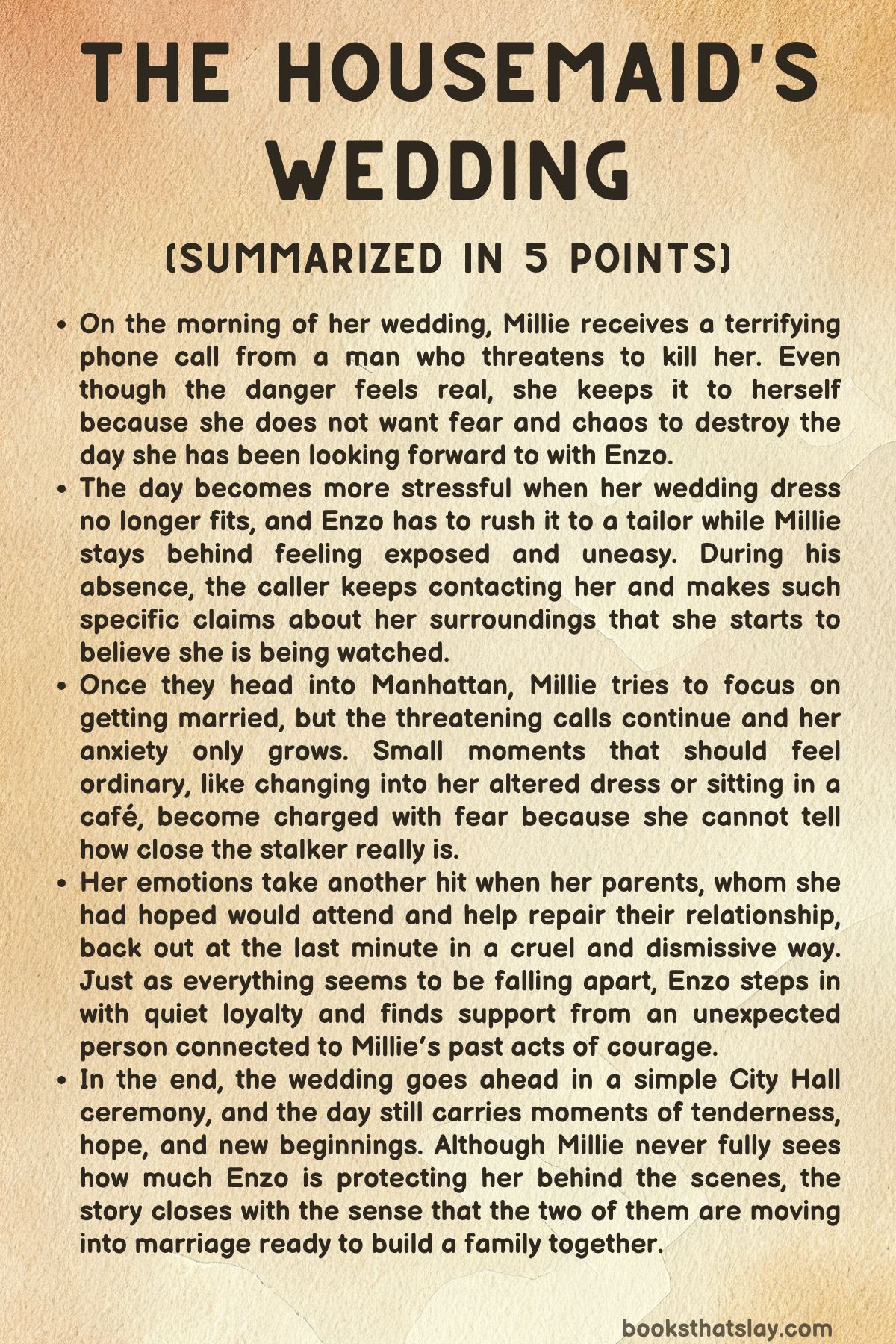
Summary
On the morning of her wedding day, Millie is awakened by a deeply disturbing phone call. A man threatens to slit her throat and kill her slowly.
Although the threat horrifies her, she tries to convince herself that it is probably not serious. Because she has helped women escape abusive husbands, she has made enemies before, and she assumes this may be another attempt to scare her.
She decides not to tell Enzo. She wants the day to remain happy, especially because they are finally getting married and because her parents, with whom she has a damaged relationship, are supposed to attend.
Since she is also pregnant, the wedding feels like the beginning of a new and more stable chapter in her life.
The morning immediately becomes chaotic for another reason. Millie discovers that the powder-blue dress she planned to wear no longer fits over her pregnant belly.
This sends her into panic, since the ceremony is only hours away. Enzo stays calm and promises he can fix the problem.
He takes the dress to a tailor friend who may be able to alter it in time. While he is gone, Millie is alone in the apartment and receives another threatening call.
This time the man sounds even more menacing. He says he can see her and tells her to look in the coat closet.
The call terrifies Millie. She becomes convinced there might really be someone in the apartment with her.
She grabs a butcher knife from the kitchen and approaches the closet, preparing herself for a possible attack. The tension builds as she stands there, ready to open the door.
Before she can do it, Enzo returns home. Not wanting to alarm him, she lies and says she thought there was a mouse in the closet.
Enzo opens it and finds nothing except her boots. The discovery proves that the caller was lying about being inside the apartment, yet it does not calm her much.
Instead, it tells her that someone is deliberately tormenting her and knows how to get inside her head.
Enzo and Millie head into Manhattan for their small City Hall wedding. They stop at a café to wait for Enzo’s tailor friend, who is supposed to bring back the fixed dress.
Millie is too nervous to eat or relax. Enzo, in contrast, remains upbeat and reassuring.
He seems genuinely excited to marry her and refuses to let small disasters ruin the day. Millie continues to think about the phone calls and tries to suppress her anxiety.
When she notices an older gaunt man outside the café, she becomes frightened that he could be the person stalking her. Instead, he turns out to be Giuseppe, Enzo’s tailor friend.
He has successfully altered the dress and saves the situation.
Millie goes into the café bathroom to change. The dress now fits, which gives her a brief sense of relief.
But that relief disappears when the stalker calls again. He comments on the dress and says he is standing right outside the bathroom door.
Millie panics. She reaches for her Mace, only to remember that she had lent it to a friend and never replaced it.
Her fear rises because the caller seems to know exactly where she is and what she is doing. Then she hears a woman’s voice outside the door and realizes the caller was bluffing about standing there himself.
Even so, she now understands that he is close enough to watch her movements. The threat feels more real than ever.
When she returns to the table, Millie thinks about finally telling Enzo everything. But when she sees how emotional and happy he is, she loses her nerve.
She does not want to spoil the day or make him worry, especially because they have already faced so much. She keeps silent and tries to act normal.
Soon after, she notices a bald man in the café staring at her. This seems suspicious, and her nerves make her immediately assume he may be the stalker.
Her anxiety follows her as they leave for City Hall.
Things get worse once they arrive. Millie receives a crushing phone call from her mother, who says that neither she nor Millie’s father will be attending the wedding after all.
What could have been a simple cancellation becomes an emotional attack. Her mother tells Millie that she is still a mess and criticizes her pregnancy and her choice of Enzo.
Instead of offering love or regret, she delivers rejection and cruelty. Millie is devastated.
The hope she had carried all day—that the wedding might also repair her relationship with her parents—is destroyed in a few moments.
Enzo immediately steps in to protect her. He takes the phone and tells her parents that they do not deserve to be part of Millie’s life if this is how they treat her.
He refuses to let them wound her further. His defense of Millie is fierce and unwavering, and it shows how completely he is on her side.
But their parents’ absence creates a practical problem too: they no longer have a witness for the wedding ceremony.
At the same time, Millie spots the bald man again and becomes convinced he is the one who has been threatening her. Angry and frightened, she marches up to confront him directly.
Instead of reacting like a criminal, the man introduces himself as Paul. He explains that Millie once helped save his sister from an abusive marriage.
He has not forgotten what she did for their family and is deeply grateful. Far from being her enemy, he is there because Enzo asked if he could help by serving as their witness.
Millie realizes she misjudged him completely, and the moment gives her a reminder that her work has also changed lives for the better.
Enzo then gives her another meaningful gift. Since the original wedding plans have gone so badly and her parents have disappointed her, he offers her a butterfly pin that belonged to his late sister, Antonia, who was murdered.
It serves as a deeply personal “something old.” The gesture touches Millie because it represents Enzo sharing a painful and precious part of his family with her. Even in the middle of fear and disappointment, he finds a way to make the wedding feel intimate and full of meaning.
Inside City Hall, the three of them wait for their number to be called. The setting is plain and bureaucratic rather than romantic, but for Millie it still matters because of what the ceremony represents.
As they sit there, she feels the baby kick for the first time. The moment is small but powerful.
It reminds her that this day is not only about marriage, but also about the child she and Enzo are going to raise together. It becomes a sign that despite the fear and hurt surrounding the day, something hopeful and alive is moving forward.
When their turn comes, Millie and Enzo are taken into a small ceremony room. Paul stands with them as witness.
The judge performs a simple wedding ceremony, asking the necessary questions and making the marriage official. Millie and Enzo both say yes.
They exchange plain gold bands. There is no grand audience, no glamorous setting, and none of the family support Millie once wished for.
Yet the moment still feels right. When the judge pronounces them husband and wife, Millie feels that, after everything she has survived and all the mistakes in her life, she has finally chosen something certain and good.
They kiss, and the wedding is complete.
The epilogue reveals what Millie never learned that day. Enzo had noticed the real stalker following them.
After the ceremony, he tracks the man into a restroom, corners him, and beats him badly. He threatens to break every bone in his body or kill him if he ever comes near Millie again.
Enzo keeps this confrontation secret because he does not want her wedding day overshadowed by more violence. He handles the danger alone so she can hold on to the happiness of the occasion.
Afterward, Millie suggests that if their baby is a girl, they should name her after Antonia. Enzo is deeply moved by the idea, since it honors his sister and joins his past to their future.
By the end of the story, Millie and Enzo leave as a married couple, no longer just surviving crisis after crisis, but stepping into family life together. Even though the day was marked by threats, disappointment, and fear, it ends with commitment, protection, and the promise of a new beginning.
Characters
Millie
Millie is the emotional center of the story, and nearly every event is filtered through her fear, hope, and determination. On what should be one of the happiest days of her life, she is forced to carry an enormous emotional burden almost entirely by herself.
The threatening phone calls immediately establish that she is a woman who has already seen enough violence and danger to recognize a serious threat, yet she still tries to control the situation on her own rather than let panic take over. That instinct says a great deal about her.
She is brave, but her bravery is not loud or dramatic. It comes through in the way she keeps moving forward despite fear, despite uncertainty, and despite the constant sense that something could go wrong at any moment.
Her character is also shaped by a deep habit of self-protection. She does not tell Enzo about the calls because she wants to preserve the wedding day, but that choice also shows how accustomed she is to handling pain privately.
Even when terrified enough to arm herself with a butcher knife, she still covers with a lie instead of admitting how badly shaken she is. That tendency suggests a life in which she has often had to be the one who absorbs danger, keeps order, and carries on.
At the same time, she is not defined only by fear. Her excitement about the baby, her wish to repair things with her parents, and her desire to build a stable future reveal how strongly she longs for love, family, and permanence.
Millie is especially compelling because she remains emotionally open despite repeated reasons to close herself off. Her parents have hurt her, strangers have threatened her, and her past clearly includes exposure to abusive men through the women she has helped.
Still, she continues to hope. She hopes her parents will come.
She hopes the wedding will go well. She hopes this day can mark the beginning of a different life.
That combination of toughness and vulnerability makes her feel human. By the end, when she embraces marriage, motherhood, and the idea of naming her daughter after Antonia, she comes across as someone choosing joy not because life has been easy, but because she has earned the right to claim it.
Enzo
Enzo is presented as a deeply steady and protective presence, someone whose love shows itself more through actions than grand speeches. Throughout the day, he acts as a counterweight to Millie’s fear.
Where she is tense and hyperaware, he is calm, cheerful, and focused on solving problems. When the dress no longer fits, he does not complain or panic; he immediately finds a way to fix it.
That practicality makes him seem dependable from the start. He is the kind of person who steps into a crisis and quietly handles what needs to be done.
At the same time, he is not merely calm in a passive way. He is emotionally invested, tender, and fiercely loyal.
His joy about the wedding gives the story warmth, and his reaction to Millie’s mother shows that his devotion is not sentimental but active. He refuses to let Millie be spoken to cruelly, and in that moment he becomes a defender not just of her feelings, but of her worth.
He sees clearly what her parents fail to see and does not hesitate to say they do not deserve a place in her life if they cannot treat her with love. That moment defines his moral center.
He is not gentle because he is weak; he is gentle because he chooses to be, until someone threatens the woman he loves.
The epilogue adds another dimension to him. He has noticed the stalker, understood the danger, and dealt with it in secret so Millie can keep her happiness untouched.
This reveals a darker, more dangerous edge beneath his warmth. He is capable of violence when needed, but the story frames that violence as an expression of protective love rather than cruelty.
His gift of Antonia’s butterfly pin further deepens him, because it shows his emotional generosity and his connection to grief. He carries the loss of his sister with him, yet he transforms that pain into a gesture of inclusion and blessing for Millie.
Altogether, Enzo comes across as loving, capable, and intensely committed, someone who offers both emotional safety and physical protection.
Paul
Paul appears late, but he serves an important role in reshaping both Millie’s fears and her understanding of her own impact on others. At first, he seems suspicious because she has been conditioned by the threatening calls to interpret unfamiliar male attention as danger.
When she sees him watching her, and then notices him again outside City Hall, he becomes a natural target for her fear. The fact that he turns out not to be a threat but a grateful ally gives his character a quiet emotional significance.
His presence reveals something powerful about Millie as well. Paul is connected to a woman Millie once helped escape abuse, and his gratitude shows that her earlier actions had real and lasting consequences.
He is not developed through a long backstory, but through what he represents: proof that Millie’s courage and compassion have changed lives. His willingness to serve as the wedding witness also makes him more than a symbolic figure.
In a moment when Millie has just been abandoned by her parents, Paul helps fill the empty place they leave behind. He becomes part of the emotional repair of the day.
Because of this, Paul functions as a reminder that goodness can return from unexpected places. He enters the story under the shadow of suspicion and exits as a figure of kindness and respect.
That reversal is important in a narrative filled with threat, because it shows that strangers are not always dangers and that past acts of decency can come back as support when most needed.
Millie’s Mother
Millie’s mother is one of the harshest figures in the story despite appearing only briefly. Her importance lies not in how much page time she gets, but in the emotional damage she causes with just a few words.
On a day when Millie is already frightened and overwhelmed, her mother’s call delivers a different kind of violence: rejection dressed as judgment. Instead of offering love, reassurance, or even a polite excuse, she attacks Millie’s choices, her pregnancy, and the man she is about to marry.
This cruelty makes clear that the estrangement between them is not the result of mere distance or misunderstanding. It comes from a deeper pattern of emotional harm.
What makes her characterization effective is how directly she undercuts Millie’s hope. Millie has been holding onto the possibility that the wedding might begin to heal their broken relationship, and her mother destroys that hope without hesitation.
In doing so, she becomes a symbol of the kind of family wound that does not heal simply because an important day arrives. Her response suggests someone controlling, judgmental, and unwilling to meet her daughter with generosity.
She also helps define Millie by contrast. Where Millie longs for connection, her mother withholds it.
Where Millie tries to move toward love and family, her mother responds with contempt. That contrast sharpens the reader’s understanding of why Millie’s chosen family matters so much.
The mother may not be explored in depth, but she leaves a strong impression as a source of pain that Millie must finally stop chasing.
Giuseppe
Giuseppe is a minor but memorable supporting figure whose role brings a touch of practical kindness into an otherwise tense day. At first, his appearance unsettles Millie because she is already frightened and on edge, so his gaunt presence outside the café briefly seems threatening.
Once his identity is revealed, however, he becomes another example of how fear has distorted her ability to trust what she sees around her.
His most important function is simple but meaningful: he helps save the wedding day by altering the dress in time. In a story filled with menace, emotional disappointment, and constant disruption, that small act of competence matters.
He represents the network of ordinary people who quietly keep life moving forward. His role may be limited, but he contributes to the sense that Enzo is surrounded by loyal connections and that Millie is being drawn into a wider circle of support.
Because he appears only in relation to the dress, Giuseppe is not psychologically complex, yet he still serves a useful purpose in the story. He turns a practical crisis into a solvable problem and briefly restores order.
That makes him a small but welcome stabilizing presence.
Antonia
Antonia never appears directly, yet her absence carries emotional weight. As Enzo’s murdered sister, she exists in the story as a memory shaped by loss, grief, and enduring love.
The butterfly pin that belonged to her becomes one of the most meaningful objects in the narrative. By giving it to Millie, Enzo is not only offering a sentimental token for the wedding; he is inviting Millie into a part of his deepest emotional history.
Through that gesture, Antonia becomes more than a tragic backstory detail. She represents the family Enzo has lost and the family he hopes to build again in a new form.
Her memory connects death and renewal, grief and marriage, mourning and future parenthood. When Millie later suggests naming their daughter in Antonia’s honor, it confirms that Antonia’s place in Enzo’s heart is not private or closed off.
She becomes part of the foundation of the family they are creating together.
Even in absence, Antonia feels important because she reveals Enzo’s capacity for remembrance and emotional depth. Her presence in memory softens the harder edges of the story and gives the ending an added layer of tenderness.
The Stalker
The stalker is less a fully individualized character than a concentrated force of menace, but he is still effective because of the way he operates. He remains unnamed throughout the storyline of The Housemaid’s Wedding. His power comes from surveillance, intimidation, and psychological manipulation rather than direct presence for most of the plot.
By calling Millie repeatedly, claiming to see her, and making specific comments about her surroundings and clothing, he invades what should be an intimate, joyful day and turns it into a day of constant dread. He understands that fear can be as disruptive as physical violence, and he uses that knowledge to control her emotions from a distance.
What makes him especially disturbing is that he emerges from the consequences of Millie’s past efforts to help abused women. He seems to belong to the world of men who resent her for interfering with their power.
That connection gives him symbolic weight. He is not only one dangerous man, but also a reminder of the hatred and retaliation that can follow acts of courage.
By the time Enzo confronts him in the epilogue, the stalker is stripped of the mystery that made him frightening. He becomes smaller, weaker, and less powerful once faced directly.
That shift matters because it turns him from an unseen terror into a coward who relied on intimidation. His role is to create suspense, but also to highlight the strength of the bond between Millie and Enzo by showing what rises against them and what ultimately fails.
Themes
Love as Protection
Care is shown less through sentimental speeches and more through practical, immediate acts of protection. Millie and Enzo are both trying to shield each other from fear on a day that is supposed to mark joy and commitment.
Millie hides the threatening calls because she does not want panic to overshadow the wedding, while Enzo quietly handles problems as they arise, from fixing her dress crisis to later confronting the stalker without telling her. Their choices are not perfect, because secrecy creates distance, yet the story presents that secrecy as coming from devotion rather than mistrust.
Love here means taking on burdens privately so the other person can breathe a little easier. Even the small details support that idea: his effort to preserve the ceremony, his defense of her when her mother attacks her, and her wish to honor his late sister through their daughter’s name.
The relationship feels rooted in action, not performance. Marriage is therefore presented not simply as a romantic milestone, but as a promise to stand between the other person and harm, humiliation, and loneliness.
The Search for Family and Belonging
The wedding carries emotional weight because it is not only about legal union, but also about the family Millie hopes to build and repair. She begins the day wanting two kinds of acceptance: a future with Enzo and reconciliation with her parents.
That hope is crushed when her mother rejects her again, dismissing her pregnancy, insulting Enzo, and refusing to attend. The cruelty of that conversation makes clear that biological ties do not automatically create safety or love.
Against that failure, the story offers a different model of family, one chosen through loyalty, kindness, and mutual care. Enzo becomes the person who protects her dignity when her parents will not.
Paul, a near stranger, steps in as witness because of the good Millie once did for his sister, suggesting that human connection can return in unexpected ways. Even Antonia, though dead, becomes part of this new family structure through memory and inheritance.
By the end, belonging is no longer attached to parental approval. It is found in the household Millie and Enzo are forming, with their unborn child at its center.
Fear Beneath Ordinary Happiness
One of the strongest tensions in the story comes from the collision between domestic happiness and lurking danger. A wedding day usually carries images of celebration, anticipation, and order, yet Millie moves through the day under the pressure of surveillance and threat.
The phone calls turn ordinary spaces into sources of dread: her apartment, the closet, the café bathroom, even City Hall. Because the stalker is mostly unseen, fear becomes psychological as much as physical.
Millie cannot trust what she sees, and every stranger starts to look dangerous. This creates a world where joy is constantly interrupted by anxiety, showing how violence and intimidation can invade even the most intimate milestones.
At the same time, the story refuses to let fear fully take control. The ceremony still happens, the vows are still spoken, and the baby’s first kick becomes a powerful reminder of life moving forward.
The contrast suggests that happiness is not the absence of threat, but the decision to keep claiming moments of meaning despite it. Fear remains present, but it does not win.
Renewal Through Commitment
The wedding marks a turning point because it transforms a day of disorder into one of affirmation and forward movement. Nearly everything that could go wrong does go wrong: the dress does not fit, the threats intensify, the parents fail her, and Millie feels exposed and unsupported.
Yet each setback strips away fantasy and leaves only what truly matters. By the time the ceremony takes place, the focus is no longer on appearances or perfect family participation.
What remains is a clear choice between two people who want to build a life together. The first kick of the baby just before the ceremony deepens this sense of transition, linking marriage with new life and future responsibility.
The butterfly pin from Antonia also adds another layer, carrying grief from the past into a moment that points ahead. The ending reinforces renewal by showing the couple leaving not simply as bride and groom, but as the beginning of a family unit shaped by survival, loyalty, and hope.
Commitment becomes the force that turns pain, rejection, and danger into the starting point for something steadier.