The Sea Spinner Summary, Characters and Themes
The Sea Spinner by Julie Johnson is a fantasy romance about Rhya, an Air Remnant caught between war, prophecy, grief, and two powerful kings who both pull at different parts of her heart.
The book follows the aftermath of a devastating attack on Caeldera, then moves into the shining sea kingdom of Hylios, where Rhya begins to understand her maegic, her history, and the cost of being treated as a weapon. Julie Johnson builds the story around elemental power, political alliances, old betrayals, and a heroine who must decide whether love is enough when freedom and equality are still uncertain. It’s the 2nd book of the Reign of Remnants series.
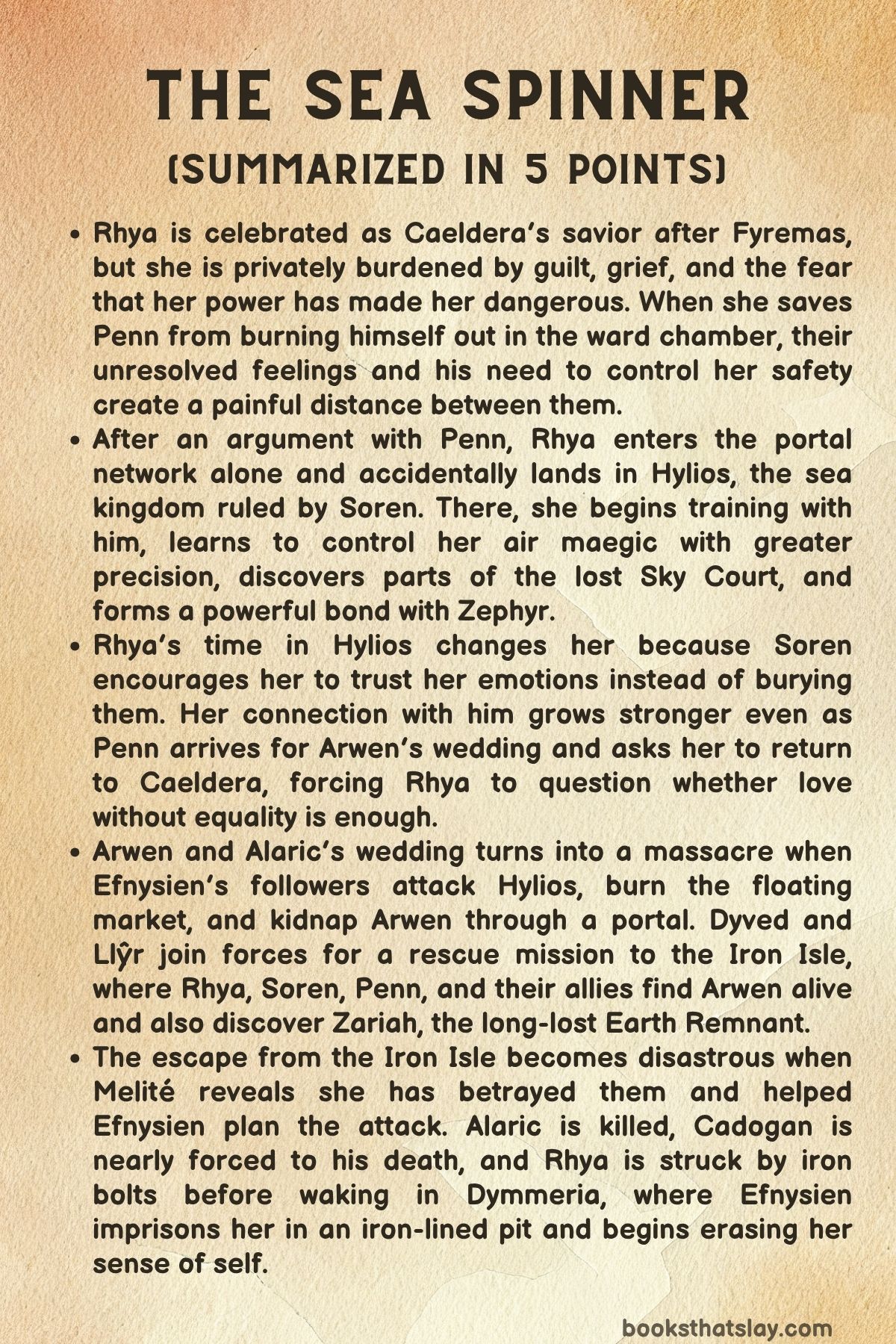
Summary
The story begins after the devastation of Fyremas, when Caeldera is broken, Queen Vanora is dead, and Rhya has already been turned into a public legend. The people sing of her as a savior, but Rhya privately carries fear, guilt, grief, and the memory of everything the songs leave out.
Rhya finds Pendefyre deep in the ruined palace’s ward chamber, forcing dangerous amounts of fire maegic into the city’s defenses. Blood pours from him as he loses himself to the work, and Rhya saves him by drawing part of his fire into herself through their Remnant bond.
Penn survives, but he is furious that she risked herself. Their argument reveals the main tension between them: Penn is consumed by guilt and terror, while Rhya refuses to be protected in a way that makes her powerless.
Rhya takes Penn to the apothecary’s shop where she has been living. Their quiet time there is tender and awkward, filled with exhaustion, unspoken desire, and the weight of the kiss they have avoided discussing.
By morning, Penn is gone. Rhya returns to the infirmary, where Caeldera’s losses remain everywhere: injured people, limited supplies, grieving survivors, and friends who are either distant, wounded, or leaving.
Carys still refuses to see Rhya after Uther’s death, which deepens Rhya’s guilt. Teagan leaves Caeldera after losing Keda, and Rhya feels increasingly alone in a city that needs her but does not truly understand her.
When earthquakes begin worsening, the city faces another threat from Frostlander longships. General Yale challenges Penn’s authority and publicly blames Rhya for Caeldera’s suffering, forcing Penn to step in and protect her from his cruelty.
Penn later takes Rhya to Blister Bight, a strange coastal place of sulfur pools, portals, natural maegic, and fire salamanders. The visit begins as a quiet escape, but it becomes another painful confrontation about fear, love, control, and the danger of Efnysien.
Rhya wants Penn to trust her as an equal, while Penn wants to keep her away from danger. Their attraction breaks through in a fierce kiss, but when Penn admits he has wondered whether his feelings for her distracted him before Fyremas, Rhya is deeply hurt.
Angry and reckless, she enters the portal network alone during a storm. Penn’s warnings prove true when she loses her way in the leylines and nearly loses herself before landing unexpectedly in Soren’s bathhouse in Hylios.
Soren, the Water Remnant and king of Hylios, quickly realizes how exhausted and emotionally battered Rhya is. Instead of returning her to Caeldera, he keeps her in Hylios, insisting that she needs food, rest, and training.
Hylios gives Rhya a new world: white stone, blue roofs, canals, gardens, bridges, sea air, and towering beacons. Soren moves through the city freely, loved by his people in a way that surprises Rhya and contrasts with the formal distance of other courts.
A strange ship arrives in the harbor, bringing danger instead of peace. Rhya and Soren board it and fight an imeera, a monstrous sea creature, and Soren pushes Rhya to use her air maegic with purpose rather than panic.
During the fight, Rhya channels Soren’s water maegic and begins to understand control in a new way. Power does not have to be wild destruction; it can be guided, shaped, and used with intention.
After the creature is defeated, Rhya meets Arwen, Soren’s sister, who treats her with open hostility. Arwen sees Rhya as dangerous, disruptive, and unwanted, especially with her wedding and the city’s stability under pressure.
Soren shows Rhya more of Hylios, including its defenses and aviary. A furious message from Penn proves that he is worried about her, and Rhya breaks down afterward, overwhelmed by guilt, desire, longing, and confusion.
Soren urges Rhya to remain in Hylios until midsummer, when Penn is expected for Arwen’s wedding and political talks. Rhya agrees, knowing that returning to Caeldera immediately would only place her back inside the same unresolved pain.
Her training begins with careful lessons in finesse. Soren teaches her to move a feather with delicate currents, study her instincts, and use emotion as direction rather than something to bury.
Rhya also learns more about the Remnants, the lost Sky Court, the Cull, Emperor Belenus, and earlier wind wielders. The knowledge makes her realize that her identity has been hidden from her for longer than she knew.
When Frostlander ships approach Hylios, the city shifts into defense. Arwen leads from the sea gate on a winged Paexyri horse, Soren attacks from the water, and Rhya uses air maegic from the walls to help drive the enemy back.
The victory proves that Rhya’s training is changing her. She is no longer only surviving bursts of power; she is learning to act with precision under pressure.
After the battle, Rhya meets more of Soren’s world, including Yara and the Paexyrian women. She also meets Melité, Soren’s half-siren sister, whose power affects Rhya against her will and exposes a cruel, jealous side of Soren’s family.
Soren takes Rhya to the Kettle, a public network of hot springs, where their attraction becomes impossible to ignore. Their intimate encounter leaves Rhya shaken because she wanted it, but she is still emotionally tied to Penn.
Later, Soren takes Rhya to the Vale, a secret refuge connected to the lost Sky Court. There she meets Zephyr, a winged horse tied to her air heritage, and flight gives her a sense of freedom and belonging she has never known.
Soren also gives Rhya the Whip of Light, a Sky Court weapon once used by Queen Arianrhod. With it, she learns to channel lightning with new focus, gaining a stronger connection to her inheritance.
When Penn arrives in Hylios with Jac, Mabon, Cadogan, and Farley, old feelings return immediately. At a war council, Soren and Vaughn reveal more about Efnysien, who was once Soren’s stepbrother and was banished after trying to assault Arwen.
Penn wants immediate action against Efnysien, but Soren warns that Dymmeria and the Husk Desert cannot be attacked carelessly. Their political disagreement turns personal when Penn accuses Soren of taking the place he left empty in Rhya’s life.
Alone with Rhya, Penn finally asks her to return to Caeldera. He admits that the city feels empty without her, but when she asks whether she would truly be his equal, he cannot fully give her the answer she needs.
Arwen and Alaric marry in a brilliant ceremony, but Rhya remains torn between Penn, Soren, Caeldera, and Hylios. A letter from Carys changes her by offering forgiveness for Uther’s death and urging her to live fully instead of wasting herself in guilt.
Rhya finds Soren at the sea organ, where he expects her to say goodbye. Instead, she moves toward him, and their guarded attraction finally becomes open before alarms interrupt them.
The floating market is burning, and two attackers shout loyalty to Shadowfall before killing themselves. Soren realizes the fire is only a diversion, and smoke rising from the royal grounds confirms a much greater attack.
At the wedding feast, attackers have slaughtered guests and allies. Arwen has been taken through Soren’s bathhouse portal by men using fae blood, and Rhya interrogates a survivor brutally enough to learn that Arwen has been taken to the Iron Isle.
Hylios and Dyved unite for the rescue. Yara vows revenge after Paexyri deaths, Melité insists on joining, and Rhya sees a disturbing mural in Soren’s room that resembles herself as a destructive force.
The rescue party sails toward Dymmeria on black-sailed ships. Rhya and Soren combine wind and water to speed the journey, making their bond visible enough to wound Penn.
Near Dymmeria, an earthquake sends sand into the sea and creates a huge wave. An octopaeron crushes one ship, and when Soren disappears beneath the water, Rhya dives after him.
She finds him unconscious on the seafloor and forces breath and maegic back into him, nearly destroying herself to save him. When the creature attacks again, they fight free together, and Rhya carries them into the sky, discovering a new level of flight.
At the Iron Isle, the rescue party enters under fog, climbs the prison walls, kills corrupted guards, and moves through torture chambers, blood vats, and traps. They find Arwen alive but deeply traumatized.
They also discover Zariah, the long-lost Earth Remnant, feral and terrified after years of captivity. Rhya refuses to leave her behind, and Vaughn carries her out as earthquakes tear the prison apart.
The escape becomes a disaster when Melité reveals she has betrayed them. She helped Efnysien attack Hylios, use portals, kidnap Arwen, and trap the rescuers, and her treachery leads to Alaric’s death and nearly kills Cadogan.
Rhya fights beside Penn and helps him reach safety, but iron bolts strike her lung, stomach, and heart before she can escape. She falls as Soren screams through their bond.
Rhya wakes in Dymmeria, gravely wounded and imprisoned by Efnysien. He has become monstrous, red-eyed, and sustained by blood maegic, able to drain life with a touch.
Melité stands with him, carrying Rhya’s Whip of Light and eager to hurt her. Efnysien shackles Rhya with black stone cuffs made from dead portals, damaging her mind and weakening her sense of self.
He then has her thrown into a deep iron-lined pit in the Husk Desert, using her fear of confinement against her. Time fractures into months and years as he taunts her with the claim that no one has come, and the cuffs slowly erode her memory until even her name begins to fade.
Characters
Rhya
Rhya is the emotional and maegical center of the book, a young woman forced to carry the weight of prophecy, public myth, and private grief all at once. At the beginning, Caeldera’s people see her as a hero after Fyremas, but her own experience is far more painful: she remembers fear, death, responsibility, and the terrifying cost of power.
Her journey in The Sea Spinner is not simply about becoming stronger. It is about learning that strength without self-knowledge can become another kind of prison, especially when everyone around her wants to define what she should be.
Rhya’s relationship with Penn reveals her need for equality. She loves him and is deeply tied to him through history, battle, guilt, and the Fire Remnant bond, but she begins to understand that love cannot survive if it requires her to shrink herself for his comfort.
With Soren, Rhya discovers another version of herself. His training teaches her control, but more importantly, he pushes her to own her feelings, choices, anger, desire, and fear without apologizing for their existence.
By the time she bonds with Zephyr, wields the Whip of Light, saves Soren from the sea, and helps rescue Arwen and Zariah, Rhya has become far more than Caeldera’s symbol. Her capture by Efnysien is devastating because it attacks the identity she has only just begun to claim.
Pendefyre / Penn
Penn is a king shaped by guilt, duty, fire, and fear. After Caeldera’s devastation, he pours himself into the wards as if suffering enough might compensate for the lives lost under his protection.
His love for Rhya is intense but deeply conflicted. In The Sea Spinner, Penn wants Rhya near him, yet he also wants to keep her away from danger, and that contradiction becomes one of the central wounds between them.
Penn’s protectiveness is not empty affection; it comes from real terror. He knows Efnysien remains dangerous, and he cannot endure the thought of Rhya being taken, harmed, or killed because of the war around them.
Still, his failure lies in how often he turns fear into restriction. Even when he speaks honestly in Hylios and asks Rhya to come home, he struggles to promise her the freedom and equal standing she needs.
Penn is not cruel in the way Yale or Efnysien is cruel, but he is trapped by restraint. His tragedy is that he loves Rhya deeply while failing, at least for much of the story, to trust her fully as a partner in power and choice.
Soren
Soren is the Water Remnant, the king of Hylios, and one of the most important forces in Rhya’s transformation. He first appears to her as playful, seductive, and difficult to read, but beneath that surface is an ancient ruler burdened by memory, regret, and loneliness.
Soren’s greatest strength is his understanding of controlled feeling. Unlike Penn, he does not ask Rhya to suppress herself; he teaches her to direct what she feels until emotion and maegic work together rather than against each other.
His bond with Rhya develops through training, danger, honesty, and desire. He gives her tools, knowledge, and access to hidden parts of her heritage, including the Vale, Zephyr, the Whip of Light, and the memory of the Sky Court.
Soren is also morally complicated because his past choices have consequences. His decision to banish Efnysien instead of killing him allowed an old threat to grow, and Arwen’s kidnapping forces him to confront the cost of that mercy.
What makes Soren compelling is that his confidence never fully erases his vulnerability. He wants Rhya to choose him, but he is also afraid that truths he has hidden will drive her away.
Arwen
Arwen is fierce, sharp-tongued, proud, and difficult, but the book gradually reveals that her hostility is rooted in history, power, and self-protection. As Soren’s sister and a major figure in Hylios, she guards her city and family with ferocity.
Her early treatment of Rhya is harsh and suspicious. She sees Rhya as disruptive, dangerous, and possibly another source of instability at a time when her own wedding and kingdom are under pressure.
Arwen’s command during the Frostlander attack reveals her true stature. When she leaps from the sea gate and takes to the sky on a Paexyri horse, she becomes a symbol of Hylian courage and military discipline.
Her kidnapping and trauma on the Iron Isle change the tone around her. She is no longer only the hostile sister or proud bride; she becomes a victim of Efnysien’s obsession and Melité’s betrayal, and Alaric’s death adds another terrible loss to her story.
Efnysien
Efnysien is the novel’s clearest image of power corrupted by obsession. Once tied to Soren’s family as a stepbrother, he becomes a figure of blood maegic, experimentation, cruelty, and revenge.
His fascination with fae abilities, especially Arwen’s, reveals a hunger to possess what he cannot naturally command. His attempted assault on Arwen and later abduction of her show that he treats people as sources of power rather than as living beings.
By the time Rhya wakes in Dymmeria, Efnysien has become almost corpse-like, sustained by unnatural maegic and able to drain life from others. His body reflects his moral state: decayed, hungry, and dependent on violation.
His treatment of Zariah and Rhya reveals his deepest horror. He does not merely want to kill Remnants; he wants to own, break, study, and use them, turning prophecy and elemental power into instruments of imprisonment.
Melité
Melité is dangerous because her betrayal grows out of jealousy, resentment, and a willingness to use intimacy as a weapon. As Soren’s half-siren sister, she has a power that can pull at others’ bodies and choices, which makes her presence unsettling from the start.
Her early encounter with Rhya shows cruelty wrapped in performance. She enjoys provoking Soren, humiliating Rhya, and testing the limits of what others will allow her to do.
Her later betrayal at the Iron Isle confirms that her malice is not merely family rivalry. She has actively helped Efnysien attack Hylios, use portals, kidnap Arwen, and trap the rescue party.
Melité’s role is especially disturbing because she targets emotional bonds as well as bodies. She hurts Arwen by helping cause Alaric’s death, nearly destroys Cadogan through siren control, and wounds Soren by proving that treachery has lived inside his own family.
Carys
Carys represents grief, silence, and the long shadow left by Uther’s death. For much of the book, her refusal to see Rhya keeps Rhya trapped in guilt, even though that guilt is more complicated than direct blame.
Her absence is emotionally powerful because Rhya respects it. She wants to help Carys and baby Nevin but does not force herself into their lives, showing how much she has learned about boundaries and pain.
Carys’s letter becomes a turning point. By telling Rhya that she does not blame her, thanking her for saving her and Nevin, and urging her to live fully, Carys gives Rhya a kind of permission she could not give herself.
Through Carys, the story shows that forgiveness does not erase grief, but it can release someone from carrying punishment forever. Her letter helps Rhya move toward desire, choice, and life instead of endless self-denial.
Farley
Farley is one of Rhya’s most grounded connections to Caeldera and the Ember Guild. She brings warmth, bluntness, and loyalty into scenes where Rhya might otherwise be swallowed by guilt or isolation.
Her return to active duty after injury shows resilience, but her importance is not only military. She understands enough of Rhya’s pain to speak honestly about Carys without feeding Rhya’s self-blame.
Farley also acts as a bridge between Rhya’s old life and the wider conflict. When she arrives in Hylios with Penn’s delegation, she carries the familiarity of Caeldera into a setting where Rhya has already begun to change.
Her drunken collapse at the wedding feast offers a small human moment in a story crowded with politics and war. Farley reminds the reader that survival also includes friendship, foolishness, and the need for ordinary relief amid catastrophe.
Yara
Yara is bold, loyal, and direct, a Paexyrian woman who quickly becomes one of Rhya’s strongest links to the living culture of Hylios. Her humor and confidence make Rhya feel less alone in Soren’s world.
Her bond with the Paexyri horses gives her character a sense of freedom and skill. Through Yara, Rhya learns that the winged horses are not simply weapons or symbols, but companions tied to trust and identity.
Yara’s grief after Umyr’s death is sharp and immediate. Her vow of revenge shows that she is not only playful or welcoming; she is a warrior whose love for her people and creatures can turn fierce when they are harmed.
She also helps Rhya enter parts of Hylios that Soren alone could not show her in the same way. Yara makes the city feel social, lived-in, and loyal beyond the royal household.
Vaughn
Vaughn brings warmth, blunt humor, and old history into the story. As Soren’s half-Titan brother, he is physically imposing, but his personality is surprisingly open and mischievous.
His arrival in the Vale interrupts the emotional intensity between Rhya and Soren, but it also expands the reader’s understanding of Soren’s family. Not every sibling bond in that household is poisoned like Melité’s.
Vaughn’s recognition that Rhya resembles someone important hints at buried truths about her heritage. His reaction suggests that the history of the Sky Court and the Remnants is more personal than Rhya yet understands.
During the Iron Isle rescue, Vaughn’s strength becomes essential when he carries the feral Earth Remnant out of captivity. His struggle with Zariah shows both his physical power and his willingness to risk himself for someone too broken to trust rescue.
Zariah
Zariah, the lost Earth Remnant, appears late but changes the meaning of the earthquakes that have shaken the land throughout the book. Her captivity suggests that the blight and tremors are not abstract disasters; they are tied to the suffering of a living person.
When Rhya finds her, Zariah is feral, terrified, and violent. Her reaction is not simple aggression, but the survival response of someone imprisoned and tortured long enough to lose trust in anyone approaching her.
Her presence also mirrors Rhya’s possible fate. Efnysien kept Zariah as a captive Remnant, and by the end he intends to do the same to Rhya, making Zariah a warning of what long imprisonment can do.
Zariah’s rescue matters even before she can speak or explain herself. Rhya’s refusal to leave her behind proves that Remnant solidarity is not only prophecy, but a moral choice made in the middle of disaster.
Alaric
Alaric’s role is tied closely to Arwen, but he is more than a ceremonial groom. His love for her is clear in his helpless devastation when she is taken and in the desperate urgency of the rescue.
During the Iron Isle mission, he carries Arwen after she is found, turning his body into the support she needs when trauma has left her shattered. That image gives their relationship tenderness amid violence.
His death is one of Melité’s cruelest acts. By ordering soldiers to shoot him in front of Arwen, she does not simply kill a man; she destroys a future that has barely begun.
Alaric’s loss gives the wedding attack a lasting emotional cost. The celebration that began as alliance, joy, and renewal is transformed into grief, showing how quickly Efnysien’s reach can corrupt moments of hope.
Cadogan
Cadogan adds loyalty, dry humor, and vulnerability to Penn’s side of the story. His presence among the Dyvedi delegation helps show that Penn does not stand alone, even when political tension isolates him from Soren.
At the wedding feast, his fascination with the siren sisters adds levity before the attack. That same attraction later becomes dangerous when Melité uses siren power to force him toward death.
Cadogan’s near-fall demonstrates how terrifying siren control can be. It strips away will, making a strong person move against his own survival.
His survival matters because it keeps the betrayal from becoming only symbolic. Through Cadogan, the story shows the personal cost of Melité’s power on someone the reader has seen as lively, loyal, and human.
Jac
Jac is practical, observant, and often useful in moments when emotion threatens to overwhelm others. His decision to steer Rhya onto the Dyvedi vessel during the rescue voyage physically places her near Penn, showing that he understands the emotional currents around the group.
He also represents the political and personal complexity of Dyved’s alliance with Llŷr. Old rivalries shape his arrival in Hylios, yet new connections, including his charged dynamic with Bretiax, suggest that alliances can form in unexpected places.
Jac’s role is not as central as Rhya, Penn, or Soren’s, but he helps keep the larger cast active and human. He is one of the figures who makes the rescue party feel like a fragile union of people, not only kingdoms.
Lestyn
Lestyn is a young Life Guild novitiate whose presence at the infirmary shows how badly Caeldera has been stripped of experienced healers. He is still learning, but his work beside Rhya gives the ruined city a sense of continuation.
His youthful crush on Teagan adds innocence and sadness to the early part of the book. When Teagan leaves Caeldera, his heartbreak reflects a smaller version of the losses everyone is carrying.
Later, Carys’s letter reveals that Lestyn has moved in with her, suggesting that healing in Caeldera is not only medical. People are forming small households, bonds, and acts of care in the ruins.
Lestyn matters because he represents the ordinary rebuilding that continues while kings and Remnants face larger threats. His quiet usefulness balances the grand scale of maegic and war.
Themes
Power, Control, and the Fear of Becoming a Weapon
Rhya’s power is never treated as simple strength. From the beginning, others turn her into a symbol, a danger, a savior, or a tool, while she privately fears that killing and maegic are changing her into someone she cannot recognize.
That fear becomes sharper because each kingdom wants something from her. Caeldera needs her as a healer and hero, Penn wants her protected but nearby, Soren wants her trained and awakened, and Efnysien wants her captive and usable.
The contrast between Penn and Soren shapes this theme strongly. Penn often sees control as restraint: hold back, stay safe, avoid the front line, contain the threat. Soren teaches a different kind of control, one based on feeling fully and directing power with precision.
The Whip of Light, Zephyr, and the training in Hylios all show Rhya learning that power does not have to erase the self. It can become an extension of choice, identity, and purpose.
Efnysien is the dark opposite of that growth. He uses blood maegic, imprisonment, and stolen vitality to turn living beings into resources. By ending with Rhya in his pit, The Sea Spinner makes the central fear brutally literal: if Rhya cannot hold onto herself, someone else will try to define and use her.
Love, Autonomy, and the Need for Equality
Rhya’s romantic conflict is not only a choice between Penn and Soren. It is a deeper question about whether love can survive without freedom, equality, and trust.
Penn loves Rhya with real intensity, but his fear repeatedly narrows the space around her. He wants her safe, but safety often means placing her away from battle, away from decisions, and away from the full danger that defines her life.
Rhya does not reject Penn because she stops caring for him. Their history, physical pull, and Remnant bond remain powerful. What changes is her understanding that being loved is not the same as being treated as an equal.
Soren offers something different. He pushes Rhya to make her own choices, feel without shame, and understand her power rather than hide from it. Yet even with Soren, the relationship is not simple, because he withholds truths and carries old secrets that may later hurt her.
Carys’s letter helps clarify the theme by urging Rhya to live fully instead of waiting in guilt and fear. The story suggests that love is not proven by possession, sacrifice, or longing alone. It must leave room for the beloved person to become whole, even when that growth changes the relationship.
Grief, Survival, and Rebuilding After Catastrophe
The ruins of Caeldera shape the emotional ground of the story. Broken halls, empty markets, bloodstains, lost healers, abandoned homes, and grieving survivors show that victory after Fyremas did not restore the city.
Rhya’s daily work in the infirmary makes survival feel practical rather than grand. People need medicine, food, clean wounds, steady hands, and someone willing to keep showing up even when hope is thin.
The book also shows that grief separates people in different ways. Carys withdraws after Uther’s death, Teagan leaves after losing Keda, Penn drives himself into dangerous overwork, and Rhya tries to make herself useful so she does not have to sit still with pain.
Hylios offers a different image of survival. It is beautiful, social, and proud, but it is not untouched by danger. Frostlander ships, sea surges, family betrayals, and the wedding attack prove that no kingdom can remain innocent while Efnysien’s threat grows.
Rebuilding, then, is not a clean return to the past. It is the painful work of making new bonds, accepting changed people, and choosing life while carrying loss. Carys’s forgiveness and Hylios’s celebrations both show that joy after disaster is not denial; it is resistance.
Hidden Histories, Lost Heritage, and the Search for Self
Rhya’s journey in Hylios reveals how much of her identity has been buried before she ever had the chance to understand it. The lost Sky Court, previous wind wielders, Queen Arianrhod’s weapon, Zephyr, and the Vale all point to a past that has been damaged, hidden, or nearly erased.
This theme matters because Rhya has spent much of her life reacting to other people’s needs. In Caeldera, she is healer, survivor, weapon, symbol, and source of controversy. In Hylios, she begins to encounter a deeper inheritance that belongs to her whether others recognize it or not.
Soren’s knowledge helps her, but it also creates tension because he chooses when and how to reveal information. His secrets suggest that history can guide someone toward selfhood, but it can also be controlled by those who know more.
Zariah’s discovery expands this search beyond Rhya. The Earth Remnant’s captivity reveals that missing history is not only academic or mythic; it has living victims.
By the end, Rhya’s own identity is under direct attack as the dead-portal cuffs erode her memory. The pit in Dymmeria turns the search for self into a fight for mental survival, making memory, name, and heritage as important as maegic or physical escape.