Ryder by Jessica Peterson Summary, Characters and Themes
Ryder by Jessica Peterson is a contemporary cowboy romance about love, grief, self-discovery, and the courage to stop living by other people’s expectations. The story follows Billie Wallace, a restless ranch girl who feels trapped in a safe but joyless life, and Ryder Rivers, her brother’s best friend, a man carrying years of buried sorrow.
Their connection begins in childhood and grows into a romance that challenges family rules, old wounds, and personal fears. Set around ranches, rodeos, horses, music, and tight-knit families, the book balances passion with emotional healing and the search for a life that feels honest. It’s the 5th book of the Lucky River Ranch series.
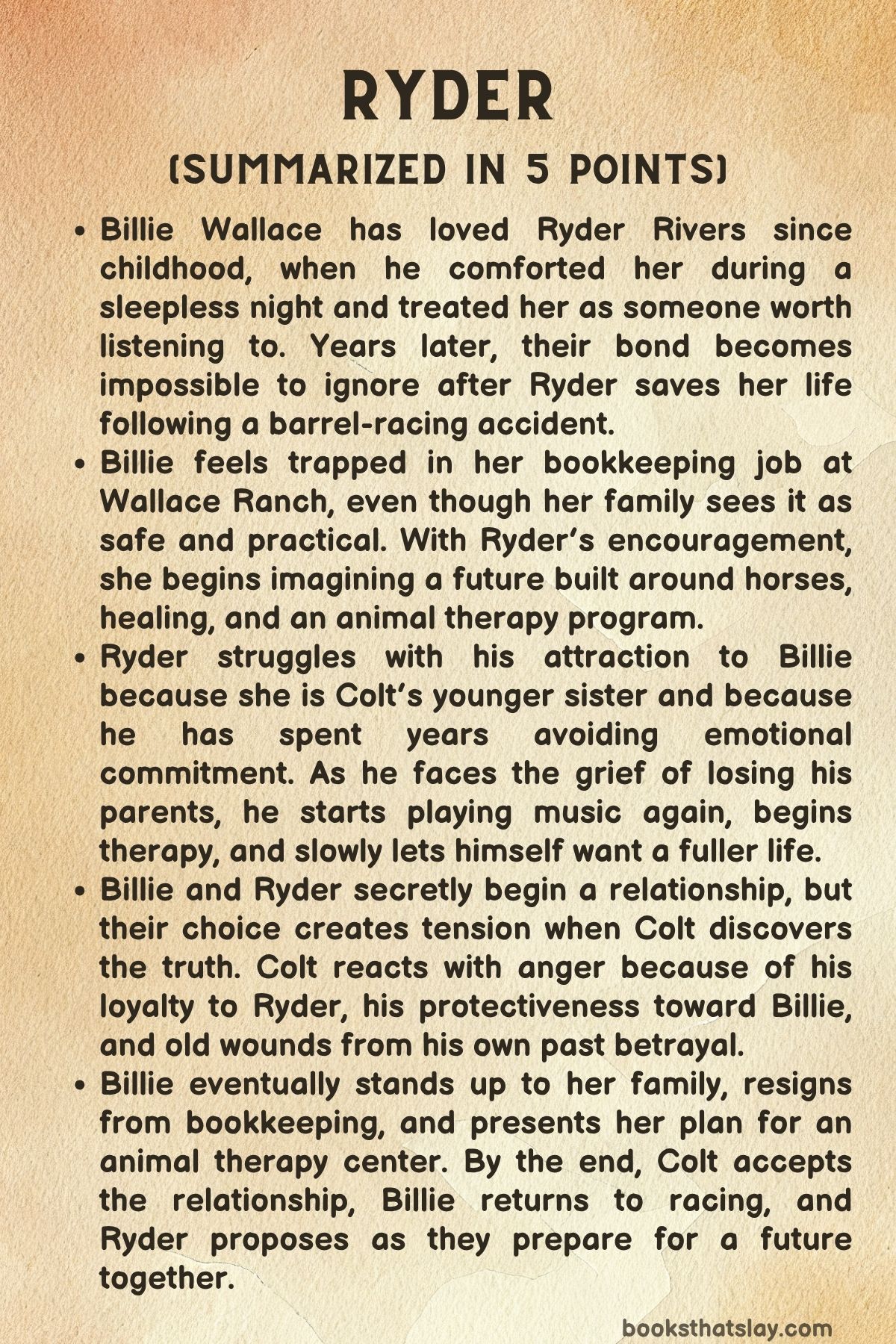
Summary
Billie Wallace’s story begins long before adulthood, when she is still a ten-year-old girl trying to understand why the world seems to expect her to be smaller, quieter, and easier than she really is. After waking from a nightmare about being trapped in a shrinking room, she slips out to the barn for comfort.
There she finds thirteen-year-old Ryder Rivers, her brother Colt’s best friend, unable to sleep as well. Instead of brushing off her fears, he listens to her.
Billie talks about the rules she feels closing in around her simply because she is a girl, and Ryder promises he will not treat her differently. When he plays guitar and she sings with him, the moment becomes more than a childhood memory.
It becomes the beginning of a crush that stays with Billie for years.
In the present, Billie is ready for her first official barrel race at the Hart County Rodeo. She is full of fire, joy, and nerves, finally doing something that makes her feel alive.
Ryder watches from the sidelines, proud of her and drawn to her in a way he keeps trying to deny. To him, Billie is still Colt’s little sister, and that boundary feels too dangerous to cross.
He also believes he is not made for relationships, so he keeps his feelings locked down. But when Billie’s horse stumbles near the third barrel and throws her, all his restraint vanishes.
He is the first person into the arena. When he realizes she is not breathing, he performs CPR and stays with her as she comes back to consciousness, scared, hurt, and confused.
The accident shakes everyone. Billie is taken to the hospital with serious injuries, including a damaged elbow and possible rib and lung trauma.
Terrified of what is happening and frightened by needles, she begs Ryder to ride with her in the ambulance. He does.
He holds her hand, makes jokes, and distracts her with a song-guessing game. His steady presence calms her in a way few people can.
At the hospital, doctors confirm that she needs surgery, and Ryder stays with her until her family arrives. The emergency exposes how deeply he cares, even if he is not ready to admit what that care means.
After surgery, Billie returns to Wallace Ranch, where she works as the family bookkeeper. On paper, the job is practical, useful, and safe.
In reality, it leaves her miserable. Billie is good with numbers, but she hates being stuck indoors, cut off from horses, movement, and open air.
Her parents see the job as a sensible future, while Billie feels as if she has been placed back inside the shrinking room from her childhood nightmare. She wants more than stability.
She wants purpose, freedom, and a life that fits who she actually is.
Wanting to thank Ryder for helping her after the accident, Billie brings him her mother’s blondies at Lucky River Ranch. She finds him cutting hay on a tractor, and he lets her ride with him.
Away from her family’s expectations, she admits how unhappy she is with bookkeeping. Ryder understands her frustration more deeply than she expects.
He has always seen the restless, brave, untamed parts of her that others often try to manage. Their bond, already shaped by years of history, grows stronger.
Ryder is also facing parts of himself he has avoided for a long time. The anniversary of his parents’ deaths brings grief back to the surface.
He has spent years surviving rather than truly living, keeping his pain controlled by routine, work, and emotional distance. After a difficult day hunting with Colt and a quiet family supper, he goes to an old storage shed and finds the guitar his parents gave him.
Playing again hurts, but it also opens something inside him. Music, once tied to memory and loss, begins to become a way back to himself.
The next day, Ryder invites Billie to Lucky River Ranch while a preschool group is visiting the animals. Billie watches him gently help children connect with foals, and the scene affects her.
She sees how animals can calm, teach, and heal people. This moment gives shape to an idea that had not fully formed before: an animal therapy program might be meaningful work for her.
It would allow her to use the ranch, her love of horses, and her desire to help others in a way that feels alive and real.
Ryder continues supporting Billie’s future by arranging for her to visit the Bellamy Brooks boot studio. Mollie, Ava, Sally, and Wheeler welcome Billie warmly, gift her custom boots, and encourage her to think seriously about what she wants.
Their support matters because Billie has often felt boxed in by family expectations. Around these women, she is not treated like a problem to solve or a younger sister to protect.
She is treated like someone capable of choosing her own path.
As Billie and Ryder spend more time together, the attraction between them becomes harder to ignore. Billie brings him a guitar and asks him to play by a fire.
He plays Fleetwood Mac while she sings, and the old intimacy between them returns in a more adult, charged form. Billie finally admits she would be open to being more than friends.
Ryder wants her badly, but he backs away. Colt is his best friend, their families are close, and he fears that loving Billie could end in hurting her.
Billie is wounded by his hesitation. Frustrated and wanting to feel desired rather than protected, she goes to the Rattler with the girls and dances with Xander, a bull rider.
Ryder’s jealousy rises fast. Later, when Billie texts him from a field party, he tracks her down and takes her away from Xander.
The tension between them finally breaks. Pulled over on the side of the road, they give in to the desire they have been fighting and sleep together in his truck.
Afterward, they agree not to tell Colt yet, though both understand that secrecy could cause serious damage.
Their relationship continues to deepen. Ryder begins opening up to his family about his parents and the way grief has kept him half-alive.
He also begins therapy, a major step for someone used to carrying pain alone. Billie confides in Tate that she slept with Ryder and believes she may be falling in love with him.
Tate urges her to be honest with Colt if the relationship continues. The warning is fair, but Billie and Ryder are still trying to understand what they are building.
During a rainstorm, Ryder finds Billie riding alone and tells her he cannot stop thinking about her. He also brings up the animal therapy idea as a real career path, not just a passing thought.
His belief in her matters. He is not only attracted to her; he sees her future and wants to help her claim it.
They sleep together again, and afterward Ryder takes her home, calls her his girlfriend, and commits to helping her make a plan.
At Wheeler’s baby shower, Billie tells the women about Ryder and the possible therapy program. They respond with excitement and support, giving her more confidence.
Soon after, Billie and Ryder finally tell Colt they are together. Colt reacts badly.
To him, the relationship feels like betrayal from both sides. Ryder is his best friend, Billie is his sister, and Colt’s grief over Abby’s past betrayal makes the situation even harder for him.
Billie pushes back, telling Colt that he and her brothers have spent years protecting her in ways that also control her. Colt walks away angry and warns them not to flaunt the relationship.
Even with Colt’s silence hanging over them, Billie and Ryder continue moving forward. With help from Ryder, Beck, Tate, Duke, and the women, Billie prepares a detailed pitch for an animal therapy program on Wallace land.
She tells her parents she wants to resign as bookkeeper and become director of the new program. Her parents resist at first, worried about money, practicality, and losing her help in the office.
But Billie finally explains how unhappy she has been and how long she has felt unseen. Her honesty changes the conversation.
Her parents apologize for pressuring her and begin to take her vision seriously.
Ryder arrives after realizing Billie has been crying and helps speak up for the program. Billie shares the mission clearly, and her parents admit they are very interested.
This is a turning point for her. She is no longer quietly accepting a life chosen for her.
She is asking to be trusted.
At the same time, the Wallace family begins a ranch rebrand led by Lainey, a sharp consultant whose “Double U Ranch” idea wins most of the family over. Colt resists her, but the tension between them hints at something more.
Ryder is welcomed at a Wallace family dinner, and Colt, though still guarded, silently raises his glass during a toast to Ryder and Billie. The gesture suggests that his anger is beginning to soften.
After Wheeler gives birth to twins, Billie finally has an honest conversation with Colt. He admits that his anger came from loneliness, grief, jealousy, and old wounds.
Therapy is helping him see that his reaction was not only about Billie and Ryder. He apologizes to Billie, then later goes to Ryder, returns his pocketknife, and apologizes to him as well.
His acceptance repairs the deepest family fracture caused by the relationship.
The families later gather at Lucky River Ranch for a celebratory dinner. During the Wallace “roses and thorns” game, Billie announces that she has been cleared to race again.
Ryder plays guitar for everyone, with Billie singing beside him, bringing their story back to the music that first connected them. Later, Billie returns to barrel racing, finishes successfully, and places in the top three.
Ryder celebrates her with a Taylor Swift-themed party at the Rattler, honoring one of the songs tied to their earliest memories. He then proposes with a paper ring wrapped around his father’s pocketknife.
Billie says yes. In the final moments, they visit the future Anne and Robbie Rivers Therapy and Rehabilitation Center, only to hear Colt and Lainey together in the loft, suggesting that another romance is just beginning.
Characters
Billie Wallace
Billie Wallace is the emotional center of the book, a woman whose greatest conflict is not only about love but about the right to define herself. From childhood, she has felt trapped by rules that ask her to be calmer, safer, and more convenient than she naturally is.
Her recurring nightmare of a shrinking room captures the pressure she feels from family expectations and gendered limits. As an adult, this pressure appears in her bookkeeping job, where she is competent but deeply unhappy.
Billie’s arc in Ryder is about learning that being good at something does not mean it is the life she owes everyone else. Her love of horses, racing, open air, and movement reflects her need for freedom, while her interest in animal therapy reveals her growing maturity.
She does not simply reject responsibility; she searches for responsibility that suits her soul. In romance, Billie is brave and vulnerable.
She wants to be chosen openly, not hidden away because others might disapprove. Her courage comes through most clearly when she confronts her family, resigns from a safe role, and asks to be seen as a capable woman rather than a protected younger sister.
Ryder Rivers
Ryder Rivers is a man shaped by loyalty, grief, restraint, and quiet devotion. His early kindness to Billie shows that he has always had a rare ability to listen without judgment.
As an adult, however, he has built emotional walls around himself, partly because of his parents’ deaths and partly because he believes distance is safer than attachment. His desire for Billie threatens the careful control he has maintained for years.
He is drawn to her fire, but he fears betraying Colt, damaging family bonds, and becoming someone who hurts the woman he cares about. What makes him compelling is the gap between what he says he can offer and what his actions reveal.
He runs to Billie after her accident, stays with her in fear, supports her dreams, and sees her clearly when others miss her pain. His return to music marks a major emotional shift.
The guitar connects him to grief, memory, and eventually healing. By beginning therapy and speaking honestly about his parents, he stops treating survival as enough.
His romance with Billie becomes part of his larger return to life, love, and hope.
Colt Wallace
Colt Wallace is protective, wounded, and often difficult, but his behavior comes from pain rather than simple cruelty. As Billie’s older brother and Ryder’s best friend, he occupies the most complicated position in the central romance.
When he learns about the relationship, he feels betrayed by both people, and his reaction is intensified by the emotional damage left by Abby’s betrayal. Colt’s anger also exposes a wider family pattern: the Wallace brothers love Billie, but their protection can become control.
He has spent years seeing her as someone to guard, not always as an adult capable of making her own choices. His silence and resistance hurt Billie, but the book does not leave him frozen in resentment.
Therapy helps him understand that his reaction is tied to loneliness, grief, jealousy, and fear of being left behind. His apology to Billie and later to Ryder shows real growth.
Returning the pocketknife is especially meaningful because it restores trust and brotherhood. Colt’s later tension with Lainey suggests he is beginning a new emotional chapter of his own.
Billie’s Parents
Billie’s parents are loving but imperfect figures who represent the practical expectations Billie has been trying to escape. They do not intend to make her miserable.
In their eyes, bookkeeping is safe, useful, and responsible, especially within a family ranch where everyone has a role. Their mistake is assuming that stability is the same as fulfillment.
Because Billie performs the work well, they fail to see how much it drains her. Their resistance to her animal therapy idea comes from financial caution and fear of disruption, not from lack of love.
Still, their pressure contributes to Billie’s sense of being unseen. Their most important moment comes when they finally listen.
Once Billie explains the depth of her unhappiness, they apologize and begin to consider her vision seriously. This makes them more than obstacles.
They are parents learning, late but sincerely, that supporting a child does not always mean choosing the safest path for her.
Tate Wallace
Tate Wallace functions as one of Billie’s most useful sources of honesty. Unlike family members who may be too protective or too emotionally invested to see clearly, Tate gives Billie direct advice without trying to control her.
When Billie confesses that she slept with Ryder and may be falling in love, Tate does not shame her. Instead, she points out the practical and emotional truth: if the relationship continues, Colt needs to know.
This makes Tate an important voice of balance. She recognizes Billie’s right to make her own choices, but she also understands that secrecy will hurt people and make the situation worse.
Tate’s role in the book is not as loud as Billie’s or Colt’s, but her presence matters because she respects Billie as an adult. She helps Billie move toward honesty, not by forcing her, but by naming what Billie already knows.
Beck Wallace
Beck Wallace is part of the family support system that helps Billie’s dream become realistic rather than merely emotional. His importance becomes clearer when Billie begins preparing the animal therapy pitch.
A dream needs structure, allies, and people willing to take it seriously, and Beck contributes to that process. Like the other Wallace men, he belongs to a family culture shaped by loyalty and protection, but his support of Billie’s proposal shows that he can also respect her ambition.
He helps shift the family dynamic from guarding Billie to backing her. Beck’s role may be quieter, but he represents the kind of support Billie needs most: not someone standing in front of her to block risk, but someone standing beside her while she builds the future she wants.
Duke Wallace
Duke Wallace adds to the sense of a large, close, sometimes overwhelming family. His role in helping Billie prepare her pitch shows that the Wallace family’s protectiveness can become something positive when it is redirected.
Instead of deciding for Billie, Duke helps her present her own decision more powerfully. This matters because Billie’s conflict with her family is never about whether they love her.
It is about whether they can trust her. Duke’s involvement suggests that trust is growing.
He may not carry the central emotional conflict, but he contributes to the family’s gradual movement from control toward support. In a story built around ranch life and family bonds, Duke helps show how change happens collectively, not only through one dramatic conversation.
Lainey
Lainey is introduced as a sharp, capable consultant helping the Wallaces rethink the ranch’s identity. Her “Double U Ranch” idea shows her intelligence, confidence, and ability to read what a family business needs in order to move forward.
She enters the story with fresh energy, challenging the existing Wallace patterns simply by being direct and competent. Colt’s resistance to her is especially interesting because it suggests that she unsettles him in a way he cannot easily manage.
He pushes back against her ideas, but that resistance carries a charge that hints at attraction as much as disagreement. Lainey’s role near the end opens the door to future conflict and romance.
She represents change arriving from outside the family, and her dynamic with Colt suggests she may be exactly the kind of person who forces him to keep growing.
Wheeler
Wheeler is part of the women’s circle that gives Billie encouragement, perspective, and belonging. Her baby shower becomes a safe place where Billie can speak openly about her relationship and her hopes for the animal therapy program.
Wheeler’s warmth helps create a contrast with the pressure Billie feels inside her own family. Around these women, Billie does not have to defend her desire for a different life in the same way.
Wheeler’s later birth of twins also becomes a setting for one of the story’s emotional repairs, as Billie and Colt finally talk honestly. In that sense, Wheeler’s presence is tied to family expansion, softness, and renewal.
She helps create spaces where people are able to admit what they feel and move toward reconciliation.
Mollie, Ava, and Sally
Mollie, Ava, and Sally help form the female support network that Billie badly needs. At the Bellamy Brooks boot studio, they welcome her with generosity, custom boots, and encouragement.
Their kindness is not only social; it has emotional weight. Billie has spent much of her life being loved in a way that often feels restrictive.
These women offer a different kind of care, one that makes her feel capable, stylish, seen, and free to want more. They encourage her to think seriously about both her feelings and her future, without reducing her choices to family duty.
In Ryder, their presence broadens the story beyond the central couple by showing how friendship and women’s community can give a heroine the confidence to step into a larger version of herself.
Xander
Xander is not a central romantic rival in a deep emotional sense, but he plays an important role in forcing hidden feelings into the open. As a bull rider who dances with Billie at the Rattler and later appears at the field party, he becomes a symbol of the attention Billie is willing to accept when Ryder refuses to claim what is between them.
Xander’s presence stirs jealousy and pushes Ryder past denial. He also gives Billie a way to assert that she is not going to sit quietly while someone else decides what is best for her heart.
Xander’s function in the book is less about who he is internally and more about what he exposes in the main relationship: desire, fear, possessiveness, and the cost of hesitation.
Anne and Robbie Rivers
Anne and Robbie Rivers, though absent in the present timeline, shape Ryder’s emotional life in profound ways. Their deaths leave him with grief he has not fully processed, and the guitar they gave him becomes one of the strongest symbols of memory in the story.
For years, Ryder avoids the parts of himself connected to them because remembering hurts too much. When he finally plays the guitar again, he begins to face the love and loss he has carried in silence.
The future therapy and rehabilitation center being named for Anne and Robbie gives their legacy a living purpose. They are not only figures of sadness; they become connected to healing, service, and the future Ryder builds with Billie.
Themes
Freedom and Self-Definition
Billie’s central struggle is the fight to live as herself rather than as the version of herself her family finds safest. Her childhood nightmare of a shrinking room captures the emotional truth of her life: she feels pressed into a shape that does not fit.
Bookkeeping may be practical, but it keeps her indoors, away from the horses, speed, air, and physical energy that make her feel most alive. The story treats freedom not as recklessness, but as the right to choose meaningful work and honest love.
Billie’s journey toward the animal therapy program shows this clearly. She is not rejecting responsibility; she is redefining it.
Her dream combines ranch life, care, horses, and leadership, proving that her wildness and usefulness are not opposites. The more Billie speaks honestly, the more she forces her family to recognize that love without trust can become a cage.
Her growth comes from claiming adulthood in action: resigning from a role that hurts her, presenting a serious plan, and refusing to let protection become the final word on her future.
Love as Recognition
The romance is powerful because it begins with being seen. Long before desire enters the story, Billie remembers Ryder as the boy who listened when she felt boxed in by unfair rules.
That early moment matters because it establishes love as recognition rather than rescue. As adults, their bond grows because he understands parts of Billie that others overlook.
He sees that she is not lazy, ungrateful, or careless; she is suffocating in a life chosen for her. His support of her animal therapy dream is one of the clearest expressions of love in Ryder because he does not simply want her close.
He wants her free, fulfilled, and fully herself. Billie also sees him beneath his guarded surface.
She recognizes the grief, loyalty, fear, and tenderness he tries to hide. Their physical relationship may begin in secrecy, but their emotional connection pushes them toward honesty.
Love becomes real only when it can stand in daylight, face family consequences, and make both people braver than they were alone.
Grief, Healing, and the Return to Life
Ryder’s grief over his parents has shaped his life so deeply that he has mistaken survival for healing. He works, shows up for family, and maintains loyalty, but much of him remains closed off.
The anniversary of his parents’ deaths reveals how present the loss still is. His return to the guitar is a major step because music connects him to both pain and memory.
Playing again does not erase grief, but it allows him to breathe inside it. The book treats healing as gradual and active.
Therapy matters because it gives Ryder a place to stop carrying everything alone. Speaking about his parents, accepting love, and imagining a future connected to their names all help him move from avoidance toward renewal.
The planned Anne and Robbie Rivers Therapy and Rehabilitation Center gives grief a forward-facing purpose. Loss remains part of his life, but it no longer has to keep him emotionally frozen.
Healing here means learning that remembering can hurt and still lead somewhere hopeful.
Family Protection and Control
The Wallace family’s love for Billie is real, but the story carefully shows how love can become restrictive when it is ruled by fear. Her parents want her in a stable job.
Her brothers want her safe. Colt wants to protect both his sister and his friendship.
None of these desires are cruel on their own, yet together they create a life where Billie feels watched, managed, and underestimated. The conflict with Colt makes this theme especially sharp.
His anger over the romance is partly about betrayal, but it is also about grief, loneliness, and his need to control what remains after his own losses. Billie’s confrontation with him is important because she names the cost of being constantly protected.
The family’s growth comes when protection changes into support. Her parents listen to her pain.
Her brothers help with the therapy proposal. Colt apologizes and accepts her choice.
The story suggests that healthy family love does not remove risk from someone’s life. It respects their right to choose, fail, love, and build something of their own.