Rites of the Starling Summary, Characters and Themes
Rites of the Starling by Devney Perry is a fantasy romance about bloodlines, lost history, dangerous magic, and the heavy cost of peace. Being the Shield of Sparrows series, it is set across Calandra and Nelfinex and follows women whose lives are shaped by political bargains, ancient curses, and a hidden Starling legacy.
At its center are Odessa, Ransom, and Caspia, each caught between love and survival while monsters, kings, priests, and buried truths reshape everything they thought they knew. The novel mixes romance, adventure, family secrets, and magical transformation into a story about inheritance, courage, and the price of breaking old systems. It’s the 2nd book of the Shield of Sparrows series, the first book going by the series name itself.
Summary
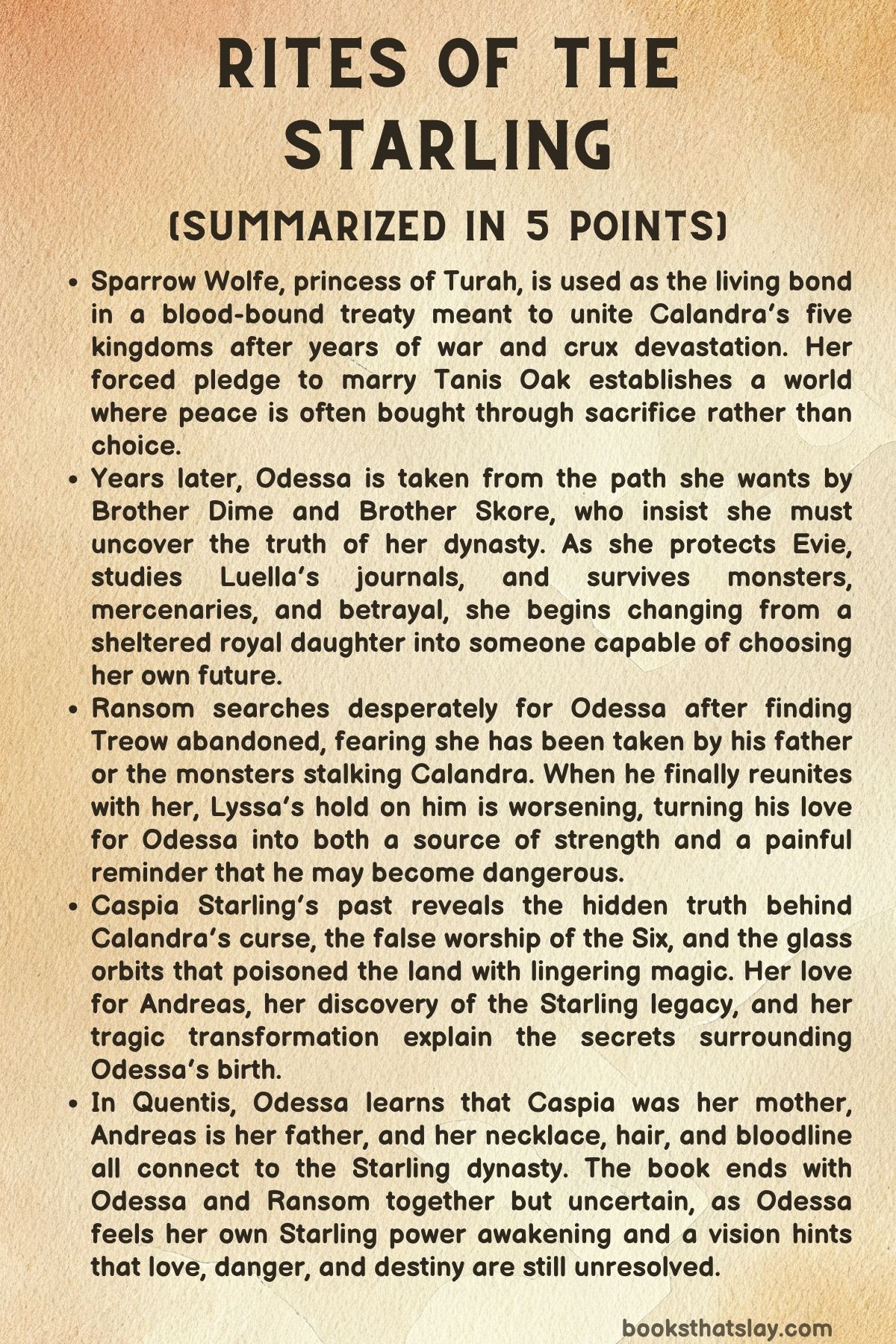
Rites of the Starling begins with Sparrow Wolfe, princess of Turah, being placed at the center of an ancient political agreement meant to end generations of violence. The five kings of Calandra create the Shield of Sparrows, a blood-bound treaty designed to hold the kingdoms together after the destruction caused by the crux migrations.
The treaty is not only political; it is personal. Sparrow is pledged to marry Tanis Oak, the king of Genesis, and her blood becomes part of the bargain.
When she signs, she understands that her life has been turned into a symbol of peace. Her father apologizes, but his words cannot undo the fact that she has been used.
He tells her to be bold and brave, leaving her to carry the burden of a peace built on sacrifice.
Years later, the story shifts to the aftermath of disaster in Ellder. Ransom reaches the Treow encampment and finds it abandoned.
Odessa and Evie are gone, and his first fear is that they have been taken either by his father’s forces or by monsters. Cathlin joins him, and they talk about the terrifying crux scout that had shifted into the form of a woman who looked like Odessa.
The threat feels more personal because it proves the monsters are not just brutal creatures; they can deceive, imitate, and hunt with intelligence. Mariette tells them that King Ramsey’s caravan passed through and that the people of Treow fled toward Allesaria.
Ransom knows Odessa well enough to believe she would try to protect Evie by going to Quentis, so he sets out after her.
Odessa is not free. She is being led away by Brother Dime with Evie and Faze, though she wants to go to Treow or Quentis.
Dime refuses and insists that she must travel toward Ozarth to discover her dynasty. Brother Skore soon joins them, deepening Odessa’s fear and distrust.
She hates the Voster, fears their power, and watches constantly for a chance to escape. Their journey takes them through mountains and forests, where danger follows closely.
They survive a grizzur pursuit and eventually take shelter with Damon and Sally, who offer kindness, food, clean clothes, and a brief sense of safety. For Evie, still hurt by Zavier’s death, this pause matters.
It gives her a small measure of comfort in a world that has become cruel and uncertain. Odessa uses the quiet moments to study Luella’s journals, especially an old-language book marked with the same winged emblem as her necklace.
She hopes the writings will help her understand Lyssa and the strange magic tied to her life.
In Nelfinex, Caspia Starling is haunted by repeated dreams of her sister Emery being killed by a silver-eyed warrior. Her aunt, Queen Oleana, refuses to accept that Emery is dead, but Caspia cannot ignore what she has seen.
At the same time, she feels the pull of the ritus, the transformation that would make her a true Starling. She believes the call is drawing her across the sea.
Driven by grief, duty, and vengeance, Caspia sneaks out of the palace, hires the pirate Cap, and sails toward Calandra. Her cousin Xandra stows away and joins her, turning Caspia’s private mission into a shared risk.
When they reach Calandra, the ritus goes terribly wrong. Xandra transforms into a bariwolf and loses herself to the beast within.
Caspia is forced to flee. She jumps from a cliff and survives, but the failure of the rite leaves her shaken and alone in a foreign land.
Caspia is found in Calandra and meets Andreas Cross. He helps her understand the unfamiliar continent and the dangers that define it.
She learns that the land is Calandra and that the monsters known in Nelfinex as swift are feared here as crux during the migrations. The difference in names points to a larger truth: both lands have suffered under the same curse, though they understand it differently.
Caspia and Andreas grow close as she continues to experience visions. Some show danger, while others reveal possible futures.
When she saves a boy named Kos after seeing him in a waking vision, she realizes the future is not always fixed. Choices can alter what she has seen.
Eventually, she and Andreas go to Quentis, where their bond deepens even as his royal responsibilities and her unfinished ritus place pressure on them both.
Odessa and Evie eventually escape Brother Skore after he finds a magical glass orbit hidden in a cave. Skore seems pleased that Odessa has located it, which makes the discovery even more troubling.
Lost and desperate, Odessa joins a caravan led by Sryker. Later, she meets the Mavins, a group of mercenaries led by Thora, and negotiates passage to Quentis.
The journey forces Odessa to become sharper and more decisive. She can no longer survive by waiting for others to protect her.
When danger threatens one of the Mavins, she reveals Lyssa, exposing a secret she has tried to keep hidden. Together they travel through Laine and Genesis as the migration threat draws nearer.
The danger becomes deadly in the skeleton forest, where bariwolves attack. Freya is killed, and Odessa, Evie, and the Mavins nearly fall.
Ransom arrives at the last moment and kills the monsters, reuniting with Odessa after a long, frightening separation. Their reunion is filled with grief as much as relief.
Freya’s death reminds them that survival always carries a cost. Odessa and Ransom cling to each other, but neither can ignore the growing threat around them or the changes taking place inside Ransom.
They continue toward Quentis with Evie, Faze, and the Mavins, carrying both loss and hope with them.
Caspia’s past becomes more important as the truth hidden in Calandra begins to surface. In Quentis, she searches the library and learns from Voster priests, especially Hain, that the accepted history of Calandra is false.
The Six were not gods. They were powerful magicians whose influence was later turned into religion and legend.
The ancient Starling fought them, and after the magicians were defeated, their remains were sealed inside glass orbits. The magic that lingered from those orbits poisoned Calandra.
It created the curse behind the migrations, strengthened the Voster, and trapped Starling shifters in monstrous forms. Caspia realizes that the orbits are not just relics; they are the source of suffering across the continent.
If they can be found and destroyed, Calandra might finally change. She and Andreas travel into the Evon Ravine and recover one orbit from a pool of violently charged magical water.
In the present, Odessa, Ransom, Evie, Faze, and the Mavins reach Roslo in Quentis. Odessa confronts her father, King Cross, who is stunned by how much she has changed.
She is no longer the controlled daughter he once knew. Her loyalty to Ransom is clear, and she demands that the Mavins be paid for helping her.
This moment marks a turning point in her relationship with power. She begins resisting not only her father’s authority but also the influence of her stepmother, Margot, who once seemed to hold secrets and control over her life.
Ransom, meanwhile, is fighting a terrible change. Lyssa is growing stronger inside him.
His eyes turn silver, and his anger becomes harder to control. Odessa fears losing him, but she refuses to surrender him to the curse.
She gives his blood to Healer Alore, hoping Luella’s journals and the old texts might help uncover a cure. The danger becomes more complicated when Odessa learns that Skore and Dime are Kennin, traitors within the Voster brotherhood.
Their connection to her places her in greater danger, because the High Priest would execute anyone tied to them.
The past and present finally meet through Caspia’s journals. Caspia gives birth to a daughter, Dess, short for Odessa.
After the baby’s birth, the ritus returns, and Caspia knows the Voster will come. When they attack, she shifts into a Starling monster to protect Andreas, their daughter, and the truth she has uncovered.
She kills the priests, but the transformation begins to consume her. Bloodlust takes over, and she fights to hold herself back long enough for Andreas to stop her.
Andreas kills her because she gives him the chance. The act destroys him.
Covered in Caspia’s blood and broken by grief, he cannot bring himself at first to touch his infant daughter.
In the present, Margot gives Odessa Caspia’s hidden journal and reveals that she had sworn to protect her. The truth changes everything Odessa knows about herself.
Caspia was her mother. Andreas is her father.
Her necklace, her hair, and her hidden inheritance all connect to the Starling dynasty. Andreas admits what happened and gives Odessa Caspia’s elfalter rings and the key to Ransom’s cell.
Odessa also learns from Skore that Xandra’s bite likely created Lyssa when it combined with Luella’s elixir. This means Ransom’s infection is tied to Starling magic and to the poisoned orbits that have shaped Calandra’s suffering.
Skore tells Odessa that she is the warrior meant to continue the fight.
The story ends with Odessa and Ransom standing on a cliff above the sea. They are together, but their future is uncertain.
The burden has shifted to Odessa, who feels the thrum of Starling blood waking inside her. Her own transformation seems near, but she hides this from Ransom.
A final vision shows a silver-eyed warrior facing a winged monster. Instead of striking, he sets down his blade and whispers, “My queen.” The ending leaves love, destiny, and danger in the same breath, suggesting that Odessa’s true role has only just begun.
Characters
Odessa
Odessa is the emotional and magical center of the book, and her journey is defined by the painful movement from sheltered daughter to active force in a much larger war. At first, she is trapped between the people who claim authority over her: her father, Margot, the Voster, and the men who want to decide where she belongs.
Yet her choices show a growing refusal to be treated as someone else’s possession. Her loyalty to Evie, her determination to save Ransom, and her ability to negotiate with people like Thora show that she becomes stronger not by losing her fear, but by acting despite it.
In Rites of the Starling, Odessa’s discovery of Caspia’s journal transforms her sense of identity. She learns that her life has been shaped by hidden bloodlines, buried promises, and a mother’s sacrifice.
By the end, Odessa is no longer only trying to survive the powers around her. She is beginning to understand that she may be the one meant to challenge them.
Ransom
Ransom is a character built around fierce devotion, inner conflict, and the fear of becoming dangerous to the people he loves. His search for Odessa after the Treow encampment is found empty shows how deeply tied he is to her safety.
He acts quickly, reads her instincts accurately, and follows the path he believes she would choose. His heroism, however, is complicated by Lyssa.
The silver in his eyes and his growing anger suggest that the threat is not only outside him but inside his body. This makes him both protector and potential danger.
His love for Odessa is intense, but it does not simplify his struggle. He wants to shield her, yet he becomes someone she must also try to save.
The final vision of a silver-eyed warrior lowering his blade before a winged monster suggests that his greatest act may not be violence, but recognition, surrender, and trust.
Caspia Starling
Caspia is one of the most important figures in the novel because her life explains the truth behind Odessa’s inheritance and Calandra’s curse. She begins as a grieving sister who believes Emery has been killed, and that grief drives her to leave Nelfinex in search of vengeance and answers.
Her courage is mixed with desperation, and her failed ritus shows how dangerous Starling power can become when shaped by fear, pain, and incomplete knowledge. Caspia’s relationship with Andreas gives her a reason to imagine a life beyond duty, but she never turns away from the truth once she finds it.
Her discoveries about the Six, the glass orbits, and the poisoned magic reveal that Calandra has been living under lies for generations. In Rites of the Starling, Caspia’s tragedy comes from the fact that she understands the enemy before anyone else is ready to defeat it.
Her death is devastating because it is both a sacrifice and a warning.
Andreas Cross
Andreas Cross is a man marked by love, failure, secrecy, and grief. In the past, he becomes Caspia’s guide, partner, and eventually the father of her child.
He helps her navigate Calandra, but he also becomes part of the terrible truth she uncovers. His love for Caspia is real, yet the moment when he must kill her defines much of his later life.
He does not kill her because he stops loving her; he does it because she gives him the chance to save their daughter and preserve what they know. In the present, Andreas is weighed down by the choices he made and the secrets he kept from Odessa.
His shock at Odessa’s transformation shows that he underestimated the strength growing in her. When he finally gives her Caspia’s rings and the key to Ransom’s cell, he is not simply handing over objects.
He is surrendering parts of the truth that should have been hers all along.
Sparrow Wolfe
Sparrow Wolfe’s role is brief but powerful because she represents the human cost of political peace. As princess of Turah, she is not allowed to exist only as a person with her own desires.
She is turned into a living bond between kingdoms, pledged to Tanis Oak as part of the Shield of Sparrows treaty. Her blood is used to seal a bargain created by kings, and her future is assigned to serve the needs of Calandra.
Sparrow’s father apologizes, but his apology cannot erase the truth of her situation. She has been sacrificed for stability.
His instruction to be bold and brave gives her a kind of emotional inheritance, but it also exposes the unfairness of asking courage from someone who has been denied choice. Sparrow’s presence sets the tone for a story where bloodlines, marriages, and daughters are often used by systems of power.
Tanis Oak
Tanis Oak, the king of Genesis, stands as part of the political structure that creates the Shield of Sparrows. His marriage to Sparrow is not presented as a private romance but as a public instrument of peace.
Because of that, he represents the way rulers often use personal lives to solve political problems. Tanis is less emotionally developed than characters like Odessa, Ransom, or Caspia, but his role matters because it helps define the world they inherit.
He is tied to a treaty meant to end war, but that treaty rests on blood and arranged union. His position shows how kings can become symbols within their own bargains, even while others pay the deeper personal cost.
Through Tanis, the story shows that peace created by authority can still carry injustice when it depends on forcing people into roles they did not choose.
Evie
Evie brings vulnerability, grief, and emotional urgency to Odessa’s journey. Her presence gives Odessa someone to protect, and that responsibility pushes Odessa to become more decisive.
Evie has already suffered through Zavier’s death, and the small kindnesses offered by Damon and Sally matter because they allow her to recover fragments of comfort in the middle of fear. She is not only a helpless figure, though.
Her survival gives weight to the choices made by others. Odessa’s decisions often become sharper because Evie is with her, and Ransom’s search becomes more urgent because he understands that both of them are in danger.
Evie represents the people who are caught in the path of kings, monsters, priests, and migrations. Her grief keeps the story grounded in personal loss rather than allowing the larger magical conflict to become abstract.
Faze
Faze is part of Odessa and Evie’s dangerous journey through forests, mountains, and uncertain alliances. While the events reveal less of Faze’s interior life, the character matters as part of the small group that must endure the consequences of decisions made by far more powerful people.
Faze’s presence emphasizes that Odessa is rarely traveling alone and that survival depends on shared movement, secrecy, and trust. As the group moves from the control of the Voster to the caravan and then to the Mavins, Faze becomes part of the human circle surrounding Odessa’s growth.
The character also helps show how danger affects groups rather than isolated heroes. In a world threatened by crux, bariwolves, and political betrayal, every companion matters because each person adds another life Odessa must consider when she chooses whether to run, reveal secrets, negotiate, or fight.
Brother Dime
Brother Dime is a troubling figure because he uses knowledge and authority to control Odessa while claiming that his actions serve a greater purpose. He refuses to take her where she wants to go and instead insists that she must travel toward Ozarth to discover her dynasty.
His behavior places him in the long line of people who treat Odessa’s life as something to direct rather than respect. As a Voster connected to hidden truths, he carries information that Odessa needs, but his secrecy makes him dangerous.
The later revelation that he is Kennin, a traitor to the Voster brotherhood, complicates him further. He is not simply obedient to the public religious order, but that does not make him safe.
Dime represents the uneasy space between guidance and manipulation, where truth is withheld until the person seeking it has already been forced onto a path.
Brother Skore
Brother Skore is one of the more unsettling characters because he seems to understand more than he says. His connection to Odessa is filled with suspicion, fear, and hidden purpose.
When he finds the magical glass orbit in the cave and seems pleased that Odessa located it, his reaction suggests that he has been watching for signs of who she truly is. Skore’s later explanation of Lyssa gives him a key role in connecting Ransom’s infection to Starling magic, Xandra’s bite, Luella’s elixir, and the poisoned orbits.
He is dangerous because he belongs to secret knowledge rather than open loyalty. As a Kennin, he is marked as a traitor by the Voster, yet he also seems to be guiding Odessa toward a role she does not fully understand.
Skore’s power lies in his patience and his ability to make others feel that their discoveries may have been expected all along.
Xandra
Xandra’s role is tragic because her loyalty to Caspia leads her into a fate neither of them fully understands. She stows away to join Caspia’s mission, turning an act of family devotion into a disaster that changes the course of multiple lives.
When the ritus goes wrong and Xandra transforms into a bariwolf, she loses herself to the beast. Her transformation is one of the clearest examples of Starling power corrupted by forces beyond the characters’ control.
Xandra becomes important not only because of what happens to her, but because the effects of her transformation appear to reach into the present through Lyssa. Skore’s claim that her bite, combined with Luella’s elixir, likely created Lyssa means Xandra’s failed rite continues to shape Ransom’s suffering.
Her story shows that a single magical rupture can echo across generations.
Queen Oleana
Queen Oleana is defined by denial, authority, and the limits of royal control. As Caspia’s aunt, she refuses to believe Emery is dead, even though Caspia’s visions insist otherwise.
This refusal may come from love, political caution, or an unwillingness to accept a truth that threatens the stability of her world. Oleana’s disbelief helps push Caspia toward action because it leaves her feeling alone with what she has seen.
The queen also represents the protected world Caspia leaves behind when she sneaks out of the palace. In Nelfinex, power has structure, titles, and rules, but those things cannot answer the call of the ritus or resolve the mystery of Emery’s fate.
Oleana’s role shows how leadership can become passive when it depends too heavily on denial. Her inability to respond to Caspia’s certainty becomes one reason Caspia chooses risk over obedience.
Emery
Emery is absent for much of the action, but her apparent death is the wound that drives Caspia across the sea. The dreams of Emery being killed by a silver-eyed warrior give Caspia’s mission urgency and emotional force.
Emery functions as both sister and symbol: she is the loved person Caspia wants to avenge, but she is also part of the mystery surrounding Starling power, visions, and fate. Because Queen Oleana refuses to accept her death, Emery becomes a point of conflict between belief and denial.
Caspia trusts what she has seen, while others resist it. Emery’s importance lies in how much her loss changes Caspia.
Without those visions, Caspia might not have left Nelfinex, crossed into Calandra, met Andreas, or uncovered the truth about the Six and the orbits. Her absence creates the path that shapes the future.
Thora
Thora is the leader of the Mavins and one of the figures who helps Odessa survive the road to Quentis. She is practical, capable, and shaped by the hard logic of mercenary life.
Odessa must negotiate with her, which gives Odessa an opportunity to prove that she can make decisions under pressure. Thora does not exist simply to rescue Odessa; she represents a world where trust is earned through usefulness, courage, and payment.
Her group becomes a temporary but meaningful shield around Odessa, Evie, and Faze. Through Thora, the story shows that loyalty can form outside royal houses and religious orders.
The Mavins are not bound to Odessa by blood or prophecy at first, yet their presence becomes vital. Thora’s leadership gives structure to that rough loyalty, making her a strong contrast to rulers and priests who hide behind inherited power.
Freya
Freya’s death in the skeleton forest gives the journey one of its clearest moments of loss. As part of the Mavins, she belongs to the group that helps Odessa reach Quentis, and her death proves how dangerous the migration threat has become.
The bariwolf attack is not only a battle scene; it is a reminder that even skilled fighters can be overwhelmed. Freya matters because her loss affects the emotional tone of the reunion between Odessa and Ransom.
They find each other again, but joy is cut by grief. Her death also strengthens Odessa’s awareness that every alliance carries responsibility.
The Mavins were not nameless escorts. They were people who risked themselves and paid a price.
Freya’s role shows that survival in this world is never clean, and each step toward truth may leave someone behind.
Margot
Margot is a complicated figure because she appears connected to control and secrecy, yet she also reveals that she swore to protect Odessa. Her earlier influence over Odessa contributes to the sense that Odessa has been shaped and restrained by the adults around her.
However, when Margot gives Odessa Caspia’s hidden journal, her role changes. She becomes a keeper of truth, even if she has kept that truth for too long.
Margot’s protection is therefore morally uneven. She may have guarded Odessa from certain dangers, but she also participated in a silence that kept Odessa from knowing her own mother and inheritance.
This makes her neither purely villainous nor purely noble. She represents the kind of protection that can become another form of imprisonment when it denies a person the knowledge needed to make free choices.
Healer Alore
Healer Alore represents the hope that knowledge can still fight what violence cannot. When Odessa gives Ransom’s blood to Alore, she is searching for a way to understand Lyssa through study, medicine, and old texts rather than fear alone.
Alore’s role is not as dramatic as that of warriors, kings, or priests, but it is crucial because Ransom’s condition cannot simply be solved by strength. His infection is tied to magic, blood, elixir, and the orbits, which means healing requires careful thought and courage of a different kind.
Alore stands at the edge between physical cure and magical mystery. Through this character, the story gives value to investigation, patience, and the willingness to look at a curse as something that can be understood rather than only feared.
Hain
Hain is important because he helps Caspia see through Calandra’s false history. As a Voster priest, he belongs to the religious structure that has shaped public belief, but his knowledge points beyond accepted doctrine.
Through Hain, Caspia learns that the Six were not true gods but powerful magicians whose remains were sealed inside glass orbits. This changes the meaning of everything: religion, migration, monsters, and the authority of the Voster.
Hain’s role makes him a bridge between institutional power and hidden truth. He shows that even within a flawed or dangerous order, there may be individuals who know more than they publicly reveal.
His guidance helps Caspia understand that the curse has a source and that the suffering of Calandra is not divine will. It is the result of magic, lies, and old violence.
Luella
Luella shapes the story through the journals and old knowledge she leaves behind. Her writings give Odessa a way to search for answers about Lyssa, the old language, the winged emblem, and the magical forces tied to her inheritance.
Even though Luella is not active in the present events, her work continues to influence the living. She represents the importance of recorded knowledge in a world where official history has been corrupted.
The suggestion that Luella’s elixir combined with Xandra’s bite to create Lyssa also makes her legacy dangerous as well as valuable. Her knowledge may have been meant to heal, change, or preserve, but its effects are not simple.
Luella’s character shows that discoveries can outlive their makers and that written truth can become a weapon, a cure, or a burden depending on who finds it.
King Cross
King Cross is Odessa’s father and one of the figures who must face the consequences of underestimating her. When she reaches Roslo, he is shocked by her transformation and by her loyalty to Ransom.
His reaction suggests that he still sees her through the lens of the daughter he once controlled or protected, not the woman she has become. He is part of a royal system that expects obedience, especially from daughters whose lives are bound to politics and secrecy.
Yet his grief over Caspia and his hidden past with her make him more than a distant ruler. His tragedy is that love and fear led him into silence.
By withholding the truth, he helped create the distance between himself and Odessa. His eventual admission does not erase the harm, but it allows Odessa to claim the history he kept from her.
King Ramsey
King Ramsey’s role is mostly connected to movement, threat, and uncertainty. His caravan passing through Treow becomes part of the trail Ransom follows while searching for Odessa and Evie.
The fear that his forces may have taken them shows that political power is a real danger alongside monsters. Ramsey represents the instability of Calandra’s kingdoms during migration and conflict.
Even when he is not directly present, his name affects decisions and assumptions. Ransom’s concern that his father or monsters could be responsible for the disappearance at Treow reveals the kind of world the characters inhabit, where royal authority can feel as dangerous as supernatural attack.
Ramsey’s importance lies in how his presence expands the threat beyond creatures in the forest. Human power, family conflict, and political ambition are part of the danger too.
Cathlin
Cathlin serves as a grounded presence during Ransom’s search for Odessa and Evie. Her arrival at the empty Treow encampment gives Ransom someone to speak with as he processes the evidence before him.
Their discussion of the crux scout that shifted into the form of a woman resembling Odessa adds emotional intensity to the threat. Cathlin helps frame the danger in practical terms, confirming that the monsters are capable of deception and that the situation is worse than simple disappearance.
Her role is not large, but it is useful. She supports the movement of the plot by helping Ransom assess what has happened and decide where to go next.
In a story filled with hidden bloodlines and magical history, Cathlin’s presence provides immediate clarity during a moment of fear.
Mariette
Mariette is a minor but necessary character because she gives Ransom information that shapes his next move. By telling him that King Ramsey’s caravan passed through and that the people of Treow fled toward Allesaria, she helps narrow the possibilities.
Her words allow Ransom to reason through Odessa’s likely choices and conclude that she would try to protect Evie by going to Quentis. Mariette’s role shows how survival often depends on fragments of information shared at the right time.
She does not need to be central to the magic or romance to affect the direction of the story. Her presence also adds to the sense of a larger world in motion, where communities flee, caravans pass, and ordinary people become witnesses to events shaped by kings, monsters, and war.
Sryker
Sryker leads the caravan that Odessa joins after escaping Brother Skore, and his role marks a transitional stage in her journey. At that point, Odessa and Evie are lost, vulnerable, and trying to reach safety without falling back under the control of the Voster.
The caravan offers movement and temporary structure, but it is not a final refuge. Sryker’s presence helps show how roads, trade routes, and traveling groups become lifelines during periods of danger.
He also acts as a bridge between Odessa’s escape and her later alliance with the Mavins. Through Sryker, the novel shows that not every important figure is tied to royalty, prophecy, or magic.
Some characters matter because they keep people moving when staying still would mean death.
Damon and Sally
Damon and Sally offer one of the gentler pauses in a story filled with pursuit and fear. They shelter Odessa, Evie, and the others, giving them food, clean clothes, and a moment to breathe.
Their kindness is simple, but it carries emotional weight because it arrives after danger and grief. For Evie especially, their home becomes a place where comfort can briefly exist after Zavier’s death.
Damon and Sally show that goodness in the story is not limited to grand sacrifice or battlefield bravery. Sometimes it appears as hospitality, warmth, and the willingness to care for strangers.
Their presence reminds the reader that Calandra is not only made of kings, priests, curses, and monsters. It is also made of ordinary people whose decency helps others keep going.
Cap
Cap, the pirate Caspia hires to take her across the sea, represents risk, escape, and the crossing between worlds. His role allows Caspia to leave Nelfinex and reach Calandra, which makes him a necessary part of the story’s larger movement.
Hiring a pirate also shows Caspia’s desperation and determination. She is not taking a safe or approved route; she is choosing the path available to someone who has been denied belief and official support.
Cap’s presence adds a rough edge to her journey, placing her outside palace protection and into a world of uncertain bargains. Although he is not central to the emotional core of the story, he helps make Caspia’s choice feel bold and dangerous.
Through him, her mission becomes real action rather than private grief.
Kos
Kos is the boy Caspia saves after seeing him in a waking vision, and his role is important because he proves that the future can be changed. Until that moment, Caspia’s visions could be understood as fixed warnings or unavoidable truths.
Saving Kos gives her a different understanding of her power. Her sight does not only reveal doom; it can guide action.
Kos therefore represents possibility. His survival matters less because of who he is individually and more because of what he teaches Caspia about choice.
In a story shaped by prophecies, curses, rites, and inherited roles, Kos becomes proof that destiny is not always a locked door. A vision can be answered.
A death can be prevented. A future can bend when someone is brave enough to act.
Zavier
Zavier is important through the grief his death leaves behind, especially in Evie. The emotional effect of losing him shapes the journey.
Evie’s pain gives weight to the danger around the characters and makes Damon and Sally’s kindness more meaningful. Zavier’s death also reinforces the cost of the larger conflict.
The migrations, monsters, and violence do not only threaten kingdoms in broad terms; they break personal bonds and leave survivors carrying sorrow. His absence functions as a reminder that every character moving forward does so with losses behind them.
Through Zavier, the novel keeps attention on the emotional aftermath of death, not just the moment of danger itself.
Lyssa
Lyssa is less a traditional character than a living magical threat within Ransom, but her presence has enormous influence over the story. She changes his body, sharpens his anger, and creates fear that he may become something he cannot control.
The later explanation that Lyssa may have been created through Xandra’s bite and Luella’s elixir makes her a product of broken magic, failed transformation, and unintended consequences. Lyssa’s importance lies in the way she turns the external curse of Calandra inward.
Ransom does not only face monsters on the road; he carries one inside him. For Odessa, Lyssa becomes both a threat to the man she loves and a clue to the larger truth about Starling magic.
Through Lyssa, the story connects romance, horror, bloodline, and cure into one urgent problem.
Themes
Blood as Bond, Burden, and Inheritance
Blood carries power long before the characters understand its full meaning. In Rites of the Starling, blood seals treaties, defines dynasties, reveals hidden lineage, and binds people to roles they did not choose.
Sparrow’s blood is used to secure political peace, turning her body into part of a royal contract. Odessa’s blood carries a different kind of burden, linking her to Caspia, the Starling dynasty, and a future she has not agreed to claim.
Ransom’s blood becomes evidence, a source of fear, and a possible path toward understanding Lyssa. The novel treats blood as more than family connection.
It is law, magic, memory, and danger. Yet blood alone does not decide who a person becomes.
Odessa’s inheritance matters, but her choices matter just as much. She protects Evie, fights for Ransom, challenges her father, and begins to face the truth of her power.
Blood may open the door to destiny, but character determines what someone does after crossing the threshold.
False History and the Power of Hidden Truth
Calandra’s suffering is sustained not only by magic but by false belief. The accepted story of the Six gives divine authority to figures who were not gods at all, but powerful magicians whose remains poisoned the land through the glass orbits.
This revelation changes the meaning of religion, political power, and the Voster brotherhood. A society that believes its curse is sacred or unavoidable is less likely to fight the real source of its pain.
Caspia’s discovery matters because it restores cause and responsibility to a world trained to accept myth as truth. The hidden journals, old-language texts, emblems, and buried accounts all become acts of resistance against official history.
Odessa’s own life has been shaped by the same pattern. She has been denied the truth of her mother, her father, her necklace, and her dynasty.
The novel shows that secrecy can be a form of control, even when it is called protection. Truth hurts, but without it, no one can choose freely or break the systems that keep harming them.
Love as Protection, Risk, and Recognition
Love in the story is rarely safe. It asks characters to act, sacrifice, wait, search, and sometimes let go.
Ransom’s love for Odessa sends him after her when he finds Treow empty, and his understanding of her instincts helps him follow the path she might take. Odessa’s love for Ransom makes her fight for a cure even when Lyssa turns him into a danger.
Caspia and Andreas’s love is both beautiful and tragic because it leads to Dess’s birth, the preservation of truth, and the devastating moment when Andreas must kill Caspia to save their child and honor her final act of control. Love does not erase horror in this world.
Instead, it gives characters reasons to endure it. The final vision of the silver-eyed warrior lowering his blade before the winged monster captures love as recognition rather than conquest.
To love someone fully may mean seeing the frightening truth of what they are becoming and refusing to reduce them to a monster.
Transformation and the Fear of Becoming Monstrous
Transformation in the novel is both inheritance and threat. The ritus is supposed to make a Starling whole, but when it goes wrong, it produces terror, loss of self, and violence.
Xandra becomes a bariwolf and loses her human identity. Caspia shifts to protect her family but begins to fall into bloodlust.
Ransom’s infection through Lyssa creates a slower and more intimate version of the same fear, as he remains himself while feeling something dangerous grow within him. Odessa’s final awareness of Starling blood waking inside her suggests that she may soon face the same boundary between power and monstrosity.
The story does not treat monsters as simple enemies. Many of them are tied to corrupted magic, poisoned history, and failed rites.
This makes the fear more painful because the monstrous is often born from people, families, and systems already known to the characters. The central question is not only how to defeat monsters, but how to understand what created them and whether a person can change without losing the self.