Revenge Prey Summary, Characters and Themes
Revenge Prey by John Sandford is a Lucas Davenport thriller (36th installment) centered on espionage, retaliation, and the dangerous afterlife of intelligence work.
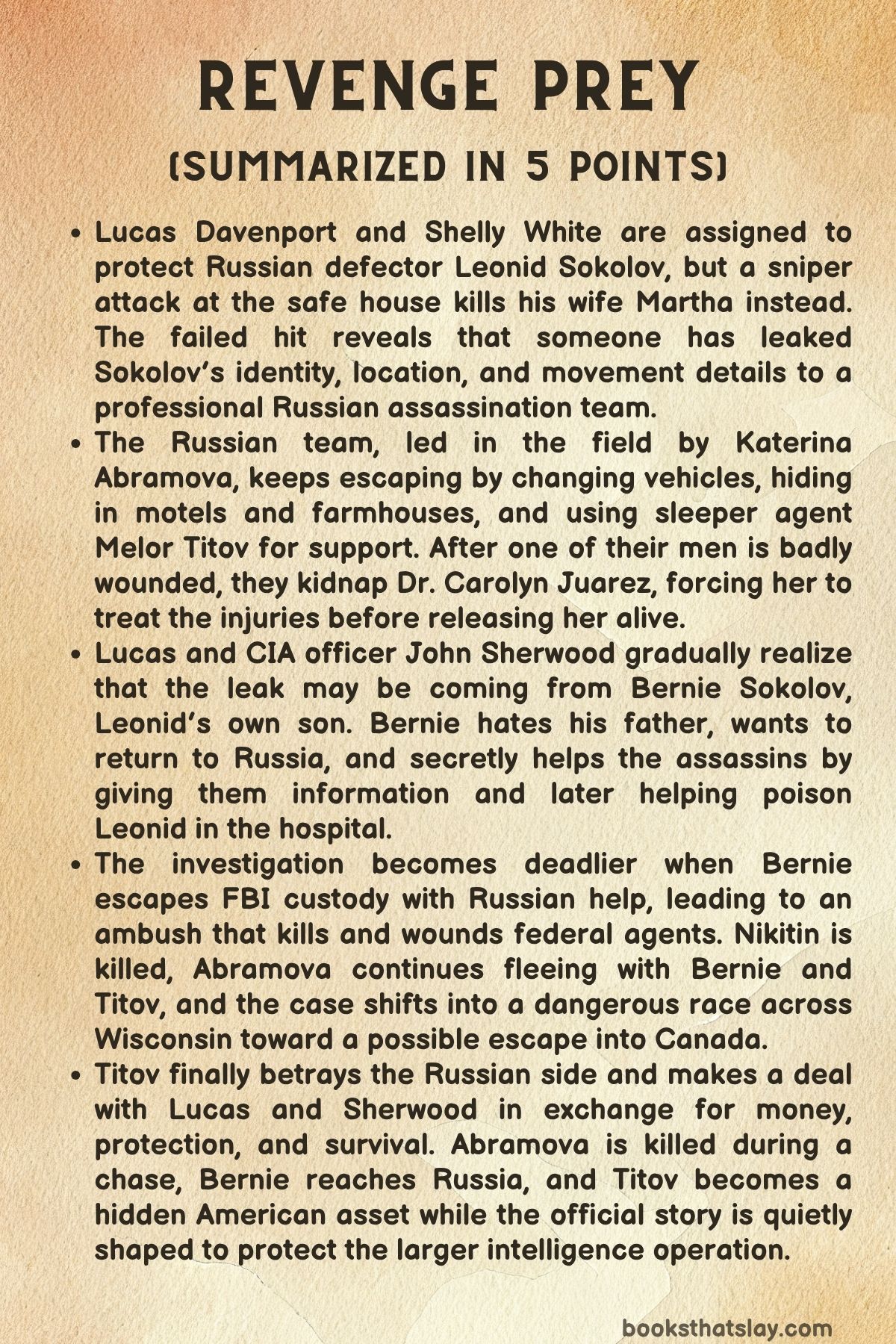
The story begins with a Russian defector under U.S. protection becoming the target of a professional hit team in Minnesota, but the case quickly grows beyond a failed assassination attempt. Lucas, Shelly White, and CIA officer John Sherwood must track wounded Russian operatives, identify the source of a devastating leak, and contain a plot that keeps changing form. The book mixes pursuit, spycraft, bureaucracy, family betrayal, and the grim cost of decisions made in secret.
Summary
In Revenge Prey, the case begins with a Russian assassination team preparing for a clean, professional strike in Minnesota. A woman trains with a powerful rifle while her partner watches, and their quiet competence makes it clear that the coming violence has been planned with care.
Lucas Davenport and Shelly White, both deputy U.S. Marshals, arrive at a secluded safe house where a Russian defector is being hidden with his family. The man, now using the name Leonard Summers, is really Leonid Sokolov, a former Russian counterintelligence officer who has given the Americans valuable information about Russian spies.
Lucas and White quickly see weaknesses in the location, especially the surrounding woods. Their concern proves justified when a rifle shot tears through the kitchen window just as Sokolov bends down to pick up a dropped cigar.
The bullet misses Sokolov but kills his wife Martha. Lucas and White rush outside, fire at the fleeing attackers, and pursue their blue Jeep until the team abandons it and switches vehicles at a motel.
The failed attack immediately raises a larger problem. The Russians knew Sokolov’s identity, arrival time, and protected location, meaning someone close to the operation leaked the information.
The attackers are Lev Nikitin, Matvey Orlov, Katerina Abramova, and Melor Titov. Nikitin is the sniper, Abramova is the field leader and driver, Orlov provides support and reconnaissance, and Titov is an American-based sleeper agent who supplies vehicles, documents, weapons, and escape routes.
Lucas and White’s return fire wounds the Russians during their escape. Orlov is badly injured, and the team hides at a rented farmhouse where Abramova and Titov try to keep him alive with basic medical supplies.
Meanwhile, Lucas, White, and CIA officer John Sherwood work through the physical evidence. They trace footprints, find the sniper’s position, review motel footage, and begin building a map of the team’s movements.
Sherwood explains why Sokolov matters so much. He was a brutal but valuable defector whose knowledge could damage Russian intelligence operations, making him a high-priority target.
At the farmhouse, the Russians realize Orlov needs a real doctor. Abramova and Titov raid a small emergency room in Bison, terrorizing the staff, stealing medical supplies, and kidnapping Dr. Carolyn Juarez.
Juarez is taken blindfolded to the farmhouse and forced to treat the wounded Russians. She remains calm, watches and listens carefully, and understands that cooperation gives her the best chance of survival.
She tells Abramova and Titov that Orlov’s condition is too serious for farmhouse treatment. He needs a proper hospital, so the Russians decide to leave him near a Milwaukee hospital while using Juarez’s release to create confusion.
Juarez is eventually left alive near Apple Valley. When Lucas and Sherwood interview her, she gives them careful time estimates and descriptions that help confirm the likely area of the farmhouse.
The investigation narrows toward Orono, but the Russian team has already begun moving again. Abramova changes her appearance, rents a new vehicle, and relocates with Nikitin to a motel near the Mall of America.
Lucas and Sherwood follow rental car clues to the area and start checking motels. At the La Quinta, they arrive almost exactly as Abramova, Nikitin, and Titov are preparing to leave.
Abramova recognizes Lucas and reacts instantly. She opens fire in the hallway, wounding a desk clerk and Sherwood, then escapes with the others before law enforcement can seal the area.
The team flees to Iowa, but the mission is not over. Russian handler Kuznetsov tells them that Sokolov will be moved from his current protected location to an airport, giving them another chance to kill him.
The Russians return to Minnesota and set up a second attack. Nikitin shoots Sokolov as he is being moved by the FBI, but body armor saves Sokolov from immediate death.
Lucas and Sherwood witness the shooting and try to follow, but Abramova disables their car with gunfire. Sokolov is left critically wounded, and the Russians escape yet again.
With a rifle attack now less likely to succeed, Abramova and Kuznetsov consider another method. The team has a modified ChapStick tube containing a nerve agent, and they need someone who can get close enough to Sokolov to use it.
The investigation begins looking beyond the Russian shooters. Lucas and Sherwood search local Russian-linked networks with help from Del Capslock, pressing men like Rick Thompson and Lawrence Bell for leads about vehicles, contacts, and hidden support.
At the same time, Lucas starts thinking seriously about Bernie Sokolov, Leonid’s son. Bernie has access, motive, and an unusual emotional position: he was dragged into defection by his father and may still see himself as loyal to Russia.
The truth is worse than suspicion. Bernie is the leak, and he becomes the perfect tool for the poison plot because he can visit his father without attracting the kind of suspicion an outsider would.
Titov hides the altered ChapStick in a hospital restroom, where Bernie retrieves it. Bernie visits his father and gets close enough to use the poison while the FBI guards notice nothing.
Lucas and Sherwood bring their theory to FBI counterintelligence. Rather than arrest Bernie immediately, they want to use him as bait to expose the wider Russian network and possibly identify the people behind the hit team.
Bernie realizes investigators have found one of his burner phones because they make the mistake of replacing its battery. He understands that his signals may have been discovered, but he still plans to continue communicating through clubs, crowds, and couriers.
Lucas, Sherwood, Capslock, and White track Bernie’s nightlife. Surveillance footage from a club shows a trained young woman making contact with him, likely passing him a new phone or object.
The courier is later linked to the Russian embassy, confirming that Bernie is still actively connected to Russian handlers. The investigators set up around his next club visit, expecting him to make a move.
Bernie goes to the White Ducks club with two FBI escorts, Dave Droll and Olaf Haskins. They underestimate him, seeing him as shallow and annoying rather than dangerous.
Bernie slips out the back and runs along a planned route. The escorts chase him, but Abramova and Nikitin are waiting.
The escape turns into a deadly ambush. Nikitin fires on FBI agents, killing and wounding them, while Bernie gets away with Abramova.
Lucas and Sherwood arrive after the shooting. A surviving agent shoots Nikitin at close range after claiming he was reaching for a weapon, and Lucas supports the account to prevent the aftermath from becoming even more damaging.
Abramova and Bernie meet Titov and head toward Wisconsin. Bernie reveals the full truth: he helped the Russians because he hated his father, felt stolen from his real country, and wanted to return to Russia.
Titov begins to see that staying with Bernie and Abramova may get him killed. He contacts Lucas, identifies himself as the sleeper agent, and offers to cooperate in exchange for protection, money, and survival.
Lucas, Sherwood, White, and Capslock head north to meet him in Hayward, Wisconsin, where a major ski race has filled the town with crowds and traffic. Titov uses the confusion as cover.
At the meeting, Titov gives Lucas and Sherwood the locations and vehicles connected to Abramova and Bernie. The plan is to let Titov continue with Bernie while Abramova is separated and neutralized.
The plan quickly becomes chaotic. Abramova senses danger in traffic, abandons her vehicle, steals a Bronco at gunpoint, and shoots an innocent bystander while escaping.
Lucas, White, Sherwood, and a local man named Penny pursue her through snowy roads and open ground. Abramova abandons the Bronco and runs toward a farmhouse, still armed and trying to survive.
Sherwood takes Penny’s rifle and follows on foot. When Abramova turns with her pistol, Sherwood fires first and kills her, ending the active threat from the original team.
Titov continues north with Bernie as part of his arrangement with the Americans. They cross toward Canada with help from Edouard Gagnon, and Bernie eventually makes it back toward Russia.
Later, Titov meets Lucas, Sherwood, and counterintelligence agents at the Mall of America. He hands over a phone containing names, contacts, and intelligence that could expose Russian operations in the United States.
Titov receives money and instructions, but his survival now depends on secretly serving the Americans while appearing useful to the Russians. Bernie reaches Moscow, Leonid and Martha’s remains are handled quietly, and Abramova is buried in Hayward with a stone honoring her as a faithful warrior.
Characters
Lucas Davenport
In Revenge Prey, Lucas Davenport is the investigator who keeps pushing when official systems slow down. He reads behavior, movement, timing, and mistakes with the instincts of someone who trusts practical evidence more than formal procedure.
Lucas is also willing to operate in gray areas when he believes the case demands it. He leaks footage to the media, uses informal contacts, pressures reluctant witnesses, and supports a questionable shooting account because he thinks the larger situation is already too fragile.
His strength comes from speed and judgment. He is not careless, but he is impatient with delay when delay means professional killers may vanish or strike again.
Lucas also has a personal side that keeps him grounded. His conversations with Weather show a man who can leave violence for moments of domestic normalcy, yet he never fully steps away from the case once danger remains active.
John Sherwood
John Sherwood is a CIA officer caught between intelligence work and street-level crisis. He understands Sokolov’s value, the danger of the leak, and the need to think beyond the shooters toward the network supporting them.
Sherwood is intelligent, dry, and more vulnerable than he first appears. Being shot in Minneapolis after surviving work in more obviously dangerous places irritates him almost as much as it hurts him.
His partnership with Lucas becomes one of the book’s strongest working relationships. Lucas brings instinct and pressure, while Sherwood brings counterintelligence knowledge and a sense of what can be gained from turning an enemy asset.
Sherwood’s final pursuit of Abramova also shows his change over the course of the story. He begins as the intelligence man near the operation, but by the end he is carrying a rifle through snow and making a lethal decision himself.
Shelly White
Shelly White is a steady and capable deputy U.S. Marshal whose value is clear from the first attack. She reacts quickly, returns fire, and stays useful in both tactical and investigative situations.
White does not dominate the story, but her presence matters because she gives Lucas another professional he can trust. She works well in tense situations, including the surveillance around Bernie’s escape attempt and the later pursuit in Wisconsin.
Her character represents competence without drama. She is not driven by ego, and that makes her especially useful in a case crowded with federal tension, intelligence secrecy, and personal agendas.
Katerina Abramova
As one of the strongest opposing forces in Revenge Prey, Katerina Abramova is disciplined, fast-thinking, and dangerous under pressure. She leads the field team with a soldier’s composure, changing vehicles, identities, and plans whenever the investigation closes in.
Abramova is not portrayed as reckless in the simple sense. She tries to avoid unnecessary deaths when it serves the mission, as seen in the hospital raid, but she never hesitates to injure or kill when survival or escape requires it.
Her loyalty is severe and almost absolute. Even after wounds, failed attacks, lost teammates, and increasing exposure, she continues to believe the mission can be finished.
Her downfall comes when isolation strips away the network that made her effective. Without phones, backup, gear, or trusted partners, she becomes a hunted individual rather than the leader of an organized team.
Melor Titov
Melor Titov is one of the most interesting figures in the book because his survival instinct eventually becomes stronger than his loyalty. He begins as the sleeper agent who supports the Russian team with logistics, vehicles, documents, weapons, and escape routes.
Titov is careful, practical, and realistic in ways that Abramova and Nikitin are not. He sees the operation getting worse, understands the danger of dead FBI agents, and knows that ideology will not save him if he is trapped.
His decision to contact Lucas is not noble in a clean way. He wants money, protection, and a way out, but his betrayal also gives the Americans their best chance to stop Abramova and recover intelligence from the Russian network.
By the end, Titov survives because he is willing to belong to whichever side can keep him alive. That makes him morally slippery, but also believable as a professional support agent who values usefulness over sacrifice.
Bernie Sokolov
Bernie Sokolov is the hidden center of the betrayal. At first he appears to be the protected son of a Russian defector, but he is actually the leak who gives the assassination team access to his father’s movements.
His motive is both political and personal. He still sees himself as Russian, wants to return home, and resents being pulled into defection by Leonid.
Bernie’s hatred of his father gives the conspiracy emotional force. Years of abuse and control turn his betrayal into revenge, while his loyalty to Russia gives it ideological shape.
What makes Bernie especially dangerous is that he does not look like the main threat to the people guarding him. The FBI escorts treat him as irritating and shallow, but he is patient, trained enough to notice surveillance mistakes, and bold enough to run when his escape route appears.
Leonid Sokolov
Leonid Sokolov is the defector whose past drives the entire conflict. He is valuable to the Americans because of what he knows about Russian intelligence, but his usefulness is rooted in a brutal career that made him many enemies.
He is not an innocent victim in a moral sense, even though he becomes the target of repeated murder attempts. The story presents him as a man whose choices have placed his family, his handlers, and federal agents in danger.
His relationship with Bernie adds a darker layer to his role. Leonid’s violence as a father helps explain why Bernie’s betrayal becomes so personal.
Even when he is wounded and helpless in the hospital, Leonid remains important. He is less active as a character than as a source of consequences, with nearly every faction reacting to what he knows, what he did, and what he represents.
Martha Sokolov
Martha, also referred to as Masha near the end, is the first major casualty of the assassination plot. Her death turns the attack from a failed operation into a personal tragedy for the protected family and a murder investigation for the Americans.
She is not given much active space in the story, but her death matters because it reveals the imprecision of supposedly professional violence. The bullet meant for Leonid kills her instead, showing that intelligence operations often destroy people who are not the intended target.
Her death also sharpens the emotional ugliness of Bernie’s betrayal. If Bernie helped expose the family’s location, then his actions helped lead not only to an attack on his father but also to his mother’s death.
Dr. Carolyn Juarez
Dr. Carolyn Juarez is one of the clearest examples of courage under pressure in the book. Kidnapped by armed operatives and forced to treat wounded men, she focuses on staying alive while also preserving information that may help investigators.
Her medical judgment is practical and honest. She does not pretend she can save Orlov in a farmhouse, and her recommendation to move him to a hospital shapes the Russians’ next decision.
Juarez’s value grows after she is released. Her disciplined memory, time estimates, and descriptions give Lucas and Sherwood some of their most useful early clues.
She also shows that ordinary civilians can become decisive in a case built around spies and federal agencies. Her calm attention under fear helps narrow the investigation more effectively than some official procedures.
Lev Nikitin
Lev Nikitin is the sniper whose skill keeps the Russian mission dangerous even after he is wounded. He misses Leonid in the first attack only because of chance, and he later hits him during the transfer.
Nikitin is less emotionally open than Abramova or Titov, but his role is direct and lethal. He exists as the sharp edge of the team’s violence.
His injuries gradually reduce his effectiveness, yet he remains committed. Even in the escape operation with Bernie, he is still armed, still deadly, and still prepared to kill federal agents.
His death during the aftermath of the shootout carries moral ambiguity. The surviving FBI agent claims Nikitin was reaching for a weapon, and Lucas backs the account, leaving the book with a sense that justice and revenge can become difficult to separate.
Matvey Orlov
Matvey Orlov is the team member whose severe injury forces the Russians into riskier actions. Because he cannot be treated properly at the farmhouse, the team kidnaps Dr. Juarez and later leaves him at a hospital.
His role shows how quickly a clean covert plan can become messy after one mistake. The Russians’ need to save him creates evidence, witnesses, movement patterns, and new leads for Lucas and Sherwood.
Orlov is important less because of what he says than because of what his body forces others to do. His wound turns the team from hunters into fugitives trying to manage damage.
Kuznetsov
Kuznetsov is the distant Russian handler who keeps pushing the operation forward. He does not face the same physical danger as Abramova, Nikitin, Orlov, or Titov, but his instructions shape their choices.
His presence shows that the hit team is only one part of a larger intelligence structure. He supplies direction, confirms objectives, and keeps the pressure on even after the first attack fails.
Kuznetsov also represents the cold logic of the mission. While the field team bleeds and improvises, he focuses on whether Sokolov can still be killed and whether Bernie can still be extracted.
Weather Davenport
Weather Davenport gives Lucas’s world a personal and practical counterpoint. Her role is not limited to being his wife, because her medical knowledge helps Lucas and Sherwood think more clearly about hospital security.
She points out that hospitals are full of people in uniforms, and that someone who looks like staff could move around without standing out. That observation strengthens the fear that Sokolov remains vulnerable even under heavy guard.
Weather also helps show Lucas outside the official case. Through her, the story reminds readers that his work does not exist in a vacuum; it enters his home, his meals, and his conversations.
Del Capslock
Del Capslock is the local investigator Lucas turns to when the official channels are not enough. He knows how to work through uncomfortable contacts and pressure people who live near the edge of legality.
His usefulness comes from access. Lucas needs someone who can move through local Russian-linked businesses and social circles without depending entirely on federal systems.
Capslock also fits Lucas’s style of investigation. He is practical, direct, and comfortable with methods that may not look clean but often produce results.
Lawrence Bell
Lawrence Bell is a Russian-connected local operator who becomes a nervous but useful source. He understands that the situation is dangerous and that being associated with the wrong people could ruin or kill him.
Bell’s request that Lucas raid Russian-run dating businesses, including his own, is a clever survival move. He wants to appear pressured by law enforcement so others will not think he is freely cooperating.
His role shows how information moves through fear. Bell does not become brave in a heroic way, but he becomes useful because self-protection and cooperation briefly point in the same direction.
Rick Thompson
Rick Thompson is another contact tied to questionable Russian-linked business activity. He is defensive when Lucas, Capslock, and Sherwood confront him, but his presence helps open a path into the local network.
Thompson represents the kind of marginal figure who may not be part of the assassination itself but exists near the people who make such operations easier. His business world gives investigators a place to apply pressure.
He is also useful as a contrast to Bell. Where Bell becomes more cooperative through fear and calculation, Thompson appears more resistant and less immediately valuable.
St. Vincent
St. Vincent represents FBI authority at its most tense and protective. He is often angry at Lucas and Sherwood because they act quickly, share information selectively, and do not always wait for permission.
His frustration is understandable because the case is full of dead bodies, wounded agents, media leaks, and jurisdictional danger. From his position, unauthorized movement can create political and legal disasters.
At the same time, the book shows the limits of his approach. His caution and attachment to procedure often appear too slow for opponents who change plans within minutes.
Louis Mallard and Jane Chase
Louis Mallard and Jane Chase are FBI figures connected to Lucas’s earlier professional world. Their presence adds history and tension to the federal side of the case.
They are more open to Lucas and Sherwood’s reasoning than some others, especially once the Bernie theory becomes too serious to ignore. Their involvement helps shift the investigation from simple pursuit to counterintelligence strategy.
They also carry the emotional weight of the White Ducks disaster. When agents are killed and wounded, the case stops being only about a Russian defector and becomes a matter of institutional grief and accountability.
Dave Droll and Olaf Haskins
Dave Droll and Olaf Haskins are the FBI escorts assigned to Bernie, and their failure shows the danger of underestimating a protected person. They see Bernie as irritating and unserious, which makes them less prepared for his escape.
Their role is tragic because they are close to the truth physically but not mentally. They follow Bernie, but they do not understand him.
When Bernie runs, they chase him into a prepared route and become targets in the Russian ambush. Their fate exposes how a small error in reading character can become deadly.
Daisy Jones
Daisy Jones is the journalist Lucas uses to put public pressure on the investigation. By giving her footage of the attack, Lucas forces broader attention onto the Russian team and their vehicles.
Her role is brief but important because media becomes a tool of pursuit. Lucas understands that public visibility can make escape harder for criminals, even if it irritates official agencies.
Daisy also reflects Lucas’s habit of using personal contacts outside formal command structures. He does not wait for institutional approval when he believes exposure will help.
Jon Duncan
Jon Duncan is a Bureau of Criminal Apprehension contact who helps Lucas with footage and information. His role is practical, showing the value of state-level connections in a federal and international case.
He is part of the broader support system Lucas relies on when the investigation demands speed. Like Daisy and Capslock, he helps Lucas work around delay without completely abandoning law enforcement resources.
Edouard Gagnon
Edouard Gagnon is the Canadian contact who helps arrange the northern escape route. He provides the snowmobile crossing plan that allows Titov and Bernie to move toward Canada.
His role shows how the Russian escape network reaches beyond the immediate assassination team. Safe movement depends on people like Gagnon, who may appear only briefly but make international flight possible.
He also becomes part of Titov’s double game. The same route meant to save Bernie also helps Titov complete his bargain with the Americans.
Penny
Penny is the local man whose pickup becomes part of the pursuit of Abramova. His knowledge of the area gives Lucas, White, and Sherwood an immediate advantage when the chase leaves ordinary roads and becomes a search through snowy rural ground.
He is a small but memorable figure because he shows how local presence can matter in a large intelligence case. In the final pursuit, knowing the land is as important as knowing spycraft.
Themes
Betrayal Inside the Protected Circle
The most damaging threat in Revenge Prey does not come only from trained assassins outside the safe house. It comes from Bernie Sokolov, the person federal agents are supposed to protect along with his father.
That betrayal changes the meaning of every failed security measure. The safe house, the hospital guard, the apartment move, and the club surveillance all become weaker because the enemy has someone inside the protected family.
Bernie’s betrayal is not random. It grows from his hatred of Leonid, his resentment over defection, his loyalty to Russia, and his belief that he was taken away from the life he wanted.
This makes the leak more disturbing than a simple act of greed. Bernie is helping kill his father, but he is also trying to reclaim identity, nation, and control over his future.
The theme becomes especially powerful because official protection depends on assumptions about loyalty. Federal agents assume a son is safer than a stranger, but the book shows that family access can be the most dangerous access of all.
Revenge as Personal and Political Violence
Revenge in the story operates on more than one level. Russia wants Leonid dead because he betrayed the state, but Bernie wants him destroyed because Leonid betrayed him as a father.
These motives strengthen each other. Political punishment gives Bernie’s personal hatred a structure, while Bernie’s private anger gives the Russian operation its most useful opening.
Leonid’s past makes him a hard man to pity completely. He was valuable to the Americans because he had done brutal intelligence work, and that history follows him into his protected life.
The violence against him is still not clean justice. Martha dies in his place, FBI agents are killed, civilians are threatened, a doctor is kidnapped, and an innocent bystander is shot during Abramova’s escape.
The story uses revenge to show how punishment spreads beyond the intended target. Once revenge becomes operational, it stops belonging to the person who first wanted it and begins consuming everyone close to the conflict.
Bureaucracy, Instinct, and the Pace of Danger
The investigation repeatedly contrasts formal federal procedure with Lucas’s faster, more instinctive style. The FBI wants control, authorization, and clean chains of command, while Lucas and Sherwood often see that waiting will let the Russians move again.
This does not mean bureaucracy is useless. The case needs warrants, surveillance, counterintelligence coordination, forensic work, and institutional reach that Lucas cannot provide alone.
The problem is timing. The Russian team survives by changing vehicles, identities, locations, and methods faster than official systems can comfortably respond.
Lucas’s approach works because he is willing to treat incomplete information as useful. A rental car clue, a motel layout, a hospital concern, a nightclub gesture, or a vehicle rumor can become action before it becomes a fully polished case file.
The tension between procedure and instinct also creates moral risk. Moving fast helps catch killers, but it can also lead to media leaks, unofficial searches, and questionable accounts after shootings.
Survival and Moral Compromise
Nearly every major player makes compromises in order to survive or win. Lucas supports an account of Nikitin’s death that may not be fully clean, Sherwood helps protect Titov’s secret cooperation, and Titov sells out his own side to save himself.
These choices do not fit simple ideas of right and wrong. They arise inside a case where hesitation can kill people, but action can damage truth.
Titov is the clearest example of survival without purity. He is not redeemed by helping the Americans, because he does it for money and protection, yet his betrayal also gives them intelligence they could not have gained otherwise.
Lucas and Sherwood accept this because intelligence work often rewards usefulness over moral cleanliness. A living traitor with names and contacts may be more valuable than a dead enemy with secrets buried.
The ending leaves a deliberately uneasy feeling. Bernie escapes to Russia, Titov becomes a hidden American asset, Abramova is publicly buried as a faithful warrior, and the official story is shaped for convenience rather than full honesty.