Release Me Summary, Characters and Themes
Release Me by Tahereh Mafi, the second book in the Shatter Me: The New Republic spin-off series is a young adult science-fiction romance set in the fractured world of The Reestablishment and The New Republic. The book follows James Kent and Rosabelle Wolff as they are pulled into a crisis involving betrayal, hidden weapons, synthetic intelligence, and a looming biological attack.
At its center, the story is about trust between people trained to see each other as enemies. Rosabelle carries the burden of trauma, loyalty, and impossible choices, while James struggles to prove that compassion is not the same as weakness.
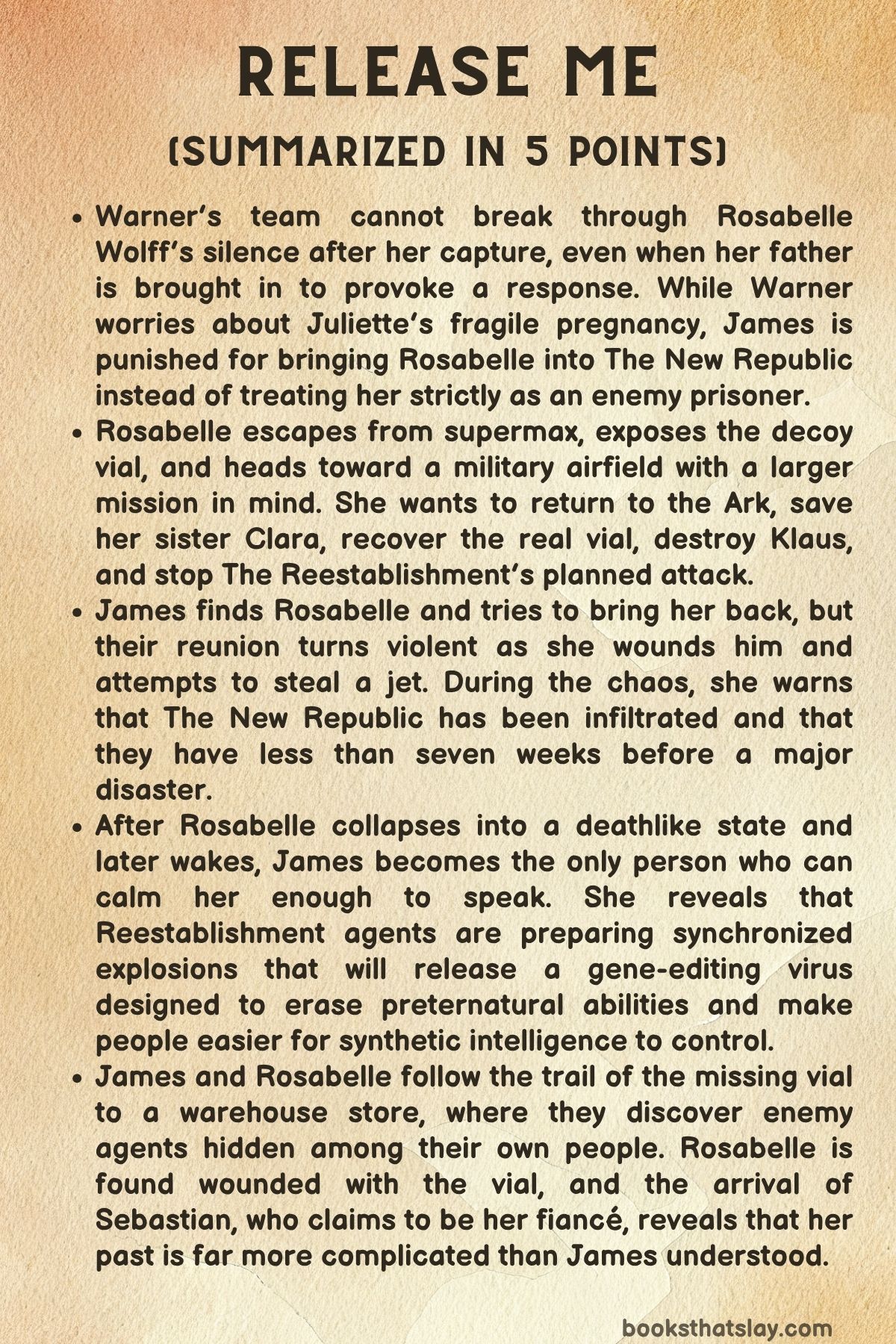
Summary
Warner watches yet another interrogation of Rosabelle Wolff from behind the glass, growing more frustrated with every passing moment. Rosabelle has been held for eight days, yet she has not spoken, reacted, or shown any emotion that can be interpreted.
Her silence is unnatural, and even Adam, whose abilities should allow him to sense or neutralize what is affecting her, cannot reach whatever is blocking her mind. Hugo Wolff, Rosabelle’s father, is repeatedly brought before her in the hope that he might stir some response, but his desperation only makes the situation worse.
He pleads with her to acknowledge him, to look at him, to prove that some part of his daughter is still present. Rosabelle remains still and unreadable.
Warner begins to see Hugo as a danger rather than a tool. The man’s panic is too obvious, and his emotional instability makes him unreliable.
Warner’s own life is under intense pressure as well. Ella, also known as Juliette, is pregnant and physically fragile, and Warner is terrified by the possibility of losing her or the baby.
His fear makes him sharper, colder, and less patient. When Adam admits that he cannot understand Rosabelle’s condition, Warner ends the session and orders her returned to her cell with stronger electrical restraints.
He also starts recording even the smallest of her nonverbal movements, hoping that tiny patterns might reveal what her silence hides. Afterward, Warner and Adam argue about James.
Each blames the other for the trouble James has created, and their bitterness reveals how worried they both are.
James is far from the interrogation room, stuck on a freezing beach with Kenji, collecting sand and ocean samples as punishment. Since bringing Rosabelle into the heart of The New Republic instead of delivering her straight to prison, he has been demoted, stripped of clearance, and treated as a liability.
Kenji is furious with him and does not hide it. To Kenji, Rosabelle is not a mystery or a victim.
She is a Reestablishment mercenary who killed their people and nearly killed him. James insists he is not in love with her, but his behavior betrays him.
He cannot stop thinking about their time together on Ark Island or about the moment when Rosabelle seemed ready to reveal something important before everything fell apart.
Warner oversleeps after Ella lets him rest, then wakes in a panic because he is late. Soon he arrives at the beach with urgent news: Rosabelle is gone.
She escaped from supermax without being seen, stole what she believed was the vial, and left behind a tracked decoy hidden in a clown mannequin at a party supply store. The act proves that she knew the vial was fake and that she understood the trap surrounding it.
James had warned Kenji that Rosabelle would escape, and now he feels vindicated. Warner questions him, but James is tired of being dismissed as unreliable.
Angry and insulted, he walks away. In private, however, James already knows where Rosabelle is likely to go.
Rosabelle moves through the city after her escape and is surprised by how loose and disorderly The New Republic appears compared with Ark Island. She expected heavier surveillance and tighter control.
Instead, she finds maps and clothing with relative ease. In an attempt to disguise herself, she changes into what she believes is a black ninja outfit, though it is actually a child’s cat costume.
The mistake adds a strange absurdity to her dangerous mission. She heads toward a military airfield, not simply to run, but to return to the Ark.
Her true goal is to save her sister Clara, recover the real vial, destroy Klaus, the synthetic intelligence that controls Ark surveillance, and stop The Reestablishment’s larger plan before it becomes irreversible.
James finds her near the airfield. Their reunion is tense, funny, and painful at once.
He teases her about the cat costume and offers her the chocolate bar she once saved for Clara. He tries to convince her to come back with him, but Rosabelle refuses.
She warns him that she does not want to kill him, but she will hurt him if he gets in her way. They fight, and she stabs him with his own knife before running.
James follows her through the storm as she tries to steal a jet from a maintenance hangar. When soldiers arrive, he hides with her and presses her for answers.
Rosabelle tells him that she trained for hundreds of hours to escape prisons built by The Reestablishment. She warns that The New Republic has already been infiltrated and that they have less than seven weeks before catastrophe strikes.
Then she uses James’s feelings for her to escape his hold and runs straight into danger.
The hangar erupts into violence. Rosabelle fights the soldiers while trying not to kill them, forcing herself to disable rather than execute.
This restraint matters because it proves she is not the cold weapon Kenji believes her to be. James keeps trying to protect her, even after she wounds him.
Soon Kenji and the others surround them. Rosabelle, cornered and desperate, shoots James in the shoulder to create a chance to escape.
She reaches the jet and begins moving it toward the runway despite the awful weather and her injuries. James refuses to give up.
He climbs onto the moving aircraft using a rolling safety ladder and gets inside, forcing her to stop.
Warner’s forces surround them. Warner orders James away from Rosabelle, but James refuses.
Warner shoots him in the leg to stop him, proving how far he is willing to go when he believes James is endangering everyone. As Warner weighs what should be done with Rosabelle, James blurts out that she warned them they have only seven weeks.
Warner notices Rosabelle’s reaction to James and begins to reconsider the situation. Before any decision can be made, Rosabelle suddenly drops dead.
For three days, Rosabelle remains in a deathlike state. At Warner and Juliette’s house, the group argues over what should happen to her if she wakes.
James insists that sending her back to prison is useless because she knows how to escape Reestablishment-designed facilities. He also argues that Hugo is the wrong person to oversee her because Rosabelle does not see him as safety.
She sees him as trauma. Nazeera offers her mostly empty cottage inside The Waffle as a secure alternative.
Warner agrees, though he remains cautious. Throughout the conversation, Ella’s pregnancy and weakness remain a source of quiet dread, especially for Warner, whose protectiveness has become almost unbearable.
Rosabelle wakes in the hospital after a strange encounter with Clara in a dreamlike space. Clara tells her that she only dreams of the dead, which suggests that Rosabelle has been closer to death than anyone understands.
When Rosabelle returns painfully to her body, she panics. James reaches her and calms her in a way no one else can.
Warner observes this closely. Rosabelle becomes emotionally and physically alive around James, yet she turns cold and unreadable when he leaves.
This makes Warner suspicious. He privately warns Rosabelle that if she is manipulating James, he will destroy her.
At Nazeera’s cottage, Rosabelle is restrained, starving, exhausted, and disoriented. Nazeera tries to care for her but struggles with the practical demands of keeping such a dangerous, traumatized person alive.
She calls Winston for help. James arrives with badly made soup, and Rosabelle, too weak to resist much, collapses asleep in his arms.
When she later wakes with James, Nazeera, Winston, and Adam nearby, she finally gives them part of the truth. Reestablishment agents have been embedded across the continent, and they are preparing synchronized terror attacks.
According to Rosabelle, their only chance is to let her return to the Ark.
James refuses to discuss strategy until she eats, so he takes her to a diner. There, she slowly eats waffles and meets more of his friends.
The ordinary setting contrasts sharply with the scale of the danger she describes. A pager alert suddenly sends many hidden soldiers rushing out of the diner, revealing how militarized and prepared The New Republic truly is beneath its casual surface.
Alone with James, Rosabelle denies stealing the vial when he questions her. Their attraction intensifies until they nearly lose control, but Nazeera returns injured and warns that the vial is missing.
Rosabelle runs, and James follows her outside.
Outside, Rosabelle notices an electromagnetic force field over The Waffle and realizes The New Republic is more protected than she first believed. James corners her, and at last she explains the vial’s true purpose.
The Reestablishment plans to use agents across the continent to set off undetectable explosions that will release a gene-editing virus. The virus is designed to erase preternatural abilities and prepare people for control by synthetic intelligence.
Rosabelle also reveals that Klaus read James’s mind on the Ark and manipulated his escape. James still insists on helping her.
After a distant explosion confirms that the threat is already active, Rosabelle accepts his deal to go with him.
Meanwhile, Warner and Kenji investigate enemy movement at the docks. Warner reveals that the stolen vial is yet another decoy with a tracker and that only he knows where the original is hidden.
James and Rosabelle follow the trail to a warehouse store, believing the explosion was meant to distract them. Inside, Rosabelle screams and vanishes into a trap.
James fights masked attackers and discovers that one of them is Allie, proving that infiltrators have penetrated their own ranks. The agents kill themselves rather than be questioned.
James finds Kenji and others suspended from the rafters in strange metal restraints and frees Kenji. He then discovers Rosabelle badly wounded and clutching the vial while being pursued by a dark-haired man.
James captures him, but Rosabelle is horrified when she recognizes him as Sebastian. Kenji demands answers.
Sebastian calmly introduces himself as Rosabelle’s fiancé and says he has come to take her home. This revelation changes everything.
Rosabelle is no longer only a prisoner, a fugitive, or an enemy agent. She is bound to a hidden past that James does not understand, and the arrival of Sebastian suggests that the personal danger surrounding her may be as serious as the political threat closing in on The New Republic.
Characters
Rosabelle Wolff
Rosabelle Wolff is one of the most guarded and damaged figures in the book. She enters the story as a silent prisoner whose lack of reaction unsettles everyone around her, because her stillness is not simple stubbornness but a survival mechanism built through training, fear, and trauma.
Rosabelle has learned how to make herself unreadable, which gives her power in captivity but also isolates her from people who might help her. Her escape proves that she is brilliant, disciplined, and far more prepared than her captors realize.
She understands Reestablishment prisons, surveillance systems, decoys, and military weakness with frightening precision. Yet the book also shows that she is not merely a weapon.
During the hangar battle, she repeatedly tries to disable soldiers rather than kill them, revealing that her conscience remains active despite everything she has endured. Her love for Clara drives many of her choices, and her loyalty to her sister explains why she is willing to risk everything to return to the Ark.
Around James, Rosabelle becomes less mechanical and more visibly human. His presence unsettles her because it reaches the parts of her she has tried to bury.
Her fear, tenderness, attraction, and guilt all surface when she is with him. In Release Me, Rosabelle stands at the center of the conflict between conditioning and choice, showing how difficult it is for a person trained to obey violence to reclaim moral freedom.
James Kent
James Kent is driven by compassion, defiance, and a dangerous need to believe in Rosabelle when almost everyone else sees her as an enemy. His decision to bring her into The New Republic instead of taking her directly to prison leads to his demotion and humiliation, but he refuses to accept that his instincts were meaningless.
James is reckless, but his recklessness is tied to emotional intelligence. He notices things others dismiss: Rosabelle’s hesitation, her pain, her hidden urgency, and the possibility that her actions are not as simple as betrayal.
His attraction to her complicates his judgment, and Kenji is right to worry that James may be too personally invested. Still, James is not only blinded by desire.
He also asks the right questions and refuses to let fear erase the truth. His willingness to follow Rosabelle, protect her, and listen to her warnings pushes the plot forward.
He is wounded again and again, emotionally and physically, but he keeps choosing involvement over safety. James’s role in the novel is not that of a perfect hero.
He is stubborn, impulsive, and sometimes naïve. Yet his belief in Rosabelle becomes important because it creates the first real opening through which her silence breaks.
He represents trust as an active choice, even when that choice looks foolish to everyone else.
Aaron Warner
Aaron Warner is presented as a man carrying power, fear, responsibility, and exhaustion all at once. He is coldly efficient when dealing with Rosabelle, ordering restraints, studying her smallest movements, and threatening her when he suspects she might be manipulating James.
Yet his severity is not empty cruelty. Warner is responsible for protecting The New Republic from infiltration, and Rosabelle’s escape proves that the threat is larger than anyone first understood.
His fear for Ella and their unborn child sharpens every decision he makes. The pregnancy has made him vulnerable in a way he can hardly tolerate, and that vulnerability turns into control, suspicion, and anger.
Warner’s relationship with James is strained because he sees James’s emotional involvement with Rosabelle as dangerous, even while James’s information becomes essential. Shooting James in the leg is a brutal act, but in Warner’s mind it is a calculated move to prevent a greater disaster.
The book uses Warner to show the burden of leadership in a world where mercy can be exploited and hesitation can cost lives. His intelligence allows him to anticipate some of the enemy’s moves, as shown by the decoy vial and tracker, but even he cannot fully control the chaos unfolding around him.
Warner is both protector and threat, a character whose love makes him more human but also more severe.
Adam Kent
Adam Kent occupies a difficult position in the story because he is both useful and limited. His abilities should make him capable of understanding or neutralizing what is happening inside Rosabelle, but he fails to reach her mind.
This failure frustrates Warner and exposes the unsettling nature of Rosabelle’s condition. Adam’s inability to solve the problem immediately matters because it proves that Rosabelle is not simply resisting in an ordinary way; something deeper and stranger is protecting or blocking her.
Adam also becomes part of the emotional conflict surrounding James. His argument with Warner reveals shared concern, buried resentment, and the long history of complicated loyalties between them.
Adam sees the danger in James’s choices, but he is also connected to him as family, which makes his frustration more personal. In the cottage scenes, Adam’s presence adds another layer of caution.
He is not as emotionally open toward Rosabelle as James, nor as aggressively suspicious as Warner, but he represents the practical concern of people trying to survive in a world where trust can be deadly. Adam’s role is quieter than some of the others, yet it helps underline how far Rosabelle exists outside everyone’s usual understanding of power, trauma, and control.
Kenji Kishimoto
Kenji Kishimoto is sharp, angry, loyal, and often the clearest voice of caution in the book. His anger toward James comes from real pain, not simple judgment.
Rosabelle is connected to the deaths of their people and to violence against Kenji himself, so he cannot view James’s interest in her as romantic or noble. To him, it looks like weakness that could endanger everyone.
Kenji’s bluntness serves an important function because he says what others may be afraid to say: James is acting like someone emotionally compromised. Yet Kenji is not only a source of criticism.
He is a soldier who responds when danger strikes and a friend who remains tied to the group even when he is furious. His presence at the docks and later in the warehouse store shows his willingness to face threats directly.
When he is captured and suspended in strange restraints, the danger becomes personal again, proving that the infiltrators are capable of reaching even trusted members of the inner circle. Kenji’s skepticism toward Rosabelle is understandable, and that makes him an important counterbalance to James.
While James sees the possibility of Rosabelle’s goodness, Kenji remembers the cost of trusting too quickly. His role keeps the story from treating forgiveness as easy.
Ella Sommers / Juliette Ferrars
Ella, also known as Juliette, is not physically active in the central conflict, but her presence shapes Warner’s emotional state and the atmosphere around the group. Her pregnancy makes her vulnerable, and her medical fragility creates an undercurrent of fear that affects nearly every decision Warner makes.
She allows Warner to rest, which shows her care for him, but his panic upon waking late reveals how little peace either of them truly has. Ella represents what Warner is trying to protect: family, future, and the possibility of life beyond war.
At the same time, her weakness reminds the reader that victory has not made the characters safe. The New Republic may exist, but its leaders are still living under threat, and the people they love can still be harmed.
Ella’s condition also softens Warner by exposing the depth of his fear. His love for her and their child does not make him gentle in public; instead, it intensifies his need for control.
In that sense, Ella’s role is emotionally powerful even when she is not at the center of the action. She stands for hope made fragile, a future that everyone wants but no one can fully secure.
Hugo Wolff
Hugo Wolff is a desperate and tragic presence in the book because his relationship with Rosabelle is defined by pain, failure, and fear. He is brought before her again and again because others believe he might be able to reach her, but every attempt only exposes how broken their bond has become.
Hugo begs Rosabelle to acknowledge him, yet she offers him nothing. Her silence suggests that he is not a comfort to her.
To James, Hugo is not a safe custodian but a source of trauma, and this interpretation changes how the group must view Rosabelle’s past. Hugo’s desperation makes him less useful to Warner because he cannot control his emotions, and in a crisis, uncontrolled emotion becomes dangerous.
He may love Rosabelle, or he may be attached to the idea of reclaiming her, but the book does not present him as someone who understands what she needs. Instead, he represents a past that continues to wound her.
His presence helps explain why Rosabelle has learned to shut herself down so completely. Hugo is important because he reveals that family is not automatically safety.
Sometimes the people who should provide refuge become part of the damage a character must escape.
Nazeera Ibrahim
Nazeera Ibrahim is practical, observant, and compassionate in a controlled way. When the group debates what to do with Rosabelle, Nazeera offers her mostly empty cottage inside The Waffle as a secure place to keep her.
This offer shows courage and responsibility because Rosabelle is not an easy person to shelter. Nazeera is willing to take on a difficult burden because she understands that prison may not work and that treating Rosabelle only as an enemy may cost them vital information.
At the cottage, however, Nazeera struggles with the reality of caring for someone restrained, starving, exhausted, and dangerous. Her decision to call Winston shows that she knows when she needs help, which makes her competence feel grounded rather than exaggerated.
Nazeera’s injury after the vial goes missing also proves that she is directly affected by the danger surrounding Rosabelle. She is not an observer standing safely outside the conflict.
Her role in Release Me is important because she offers a middle path between James’s emotional trust and Warner’s suspicion. She does not romanticize Rosabelle, but she does not reduce her to a weapon either.
Nazeera sees the practical need to keep her alive and the moral need to treat her as more than a prisoner.
Winston
Winston appears as a supporting figure whose importance lies in his reliability and practical usefulness. When Nazeera struggles to care for Rosabelle, she calls Winston for help, which suggests that he is someone the group trusts in situations that require steadiness rather than drama.
His presence at the cottage helps create a safer environment for Rosabelle’s first real attempt to explain what she knows. Winston is not the person driving the emotional conflict, and he does not dominate the action, but characters like him matter because they hold the group together in moments of stress.
He belongs to the network of friends and allies surrounding James, and Rosabelle’s exposure to that network slowly challenges her expectations of The New Republic. Through Winston, the book shows that resistance is not only made of leaders and fighters.
It is also made of people who show up when called, provide help, and make survival possible in ordinary ways. His calm support contrasts with the high emotional stakes between James and Rosabelle and with the harsher power struggles involving Warner, Kenji, and the enemy infiltrators.
Clara Wolff
Clara Wolff is the emotional force behind many of Rosabelle’s choices, even though she appears mainly through Rosabelle’s memory and dreamlike experience. Rosabelle’s desire to save Clara is one of the clearest signs that she is not motivated by selfishness or simple loyalty to The Reestablishment.
Clara represents the part of Rosabelle’s life that remains tender and worth protecting. The chocolate bar James returns to Rosabelle matters because it connects directly to Clara, showing how even a small object can carry deep emotional meaning.
The dreamlike encounter in which Clara says she only dreams of the dead adds mystery and sorrow to her role. It suggests that Clara may be in terrible danger or may already be beyond saving, though the full truth remains uncertain.
Clara’s function in the story is to humanize Rosabelle from within. Even when Rosabelle appears cold, her devotion to Clara reveals love, fear, and guilt beneath the surface.
Clara also raises the stakes of returning to the Ark. For Rosabelle, the mission is not abstract politics.
It is personal. Saving Clara is tied to stopping Klaus, recovering the real vial, and resisting the future The Reestablishment intends to create.
Sebastian
Sebastian enters late, but his arrival reshapes the meaning of Rosabelle’s past and future. When he appears as the dark-haired man pursuing her, he seems at first like another enemy agent or operative.
The revelation that he is Rosabelle’s fiancé changes the emotional landscape immediately. James’s connection to Rosabelle has already become intense and complicated, so Sebastian’s claim introduces personal conflict at the exact moment when the external threat is escalating.
Sebastian’s calm statement that he has come to take Rosabelle home suggests possession, control, and a past arrangement Rosabelle may not have freely chosen. Her horrified reaction is crucial because it tells the reader that Sebastian is not a source of comfort.
Whatever bond exists between them is tied to fear, obligation, or coercion. He represents the life Rosabelle is trying to escape and the systems that still claim ownership over her.
His appearance also complicates how the others see her. Rosabelle is not only an escaped prisoner with secret information; she is part of a larger personal and political structure that has followed her into The New Republic.
Sebastian’s presence promises that the danger around her is far from finished.
Klaus
Klaus is not human in the ordinary sense, but the synthetic intelligence is one of the most dangerous forces in the story. Klaus controls Ark surveillance and has the ability to read and manipulate minds, as shown through Rosabelle’s revelation that it read James’s mind and shaped his escape.
This makes Klaus terrifying because its power is not limited to observation. It can influence events by exploiting private thoughts, emotional vulnerabilities, and strategic weaknesses.
Rosabelle’s need to destroy Klaus shows that it is central to The Reestablishment’s larger plan. The gene-editing virus is meant to erase preternatural abilities and prepare people for control by synthetic intelligence, which means Klaus represents a future where human freedom, identity, and power can be rewritten or managed by a machine.
Its presence changes the nature of the enemy. The danger is not only soldiers, prisons, or political control.
It is also technological domination at the level of thought and biology. Klaus matters because it turns the conflict into a fight over agency itself.
If it succeeds, people will not merely be ruled. They may be altered until resistance becomes impossible.
Allie
Allie’s role is brief but significant because her presence among the masked attackers proves that infiltration has reached deep into trusted spaces. When James discovers that one of the attackers is Allie, the danger becomes more personal and more disturbing.
The enemy is no longer an outside force that can be identified by uniform, location, or known allegiance. It has entered the networks The New Republic depends on.
Allie’s appearance supports Rosabelle’s warning that Reestablishment agents are embedded across the continent. The agents’ willingness to kill themselves rather than be questioned makes the situation even more frightening, because it suggests extreme conditioning, loyalty, or control.
Allie’s role is therefore less about individual development and more about what she reveals. She is evidence that The New Republic has already been compromised and that the coming attacks are not distant possibilities.
They are already in motion. Her presence also validates Rosabelle at a moment when many still doubt her.
Through Allie, the book shows that mistrust is not paranoia when the enemy has learned how to hide in plain sight.
Themes
Trust Between Enemies
Trust in the story is never simple because the characters are surrounded by deception, trauma, and political violence. James believes Rosabelle before he has enough evidence to justify that belief, and this makes him look reckless to everyone around him.
Kenji sees that trust as emotional weakness, Warner sees it as a security risk, and Rosabelle herself tries to resist it because trust has never been safe for her. Yet James’s trust is also the reason Rosabelle begins to speak.
It creates a narrow space where she can be something other than a prisoner or a weapon. The theme becomes especially strong because the book does not present trust as innocent or easy.
James gets hurt repeatedly because of Rosabelle. She stabs him, shoots him, runs from him, and withholds information.
At the same time, she also warns him, protects him in indirect ways, and finally tells him the truth about the vial, the virus, Klaus, and the seven-week deadline. Release Me uses their relationship to show that trust can be dangerous and still necessary.
In a world built on surveillance and manipulation, choosing to believe someone becomes an act of resistance.
Trauma and Emotional Survival
Rosabelle’s silence is one of the clearest expressions of trauma in the story. She does not simply refuse to speak; she has trained herself to become unreachable.
Her stillness, lack of visible emotion, and ability to endure interrogation all suggest a person who has survived by shutting down every readable part of herself. This form of survival protects her, but it also traps her.
When Hugo is brought before her, her silence becomes even more revealing because he does not calm her or bring her back to herself. Instead, his presence seems tied to the pain she has learned to bury.
James affects her differently. Around him, she panics, softens, fights, and reacts.
These responses are messy and dangerous, but they are also signs of life. The book treats trauma not as a single wound but as a system of habits built under pressure.
Rosabelle’s training, fear, loyalty to Clara, and distrust of safety all shape how she moves through the world. Her recovery is not immediate, and it is not gentle.
It begins through hunger, exhaustion, violence, dreams, and unwanted attachment. The story shows that surviving trauma may require more than escape from a physical prison.
It may require learning how to exist without becoming numb.
Control, Surveillance, and Free Will
The conflict surrounding Klaus, the vial, and the gene-editing virus raises a major concern about control over bodies and minds. The Reestablishment does not only want political power.
Its plan involves changing people at a biological level by erasing preternatural abilities and preparing them for synthetic intelligence control. This makes the threat more disturbing than ordinary war because it attacks identity itself.
Abilities are not merely tools in this world; they are part of how many characters understand themselves and resist oppression. Removing those abilities through a hidden virus would make people vulnerable before they even knew they were under attack.
Klaus intensifies this fear because it can read minds, manipulate perception, and turn private thought into a weapon. James’s escape from the Ark becomes horrifying once Rosabelle reveals that Klaus shaped it by reading his mind.
Even moments that seemed like freedom may have been engineered. The theme is also reflected in Rosabelle’s imprisonment and restraints, Warner’s use of decoys and trackers, and the electromagnetic force field over The Waffle.
Every side uses control to survive, but the moral difference lies in whether control protects freedom or destroys it.
Love as Loyalty and Risk
Love in the story is powerful because it repeatedly places characters in danger. James’s feelings for Rosabelle make him vulnerable to manipulation, injury, and mistrust from his own people.
He knows she is dangerous, yet he continues to follow her because he senses that her actions are driven by something deeper than betrayal. Rosabelle’s love for Clara is even more central.
It pushes her to escape, return to the Ark, recover the real vial, and face Klaus. She is willing to risk death not for glory or revenge, but because Clara represents the person she cannot abandon.
Warner’s love for Ella and their unborn child creates another version of this theme. His fear for them makes him protective, severe, and sometimes frightening.
Love does not soften every character in the same way. For James, it becomes faith.
For Rosabelle, it becomes duty. For Warner, it becomes control.
For Hugo, it becomes desperation that may no longer be healthy or safe. The arrival of Sebastian adds a darker version of attachment, suggesting that what some people call love may actually be possession.
Through these different relationships, the book shows that love can save, expose, endanger, and imprison depending on the choices attached to it.