Inside The Box Summary and Analysis
Inside the Box: How Constraints Make Us Better by David Epstein is a nonfiction exploration of why limits, boundaries, and carefully chosen constraints can make people more creative, effective, and purposeful.
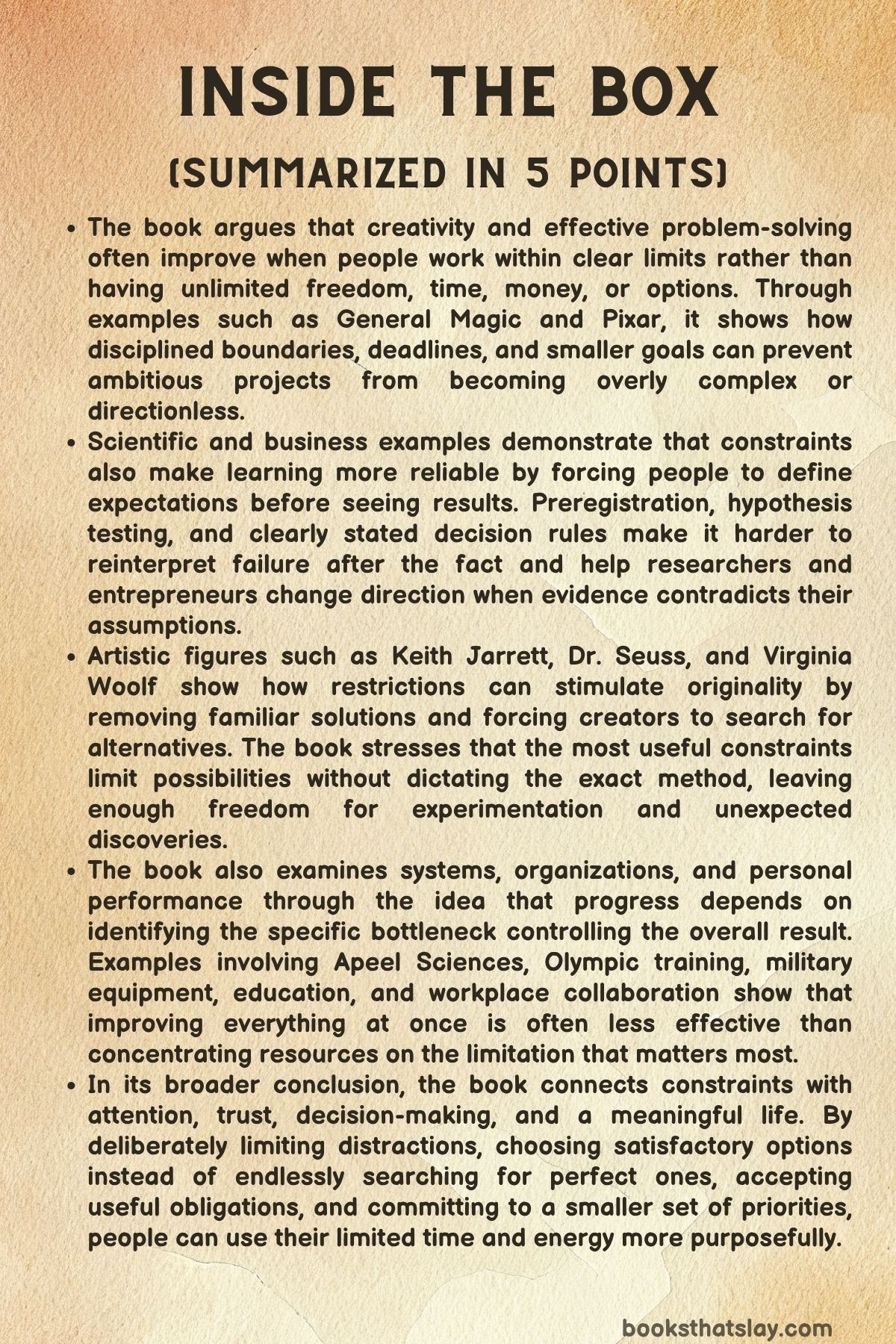
Epstein challenges the assumption that maximum freedom, unlimited resources, and endless options naturally produce better results. Through examples from technology, science, art, business, sports, education, and everyday decision-making, he shows that progress often begins when people narrow the problem instead of expanding it. The book argues that good constraints do not eliminate freedom; they give freedom a useful shape by forcing clearer choices, faster learning, stronger attention, and more imaginative solutions.
Summary
Inside The Box begins with General Magic, a technology company formed by Marc Porat and a remarkable collection of former Apple engineers who dreamed of creating a handheld digital device long before smartphones became ordinary. The company had talent, financial backing, powerful partners, and freedom to experiment, but those apparent advantages gradually became weaknesses because the team kept adding features, inventing technologies from scratch, and expanding its ambitions without clearly deciding who the customer was, how much the device should cost, or what its most essential purpose should be.
General Magic becomes Epstein’s central example of the danger of assuming that more resources naturally produce more innovation. The project demonstrates how people often respond to difficulty by adding employees, functions, money, ambitions, and complexity, even when the better solution would be to reduce the scope, clarify the objective, test the assumptions, and decide what should deliberately be excluded.
Epstein contrasts this failure with Ed Catmull’s pursuit of computer animation, an ambition that was just as enormous but approached in a very different way. Catmull and the people who eventually built Pixar broke their distant goal into smaller technical and creative problems, tested ideas separately, accepted resource limits, discarded unnecessary features, and spent years gradually developing the capabilities that ultimately made Toy Story possible.
Pixar’s later working culture preserves this same balance between freedom and restriction. Small teams are allowed to experiment, but schedules, storyboards, pitches, reviews, Braintrust meetings, deadlines, and visible limits force projects to move forward, showing that creative people often perform best when they are given freedom inside a clearly defined space rather than being asked to operate without boundaries.
Tony Fadell carries a similar lesson from his experience at General Magic into his later work at Apple. While developing products such as the iPod and participating in early iPhone work, he uses deadlines and repeated prototype cycles to force teams to stop, evaluate what they have learned, and make decisions instead of allowing perfectionism and endless possibility to keep projects open indefinitely.
The argument then moves into science, where Epstein shows that too much analytical freedom can corrupt learning itself. When researchers can change hypotheses, measurements, or interpretations after seeing results, random patterns can easily be presented as discoveries, whereas preregistration forces researchers to state what they expect in advance and therefore makes it much harder to explain away evidence that contradicts their assumptions.
Brian Wansink’s nutrition research illustrates the consequences of repeatedly searching data for interesting relationships after results are already known. Epstein connects this scientific problem to business experimentation, where entrepreneurs also benefit from treating assumptions as hypotheses that must be tested rather than personal beliefs that must be defended; companies such as Inkdome are therefore better able to change direction when evidence disproves their original ideas.
General Magic and Apple’s Newton project show the opposite response because inconvenient information about markets and users is often ignored rather than treated as useful evidence. The broader lesson is that constraints make failure productive by defining what was expected beforehand, allowing people to see clearly when reality has disproved them instead of inventing explanations after the fact.
Artistic creativity provides another form of evidence when Epstein examines Keith Jarrett’s famous 1975 performance in Cologne. Jarrett arrived exhausted and discovered that the piano available to him was smaller and more defective than the concert grand he had expected, yet by adapting his playing to the instrument’s usable range, changing his rhythm and dynamics, and playing more forcefully than usual, he produced a performance that became extraordinarily successful.
Epstein places Jarrett beside Dr. Seuss, who wrote Green Eggs and Ham after being challenged to use only fifty different words, along with artists and performers such as Bach, Stravinsky, improvisational comedians, and Kyrie Irving. Their examples suggest that a useful restriction blocks the most obvious response while still leaving enough freedom for the creator to discover an unexpected alternative.
Virginia Woolf represents a more deliberate approach to changing creative boundaries. Dissatisfied with traditional fiction, she rejected familiar techniques such as straightforward linear plots and conventional narration and experimented with forms better suited to representing consciousness, demonstrating what psychologist Patricia Stokes describes as paired constraints: preventing oneself from using a familiar method while deliberately promoting another.
That principle also appears in visual art, where Monet and the Impressionists abandoned certain traditional techniques while emphasizing alternatives, and Cubist painters rejected the single viewpoint in favor of multiple perspectives. Epstein stresses, however, that novelty still requires some recognizable connection with an audience because innovation can lose its power when it becomes so unfamiliar that people no longer understand how to enter it.
Originality is also reconsidered through Martin Luther King Jr., whose sermons drew structures, stories, references, and language from earlier preaching traditions. Rather than weakening King’s originality, familiarity gave his listeners a recognizable foundation, allowing him to transform existing material into arguments suited to the civil rights struggle and showing that creativity often develops by reshaping what already exists rather than creating from nothing.
Similar logic appears in technology and design. UPS initially encountered resistance when its ORION route-planning system gave drivers directions that contradicted years of practical experience, and acceptance improved only when the organization combined new computational possibilities with driver knowledge instead of treating established practice as worthless.
The design of military body armor offers another important lesson because equipment built around average assumptions failed to fit many soldiers well, especially as more women entered close-combat roles. By designing around people facing stronger physical limitations and creating more adaptable equipment, engineers improved the system not only for women but also for many men, supporting the broader idea of universal design: solving for the constrained user can reveal needs that average-based thinking hides.
Epstein applies the same idea to education, where working memory places a severe limit on everyone’s ability to absorb unfamiliar information. Good teaching must therefore respect cognitive capacity, connect new material to existing knowledge, and control how much unfamiliar information is introduced at once rather than assuming that presenting more content necessarily produces more learning.
James Rogers and Apeel Sciences shift the argument from personal limitations to the structure of entire systems. Rogers recognizes that increasing food production alone cannot solve food scarcity if enormous quantities spoil before reaching consumers, so Apeel focuses on extending the usable life of produce and thereby addressing a bottleneck elsewhere in the supply chain.
This leads into Eliyahu Goldratt’s Theory of Constraints, which holds that the performance of a system is controlled by its most limiting point. Improving parts that are not the bottleneck may accomplish almost nothing, while focusing attention on the one restriction controlling overall output can produce large gains, a strategy also reflected in Olympic swimmer Sheila Taormina’s decision to target the specific weakness keeping her from advancing rather than trying to improve everything simultaneously.
Attention becomes another scarce resource through the writing ritual of Isabel Allende, who has traditionally begun books on January 8. By treating that date as a commitment and protecting her writing time from competing demands, she creates boundaries that make sustained work more likely instead of relying on motivation to defeat distraction each day.
Research on task switching supports the same principle because unfinished activities continue occupying mental space and every interruption carries a cognitive cost. Epstein describes adjusting his own habits by shortening daily task lists, selecting one important goal, limiting email, moving his phone away, recording distracting thoughts rather than acting on them immediately, and deliberately creating periods when concentration becomes easier.
The importance of rules also appears in collaboration through Mary, a tailor working in Lusaka, Zambia. Where weak enforcement makes business partnerships dangerous because one person can take the profits with few consequences, refusing to collaborate becomes rational, while stronger governance and reliable social expectations allow people to trust partners and cooperate more productively.
Epstein extends this principle to teams through brainwriting and research on group norms. Independent idea generation can prevent dominant personalities from controlling discussion, while balanced participation and predictable rules make disagreement safer and encourage people who might otherwise remain silent to contribute.
Dmitri Mendeleev then challenges the myth of innovation as the achievement of an isolated genius far ahead of everyone else. Several researchers independently developed versions of the periodic system because earlier generations of scientists had already clarified definitions, measurements, and atomic weights, making a more precise next question possible for multiple people at nearly the same moment.
This pattern of simultaneous discovery appears throughout science and technology, and Epstein argues that well-defined unanswered questions often stimulate more creativity than limitless freedom. Gregor Mendel provides the reverse case: work can appear too early for its intellectual environment, and an idea may remain ignored until the surrounding field has developed enough structure to recognize its significance.
The book finally returns to General Magic, whose mistakes appear much clearer decades after its failure. Former employees and students can identify the uncontrolled scope, excessive technological ambition, unclear customer, perfectionism, delayed feedback, and reluctance to simplify, while Jeff Hawkins’s PalmPilot succeeds partly because it takes a much smaller portion of the same grand vision and turns it into a limited, practical product.
Herbert Simon’s idea of satisficing provides the closing framework. Because people have limited time, information, and mental capacity, continually searching for the theoretically best possible choice is unrealistic and often produces regret, while choosing something that meets important requirements can conserve attention for what matters most.
Epstein broadens the argument from individual decisions to the structure of a meaningful life. Unlimited options can weaken commitment, routines, obligations, relationships, and purpose, whereas deliberately choosing a small number of principles creates a framework for deciding what deserves attention and what can be ignored.
Bernard Suits’s description of games offers the final metaphor: games become meaningful because people voluntarily accept unnecessary obstacles and then attempt to succeed within them. Inside The Box therefore ends by arguing that limits are not simply barriers to freedom; chosen wisely, they are the structures that make creativity, concentration, cooperation, learning, decision-making, and purpose possible.
Key People
David Epstein
David Epstein functions as the guiding analytical presence of Inside The Box, connecting examples from technology, science, art, business, sports, psychology, and his own experience into a single argument about the productive value of limits. Rather than presenting constraints as inherently beneficial, he repeatedly distinguishes between restrictions that force useful adaptation and restrictions that merely control people without allowing discovery.
His role is also personal because he occasionally tests the principles he describes against his own habits. His reflections on attention, task switching, and reducing the size of his daily workload give the book a practical dimension, showing that the argument is not limited to famous innovators or major institutions but applies to ordinary choices about time, concentration, and priorities.
Marc Porat and the General Magic Team
Marc Porat and the engineers of General Magic represent extraordinary ability without sufficient boundaries. Inside The Box presents them as people who correctly imagined important parts of the technological future yet struggled to transform that vision into a disciplined product because almost every new possibility became another reason to expand the project.
Their tragedy is not a lack of intelligence or ambition but an inability to decide what to exclude. They become the book’s clearest warning that talented teams can become less effective when resources, freedom, prestige, and possibility encourage them to postpone basic questions about customers, deadlines, price, usability, and purpose.
Ed Catmull
Ed Catmull serves as General Magic’s strongest conceptual opposite. His ambition to create computer animation was enormous, but he approached it through smaller technical problems, long-term experimentation, realistic estimates, repeated evaluation, and a willingness to reject unnecessary work.
Within Inside The Box, Catmull demonstrates that patience is not the same as vagueness. Pixar could pursue an extraordinary creative goal because people were given room to experiment inside systems of pitches, storyboards, schedules, daily reviews, Braintrust meetings, and resource constraints that repeatedly converted abstract ambition into concrete decisions.
Tony Fadell
Tony Fadell is important because he carries lessons from failure into later success. Having experienced General Magic’s tendency toward endless expansion, he later uses firm deadlines and short prototype cycles at Apple to create moments when teams must stop designing, examine what they have learned, and choose a direction.
His approach illustrates the difference between a deadline as arbitrary pressure and a deadline as a learning mechanism. By preventing projects from remaining permanently unfinished, time limits expose weaknesses early, force prioritization, and allow a team to reset before enormous resources are committed to a mistaken path.
Brian Wansink
Brian Wansink appears as a cautionary figure in Epstein’s discussion of scientific freedom. His nutrition research represents the danger of searching through data after results are known until interesting relationships appear, because sufficiently flexible analysis can turn coincidence into something that looks like a meaningful discovery.
His role in the book is less about one researcher than about a larger methodological weakness. Wansink’s example demonstrates why scientists need rules established before they see the outcome: without those rules, intelligence can become a tool for rationalizing unexpected patterns instead of honestly testing whether an original prediction was correct.
Keith Jarrett
Keith Jarrett embodies adaptation under unavoidable limitation. Arriving for his Cologne performance exhausted and confronted with an inadequate piano, he initially faces circumstances that seem likely to diminish his performance, yet those very limitations force him to alter his usual technique.
Jarrett relies more heavily on the instrument’s functional middle range, repetition, rhythm, dynamics, and physical force. His importance lies in showing that constraints can redirect expertise rather than simply restrict it, because an experienced creator may discover possibilities that would never have been considered under normal conditions.
Dr. Seuss
Dr. Seuss represents deliberately imposed creative restriction. The famous fifty-word challenge behind Green Eggs and Ham removes an enormous portion of the vocabulary normally available to a writer, yet the restriction does not determine the story itself; it merely closes the most obvious routes.
That distinction is central to Epstein’s argument. Seuss remains free to choose characters, rhythms, situations, repetitions, and comic developments, so the rule creates a difficult problem without dictating its solution, allowing creativity to emerge through adaptation rather than simple obedience.
Virginia Woolf
Virginia Woolf represents the creator who becomes dissatisfied not with a particular work but with the conventions governing an entire form. She comes to believe that traditional linear plotting, omniscient narration, and heavy dependence on external description cannot adequately represent the disorder and movement of consciousness.
Her response is disciplined experimentation rather than unrestricted rebellion. She removes familiar techniques and deliberately promotes alternatives, using smaller works as testing grounds before developing more radical novels, which demonstrates that breaking an old convention becomes far more productive when a creator simultaneously constructs a new rule directing what should replace it.
Martin Luther King Jr.
Martin Luther King Jr. challenges the idea that originality requires complete independence from earlier material. His sermons drew on existing preaching traditions, biblical structures, stories, references, and familiar language, yet those inherited elements became foundations from which he could make arguments suited to the political and moral demands of the civil rights movement.
King’s role therefore reveals the relationship between recognition and transformation. Audiences can follow a challenging new argument more easily when some of its language and structure are familiar, while originality lies in how inherited material is reorganized, redirected, and given new force in a different historical purpose.
James Rogers
James Rogers represents the discipline of identifying the actual constraint in a system instead of improving the most visible part. His concern with feeding a growing population initially points toward production, but his work at Apeel Sciences reflects the realization that enormous losses occur because food spoils before it can be consumed.
His significance comes from reframing the problem. By developing a plant-based coating that slows deterioration, Rogers focuses on the bottleneck that controls how much existing food ultimately remains usable, illustrating why improving a system requires understanding where value is actually being lost rather than making every component more efficient.
Eliyahu Goldratt
Eliyahu Goldratt supplies one of the book’s most important organizational frameworks through the Theory of Constraints. His reasoning rejects the assumption that improving every department, process, or component independently will necessarily improve the performance of the whole system.
Goldratt’s approach requires managers to locate the single point currently limiting overall performance, organize other work around it, improve that bottleneck, and then repeat the process when another limitation becomes dominant. His importance lies in replacing scattered optimization with disciplined prioritization and showing that progress often depends more on choosing what not to improve than on improving everything at once.
Sheila Taormina
Sheila Taormina gives the Theory of Constraints a personal and athletic form. Rather than treating every element of her preparation as equally important, she identifies the particular weakness preventing her from reaching the Olympic team and concentrates effort where improvement can change the entire outcome.
Her example reveals the emotional difficulty of prioritization because concentrating on one weakness means accepting that other areas may receive less attention. Yet that selectivity is precisely what makes the approach effective: excellence in several areas cannot compensate for one decisive limitation if that limitation controls the final result.
Isabel Allende
Isabel Allende represents the use of ritual as a protective boundary around creative attention. Her practice of beginning books on January 8 turns an ordinary date into a commitment device that signals the beginning of a period in which competing demands must become secondary.
The power of her routine comes from reducing repeated negotiation with herself. Instead of deciding each day whether writing deserves priority, the ritual establishes that priority in advance, demonstrating how habits can conserve mental energy by transforming a difficult choice into a rule that no longer needs to be reconsidered constantly.
Mary
Mary, the tailor in Lusaka, provides one of the book’s clearest demonstrations that individual behavior cannot always be understood apart from institutional conditions. Her reluctance to collaborate is not presented as selfishness or lack of imagination but as a rational response to a setting in which agreements may be difficult to enforce and a dishonest partner can take profits without meaningful consequences.
Her experience shows that trust is partly created by reliable external rules. When people believe that agreements will be respected and violations will carry consequences, cooperation becomes safer, allowing individuals to share resources, take risks, disagree openly, and build partnerships that would otherwise be too dangerous.
Dmitri Mendeleev
Dmitri Mendeleev represents the extraordinary thinker whose achievement becomes possible because an intellectual field has already developed enough structure to make the next problem visible. Several people were working toward versions of a periodic system because generations of earlier chemists had clarified what counted as an element and had improved measurements of atomic properties.
Mendeleev remains exceptional, but his story weakens the romantic image of innovation appearing in complete isolation. Discovery often resembles a relay in which earlier researchers progressively narrow uncertainty until a previously vague mystery becomes a specific question that a prepared thinker can finally answer.
Gregor Mendel
Gregor Mendel provides the counterexample to the idea that being far ahead of everyone else guarantees recognition. His work on inheritance remained largely neglected for years because the surrounding scientific community had not yet developed the conceptual structure needed to understand its importance.
His position in the story shows that innovation depends partly on timing and intellectual context. An idea may be correct and original yet have little immediate influence if the questions, terminology, methods, and accumulated knowledge surrounding it have not developed enough for other people to recognize what the discovery changes.
Jeff Hawkins
Jeff Hawkins represents simplification after General Magic’s failure. The PalmPilot succeeds partly because Hawkins takes a small, useful portion of an enormous technological dream and turns it into a product whose functions can be explained, built, tested, and understood by users.
His importance lies in disciplined reduction rather than reduced ambition. By narrowing the immediate objective, Hawkins does not abandon the larger future imagined by earlier innovators; he creates a realistic entry point into that future, showing how limited products can sometimes advance a broad vision more effectively than attempting to build the entire vision at once.
Herbert Simon
Herbert Simon supplies the philosophical foundation for the book’s conclusion through the concept of satisficing. Inside The Box ultimately uses Simon to question the assumption that intelligent people should continuously search for the best possible option when human beings never possess unlimited time, complete information, perfect foresight, or endless mental capacity.
Simon’s alternative is not laziness or indifference but selective ambition. By choosing an option that meets important requirements, a person can stop comparing possibilities and conserve attention for decisions that matter more, turning limitation from an unfortunate defect of human life into a principle for living more deliberately.
Bernard Suits
Bernard Suits provides the final metaphor through his understanding of games as activities in which people voluntarily accept unnecessary obstacles. A game becomes interesting precisely because players cannot simply use the easiest possible means to reach the objective; they agree to rules that make achievement more difficult.
His idea transforms the book’s discussion of constraints into a broader argument about meaning. People often value activities not despite their limitations but because the limitations create standards, challenges, choices, identities, and opportunities for mastery that unrestricted action could never provide.
Themes
Freedom Becomes More Productive When It Has Boundaries
Inside The Box repeatedly challenges the assumption that creativity depends on removing as many restrictions as possible. General Magic possesses talent, corporate support, money, technological imagination, and extraordinary freedom, yet those advantages create a situation in which nearly every new idea can be added to the project and almost no one is forced to decide which possibilities deserve to be abandoned.
Pixar shows a more productive relationship between freedom and structure. Creative teams can experiment, disagree, and discover unusual solutions, but deadlines, reviews, storyboards, budgets, and specific project goals ensure that experimentation eventually produces a decision rather than becoming permanent exploration.
The artistic examples make the same distinction. Keith Jarrett’s inadequate piano, Dr. Seuss’s limited vocabulary, and the restrictions adopted by composers, painters, and performers remove familiar options without prescribing the precise alternative, forcing creators to use their expertise in unfamiliar ways.
The crucial issue is therefore not whether a person is constrained but whether the constraint leaves meaningful room for choice. A rule that determines both the objective and the exact method can suppress invention, while a rule that closes obvious routes yet leaves the solution open can make originality more likely because the creator must search beyond habitual responses.
Failure Becomes Valuable When Expectations Are Defined in Advance
Learning requires more than discovering that something went wrong; it requires knowing what one expected before reality produced an answer. Scientific preregistration illustrates this principle because researchers who state their hypotheses, measurements, and analytical plans in advance cannot as easily reinterpret chance patterns as confirmation after seeing the data.
Business experiments face the same problem. Entrepreneurs who clearly state assumptions can compare those assumptions with customer evidence and abandon an idea when reality contradicts it, whereas teams without explicit predictions can continually reinterpret negative results until failure appears to support whatever they already wanted to believe.
General Magic and Apple’s Newton project show how costly defensive interpretation can become. When organizations become emotionally committed to a vision, evidence stops functioning as information and begins functioning as something to be explained away, allowing the project to continue without the learning that failed tests should have produced.
Constraints therefore create accountability between expectation and outcome. By deciding in advance what evidence would count as success, failure, or a reason to change direction, people convert mistakes into information and reduce the temptation to protect their original beliefs through increasingly elaborate explanations.
Progress Depends on Identifying the Constraint That Actually Controls the System
Inside The Box repeatedly separates visible activity from meaningful progress. James Rogers’s work at Apeel Sciences demonstrates this difference because producing more food cannot solve a supply problem if enormous quantities disappear through spoilage before consumers can use them.
Goldratt’s Theory of Constraints turns that insight into a general principle. Every system contains a point that currently limits total performance, and improving areas outside that bottleneck may produce impressive local statistics without improving the final result.
Sheila Taormina applies the same reasoning to athletic performance by identifying the specific weakness standing between her and an Olympic objective. Instead of treating every ability as equally worthy of improvement, she concentrates on the limitation whose improvement can change the outcome of the entire system.
The principle demands discipline because people naturally enjoy improving areas where they already feel competent. Bottleneck thinking may require ignoring attractive opportunities, allowing some parts of a system to remain merely adequate, and directing scarce attention toward the one uncomfortable weakness that determines overall performance.
Progress therefore depends not on maximum effort everywhere but on accurate diagnosis. Once the controlling constraint changes, attention can move to the next bottleneck, making improvement a repeated process of finding the limitation that matters most now.
Chosen Limits Create Attention, Trust, and Meaning
Modern abundance creates its own form of scarcity because endless options compete for limited attention. Isabel Allende’s January 8 ritual shows how a self-imposed rule protects creative work by removing the need to repeatedly decide whether writing deserves priority, while Epstein’s own changes to email, phones, task lists, and daily priorities show how physical and behavioral limits can reduce self-interruption.
Social cooperation depends on similar structures. Mary’s experience in Lusaka demonstrates that people may rationally avoid collaboration when rules are unreliable, while stronger institutions and predictable consequences make trust possible because individuals do not have to rely entirely on another person’s goodwill.
The principle extends from institutions to teams. Brainwriting, balanced participation, and shared group norms create conditions in which quieter members can contribute ideas and disagreement becomes safer, showing that fair rules can expand participation rather than merely restrict behavior.
Herbert Simon’s satisficing brings the same logic into personal decision-making. Choosing a satisfactory option ends endless comparison and preserves attention for more important concerns, while Bernard Suits’s account of games suggests that voluntarily accepted obstacles give actions structure and significance.
A life without limits can become a life in which every possibility competes equally for attention. Deliberately choosing obligations, values, routines, communities, and goals excludes alternatives, but that exclusion is precisely what allows commitment and purpose to become durable.