One Small Echo Summary, Characters and Themes
One Small Echo by Jane Washington is a dark fantasy novel about power, identity, loyalty, coercion, and the dangerous boundaries between human beings and supernatural creatures.
At its center is Eiko Menai, a young woman who lost her sight after entering the Quiet to save a prince and who later discovers that the same supernatural world that harmed her has permanently changed what she is. As Eiko becomes bound to an extraordinary creature and is drawn into the Godsguard, royal politics, forced marriage, and a struggle for personal control, the story steadily questions whether monsters are truly the greatest threat to humanity. It’s the 1st book in the Shadowsong series.
Summary
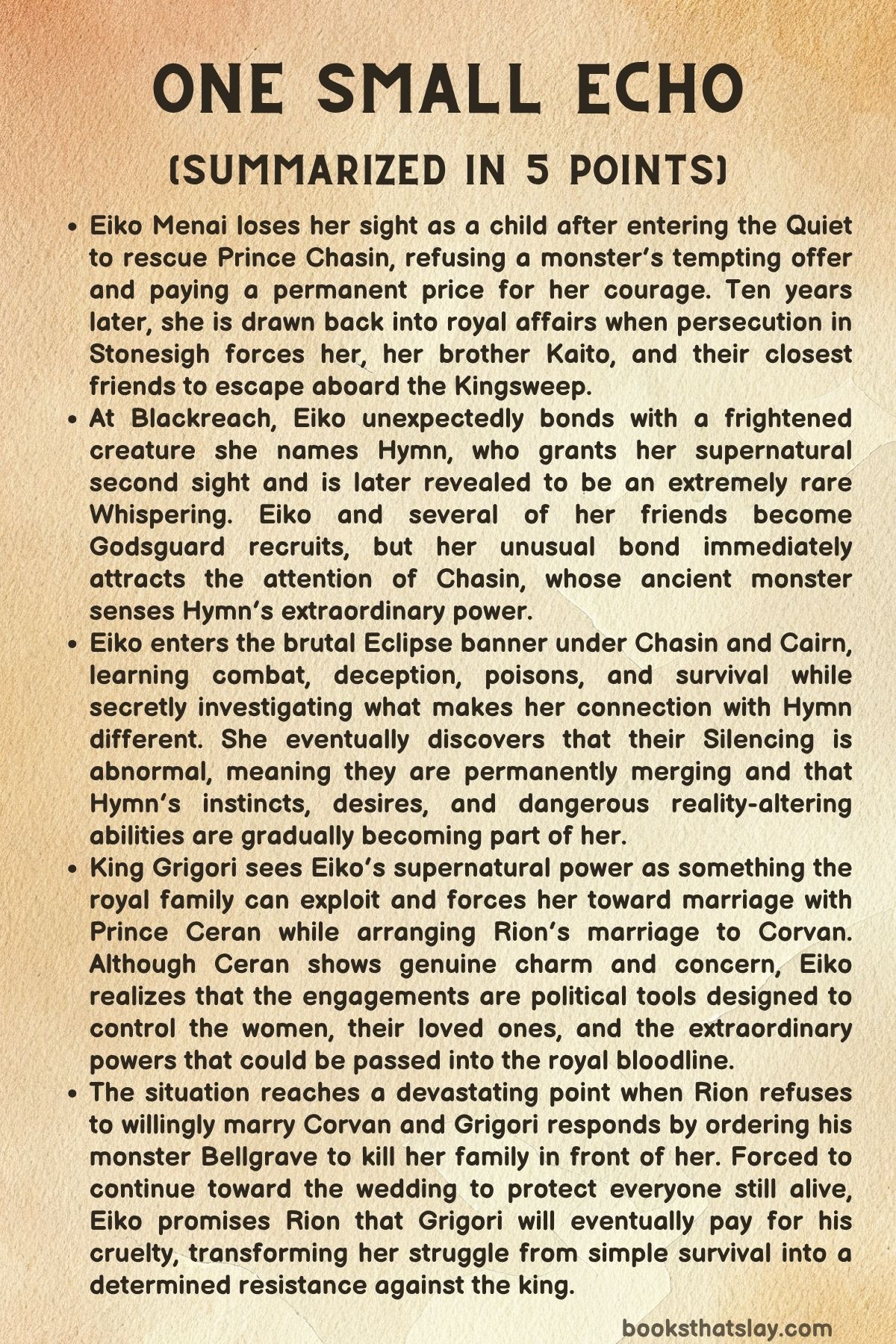
Ten-year-old Eiko Menai grows up in Stonesigh, a place where darkness is dangerous because it allows creatures from the Quiet to enter human minds. During the royal Kingsfete, curiosity takes her away from the festivities and leads her to secretly follow King Grigori and his youngest son, Chasin, into a forbidden cave where the boundary between the ordinary world and the Quiet is exceptionally weak.
Inside the cave, Grigori forces the terrified Chasin to attempt a Silencing and then abandons him while he screams. Eiko cannot leave him to die, so she enters the darkness, where a monster offers her everything she secretly wants, including wealth, power, travel, and the chance to become a great warrior.
Eiko refuses the creature and manages to drag the badly injured Chasin to safety. Her resistance carries a terrible price, however, because when she returns to the light she discovers that the Quiet has permanently taken her sight.
Ten years later, Eiko has adapted to blindness while continuing to depend on physical light for protection from the Quiet. She lives with her older brother Kaito, whose exhausting mining work supports them, while their region becomes increasingly oppressive under Lord Erendi’s purity campaign.
Eiko remains close to Rion and Ky, one of Erendi’s sons, while secretly maintaining an undefined relationship with Ren, Kaito’s best friend. Ky, threatened with disinheritance because of his relationships with men, asks Eiko to pretend to be his date at a royal dinner, drawing her unexpectedly close to Chasin again.
The dinner exposes Eiko to the royal family’s interest almost immediately. She openly criticizes Erendi’s reforms, reveals that the Quiet caused her blindness, and attracts Grigori’s attention when he questions her about the creature she refused to Silence as a child.
The situation becomes far more serious when purity guards arrest Rion. Eiko and her companions follow the guards to an abandoned prison and discover that detainees are being forced to swallow substances intended to erase what the authorities call improper desires and behavior.
The group rescues Rion and Kira and discovers Enji, Ky’s lover, among the tortured prisoners. Enji reveals that Ky himself has been marked for purification, leaving the friends with little hope of remaining safely in Stonesigh.
Their only realistic escape is the Kingsweep, a royal carriage that grants fugitives protection in exchange for permanent crown service. Eiko, Ky, Rion, Kaito, Ren, and Kira board despite knowing that they will eventually be taken to Blackreach and exposed directly to the Quiet.
At Blackreach, their intention is simply to survive without accepting the monsters’ bargains. Instead, Eiko encounters a frightened creature who does not tempt or threaten her but begs her to help him escape from stronger monsters that are hunting him.
By agreeing to help without demanding anything in return, Eiko unknowingly completes a Silencing. The creature, whom she names Hymndrake and calls Hymn, bonds with her and gives her a form of supernatural second sight that temporarily restores her ability to perceive the world.
Her friends also emerge bonded to monsters, while Kira survives without forming such a connection. Their achievement transforms Eiko, Kaito, Rion, Ren, and Ky into Godsguard recruits, but Hymn becomes terrified when Chasin approaches, sensing something ancient and exceptionally dangerous within him.
Chasin’s initial treatment of Eiko is disturbing. He grips her throat as though testing what resides inside her, while Hymn later explains that Chasin’s own monster is so powerful that it has consumed other creatures and appears almost completely merged with him.
Training at Goldmoor proves brutal. The recruits learn that their monsters can torment, bargain with, and manipulate them, while Eiko slowly discovers that her bond with Hymn differs from every accepted form of Silencing.
When ordered to manifest their monsters physically, the others eventually succeed, but Eiko appears unable to do so. Rejected by the other banners and left without an official place, she privately discovers that Hymn does manifest, only in an abnormal form beneath her skin rather than outside her body.
A later test reveals the scale of the difference. Godsguard recruits place their arms in a dangerous substance that produces markings according to the class of monster attached to them, yet Eiko emerges with brilliant gold patterns rather than the expected black, red, or white.
Hymn is identified as a Whispering, a category associated with extraordinary destruction and failed Silencings. The revelation terrifies experienced soldiers, but Chasin unexpectedly accepts Eiko into his Eclipse banner instead of ordering her death.
Research tells Eiko that Whisperings are considered unstable and catastrophic, although Hymn continues insisting that he has never deceived her. Eiko and her friends therefore decide to conceal his true physical form and other abnormalities while she learns to control the second sight that increasingly drains her strength.
At the same time, royal politics begin closing around her. Eiko overhears Grigori declaring that Godsguard soldiers belong to the crown and announcing his intention to marry Eiko and Rion to his sons Ceran and Corvan, partly because he wants Hymn’s unusual power introduced into the royal bloodline.
Chasin begins conducting strange lessons involving lies, poisons, and statements of possession, repeatedly forcing Eiko to question what is true. The royal family meanwhile presents the planned marriages as honors, even though both women understand that meaningful refusal is impossible.
Ceran complicates Eiko’s feelings because he is more candid and personable than she expected. Although he acknowledges that his father is mainly interested in her supernatural power and possible descendants, Eiko finds herself attracted to him despite the coercion surrounding their proposed marriage.
Eiko’s Eclipse training becomes relentless, but she gradually grows stronger and begins earning the acceptance of the soldiers around her. Chasin’s deceptive poison lessons eventually teach her that information, observation, and distrust are as necessary for survival as physical strength.
Royal control becomes equally sophisticated. Rion’s family is brought to Goldmoor under the appearance of celebration, making it obvious that Grigori intends to use them as leverage if Rion resists the marriage.
Eiko also begins displaying troubling changes connected to Hymn. Her supernatural sight consumes huge amounts of energy, she develops an abnormal attraction to gemstones and precious objects, and possessive impulses sometimes emerge with a force she does not recognize as entirely her own.
At the Copperlight Ball, Ceran and Corvan publicly propose to Eiko and Rion. With nobles watching and Grigori’s threat hanging over everyone they love, both women accept, converting coercion into a public spectacle that appears romantic to outsiders.
Grigori then makes his control even clearer by mentioning Ren to Eiko and indirectly demonstrating that he knows about their private relationship. Chasin warns Eiko not to trust any member of the Goldmoor family, while his own increasingly possessive behavior makes it impossible for her to treat him as a reliable protector either.
Eiko discovers an unexpected talent for poisons and begins training directly under Chasin. She enjoys the precision of the work, but her determination becomes obsessive, especially when she repeatedly fails to create a difficult compound and pushes Hymn’s second sight far beyond safe limits.
Ren later brings her a book on abnormal Silencings, and its warning signs match her condition almost exactly. Eiko learns that she and Hymn are not simply partners but are physically and psychologically merging into one entity, meaning that separating them is impossible and that Hymn’s instincts will increasingly become part of her.
Hymn then reveals the ability he has feared naming: the shadowsong, a power capable of changing reality or compelling absolute obedience through spoken commands. Its potential is enormous, but using it could consume enough energy to kill Eiko.
The royal timetable suddenly accelerates when Eiko discovers through public notices that she and Rion are to marry Ceran and Corvan in only two weeks. The group recognizes that Grigori is tightening his control, possibly because he suspects that Eiko’s continued closeness to Ren threatens the arrangement.
On the wedding day, Chasin gives Eiko a diamond-and-gold collar whose gemstones greatly amplify Hymn’s powers. He reveals that he has known about her second sight, then turns the healing of her training injuries into another coercive confrontation involving possession, attraction, and the growing influence of his own monster.
The true horror arrives moments before the ceremony. Rion collapses from panic and admits that she cannot willingly marry Corvan, and her family desperately begs Grigori to release her from the arrangement.
Instead, Grigori manifests his monster Bellgrave and orders it to kill Rion’s family in front of her. Eiko is forced to kneel and promise obedience because she understands that any open resistance could cause Ren, Kaito, Ky, or others she loves to become the king’s next victims.
After Grigori leaves, Eiko helps the devastated Rion stand, dress, and prepare to walk toward the ceremony. She gives Rion a new reason to survive by promising that Grigori will eventually die for what he has done and that she herself will kill him if necessary.
The moment completely alters Eiko’s understanding of evil. The Quiet contains terrifying creatures, but Grigori has demonstrated that deliberate human cruelty, supported by political power and the threat of supernatural violence, can be even worse.
A final revelation returns to the moment Eiko first emerged from Blackreach. Chasin had immediately sensed through Dreadwail that extraordinary power was hidden inside her, while his monster had already developed a dangerous possessive interest in whatever she carried.
Chasin believed he could control Dreadwail and use Eiko’s unusual potential within Eclipse. Yet even before Eiko understood what Hymn was or what their bond might become, her arrival had already disturbed the balance between Chasin, his monster, the Godsguard, and the royal family, setting the stage for a conflict in which possession, freedom, identity, and power have become inseparable.
Characters
Eiko Menai
Eiko is the emotional and moral center of One Small Echo, beginning as a compassionate child whose instinct to save Chasin permanently changes her life. Her decision to enter the Quiet despite knowing the danger establishes courage as one of her defining qualities, but it also shows that her bravery comes from an inability to ignore suffering rather than from any desire for glory.
As an adult, Eiko is stubborn, intelligent, sarcastic, observant, and fiercely protective of the people she loves. Blindness has required her to build independence through memory, sound, touch, trust, and determination, so gaining Hymn’s second sight does not simply restore something she lost; it forces her to renegotiate an identity she has spent ten years constructing.
Her most important conflict develops after she learns that her bond with Hymn is abnormal. His hunger, possessiveness, attraction to valuables, aggression, and supernatural instincts are gradually becoming hers, leaving Eiko uncertain where her own personality ends and his begins.
Eiko’s development therefore concerns more than becoming powerful. She must decide whether power can be accepted without surrendering moral judgment, especially after Grigori’s murder of Rion’s family turns survival into a commitment to resistance.
Hymndrake
Hymndrake, or Hymn, overturns almost every assumption made about Whisperings in One Small Echo. He initially appears timid, young, frightened, and dependent on Eiko, which makes the Godsguard’s terror of his classification difficult for her to understand.
His bond with Eiko is based on an act of assistance rather than a conventional bargain. That distinction matters because Eiko never seeks to control him, and Hymn’s gratitude grows into a relationship far closer than an ordinary Silencing.
His vulnerability hides immense power. Second sight is only one ability, while the shadowsong may be capable of altering reality or forcing obedience, explaining why other monsters fear him and why some want to consume him.
Hymn is also morally complicated because his instincts increasingly affect Eiko. His excitement about violence, valuables, possession, and hunting suggests that his affectionate behavior toward her does not erase the fact that he is still a supernatural creature whose nature can become dangerous.
Chasin Goldmoor
Chasin is one of the most unsettling figures in One Small Echo because protection, instruction, manipulation, attraction, and threat are constantly mixed in his behavior. Eiko first encounters him as an abused child abandoned by his father in the Quiet, but adulthood has transformed him into the feared commander of Eclipse.
His damaged voice and elaborate signed language set him apart from the rest of the royal family. He teaches indirectly, forcing Eiko to recognize deception, investigate problems, seek help, and develop skills without giving her the reassurance of conventional instruction.
Chasin nevertheless repeatedly violates Eiko’s boundaries. His possessive signs, throat-grabbing, poison deceptions, manipulation of physical attraction, and insistence on forms of ownership make him dangerous even when his actions protect her from Grigori.
His abnormal relationship with Dreadwail mirrors Eiko’s growing fusion with Hymn. This parallel gives Chasin unusual insight into her condition but also raises the possibility that some of his possessiveness is being intensified by Dreadwail’s desires.
King Grigori
King Grigori is the clearest human antagonist in One Small Echo, representing authority stripped of compassion and restraint. His willingness to abandon Chasin in the Quiet establishes early that even his own children can become tools in his pursuit of strength.
His interest in Eiko is primarily political and biological. Once Hymn’s rarity becomes apparent, Grigori views Eiko as a means of placing supernatural power into the royal bloodline, reducing her body, marriage, and future children to royal resources.
Grigori’s cruelty reaches its extreme when he kills Rion’s family simply to demonstrate the consequences of resistance. He does not act impulsively; the violence is calculated to destroy Rion psychologically while warning Eiko that everyone she loves can be used against her.
This deliberate use of terror makes him more frightening than many creatures from the Quiet. Monsters attack according to supernatural instinct, whereas Grigori understands human affection and consciously transforms it into a weapon.
Kaito Menai
Kaito is Eiko’s older brother and one of her strongest sources of stability. After their grandmother’s death, he supports them through difficult mining work and organizes much of his adult life around keeping Eiko safe.
His protectiveness is not merely sentimental. He follows Eiko onto the Kingsweep because he refuses to abandon her and because he remembers the help Rion’s family once gave them during hardship.
Kaito’s bond with Bourdon gives him the ability to remove pain and fear from people he loves, making the supernatural power unusually consistent with his existing personality. His greatest strength is therefore also his vulnerability: he repeatedly defines himself through his responsibility toward others.
Rion Shulin
Rion is Eiko’s closest female friend and an important emotional counterweight to her. She has spent years describing the visible world to Eiko, demonstrating patience and affection without treating her blindness as a reason to exclude her.
Rion appears outwardly well suited to royal life because she carries herself with natural poise, yet this appearance hides growing fear. Her forced engagement to Corvan becomes particularly cruel because Grigori uses the presence of her family to make refusal nearly impossible.
Her collapse before the wedding is therefore not weakness but the point at which sustained coercion overwhelms her ability to perform obedience. The murder of her family then destroys any remaining illusion that royal marriage could become an acceptable compromise.
Ren
Ren is Kaito’s closest friend and Eiko’s secret romantic partner. Their relationship initially lacks a clear definition, but his actions repeatedly show that his attachment to Eiko is far deeper than either of them comfortably acknowledges.
His choice during Silencing reveals the extent of that loyalty. Ren asks Lamenth for the ability to take another person’s fatal injury or death, essentially choosing to make his own life a reserve that can be sacrificed for someone he loves.
Ren can be volatile, particularly under the influence of Lamenth, but he also becomes essential to discovering the truth about Eiko’s abnormal bond. His presence threatens Grigori’s plans because he represents a relationship Eiko chose for herself rather than one imposed by royal command.
Ky Erendi
Ky is one of Lord Erendi’s sons, yet he becomes one of the strongest personal challenges to his father’s ideology. His relationship with Enji places him directly in conflict with the purity movement, forcing him to choose between family status and personal identity.
Ky’s request that Eiko accompany him to the royal dinner begins as an attempt to survive his father’s expectations. After the prison rescue, however, the consequences become much greater when Enji reveals that Ky himself has been targeted for purification.
His loyalty to Eiko is reinforced when he learns about her second sight and agrees to protect the secret. His bond with Mirebell also gives him the ability to reflect harm toward an attacker, fitting a character whose life has required constant resistance against people trying to control him.
Ceran Goldmoor
Ceran initially appears to be another part of Grigori’s forced-marriage plan, but his personality complicates Eiko’s expectations. He openly acknowledges that his father wants Hymn’s power placed into the royal bloodline and does not pretend that the marriage arrangement is based on romance.
His humor, candor, attentiveness, and genuine interest in Eiko create an attraction that she did not expect. This makes him important because Eiko cannot simply categorize everyone associated with the royal family as personally identical to Grigori.
Ceran nevertheless remains part of a system that denies Eiko meaningful choice. His charm therefore never removes the political reality of the engagement.
Corvan Goldmoor
Corvan is the royal son chosen to marry Rion. Compared with Ceran and Chasin, he receives less individual development, but his role becomes important because he represents the version of royal duty that Rion is being forced to accept.
His public proposal at the Copperlight Ball creates the appearance of romance while concealing the coercion behind it. Rion’s eventual panic demonstrates how little personal choice exists beneath the ceremony.
Corvan is therefore less important as an individual antagonist than as a participant in a dynastic structure arranged by Grigori. His marriage has political significance even when his own intentions remain less clearly defined.
Queen Noemi
Queen Noemi manages the social presentation of the royal family. She frames the marriages of Eiko and Rion as extraordinary opportunities for warrior women, transforming coercion into language about honor, progress, and royal privilege.
Her position is complicated because Eiko later recognizes that Grigori controls Noemi as well. She therefore possesses substantial social authority while remaining subordinate to the king’s deeper power.
Noemi’s role demonstrates how oppressive systems can depend on people who manage appearances rather than directly committing the worst violence. She helps make royal control look respectable.
Cairn Torven
Cairn initially appears as the ominous guard assigned to the Kingsweep, but he gradually becomes one of Eiko’s most important mentors. His reputation as an experienced Eclipse soldier makes his quiet support especially significant.
He trains Eiko through repeated physical failure, gradually increasing difficulty as she improves. What initially seems like pointless brutality eventually proves to be a carefully calibrated method for teaching her to fight effectively without relying on supernatural sight.
Cairn also notices several of Eiko’s secrets without immediately exposing them. His discretion suggests that loyalty within Eclipse can operate independently of royal authority.
Lord Erendi
Lord Erendi represents ideological repression at the regional level. His purity movement criminalizes relationships and behavior he considers immoral, allowing private prejudice to become organized political violence.
His treatment of Ky makes the personal consequences clear. Rather than accepting his son’s relationships with men, Erendi threatens disinheritance and pressures him to publicly perform heterosexual respectability.
The prison system associated with his movement reveals where such ideology leads when granted institutional power. People are tortured, chemically altered, and treated as problems to be corrected rather than individuals with autonomy.
Enji
Enji is Ky’s lover and one of the direct victims of the purity campaign. By the time Eiko’s group finds him, he has already suffered torture severe enough to force information from him.
His revelation that Ky’s name is on the authorities’ list immediately transforms the rescue into a larger escape. Enji therefore becomes proof that the purity movement is not simply threatening outsiders but is willing to destroy the families of the people enforcing it.
Although his presence is brief, his suffering gives emotional reality to the political persecution surrounding Ky.
Kira
Kira is another prisoner rescued during the group’s attack on the purification facility. She joins the Kingsweep but survives Blackreach without successfully Silencing a monster.
Her path then separates from the Godsguard recruits. When she later returns as a goldrunner, she demonstrates that survival after the Kingsweep does not require becoming a supernatural warrior.
Kira therefore represents an alternative form of adaptation within Goldmoor. She finds a civil role rather than entering the violent hierarchy surrounding Eiko and her friends.
Dreadwail
Dreadwail is Chasin’s ancient Rustling and one of the most dangerous supernatural presences in the story. His enormous age, strength, and history of consuming other monsters immediately explain Hymn’s terror.
The relationship between Dreadwail and Chasin appears unusually fused. Dreadwail’s possessive interest in Eiko and Hymn becomes so strong that even Chasin must actively restrain him.
His presence also raises an important uncertainty about Chasin’s behavior. The closer their personalities have merged, the harder it becomes to determine whether possession and aggression originate with the man, the monster, or both.
Bellgrave
Bellgrave is King Grigori’s enormous Silenced monster. Its physical manifestation terrifies Hymn and confirms that Grigori possesses supernatural power in addition to political authority.
Bellgrave becomes the instrument through which Grigori murders Rion’s family. The creature performs the violence, but the moral responsibility remains entirely Grigori’s because the slaughter occurs as a deliberate royal command.
Bellgrave consequently illustrates one of the story’s clearest distinctions between power and responsibility. A monster may possess destructive ability, but human intention determines how that ability is used.
Lamenth
Lamenth is the violent creature bonded to Ren. Its temperament appears volatile enough to intensify concerns about Ren’s control, especially after his behavior in Blackreach.
At the same time, the power Ren requests through Lamenth is deeply self-sacrificing. He chooses the ability to take another person’s fatal injury, turning a dangerous monster bond into a means of protecting the people closest to him.
Lamenth therefore embodies the contradiction at the center of Silencing: terrifying creatures can become the sources of abilities shaped by human love and intention.
Bourdon
Bourdon is Kaito’s bonded monster. The ability associated with the bond allows Kaito to remove pain and fear from people he loves.
This power closely matches Kaito’s existing role as a protector. Rather than changing his priorities, Bourdon amplifies the instinct that has already governed Kaito’s relationship with Eiko and their friends.
The bond therefore suggests that Silencing can reveal something fundamental about what the human participant values most.
Sonette
Sonette is the creature bonded to Rion. Rion gains the ability to sense when someone she loves is in danger, an ability rooted in attachment rather than aggression.
The choice suits a character whose strongest relationships repeatedly determine her actions. It also becomes especially tragic once her family is placed directly within Grigori’s reach.
Sonette’s gift reinforces how supernatural abilities in the story often expose emotional priorities rather than functioning as random powers.
Mirebell
Mirebell is Ky’s bonded monster. Through the connection, Ky gains the ability to reflect harm back on an attacker.
The power is particularly appropriate for someone whose life has been shaped by persecution. Ky has spent years threatened because of his relationships, and Mirebell gives him a supernatural method of turning violence back toward those who initiate it.
The bond makes defense rather than domination central to Ky’s abilities.
Alessandra
Alessandra commands the Crescent banner and is experienced enough to understand the danger posed by unusual Silencings. She does not initially accept Eiko, but her later reactions show that this caution is based on genuine knowledge of monster behavior.
She is also willing to confront Chasin about Dreadwail’s interest in Eiko. That conversation shows that senior Godsguard members understand how catastrophic a loss of control could become.
Alessandra represents institutional caution within an organization that constantly works near supernatural disaster.
Ilara
Ilara leads the Half-Moon banner and, like Alessandra, declines to select Eiko when Hymn initially appears impossible to manifest. Her decision contributes to Eiko’s temporary status as bannerless.
Ilara’s limited presence nevertheless helps establish how structured Godsguard recruitment is. A recruit’s survival alone does not guarantee belonging, because each commander evaluates whether a particular monster bond can fit within the banner’s expectations.
Her rejection also makes Chasin’s later decision to claim Eiko for Eclipse more significant.
Vana
Vana appears briefly during preparations for the royal ball, but her cryptic statements carry unusual significance. Although her mental state appears unstable, she tells Eiko that she has been specifically chosen.
Eiko’s second sight identifies Vana’s statement as true, making her words difficult to dismiss as confusion.
Vana therefore functions as a source of unresolved warning, suggesting that forces surrounding Eiko may understand her importance better than she does.
Ron
Ron is a recruit whose failed attempt to manifest his monster shows the lethal risks of Godsguard training. His creature escapes his control and tears free, forcing Chasin to release his own monster and destroy it.
The incident destroys any illusion that Silencing guarantees safety. Ron demonstrates that a human can survive Blackreach and still die or lose control later because the bond remains fundamentally dangerous.
His fate also explains why the Godsguard reacts so severely to abnormalities in recruits.
Ewan
Ewan is an experienced Eclipse soldier who becomes a measure of Eiko’s development. When she finally begins landing blows against him, she realizes that Cairn’s seemingly brutal training has been steadily adapting to her improving abilities.
His role is therefore primarily functional but important. Through Ewan, Eiko receives concrete evidence that she is becoming capable of competing against trained fighters without depending completely on Hymn’s sight.
Hayu and Mei Shulin
Hayu and Mei are members of Rion’s family whose presence at Goldmoor becomes a source of leverage against her. They care enough for Rion to offer themselves to the Kingsweep if Grigori will allow her to return home.
Their plea reveals both parental devotion and complete misunderstanding of how little mercy Grigori possesses. His decision to kill the family rather than negotiate transforms their love for Rion into the very vulnerability he exploits.
Their deaths become one of the strongest motivations behind Eiko’s decision to resist the king.
Themes
Freedom, Ownership, and the Right to Choose
Control over one’s own life is repeatedly threatened in One Small Echo, and nearly every major conflict asks who has the right to make decisions about another person. Eiko loses control first through supernatural consequences, later through Godsguard obligations, and finally through royal plans for her marriage, body, powers, and possible children.
The language of ownership becomes especially disturbing around both Grigori and Chasin. Grigori openly considers Godsguard soldiers crown property, while Chasin repeatedly forces Eiko to sign statements of belonging, making possession both a political idea and an intensely personal one.
Rion experiences the same denial of choice when her marriage to Corvan is publicly presented as an honor. Her family is deliberately positioned as leverage, proving that consent becomes meaningless when refusal carries the threat of punishment against loved ones.
Ky’s experiences under Lord Erendi expand the theme beyond the royal court. He is pressured to deny his relationships and publicly perform an identity acceptable to his father, while the purification program attempts to destroy people whose lives violate official expectations.
Freedom in the story therefore requires more than physical escape. The characters struggle for control over identity, relationships, loyalty, sexuality, supernatural bonds, and even their own thoughts.
Human Cruelty and Monstrous Nature
The distinction between human beings and monsters becomes increasingly unstable as Eiko discovers that supernatural creatures are not automatically the greatest sources of evil. Hymn is classified among the most terrifying monsters ever documented, yet his first interaction with Eiko is a plea for help rather than an attempt to dominate her.
Grigori provides the opposite example. He is fully human and understands affection, fear, family loyalty, and grief, which allows him to weaponize those emotions with greater precision than many creatures from the Quiet.
The murder of Rion’s family becomes the clearest expression of this contrast. Bellgrave possesses the destructive ability, but Grigori chooses the victims, gives the order, and uses the deaths to create obedience.
Lord Erendi’s purification campaign makes the same point through institutions rather than individual violence. Ordinary people create prisons, justify torture, classify certain relationships as unacceptable, and attempt to chemically destroy parts of other people’s identities.
The novel consequently treats monstrosity as a moral category rather than a biological one. Appearance, species, power, and classification matter less than what an individual chooses to do with the power available to them.
Identity, Transformation, and the Loss of Boundaries
Eiko’s changing relationship with Hymn turns identity into one of the story’s most unsettling questions. At first, she thinks of him as a separate companion living inside her, but the discovery of their abnormal Silencing reveals that this distinction will gradually become impossible to maintain.
The changes begin subtly. Eiko develops a stronger appetite, unusual endurance, possessiveness, aggression, attraction to valuables, hunting instincts, and obsessive behavior that resemble traits associated with monsters.
These changes frighten her because they cannot simply be removed. Ren’s discovery confirms that Eiko and Hymn are becoming a single entity and that killing one would kill the other, turning transformation from a temporary danger into a permanent fact.
Chasin and Dreadwail provide a possible image of Eiko’s future. Their bond has progressed so far that Hymn struggles to distinguish the monster’s desires from Chasin’s, especially where violence and possession are concerned.
The story therefore treats identity as something capable of changing through intimacy, power, trauma, and dependency. Eiko’s challenge is not preserving an untouched former self but deciding what principles she will carry forward as that self changes.
Power, Corruption, and Resistance
Power in One Small Echo appears in many forms: royal authority, supernatural abilities, military rank, money, family influence, social reputation, physical violence, and control over information. The novel repeatedly demonstrates that the danger of power depends less on its existence than on how a person chooses to use it.
Grigori uses nearly every form available to him. He controls institutions, marriages, soldiers, public narratives, family access, and Bellgrave’s destructive force, allowing him to make obedience appear voluntary while ensuring that resistance carries unbearable consequences.
Chasin’s power is more ambiguous. He manipulates Eiko and repeatedly violates her sense of control, yet he also resists his father’s attempts to claim authority over her training and provides her with the skills necessary to recognize deception and survive dangerous situations.
Eiko’s growing abilities create the same moral challenge on an even larger scale. Hymn’s shadowsong may eventually allow her to command absolute obedience or alter reality itself, giving her access to precisely the kind of overwhelming control she hates when others exercise it.
Her promise to kill Grigori therefore introduces a difficult future test. Resistance may require enormous power, but defeating a tyrant without adopting the tyrant’s methods will determine what kind of person Eiko ultimately becomes.