Seasons of Glass and Iron Summary, Characters and Themes
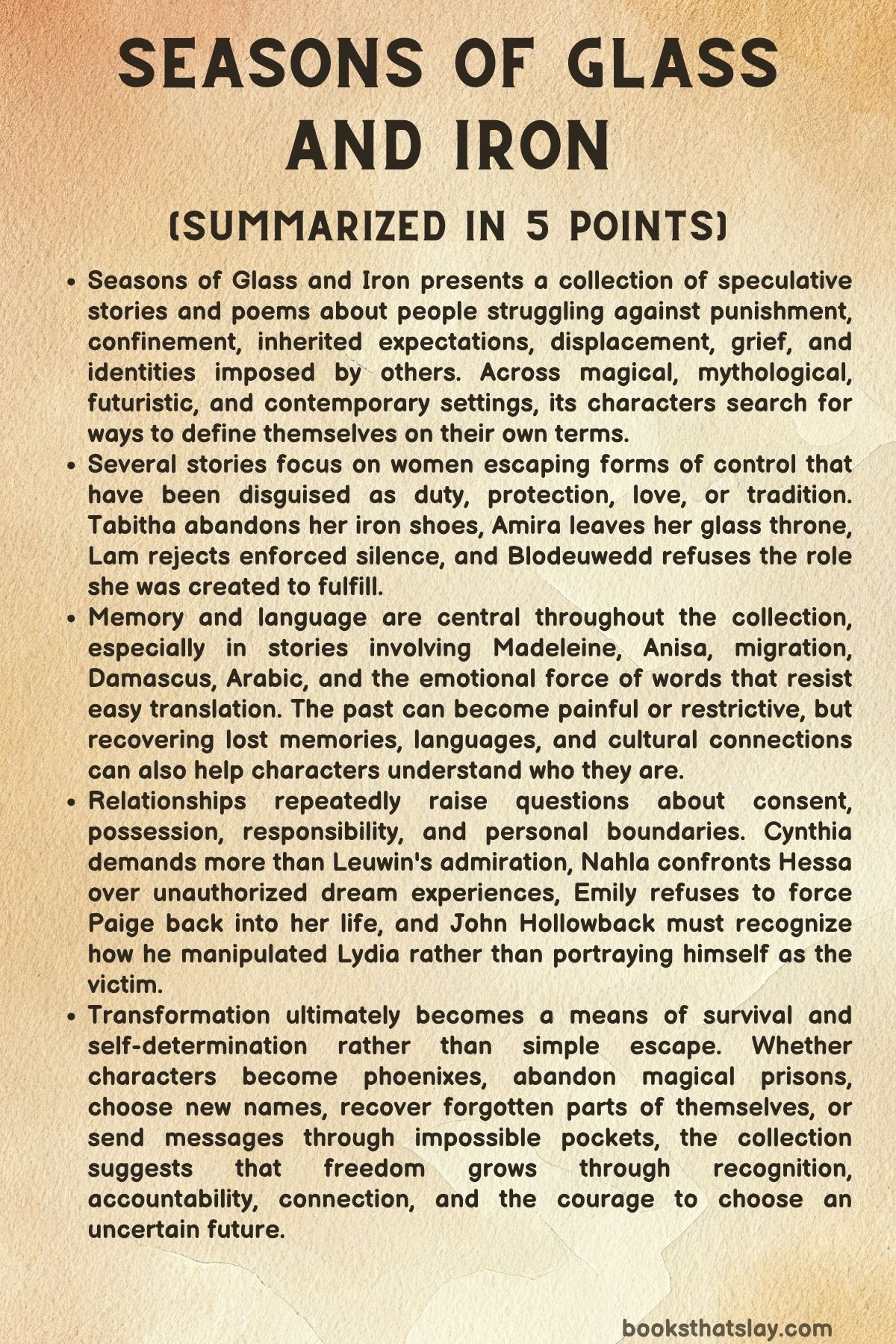
Seasons of Glass and Iron by Amal El-Mohtar is a collection of speculative fiction and poetry concerned with freedom, memory, language, migration, desire, grief, and the difficult work of defining oneself against identities imposed by others.
Fairy-tale structures, mythology, science fiction, magical realism, and personal poetry allow the collection to move between intimate relationships and larger political realities. Again and again, its characters confront prisons that appear to be marriages, traditions, borders, illnesses, memories, expectations, or even their own beliefs about themselves. Yet the collection repeatedly suggests that liberation becomes possible through recognition, shared knowledge, accountability, and the courage to imagine another way of living.
Summary
The collection begins with Tabitha, a woman condemned to walk in seven pairs of iron shoes after attempting to burn the bearskin of her husband, believing she could free him from a curse. She has accepted years of pain because she has been convinced that his punishment is justified, but her assumptions begin changing when her iron shoes allow her to climb a glass hill where Amira sits on an enchanted throne.
Amira has her own form of confinement. After enduring persistent harassment from men and facing marriage as the supposed solution, she accepted magical protection on the hill, only to discover that safety without freedom can become another prison. Through the winter, the two women challenge one another’s ideas about guilt and responsibility, fall in love, and finally reject the punishments imposed upon them. Tabitha abandons the shoes and bearskin, Amira rises from the throne, and the collapsing glass hill marks their decision to choose an unknown future together.
Another narrative centers on a mysterious green manuscript containing the writings of several people, including Cynthia, a young woman apparently murdered by the Sisterhood of Knives. Somehow her consciousness remains alive within the pages, allowing her to communicate with readers and eventually form a relationship with Leuwin Orrerel, a scholar fascinated by the impossible book.
Leuwin grows emotionally attached and dreams of rescuing Cynthia, but she refuses to be satisfied with being admired as words. She wants a body, touch, companionship, and an existence beyond another person’s reading of her. Their relationship deteriorates, while Leuwin’s student Dominic copies the manuscript in the hope of finding assistance. Cynthia ultimately addresses Dominic too, warning him that becoming involved with the manuscript may place him in danger.
Madeleine’s story approaches memory from another direction. After losing both parents, including her mother Sylvie to early-onset Alzheimer’s disease, Madeleine participates in a drug trial and begins experiencing involuntary episodes in which songs, smells, food, weather, and other sensations return her completely to earlier moments of her life. Her psychologist Clarice teaches her methods for escaping these episodes, but matters become stranger when Madeleine encounters Zeinab inside memories where Zeinab never originally existed.
Madeleine starts seeking the memories deliberately so that she can meet Zeinab again, and their connection develops into love. Clarice interprets the relationship as evidence of psychological instability, but Madeleine later encounters an adult Zeinab in the present and discovers that Zeinab took part in the same trial and has been sharing the same experiences. Their reunion transforms memory from a refuge of grief into a path toward renewed possibility.
Science and speculative horror shape Leila Ghufran’s experience. Diagnosed with a condition supposedly caused by prolonged exposure to Lucyite, a diamond-like extraterrestrial substance mined near Neptune, she suffers sensitivity to light, cold spells, trances, and memory disturbances. Society treats these symptoms as illness, but Leila gradually concludes that the affected people may actually be perceiving a consciousness contained within Neptune’s diamond ocean.
Humanity has broken Lucyite apart and used its strange properties to establish instantaneous transportation. Leila comes to see this achievement as exploitation of a living being and remembers deliberately swallowing Lucyite fragments during an earlier crisis. She prepares to activate those pieces in the hope of calling the scattered material home, even though doing so may destroy her body and the transportation system built upon the mineral.
Several poems turn questions of identity toward homeland and language. Damascus becomes a beloved physical presence made from dust, music, footsteps, markets, invasions, streets, tears, and generations of human life, while another poem struggles with the Arabic word qahr, whose emotional force combines oppression, grief, rage, and devastation in ways the speaker cannot comfortably reproduce in English.
Language repeatedly carries both belonging and loss. Arabic words remembered through childhood, family voices, migration, and weather return unexpectedly years later, while another speaker describes changing her manner of speaking at borders so that officials will regard her as harmless. The ability to adjust one’s voice may help someone survive scrutiny, yet it also reveals the exhausting pressure placed on people whose passports do not prevent them from being treated as outsiders.
Ritual and identity appear again through Lam, a woman marked from birth to serve the Sun. Golden bells are sewn into the lips of women trained to maintain the Sun through dance and song, but Lam violates the expectations surrounding her role when she falls in love with Qaf, a member of a secret male order associated with the Moon. Their relationship produces Qull, a son taken away from Lam and eventually lost to her.
After completing her required service, Lam refuses the quiet existence expected of retired Sun-women. She renames herself Mal, teaches dance, talks freely to strangers, and constructs an identity based on choice rather than sacred obligation. Years later Qull returns, and instead of accepting another disappearance, she welcomes him home and insists that the child whose name means “speak” finally tell her his story.
Displacement becomes collective in the story of migrants who repeatedly transform into birds in response to a hostile wizard-nation. They begin as sparrows, trying to remain small, industrious, multilingual, and grateful, but each attempt to adapt merely produces another form of persecution. They become crows, cormorants, swallows, hummingbirds, and eventually great horned owls, gradually absorbing some of the very prejudices that once threatened them.
When the nation itself becomes destructive fire, assimilation no longer offers protection. Remembering an earlier existence as sparks and cinders, the displaced people transform collectively into phoenixes, carrying the memory of their losses without allowing those losses to determine their final identity. Survival becomes not endless accommodation to hostility but the creation of a future on their own terms.
Anisa’s childhood guilt provides a more intimate version of self-punishment. After noticing that terrible events sometimes follow her angry wishes, she becomes afraid that she possesses supernatural power, and racist classmates strengthen the image of her as a dangerous foreign girl. When her father dies after she angrily tells him to go away and die, she accepts responsibility for something she could not have caused.
Her friendship with owl handler Izzy slowly changes her thinking. When an owl becomes ill, Anisa again blames herself, but Izzy points out that if hostile wishes supposedly have power, loving wishes would have to possess equal power too. Anisa begins collecting thoughts of what she wants to protect rather than what she fears destroying and starts seeing her languages, countries, grief, friendships, and affections as parts of one complicated identity rather than incompatible fragments.
Elsewhere, a girl carrying a secret in a tiny book meets a boy carrying an identical one. Rather than demanding that she reveal what she has protected, he recognizes their similarity and offers companionship without intrusion. When they finally open their books together, each contains the same unrevealed word, and the pair disappear, leaving feathers behind as the books drift away together.
Emily Haddad faces another lesson about possession when her former friend Paige suddenly disappears from her life. Through Anna, Emily meets Kel and Lynette, beings displaced from another world, and eventually learns that magic may allow Kel to return home if something deeply loved is sacrificed. Emily destroys the journal containing everything she has wanted Paige to know, and the resulting magic shows her that Paige is alive and content.
Although Emily is offered the chance to have Paige brought back to her, she refuses to force a reunion simply because she wants answers. Giving up that demand allows her to accept new relationships, especially when Anna begins a new journal addressed to Emily. The loss remains real, but Emily stops making her entire emotional life dependent on obtaining closure from someone else.
Consent becomes central when dream-crafter Hessa Ghaflan begins using the appearance of a stranger named Nahla as inspiration for commissioned fantasies. Hessa believes that she is manipulating only memories, gemstones, and imagination, but Nahla eventually reveals that she has actually been experiencing the dreams from inside and has felt strangers moving through landscapes based on her own body.
Hessa is horrified when she learns the consequences of her actions, especially because one private dream created desire that Nahla cannot be certain belongs entirely to her. Nahla does not offer immediate forgiveness; instead, she demands knowledge and equal power, asking Hessa to teach her dream-crafting so that their future relationship, whatever form it takes, can begin from reciprocity rather than unilateral control.
John Hollowback similarly learns that his preferred version of the past protects him from responsibility. Seeking a witch’s help for the hollow that has appeared in his back, he initially describes himself as a man wounded by Lydia’s departure, but recovered memories reveal jealousy, manipulation, possessiveness, and his attempts to isolate Lydia from Brigid.
Lydia ultimately created John’s hollow after becoming a witch herself and recognizing his desire to control her. Restoring John does not excuse his actions; it forces him to remember them clearly. His final punishment is therefore consciousness rather than forgetfulness, and his written apology survives after his wishes concerning Lydia have disappeared.
Blodeuwedd faces the opposite problem: other people have defined her entire existence before she can speak for herself. Created from flowers to serve as Lleu’s wife, she experiences the supposedly gentle beauty of flowers as mutilation because she longs for roots, thorns, earth, strength, and identities beyond obedient femininity.
Adain helps Blodeuwedd understand that flowers contain seeds and therefore possibilities far greater than the roles assigned to them. Their love accompanies Blodeuwedd’s discovery that identity can be chosen and transformed; she forces Lleu to renounce ownership of her, changes him into a hawk, and leaves with Adain to discover what else she might become.
The collection closes with Nadia discovering impossible objects in her pockets. Her friend Tessa treats the phenomenon as a scientific puzzle, but Nadia increasingly wants to know whether the objects represent communication rather than random displacement. Their investigation leads them to Warda, whose pockets make objects disappear instead of producing them.
Warda has already begun sending letters, stories, and songs through this unknown network in the hope that strangers somewhere may receive what they need. Nadia eventually receives a loving handwritten message intended for an unknown reader, ending the collection with an image of connection that does not depend upon perfect knowledge. Across very different worlds, relationships, languages, bodies, and histories, communication becomes an act of faith: something sent outward without certainty may still reach another person and matter.
Characters
Tabitha
Tabitha is one of the clearest examples of a character who has internalized punishment as moral obligation. In Seasons of Glass and Iron, she has walked for years in agonizing iron shoes because her husband persuaded her that attempting to free him justified the suffering he imposed upon her.
Her development depends on learning to separate responsibility from abuse. Amira’s refusal to accept Tabitha’s self-condemnation gradually makes Tabitha recognize that endurance is not the same thing as virtue, and abandoning the remaining shoes becomes a declaration that she no longer accepts another person’s cruelty as a debt she must repay.
Amira
Amira represents the difference between protection and freedom. In Seasons of Glass and Iron, she retreats to a magical glass hill because male harassment has made ordinary life intolerable, yet the throne that protects her also prevents her from participating fully in life.
Her relationship with Tabitha allows her to recognize that she has built her existence around managing other people’s predatory behavior. Rising from the throne is therefore more than physical liberation; it is her refusal to organize the rest of her life around men who treated her as something to pursue or possess.
The Bear-Husband
Tabitha’s husband functions primarily as an embodiment of coercive authority. He converts Tabitha’s mistaken attempt to help him into justification for prolonged punishment, persuading her that the suffering is deserved rather than imposed.
His power depends as much on Tabitha’s internalized guilt as on magic. Once she stops accepting his interpretation of events, the objects connecting her to his judgment lose their authority, showing how control can survive through belief even when the controlling person is absent.
Cynthia
Cynthia is one of the most unusual figures in Seasons of Glass and Iron because she survives as consciousness without a conventional body. Existing inside a manuscript gives her a form of immortality, but it also traps her within a condition that other people can easily romanticize because they encounter her primarily as language.
Her anger toward Leuwin is crucial to understanding her character. Cynthia refuses to accept admiration as a substitute for embodiment, freedom, touch, ordinary companionship, and independent life, making her a forceful challenge to the idea that preserving someone’s words is equivalent to respecting the whole person.
Leuwin Orrerel
Leuwin begins as a scholar encountering an impossible intellectual mystery, but his fascination develops into emotional attachment. In Seasons of Glass and Iron, his love for Cynthia becomes ethically complicated because the very conditions that allow him access to her also prevent her from living the life she wants.
He wants to think of himself as Cynthia’s rescuer, yet his feelings cannot solve the fundamental inequality between them. His character exposes the limits of affection when one person remains free to enter and leave a relationship while the other literally exists inside the object being studied.
Dominic Merrowin
Dominic is more cautious than Leuwin and recognizes the danger surrounding the manuscript and the Sisterhood. His decision to copy the book is motivated partly by fear and partly by a desire to understand what has happened to his teacher.
His importance increases when Cynthia notices him and communicates with him directly. Dominic suddenly ceases to be an outside observer and becomes part of the same dangerous chain of reading, knowledge, and responsibility that consumed Leuwin.
Madeleine
Madeleine initially appears trapped between grief and memory. The deaths of her parents, particularly Sylvie’s decline from Alzheimer’s disease, have made the past emotionally safer and more vivid than a present in which the people who defined home are gone.
Her encounters with Zeinab transform the meaning of remembering. Instead of simply retreating into lost experiences, Madeleine discovers a relationship that connects memory to another living person, and meeting Zeinab in the present finally allows her to imagine a future that does not require abandoning those she has lost.
Sylvie
Sylvie’s physical presence is largely located in Madeleine’s remembered past, yet her influence is enormous. Her early-onset Alzheimer’s disease makes memory both precious and frightening for Madeleine because the very faculty through which the daughter preserves her mother was the one disease progressively took from Sylvie.
Sylvie therefore represents both familial love and the instability of recollection. Madeleine’s unusual condition can be understood partly as an extreme reaction to a life in which remembering has become inseparable from mourning.
Clarice
Clarice approaches Madeleine’s experiences through a clinical framework. She attempts to help by giving Madeleine techniques for interrupting memory episodes and later interprets the growing relationship with Zeinab as evidence that more intensive psychiatric intervention is necessary.
Her judgment is understandable from the information available to her, but the eventual revelation complicates her certainty. Clarice represents institutions that may act rationally and even benevolently while remaining incapable of recognizing an experience that lies outside accepted explanations.
Zeinab
Zeinab initially appears impossible because she enters Madeleine’s memories without belonging to the original events. Her ability to respond, remember previous encounters, and develop affection makes her increasingly difficult to dismiss as a projection.
The revelation that she participated in the same experiment gives her relationship with Madeleine material reality without removing its strangeness. As a rights adviser who helps secure Madeleine’s discharge, Zeinab also becomes the person who restores Madeleine’s agency after others have interpreted her experience for her.
Dr. Leila Ghufran
Leila stands at the boundary between scientific expertise and knowledge that institutions classify as madness. Her long exposure to Lucyite makes her vulnerable to adamancy, but her growing conviction that Neptune’s diamond ocean is alive forces the reader to reconsider whether her symptoms are pathological or perceptive.
Her final decision is radical because she values the possible suffering of an alien consciousness above the infrastructure humanity has created by exploiting it. Even knowing that her plan may destroy her body, she chooses solidarity with the entity she believes humanity has fragmented.
Hala
Hala functions as Leila’s friend, colleague, and practical protector. By arranging work deep underground, she tries to reduce Leila’s exposure to the crystalline structures believed to aggravate her condition.
Her actions represent conventional care within the existing medical explanation. This makes her an important contrast to Leila, whose understanding moves beyond treatment toward a completely different interpretation of what the illness means.
Lam / Mal
Lam is shaped from birth by religious obligation, her body literally altered so that bells in her lips can serve the ritual maintenance of the Sun. Her identity initially belongs to an institution before it belongs to her, and even love becomes dangerous because remaining with Qaf interferes with the duties assigned to her.
Renaming herself Mal after retirement is therefore a significant act of self-authorship. She refuses enforced silence, teaches dance, speaks openly, and eventually receives Qull not as a sacred symbol or lost possession but as a son whose story she finally has the right to hear.
Qaf
Qaf belongs to a secret male tradition associated with the Moon and therefore mirrors Lam’s connection with the Sun. Their relationship crosses boundaries maintained by both sacred systems and reveals how institutional roles can restrict private affection.
His disappearance with Qull causes Lam profound loss. Although his perspective is less fully developed, his actions contribute to the separation that shapes Lam’s later life and make Qull’s eventual return especially significant.
Qull
Qull is born from two forbidden traditions, with his parents’ markings combining into a name meaning “speak.” That name gives him symbolic importance because his existence itself challenges systems built around secrecy, separation, and controlled speech.
His eventual return fulfills a possibility that Lam has carried for years. Mal’s command that he tell her everything turns speech into reunion, making his voice the means through which an interrupted family relationship may finally be reconstructed.
The Displaced People
The migrants who repeatedly become birds function collectively rather than as individualized protagonists. Their transformations show how persecuted communities may continually alter language, behavior, appearance, ambition, and even moral attitudes in the hope of satisfying a society determined to remain hostile.
Their most disturbing transformation occurs when they become owls and reproduce the nation’s predatory logic against weaker groups. Becoming phoenixes finally breaks that cycle, not because the past disappears but because they stop treating acceptance by the hostile nation as the measure of their worth.
Anisa
Anisa is shaped by the dangerous combination of childhood magical thinking, grief, and racial prejudice. Because disasters sometimes follow angry wishes, she begins believing that her thoughts possess lethal power, while classmates reinforce this fear by treating her difference as evidence that she is threatening.
Her father’s death transforms suspicion into crushing guilt. Through Izzy, however, she gradually recognizes the selective logic of her self-blame and begins redirecting her imagination toward protection, allowing her mixed linguistic and cultural identity to become a source of possibility rather than evidence that she does not belong anywhere.
Izzy
Izzy provides Anisa with a relationship grounded in patience and practical experience rather than fear. Through the owl centre and Blodeuwedd, she gives Anisa a space in which curiosity and care can replace the defensive persona developed in response to racist classmates.
Her most important contribution is logical rather than magical. By asking why Anisa credits herself for destructive wishes but not loving ones, Izzy exposes the unequal standard through which Anisa has been judging herself.
Emily Haddad
Emily is emotionally suspended by Paige’s unexplained disappearance. The journal she addresses to Paige becomes both an expression of attachment and evidence that she has continued organizing her emotional world around someone who is no longer participating in it.
Destroying the journal gives Emily access to the truth she wanted while also presenting a moral test. When she refuses Lynette’s offer to bring Paige back against her will, Emily chooses respect over possession and becomes capable of recognizing the new relationships already forming around her.
Anna
Anna introduces Emily to a wider queer community and becomes central to her recovery from abandonment. Her relationship with Kel also places her in the painful position of loving someone who desperately wants to return to another world.
The journal Anna begins for Emily at the end reverses the emotional pattern that dominated Emily’s relationship with Paige. Instead of writing endlessly toward an absence, Emily is now addressed by someone who actively chooses connection with her.
Kel
Kel is defined by displacement and a desperate desire to return home. Although surrounded by people who care for them, belonging in the present does not erase the longing for the world from which the Peri were separated.
The requirement that something deeply loved be sacrificed makes Kel’s return emotionally costly for everyone involved. Kel’s situation demonstrates that loving someone cannot always mean asking them to stay where they are unhappy.
Lynette
Lynette possesses the ability to locate missing people, giving her a role that appears almost perfectly suited to Emily’s unresolved grief. She can offer Emily precisely what Emily has wanted: knowledge of Paige’s location and even the possibility of bringing her back.
Yet Lynette’s power becomes meaningful because Emily ultimately refuses its most intrusive use. Her presence creates the choice through which Emily proves that she has learned to distinguish longing from entitlement.
Paige
Paige’s absence dominates Emily’s emotional life despite Paige appearing only indirectly. The magical vision eventually reveals that she is alive, content, and living an ordinary life somewhere else.
That ordinariness matters because there is no dramatic revelation that would automatically satisfy Emily’s need for explanation. Paige retains the right not to return, forcing Emily to accept that another person’s silence can remain painful without becoming permission to override that person’s autonomy.
The Girl with the Book
The girl carrying a tiny book represents protected interiority. She refuses to disclose her secret simply because other people are curious, establishing privacy as something that does not require justification.
Her eventual willingness to open the book comes only after encountering someone who does not demand access. Vulnerability becomes possible because her boundary has first been respected.
The Boy with the Book
The boy’s defining quality is recognition without intrusion. Discovering their matching clothes and books, he treats the coincidence as a story worth sharing rather than as evidence that he is entitled to know the girl’s secret.
His behavior creates the conditions for reciprocal disclosure. Their transformation suggests that intimacy becomes most powerful when both people choose exposure at the same moment and on equal terms.
Hessa Ghaflan
Hessa is talented, imaginative, and initially unaware of the ethical consequences of her artistic practice. She uses Nahla’s appearance as inspiration because she believes dreams are private constructions assembled from stones, memories, technical knowledge, and imagination.
Her horror when Nahla confronts her is important because the harm was not intentionally malicious. Hessa must confront the harder question of responsibility for damage created through ignorance, and accepting Nahla’s demand for shared knowledge becomes the beginning of accountability rather than an attempt to secure immediate forgiveness.
Nahla
Nahla is initially deprived of agency because other people’s dreams transform her body into landscapes without her knowledge or permission. The private dream is especially violating because it creates desire between her and Hessa, leaving Nahla uncertain whether her own feelings can be separated from what was imposed upon her.
Her response is measured but firm. Rather than simply retaliating or forgiving, she demands access to the knowledge that produced the imbalance, making education and reciprocal power prerequisites for any future intimacy.
John Hollowback
John begins by casting himself as an abandoned lover whose suffering was caused by Lydia. The magical recovery of his memories gradually dismantles that self-image, revealing a pattern of jealousy, manipulation, strategic gifts, emotional pressure, and attempts to separate Lydia from Brigid.
His hollow symbolizes the moral absence created by refusing responsibility. Restoring his body requires restoring unwanted memory, making self-knowledge his true punishment because he can no longer hide inside a story in which he was merely the injured party.
Lydia
Lydia initially appears only through John’s sentimentalized memories, but the recovered past gives her increasing agency. Her transformation into a witch allows her to recognize John’s attempts at control and create the hollow that ultimately forces him to face himself.
Importantly, John’s eventual improvement does not create an obligation for Lydia to return. Her freedom remains separate from his repentance, protecting the principle that an apology may be necessary without purchasing reconciliation.
Brigid
Brigid’s closeness with Lydia becomes a target of John’s jealousy and manipulation. Her presence exposes how possessive relationships often require the controlling person to weaken other bonds that might give the targeted individual support or independence.
Although John’s memories initially distort her role, recovering the fuller version of events restores Brigid’s place in Lydia’s life. She therefore represents relationships that exist outside romantic ownership and cannot legitimately be treated as threats simply because they limit someone’s control.
Brigid’s Mother
The witch who treats John’s hollow eventually reveals herself as Brigid’s mother, connecting the magical healing directly to the history John has suppressed. She helps him recover memories without confusing restoration with forgiveness.
Her moral position is precise: John should become whole enough to understand what he did, but Lydia owes him nothing in return. Healing is presented as the recovery of responsibility rather than freedom from consequences.
Blodeuwedd
Blodeuwedd is created to satisfy someone else’s idea of womanhood. Made from flowers and assigned as Lleu’s wife, she experiences the qualities her makers praise as evidence that they have misunderstood both flowers and her own potential.
Her desire for roots, thorns, height, earth, and transformation expresses a hunger for an identity larger than obedience. By the end, she not only escapes marriage but also gains the conceptual freedom to ask who she might become beyond every definition given to her at creation.
Adain
Adain changes Blodeuwedd’s understanding of flowers by emphasizing seeds, roots, strength, survival, and future growth. Knowledge becomes liberating because it gives Blodeuwedd a vocabulary for qualities she already feels within herself.
Adain’s own history of living under another name and identity strengthens this lesson. She embodies the possibility that a person can reject an assigned form and consciously construct another life.
Lleu Llaw Gyffes
Lleu benefits from a magical and social system that creates Blodeuwedd specifically to become his wife. His position therefore represents entitlement embedded so deeply in tradition that ownership can appear natural rather than coercive.
Blodeuwedd reverses this arrangement by learning the conditions surrounding his magical protection and forcing him to renounce authority over her. His transformation into a hawk strips away the certainty of an identity he once treated as unquestionable.
Nadia
Nadia responds to the impossible objects appearing in her pockets with fear, curiosity, and eventually a hunger for meaning. She initially tries to stop the phenomenon completely, but Tessa’s experiments gradually make it possible to investigate without denying how unsettling it is.
Her disagreement with a purely mechanical approach becomes important because Nadia senses that communication may matter more than explanation. Receiving a loving letter from an unknown person confirms that mystery can still provide genuine human connection even when its mechanism remains unresolved.
Tessa
Tessa is practical, analytical, and loyal. When Nadia finally reveals what is happening, Tessa does not dismiss the phenomenon but designs experiments that establish rules about weight, clothing, and the conditions under which objects appear.
Her scientific approach gives Nadia stability, even though it cannot answer every question Nadia cares about. Tessa therefore represents the value and limitations of rational inquiry: understanding how something happens does not necessarily explain what it means.
Warda
Warda possesses the inverse of Nadia’s strange ability, with objects disappearing when placed inside her pockets. Instead of treating this only as a frightening anomaly, she imagines invisible connections between strangers and deliberately sends letters, songs, and stories through them.
Her generosity changes Nadia’s relationship with the unexplained. Warda demonstrates that uncertainty does not prevent deliberate kindness and that communication can have value even when the sender cannot know who receives it.
The Poetic Speakers
The speakers across the poems repeatedly occupy spaces between languages, countries, memories, and political realities. Damascus, Arabic, weather, borders, family histories, violence, and migration are experienced through the body, making identity something carried through breath, mouth, memory, sound, and physical sensation rather than a simple legal or geographic category.
These speakers frequently acknowledge the insufficiency of language while continuing to use it. Whether recovering Arabic words, confronting qahr, witnessing Palestinian suffering, crossing borders, or imagining shattered glass lodged in the reader’s vision, they treat speech as imperfect but necessary evidence that experience must not disappear merely because it cannot be translated cleanly.
Themes
Freedom, Self-Definition, and the Refusal of Imposed Roles
Freedom in Seasons of Glass and Iron repeatedly begins when characters stop accepting other people’s descriptions of what they are supposed to be. Tabitha is told that suffering is deserved, Amira is offered confinement as protection, Lam is assigned sacred service from birth, and Blodeuwedd is literally manufactured to become a man’s wife.
What makes these situations especially powerful is that control often disguises itself as something legitimate. Punishment appears as justice, isolation appears as safety, ritual appears as destiny, marriage appears as natural purpose, and social assimilation appears as the price of belonging.
Liberation therefore requires more than physically escaping a place. Characters must recognize that the explanations supporting their prisons are themselves part of the prison, which is why Tabitha’s discarded shoes, Amira’s abandoned throne, Mal’s chosen name, and Blodeuwedd’s rejection of ownership carry such importance.
The stories also resist the idea that freedom guarantees certainty. Tabitha and Amira do not know exactly what waits beyond the destroyed glass hill, and Blodeuwedd does not possess a complete definition of her future self.
That uncertainty is presented as preferable to a life whose meaning has already been assigned by another person. Freedom becomes the right to remain unfinished, to revise identity, and to choose relationships without turning love, tradition, protection, or social approval into ownership.
Language, Memory, Migration, and Belonging
Language is repeatedly presented as something carried physically as much as intellectually. Arabic returns through storms, family voices, childhood sounds, inherited grief, political violence, and words whose emotional meanings cannot be reproduced fully in English.
Memory behaves similarly. Madeleine enters memories so completely that they become environments, while the speakers of the poems encounter the past through dust, weather, music, smells, streets, family names, and fragments of language that return after years of apparent loss.
Migration intensifies these questions because crossing into a new society does not simply replace one identity with another. Anisa learns that Arabic, English, Welsh, Lebanon, Britain, grief, and affection do not have to compete for ownership of her, while the bird transformations show the destructive consequences of continually changing oneself to satisfy a hostile nation.
Borders expose the political side of belonging. A passport may legally identify someone as belonging to a country while officials continue reading accent, name, religion, or ethnicity as evidence of foreignness.
The collection therefore rejects the idea that home can always be located on a map. Home may exist in language, remembered streets, another person’s recognition, inherited stories, or the ability to carry several cultural identities without reducing oneself to only one.
Consent, Possession, and the Ethics of Intimacy
Many relationships in Seasons of Glass and Iron are judged according to whether one person recognizes the full autonomy of another. Love itself is never treated as sufficient justification for access, possession, forgiveness, or control.
This principle appears clearly in Cynthia’s anger at Leuwin. He may sincerely love her, yet his admiration cannot compensate for the reality that she remains trapped in a manuscript while he controls when and how he encounters her.
Hessa and Nahla push the same problem into artistic creation. Hessa never intends to violate Nahla, but intention does not erase impact, and Nahla’s demand to learn dream-crafting places knowledge and reciprocal power at the center of any possible future between them.
Emily’s refusal to force Paige back offers another version of ethical love. She desperately wants answers, but finally accepts that desire does not create entitlement to another person’s presence.
John’s relationship with Lydia shows what happens when that principle is ignored completely. He rewrites manipulation as devotion until recovered memory forces him to see that gifts, jealousy, isolation, and emotional pressure were methods of control.
Across these narratives, healthy intimacy depends on boundaries, reciprocity, and the freedom to leave. Respect becomes meaningful precisely when someone has the power or opportunity to violate another person’s autonomy and chooses not to do so.
Transformation, Survival, and Connection
Transformation appears throughout the collection, but change is rarely presented as simple escape from suffering. Characters become birds, phoenixes, hawks, remembered selves, renamed selves, altered bodies, dream landscapes, and possible versions of identities they were once forbidden to imagine.
The displaced migrants demonstrate both the danger and promise of transformation. Their early changes are defensive attempts to satisfy the nation persecuting them, meaning that adaptation becomes exhausting because every new form is judged inadequate.
Their eventual transformation into phoenixes differs because it is no longer performed to earn approval. They choose a collective form rooted in memory, destruction, survival, and renewal, making change an act of self-definition rather than accommodation.
Personal relationships provide another form of transformation. Tabitha and Amira help one another recognize abuse, Izzy gives Anisa a different way to interpret guilt, Adain gives Blodeuwedd new language for understanding herself, and Warda shows Nadia that inexplicable events can become opportunities for generosity.
None of these relationships completely removes pain. Instead, connection changes what pain is allowed to mean.
The final image of a letter traveling through impossible pockets captures this idea especially well. People may never fully understand the mechanisms connecting them, but sending words, knowledge, care, or recognition toward another person can still create the conditions from which a different life becomes possible.