Scars Beneath a Serpent’s Scales Summary, Characters and Themes
Scars Beneath a Serpent’s Scales by Nicole Platania is a fantasy mystery centered on Fate magic, ritual murder, buried trauma, political secrecy, and an increasingly powerful bond between two guarded people.
Emmeline DeLeoste has spent most of her life searching for the sister stolen from her family, while Roremar Silventa carries a reputation for recklessness that conceals years of responsibility and guilt. Their reluctant investigation into disappearances on the Isle of Lyra gradually exposes ancient celestial conflicts, criminal networks, manipulated Fate connections, and truths neither is prepared to confront. The novel combines an investigative plot with questions about personal freedom, destiny, trust, and the consequences of surviving by remaining emotionally isolated.
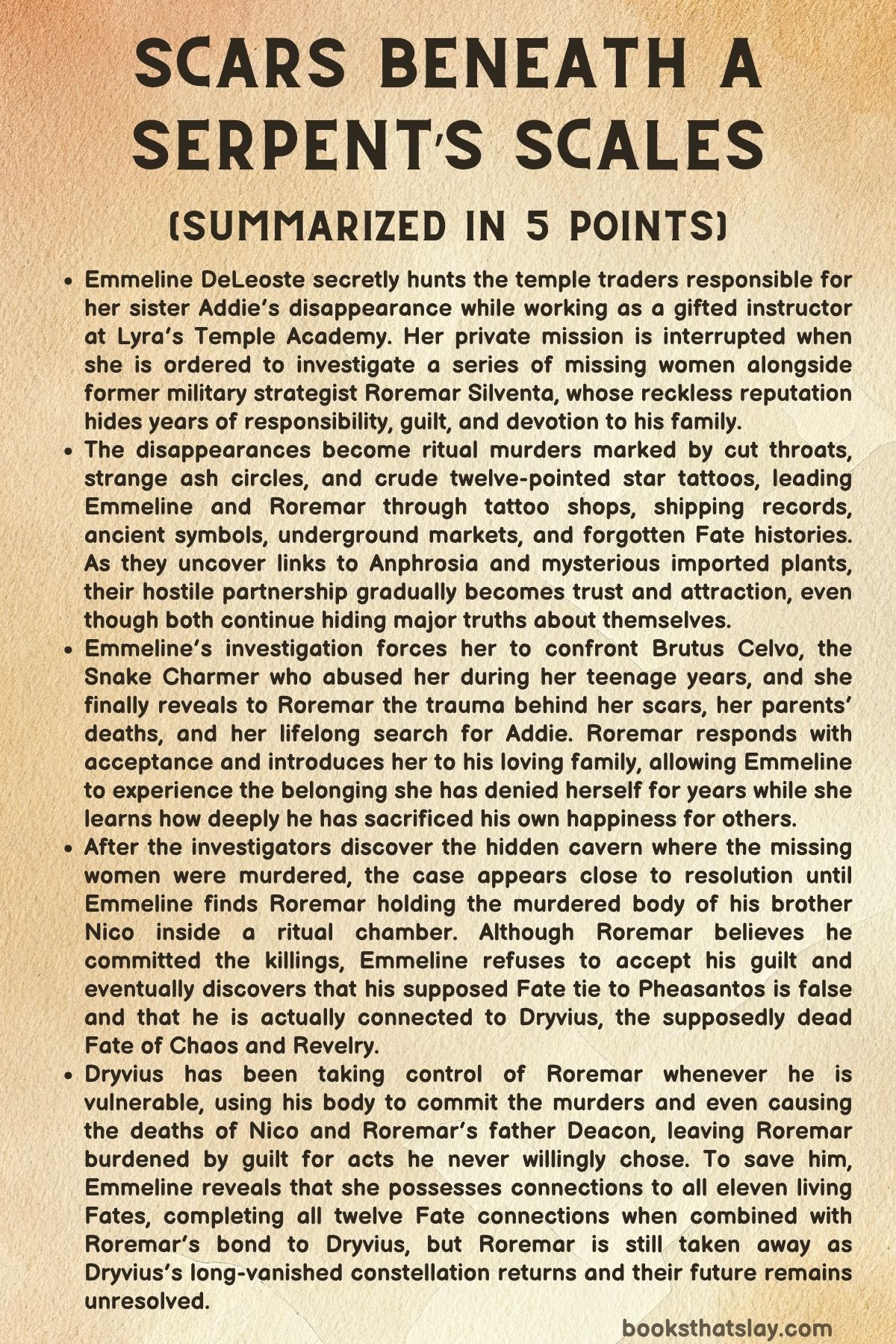
Summary
Emmeline DeLeoste lives two lives on the Isle of Lyra. By day, she is a highly skilled instructor at the Temple Academy, teaching young Starsearchers how to understand and control their connections to the Fates; by night, she secretly hunts former temple traders connected to the childhood disappearance of her sister Addie.
Her search has continued for more than twenty years. Emmeline interrogates and sometimes kills people involved in the kidnapping and exploitation of magically gifted children, believing that somewhere within the old network lies the answer to what happened to Addie, yet every violent act adds another burden to a woman already marked by physical and emotional scars.
Emmeline’s private mission is interrupted when Academy Master Aldryn Falliare orders her to investigate a series of disappearances with Roremar Silventa. Roremar is a former military strategist known as “Roremar the Reckless,” although the reputation hides a disciplined man who has spent years supporting his mother and younger siblings after the death of his father.
Neither investigator wants the partnership. Emmeline fears Roremar’s curiosity will expose her secret activities, while Roremar distrusts her unwillingness to share information, but Aldryn gives both of them powerful reasons to cooperate: Emmeline may finally receive her desired transfer to Valyn, and Roremar will receive financial assistance for his siblings’ education.
Their early investigation is defined by conflict. Emmeline attempts a Fate reading and receives a terrible warning that continuing their path will bring ruin, while Roremar pushes for more direct investigation and refuses to be intimidated by her secrecy.
The warning frightens Emmeline enough that she briefly attempts to distance herself from Roremar. During another private reading, however, she sees horrifying visions of him covered in blood, and shortly afterward she witnesses two cloaked men meeting secretly near the cliff ruins.
A murdered woman soon transforms the disappearances into an obvious serial killing. The victim has been placed in an alley with her throat cut and a crudely tattooed twelve-pointed star across her chest, and Roremar unexpectedly sees Emmeline at the scene dressed in the black leathers she wears during her private hunts.
Rather than continue fighting one another, they restart their partnership. With help from Roremar’s best friend Desmond Alvanti, his brother Nico, and Isle Guard officer Torvin Darcy, they begin comparing victims, tattoo symbols, travel records, and historical information.
The trail repeatedly leads toward the wing-and-rose emblem used by Angel’s Draw tattoo shop and toward an obscure historical group called the Warders of Selene. When another murdered woman is found with the same star tattoo, ash arranged around her body, and fragmented language suggesting sacrifice, Emmeline begins suspecting that the killings have a ritual purpose.
Meanwhile, Emmeline continues pursuing her private enemy and finally learns the title of the temple trader she has sought for years: the Averian. Her secret investigation increasingly overlaps with the murder case, especially when unusual herbs, suspicious shipments, and strange reactions among Lyra’s drug users begin appearing around both mysteries.
The danger becomes personal when someone breaks into Emmeline’s Academy room, writes a threatening message in blood, and attempts to strangle her. Roremar inexplicably senses her distress from elsewhere and reaches the Academy with Desmond and Nico, revealing that some unexplained connection already exists between him and Emmeline.
Emmeline temporarily moves into the apartment above Desmond’s tattoo parlor. As she and Roremar investigate ancient temples, cave imagery, port records, and irregular shipments, their initial hostility slowly becomes trust and attraction.
A major complication develops when Emmeline recognizes Desmond’s voice as belonging to one of the cloaked men she saw at the cliff ruins. His knowledge of tattoo ink, secret shipments, Alvan background, and unusual Fate ties make him appear increasingly suspicious, although Emmeline hesitates to accuse Roremar’s closest friend without proof.
The investigation becomes more urgent when Liana, one of Emmeline’s fellow instructors, is murdered and returned to the Academy bearing the same ritual markings. Evidence linking several victims to Alvan leads Emmeline, Roremar, Desmond, Nico, and Myrella to travel there in search of historical records and information about ancient Fate worship.
In Alvan, the mysterious Storytellers reveal fragments of ancient conflicts involving Anphrosia, Arenothos, Aevollon, Dryvius, and the Warders of Selene. They direct Emmeline and Roremar toward the Mourning Gardens, where a magical reflecting pool finally reveals that every murdered woman shares a Fate connection to Anphrosia.
The discovery immediately places Emmeline in danger because she admits that Anphrosia is one of her own Fate ties. She still hides the full extent of her abilities, but Roremar now knows she matches the killer’s victim profile.
Suspicion then turns strongly toward Desmond. Shipping documents connect suspicious ink deliveries to a hidden house he uses, and Emmeline finally tells Roremar that she believes his closest friend is the murderer.
The accusation proves wrong. Desmond admits that he illegally imports ink and secretly protects his mother from his abusive father, explaining the hidden house and clandestine meetings, and Roremar is deeply hurt that Emmeline investigated Desmond behind his back instead of trusting him.
Emmeline recognizes that her secrecy was partly self-sabotage. Her growing feelings for Roremar frightened her, and damaging their relationship offered the familiar protection of isolation, but a new Storyteller clue tells her that solving the murders requires confronting the traumatic past represented by the scars beneath the serpent’s scales.
That past leads to the Mezzanine and Brutus Celvo, the criminal broker known as the Snake Charmer. Brutus once owned the teenage Emmeline and forced her to dance with snakes that repeatedly bit her, and he now demands that she perform again before giving them information.
The ordeal exposes the origins of Emmeline’s scars to Roremar and produces an important clue: shipments officially listed as ink are actually concealing large quantities of mysterious seeds distributed through Lyra’s trade and apothecary systems. Afterward, Emmeline finally tells Roremar the larger truth of her childhood—Addie’s kidnapping, her father’s disappearance, her mother’s murder, her years inside pleasure houses, her abuse by Brutus, and her lifelong hunt for the people responsible.
Roremar responds with acceptance rather than judgment. He later brings Emmeline to his family home for his sister Siena’s birthday, allowing her to experience the ordinary affection and belonging she has avoided for years.
Emmeline also learns the truth beneath Roremar’s reputation. After his father Deacon died, Roremar became responsible for his mother and siblings, sacrificing much of his adult life to keep them financially secure while privately blaming himself for Deacon’s death.
Their investigation finally leads underground. Darcy discovers a ritual tunnel containing the same malformed star symbol and mysterious seeds, while Emmeline independently returns to coastal caves to recover an opal ring inherited from her mother.
Guided deeper into the caves by the black panther Cirre, Emmeline and Roremar discover the imported plants growing in a hidden chamber. Beyond them lie several missing women, Desmond’s stolen design book, and evidence proving they have found the place where the ritual murders were carried out.
Believing the investigation nearly solved, Emmeline and Roremar finally stop resisting their attraction, although emotional vulnerability remains difficult for both of them. Their night together becomes less about physical desire than trust, belonging, and the recognition that each has begun changing how the other understands life.
The apparent victory collapses on the first morning of the Remembrance Revels. Emmeline follows an overwhelming emotional pull into the underground Trade House cells and finds Roremar kneeling in a ritual chamber holding Nico’s dead body.
Nico has been killed in the same manner as the other victims, and Roremar appears to admit responsibility. He is arrested without resistance, while Emmeline is left trying to reconcile the evidence with the man who devoted his life to protecting the brother now dead in his arms.
Roremar himself believes he killed Nico. He remembers witnessing his own hands commit the act, just as he has spent years believing those same hands killed his father, and he therefore accepts imprisonment because he thinks removing himself from society is the only way to protect everyone he loves.
Emmeline refuses to accept the obvious explanation because the motive makes no sense. With Desmond, she reconstructs the entire case and learns from Anphrosia that blood will continue to spill despite Roremar’s imprisonment, proving that the true threat remains active.
A crucial astronomical contradiction finally breaks the mystery open. Roremar claims a connection to Pheasantos, yet the celestial circumstances surrounding his birth should have made such a tie impossible, and Desmond realizes he has never once seen Roremar perform a genuine reading.
Emmeline conducts an extraordinarily dangerous reading and discovers the answer. In front of Lyra’s leaders and officials, she declares that Roremar’s body committed the murders but his will did not: the true killer is Dryvius, the supposedly dead Fate of Chaos and Revelry.
Roremar confirms the truth he has hidden since childhood. He is not tied to Pheasantos at all; he is the sole known Starsearcher still connected to Dryvius.
Because Dryvius appears to have only one surviving human connection, his bond with Roremar is exceptionally powerful. Whenever Roremar became unconscious, intoxicated, or otherwise vulnerable, Dryvius could seize control of his body, explaining the blackouts, murders, stolen materials, unexplained exhaustion, Nico’s death, and even Deacon’s death years earlier.
Officials nevertheless consider Roremar too dangerous to remain free and force him into a seeing chamber designed to manipulate Fate ties. The magical device cannot break his bond with Dryvius and instead forces him to relive the killings while tearing violently at his mind and body.
Emmeline fights through the guards and enters the chamber to save him, knowing that doing so requires exposing the greatest secret of her own life. The chamber explodes beneath the force of her power, and eleven constellations illuminate the sky.
Emmeline reveals that she is not connected to only Metrina and Anphrosia. She possesses ties to all eleven living Fates, an unprecedented condition that explains why her family was targeted when she was a child and why she has spent her life suppressing most of her abilities.
Together, Emmeline’s eleven ties and Roremar’s connection to Dryvius represent all twelve Fates. Prophetic language identifies them as “Star’s Reign” and “Star’s Ruin,” suggesting that their relationship may influence the future of the entire celestial order rather than merely the politics of Lyra.
The revelation still does not immediately free Roremar. Fearing that Dryvius will destroy Emmeline’s future, he allows himself to be taken away despite her insistence that being controlled does not make him guilty.
Before they are separated, Emmeline finally abandons the emotional boundary she has maintained between them and demands that Roremar kiss her. Their first kiss becomes an acknowledgment of everything they have refused to name, while Aldryn informs Emmeline that the transfer to Valyn she once wanted more than anything is finally available.
The victory feels hollow. Emmeline has gained the influence, recognition, and access that may help her find Addie, but Roremar has become essential to the future she now wants.
As she looks toward the sky, Dryvius’s constellation appears again for the first time since his supposed destruction. Scars Beneath a Serpent’s Scales therefore closes with the central murder mystery exposed but the larger struggle unresolved: Dryvius has returned, Roremar remains tied to him, Emmeline’s true power is now public, and the bond between Star’s Reign and Star’s Ruin has only begun.
Characters
Emmeline DeLeoste
Emmeline is the emotional and investigative center of Scars Beneath a Serpent’s Scales, a woman whose competence has been built from experiences that taught her dependence could be dangerous. She is an exceptional Starsearcher, gifted teacher, skilled fighter, investigator, and survivor, yet much of her strength comes from continuously controlling what other people are permitted to know about her.
Her search for Addie supplies the deepest motivation behind her choices. Emmeline does not merely want justice for an old crime; she has organized her adult life around the possibility that her sister remains somewhere within reach, making Valyn, the temple-trading network, and the Averian symbols of a promise she refuses to abandon.
Her greatest development concerns isolation. Roremar, Myrella, the Silventa family, and eventually even Desmond force her to recognize that secrecy can protect her from betrayal while also preventing her from experiencing belonging.
By the ending, Emmeline makes the opposite choice from the frightened child who learned to hide. She publicly reveals her eleven Fate ties to save Roremar, knowingly surrendering the anonymity that protected her for decades and proving that her love for another person has become stronger than her instinct for concealment.
Roremar Silventa
Roremar is one of the most deliberately misjudged figures in Scars Beneath a Serpent’s Scales. His nickname, “Roremar the Reckless,” suggests carelessness, yet his behavior repeatedly reveals planning, patience, loyalty, and an almost destructive sense of responsibility.
His father’s death shaped his adulthood. Roremar transformed Deacon’s request that he care for the family into a permanent obligation, convincing himself that personal happiness should always come second to his mother, brothers, and sisters.
That same mentality explains why he so readily accepts guilt for Nico’s murder. Once Roremar believes his body is dangerous, he regards imprisonment and death as reasonable sacrifices if they protect everyone else.
His connection to Dryvius gives his character an especially painful conflict between action and intention. His hands really did kill, but another consciousness controlled them, forcing him to confront whether guilt should attach to a person whose body was turned into someone else’s weapon.
Desmond Alvanti
Desmond initially appears to be Roremar’s dependable friend and comic counterweight, but Scars Beneath a Serpent’s Scales gradually gives him enough secrecy to become a convincing suspect. His occupation as a tattoo artist, private shipments, Alvan origins, hidden meetings, unusual Fate ties, and association with stolen designs all seem capable of explaining the murder evidence.
The truth demonstrates how incomplete evidence can create a persuasive but false narrative. Desmond is involved in illegal ink imports, yet his secrecy protects his mother and helps him escape Aldryn’s trade restrictions rather than covering murder.
His anger toward Emmeline after her accusation is therefore justified, but he does not allow resentment to become more important than Roremar’s survival. Once Roremar is arrested, Desmond works alongside Emmeline, proving that his deepest loyalty is not based on personal comfort but on refusing to abandon someone he considers family.
Nico Silventa
Nico brings warmth, humor, and youthful possibility into Scars Beneath a Serpent’s Scales, but his importance increases considerably once his relationship with Myrella and his place within Roremar’s family become clear. He admires his older brother so deeply that he initially begins imitating Roremar’s worst habit: sacrificing personal happiness for family duty.
His relationship with Myrella offers an alternative future built around travel, love, and greater freedom. That possibility makes his murder especially devastating because Dryvius destroys not only a life but a future Nico had finally started allowing himself to want.
Nico’s death also exposes the cruelty of Roremar’s possession more clearly than any previous murder. Dryvius uses Roremar to kill the brother he spent his entire adulthood protecting, turning Roremar’s strongest devotion into the instrument of his deepest psychological punishment.
Myrella
Myrella begins as one of the people Emmeline deliberately keeps at a distance, yet she steadily refuses to accept that distance as permanent. Her insistence that they are friends challenges Emmeline’s belief that relationships inevitably place other people in danger.
She also becomes useful to the investigation, helping organize evidence and research connections that Emmeline can no longer manage entirely by herself. Her willingness to assist without demanding access to every secret makes her friendship particularly important.
Her relationship with Nico adds another dimension. Myrella is cautious after his deception, but she eventually acknowledges that she had begun imagining a future with him, making his murder one of the story’s most painful demonstrations of how fear can steal time that people assumed they still possessed.
Aldryn Falliare
Aldryn is a morally ambiguous authority figure whose actions constantly raise questions about whether protection and manipulation can coexist. As Academy Master and Roremar’s uncle, he has institutional power over both protagonists and uses rewards, information, money, and assignments to move them toward outcomes he prefers.
His support for the Silventa family is genuine in practical terms, but that financial assistance also keeps Roremar indebted to him. Likewise, promising Emmeline a Valyn transfer encourages her to accept a dangerous investigation that Aldryn knows may connect to secrets surrounding her unusual abilities.
Later revelations show that Aldryn is also manipulating Lyra’s economic system, trade regulations, and illicit markets for political advantage. In Scars Beneath a Serpent’s Scales, he therefore represents power operating through obligation rather than open force, making his help difficult to separate from control.
Brutus Celvo
Brutus, known as the Snake Charmer, embodies the most personal form of domination in Emmeline’s past. He purchased her when she was fourteen and forced her to perform with snakes, leaving the crescent-shaped bite scars that remain visible evidence of prolonged abuse.
His later meeting with Emmeline shows that his power has always depended on making other people pay personally for information. Requiring her to dance again is an attempt to restore the old hierarchy between owner and captive even though she is now an armed, capable adult.
Brutus nevertheless supplies information crucial to the murder investigation, demonstrating how knowledge within Lyra often comes from compromised sources. His awareness of the Averian also confirms that Emmeline’s private hunt is known within the criminal networks she has spent years pursuing.
Torvin Darcy
Darcy is one of the few Isle Guard officers Roremar considers genuinely competent. He approaches the murders as an investigation rather than an inconvenience and repeatedly provides access to evidence that moves the case forward.
His importance becomes more visible once the mystery reaches the Trade House and seeing chamber. When institutional authority turns against Roremar and Emmeline, Darcy ultimately chooses individual judgment over automatic obedience and helps Emmeline reach Roremar.
That decision separates him from the officers who simply enforce orders. Darcy represents the possibility that working within a flawed institution does not require surrendering personal responsibility.
Addie
Addie is absent physically but present in nearly every major decision Emmeline makes. Her kidnapping when Emmeline was seven becomes the event around which the DeLeoste family collapses.
Emmeline’s father disappears while searching for Addie, her mother later dies protecting Emmeline, and Emmeline herself spends adulthood tracking temple traders. Addie therefore represents both a beloved sister and the unresolved past that prevents Emmeline from fully imagining a future.
The matching opal rings given to the sisters by their mother reinforce that connection. Recovering Emmeline’s ring in the caves restores a tangible link to Addie just before the investigation reaches its most important physical discovery.
Deacon Silventa
Deacon exists largely through Roremar’s memory, but his influence shapes the entire Silventa household. He taught his children practical skills, gave Roremar a model of family responsibility, and remained deeply associated with the sea, sailing, and the family identity.
His death becomes the foundation of Roremar’s guilt. Because Roremar believes he killed Deacon during a blackout, he interprets his father’s final request to care for the family as both an obligation and a punishment.
The later discovery that Dryvius had already been capable of controlling Roremar changes the moral meaning of Deacon’s death. What Roremar considered proof of his own hidden monstrosity becomes evidence that he has been a victim for far longer than anyone understood.
Chrysta Silventa
Chrysta is Roremar’s mother and one of the people around whom his adult responsibilities are organized. Her recurring headaches, exhausting work, and limited opportunities continually intensify his belief that he must keep the household stable.
Her presence also helps Emmeline understand Roremar differently. At the Silventa home, she sees that his constant attention to other people is not a temporary response to the murder case but the pattern of a life built around caretaking.
Chrysta therefore contributes to the contrast between Roremar’s reputation and reality. The supposedly reckless man has spent years noticing meals, finances, schooling, health, and the emotional needs of everyone around him.
Aviana
Aviana is one of Emmeline’s students and serves as a younger reflection of her teacher. When the girl unexpectedly develops a second Fate connection, she fears that something is wrong with her.
Emmeline responds with the reassurance she herself needed as a child, telling Aviana that unusual power is not a defect. The scene reveals the compassion beneath Emmeline’s guarded personality and shows that her own suffering has not made her indifferent to the vulnerability of others.
Aviana also provides an important contrast with Emmeline’s hidden eleven ties. Where Aviana is frightened by having two connections, Emmeline has spent decades concealing an almost unimaginable level of celestial power.
Liana
Liana begins as part of the ordinary Academy companionship Emmeline observes from a distance. Her presence among instructors discussing romance, recreation, and daily life represents the normal social world Emmeline repeatedly denies herself.
Her murder therefore changes the investigation emotionally. The victims are no longer strangers whose deaths Emmeline can process primarily through evidence; the killer has entered her professional community and taken someone she personally knew.
Liana also becomes important to the eventual explanation of Roremar’s possession. Evidence suggests that some buried part of him may have resisted Dryvius while killing a woman connected to Emmeline, indicating that Roremar’s own consciousness was never entirely absent beneath the Fate’s control.
Charisse
Charisse belongs to the circle of Academy instructors whose companionship initially emphasizes Emmeline’s emotional isolation. She is part of a social environment where ordinary conversation and friendship can exist without the constant suspicion governing Emmeline’s private life.
Liana’s death changes Charisse from a background colleague into a figure of visible grief. Her reaction reminds Emmeline that murder creates damage far beyond a single body because every victim leaves behind relationships that cannot simply be restored once the case is solved.
Through Charisse, the cost of the investigation becomes personal and communal rather than merely procedural.
Regina
Regina contributes through historical research rather than physical investigation. Her work on the Warders of Selene eventually produces one of the conceptual breakthroughs needed to understand the murder pattern.
She discovers that Selene may represent a three-part celestial idea rather than an ordinary historical person and that variations of the winged symbol appear across ancient sites. Those findings help Emmeline stop treating the Warders as a conventional mortal organization.
Regina therefore demonstrates the importance of scholarly evidence within a case frequently distorted by rumor, prophecy, and misleading physical clues. Her information becomes especially valuable once Emmeline realizes that the symbols may correspond to the Fates themselves.
Siena, Vivienne, and Leo Silventa
Roremar’s younger siblings help explain why he has been willing to sacrifice so much of himself. Their education, safety, meals, and futures have occupied his attention since Deacon’s death.
Siena’s birthday gives Emmeline her first extended experience of the Silventa household’s affectionate disorder. Rather than being treated as an outsider who must earn her place, she is welcomed into games, food preparation, swimming, and family routines.
Leo and Vivienne become especially important after Roremar’s arrest. Their absolute certainty that their brother could never willingly kill Nico helps Emmeline reject the convenient explanation accepted by much of Lyra and pushes her to search for the missing motive.
Enya Yorren
Enya Yorren, the War Master of Alvan, represents authority outside Aldryn’s immediate control. Her records provide critical information about residents, travelers, cult histories, Fate ties, and shipping connections that help transform vague suspicions into evidence.
Her later presence at the confrontation concerning Roremar is equally significant. Emmeline deliberately gathers officials from beyond Lyra because she understands that exposing the truth in front of multiple power centers makes it harder for Aldryn or local authorities to control the outcome.
Enya therefore functions both as an information source and as an independent witness whose status gives Emmeline’s accusation against Dryvius greater political weight.
Maeson Trellis
Maeson Trellis appears during the public confrontation involving Roremar, Emmeline, and Lyra’s officials. As Lead Cartographer of Byron, his presence expands the consequences of the revelation beyond the immediate island.
Even after Emmeline proves that Dryvius controls Roremar, Maeson remains focused on the danger created by that connection. His refusal to treat innocence of intention as sufficient protection creates one of the final conflicts of the novel.
Maeson embodies the cold logic of institutional risk. From his perspective, Roremar may be a victim and still remain an unacceptable weapon if Dryvius can use him again.
Brean Witz
Brean Witz, head of the Trade House, becomes important when the authorities decide that Roremar must be taken to the seeing chamber. His possession of the keys places him directly within the mechanism of institutional control.
The seeing chamber is not treated as a neutral medical or spiritual device. Its ability to force Fate connections makes it closely associated with the same history of coercion that shaped Emmeline’s childhood.
Brean’s role in unlocking it therefore places him on the side of authorities willing to violate Roremar in the name of public safety. Emmeline’s attack on him is consequently not merely an escape attempt but a rejection of the idea that official power automatically makes coercion legitimate.
Dryvius
Dryvius is the hidden antagonist whose influence reshapes nearly every mystery in the story. History remembers him as the supposedly destroyed Fate of Chaos and Revelry, yet Roremar’s existence proves that his power and celestial connection survived.
His method of killing is particularly cruel because he does not simply murder victims himself. He repeatedly takes control of Roremar during periods of vulnerability, forcing another person’s body to perform the violence and leaving Roremar to believe the guilt belongs entirely to him.
Nico and Deacon reveal the full psychological brutality of Dryvius’s control. By making Roremar kill the people he most wants to protect, Dryvius attacks not only bodies but identity, memory, trust, and Roremar’s belief that he deserves a future.
Anphrosia
Anphrosia, Fate of Cruelty and Adoration, occupies a complicated position because the murdered women are selected through their ties to her. Ancient stories involving jealousy and betrayal initially make her relationships with Arenothos and Aevollon appear central to the motive.
She is also one of the connections Emmeline openly acknowledges before her larger secret is revealed. Through readings, Anphrosia guides without providing simple solutions, repeatedly insisting that choices and interpretation remain necessary.
Her title itself reflects the emotional contradictions surrounding the novel’s relationships. Adoration can create devotion and protection, while cruelty can corrupt those same attachments into possession, revenge, or suffering.
Metrina
Metrina, Fate of Prophecy and Demise, is one of Emmeline’s most frequently used celestial connections. Her warnings are rarely direct enough to eliminate uncertainty, forcing Emmeline to interpret symbols and decide how much faith she should place in possible futures.
Metrina repeatedly warns Emmeline about ruin, loss, and danger surrounding Roremar. Those messages contribute to Emmeline’s attempts to distance herself from him, demonstrating how prophecy can influence behavior even when its meaning remains incomplete.
Her later instruction concerning what Emmeline has lost leads to the missing opal ring and eventually to the hidden caves. Metrina therefore shows that prophecy often becomes useful only through action rather than passive acceptance.
Cirre
Cirre is the black panther associated with the Silventa family and one of the story’s strongest links between instinct, celestial guidance, and personal history. Her appearance around Emmeline initially seems mysterious, especially because of the distinctive crescent marking she carries.
Roremar later reveals Cirre’s long relationship with his family, connecting her with Deacon and the images Roremar has permanently placed on his body. She therefore becomes part of the emotional history Emmeline is gradually invited to share.
Her most important action occurs in the coastal caves. By leading Emmeline deeper underground after the recovery of her mother’s ring, Cirre guides both protagonists toward the hidden flowers and bodies that expose the murderer’s physical base of operations.
Gideon
Gideon serves as a gatekeeper to Lyra’s port information. His initial unwillingness to provide unrestricted records emphasizes how heavily the investigation depends on institutional permission rather than simply intelligence or determination.
Roremar’s ability to produce Aldryn’s authorization also becomes the source of an argument with Emmeline because he never told her that he possessed such extensive access. Gideon’s relatively small role therefore contributes to the larger issue of secrecy within the partnership.
The records he protects ultimately help expose irregular travel and shipping patterns, making administrative information as significant to the investigation as magical visions.
Baron
Baron, the owner of Angel’s Draw, initially appears suspicious because his shop uses the wing-and-rose symbol associated with the murdered women. His unexplained absence strengthens early assumptions that the tattoo business may be directly connected to the killer.
When questioned, however, Baron explains that the emblem came from family memories and older imagery rather than a newly invented design. His account redirects the investigators from the modern tattoo shop toward ancient sites, ruins, and religious history.
Baron therefore functions as another example of evidence that looks incriminating before receiving proper context. His information helps move the investigation away from a simple criminal explanation and toward the much older celestial conflict behind the murders.
Themes
Trauma, Scars, and the Difference Between Surviving and Living
Emmeline’s scars are not simply reminders of physical injury. They represent a survival system built from Addie’s kidnapping, her father’s disappearance, her mother’s murder, years spent in pleasure houses, Brutus’s abuse, and the knowledge that people once hunted her because of abilities she barely understood.
In Scars Beneath a Serpent’s Scales, survival repeatedly requires concealment. Emmeline hides her Fate ties, weapons, investigations, killings, fears, scars, and attachments because controlling information once meant controlling whether another person could hurt her.
The problem is that strategies created for dangerous circumstances remain long after those circumstances change. Emmeline can protect herself physically, yet her refusal to accept care leaves her emotionally trapped inside the same assumptions formed during childhood.
Roremar carries a parallel kind of damage. He hides guilt rather than power, constructing his identity around the belief that he killed his father and must spend the rest of his life compensating through sacrifice.
Both characters therefore have to learn that endurance alone is not freedom. Emmeline begins healing when she allows people to know her, while Roremar must eventually confront the possibility that punishment cannot repair acts he never willingly committed.
The scars remain, but their meaning changes. Rather than proving permanent captivity to the past, they become evidence of what each character survived and what neither should have to survive alone.
Autonomy, Possession, and the Abuse of Power
Control operates at nearly every level of the story. Brutus controls Emmeline’s body through ownership and fear, temple traders exploit children for magical value, Aldryn manipulates people through money and institutional influence, and the seeing chamber attempts to overpower Fate connections through magical force.
Dryvius represents the most extreme violation because he takes possession of Roremar’s body itself. Roremar remains conscious enough to inherit the memories and guilt of the killings but lacks the freedom necessary to prevent them, creating a brutal separation between physical action and moral responsibility.
The authorities reproduce part of that violation when they place him inside the seeing chamber. Their fear is understandable because Roremar genuinely can be used as a weapon, yet their solution again removes his autonomy rather than treating him as a person being exploited.
Emmeline’s reaction is shaped by her own history. Having experienced people deciding what her body and power were worth, she immediately recognizes the danger of reducing Roremar to the threat attached to him.
The novel repeatedly asks whether protection becomes another form of domination when consent disappears. Roremar also has to confront this question personally because his protective instincts sometimes become controlling, while Emmeline must learn that accepting voluntary care is fundamentally different from surrendering autonomy.
Their relationship improves when each begins respecting choice rather than simply trying to prevent harm.
Trust, Love, and Belonging
Emmeline and Roremar begin by treating information as leverage. Each watches for weaknesses, withholds important facts, and assumes that complete openness creates unnecessary risk.
Their failed partnership and the later accusation against Desmond show why trust cannot develop through attraction alone. Emmeline’s decision to investigate Desmond secretly is logically understandable, yet it damages Roremar because partnership requires giving another person the opportunity to respond before judgment becomes certainty.
Trust gradually develops through smaller acts. Roremar notices Emmeline’s fear of the Mezzanine without demanding an explanation, respects her boundaries after the encounter with Brutus, and listens when she finally tells him about Addie and her childhood.
Emmeline reciprocates by allowing Roremar to show her his family rather than reducing him to the reckless reputation she initially accepted. The Silventa home becomes especially important because belonging there does not require Emmeline to demonstrate usefulness first.
Her friendship with Myrella develops according to the same principle. Myrella simply insists that friendship exists and continues showing up, forcing Emmeline to confront how much of her loneliness is maintained by her own defensive choices.
The romantic relationship therefore grows from a larger emotional question: whether two people defined by responsibility and self-protection can believe that belonging does not require surrendering identity. By the end, neither has solved that problem completely, but both have stopped pretending they need no one.
Fate, Choice, and the Meaning of Destiny
Prophecy constantly offers possibilities without removing the responsibility to choose. Emmeline receives warnings that Roremar will bring ruin, Roremar hears that he will destroy her, and both repeatedly consider withdrawing from the relationship because they assume distance may prevent the predicted future.
Yet many of their worst decisions occur when they treat prophecy as certainty. Fear of ruin encourages emotional withdrawal, secrecy, and self-sacrifice, sometimes helping create the very suffering they hope to avoid.
The Fates themselves complicate the idea of destiny. Anphrosia repeatedly refuses to provide easy solutions, while Emmeline tells her students that celestial connections require interpretation, discipline, and personal responsibility rather than passive obedience.
Dryvius provides the darker opposite. His control of Roremar represents Fate literally replacing human choice, making their conflict a battle over whether celestial power should determine human action.
The final revelations in Scars Beneath a Serpent’s Scales expand this conflict dramatically. Emmeline’s eleven ties and Roremar’s bond with Dryvius unite all twelve Fates through two people identified as Star’s Reign and Star’s Ruin, yet neither title explains what they must become.
That uncertainty is essential. The story treats destiny less as a completed script than as pressure placed upon human choice, leaving Emmeline and Roremar responsible for deciding whether prophecy describes an inevitable future or only one possibility among many.