Sap & Secrets Summary, Characters and Themes
Sap & Secrets by Daphne Elliot is a contemporary small-town romance that combines unexpected parenthood, emotional recovery, family relationships, and a murder mystery set in Maplewood, Vermont.
At its center are Evie Marino, an independent marketing professional who unexpectedly gives birth to a son she never knew she was carrying, and Jasper Lawrence, the firefighter who discovers that he is the baby’s father. Their sudden transition from a forgotten one-night encounter to coparents forces both to reconsider what they believe about love, responsibility, and family. Around them, a suspicious death, corporate irregularities, and a damaging fire threaten the community that is becoming their home. It’s the 1st book in the Maplewood series.
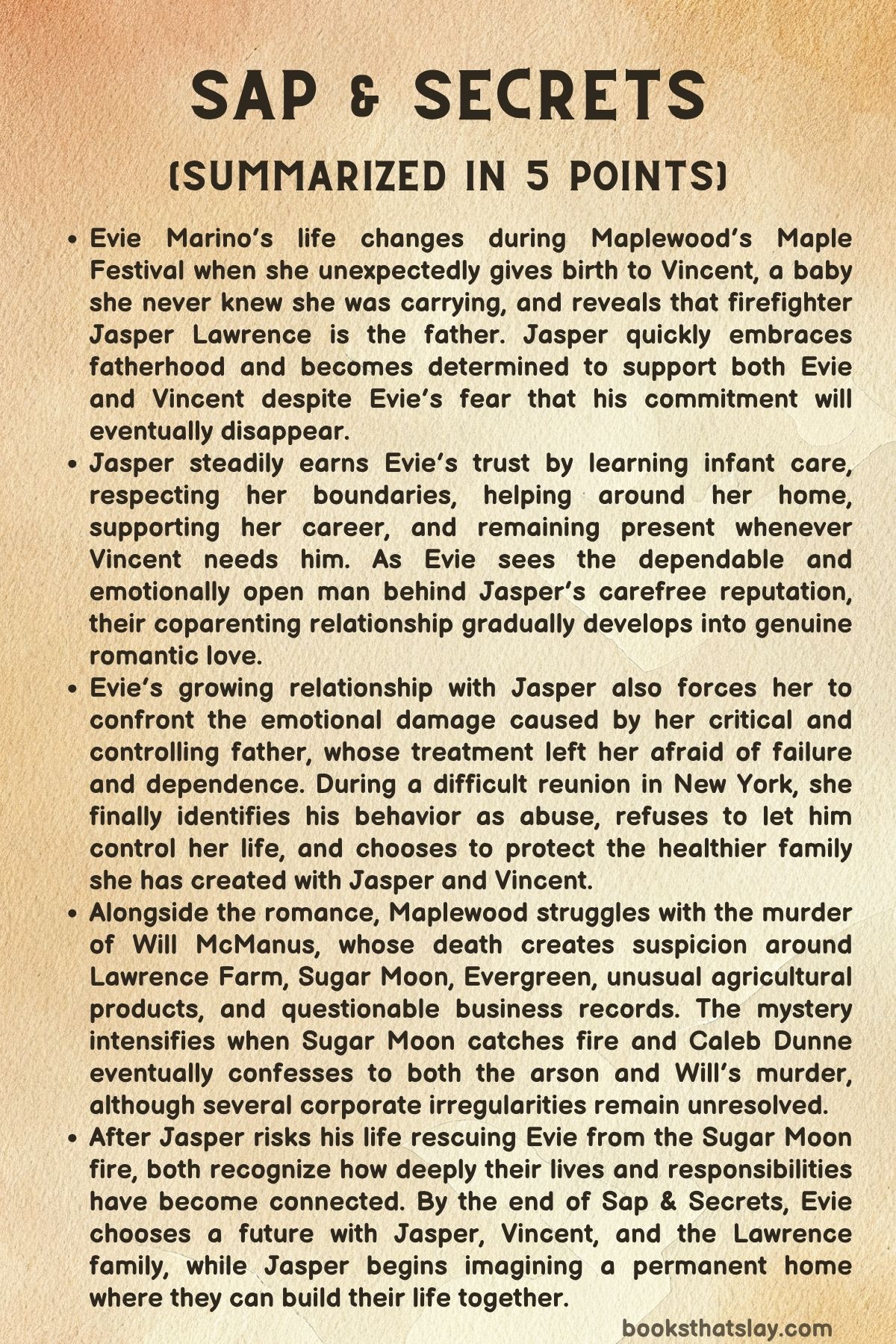
Summary
Maplewood’s annual Maple Festival changes Evie Marino and Jasper Lawrence’s lives in a matter of hours. Firefighter and paramedic Jasper is responding to festival emergencies when he is called to help Evie, who is suffering intense pain inside Tony Moretti’s pizzeria, and discovers that she is pregnant and already in labor despite having had no idea she was carrying a child.
Evie’s PCOS, irregular cycles, and previous medical advice had made pregnancy seem extremely unlikely. As she is taken to the hospital, Jasper asks whether he should contact the baby’s father, only for Evie to reveal that Jasper himself is the father; at almost the same moment, Maplewood is shaken by the discovery of Will McManus’s body at a sugar shack.
Evie gives birth to a healthy son and struggles with guilt over not recognizing her pregnancy or receiving prenatal care. Jasper arrives frightened and confused, but the moment he holds the baby, his uncertainty begins giving way to attachment, and together they name their son Vincent James after Evie’s grandfather and Jasper’s late father.
Evie worries that Jasper will eventually resent an unwanted responsibility, but Jasper immediately rejects the idea that Vincent is a mistake. He promises that he intends to remain fully involved, even though neither parent has had time to prepare for the enormous change in their lives.
The situation becomes more complicated when Jasper tells his siblings about Vincent and learns how seriously Will’s murder may affect Lawrence Farm. Will was found inside a barrel associated with the farm’s sap supply, placing the Lawrence family under suspicion and threatening the local maple industry, while Jasper’s lawyer cousin Gabe begins urging him to establish formal paternity and custody arrangements.
Jasper dislikes treating Evie as someone he needs protection from. His attention increasingly shifts away from his former carefree life and toward Vincent, while Evie remains hesitant to believe that his enthusiasm will last.
When Evie brings Vincent home, her friends and members of the Maplewood community have filled her house with supplies and prepared a nursery. Jasper contributes the rocking chair his father once made for his mother, giving Vincent a physical connection to grandparents he will never know, but Evie’s long-established fear of depending on others causes her to insist that she needs a coparent rather than someone temporarily pretending they are a family.
Jasper responds not with resentment but with consistency. He researches infant care, brings meals and coffee, helps Evie through Vincent’s discomfort and illness, and even camps in her backyard so that he can remain available without violating her boundaries.
His patience gradually changes Evie’s opinion of him. The man she once regarded as an irresponsible thrill-seeker proves emotionally aware, competent, generous, and serious about fatherhood, while Jasper realizes that caring for Vincent gives him more satisfaction than the danger, parties, and casual relationships that once defined his life.
Their growing attachment develops through ordinary moments. Jasper helps Vincent laugh for the first time, supports Evie through separation anxiety, brings the baby close enough during her birthday spa day that she can relax, and encourages her to rediscover parts of herself that existed before motherhood.
A basketball game brings their attraction into the open when Jasper tells Evie that he sees her as remarkable rather than ordinary or disappointing, directly challenging the beliefs created by years of criticism from her father. Their first deliberate kiss is interrupted by Vincent, but the emotional boundary between them has already shifted.
At the same time, Will’s murder continues damaging Maplewood’s economy and creating suspicion around Sugar Moon, the maple company where Evie works. Jasper learns that investigators are interested in Will’s delivery work, while Evie encounters references to BGX, an agricultural product associated with tree yields and later discovers the more specific BGX-9 in company records.
Questions begin accumulating around Sugar Moon’s suppliers, Evergreen, suspicious shipments, compliance records, and agricultural practices. Evie initially believes much of the suspicion surrounding CEO Louisa Meyers is exaggerated, but even she cannot ignore every irregularity.
Evie’s relationship with Jasper deepens when she finally brings Vincent to Lawrence Farm. She expects discomfort or judgment but instead discovers a loud, affectionate extended family that welcomes both her and Vincent without reservation, showing her a form of family life dramatically different from the criticism and emotional manipulation of her childhood.
Watching her friend Ruby give birth further changes Evie’s thinking. She begins forgiving herself for the circumstances surrounding Vincent’s unexpected birth and recognizes that Jasper has spent months behaving not merely as a responsible father but as a dependable partner.
Evie finally admits that she wants Jasper but has been afraid of depending on him. Their renewed physical relationship now carries emotional meaning because it follows months of trust, shared parenting, conflict, and companionship rather than the impulsive encounter that resulted in Vincent.
Jasper admits that he had noticed Evie long before their first night together and had considered her intelligent, confident, beautiful, and almost unattainable. His confession directly contradicts Evie’s deeply rooted belief that a man like Jasper could never genuinely desire someone like her.
Their relationship becomes increasingly serious even before Evie can comfortably label it. Jasper tells Josh that he loves her and explains that the domestic life he once might have considered boring now feels more valuable than anything he previously chased, while Josh reveals that his insistence on paternity testing comes from his own devastating experience of discovering that his former fiancée’s baby was not his.
Gabe nevertheless gives Jasper legal documents concerning paternity, custody, and support. Jasper takes the folder but leaves it unread, believing that he and Evie can continue handling their responsibilities cooperatively.
A professional conference in New York becomes another major turning point. Jasper travels with Evie and Vincent so she can participate without being separated from her baby, and his support helps Evie regain confidence in her professional abilities.
The trip becomes more difficult when Evie’s estranged sister Giovanna arrives and unexpectedly brings their father. Evie’s father immediately begins insulting and belittling her, but Evie finally confronts him, identifies his treatment as abuse, and refuses to allow him to control her or have access to the family she is building.
Afterward, Jasper quietly cares for Vincent while Evie processes what happened. Evie realizes that her desire to protect her child has helped her break the emotional patterns that kept her afraid of her father, and she finally tells Jasper that she loves him.
Jasper returns the declaration, admitting that losing his own parents led him to believe he could never recreate the kind of loving family they had given him. Evie and Vincent have changed that belief, allowing him to see the three of them as a family created not merely by circumstance but by mutual choice.
Their happiness is soon tested by Maplewood’s continuing crisis. During the Founder’s Festival, police publicly take Louisa into custody, leaving Evie worried about Sugar Moon, its employees, and the farms dependent on the company.
Soon afterward, Evie accidentally discovers the folder containing Jasper’s proposed paternity and custody documents. Her old fear immediately interprets them as proof that Jasper has been deceiving her, and although he explains that Gabe and another attorney prepared them without anything being filed, their argument forces both to confront the fact that Jasper does possess legitimate parental rights and Evie remains terrified of losing Vincent.
While they are still emotionally separated, the Lawrence family uncovers suspicious paperwork apparently carrying authorization that neither Jasper nor Josh provided. Evergreen’s repeated attempts to buy Lawrence land and its association with BGX-9 suggest that Will’s murder, Sugar Moon’s problems, forged documents, and local agricultural interests may be connected.
Before those questions can be resolved, Sugar Moon catches fire while Evie is inside. Jasper hears the emergency dispatch, realizes she may be trapped in the windowless pumping room, and enters the burning building despite being off duty and being ordered to remain outside.
Jasper finds Evie collapsed behind a stuck door and repeatedly gives her access to his respirator while dragging her toward safety. Evie escapes with relatively minor smoke inhalation, but Jasper suffers dangerous carbon monoxide exposure and burns to his airway because of the risks he took to save her.
The crisis gathers their families and friends at the hospital and reminds Evie how thoroughly Maplewood has accepted her. Jasper, meanwhile, begins recognizing that courage now means more than running toward danger; because Evie and Vincent depend on him, surviving for them must also become part of his responsibility.
Investigators then arrest Frankie Dunne’s brother Caleb for the fire. Caleb admits starting it to destroy records and also confesses to murdering Will, even though the revelation shocks everyone because the two men had been friends.
His confession appears to answer the immediate question of Will’s death, but it does not fully explain the suspicious corporate records, Evergreen’s activity, BGX-9, or the questionable transactions involving local farms. The larger business uncertainty therefore remains even after Maplewood receives an apparent answer to its most frightening crime.
Two weeks later, Evie, Jasper, and Vincent take a gentle hike while recovering. At the falls associated with Maplewood’s tragic lovers Cora and Nathaniel, Jasper proposes marriage, but when Evie tells him she is not ready for that step, he changes the question and simply asks her to choose a life with him.
Evie realizes that she already has. Their future is not defined by a dramatic promise but by the repeated decision to trust, adapt, remain present, and build a family together.
At Lawrence Farm soon afterward, Celine LeBlanc and her son Julian arrive to live in the guest cottage, creating the possibility of a future connection with Jasper’s guarded brother Josh. Jasper then takes Evie to a hill overlooking the property and tells her that he hopes to build a house there for her, Vincent, and whatever family they may create, making his long-term intentions unmistakable.
Characters
Evie Marino
Evie is the emotional center of Sap & Secrets, and much of her development concerns the difference between genuine independence and defensive isolation. At the beginning of the novel, she has constructed a controlled adult life in response to childhood criticism, professional burnout, and the belief that depending on someone gives that person the power to disappoint or hurt her.
The discovery that she has unknowingly carried and delivered Vincent destroys that sense of control almost instantly. Her first response to motherhood contains both overwhelming love and severe self-judgment, as she blames herself for missing a pregnancy that her PCOS, irregular cycles, and medical history had given her little reason to suspect.
Evie’s difficulty accepting Jasper is therefore not simple stubbornness. She expects unreliability because emotional self-protection has taught her to prepare for abandonment before it occurs, and Jasper’s consistency becomes difficult for her precisely because it challenges the worldview that has kept her functioning.
Her transformation occurs gradually through repeated experiences rather than one sudden realization. She learns to accept help from friends, trusts Jasper with Vincent, returns to professional work, confronts her father, allows Jasper to comfort her, and eventually recognizes that vulnerability does not automatically lead to humiliation or loss.
Motherhood also gives Evie a new source of courage. She may once have tolerated her father’s cruelty toward herself, but she refuses to let the same behavior reach Vincent, and that protective instinct helps her finally identify the past clearly and reject her father’s authority over her present life.
By the end, Evie remains independent, ambitious, and cautious, but those qualities are no longer barriers against intimacy. Choosing Jasper becomes meaningful because she does not surrender herself to do it; she learns that partnership can support the identity she has built rather than erase it.
Jasper Lawrence
Jasper begins Sap & Secrets with a reputation for adventure, casual relationships, humor, and a willingness to run toward danger. Vincent’s birth reveals that beneath this image is a man shaped by deep loyalty, unresolved grief over his parents, strong community values, and an instinctive desire to care for other people.
His transition into fatherhood is immediate but not unrealistic in the sense of knowing everything automatically. Jasper researches infant care, learns routines, accepts correction, handles practical tasks, and repeatedly rearranges his life around Vincent rather than expecting Evie to accommodate him.
Jasper’s strongest quality is consistency. Camping in Evie’s backyard perfectly represents his approach: he wants greater access to his son, but he also respects Evie’s anxiety enough to accept an inconvenient compromise rather than force his way into her home.
His emotional maturity becomes equally important. Jasper has attended therapy, can discuss grief and fear openly, and recognizes that strength sometimes means admitting vulnerability, qualities that undermine Evie’s original assumption that his easygoing personality indicates emotional shallowness.
His major weakness is his instinct to treat physical bravery as an uncomplicated virtue. Entering the Sugar Moon fire saves Evie’s life, but his injuries force him to understand that fatherhood changes the moral consequences of risking himself because Vincent and Evie now depend upon his survival.
By the end, Jasper’s idea of happiness has fundamentally changed. The man who once valued excitement now wants ordinary mornings, repairs around the house, time with his child, partnership with Evie, and eventually a permanent home on Lawrence Farm.
Vincent James
Vincent is an infant and therefore cannot undergo a conventional psychological character arc, yet he is one of the most consequential figures in the book. His unexpected arrival forces both protagonists to confront identities they had never planned to assume and becomes the catalyst for nearly every major emotional change between them.
For Evie, Vincent awakens fierce love while intensifying her fear of failure. For Jasper, holding his son creates an immediate sense of responsibility and gives him a new standard against which to measure his choices, priorities, and willingness to take risks.
Vincent also acts as the bridge connecting previously separate worlds. Through him, Evie becomes part of the Lawrence family, Jasper gains entry into Evie’s carefully guarded domestic life, and both are required to communicate even when their romantic relationship is uncertain.
His presence changes the meaning of ordinary activities throughout the story. Diaper changes, feeding, first laughter, illness, daycare, family outings, and quiet evenings gradually become evidence of a functioning family long before Evie and Jasper are ready to use that word themselves.
Ruby
Ruby is one of Evie’s closest friends and represents the supportive chosen family Evie develops after moving to Maplewood. She helps immediately after Vincent’s birth, participates in preparing Evie’s home, encourages her to leave the house, and repeatedly challenges her tendency to retreat when emotional situations become uncomfortable.
Ruby also recognizes the possibility of romance between Evie and Jasper before Evie is prepared to accept it. Her teasing is playful, but her observations are usually grounded in Jasper’s behavior rather than fantasy, particularly his willingness to restructure his life around Evie and Vincent.
Her own marriage to Paul and the birth of Brooks become especially important to Evie’s development. Watching Ruby labor with a committed partner beside her allows Evie to reconsider her own unusual birth experience and understand that preparedness does not guarantee control.
Ruby therefore functions both as emotional support and as an example of a relationship built around mutual presence. Her friendship reminds Evie that accepting care is not weakness and that people can remain close without demanding perfection.
Frankie Dunne
Frankie is another central member of Evie’s chosen family and frequently provides the more direct voice among her friends. She supports Evie through the shock of Vincent’s birth, helps her adjust to motherhood, participates in the No Book Club, and refuses to let Evie dismiss Jasper’s increasingly obvious devotion.
Frankie becomes especially important when she tells Evie that Jasper’s behavior cannot be explained by fatherhood alone. Sleeping in the yard, repairing the house, offering emotional reassurance, bringing food, and prioritizing Evie’s comfort all demonstrate a personal attachment that Evie has been reluctant to name.
Her role becomes more painful when Caleb, her brother, is arrested for the Sugar Moon fire and confesses to Will’s murder. Frankie’s immediate disbelief gives the criminal storyline a personal cost, because the suspect is no longer an abstract figure but someone connected directly to a person Evie loves.
Through Frankie, the novel demonstrates how a small community’s crises spread across friendships and families. She can be humorous and confrontational, but her loyalty gives Evie one of the stable relationships that ultimately teach her to trust others.
Josh Lawrence
Josh is one of Jasper’s brothers and one of the most emotionally guarded figures in Sap & Secrets. His seriousness initially contrasts sharply with Jasper’s easy humor, especially when he supports the idea that Jasper should obtain a paternity test and protect his legal rights.
That advice initially seems suspicious or overly cautious, but the revelation of Josh’s past explains it. His former fiancée became pregnant while they were engaged, and Josh believed he was going to become a father before discovering that she had been having an affair and that the baby was not his.
The experience helps explain both his need for certainty and his retreat into the structured world of Lawrence Farm. Unlike Jasper, who responds to loss by seeking experience and connection, Josh has responded to betrayal by tightening control over his emotional life.
His later involvement in examining forged documents and Evergreen’s activity also establishes him as a practical guardian of the family’s livelihood. The epilogue introduces Celine and Julian as forces capable of disrupting his carefully regulated existence, suggesting that Josh’s emotional story is only beginning.
Gabe Lawrence
Gabe occupies several roles simultaneously as Jasper’s cousin, Maplewood’s mayor, and a lawyer. This combination makes him unusually focused on consequences, documentation, public perception, and the legal vulnerabilities facing both Jasper and Lawrence Farm.
His repeated insistence that Jasper establish paternity and formal custody protections creates friction because Jasper interprets legal planning as an accusation against Evie. Gabe, however, sees the matter more impersonally: Vincent’s future should not depend entirely on goodwill when legal structures exist to protect both parents and child.
The murder investigation places additional pressure on him. Maplewood’s businesses suffer as tourists stay away, residents demand answers, and the Lawrence family’s connection to the barrel in which Will was found increases public scrutiny.
Gabe can therefore appear intrusive, but his behavior reflects the burden of anticipating problems before other people are ready to acknowledge them. The custody folder eventually contributes to Evie and Jasper’s largest argument, yet the underlying issue he raises is legitimate and forces them to confront responsibilities they had postponed.
Louisa Meyers
Louisa is one of the most ambiguous supporting figures in Sap & Secrets because much of her significance comes from what other people suspect rather than what the story conclusively establishes about her. As CEO of Sugar Moon, she represents the company around which many of Maplewood’s economic hopes and fears have gathered.
Evie initially sees Louisa as a capable employer who gave her a meaningful professional opportunity. Because Sugar Moon helped Evie rebuild her career after New York, Evie resists the town’s eagerness to interpret every rumor as evidence that Louisa is corrupt.
The discovery of BGX-9, missing compliance information, questionable supply practices, and Evergreen connections nevertheless creates legitimate reasons for concern. Louisa’s public detention at the Founder’s Festival therefore shocks Evie because it destabilizes both her personal loyalty and the company supporting hundreds of local workers.
Her later release prevents her from becoming a simple villain. Even after Caleb confesses to murder and arson, unresolved corporate irregularities remain, leaving Louisa associated with questions that extend beyond the solved criminal acts.
Will McManus
Will is dead when the principal story begins, but his murder creates the external crisis that runs alongside Evie and Jasper’s developing relationship. Because his body is discovered in a barrel connected to Lawrence Farm’s sap supply, his death immediately damages the farm’s reputation and threatens Maplewood’s tourism economy.
Information about Will emerges indirectly through police interviews, rumors, and conversations. He had performed deliveries, knew people connected to Sugar Moon, had apparently argued with Caleb, and reportedly suggested that something important was about to become public.
His friendship with Caleb makes Caleb’s eventual confession especially disturbing. The personal connection suggests that Will trusted the person who harmed him, consistent with Jasper’s earlier speculation that whoever lured Will into danger was probably familiar to him.
Will therefore operates less as a developed living personality than as the absent figure whose death exposes weaknesses within Maplewood’s business relationships. His murder forces secrets, resentments, financial pressures, and questionable corporate practices into public view.
Caleb Dunne
Caleb is initially known mainly through other characters, particularly Frankie and the rumors surrounding Will’s final days. His eventual arrest transforms him from a peripheral figure into the apparent answer to the novel’s central criminal mystery.
Authorities find physical evidence linking him to the Sugar Moon fire, and Caleb admits deliberately starting it because he wanted to destroy records. He then confesses to Will’s murder, shocking the community because he had generally been regarded as gentle and helpful and because Will had been his friend.
Caleb’s confession provides legal clarity without fully restoring moral or practical certainty. The wider irregularities involving Evergreen, BGX-9, Sugar Moon, suspicious shipments, and forged paperwork are not automatically explained by his admission.
His role therefore emphasizes the difference between identifying a perpetrator and understanding an entire chain of events. The murder and fire may have an admitted culprit, but Maplewood’s institutional problems remain considerably more complicated.
Giovanna
Giovanna is Evie’s older sister and represents the painful difficulty of separating from an abusive family system when other relatives remain loyal to it. Evie reaches out because she wants to give Giovanna the chance to meet Vincent, suggesting that she has not completely abandoned hope of preserving some relationship with her sister.
The reunion initially appears manageable until their father arrives unexpectedly. Giovanna’s willingness to remain connected to him places her in conflict with Evie’s determination to maintain boundaries, especially after he immediately resumes belittling Evie.
Giovanna tells Evie that she loves her but ultimately leaves with their father. Her decision demonstrates that affection alone cannot repair a relationship when two people refuse to agree on what behavior is acceptable.
She is therefore a sad but important contrast to Evie’s Maplewood friendships. Ruby and Frankie support Evie’s growth without requiring her to tolerate mistreatment, while Giovanna remains attached to the family structure Evie has chosen to escape.
Evie’s Father
Evie’s father is the clearest source of her chronic self-doubt and fear of imperfection. Throughout her childhood, he criticized her weight, academic performance, athletic ability, and mistakes, teaching her that acceptance depended upon meeting standards that could continually be moved against her.
His influence remains visible long after physical distance separates them. Evie’s difficulty accepting praise, her belief that someone like Jasper would not genuinely desire her, and her need to complete everything herself all reflect survival strategies created in an environment where mistakes invited humiliation.
The New York confrontation exposes how little he has changed. He insults Evie’s choices, attacks her relationship, and attempts to restore the same psychological hierarchy that once made her afraid of his judgment.
The difference is Evie herself. She names his behavior as abuse, refuses to fear him, and denies him access to the family she is protecting, making their confrontation one of the clearest demonstrations of her emotional growth.
Paul
Paul, Ruby’s husband, appears less frequently than many supporting characters but serves an important comparative purpose. His steady presence during Ruby’s labor gives Evie an opportunity to observe a partnership in which difficulty is faced jointly rather than managed through criticism or abandonment.
Watching Paul remain beside Ruby helps Evie reinterpret her own experience. She begins to understand that childbirth can remain unpredictable even with preparation, allowing her to release some of the guilt she has carried over Vincent’s unexpected arrival.
Paul also belongs naturally within the wider Maplewood support network surrounding Evie. His relationship with Ruby quietly reinforces the possibility that long-term love can consist of practical presence rather than dramatic declarations.
Police Chief Nolan Foster
Nolan represents the institutional pressure created by Will’s murder. As police chief, he must investigate a crime affecting people he knows personally while facing rumors, economic anxiety, public frustration, and residents who expect immediate answers.
His conversation with Jasper shows him attempting to separate useful information from gossip. He verifies Jasper’s alibi, asks practical questions about farm operations and Will’s movements, and acknowledges that frightened townspeople have overwhelmed authorities with theories and questionable tips.
Nolan’s position becomes increasingly uncomfortable as Maplewood’s financial losses grow. Residents criticize him publicly, but Jasper recognizes that Nolan is carrying responsibilities that outsiders underestimate.
His later involvement in Louisa’s public detention demonstrates that he remains committed to following the investigation even when doing so creates new controversy. Nolan consequently functions as a reminder that community loyalty cannot replace formal accountability.
Celine LeBlanc
Celine appears only near the end of the story, but her introduction clearly establishes a new direction for the Lawrence family. She arrives in Maplewood as the new kindergarten teacher and moves into the Lawrence guest cottage with her son Julian.
Her energetic, outspoken manner immediately clashes with Josh’s controlled personality. Rather than being intimidated by his gruffness, she responds directly and confidently, creating an obvious contrast between her spontaneity and his emotional rigidity.
Evie quickly notices the possibility of attraction between them even though Jasper dismisses it. Celine’s role therefore acts as a bridge beyond Evie and Jasper’s completed romantic arc, suggesting that another Lawrence may soon have his carefully protected life challenged by an unexpected relationship.
Julian
Julian is Celine’s young son and is introduced when he is discovered inside one of Lawrence Farm’s tractors because of his fascination with the machinery. Celine explains that he is autistic and may run when overwhelmed, particularly during periods of major change.
His arrival immediately gives Josh an interaction that cannot be handled through his usual emotional distance alone. Julian’s curiosity about the farm also gives him a natural connection to the physical environment that defines Josh’s life.
Although his role is brief, Julian helps establish Celine and Josh’s future circumstances. Like Vincent in Jasper’s story, a child may become one of the factors through which an emotionally guarded Lawrence brother is required to reconsider what family and attachment can mean.
Themes
Trust as a Repeated Choice
Trust in Sap & Secrets develops through behavior rather than promises. Evie has strong reasons for resisting dependence: her childhood taught her that love can become a method of control, while adulthood taught her to rely on competence and self-sufficiency whenever emotional security was unavailable.
Jasper cannot undo those experiences simply by saying that he is different. His credibility grows because he repeatedly returns, cares for Vincent, learns what he does not know, respects Evie’s limits, sleeps in the backyard rather than demand access to her house, supports her career, and remains available without asking for immediate romantic commitment.
The custody documents create such a severe rupture because they appear to contradict this accumulated trust. Evie’s response is disproportionate to Jasper’s actual actions but completely consistent with her deepest fear: that the moment she becomes vulnerable, someone will use that vulnerability against her.
Their reconciliation requires more than reassurance. Both must acknowledge legitimate realities—Evie’s fear of losing Vincent and Jasper’s right to legal recognition as Vincent’s father—without treating those realities as evidence that one intends to harm the other.
By the ending, trust has become something active. Evie does not suddenly become fearless, and Jasper does not become incapable of mistakes; they choose to continue communicating and building a future even when certainty is unavailable.
Family, Belonging, and Chosen Community
Evie’s understanding of family changes dramatically because the people surrounding her in Maplewood offer an experience completely different from the one she knew growing up. Her biological family taught her that closeness could involve criticism, conditional approval, manipulation, and pressure to tolerate harmful behavior.
Maplewood initially feels almost excessively involved in everyone’s personal affairs, yet its intrusiveness is accompanied by practical generosity. Friends clean Evie’s house, prepare meals, create a nursery, care for Vincent, encourage Evie to rest, celebrate milestones, and remain present during emergencies.
The Lawrence family adds another dimension. Their teasing contains affection rather than humiliation, and their immediate acceptance of Vincent and Evie shows her that a family can welcome someone without first requiring them to earn a place through obedience or perfection.
This contrast becomes crucial when Evie confronts her father and Giovanna. She realizes that biological connection does not create an unlimited obligation to accept damaging behavior, just as choosing boundaries does not mean she must live without family.
By the end, home is defined less by ancestry than by repeated acts of presence. Evie has friends, a partner, a child, an extended family, and a community that have chosen her while allowing her to remain herself, transforming Maplewood from the town she escaped to into the place where she genuinely belongs.
Healing, Vulnerability, and Breaking Old Patterns
The emotional movement of Sap & Secrets depends heavily on the idea that surviving damaging experiences and healing from them are not identical. Evie has already achieved considerable independence before the story begins: she left her family environment, changed her career, moved from New York to Vermont, attended therapy, and built a competent professional identity.
Yet the beliefs created by her childhood remain active. She assumes mistakes indicate failure, expects desirable people to reject her, interprets help as a threat to independence, and prepares for abandonment even when no abandonment has occurred.
Motherhood intensifies these patterns because Vincent matters more to her than anything she has previously risked losing. At first this makes Evie even more controlling, but eventually her love for him becomes the force that helps her reject the worldview inherited from her father.
Jasper’s vulnerability is equally significant. He discusses therapy, grief, fear, and his parents openly, showing Evie that emotional honesty can coexist with confidence and strength.
Their relationship becomes healthier as both stop performing identities designed for protection. Evie does not have to be permanently self-sufficient, while Jasper does not have to remain the carefree man who avoids attachment because losing people is frightening.
Healing therefore appears not as forgetting the past but as recognizing when old survival strategies are controlling present choices and deliberately responding differently.
Responsibility, Courage, and the Meaning of Home
Responsibility changes meaning for both protagonists as their lives become connected to other people. Jasper has always been courageous in the physical sense: firefighting, emergency medicine, farm work, and community service all place him in situations where acting quickly and accepting danger are valued qualities.
Fatherhood complicates that identity. Running into the Sugar Moon fire saves Evie’s life, but his serious injuries force him to recognize that courage can become reckless when people depend upon his survival.
Evie’s version of responsibility undergoes an opposite correction. She initially believes being responsible means personally managing every problem, anticipating every failure, and avoiding dependence, but motherhood eventually teaches her that accepting competent help can itself be responsible.
The wider Maplewood storyline expands this idea beyond the couple. Will’s murder damages tourism, Sugar Moon’s instability threatens workers and farmers, forged documents endanger Lawrence Farm, and the fire shows how one person’s actions can affect an entire community.
Against that instability, home becomes less about guaranteed safety than about having people willing to face uncertainty together. Maplewood loses some of Evie’s idealized sense of security, yet it becomes more deeply hers because she experiences the community responding to crisis rather than existing only during peaceful moments.
The final image of Jasper imagining a house overlooking Lawrence Farm reflects that mature understanding: permanence cannot be guaranteed, but a future can still be built deliberately, one decision and one shared responsibility at a time.