Safe Keeping Summary, Characters and Themes
Safe Keeping by Kristen Proby is a contemporary romantic suspense novel centered on protection, recovery, chosen family, and the difficult process of deciding where home truly is.
The story pairs Lena Eagle, the daughter of the president of the United States, with Gideon James, the former Secret Service agent who once nearly died protecting her. When a kidnapping conspiracy forces Lena into hiding at Gideon’s Montana ranch, their old connection develops into something far more personal. Beneath the romance, the novel examines childhood loneliness, unresolved trauma, unhealthy relationships, family loyalty, and the courage required to build a life based on personal choice rather than obligation. It’s the 2nd book in the Triple Creek Ranch series.
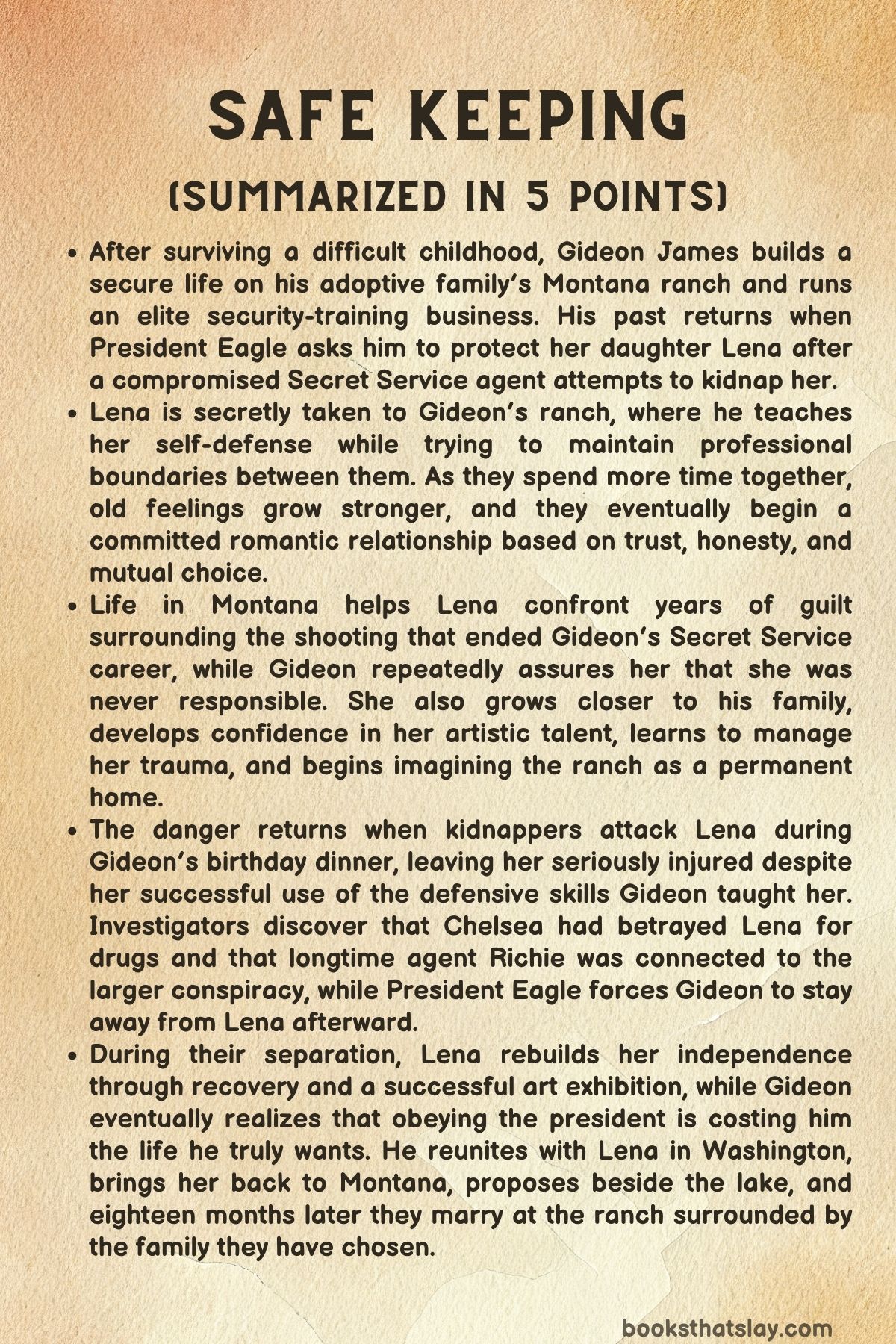
Summary
Gideon James first arrives at Triple Creek Ranch when he is fifteen, after a childhood marked by violence, foster care, and rejection. His biological father is imprisoned for murdering Gideon’s mother, and Gideon has learned not to expect much from adults until Ray and Debbie bring him and another foster boy, Ryker, to their Montana home.
Ray establishes firm rules, while Debbie gives Gideon something even more unfamiliar: unconditional kindness. Their niece Willow quickly includes both boys in her life, and what begins as a temporary placement eventually becomes a permanent family when Ray and Debbie adopt Gideon and Ryker.
Years later, Lena Eagle is twenty-four and living under constant Secret Service protection because her mother is president of the United States. After attending an art exhibition with her longtime friend Chelsea, Lena narrowly escapes an attempted kidnapping carried out by a compromised Secret Service agent, forcing the White House to acknowledge that the threat may come from inside her own security structure.
President Eagle turns to Gideon, who has left government service and now runs an elite security-training business from the Montana ranch. Gideon initially resists returning to Washington, but he agrees when he learns that Lena is in serious danger and that her mother trusts virtually no one else to keep her safe.
Gideon has not seen Lena for four years, and their reunion immediately unsettles both of them. Lena had been attracted to him when she was younger, while Gideon is surprised to discover that the young woman he once guarded has become someone he finds difficult to view with professional detachment.
He takes Lena secretly to Montana, ordering her to leave behind electronics that could reveal her location. Lena accepts the restrictions because the attempted kidnapping has frightened her enough to change the rebellious attitude she once had toward security, and she trusts Gideon more than anyone else responsible for protecting her.
At Gideon’s lakeside home, Lena begins settling into a completely different kind of existence. Gideon plans to use their isolation not only to hide her but also to teach her practical self-defense so that she will never be entirely dependent on security agents again.
Their training quickly exposes Lena’s determination. She runs despite altitude and physical discomfort, learns defensive techniques, and refuses to give up, although Gideon becomes angry when he discovers that she has hidden injuries from him rather than admitting that she is hurting.
The larger difficulty comes from Willow, who resents Lena because Gideon was once shot while assigned to protect her. Willow believes Lena cost Gideon his Secret Service career and years of family time, and her hostility intensifies Lena’s own long-standing guilt about the shooting.
Lena becomes convinced that leaving the ranch would prevent further conflict, but Gideon refuses to let her sacrifice her safety because she believes she is causing trouble. He tells her directly that he wants her there and repeatedly insists that she was never responsible for the injury that changed his career.
As Lena grows more comfortable at Triple Creek, Gideon shows her the ranch and the family history behind it. Ryker welcomes her, Aiden treats her playfully, and Gideon takes her to Ray and Debbie’s graves, helping her understand how profoundly his adoptive parents transformed his life.
Lena also returns to her art. Gideon is impressed by her ability and suggests exhibiting under another name so that viewers can respond to her work without being influenced by her identity as the president’s daughter, an idea that appeals to Lena because public status has long overshadowed her individual achievements.
Meanwhile, the attraction between Lena and Gideon becomes increasingly difficult to control. Their ordinary domestic life, intense training sessions, private conversations, and even humorous incidents reveal how comfortable they have become together, despite Gideon’s repeated attempts to preserve emotional distance.
Eventually Gideon admits that professional boundaries are no longer enough to contain what he feels. After their first kiss, he makes clear that he will not treat their connection as casual; if they become involved, he wants honesty, exclusivity, and a genuine relationship.
Lena accepts because her feelings are equally serious. Their physical closeness is accompanied by conversations about consent, trust, health, expectations, and the scars Gideon still carries from the shooting, making their relationship increasingly emotional rather than merely based on attraction.
For the first time, they speak openly about the museum attack that changed both of their lives. Lena explains that she was never allowed to visit Gideon afterward, was given little meaningful information, and received no proper therapy despite continuing nightmares and guilt.
Gideon tells her that the shooting ended his field career after extensive rehabilitation, but he refuses to regard Lena as the cause of what happened. He encourages her to view herself as someone who survived a terrible event rather than someone responsible for his suffering.
Their relationship also changes the nature of Lena’s training. When she protests Gideon’s ability to become emotionally distant whenever he acts as her instructor, they work through the conflict and establish a better balance in which he can challenge her without pretending their personal relationship disappears inside the gym.
Lena eventually repairs her relationship with Willow as well. She gives Willow a charcoal drawing of Gideon, Ryker, and Aiden, and the two women have an honest conversation that transforms their relationship from hostility into genuine friendship.
Through Gideon’s family, Lena begins recognizing how emotionally neglected her own childhood was. Although raised with extraordinary privilege, she spent much of her childhood with nannies while her parents concentrated on political life, and she grew accustomed to accepting small amounts of attention from people who did not always treat her well.
Gideon also shares the darkest part of his childhood, explaining that his father murdered his pregnant mother when Gideon was twelve. Lena understands that Gideon’s instinct to protect other people is closely connected to the helplessness and violence he experienced before Ray and Debbie gave him another kind of life.
One major obstacle remains Lena’s fear of firearms. When Gideon fires a rifle during training, she experiences a severe trauma response and relives the museum shooting, remembering Gideon being wounded while protecting her and her desperate attempt to stop his bleeding.
Gideon stops the training and helps her reconstruct the event more accurately. He reveals that the museum shooting was a random revenge attack committed by a former security guard and his brother, rather than something caused by Lena or her political family, finally removing the factual basis for the guilt she has carried for years.
Lena gradually becomes stronger, and her nightmares decrease. She successfully returns to the shooting range, begins helping Gideon with the financial side of his business, and tells him that even when the danger ends, she wants to remain at the ranch and build an ordinary life there.
Her growth becomes especially clear when she speaks to Chelsea for the first time since disappearing. Lena discovers that Chelsea has relapsed into cocaine use and is again asking her for money, but instead of rescuing her as she has repeatedly done in the past, Lena recognizes how one-sided their friendship has become and ends their twenty-year relationship.
By now, Willow openly regards Lena as family, and Gideon privately admits to Ryker that he is in love with her. During Gideon’s birthday dinner away from the ranch, however, the security threat that brought Lena to Montana finally reaches them.
Several men attack Lena outside the pub. Instead of becoming helpless, she uses the techniques Gideon taught her to injure and resist multiple attackers before Rogers, one of the kidnappers, finally holds her at gunpoint and strikes her in the head.
Gideon kills Rogers and the remaining attackers, but Lena suffers a fractured skull and brain contusion. Investigators discover that Chelsea had been providing information in exchange for drugs and that Richie, Lena’s longtime Secret Service protector, was part of a political faction attempting to use her kidnapping as leverage against President Eagle.
While Lena remains unconscious, President Eagle privately orders Gideon to stay away from her and threatens the people and life he cares about if he refuses. Believing that he has failed Lena and still conditioned to obey the commander in chief, Gideon leaves Montana’s future first and returns home without waiting for Lena to wake.
When Lena awakens, she assumes Gideon may have abandoned her willingly until Bishop reveals the truth. Once she understands that her mother forced the separation, Lena decides that she will recover, hold her first gallery exhibition under a pseudonym, and return to Montana whether the president approves or not.
Because Gideon’s phone remains off, Lena begins sending him messages that function like a diary. She tells him about her rehabilitation, her art, ordinary memories of their life together, and her intention to come home, never knowing whether he will eventually read them.
Gideon is equally miserable during their separation. After learning that his biological father has died and realizing once again that his real family is the one he built in Montana, he finally allows Willow and Ryker to challenge his obedience to the president’s order.
Willow reveals that Lena has an upcoming Washington exhibition and shows Gideon a painting signed “L. James,” the pseudonym Lena chose using his surname. Gideon turns his phone back on, finds hundreds of Lena’s messages, reads them, and decides that he is going to Washington to fight for their relationship in person.
At the same time, Lena finally confronts her mother and announces that she will not inherit the political future others have imagined for her. President Eagle eventually acknowledges that fear influenced her treatment of Gideon and agrees not to interfere with Lena’s decision to return to him.
At Lena’s exhibition, Howey attempts to grab her, but she uses Gideon’s training to free herself before security can intervene. Seconds later, Gideon appears, and their reunion confirms that neither of them wants the separation to continue.
They finally exchange declarations of love, and Gideon tells Lena that she is returning to Montana with him. Back at Triple Creek Ranch, Willow and Ryker welcome Lena home, while Gideon gives her one rose for every day they spent apart before proposing beside the frozen lake.
Lena accepts, completing the transformation of the ranch from a hiding place into the home she has deliberately chosen. Eighteen months later, after President Eagle has left office, Lena and Gideon marry beside the lake, surrounded by the family that has become hers as fully as it has always been Gideon’s.
Characters
Gideon James
Gideon is the emotional anchor of Safe Keeping, shaped by a childhood in which violence and abandonment taught him to expect danger long before he learned to expect love. His father’s murder of his mother and Gideon’s subsequent years in foster care explain both his instinctive distrust and his intense need to protect people once he considers them his own.
Ray and Debbie fundamentally redirect his life by providing structure, affection, and permanence. Their influence remains visible long after their deaths because Gideon preserves the ranch, builds his security business there, maintains fierce loyalty to Ryker and Willow, and measures emotional safety according to the kind of home his adoptive parents created.
His protective nature initially makes him highly disciplined around Lena. Gideon believes there must be a clear boundary between protecting her and wanting her, yet that distinction becomes impossible to maintain once he begins seeing her as an adult whose intelligence, talent, resilience, and loneliness he understands on a personal level.
Gideon can also be controlling, especially when fear is involved. His insistence on rules, training, communication, and physical safety comes from professional experience, but the story gradually forces him to recognize that protecting Lena cannot mean removing her ability to make choices for herself.
His greatest emotional weakness is his tendency to convert love into responsibility and responsibility into blame. After Lena is injured at the pub, he immediately decides that loving her damaged his judgment, accepts President Eagle’s accusation, and leaves because he believes his own feelings have made him dangerous to the person he most wants to protect.
Gideon’s eventual return to Washington represents growth because he finally chooses his own life rather than acting according to an old chain of command. By going back to Lena, he accepts that loyalty to another person sometimes requires partnership rather than obedience, and his proposal completes his movement from protector standing outside Lena’s life to equal partner building a future with her.
Lena Eagle
Lena is the central figure through whom Safe Keeping examines the difference between public privilege and private emotional neglect. As the president’s daughter, she has wealth, security, access, and status, yet she grows up largely surrounded by nannies and government personnel rather than parents who consistently place her emotional needs first.
That childhood helps explain why Lena remains loyal for so long to people such as Chelsea and why she once accepted Howey’s unhealthy behavior. She has learned to value continuity so strongly that she sometimes mistakes familiarity for genuine care, making her willing to give more than she receives in return.
Her guilt over Gideon’s shooting is another defining force. Lena has spent years believing that her own decisions caused his injury, and because no one helped her properly process the museum attack, fear becomes embedded in her responses to firearms, nightmares, and even Gideon’s scars.
Her development is therefore less about becoming physically tough than learning to stop accepting responsibility for other people’s actions. Self-defense training matters because it gives Lena practical competence, but her larger transformation appears when she speaks honestly to Gideon, refuses Chelsea money, confronts her mother, chooses her career as an artist, and decides where she wants to live.
Lena’s artistic identity also reveals her desire to be evaluated as herself. By exhibiting under “L. James,” she creates a private identity separate from presidential politics while simultaneously acknowledging the emotional home she associates with Gideon and Montana.
By the ending, Lena no longer treats other people’s expectations as instructions for her future. Choosing Gideon, the ranch, art, and a quieter family life is important precisely because these choices are hers rather than roles selected for political convenience.
Willow
Willow initially functions as the strongest obstacle to Lena’s acceptance within Gideon’s family. In Safe Keeping, her hostility comes not from simple jealousy but from years of unresolved anger surrounding Gideon’s Secret Service career, the family occasions he missed, and the shooting that permanently ended his field work.
She directs that pain toward Lena because Lena is the most visible symbol of everything Willow believes took Gideon away from the ranch. Her mistake is understandable on an emotional level but unfair in practice, particularly because Lena already carries severe guilt over the same events.
Willow’s ability to reconsider her behavior becomes one of her most important qualities. Once she begins seeing Lena as an individual rather than as the president’s daughter connected to Gideon’s injury, she apologizes, opens her home, shares family history, and gradually becomes the sister-like friend Lena has never truly had.
Her later actions prove that reconciliation is genuine. Willow remains in contact with Lena during the forced separation, sends her birthday cake, tells Gideon about the exhibition, and ultimately helps push him out of his self-imposed isolation.
Ryker
Ryker begins as another foster boy sent to Ray and Debbie’s ranch alongside Gideon, and their early relationship is marked by fighting before gradually becoming a brotherhood. Adoption makes that bond legal, but their loyalty is clearly based on shared history rather than paperwork alone.
As an adult, Ryker is one of Gideon’s stabilizing influences. He welcomes Lena more easily than Willow does, helps when Gideon needs assistance during training or emergencies, and later challenges Gideon’s belief that obeying President Eagle must matter more than fighting for the woman he loves.
His marriage to Willow further strengthens the family structure around Gideon. Ryker also develops an easy connection with Lena through their shared interest in finance, helping her feel that she can contribute intellectually as well as emotionally to life on the ranch.
Debbie
Debbie is one of the most influential characters in Safe Keeping despite having died before most of the present-day events. Her kindness toward the teenage Gideon establishes his first experience of maternal security, and her simple assurance that he is safe and welcome gives him a model of home that continues shaping his adult life.
Her legacy appears through the way Gideon treats Lena. He imagines that Debbie would have welcomed her without hesitation, and much of the warmth of the ranch comes from traditions and emotional habits Debbie established years earlier.
Lena wearing Debbie’s wedding dress later creates a symbolic connection between two women who never met. Debbie helped give Gideon a family when he needed one, while Lena becomes the person with whom he carries that family forward.
Ray
Ray provides the structure that complements Debbie’s warmth. When Gideon and Ryker first arrive, he immediately establishes expectations concerning respect, work, and behavior, giving two boys accustomed to instability boundaries that are firm without being cruel.
His decision to adopt Gideon and Ryker gives them permanence and a legal place within the family they have already begun creating. Even after his death, the ranch remains inseparable from his influence because the land, work ethic, and family relationships Gideon protects are part of what Ray helped build.
Ray’s grief after Debbie’s illness and death also shows how deeply the older couple loved one another. Their marriage becomes an understated model of lasting partnership within a story where several younger characters are still learning the difference between possession, dependency, and genuine commitment.
Chelsea
Chelsea represents one of the clearest examples of an unhealthy relationship in Safe Keeping. Because she has been Lena’s friend for approximately twenty years, Lena initially sees their shared history as proof of loyalty, even though Chelsea repeatedly depends on Lena financially and encourages reckless behavior.
Her addiction complicates rather than excuses her actions. Lena has paid for treatment, supported her through overdoses, and repeatedly rescued her, creating a pattern in which Chelsea expects Lena to solve crises without demanding equal responsibility or care.
The eventual betrayal makes that imbalance devastatingly concrete. Chelsea supplies information about Lena to Rogers in exchange for drugs, turning private knowledge gained through friendship into a tool that nearly gets Lena abducted and killed.
Lena’s decision to end the friendship before discovering the full betrayal is therefore significant. She has already realized that love cannot require endless rescue, and Chelsea becomes the relationship through which Lena finally learns that longevity alone does not make a bond healthy.
President Eagle
President Eagle is both Lena’s mother and one of the people most responsible for the restrictions surrounding her life. Her political authority gives her extraordinary power to protect Lena, yet that same authority repeatedly encourages her to treat personal relationships as matters to be managed through decisions, secrecy, and command.
She trusts Gideon enough to place Lena in his care when the Secret Service itself may be compromised, which shows that she respects his competence. After the pub attack, however, fear turns into blame, and she orders him away while threatening his ranch and Aiden’s career if he refuses.
Her relationship with Lena is similarly complicated. She is not presented simply as a cruel parent, but political ambition and institutional thinking repeatedly take priority over emotional availability, leaving Lena to grow up surrounded by protection without consistently feeling personally known.
Her eventual willingness to acknowledge that fear influenced her judgment is important. When Lena insists on choosing Gideon and Montana rather than accepting a political future involving Howey, President Eagle finally steps back instead of treating her daughter’s life as another strategic decision.
Lena’s Father
Lena’s father occupies a quieter position than President Eagle, but he remains part of the emotionally distant family structure surrounding Lena. He arrives at the hospital after the pub attack and confirms to Lena when she wakes that Gideon survived, yet he is not shown challenging his wife’s larger decisions about their daughter’s future.
His limited presence reinforces an important aspect of Lena’s childhood: she has parents who are physically and politically powerful but have often delegated the daily emotional work of raising her to others. Lena can still love them while recognizing that they did not provide the kind of parental involvement she needed.
Bishop
Bishop is Gideon’s former Secret Service director and one of the few government figures consistently positioned as an ally to both Gideon and Lena. He understands Gideon well enough to know that ordinary requests will not bring him back to Washington, which is why the president ultimately becomes involved when Lena needs protection.
Later, Bishop becomes particularly important to Lena because he tells her truths that other people conceal. He explains Chelsea’s betrayal, confirms that Gideon left only because President Eagle ordered him away, restores Lena’s contact information, and gives her the knowledge necessary to interpret Gideon’s disappearance accurately.
His role contrasts with the secrecy practiced elsewhere in Lena’s life. Bishop works within the same government system that frequently withholds information from her, yet he ultimately chooses honesty when he sees that continued silence is causing unnecessary damage.
Richie
Richie initially appears to be one of Lena’s most trusted longtime Secret Service agents. His familiar presence makes the attempted kidnapping especially confusing because Lena initially assumes he has simply been pulled away while another agent attempts to force her out of the building.
The later revelation that Richie belongs to the conspiracy represents one of the story’s strongest betrayals of institutional trust. He is connected to a political faction opposed to President Eagle’s policies and participates in a plan to abduct Lena in order to use her as leverage.
His betrayal also validates Gideon’s insistence that Lena cannot rely entirely on professional protection. An official badge, years of service, and personal familiarity do not guarantee loyalty, making Lena’s growing ability to assess danger and defend herself essential rather than symbolic.
Howey
Howey is Lena’s former boyfriend and represents the kind of relationship she once tolerated because she had not yet developed strong personal boundaries. He struck her during their relationship, and Lena ended things after the incident, demonstrating that even before Montana she possessed a clear line she would not allow him to cross.
His later appearance at Lena’s exhibition demonstrates how much she has changed. Howey insults the artwork without knowing it belongs to Lena and then grabs her after she has warned him, but Lena physically frees herself using what Gideon taught her rather than waiting passively for security.
He also represents the political future Lena rejects. President Eagle views him as a socially suitable possibility, while Lena recognizes that public suitability cannot compensate for a lack of respect.
Rogers
Rogers is the visible leader of the group that attacks Lena outside the pub, although later evidence confirms that the conspiracy extends beyond him. His willingness to hold Lena at gunpoint and strike her hard enough to fracture her skull makes him the immediate physical threat during the story’s most dangerous confrontation.
His role also provides the ultimate test of Lena’s training. She cannot defeat every attacker, but she successfully injures and delays several of them, proving that Gideon’s insistence on preparation has materially changed her chances of survival.
Rogers is ultimately killed by Gideon after attacking Lena. His death ends the immediate assault but opens the larger investigation that exposes Chelsea and Richie.
Nicholas Peterson
Nicholas Peterson, Gideon’s biological father, exists largely as a symbol of the family Gideon consciously rejects. His alcoholism, gambling problems, murder of Gideon’s pregnant mother, and later attempts to prevent Ray and Debbie from adopting Gideon make biological connection almost meaningless beside the loyalty Gideon experiences at the ranch.
When the prison warden eventually informs Gideon that Nicholas has died, Gideon feels relief rather than conventional grief. The moment confirms something Gideon has already known emotionally for years: fatherhood was provided by Ray, while Nicholas represents violence and a past Gideon does not need to preserve.
Aiden
Aiden is Willow’s nephew but is treated by Gideon, Ryker, and Willow as part of their immediate family. His playful personality, teasing conversations, and hockey career add ordinary family life to a story otherwise dominated by security threats and political pressure.
His presence helps Lena see how relaxed and inclusive the James family can be. By the wedding, Aiden has won the Stanley Cup, and his participation in the family photographs reinforces the continuing influence of Ray and Debbie across generations.
Malachi
Malachi is a ranch hand whose interest in Lena has limited narrative importance but reveals something about Gideon. Gideon reacts possessively when Malachi appears interested in her, exposing feelings that Gideon is still attempting to describe as professional responsibility rather than jealousy.
Malachi therefore functions mainly as a brief catalyst. His presence helps make Gideon’s emotional attachment visible before Gideon is fully prepared to acknowledge it.
Miranda
Miranda is the young barista Aiden begins dating. Very little information is provided about her beyond Aiden eventually admitting that she is twenty-one after initially joking about seeing a much older woman.
Her role is minor, but the conversation surrounding her contributes to the informal family atmosphere Lena is gradually entering. She belongs to the ordinary social world of dating, teasing, work, and family conversation that contrasts with Lena’s highly managed public existence.
Themes
Chosen Family and the Meaning of Home
Home in Safe Keeping is defined less by biology or status than by the people who repeatedly choose one another. Gideon’s biological family gives him violence and loss, while Ray and Debbie give him rules, affection, food, stability, and eventually adoption, turning the ranch into the emotional foundation of his adult identity.
That distinction remains important throughout Gideon’s life. Even when his biological father dies, Gideon feels little grief because the people he considers his real parents are Ray and Debbie, while Ryker and Willow have become his brother and sister through years of shared loyalty.
Lena experiences the opposite problem. Her biological family is wealthy, powerful, and intact, yet political ambition and emotional distance have left her without the everyday closeness that Gideon’s family takes for granted.
Her gradual acceptance at Triple Creek therefore matters as much as her romance with Gideon. Willow’s apology, Ryker’s welcome, Aiden’s teasing, family meals, shared jokes, birthday gestures, and ordinary plans teach Lena what belonging feels like when affection is mutual rather than transactional.
By the ending, the ranch has changed meaning for Lena. It begins as a secret location selected for her protection but becomes the place she chooses to return to, marry, work, create art, and build a future, proving that home can be constructed deliberately through commitment rather than inherited automatically through blood.
Trauma, Guilt, and Recovery
Both central characters are living with experiences they have never completely resolved. Gideon carries physical scars and occasional pain from the museum shooting, while Lena carries nightmares, fear of rifles, and years of responsibility for an injury that was never actually her fault.
Lena’s trauma is intensified by institutional neglect. After witnessing Gideon being shot and desperately trying to keep him alive, she is denied meaningful access to him, receives little information, and is apparently expected to continue functioning without appropriate therapy.
Her fear therefore survives because the event has never been fully processed. When Gideon fires a rifle, Lena does not merely remember the museum intellectually; her body reacts as though the danger has returned, showing how trauma can persist even when a person consciously understands that an event is over.
Recovery begins when the past is discussed accurately rather than avoided. Gideon tells Lena that the shooting was a random revenge attack and that she did not cause it, while Lena finally explains what she witnessed, what she believed, and why the event has controlled so much of her emotional life.
Her later decision to fire the rifle again is important because she chooses to confront the trigger instead of allowing fear to determine her limits. The reduction in nightmares, her growing physical confidence, and her ability to defend herself later show recovery as gradual reconstruction rather than a sudden disappearance of pain.
Identity, Independence, and Personal Choice
Lena spends much of Safe Keeping surrounded by identities created for her by other people. She is the president’s daughter, a protected person with a Secret Service call sign, a useful political image, Chelsea’s reliable rescuer, and someone whose career choices are restricted because nearly everything she does can become publicly significant.
Art offers Lena one of the first identities she can construct privately. Gideon’s suggestion that she exhibit under another name allows her work to be judged without the political meaning attached to her family, and the success of her exhibition proves that her ability exists independently of presidential status.
Her developing independence also appears in relationships. She stops silently accepting pain during training, tells Gideon what she needs emotionally, refuses to keep financing Chelsea’s destructive behavior, and eventually tells her mother that she will not organize her future according to political expectations.
Even the pseudonym “L. James” has several meanings. It allows Lena to create anonymously, but it also connects her artistic self to the place and person she has freely chosen rather than to the political identity she inherited.
Her eventual marriage is meaningful because it follows rather than replaces her independence. Lena does not choose Gideon because she needs another person to make decisions for her; she chooses him after learning to set boundaries, defend herself, pursue her work, confront her mother, and decide what kind of life she personally values.
Protection, Control, and Trust
Protection repeatedly becomes complicated when fear gives one person power over another. President Eagle restricts Lena because she fears losing her daughter, Gideon imposes rules because he understands the danger surrounding her, and the Secret Service organizes Lena’s daily existence around the possibility that someone may try to harm her.
The story does not suggest that these dangers are imaginary. Lena is targeted more than once, her security detail is compromised, trusted people betray her, and she suffers serious injuries during the attempted abduction outside the pub.
The important question is therefore not whether Lena needs protection but whether protection leaves room for autonomy. Gideon’s training becomes valuable because instead of demanding that Lena remain permanently helpless behind stronger people, he teaches her to recognize danger, communicate clearly, resist attackers, use weapons responsibly, and participate in her own safety.
His relationship with Lena also forces Gideon to reconsider his instinct to decide what is safest without always consulting her. Their disagreement over his cold training persona and his later decision to obey President Eagle demonstrate how easily duty can become separation when protection is treated as more important than communication.
The ending replaces that imbalance with partnership. Lena can defend herself and make her own decisions, while Gideon remains protective without standing outside her life as an employee, allowing trust to become something they practice mutually rather than something one person imposes on the other.