Rune Breaker Summary, Characters and Themes
Rune Breaker by Mila Finch is a fantasy novel built around magical oppression, forbidden abilities, political betrayal, ancient bargains, and a relationship formed between two people who have both spent much of their lives under someone else’s control.
Aelie begins as a human servant secretly capable of destroying runes, but that ability eventually places her at the center of conflicts involving kings, rival fae realms, dragons, and a magical system sustained through human suffering. Alongside the larger conflict, the story follows Aelie’s struggle to distinguish protection from possession, usefulness from worth, and genuine freedom from merely exchanging one powerful master for another. It’s the 1st book in The Dragon Heirs series.
Summary
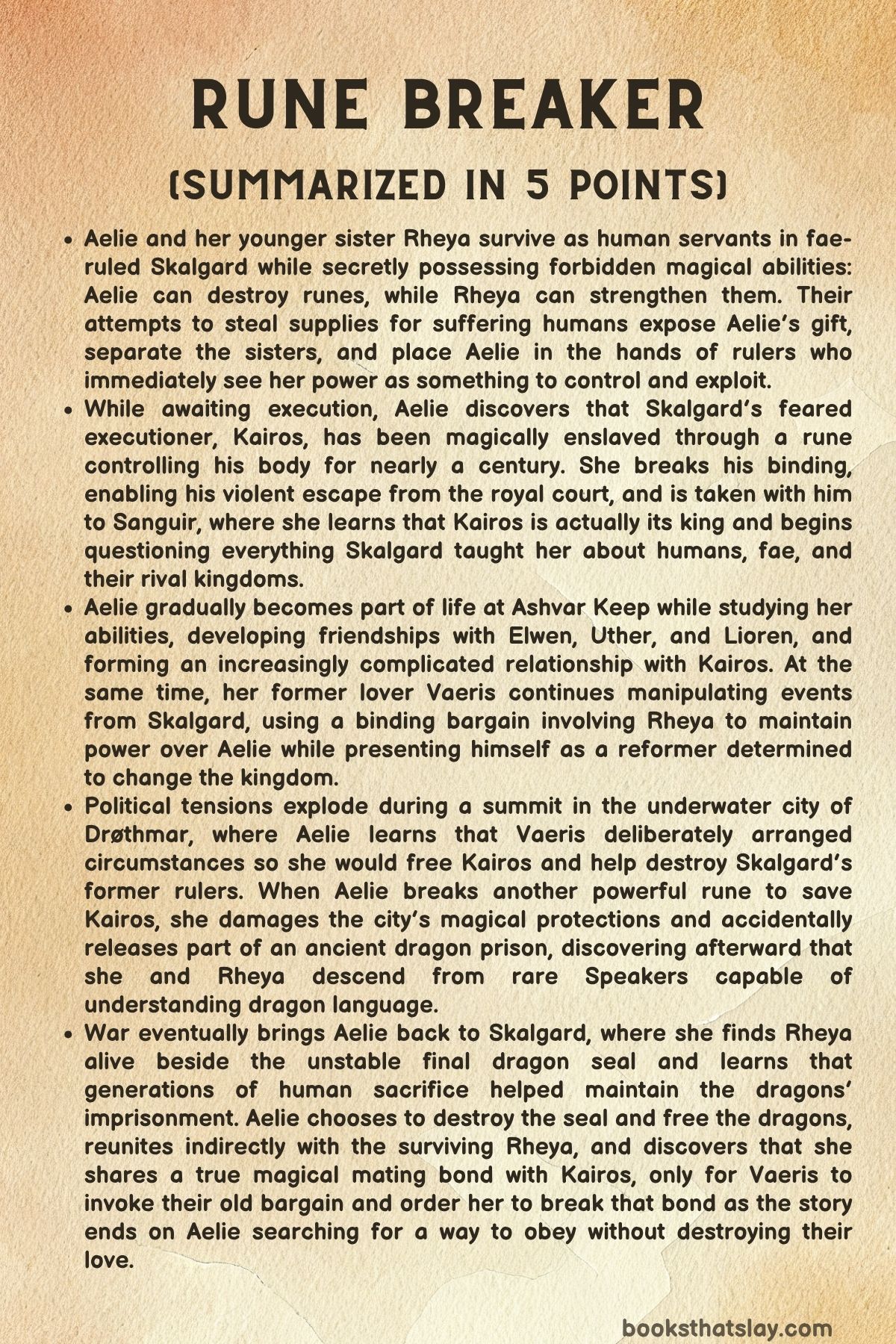
Aelie lives in Skalgard with her younger sister Rheya, where wealthy fae enjoy magical comfort while humans survive through servitude, hunger, and strict obedience. The sisters conceal extraordinary abilities that humans are not supposed to possess: Aelie can dismantle runes while Rheya can strengthen them, and they secretly use theft to obtain food, medicine, and money for suffering humans while trying to avoid the authorities.
During a robbery at Arathi Manor, Aelie discovers evidence suggesting that powerful fae have experimented with barrenness runes and human population control. Their escape attracts dangerous attention, including that of the king’s executioner, who recognizes Aelie as a thief but inexplicably lets her go, while Crown Prince Vaeris soon enters her employer’s home and reopens the pain of the secret romantic relationship he once shared with her.
Aelie learns that protective runes throughout the realm are disappearing and that Vaeris has concealed the fact that he witnessed her destroying one. Realizing that the authorities are getting dangerously close to discovering her ability, she and Rheya prepare to flee, but an Arathi steward identifies Aelie as one of the thieves and Runecloaks arrive before the sisters can escape.
Henrik, Aelie’s employer, tries to enter her mind and uncover the truth, but the executioner secretly disrupts the interrogation by destroying a light rune. Soon afterward Aelie breaks the rune protecting a stolen mirror, and when the resulting destruction forces the sisters to flee across Skalgard, Aelie destroys the storm gate in desperation, unleashing a flood that separates her from Rheya and leaves Aelie captured.
Inside the Arcanum and later the palace dungeon, Aelie is tortured and interrogated while Henrik considers turning her into a living weapon for the Crown. Vaeris finally visits her and admits that his political power is weaker than she imagined, but Aelie refuses to trust him without protection, forcing him into a binding bargain requiring him to find Rheya and keep her safe while obligating Aelie, if she survives, to break a rune of his choosing.
As Aelie is taken toward execution, she discovers that the feared executioner is himself enslaved by a rune attached to his gauntlet. During the private execution before King Vaeron, Queen Livia, Henrik, and members of the court, the executioner deliberately signals Aelie toward that rune, and she destroys it moments before he can kill her.
Freedom releases decades of suppressed rage in the executioner, who kills Henrik, Vaeron, Livia, guards, clerics, and nobles before taking Aelie from the palace. His behavior confuses her because his capacity for brutal violence exists beside unexpected care: he heals her burned hand, refuses to let her return to certain death, and carries her through a magical passage into the warmer lands beyond Skalgard.
Aelie eventually learns that his name is Kairos and that he belongs to Sanguir, a realm she has been taught to fear. Their journey gradually exposes the propaganda both sides have absorbed, and after Aelie chooses not to abandon an injured Kairos following a fellcat attack, their relationship begins shifting from hostility toward reluctant trust.
At Ashvar Keep, Aelie discovers that Kairos is not merely a warrior but the king of Sanguir, and that the rune she broke had enslaved him to Skaldir for roughly a century. Kairos offers her security and a place in his realm, while Aelie explores Sanguir’s library, meets Elwen, Uther, and Lioren, and begins learning that her abilities may be far more significant than she previously understood.
Her importance becomes increasingly political as Sanguir’s leaders question whether Kairos is placing one human above his kingdom. Tests confirm that Aelie can destroy several kinds of runes, though doing so badly injures her, and Kairos surprises her by stopping the experiments rather than accepting her suffering as the natural price of her usefulness.
Meanwhile, the bargain with Vaeris begins darkening and tightening inside Aelie’s body. As she and Kairos grow closer during celebrations, training, arguments, escape attempts, and moments of genuine vulnerability, Aelie increasingly recognizes that Sanguir has started to feel like somewhere she might choose to remain, even though Rheya and the bargain still bind her emotionally and magically to Skalgard.
A diplomatic summit in the underwater city of Drøthmar gives Aelie the chance to confront Vaeris while she and Kairos publicly pretend to be lovers to conceal her strategic importance. There she learns that Vaeris deliberately allowed her imprisonment beside Kairos because he expected her to free the executioner, destroy the old royal court, and clear the way for Vaeris to take the throne without appearing responsible.
Vaeris also reveals that Rheya is alive but refuses to reunite the sisters, using her as leverage while insisting he fulfilled the precise terms of their bargain. When Kairos reacts violently to Vaeris restraining Aelie, the summit oath begins killing him, so Aelie destroys the oath rune to save him, accidentally damaging Drøthmar’s interconnected magical systems and causing the underwater palace to flood and collapse.
Pulled into a strange realm called Myndra, Aelie encounters the ancient dragon Tazurel, who calls her Aelithra, forces her to kneel through magical punishment, and reveals that the rune beneath Drøthmar was one of two seals imprisoning the dragons. He commands her to return to Vaeris and break the remaining seal, making clear that her gift has become essential to the possible restoration of creatures once worshipped as gods.
After Kairos rescues Aelie from the sea, they return toward Sanguir while acknowledging that their connection has become more than political necessity. Back at Ashvar Keep, Lioren determines that Aelie descends from the ancient Speakers, people born from dragon and fae blood who could understand true dragon speech, and the discovery suggests that her ancestry explains both her unusual relationship with runes and Tazurel’s ability to communicate directly with her.
War spreads as Vaeris attacks Sanguir settlements, and Aelie enters a forbidden time rune that has frozen the village of Vaelrith along with everyone inside it. She recognizes an illusion of Rheya as a psychological weapon, breaks the rune despite suffering devastating internal damage, and saves the village, further convincing Sanguir’s people that her ability can represent liberation rather than destruction.
Aelie and Kairos become increasingly open about their feelings, particularly after she learns that Kairos has preserved the names and ages of the people he was forced to execute during his century of enslavement. They eventually admit their love for one another, while Aelie’s research leads her to conclude that the Rite of human sacrifice in Skalgard may actually have supplied the blood required to maintain the second dragon seal beneath the city.
A small Sanguir force heads toward Skalgard, but Tazurel punishes Aelie for disobedience by killing Barra and other warriors in dragonfire. The survivors continue through Wraithspine Ridge, and when they finally reach Skalgard, Aelie destroys the enormous gate rune and returns to the city she spent her entire life trying to escape.
In the Square, Aelie finds Rheya alive beside Vaeris and discovers her sister is using her amplification ability on the final dragon seal. The ground collapses, Rheya falls into the opening toward Myndra, and although Kairos and Vaeris try to save her, she disappears into the abyss; Uther immediately jumps after her.
Because Vaeris remains alive under the bargain requiring Rheya’s protection, Aelie concludes that Rheya must still be alive inside Myndra. Refusing to preserve a system that has demanded generations of human sacrifice, Aelie chooses to break the final seal with Kairos supporting her right to decide, and the destruction releases the imprisoned dragons into the world.
Tazurel heals Aelie and confirms that Rheya and Uther survived, while Aelie immediately uses the reward she is offered to protect the people she loves instead of seeking personal power. He also identifies Aelie as Kairos’s mate and future queen, but before she can fully process that revelation, Vaeris captures her again in ruined Skalgard.
Vaeris recognizes the new golden-crimson pattern on Aelie’s body as a genuine mating bond connecting her to Kairos. He then invokes the dungeon bargain and orders Aelie to fulfill her promise by breaking one rune of his choosing: the bond itself.
The bargain forces Aelie to search through the magical connection, where she experiences fragments of Kairos’s life, suffering, memories, and love. Instead of destroying the deepest strands that bind them emotionally, she identifies a smaller thread responsible only for carrying their thoughts across distance and realizes that Vaeris demanded she break a rune without specifying how much of it she must destroy, ending the story with Aelie pulling at that single thread after she and Kairos tell each other they love one another.
Characters
Aelie
At the center of Rune Breaker, Aelie is defined by a constant conflict between survival and responsibility. She has every practical reason to protect herself, yet from the beginning she repeatedly accepts danger to obtain medicine for humans, care for abandoned children, protect Rheya, dismantle cruel magic, and later free people suffering under unwanted runes.
Her greatest strength is not simply her ability to destroy runes but her refusal to accept permanence as a moral argument. Kings, clerics, warriors, and scholars repeatedly tell her that certain magical arrangements cannot or should not be challenged, while Aelie instinctively asks who benefits from those arrangements and who is paying for them.
This compassion can also become self-destructive. Aelie often treats her own body as a resource she is entitled to spend for other people, and Kairos repeatedly challenges the belief that saving others requires her to regard her own suffering as unimportant.
Her emotional development is equally important. Vaeris teaches her that affection without equality can still become exploitation, while Kairos gradually forces her to consider the possibility that love can coexist with disagreement, boundaries, and genuine choice.
Aelie also changes politically. She begins as a servant stealing small amounts from the powerful, but by the later events she is confronting kings, negotiating with dragons, deciding the fate of ancient seals, and influencing the future of entire realms.
Even with that growth, her motivations remain deeply personal. She wants Rheya safe, wants ordinary people to live without magical chains, and wants enough control over her own life to decide what risks, relationships, and responsibilities she is willing to accept.
Kairos
Within Rune Breaker, Kairos first appears as an almost mythic figure of terror: Skalgard’s executioner, a pale-haired killer associated with obedience, blood, and death. The discovery that his gauntlet contains a rune controlling his body transforms that image, revealing that the feared instrument of royal violence has himself endured about a century of magical enslavement.
Freedom does not instantly make him gentle. His slaughter of Skalgard’s rulers shows that anger, vengeance, and violence have become deeply embedded survival responses, and Kairos openly admits that he enjoyed killing some of the people responsible for his captivity.
Yet the book steadily separates capacity for violence from cruelty as a moral identity. Kairos heals Aelie, protects her when he could exploit her, stops experiments when they become dangerous, remembers the victims he was forced to execute, helps refugees despite military urgency, and repeatedly reveals that the executioner persona concealed a man who still understood mercy.
His flaws are strongly connected to control. Having spent a century powerless, Kairos responds to fear by trying to control situations around Aelie, sometimes violating her privacy or deciding what dangers she should be permitted to face.
His growth therefore requires him to understand that protection without choice can reproduce the structure of captivity. He does not completely abandon his possessiveness, but he gradually becomes more capable of supporting Aelie’s decisions even when those decisions terrify him.
His relationship with Aelie restores his ability to imagine a future rather than merely revenge. By the time he admits his love, warmth, food, laughter, exploration, and companionship have become as important to him as defeating enemies, suggesting that his deepest liberation is emotional rather than merely political.
Rheya
Rheya is the emotional axis of Rune Breaker because almost every major decision Aelie makes is affected by her younger sister. The sisters begin as partners in theft and resistance, with Rheya using her rare ability to amplify runes while Aelie destroys them.
Rheya is bolder and more impulsive than Aelie, particularly when she advocates stealing horses and fleeing Skalgard immediately. Her recklessness nevertheless exists beside fierce loyalty, and the sisters’ partnership gives both of them courage they would struggle to maintain alone.
Her disappearance after the storm-gate flood changes her narrative function. For much of the story Rheya is physically absent but emotionally present, becoming the standard against which Aelie measures every political bargain, romantic attachment, and opportunity for safety.
Vaeris’s treatment of Rheya demonstrates his understanding of Aelie’s greatest vulnerability. By fulfilling the literal requirement to keep Rheya alive while refusing to reunite the sisters, he turns affection itself into leverage.
The later discovery that Rheya can also hear dragon speech makes clear that she is not merely someone waiting to be rescued. She shares the Speaker bloodline with Aelie, and her amplification gift may make her just as important to the struggle over ancient magic.
Her disappearance into Myndra, followed by Uther’s immediate pursuit, opens a new path for her beyond being Aelie’s missing sister. Tazurel’s confirmation that both survive ensures Rheya remains central to whatever political and magical consequences follow the dragons’ release.
Vaeris
Vaeris is one of the most morally dangerous figures in Rune Breaker because he combines genuine emotional connection with extraordinary manipulation. His human mother and his own half-human status allow him to understand the cruelty of Skaldir’s hierarchy, yet that awareness does not prevent him from using the people harmed by the system as pieces in his political strategy.
His relationship with Aelie appears to have contained real affection, but he never grants that affection the dignity of equality. He keeps her hidden, publicly humiliates her, allows her to suffer when intervention might threaten his plans, and repeatedly decides that political necessity gives him the right to manipulate her choices.
His greatest betrayal is the revelation that he expected Aelie to free Kairos so the executioner would destroy the existing royal court. Vaeris therefore engineers circumstances in which both Aelie and Kairos become instruments for a regime change while he preserves enough distance to deny responsibility.
His use of faerie bargains demonstrates the difference between legality and consent. Vaeris frequently relies on exact wording to justify actions whose consequences he deliberately fails to explain, allowing him to claim technical innocence while exercising overwhelming control.
Even his reformist ambitions remain morally unstable. Ending the Rite and challenging anti-human institutions could represent progress, but his willingness to destabilize dragon seals, manipulate Rheya, threaten Sanguir, and exploit Aelie’s mating bond suggests that he increasingly sees his goals as justification for almost any method.
Vaeris is therefore not simply a rejected lover or political rival. He represents the danger of someone who can correctly identify injustice while becoming convinced that his own superior understanding entitles him to decide how everyone else must be used to correct it.
Elwen
Elwen provides one of Aelie’s earliest experiences of powerful fae authority that is not automatically humiliating or exploitative. As a healer and Kairos’s sister in all but blood, she treats Aelie according to the seriousness of her injuries rather than her human social status.
Her kindness complicates Aelie’s inherited belief that Sanguir is populated only by monsters. Elwen does not demand immediate trust, and her practical care gradually becomes part of the evidence that Aelie’s understanding of the fae realms has been shaped by Skaldir propaganda.
Elwen also functions as an independent moral force within Kairos’s circle. She rebukes Uther for magically compelling Aelie, challenges reckless behavior, cares for injured warriors regardless of pride, and refuses to treat loyalty to Kairos as a requirement to agree with everything he does.
Her past explains much of Kairos’s history because his attempt to rescue her led to the bargain that enslaved him. Elwen therefore carries complicated knowledge of the price other people have paid for her survival, even though the book never presents her as responsible for Kairos’s sacrifice.
Uther
Uther initially approaches Aelie as a security problem rather than a person. As an influential Dreadfae warrior connected with the Mountain Clan, he worries that Kairos’s interest in a mysterious human may endanger Sanguir and goes so far as to use magical compulsion to test her.
His relationship with Aelie changes once she demonstrates resilience, courage, and genuine loyalty to Sanguir’s people. Their interactions develop a teasing familiarity, but Uther never becomes merely comic relief; he remains a formidable warrior whose political concerns are often reasonable even when his methods are not.
Vaelrith creates a decisive shift in his attitude. Aelie nearly dies breaking the time rune that has trapped Uther’s family, making her willingness to risk herself for people who once distrusted her impossible for him to dismiss.
His leap into the fissure after Rheya is one of his most revealing actions. There is no time for calculation, reward, or command, suggesting that beneath his suspicion and aggressive manner lies an instinct to act when someone is in immediate danger.
Lioren
Lioren represents knowledge that has been protected from ordinary humans. As Ashvar Keep’s archivist, he begins with skepticism toward Aelie but eventually becomes essential to helping her understand runic systems, dragon history, Speaker bloodlines, and the consequences of manipulating connected magical structures.
His importance lies partly in the contrast between Skalgard and Sanguir. In Skalgard, human access to magical knowledge can mean death, while Lioren eventually allows Aelie to participate in advanced study rather than insisting that knowledge belongs only to the fae.
He is also one of the characters most capable of translating Aelie’s instincts into historical context. When he recognizes that true dragon speech can be understood only by Speakers, his scholarship changes the group’s understanding of Aelie from unexplained human anomaly to surviving descendant of a supposedly destroyed bloodline.
Tazurel
Tazurel is an ancient dragon whose first encounter with Aelie destroys any easy assumption that freeing the dragons must be morally righteous. He demands submission, inflicts pain when Aelie refuses to kneel, and speaks as someone who considers mortal beings insignificant beside his own ancient authority.
His history introduces a difficult moral contradiction. The dragons were betrayed and imprisoned, making their captivity unjust, yet Tazurel’s own behavior shows that victims of historical injustice are not automatically benevolent once freed.
He treats Aelie largely as a necessary instrument because she can destroy the seals, and his killing of Barra and other warriors demonstrates how casually he uses terror to enforce obedience. At the same time, he follows his own concept of debt by healing Aelie and granting rewards once she completes the act that frees his kind.
Tazurel therefore expands the story beyond conflicts between good and bad rulers. His presence forces Aelie to confront powers so ancient that ordinary political categories cannot contain them, while still insisting on judging those powers by what they choose to do.
Henrik
Henrik represents ordinary institutional cruelty rather than extraordinary evil. As Aelie’s employer, he benefits from a system in which human servants must obey, conceal pain, and accept invasive treatment from their social superiors.
His use of the Unburdening is particularly disturbing because it turns Aelie’s memories into property he believes he is entitled to search. The violation is not presented as an impulsive loss of control but as something Henrik can justify through authority and suspicion.
Once Aelie’s ability becomes clear, Henrik immediately thinks about political usefulness. Instead of seeing a frightened human woman in danger, he sees an opportunity to improve his own standing by delivering a rare magical asset to the Crown.
His death at Kairos’s hands is therefore connected directly to the system he helped maintain. Henrik spent years assuming magical hierarchy protected him from people like Aelie and Kairos, only to die when one of that hierarchy’s most powerful weapons becomes free.
Taryn
Taryn participates in the same household structure that keeps Aelie and Rheya subordinate. Although she is less directly violent than Henrik, she quickly supports using invasive magical methods when the sisters become suspicious.
Her role demonstrates how oppressive systems depend on more than their most openly brutal participants. Taryn benefits from human servitude, accepts its assumptions, and shows little concern for what an Unburdening might do to Aelie as long as it protects the household’s interests.
King Vaeron
King Vaeron embodies Skaldir’s ideology in its most explicit form. He declares fae dominance over humans to be divinely sanctioned, transforming political exploitation into a supposedly sacred natural order.
His treatment of Kairos further exposes his cruelty. The forced bargain, executioner role, and magical alterations imposed on Kairos demonstrate that Vaeron’s hunger for control extends even to powerful fae when enslaving them benefits the throne.
Vaeron’s death therefore carries symbolic importance beyond regime change. His fall reveals how a ruler who bases authority on unbreakable magical obedience becomes vulnerable the moment someone capable of breaking that magic appears.
Queen Livia
Queen Livia uses emotional manipulation where Vaeron prefers ideological authority. During Aelie’s execution, she offers Rheya’s safety in exchange for Aelie willingly accepting sacrifice, knowing that voluntary human death would strengthen Skalgard’s runic system.
Her approach shows sophisticated understanding of Aelie’s emotional priorities. Rather than merely threatening her, Livia attempts to make Aelie participate willingly in the system that destroys humans by turning sisterly love into the mechanism of consent.
King Soren
King Soren initially appears more flexible and observant than Skaldir’s rulers. He quickly notices that Aelie is more educated than the role of helpless human companion suggests, and Thalir’s relationship with humans is presented as complicated rather than identical to Skalgard’s direct enslavement.
Yet Soren remains committed to political systems that value stability and ancient law above individual circumstances. When Kairos breaks the summit oath, Soren enforces its traditional death penalty even though the confrontation was provoked by Vaeris’s treatment of Aelie.
His refusal to immediately surrender Aelie to Vaeris shows some independence and concern for coercion. Nevertheless, the collapse of Drøthmar demonstrates that systems built around absolute magical enforcement can become catastrophically fragile once their core assumptions fail.
King Lysander
Lysander represents Caelir’s open hostility toward Kairos and Sanguir. His wings immediately draw Aelie’s attention because Kairos bears the scars of having lost his own, creating suspicion that their political hostility is connected to older personal violence.
During Drøthmar’s destruction, Lysander quickly converts political conflict into attempted killing and declares Aelie’s death an acceptable response to the disaster. His aggression shows how easily Aelie becomes a symbolic target for rulers unwilling to distinguish between the person who broke a rune and the centuries of decisions that made an entire city dependent on it.
Queen Taressa
Queen Taressa of Lunir has a comparatively limited direct role, but her presence at the summit establishes Lunir as one of the major powers whose response could determine the balance of the coming conflict. Her neutrality therefore carries strategic importance even though the available material provides relatively little information about her personality.
Later reports that Lunir may impose consequences after Drøthmar’s destruction reinforce her kingdom’s importance. Taressa functions primarily as evidence that Aelie and Kairos’s actions have consequences far beyond the personal rivalry with Vaeris.
Brisa
Brisa is connected with the foundlings hall and infirmary that Aelie has quietly supported with stolen money and supplies. Her presence helps establish the network of ordinary humans whose survival motivates Aelie’s crimes and reinforces that Aelie’s resistance existed long before kings began competing over her abilities.
Although Brisa is not developed extensively as an individual, she represents the community Aelie fears abandoning. Leaving Skalgard therefore carries guilt because escape means separating herself from people who depend on the small acts of support she has been able to provide.
Kavi
Kavi is a young orphan who adores Aelie and receives a carved hawk from her before she attempts to leave Skalgard. His innocence gives personal scale to the broader suffering of humans under fae rule.
Aelie cannot explain why she is leaving because knowing too much could place him in danger. Her goodbye to Kavi emphasizes that escape from oppression is rarely emotionally simple when the person escaping must leave vulnerable people behind.
Madam Cass
Madam Cass operates as a practical connection between Aelie’s thefts and the underground economy of Skalgard. She has fenced stolen goods for the sisters before and understands enough about the city’s danger to recognize when their situation has become unusually serious.
She occupies a morally complicated space outside respectable fae authority. Her establishment provides temporary shelter and information, showing that people surviving at the edges of Skalgard’s system develop their own informal networks of trade, secrecy, and mutual assistance.
Barra
Barra first appears as a warrior who has spent years magically bound to a cursed sword. Aelie frees her without demanding payment, turning a personal act of assistance into a public demonstration of what rune-breaking can mean for Sanguir’s people.
Her later decision to join the mission to Skalgard reflects that gratitude. Barra becomes one of the people whose loyalty to Aelie has been earned directly through liberation rather than rank or command.
Her death at Tazurel’s hands is especially painful because it demonstrates the dragon’s willingness to punish Aelie by killing people around her. Barra’s fate turns Tazurel’s threats from abstract danger into irreversible personal loss.
Thessia
Thessia helps prepare Aelie for the diplomatic summit, where clothing and appearance function as political armor. Her participation shows how Sanguir understands presentation as part of warfare when rival courts are searching for weakness, coercion, or strategic information.
The available material gives Thessia little independent development beyond this function. Even so, she contributes to the wider sense that Aelie is gradually being incorporated into a court community rather than remaining entirely isolated beside Kairos.
Torvin
Torvin is one of the trusted companions who joins the strike force heading toward Skalgard once the location of the second dragon seal becomes clear. His inclusion indicates that Kairos chooses a relatively small group for a mission where trust matters more than overwhelming military numbers.
The available material provides limited individual characterization for Torvin. His main narrative role is as part of the collective of Sanguir warriors willing to accompany Aelie into an operation whose consequences could affect every realm.
Bastian
Bastian is a Skaldir scout captured near the approach to Skalgard. Through his interrogation, Kairos and the others learn that Vaeris has kept relatively few soldiers inside the city while positioning most of his forces outside, suggesting that the military arrangement is part of a larger trap.
His death also reveals something important about Kairos. Aelie notices Kairos’s hand trembling afterward and understands that his ritual of cleaning his blade is a coping mechanism rather than evidence that killing has become emotionally meaningless to him.
The High Cleric
The High Cleric represents the religious and magical institution supporting Skaldir’s hierarchy. Henrik believes Aelie could be kept alive, collared, studied, and exploited if the High Cleric can be persuaded that her unusual ability is useful enough to preserve.
The institution is also connected with the magical torture that placed a spirit inside Kairos and expanded his destructive abilities. Through this figure, spiritual authority becomes inseparable from political control, experimentation, and the justification of suffering.
Lord Arathi’s Steward
The steward plays a brief but decisive role when he recognizes the scent Aelie picked up inside Arathi Manor and correctly concludes that she was involved in the robbery. His recognition turns the sisters’ careful escape preparations into an immediate emergency.
He illustrates how vulnerable Aelie and Rheya remain even when they are clever. Their entire secret life can collapse because of one remembered sensory detail, reinforcing how little security humans possess inside Skalgard’s social order.
Themes
Oppression, Power, and the Right to Resist
In Rune Breaker, power is repeatedly presented as something that survives by convincing people its structures are natural, sacred, or impossible to change. Skalgard’s rulers claim that fae dominance over humans reflects divine intention, servant bracelets turn obedience into magical law, the Rite normalizes human sacrifice, and restricted access to education prevents humans from gaining the knowledge necessary to question these systems.
Aelie’s gift is therefore threatening for reasons far beyond physical destruction. Every time she breaks a rune, she proves that an arrangement declared permanent can be dismantled, whether that arrangement controls a servant, binds Kairos to execution, traps Barra to a weapon, freezes Vaelrith, enforces a summit oath, or seals dragons beneath the world.
The story also refuses to make resistance morally simple. Breaking oppressive systems can release consequences that no individual fully understands, as shown by Drøthmar’s destruction and the return of the dragons.
That complexity does not become an argument for preserving injustice forever. Instead, the book asks whether stability has moral value when maintaining it requires continued sacrifice from people who never consented to the arrangement, and Aelie repeatedly answers that inherited cruelty cannot become legitimate merely because dismantling it is dangerous.
Freedom, Consent, and the Meaning of Choice
Aelie and Kairos are both shaped by forms of captivity, making freedom much more complicated than leaving a physical prison. Aelie escapes servitude in Skalgard only to discover that bargains, political expectations, romantic claims, magical obligations, fear for Rheya, and Kairos’s protectiveness can still limit her decisions.
Kairos faces the same issue from a different direction. Once the gauntlet controlling him is destroyed, he is physically free, but a century of forced obedience has trained him to associate safety with control, causing him to impose restrictions on Aelie whenever fear overwhelms his respect for her independence.
Their relationship develops when both begin separating care from authority. Aelie learns that accepting protection does not necessarily mean surrendering herself, while Kairos learns that loving someone requires allowing that person to make dangerous choices he may hate.
Vaeris offers the opposite model. He repeatedly relies on technically valid consent obtained through incomplete information, exact bargain language, emotional leverage, or unequal power, exposing how meaningless agreement can become when one person controls the conditions under which another must choose.
Love, Trust, and Possession
The contrast between Vaeris and Kairos allows the story to examine the difference between being loved and being treated as someone capable of making decisions. Vaeris may genuinely care for Aelie, but he repeatedly hides information, manipulates circumstances, and assumes that his political goals justify deciding what she must endure.
Kairos also displays possessiveness, jealousy, and controlling instincts. He reads and destroys Vaeris’s letter, limits Aelie’s movements, interferes with the risks she chooses to take, and frequently speaks about her in terms that initially sound disturbingly close to ownership.
The distinction develops through accountability. Kairos can eventually admit that jealousy motivated his actions, recognize when he has violated Aelie’s boundaries, and change his behavior, while Vaeris repeatedly insists that necessity excuses what he has done.
Aelie’s eventual love for Kairos matters because she begins choosing him only after gaining opportunities to challenge him, reject him, flee from him, bargain with him, and demand boundaries. The mating bond becomes meaningful not because magic declares ownership but because the emotional connection underneath it has been formed through decisions that both characters repeatedly make for themselves.
Sacrifice, Responsibility, and the Cost of Power
The moral structure of Rune Breaker repeatedly asks who pays when societies decide that power is worth preserving. Skalgard’s magical prosperity depends partly on human suffering, Kairos gains extraordinary abilities through torture, Aelie damages her body whenever she breaks powerful runes, and ancient political stability ultimately depends on seals maintained through generations of sacrifice.
Aelie initially accepts personal suffering almost automatically. Because she grew up in a world where human pain was considered cheap, she internalizes the belief that her body is an acceptable price whenever someone else might benefit.
Kairos challenges that belief, but the story does not simply conclude that sacrifice should always be avoided. Aelie’s decision to save Vaelrith nearly kills her, yet the restored villagers and Uther’s surviving family demonstrate that some risks genuinely matter to her and that forbidding her from taking them would deny her agency.
The deeper question concerns voluntary sacrifice versus imposed sacrifice. Kairos chooses captivity to save Elwen, Aelie chooses danger to save others, and Uther chooses to leap after Rheya, while Skalgard’s humans are given no meaningful choice about the suffering demanded from them.
The distinction becomes central when Aelie destroys the final seal. She accepts responsibility for the danger of her decision, but she refuses to continue making generations of powerless humans pay for a magical order created long before they were born.