Seek Immediate Shelter Summary, Characters and Themes
Seek Immediate Shelter by Vincent Yu is a linked collection of stories centered on the eighteen minutes when residents of Beckitt believe a ballistic missile is heading toward them.
The false alarm exposes instincts, loyalties, regrets, hidden resentments, and private fears that ordinary life had allowed the characters to conceal. Rather than focusing on the physical danger of the warning, the book examines what people reveal when they believe there may be no future in which to repair their mistakes. Across marriages, families, friendships, workplaces, illness, addiction, grief, and loneliness, the characters discover that surviving the emergency does not free them from what those eighteen minutes have shown them about themselves.
Summary
Seek Immediate Shelter begins with David Li receiving an emergency warning that a ballistic missile is approaching Beckitt. Certain that death may be only minutes away, David rushes toward the family car while his wife, Daphne, gathers their infant son Nathan and whatever supplies she can carry.
A crashing tree nearby sends David into panic. He accelerates through the garage door before it has fully opened and, more importantly, before confirming that Daphne and Nathan are with him. Eighteen minutes later, the alert is declared a mistake, but the emotional consequences cannot be canceled as easily as the warning itself.
Daphne sees David’s action as a revelation of what he does when instinct takes control: he saves himself. David cannot accept that judgment because it contradicts his understanding of himself as a loving husband and father.
He repeatedly insists that his memory is confused and begins constructing versions of the event that protect his self-image. His father, an experienced public-relations professional, encourages this approach by treating the marital crisis as a question of controlling the story rather than facing the truth.
David even attempts to demonstrate courage by confronting workers who harass Daphne, but the incident merely creates further embarrassment. Eventually, after a difficult night out, he admits privately that Daphne’s account is correct and apologizes.
His acceptance is genuine, but he still struggles to understand emotional repair without turning it into another project. He begins planning an expensive Hawaii vacation, hoping an impressive gesture can restore what his moment of panic damaged.
Elsewhere in Beckitt, Nina Chang reacts to the same missile warning by contacting her adult daughter Cate. Nina tells Cate that she loves her, but she also criticizes her for moving across the country to build a life near Shana, the woman she loves.
Nina’s husband Dean is disturbed by the message. He points out that, if the missile had actually arrived, Nina would have left their daughter with guilt and condemnation among her final memories of her mother.
His reaction forces Nina to confront the way she has always connected love with correction, sacrifice, discipline, and disappointment. Raised by demanding Chinese immigrant parents, she has learned to believe that criticism can be an expression of devotion, even when the person receiving it experiences something very different.
Nina and Dean run a music store called Major Third, but Nina’s relationship with Cate continues to weaken. Cate’s independence, sexuality, willingness to seek therapy, and refusal to structure her life according to her mother’s expectations all challenge Nina’s assumptions about family.
At the same time, Nina receives a grave medical diagnosis and begins aggressive treatment. She does not tell Cate, partly because of fear and partly because withholding painful truths has become another form of control.
Her health declines while the distance between mother and daughter remains unresolved. Cate later introduces Shana and eventually announces that the couple has adopted a two-year-old boy named Freddie.
The news that she has become a grandmother breaks through Nina’s defenses. Knowing that her time is limited, she finally tells Cate that she is dying and reduces everything she has struggled to express into a simple declaration of love. She finds comfort in knowing that Cate and Freddie will soon come to see her.
Nick Chen arrives in Beckitt in a far more dangerous emotional state. Carrying his violin, he is uncertain whether he wants to continue living at all.
Nick has long felt uncomfortable around other people because of involuntary tics and a persistent belief that social interaction exposes everything about him that seems strange. Music offers an alternative space in which he can feel competent, expressive, and whole.
His attempts to build a musical career and maintain a relationship with another musician end in disappointment. Professional hopes weaken, personal attachments fail, and the life he imagined for himself becomes harder to believe in.
Nick eventually returns to his gravely ill father. During the final stage of his father’s life, the two achieve an intimacy that had often been missing from their relationship.
His father suggests that truly being understood by another person may be the closest anyone comes to curing loneliness. Nick plays violin for him shortly before his death, creating one of the rare moments in which grief, love, and music become inseparable.
Afterward, Nick begins wandering again under the weight of bereavement. The missile warning interrupts his movement toward self-destruction, however, and unexpectedly leaves open the possibility that connection may still be available to him.
The story also turns toward teenager Rachel Yen. During the warning, her family gathers protectively around her even though Rachel has recently discovered evidence that makes her suspect her parents hid a painful reproductive decision.
Her anger does not disappear simply because they believe they might die. Yet the emergency forces her to recognize that secrets and genuine love can exist inside the same family.
Rachel begins confronting a difficult part of adulthood: learning information about one’s parents that changes childhood assumptions without necessarily erasing affection. Some knowledge cannot be forgotten, but it can become part of a more complicated understanding of the people who raised her.
The warning becomes fatal for Clare Hilldon’s husband Jacob, though not because a missile actually strikes. Jacob suffers a medical emergency while emergency services are overwhelmed by the expected attack, and assistance does not arrive in time.
His death destroys the structure around which Clare has built her adult identity. She resigns from her demanding career in public relations and finds herself without the work, partnership, and routines that once made her life feel organized.
Clare’s sister Jorie comes to stay, but grief intensifies rather than eliminates the unresolved tensions between them. Differences involving money, success, independence, and the different directions their lives have taken rise quickly to the surface.
Then Clare discovers that Jacob had been unfaithful and had created obligations outside their marriage. His betrayal alters not merely how she remembers him but how she sees herself.
If she failed to understand the person closest to her, Clare wonders what else about her supposedly stable life may have been false. Her anger becomes so consuming that she eventually directs it toward Jorie and drives her sister away.
A book about Darwin and the finches of the Galápagos gives Clare another way to interpret survival. Adaptation does not mean destroying the organism that already exists and replacing it with something entirely new; change happens through what is already there.
Clare begins applying that idea to herself. Jacob’s death, his betrayal, and her previous misconceptions remain permanent parts of her history, but they do not erase the abilities and identity she developed before them.
She starts moving toward reconciliation with Jorie and toward a future she cannot fully describe. Instead of demanding certainty before continuing, she accepts that survival may require becoming different without knowing exactly what the final form will be.
The person directly responsible for the false missile warning is Chase Sun, an employee of the Massachusetts emergency-management system. During an otherwise routine shift, exhaustion, confusing technology, inflexible procedures, and misplaced trust in instructions lead him to send the alert accidentally.
The institution quickly turns Chase into the public face of the failure. He is subjected to ridicule, racist abuse, and threats while the larger systems that made the mistake possible remain far less visible.
The crisis arrives while Chase’s relationship with Mick is already deteriorating. Chase has become disturbed by Mick’s cruel online behavior and increasingly doubtful that the future they once imagined together is a future he still wants.
He has also begun imagining a different professional life near Yosemite. Nature represents space, change, and perspective in contrast with the increasingly constricted life he experiences in Beckitt.
After the alert, Chase loses his job. Officials quietly offer him another professional opportunity on the condition that he does not challenge the public version of events, reinforcing the idea that institutions often protect themselves by simplifying responsibility.
Mick offers to go with him, but Chase realizes that accepting Mick’s presence would carry the old relationship into the new life he is trying to build. For once, the decision has to belong entirely to him.
A call from Janice provides further evidence that drastic change can lead somewhere unexpected. She has begun a new musical life with Nick, suggesting that people who appeared trapped by one identity can discover another.
Thinking about the birch trees of his childhood, Chase recognizes that adulthood offers no promise that a person can bend under pressure and then return unchanged to the original position. He chooses uncertainty, leaving Beckitt without demanding guarantees about what comes next.
Russell Zhang experiences the alert beside his wife Ruthie and their young son Miles. He shelters them in a bathtub protected by a mattress and then lies beside them because the idea of surviving without his family feels worse than dying with them.
At nearly the same moment, Russell receives a message from Milly, a woman he once met on a business trip, telling him that she has continued thinking about him. The timing awakens doubts already connected to his father’s abandonment of Russell’s family.
Once the immediate danger disappears, Russell becomes obsessed with alternative lives. He drinks more heavily and begins imagining Milly as proof that another version of himself remains available somewhere outside marriage and middle age.
He also searches for Leo, a young man who may be his half brother. Russell hopes that meeting him will finally answer whether his father abandoned one family in order to create another.
When Russell actually meets Milly, fantasy gives way to reality. She cannot provide the transformation he has projected onto her, and his attempt to make the imagined relationship real is rejected.
His behavior has already damaged his marriage badly enough that Ruthie takes Miles and asks for a temporary separation. Suddenly Russell faces the possibility of repeating his father’s history by losing the family whose presence he has taken for granted.
Meeting Leo does not provide the clean explanation Russell expected either. He is forced to live with uncertainty concerning his father rather than solving the past through one encounter.
Russell finally realizes that the missile alert had already given him the most important information about himself. When he truly believed his life was ending, he did not think about freedom, Milly, or another identity; he wanted only to remain beside Ruthie and Miles.
After Nina dies, Dean Chang must learn how to live without the woman who had occupied almost every ordinary part of his adult life. He attends a grief-support group, where he meets Quinn.
Quinn’s situation differs sharply from Dean’s because her son Alex is alive but imprisoned for causing a fatal drunk-driving accident. She loves him while also carrying guilt toward the family of the person who died.
Dean and Quinn develop a companionship founded on their ability to discuss loss without simplifying it. Dean can speak about Nina, regret, aging, and the emptiness of surviving the person with whom he shared decades.
His relationship with Cate remains complicated as well. Dean sometimes feels protective of Nina when Cate describes her critically, yet he also sees his daughter creating an independent family with Shana and Freddie.
Quinn prepares for Alex’s possible early-parole hearing and needs Dean’s presence. At the same time, Dean begins recognizing that loyalty to Nina cannot require permanent withdrawal from the living.
A visit to the abandoned Major Third store makes the finality of Nina’s absence undeniable. The shared life represented by the store cannot be restored simply by remembering it.
Then Cate calls and asks Dean to help care for Freddie. She tells him that he can stay with her and Shana for as long as necessary.
The invitation gives Dean something he has been missing: a reason to feel urgently needed. He accepts, but first makes sure he can remain beside Quinn during Alex’s hearing, showing that moving forward does not require abandoning either grief or friendship.
Grant Gao’s story presents another form of moral collapse and possible recovery. He works at Lark’s Landing, a nursing facility whose polished image hides understaffing and declining standards created by corporate pressure for higher profits.
Repeated exposure to illness and death has exhausted Grant’s original sense of responsibility. His personal life worsens when Milly ends their relationship shortly before marriage, destroying the future he believed was waiting for him.
When a nurse named Olive gives Grant unused pain medication belonging to a dead resident, the temporary escape becomes an addiction. The two begin diverting opioids from residents, binding their relationship to secrecy, dependency, and shame.
Olive still imagines that they might become sober and form some kind of family with her son Jesse. Grant cannot promise her love, stability, or even continued survival because he has lost faith in his own moral worth.
The missile warning creates a moment in which Grant can either continue surrendering to numbness or act differently. Employees flee, medication becomes a target for theft, and Olive urges him to escape with her.
Grant instead thinks about the residents who cannot rescue themselves. He defends their medication, gathers people into a protected hallway, and starts moving vulnerable residents toward the basement.
The residents call him a hero, but the moment does not erase his thefts or addiction. What changes is that Grant acts according to responsibility when responsibility is most difficult.
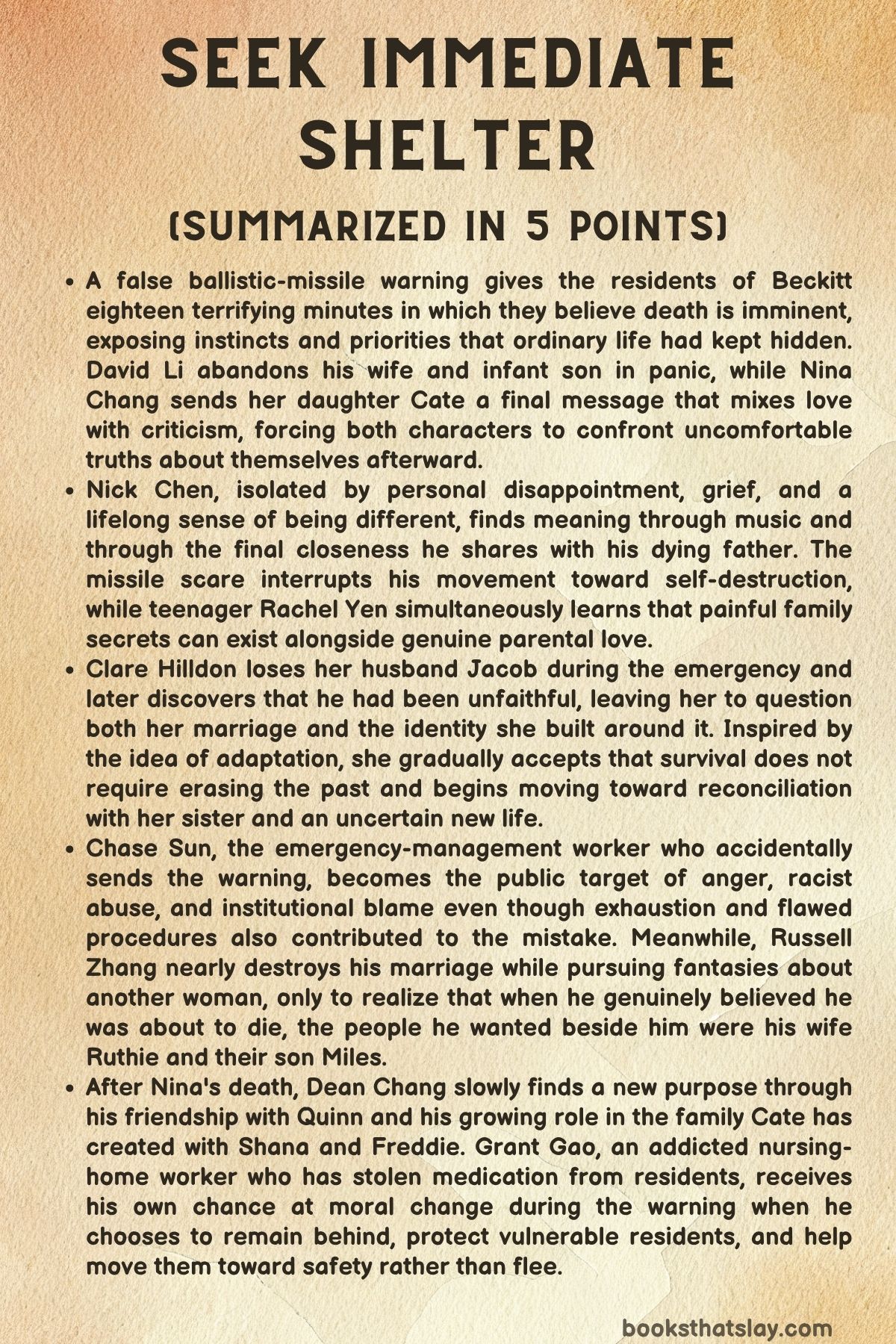
Across these connected lives, the false missile warning becomes less important as an error than as an instrument of revelation. David discovers what panic can expose, Nina confronts the cruelty mixed into her love, Nick discovers that connection may interrupt despair, Clare learns to survive without certainty, Chase chooses autonomy, Russell recognizes the family he truly values, Dean finds new usefulness after bereavement, and Grant discovers that shame does not completely remove the capacity to act well.
Survival therefore becomes only the beginning. Once the eighteen minutes are over, each character must decide whether the truth revealed under pressure will be denied, managed, accepted, or used as the starting point for change.
Characters
David Li
David is one of the clearest examples in Seek Immediate Shelter of the difference between the person someone believes himself to be and the person revealed by instinct. He sees himself as a devoted husband and father, yet his immediate response to danger is to drive away before ensuring that Daphne and Nathan are safely with him.
His most significant flaw is not simply cowardice but his resistance to honest self-knowledge. David spends considerable energy altering the interpretation of what happened because admitting the truth threatens the identity he has built around being a good family man.
Even his eventual apology contains evidence that he has not entirely changed his habits. Planning an extravagant vacation demonstrates love and remorse, but it also shows his tendency to manage emotional problems through gestures rather than remaining with the uncomfortable truth that trust must be rebuilt slowly.
Daphne
Daphne functions as the moral counterweight to David’s self-protective storytelling. She understands immediately that the false alarm has exposed something genuine about her husband, and she refuses to let the official cancellation of the warning cancel what happened between them.
Her anger is therefore about more than being temporarily left behind. David’s action forces her to question whether his stated devotion can be trusted when circumstances remove social expectations and leave only instinct.
Daphne also exposes the limits of symbolic heroism when David confronts workers who harass her. What she needs is not theatrical proof of his bravery but honesty, dependability, and recognition of the harm already done.
Nathan Li
Nathan is too young to make meaningful choices of his own, but his presence intensifies the moral significance of David’s action. As an infant entirely dependent on his parents, Nathan represents the responsibility David imagines himself fulfilling until panic tests that belief.
His vulnerability also clarifies Daphne’s position. She is not merely judging David as a disappointed spouse; she is evaluating whether the person beside her can be relied upon when their child’s safety depends on him.
Nina Chang
Nina is among the most complicated figures in Seek Immediate Shelter because her love for Cate is sincere even when it becomes controlling and hurtful. Her response to the missile warning exposes a lifelong habit of combining affection with criticism, as though love becomes legitimate only when accompanied by correction.
Her upbringing helps explain this pattern without excusing it. Nina has inherited an understanding of family in which sacrifice, duty, discipline, and disappointment exist beside genuine care, and she reproduces that emotional structure with her own daughter.
Illness gradually removes Nina’s ability to hide behind authority. Becoming a grandmother and confronting death finally reduces her relationship with Cate to what has always existed beneath the arguments: love, fear of separation, and a desire to remain part of her daughter’s life.
Dean Chang
Dean often sees the emotional consequences that Nina cannot initially recognize. His criticism of her final-message-to-Cate exposes his moral clarity: love cannot justify leaving another person burdened by shame merely because the criticism comes from a parent.
After Nina’s death, however, Dean becomes more vulnerable and less certain. He must balance loyalty to his memories of his wife with Cate’s right to interpret her own relationship with her mother differently.
His friendship with Quinn and eventual decision to help raise Freddie show meaningful development. Dean learns that continuing to love the dead does not require removing himself from the needs of the living.
Cate
Cate embodies independence earned through conflict. Moving across the country, forming a life with Shana, attending therapy, and creating a family on her own terms all challenge Nina’s expectation that closeness should include obedience.
Her difficult relationship with Nina does not mean that she lacks love for her mother. Instead, Cate demonstrates that maintaining emotional boundaries can be necessary precisely because a relationship matters.
By eventually bringing Shana and Freddie fully into the family, Cate creates the possibility of a larger definition of belonging. Her later invitation to Dean also shows that independence has not eliminated her desire for intergenerational connection.
Shana
Shana is important because her relationship with Cate becomes one of the clearest symbols of the life Cate has chosen for herself. Nina initially experiences that choice as distance and rejection, but Shana’s presence eventually becomes inseparable from the new family Nina must learn to recognize.
Shana is not presented as someone who needs to defeat Nina or compete for Cate’s loyalty. Instead, her place beside Cate shows that adult love can expand a family even when older members initially interpret change as loss.
Freddie
Freddie’s arrival changes the emotional direction of the Chang family. His adoption makes Nina a grandmother at the moment when illness has made time especially precious, breaking through defenses that years of argument could not remove.
He also becomes part of Dean’s recovery after Nina dies. Caring for Freddie gives Dean a renewed role in family life and turns the future from an abstract continuation into something that actively needs his presence.
Nick Chen
Nick is a character shaped by alienation, artistic identity, grief, and the desire to be understood. His involuntary tics contribute to his sense that social contact exposes him, while music provides a language through which he can experience competence without constantly monitoring how others perceive him.
The failure of his professional and personal hopes intensifies his loneliness until continuing to live itself becomes uncertain. His father’s final insight about understanding gives Nick a different measure of what a meaningful life might contain.
The warning unexpectedly interrupts his movement toward self-destruction. Nick’s later connection with Janice suggests that survival becomes possible not because his pain disappears, but because isolation is no longer absolute.
Nick’s Father
Nick’s father becomes emotionally important during the last stage of his life. Their relationship appears to have lacked consistent intimacy, but approaching death allows them to reach a closeness that ordinary life had often prevented.
His observation that being understood may be the closest cure for loneliness gives the book one of its clearest statements about human connection. Nick’s final act of playing violin for him transforms music from professional ambition into a form of communication between father and son.
Rachel Yen
Rachel represents the painful transition from seeing parents as unquestioned authorities to recognizing them as imperfect adults capable of secrecy. Her discovery concerning a concealed reproductive decision makes her feel that important parts of her own family history have been withheld from her.
The warning does not resolve her anger, but it forces her to hold anger and love at the same time. Her parents’ instinctive effort to protect her becomes evidence that people can make choices that damage trust while still caring deeply.
Rachel’s Parents
Rachel’s parents are defined through the tension between concealment and protection. Whatever their reasons for hiding the reproductive decision, the secrecy has consequences because Rachel experiences it as information connected to her own identity and family history.
During the emergency, however, their immediate focus is Rachel’s safety. Their actions prevent the story from reducing them either to deceptive parents or selfless protectors; they can be both loving and responsible for choices their daughter may struggle to forgive.
Clare Hilldon
Clare begins as someone whose identity has been structured by work, marriage, competence, and predictability. Jacob’s sudden death destroys those supports almost simultaneously, leaving her without the external structures through which she understood herself.
The discovery of his infidelity makes grief more difficult because Clare cannot even preserve an uncomplicated memory of the person she lost. She must mourn Jacob while also becoming angry with him and questioning her own judgment.
Her eventual insight about adaptation allows her to imagine change without treating her earlier life as meaningless. She cannot return to who she was, but she does not have to become an entirely different person either.
Jacob
Jacob’s death is central to Clare’s transformation, but his later-discovered infidelity prevents him from becoming an idealized dead husband. His betrayal forces Clare to recognize that love and deception existed inside the same marriage.
Because he is dead, Clare cannot confront him, receive an explanation, or decide what forgiveness might look like through conversation. His absence therefore makes the betrayal harder to process, since every answer must be constructed without him.
Jorie
Jorie provides Clare with an important relationship outside marriage, but the sisters carry years of resentment involving money, success, and independence. Her attempt to support Clare brings those differences into close proximity at the worst possible time.
When Clare drives her away, Jorie’s absence helps expose how grief can become destructive when pain is redirected toward available targets. Clare’s later movement toward reconciliation suggests that sisterhood can survive conflict if both women allow the relationship to change.
Chase Sun
Chase occupies the center of the institutional failure in Seek Immediate Shelter, yet the book carefully separates individual error from collective responsibility. He sends the alert, but exhaustion, confusing systems, procedural rigidity, and organizational weaknesses all contribute to the mistake.
The public nevertheless needs a recognizable person to blame, and Chase becomes that figure. Racist abuse and threats reveal how quickly legitimate anger about a mistake can transform into dehumanization.
His relationship with Mick presents a more private version of the same question about responsibility. Chase eventually realizes that he cannot begin a new life while continuing to carry a relationship he no longer believes in simply because leaving feels difficult.
Mick
Mick represents the life Chase is gradually outgrowing. His online cruelty troubles Chase because it reveals values that Chase no longer wants to tolerate simply for the sake of maintaining a relationship.
Mick’s offer to accompany Chase might appear supportive, but accepting it would allow Chase to avoid making a truly independent decision. Chase’s refusal marks the point at which affection and history stop being sufficient reasons to continue a future that no longer fits.
Janice
Janice appears briefly but provides an important example of unexpected reinvention. Her new musical life with Nick gives Chase evidence that radical change does not necessarily lead only to loss.
She therefore functions as a living counterargument to the fear that leaving familiar structures guarantees emptiness. Her transformation helps Chase imagine a future that does not need to resemble his past.
Russell Zhang
Russell is caught between genuine devotion to his family and a persistent fascination with lives he did not choose. During the missile alert, his instinct is completely clear: he would rather die beside Ruthie and Miles than survive without them.
Afterward, however, Milly’s message awakens his dissatisfaction and allows fantasy to compete with what the emergency revealed. He begins treating another woman and another possible family history as routes toward a more exciting identity.
His eventual crisis exposes the danger of valuing imagined alternatives more highly than actual relationships. Russell’s growth begins when he stops demanding certainty about every road not taken and takes seriously the family he already possesses.
Ruthie
Ruthie represents the real life Russell risks sacrificing while chasing imagined possibilities. Her presence during the emergency demonstrates the depth of Russell’s attachment to her, yet his later behavior shows that knowing whom one loves does not automatically prevent selfish choices.
Her decision to take Miles and demand separation gives Russell’s actions consequences. Rather than remaining a passive object of his eventual realization, Ruthie asserts that love cannot survive indefinitely without trust and accountability.
Miles
Miles intensifies Russell’s conflict with his father’s legacy. Russell knows what parental abandonment feels like, making the possibility that his own choices could destabilize Miles’s childhood particularly significant.
During the warning, Miles is part of the family unit Russell instinctively chooses above everything else. His presence turns Russell’s marital crisis into an intergenerational question about whether people repeat the injuries they once condemned.
Milly
Milly serves different functions in the lives of Russell and Grant. For Russell, she becomes an imagined doorway into a life of freedom and romantic possibility, although the actual encounter cannot sustain the meaning he has projected onto her.
For Grant, her decision to end their relationship shortly before marriage contributes to the collapse of the future he expected. In both cases, Milly becomes associated with male characters confronting the gap between imagined futures and realities they cannot control.
Leo
Leo becomes the focus of Russell’s attempt to solve the mystery of his father’s abandonment. Russell hopes that discovering a half brother will provide a clear explanation for whether his father simply replaced one family with another.
Meeting Leo cannot provide that certainty. His importance lies partly in forcing Russell to accept that another human being cannot be reduced to evidence in an old family investigation.
Russell’s Father
Russell’s father exerts influence largely through absence. His abandonment becomes the model Russell fears repeating and the unresolved event Russell continues trying to understand long after childhood.
Because no perfect explanation is available, his absence also teaches Russell an uncomfortable lesson about uncertainty. A person may have to decide how to live without ever receiving enough information to make the past fully coherent.
Quinn
Quinn is one of the most morally complicated supporting figures because her grief concerns a child who is still alive. Her son Alex caused another person’s death while driving drunk, placing her in the painful position of loving him while understanding the irreversible harm he caused.
Her friendship with Dean is meaningful because neither can solve the other’s suffering. They provide companionship rather than answers, allowing regret, anger, guilt, hope, and affection to exist without demanding that one emotion cancel another.
Alex
Alex exists at the center of a moral conflict involving responsibility, punishment, family love, and possible rehabilitation. His fatal drunk-driving offense cannot be undone, yet his possible early parole raises the question of whether wrongdoing should define the entirety of a person’s remaining life.
Through Alex, the story also examines the burden carried by relatives of people who have caused serious harm. Quinn’s love for her son remains real even when she cannot deny what he did.
Grant Gao
Grant’s journey in Seek Immediate Shelter asks whether a person who has committed serious wrongdoing can still make a morally meaningful choice. Working inside a failing nursing facility has numbed him, while Milly’s departure and opioid addiction deepen his sense that his life has moved beyond repair.
His theft of medication from vulnerable residents represents a genuine violation of responsibility. Grant knows this, and his shame becomes so severe that he begins treating himself as someone who no longer deserves or can produce anything good.
The missile alert challenges that belief. By protecting the residents and organizing their movement toward safety, Grant does not erase his previous actions, but he demonstrates that moral failure and moral capacity can continue to exist inside the same person.
Olive
Olive is both Grant’s companion and his partner in addiction. Their relationship is formed partly through shared intoxication, secrecy, and the diversion of medication, making it difficult to separate intimacy from mutual self-destruction.
Yet Olive still imagines sobriety and a possible family life with Grant and Jesse. Her hope reveals that she has not completely surrendered to addiction, even though her desire to flee during the missile warning contrasts sharply with Grant’s sudden decision to remain responsible for the residents.
Jesse
Jesse represents the stable future Olive wants but cannot currently provide. As her son, he makes the consequences of her addiction larger than her individual suffering.
He also becomes part of the family life she imagines with Grant. Grant’s inability to promise stability therefore reflects not only uncertainty about romance but his awareness that joining Olive and Jesse would require a level of responsibility he does not yet trust himself to sustain.
Themes
Crisis as a Revelation of Character
The false missile warning functions as a test that removes the comforting assumption that there will always be time to explain, improve, apologize, or reconsider. In Seek Immediate Shelter, characters who believe death is minutes away respond before they can construct respectable versions of themselves, and those responses frequently reveal priorities they later struggle to accept.
David’s instinct to drive away without Daphne and Nathan becomes more important than the physical danger because it contradicts his preferred image of himself. Russell’s behavior produces the opposite revelation: despite his later fascination with Milly and alternative lives, he instinctively chooses to remain beside Ruthie and Miles when he believes the end is coming.
Nina’s message to Cate exposes another kind of truth. Even when Nina thinks she is composing her final words, criticism remains mixed with love, revealing how deeply judgment has become embedded in her understanding of motherhood.
Grant’s reaction creates still another possibility. A man who has been stealing medication from vulnerable residents unexpectedly chooses to protect them when institutional order collapses, showing that a moment of crisis can expose moral capacity as well as weakness.
The theme therefore rejects the idea that emergencies simply reveal whether someone is good or bad. They reveal contradictions, impulses, loyalties, fears, and values that ordinary life gives people more time to disguise.
Love, Responsibility, and the Limits of Good Intentions
Many characters sincerely love the people they hurt. The tension between intention and consequence becomes especially visible in families, where affection is often used to justify control, concealment, criticism, or avoidance.
Nina believes her demands on Cate arise from concern, sacrifice, and parental responsibility. Cate experiences those same behaviors as restrictions on her independence, identity, and right to create an adult life according to her own values.
David also believes he loves Daphne and Nathan deeply, and nothing in his later behavior suggests that this love is false. The problem is that affection cannot erase the fact that his first reaction to danger was self-preservation, nor can an expensive vacation substitute for rebuilding trust.
Rachel’s parents provide a quieter version of the same conflict. Their concealment of an important reproductive decision appears to have been compatible, in their minds, with protecting their daughter, yet Rachel experiences the secrecy as a rupture in her understanding of her family.
Russell discovers that loving Ruthie and Miles does not protect them from damage caused by his drinking and fantasies of another life. Across these relationships, responsibility requires more than feeling love; it requires accepting that other people experience one’s choices independently of one’s intentions.
Adaptation, Reinvention, and Uncertain Futures
Change throughout Seek Immediate Shelter rarely arrives because a character confidently chooses a new direction. More often, an old structure collapses first, forcing the person to continue without guarantees about what should replace it.
Clare’s reading about Darwin and the Galápagos finches gives this process its clearest metaphor. Adaptation does not require erasing everything that already exists; it involves responding to altered conditions using whatever qualities remain available.
Clare therefore does not need to discard her entire identity because Jacob died and betrayed her. Chase likewise cannot undo the alert, the loss of his job, or the failure of his relationship with Mick, but he can decide whether those events become reasons to remain trapped or reasons to choose differently.
Dean’s later life offers a quieter form of reinvention. He cannot replace Nina, but caring for Freddie gives him a role that belongs to the future rather than only to memory.
Nick’s connection with Janice also suggests that a person can emerge from despair into a life that would previously have seemed unimaginable. None of these transformations guarantees happiness, and that uncertainty is essential to the theme: adaptation means continuing before the destination is known.
Guilt, Forgiveness, and the Possibility of Moral Repair
The book repeatedly asks what should happen after a person does something that cannot simply be taken back. The answers resist both easy absolution and permanent condemnation.
David’s abandonment of his family lasts only moments, yet its psychological meaning remains after the threat disappears. His eventual apology matters because he finally stops rewriting the event, but acknowledging the truth does not automatically restore Daphne’s trust.
Grant’s wrongdoing is more severe. He has participated in stealing medication from vulnerable residents, and his later heroism cannot erase those actions; nevertheless, his decision to protect the residents demonstrates that wrongdoing does not eliminate every possibility of ethical action.
Quinn’s situation extends the question beyond the person who caused harm. She must decide how to love Alex after his drunk driving killed another person, while also respecting the suffering of the victim’s family and confronting the moral complexity of his possible release.
Russell faces a more domestic form of accountability when Ruthie leaves with Miles. His realization that he values his family is only the beginning, because understanding one’s mistake is different from repairing the damage it caused.
Forgiveness in these stories is therefore not presented as forgetting, excusing, or returning to an earlier condition. Moral repair begins with accurate recognition of harm and continues through choices made after that recognition, even when complete restoration is impossible.