She Who Remains Summary, Characters and Themes
She Who Remains by Rene Karabash is a literary novel about identity, family loyalty, inherited violence, forbidden love, and the complicated meaning of survival.
At its center is Matija, born Bekija, who becomes a sworn virgin under the Kanun and assumes a masculine social role after refusing an arranged marriage. What first appears to be a story of escape gradually becomes an examination of the lives harmed by that escape and the secrets that shaped it. Through family memories, hidden letters, and recovered truths, the novel asks whether a person can outlive the rules that formed them without continuing to carry those rules inside.
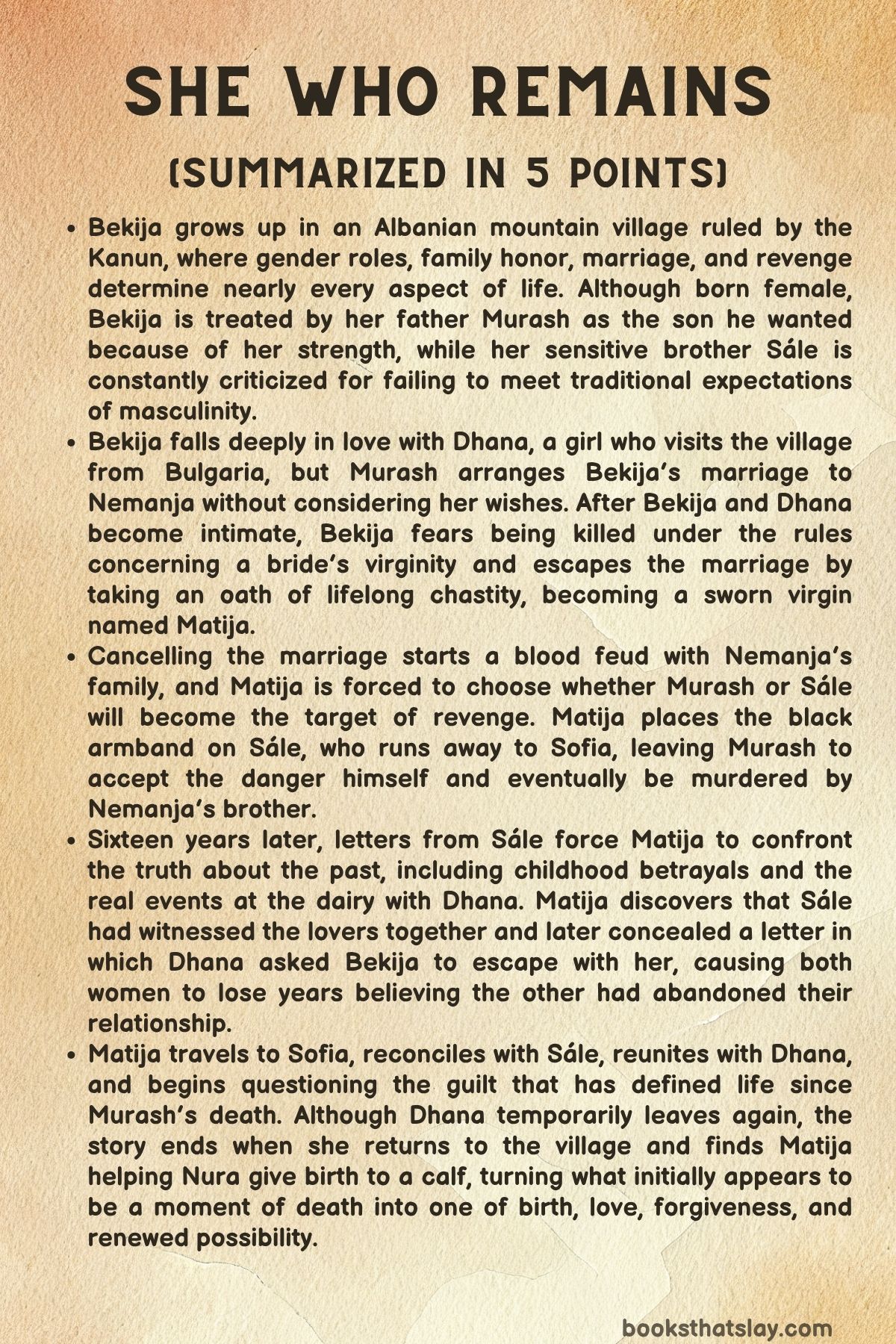
Summary
Matija lives almost alone in an Albanian mountain village, caring for a cow named Nura and the pigeons once kept by Murash, the father whose death still defines the household. When a journalist comes to interview Matija about life as a sworn virgin, the questions reopen a past that has been preserved through rituals, family possessions, silences, and a box of letters Matija cannot read independently.
Murash was murdered near the wild pomegranate trees by Nemanja’s brother as part of a blood feud. Even when Murash’s body is carried home, Matija cannot simply respond as a grieving child because the Kanun dictates the correct words, gestures, and social responsibilities expected from the person now occupying the masculine position in the family.
Long before the murder, Bekija grows up in a household where the birth of a boy is valued more highly than that of a girl. Bekija had shared the womb with a male twin who disappeared during pregnancy, leaving the female fetus alive, and Murash initially reacts to the surviving daughter with disappointment before discovering that Bekija is strong, practical, and comfortable with tasks he associates with boys.
Murash eventually begins calling Bekija his “daddy’s boy,” while his actual son, Sále, becomes a source of frustration. Sále prefers reading, sewing, and dancing, and Murash repeatedly humiliates him for failing to meet his ideas about masculinity; when Murash orders him to shoot a sparrow, the terrified boy accidentally shoots his father in the leg instead, deepening the fear and resentment already present in the household.
Bekija’s own sense of identity is complicated from childhood. Seeing the shadow of Murash’s razor above the upper lip creates an unexpected feeling of recognition, while the arrival of Dhana, a girl who visits the village from Bulgaria, awakens an equally powerful emotional attraction.
Dhana and Bekija become intensely close, often meeting at the water mill where Dhana reads aloud. They compare scars, share private stories, and create a space in which Bekija can exist outside the expectations imposed by Murash and the village, but their closeness soon attracts gossip and suspicion.
Murash then announces that Bekija will marry Nemanja, a man chosen because his family is respectable and capable of providing valuable property and grain. Bekija’s wishes have little importance within the arrangement, and the threat is made even clearer when Murash explains that a bullet will be placed in the bridal trousseau so that Nemanja can kill his bride if she is discovered not to be a virgin.
For much of the novel, Matija presents a terrible explanation for what happened shortly before the wedding. According to this version, a mentally unstable man named Kuka sexually attacked Bekija in the dairy, leaving her terrified that Nemanja would discover she was no longer a virgin and use the bullet permitted by custom to kill her.
Bekija therefore announces the decision to become a sworn virgin. Before twelve elders, Bekija renounces the social identity of a woman, accepts lifelong chastity, takes the name Matija, cuts the hair, begins wearing men’s clothes, and assumes duties normally reserved for the male head of a household.
The oath saves Bekija from marrying Nemanja, but breaking the engagement insults his family and creates a blood feud. Murash forces the newly sworn Matija to choose whether he or Sále will be marked as the man whose death can satisfy Nemanja’s family, and Matija ties the black armband around Sále’s arm.
Sále refuses to accept the sentence and escapes the village. Murash then places the armband on himself, accepting the possibility of death while responding to his son’s departure with a mixture of pain, pride, and devotion to the code that has already divided his family.
A temporary truce protects Murash for a limited period, but instead of fleeing he dedicates himself to constructing an enormous dovecote. His treatment of pigeons reflects the contradictions of his character: he loves the birds but clips their flight feathers to make sure they remain at home, just as his idea of protecting his family repeatedly requires limiting the freedom of the people he loves.
When the protection ends, Nemanja’s brother waits in the fog and kills Murash. Murash’s wife had been gathering wild pomegranates to make jam for him and reaches his body too late, becoming another member of the family whose ordinary hopes have been destroyed by a system that treats revenge as duty.
The funeral follows the same customs that produced the murder. Nemanja and Murash’s killer even sit at the dead man’s household table for the funeral meal because the Kanun requires it, yet the feud effectively ends because Sále has escaped and Matija, as a sworn virgin, cannot perform the expected revenge.
Years later, the journalist begins reading Sále’s letters aloud to Matija. Living in Sofia under the name Mihail, Sále describes how escape allowed him to transform the dancing that once brought ridicule into a life of independence, but he also demands to know why his sibling chose him for the black armband and what truly happened at the dairy before the wedding was cancelled.
Sále’s accusations force Matija to remember another betrayal. As children, Bekija accidentally killed a rabbit by warming it too close to the stove and then blamed Sále, who suffered Murash’s punishment; the old lie becomes evidence that the siblings had long been placed in competition for their father’s approval.
The letters eventually reveal something even more dangerous: Sále knows what happened at the dairy. Matija leaves the village, burns possessions, releases Murash’s pigeons, and begins the journey toward Sofia while the suppressed memory finally returns.
Kuka had never attacked Bekija. Dhana had come to the dairy after learning about the coming marriage, and the two young women finally confessed their love and became physically intimate by choice; Bekija understood afterward that marrying Nemanja could now lead to death under the rules surrounding virginity, so becoming a sworn virgin became a means of survival.
Sále had secretly followed Bekija and witnessed the encounter through a hole in the wall. He understood why the oath was necessary, but when Bekija later selected him for the black armband, he retaliated by withholding a letter Dhana had entrusted to him before he fled.
That letter contains another devastating truth. Murash had told Dhana that Bekija happily wanted to marry Nemanja, so Dhana wrote asking Bekija to meet her at the dairy and escape with her to Bulgaria if Murash’s claim was false; because Sále concealed the letter, Bekija never knew that another life had been offered.
Matija reaches Sofia and reunites with Sále after sixteen years. Their first encounter requires no immediate explanation: they collapse into an embrace at the bus station, beginning a reconciliation between two people who once endangered each other because both had been trying to survive the same destructive system.
At Sále’s apartment, Matija is offered women’s clothing but chooses Sále’s trousers and shirt instead. Sále remembers that even before the oath Bekija had imagined Matija as the name that would have been chosen if born male, suggesting that Matija cannot be reduced simply to a disguise created for legal protection.
Severe abdominal pain sends Matija to the hospital, where doctors discover the remains of the male twin that disappeared during pregnancy. Matija immediately interprets the discovery through years of guilt, as though surviving even before birth required another person to die, but Dhana—now reunited with Matija—rejects this idea and insists that nobody can be guilty merely for having been born.
During Matija’s recovery, Dhana learns the full history of the oath, feud, Sále’s escape, Murash’s murder, and the hidden letter. They finally admit that their love has survived sixteen years, and Matija refuses to treat their night together as something shameful even though the social consequences surrounding it were catastrophic.
Their reunion does not immediately erase guilt. Dhana leaves for a writing residency in England, convinced that the suffering connected to their past makes happiness difficult to accept, and Matija responds by returning to Albania in despair rather than remaining with Sále in Sofia.
Back in the empty family house, Matija appears to prepare for suicide with a stool and rope. The final scene overturns that expectation when the rope is revealed to be helping Nura during the birth of a calf, and Dhana unexpectedly returns to find Matija beside the newborn animal.
Dhana calls the old name Bekija, Matija looks toward the calf, and tears give way to an embrace. Instead of ending with another death demanded by loyalty, shame, or guilt, the story closes with birth and the possibility that survival no longer has to be understood as a crime committed against someone else.
Characters
Matija/Bekija
Matija is the emotional and psychological center of She Who Remains, and the character cannot be understood through a simple division between a female past and a masculine present. Even before taking the oath, Bekija feels a powerful recognition when the shadow of Murash’s razor resembles a mustache, enjoys activities culturally assigned to boys, and has already imagined Matija as the name that might have belonged to a male version of the self.
The sworn-virgin identity nevertheless emerges under extreme pressure. Refusing Nemanja becomes necessary after Bekija and Dhana become intimate, because the social rules governing virginity make the arranged marriage potentially fatal, and taking the oath creates a lawful means of escape.
That act of survival becomes inseparable from guilt because Matija is forced to place the black armband on Sále. From that moment onward, personal freedom seems contaminated by the belief that every life preserved must be purchased with somebody else’s suffering.
Matija’s deepest flaw is therefore not selfishness in any simple sense, but the tendency to absorb responsibility until guilt becomes an identity. The lie about Kuka, the false accusation involving the rabbit, Sále’s exile, Murash’s death, and the lost years with Dhana are eventually combined into a single internal narrative in which Matija imagines being the source of nearly every wound in the family.
The later journey complicates that self-condemnation. Reuniting with Sále, learning the truth about Dhana’s letter, choosing men’s clothing without being compelled to do so, and hearing Dhana reject guilt over the unborn twin all help separate Matija’s identity from the punishments once attached to it.
By the end, Matija has not solved every question of gender, responsibility, or belonging. The important change is that the character is beginning to recognize survival as something that can coexist with love and new life rather than as evidence that another person had to be destroyed.
Sále/Mihail
Sále is one of the clearest demonstrations in She Who Remains of how rigid masculinity damages people who do not conform to it. Sensitive, intelligent, interested in sewing, reading, and dance, he represents nearly everything Murash refuses to accept in a son, and the resulting humiliation makes his childhood home a place of danger rather than security.
The sparrow incident captures his position within the family. Murash attempts to force violence into him as proof of manhood, but Sále’s terror makes him accidentally injure his father, after which shame and fear become associated with the masculine role he is repeatedly told he has failed to perform.
His relationship with Bekija is equally painful because the siblings are pushed into competition. Murash increasingly treats Bekija as the son he wanted while viewing Sále as inadequate, and Bekija’s childhood lie about the rabbit confirms to Sále that even the sibling he trusts can sacrifice him in order to remain aligned with their father.
The black armband becomes the final betrayal. When Matija chooses him as the person whose death may satisfy Nemanja’s family, Sále refuses the role and escapes, proving that his greatest act of courage is not accepting the village’s definition of courage at all.
In Sofia, he reconstructs himself as Mihail and turns dancing into the foundation of a new life. His development shows that qualities condemned as weakness in one social world can become sources of confidence and independence elsewhere.
Sále is not morally innocent, however. He deliberately hides Dhana’s letter because he wants Bekija to suffer, thereby helping to steal sixteen years from both women; his maturity lies in eventually admitting what he did and asking for reconciliation without pretending that forgiveness can erase responsibility.
Murash
Murash is the character through whom She Who Remains most strongly examines the attraction and cruelty of inherited authority. He is capable of affection, skill, humor, pride, and devotion, yet nearly every expression of love is shaped by rules about gender, obedience, honor, and control.
His treatment of Bekija demonstrates this contradiction. He initially mourns the absence of a son but later celebrates Bekija’s strength and calls the child “daddy’s boy,” offering approval only when the daughter behaves in ways he associates with masculinity.
His treatment of Sále reveals the darker side of the same values. Murash believes cruelty can manufacture manhood, so he humiliates the boy, forces him toward violence, and treats sensitivity as a defect rather than recognizing the fear he is creating.
Murash also treats Bekija’s marriage primarily as an arrangement governed by economic exchange, family standing, and customary law. The bullet placed in the bridal trousseau shows the extreme point at which his acceptance of tradition overrides parental protection.
His pigeons provide the clearest metaphor for his personality. Murash loves them enough to build elaborate shelters, but he clips their feathers so that they cannot leave, converting care into confinement.
The same logic controls his final choices. Even after the feud places him under a death sentence, he does not flee because accepting the risk confirms his commitment to the code through which he understands dignity, and he dedicates his remaining time to building an enormous dovecote.
Murash is therefore neither merely a monster nor simply a victim of tradition. He is dangerous precisely because he sincerely believes that obedience to inherited rules is honorable, even when those rules destroy the wife, daughter, and son he claims to protect.
Dhana
Dhana represents the possibility of being seen outside the categories that dominate She Who Remains. From Bekija’s youth onward, she offers affection without demanding that Bekija prove femininity or masculinity, and their relationship develops through reading, shared scars, private jokes, physical closeness, and a sense that each recognizes something essential in the other.
Her ability to read is especially important because language becomes a form of freedom between them. Dhana brings books into Bekija’s life, eases physical pain through reading aloud, and imagines a future in which they might escape the village and build a life in which words rather than customary law define their days.
The night in the dairy confirms that their attachment is mutual and chosen. Its tragedy comes not from their love but from a social order in which intimacy outside the arranged marriage can expose Bekija to lawful death.
Dhana is also vulnerable to manipulation. Murash’s false claim that Bekija happily wants Nemanja convinces her that the love they confessed might itself have been a lie, and the letter she sends as a final invitation never reaches its destination because Sále hides it.
Her return sixteen years later initially seems capable of repairing everything, but Dhana has developed her own form of survivor’s guilt. Once she learns that their intimacy preceded the oath, feud, exile, and murder, she begins imagining herself as partly responsible and leaves for England even after admitting that she still loves Matija.
Her final return matters because she ultimately chooses presence over self-punishment. Finding Matija beside Nura’s newborn calf turns her arrival into part of the novel’s final movement away from separation and toward the possibility of creating a life that does not require either lover to disappear.
Matija and Sále’s Mother
The mother occupies a quieter position than Murash, but her suffering reveals the domestic cost of the family’s masculine code. She has little authority to prevent the decisions made around her, yet she repeatedly understands the emotional damage those decisions create.
Her small gesture of giving Sále the larger piece of bread becomes important because it offers a form of love almost absent from Murash’s relationship with him. She recognizes that Sále’s supposed failures resemble criticisms once directed at her, but instead of passing that cruelty forward, she responds with sympathy.
Her response to the black armband is far more desperate. When Matija is forced to choose between Murash and Sále, she understands that the family’s obsession with producing the correct kind of son has reached a horrifying conclusion, and her accusation that Murash has finally received the son he wanted exposes the cost of transforming Bekija into a replacement for Sále.
After Sále runs away, she continues setting four forks at the table, physically preserving the shape of a family that no longer exists. Her sleep-talking as Murash’s death approaches similarly shows grief occurring in private because she cannot stop the feud or persuade her husband to escape.
Her final attempt to make wild-pomegranate jam for Murash gives her tragedy an ordinary domestic form. She wants to perform one last act of care, but violence reaches him before she can complete it, leaving her with fruit that will never become the gift she intended.
Nemanja
Nemanja functions less as a developed romantic partner than as the human form of the future chosen for Bekija by others. Murash judges him according to family respectability, wealth, and social suitability, while Bekija barely knows him and has no meaningful participation in deciding whether the marriage should occur.
His importance lies in what marriage to him represents. The relationship is surrounded by economic exchange, the requirement of virginity, family honor, and a bullet specifically intended to permit Bekija’s death if the expected bodily condition is not satisfied.
The novel does not need Nemanja to behave as an individually cruel man for the arrangement to be terrifying. The system has already granted him the authority to occupy a position in which Bekija’s life may depend upon his judgment, making the structure itself more important than his personality.
After the engagement is broken, Nemanja remains linked to the feud that kills Murash. His later presence at Murash’s funeral meal demonstrates how deeply personal hostility has been transformed into regulated behavior: the family connected to the killing can sit at the victim’s table because custom determines not only who may die but also how enemies must behave after the death.
Nemanja’s Brother
Nemanja’s brother becomes the direct instrument of the blood feud. His killing of Murash is personal in action but institutional in justification, since he presents the murder as repayment for the dishonor created when Bekija refuses the marriage.
The calm ritual surrounding the killing makes him more disturbing than an impulsive murderer would be. He waits, shoots Murash, delivers his brother’s regards, and performs an act understood by the community as fulfillment of an obligation rather than simply a private crime.
His later attendance at the funeral meal reinforces the same point. He can kill Murash and then sit at Murash’s family table because both actions belong to the same legal and cultural structure.
The character therefore illustrates how responsibility becomes difficult to separate from tradition. He chooses to kill, but he also inhabits a society that names the killing honorable, expected, and necessary, demonstrating how inherited systems can turn violence into a form of social obedience.
The Journalist
The visiting journalist functions as the person who makes Matija’s private history speak aloud. Her questions create the circumstances in which family stories, customs, memories, and hidden letters can move from the closed household into language.
Because Matija cannot read the letters independently, the journalist becomes especially important once Sále’s correspondence is opened. She acts as a temporary bridge between Matija and the truths that have existed physically inside the house for years without being fully accessible.
Her presence also reveals Matija’s defensiveness. Certain questions are answered through rehearsed explanations, warnings about hospitality, or deliberate silence, and Matija’s insistence on being called Matija rather than Bekija shows how threatening the recovery of the earlier identity initially feels.
The journalist does not solve Matija’s problems. Her significance is that she makes continued avoidance more difficult, allowing Sále’s words to enter the room and begin the collapse of the false history Matija has used to survive.
Kuka
Kuka is important primarily because of the role Matija assigns to him in a false memory. In the version first told about the dairy, he becomes the man who sexually assaults Bekija, creating an explanation for the lost virginity and the sudden decision to reject Nemanja.
The later revelation that Dhana, not Kuka, entered the dairy changes the meaning of his presence completely. Matija has transformed a consensual encounter with a beloved woman into an assault by a socially vulnerable village man because the invented violation is easier to integrate into the moral system of the village than the truth about same-sex love and choice.
Kuka therefore represents the collateral damage created by repression. Even though the accusation exists largely within Matija’s retelling rather than as a formal public charge, his identity is used to carry a shame and trauma that do not belong to him.
The false story also demonstrates the extent of Matija’s psychological self-protection. Remembering the dairy accurately would mean admitting not only love for Dhana but also the fact that the oath emerged from a conscious choice to preserve that love’s consequences, which would reopen the guilt surrounding everything that followed.
Nura and the Calf
Nura is more than part of Matija’s daily routine. Caring for the cow helps structure a life narrowed by loss, isolation, and repetition, giving Matija responsibilities that continue even when conversation about the past becomes unbearable.
Her importance becomes clearest in the final scene. The rope that appears to confirm Matija’s intention to die is actually being used to assist with the birth of Nura’s calf, transforming an image associated with self-destruction into one associated with helping new life enter the world.
The calf is therefore the final challenge to Matija’s belief that survival always demands another death. It is born while the mother survives, Matija survives, and Dhana returns, creating a moment in which one life does not need to replace another.
Murash’s Pigeons
The pigeons are treated almost like members of the household because Murash devotes enormous energy to breeding, sheltering, and protecting them. His affection is genuine, yet he removes flight feathers from newly acquired birds so they cannot leave before learning to return home.
That contradiction closely reflects the family around him. Home offers food, identity, history, and belonging, but it also becomes the place where freedom is deliberately limited in order to guarantee loyalty.
After Murash’s death, Matija continues caring for the pigeons, effectively inheriting both his animals and the emotional structure they represent. When Matija finally prepares to leave, opening every enclosure becomes a rejection of the idea that love must guarantee return through confinement.
The birds may still come back because their earliest experience taught them where home is, but the doors are finally opened. Their release parallels Matija’s attempt to leave without yet knowing whether departure, return, or some combination of both will ultimately define freedom.
Themes
Gender, Identity, and the Roles People Are Forced to Perform
Gender in She Who Remains operates simultaneously as social law, personal experience, family expectation, and a means of survival. Bekija grows up in a culture where men and women are assigned sharply different freedoms, responsibilities, forms of dress, kinds of work, and levels of authority, while Murash’s treatment of his children demonstrates how aggressively those categories are enforced.
Sále is biologically the son Murash wanted, yet his love of dancing, reading, and sewing makes him unacceptable to his father. Bekija, meanwhile, receives approval because strength, practical work, guns, and physical courage allow Murash to imagine the daughter as his “boy,” exposing how gender expectations depend as much on behavior as on the body.
The sworn-virgin oath initially appears to formalize this exchange. By renouncing marriage and sexuality, Bekija gains access to clothing, movement, work, weapons, drinking, smoking, and public authority reserved for men, but those freedoms are granted only after another set of restrictions has been accepted.
The later story refuses to reduce Matija to either a false male identity or a woman who must simply recover an abandoned feminine self. Matija chooses Sále’s clothes in Sofia even when women’s clothing is freely available, while Sále remembers that the name Matija existed in Bekija’s imagination before the oath.
Identity therefore becomes something more complex than the village’s categories permit. The novel leaves Matija between inherited definitions while suggesting that genuine freedom begins when clothing, names, love, and behavior no longer have to prove membership in a socially approved role.
Honor, the Kanun, and Inherited Violence
The Kanun gives the village an ordered explanation for nearly every major event: hospitality, marriage, virginity, inheritance, vengeance, masculinity, family leadership, mourning, and even the conduct expected between killers and the families of their victims. Because its authority is treated as older and more permanent than individual preference, characters often experience its demands as facts of existence rather than choices made by human beings.
Murash embodies this obedience most completely. He can recognize rules in nature as unquestionable, arrange Bekija’s marriage without requiring love, place a lethal bullet in the bridal possessions, and later accept his own death sentence because challenging the code would threaten the understanding of honor around which he has built his identity.
The feud demonstrates how such obedience removes ordinary moral language from killing. Nemanja’s brother murders Murash as compensation for insult, yet the same code later requires him to attend the funeral meal, making hospitality and homicide parts of one continuous system.
The novel repeatedly shows that people can suffer terribly while still defending the structure responsible for their suffering. Matija initially continues explaining the Kanun with respect even after it has contributed to Sále’s exile, Murash’s death, the loss of Dhana, and the destruction of the household.
The central challenge is therefore not merely ending one feud. It is recognizing that tradition stops being inevitable when individuals begin questioning whether inherited rules deserve obedience simply because previous generations obeyed them.
Love, Silence, Lies, and Lost Time
Love in She Who Remains repeatedly becomes dangerous when it cannot be spoken openly. Bekija and Dhana build their relationship in private spaces where reading, touch, scars, and shared memories allow them to recognize one another without the village defining what their closeness means.
Their night in the dairy is not presented as the moral disaster Matija later pretends it was. The danger comes from the surrounding rules, because an intimate act freely chosen by two people becomes potentially fatal once Bekija is expected to enter a marriage in which virginity determines whether the groom is permitted to kill her.
The tragedy deepens through a chain of lies and silences. Murash tells Dhana that Bekija happily wants Nemanja, Sále hides Dhana’s letter in retaliation for the black armband, and Matija later replaces the true dairy memory with a false story about Kuka.
None of these deceptions exists in isolation. Together they remove sixteen years from Bekija and Dhana, allowing each woman to believe the other made a choice that was never actually made.
The recurring comparison of a lie to a worm captures this process because falsehood continues acting long after the original moment has passed. A single lie changes another person’s understanding, which changes another decision, which produces consequences far beyond the intention of the first speaker.
Truth cannot restore the lost years, but it creates the possibility of choosing differently in the present. The eventual reunion becomes meaningful precisely because both women finally know what actually happened rather than continuing to love versions of the past built by other people’s words.
Survival, Guilt, Forgiveness, and Rebirth
Matija and Sále both survive by making choices that redirect danger toward someone else. Matija escapes the marriage by taking the oath and then marks Sále for possible death, while Sále escapes the village and leaves Murash to assume the black armband; each sibling therefore grows into adulthood believing that personal survival was purchased through another person’s suffering.
That belief gradually becomes more destructive than the original choices. Matija interprets nearly every later discovery as evidence of personal corruption, while Sále’s retaliation through Dhana’s hidden letter shows how untreated pain can turn a victim into someone capable of inflicting a different kind of wound.
Their reunion begins a more mature understanding of responsibility. Neither sibling denies what happened, yet their embrace at the station allows acknowledgment to exist beside affection, suggesting that forgiveness does not require pretending the past was harmless.
The discovery of the undeveloped twin pushes the question of guilt to its most extreme point. Matija imagines being responsible even for surviving pregnancy, but Dhana’s refusal of that idea challenges a lifelong assumption that existence itself must be justified against someone else’s loss.
The final birth completes that challenge. What initially appears to be a scene of suicide becomes a scene in which Matija is assisting Nura’s calf into the world, while Dhana returns at the same moment.
Life is no longer represented as a victory over another person’s death. Mother and calf survive together, Matija remains alive, Dhana comes back, and the closing embrace suggests that accepting life may require abandoning the inherited belief that suffering is the price that must always be paid for love, freedom, or survival.