Wellness by Nathan Hill Summary, Characters and Themes
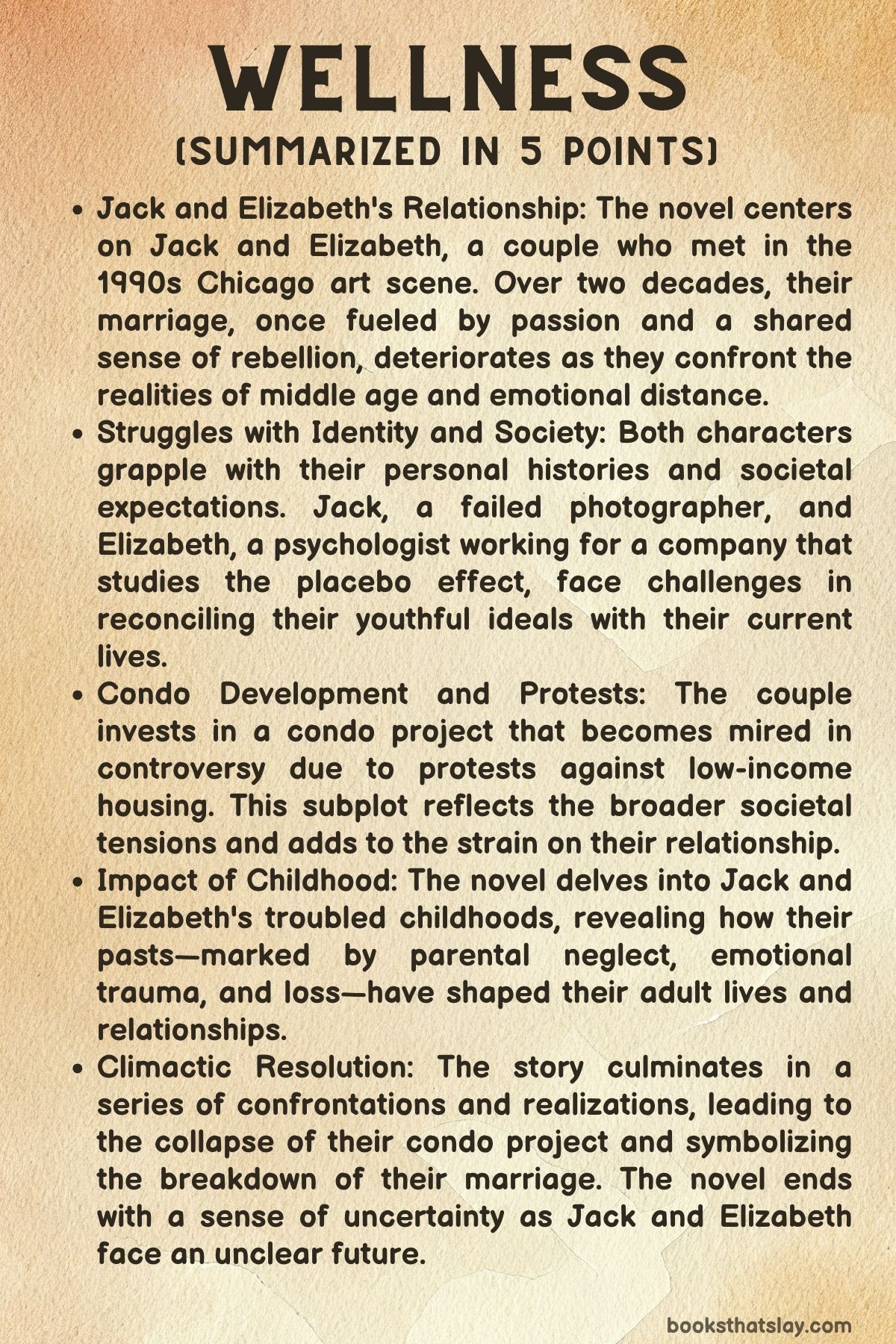
Wellness by Nathan Hill is a sweeping novel that spans decades, exploring the lives of Jack and Elizabeth from their youth in Chicago during the 1990s to their struggles with marriage, family, and identity in middle age. It is a story of love found across an alleyway, nurtured through shared dreams, and tested by the complexities of adulthood.
With sharp observations about art, culture, technology, and self-improvement, the novel examines how relationships evolve under pressure, how individuals wrestle with inherited wounds, and how love can persist amid disappointment, chaos, and imperfection. It is both intimate and expansive, a portrait of modern life and marriage.
Summary
The novel begins in Chicago in the winter of 1993. Jack, a young photographer from Kansas, lives in a bare apartment while Elizabeth Augustine, a student from a wealthy East Coast family, moves into the building across the alley.
They do not know each other’s names but secretly observe one another through their windows. Jack admires her elegance, books, and music, while Elizabeth is drawn to his quiet dedication to art and his solitary routines.
Both imagine the other is unreachable, yet both feel a growing connection. This silent observation lasts through the season until fate brings them together in a Chicago bar.
Jack is photographing a performance when he notices Elizabeth, and their eyes finally meet. His first words to her are “Come with,” beginning their lifelong bond.
Jack and Elizabeth quickly fall in love, moving through the city together, sharing experiences, and discovering each other’s backgrounds. Jack, raised in poverty with a difficult family life, carries guilt over his sister Evelyn’s tragic death.
Elizabeth, raised under her father’s authoritarian control, longs to escape her family’s wealth and expectations. Their shared desire to build an authentic life draws them together, and “Come with” becomes their mantra as they build a relationship defined by exploration and closeness.
Over time, they marry, settle into adult life, and have a son, Toby. Their life together, however, is not without conflict.
As they shift from youthful passion to suburban domesticity, questions about identity, fulfillment, and intimacy begin to emerge.
As adults in their forties, Jack and Elizabeth grapple with midlife dissatisfaction. Elizabeth frames their malaise through the “U-shaped curve” of happiness, suggesting it is a natural phase, though Jack only hears her sadness.
Their disagreements—over fireplaces, home choices, and parenting—expose deeper fissures. They invest in a new condo project, Shipworks, run by Jack’s old friend Benjamin Quince, now a polished developer.
Elizabeth embraces its design and even supports separate bedrooms, while Jack resists, seeing it as symbolic of emotional distance. Their marriage begins to strain under these opposing desires: her longing for order and his nostalgia for intimacy.
Parenting Toby proves equally challenging. Withdrawn and more comfortable in digital worlds than with peers, Toby frustrates Elizabeth’s attempts to coach him into social integration.
At playdates, he melts down, soothed more easily by Brandie, the leader of the parent group, than by Elizabeth. Brandie’s curated perfection highlights Elizabeth’s insecurities, especially when Brandie gifts Toby apple turnovers, a dessert Elizabeth never knew he liked.
Meanwhile, Jack throws himself into self-improvement. He adopts “the System,” a wearable app that quantifies his marriage and personal health, turning love into data points.
Despite his efforts, Elizabeth remains distant, and their intimacy falters. Jack’s acts of devotion become mechanical, while Elizabeth interprets them as inadequate.
The System’s cold scoring system underscores their disconnection.
The narrative flashes back to Jack’s struggles at the Art Institute, where he arrives unprepared compared to privileged classmates. Feeling alien, he throws himself into reading philosophy and experimenting with photography.
His turning point comes when he reappropriates internet pornography into an art project, reframing it as cultural critique. To his surprise, his professor praises it, and Jack finds himself propelled into Chicago’s art scene with his breakthrough piece, Girl in Window.
For the first time, he feels validated, though the origins of his success remain tied to insecurity and chance.
Elizabeth’s background is also explored in depth. Growing up under a controlling father and vain mother, she is subjected to constant pressure to perform and maintain appearances.
A pivotal moment occurs when she defeats her father in a tennis match, only to have him hurl his racket at her face in rage. The violence, covered up by those around her, leaves lasting scars.
Later, cornered in the abandoned servant quarters of her family’s home, overwhelmed by bats and fumes, she nearly lets herself die, fantasizing about exposing her father’s cruelty. Instead, she survives, carrying forward both her pride and her pain.
These experiences shape her adult need for control and her tendency toward self-sabotage.
In adulthood, Jack and Elizabeth continue to wrestle with personal and marital challenges. A double date with polyamorous parents from Toby’s school exposes them to alternative models of love, further unsettling their already fragile connection.
Jack feels both threatened and tempted, while Elizabeth remains elusive in her responses. Later, Jack revisits his childhood trauma in Kansas, where he confronts the long shadow of Evelyn’s death and his parents’ failings.
He learns his guilt may have been misplaced, opening the possibility of release. He recalls Evelyn’s lesson that art—and love—must be allowed to breathe rather than controlled, a realization that begins to shift his perspective on his marriage.
Elizabeth, meanwhile, faces professional collapse when her placebo-based psychology clinic, Wellness, is exposed. Feeling like a failure as a wife, mother, and professional, she recalls her near-death with the bats, recognizing her lifelong pattern of reenacting her father’s abuse.
Yet Toby’s innocent concern reminds her of her value as a mother, grounding her in love rather than self-destruction. Just as she resolves to reclaim her family, Shipworks becomes engulfed in flames—revealed as an insurance scheme by Benjamin.
Racing to the scene, she finds Jack safe, and in the fire’s glow, they recognize each other again, not as perfect partners but as flawed, enduring companions. Their shared question—can they love someone so broken?—becomes the foundation of their bond.
The book closes with a vignette of their early years in Chicago, when they created playful private worlds together, naming their belongings and inventing rituals. In their youth, they wondered what “real couples” did behind closed doors.
Now, after decades of joy, disappointment, and resilience, they understand the truth: real couples endure, invent, and continue. Wellness ends with an affirmation that love is not about perfection or control but about persistence and acceptance in the face of chaos.
Characters
Jack Baker
Jack emerges in Wellness as a deeply conflicted figure whose life has been shaped by grief, guilt, and longing. His childhood in Kansas, marred by poverty and the tragic death of his sister Evelyn in a fire, instills in him a persistent sense of inadequacy.
His mother’s accusation that he was “rotten to the core” leaves an indelible scar, while his father’s silence forces him into emotional isolation. These early experiences fuel his hunger for validation and belonging, which he first pursues through art.
His discovery of photography becomes a means of control and self-expression, yet also an unconscious way of processing trauma, with recurring motifs of fire and destruction appearing in his work.
In Chicago, Jack feels alien among wealthier, more sophisticated students, but he pushes himself to assimilate, even framing his accidental obsession with online pornography as “art.” This blend of shame and ingenuity catalyzes his artistic breakthrough, earning him the recognition he craves. Yet beneath his success lies a fragile man, perpetually anxious about being overlooked or unloved.
In marriage, Jack clings tightly to Elizabeth, unable to release the intimacy of their early years, and later turns to data-driven self-improvement systems to fix his body and his marriage. His arc, however, leads him toward a realization: love cannot be possessed or quantified, only allowed to breathe.
By returning to Evelyn’s tree in Kansas, Jack learns to let go—choosing trust and acceptance over control.
Elizabeth Augustine
Elizabeth is portrayed as a woman striving to escape the suffocating grip of privilege and parental control, yet continually haunted by her father’s abuse and her mother’s vanity. Raised in a world where posture and presentation mattered more than authenticity, she learns early how easily power can be misused and how appearances can conceal cruelty.
Her victory over her father on the tennis court—and the violent punishment it provokes—exemplifies both her courage and the heavy cost of defiance. This dynamic shapes her adulthood, where she often veers toward self-sabotage, replicating the patterns of control and humiliation she endured.
As a student in Chicago, Elizabeth seeks identity and independence, immersing herself in bohemian circles, but beneath her cultivated confidence lies fragility. With Jack, she initially finds liberation—someone equally scarred, equally searching—but over time, her restlessness resurfaces.
In motherhood, she projects her anxieties onto Toby, pushing him to master social strategies, only to be thwarted by his vulnerability. Professionally, her collapse at the Wellness clinic reveals her susceptibility to chasing illusions of control, even through placebos.
Elizabeth’s ultimate growth comes not through mastery but through surrender: she accepts that love is not about perfection but about embracing chaos, imperfection, and the unvarnished real.
Benjamin Quince
Benjamin represents both opportunity and corruption within Jack and Elizabeth’s world. Initially introduced as the eccentric owner of the Foundry, he embodies youthful rebellion, authenticity, and artistic freedom.
To Jack, Benjamin is a gatekeeper to the underground art scene, a figure who validates his talent and opens doors to Chicago’s cultural life. Over the decades, however, Benjamin evolves—or devolves—into a slick, profit-driven real estate developer, peddling artificial luxury under the guise of “vintage living.” His flamboyant rhetoric about authenticity gives way to hollow sales pitches, exposing the irony of his trajectory.
Benjamin is also an emblem of temptation and instability: he introduces Jack to the artifice of hypertext and pornography, and later lures Jack and Elizabeth into financial risk with the Shipworks project. His flamboyance, whether in art, food systems, or property deals, is captivating but corrosive, destabilizing those around him.
Yet, despite his flaws, Benjamin remains a constant mirror for Jack—a reminder of both the exhilaration of artistic youth and the compromises of adulthood.
Toby Baker
Toby, the son of Jack and Elizabeth, is a child caught between his parents’ competing anxieties and their legacy of isolation. Withdrawn and socially awkward, he prefers the safe, controlled worlds of Minecraft and YouTube to the unpredictable dynamics of playground politics.
His booby-trapped digital hideouts mirror his parents’ own emotional defenses: Jack’s retreat into art and systems, Elizabeth’s into strategies and control. Toby’s meltdowns, soothed more effectively by outsiders like Brandie than by his parents, reveal not only his fragility but also Jack and Elizabeth’s struggle to truly connect with him.
Yet Toby also embodies resilience and possibility. His nightly fears expose his longing for protection, while his quick indulgence in treats during Elizabeth’s “marshmallow experiments” underscores his honesty and immediacy.
He is not calculating or manipulative but profoundly present, resisting the adult world’s constant demand for delayed gratification. In many ways, Toby becomes the catalyst for Elizabeth’s realization: in soothing his fears and feeling his innocent concern, she rediscovers love stripped of pretense.
Through Toby, the novel underscores the messy, imperfect reality of family life—and the hope that, despite fractures, connection endures.
Evelyn Baker
Though Evelyn dies young, her presence reverberates throughout Jack’s life and the narrative of Wellness. As Jack’s older sister, she represents both nurturing guidance and the devastating source of his guilt.
Her lessons in art—particularly the idea that one must let things “breathe”—become a symbolic touchstone for Jack, a counterpoint to his obsessive need for control. Her death in the fire haunts him, a trauma compounded by his mother’s blame and his father’s silence.
Evelyn also becomes a moral compass, even in absence. Jack’s return to her tree in Kansas marks his turning point, as he embraces her wisdom of release.
She is less a character of action than one of memory and influence, shaping Jack’s identity across decades. Evelyn embodies both loss and the possibility of forgiveness, offering Jack a way to transform grief into growth.
Brandie
Brandie enters the story as the confident, authoritative mother figure in Toby’s social world. She contrasts sharply with Elizabeth, whose anxieties about parenting often backfire.
Brandie’s ease with children—calming Toby with “brain breaks” and weighted blankets—demonstrates her intuitive authority and her dominance in the parent community. Her Instagram-curated perfection and generosity, like gifting Toby turnovers, highlight her control not only over children but also over adult perceptions.
For Elizabeth, Brandie is both ally and rival: she admires her competence yet resents the way Brandie seems to know Toby better than she does. Brandie exposes Elizabeth’s insecurities about motherhood and belonging, forcing her to confront her own shortcomings.
Though a secondary character, Brandie represents the modern, performative parenthood culture—seamlessly blending care with curation, authority with influence.
Themes
Love and Distance
In Wellness, love is first experienced through observation rather than direct contact. Jack and Elizabeth’s fascination begins across an alley, where each silently imagines the other as an idealized partner.
This distance allows them to project their desires, insecurities, and fantasies onto the other, making their connection initially one of longing rather than reality. The progression from gazing across windows to finally speaking encapsulates how love often grows from imagination before it can be tested by the ordinary trials of life.
As the years pass, distance continues to play a role—whether in the form of separate master bedrooms in their new condo or the subtle emotional estrangements that midlife brings. Love in the novel is not a static, passionate state but a negotiation between closeness and separation.
The early intimacy that made them inseparable becomes tested by the demands of parenting, financial risk, and personal dissatisfaction. The theme highlights how love requires persistence not only in moments of passion but also in enduring silence, compromise, and even estrangement.
The novel portrays love as fragile yet resilient, built less on the absence of flaws than on the decision to keep showing up despite them.
Identity and Reinvention
Both Jack and Elizabeth arrive in Chicago yearning for reinvention. Jack, insecure about his working-class Kansas background, tries to assimilate into the intellectual art world by imitating peers and reframing his photography as cultural commentary.
Elizabeth rejects her East Coast privilege, searching for authenticity in bohemian Chicago, while still carrying the scars of her father’s control. Their reinventions are initially liberating, granting them entry into art, music, and each other’s lives.
Yet reinvention also becomes a burden, as each fears being unmasked as inadequate. Jack worries that his career rests on a misunderstanding of his work, while Elizabeth later sees her professional identity collapse with the failure of her clinic.
This theme underscores how identity is never fully settled; it is constantly in flux, shaped by external pressures, personal histories, and relationships. Reinvention provides freedom but also instability, since each attempt at self-creation carries with it the shadow of who they once were and the fear of failure.
Technology and Control
Technology permeates the narrative, shaping both art and intimacy. Jack’s early obsession with online pornography not only provides him with artistic recognition but also reveals the allure and emptiness of digitized desire.
Later, his embrace of “the System”—a wearable that gamifies marriage—shows how technology seduces with promises of order and improvement while reducing human connection to data points and scores. Similarly, the VR condo tour at Shipworks offers Elizabeth an idealized, sanitized version of home, masking the artificiality beneath the design.
These episodes reveal a persistent tension between the desire for control and the uncontrollable messiness of real life. Technology becomes a metaphor for the human tendency to manage relationships and selves as if they were projects to optimize, yet every attempt at quantification leaves behind the irreducible complexity of love, grief, and desire.
The novel suggests that control is an illusion, and technology amplifies the gap between what people want to measure and what actually matters.
Family and Inheritance
The family histories of both Jack and Elizabeth shape their adult struggles. Jack carries the guilt of his sister Evelyn’s death, internalizing blame that was unfairly thrust upon him.
His father’s retreat into conspiracy cures and his mother’s bitterness leave him with a lifelong sense of inadequacy. Elizabeth, meanwhile, endures her father’s abuse and her mother’s shallow perfectionism, absorbing patterns of control and self-sabotage.
Their marriage reflects these inherited wounds, as they oscillate between clinging too tightly and pulling too far apart. Their son Toby becomes a mirror of their unresolved anxieties—withdrawn, creative, and vulnerable, embodying both their fears and their hopes for a different future.
The theme of family inheritance demonstrates how cycles of pain can repeat across generations unless confronted. Jack and Elizabeth’s challenge is not only to build a marriage but also to break from the legacies that haunt them, learning to nurture rather than perpetuate harm.
Authenticity and Performance
From Jack’s struggle to be seen as a legitimate artist to Elizabeth’s attempts to appear as a capable mother among Instagram-perfect peers, authenticity is a constant preoccupation. Jack’s accidental success with his pornography project exposes the arbitrariness of what is deemed authentic art, while Elizabeth’s interactions with parents like Brandie highlight the performative nature of modern family life.
Even their double date with Kate and Kyle introduces another layer of performance, as polyamory is presented both as liberation and as its own form of curated identity. In each case, the line between what is authentic and what is staged blurs.
The novel suggests that authenticity is less about stripping away performance and more about recognizing that all identity involves a degree of self-presentation. The challenge lies in finding meaning within these performances rather than seeking an impossible purity.
This theme resonates especially in an age where digital life amplifies self-curation, making authenticity both more elusive and more necessary.