Sinful King by Natalie Kane Summary, Characters and Themes
Sinful King by Natalie Kane is a dark contemporary romance centered on power, survival, trust, and the difference between protection and control.
Set within the criminal world of Las Vegas, the novel follows Eloise “Lulu” Rizzo after she escapes an abusive Mafia father and unexpectedly crosses paths with Roman Alexander, one of the feared Kings of Vegas. Rome is dangerous, possessive, and deeply involved in organized crime, yet his treatment of Lulu challenges everything she has learned about powerful men. Their relationship develops alongside violent conflicts, betrayals, criminal rivalries, and Lulu’s gradual effort to reclaim control over her own life. It’s the 1st book in the Kings of Vegas series.
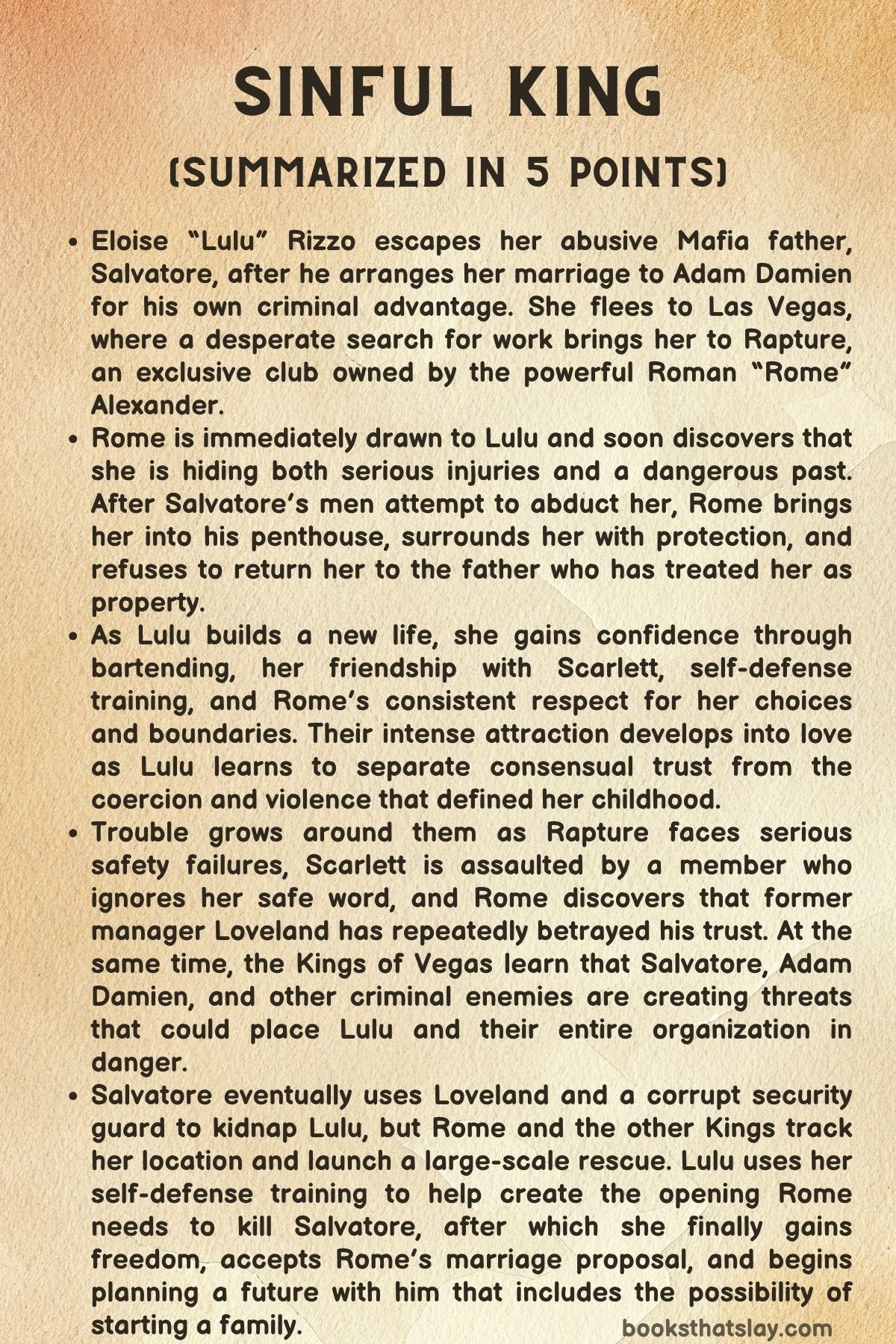
Summary
Roman “Rome” Alexander considers Las Vegas the territory of himself and the three men he calls his brothers. Known collectively as the Kings of Vegas, Rome, Julian, Mateo, and Carson control different criminal enterprises while maintaining influence over businesses, politicians, law enforcement, and the city’s underground economy.
Elsewhere, Eloise “Lulu” Rizzo lives under the authority of her father, Salvatore Rizzo, a powerful Mafia leader who has spent years treating her as property. Lulu has secretly used college as an opportunity to explore subjects she actually enjoys, including cooking, massage therapy, goldsmithing, and mixology, while preparing for the possibility that she might eventually have to escape.
That moment arrives when Salvatore announces that Lulu will marry Adam Damien for the benefit of his organization. When she refuses, he humiliates and attacks her, confirming that she has no future in his home except one dictated completely by him.
Lulu activates the escape plan she has prepared for two years. She takes hidden money, false identification, and burner phones, says goodbye to Iris, the housekeeper who has shown her genuine affection, and leaves Reno for Las Vegas.
Her freedom begins badly. Lulu is mugged, loses most of her money and phones, suffers painful injuries, and ends up staying in a cheap motel while urgently searching for work.
She enters Rapture, an exclusive sex club owned by Rome, hoping to find work as a bartender. Scarlett, the receptionist, treats her kindly, but general manager Madam Loveland rejects her because of her body, claiming wealthy customers expect a different appearance.
Rome sees the interview through Rapture’s surveillance system and reacts immediately. He has already been struck by Lulu’s appearance and is furious at Loveland’s cruelty, ordering that Lulu be brought back and hired that same night.
Lulu accepts because she desperately needs income. She meets Rita and Max behind the bar and quickly realizes that, despite the nature of Rapture, its rules are built around consent, boundaries, and personal safety.
Rome approaches her without initially admitting that he owns the club. Their attraction is immediate, but his attention changes when he notices bruises, scars, and injuries that do not seem fully explained by Lulu’s claim that she was mugged.
After Lulu’s shift, Rome secretly follows her and discovers the dangerous motel where she is staying. His concern becomes extreme almost immediately, and he arranges covert security around her while remaining outside the motel himself.
His protectiveness proves important when one of Salvatore’s men eventually enters Lulu’s room and tries to take her. Bruno, one of Rome’s guards, stops the intruder, and Rome rushes to Lulu with the other Kings.
Terrified and confused, Lulu assumes Rome and the armed men surrounding him may also work for her father. After she is taken to Rome’s penthouse for safety, the captured attacker reveals that Salvatore Rizzo ordered Lulu’s kidnapping.
Lulu finally admits that her real name is Eloise Rizzo and explains why she ran away. Rome’s brothers immediately recognize the danger of the situation because Salvatore’s organization has recently attacked Julian’s operation, raising the possibility that Lulu’s arrival could somehow be connected to their conflict.
Rome refuses to treat her as a possible enemy. He believes her injuries and fear are genuine and makes it clear that she will not be returned to Salvatore.
Lulu begins living in Rome’s penthouse. Although his protectiveness can be intense, she slowly recognizes an important difference between Rome and her father: Rome repeatedly protects her choices rather than eliminating them.
He encourages her to continue bartending, gives her access to his home, arranges clothing and security, and listens with genuine interest when she talks about cooking, goldsmithing, massage therapy, and other skills her father dismissed. Lulu is particularly affected by the fact that Rome admires the body Salvatore spent years teaching her to hate.
Lulu also becomes close friends with Scarlett. Through Scarlett, she learns more about Rapture and discovers that the activities occurring beyond the lounge are carefully structured around communication and consent.
Some practices immediately disturb Lulu because they remind her of her father’s violence, while others interest her, particularly decorative rope work and voyeurism. Rome observes her reactions and understands that anything they explore together must remain separated from the coercion Lulu experienced throughout her childhood.
Their emotional relationship grows as quickly as their attraction. Lulu begins cooking in Rome’s enormous kitchen, spending time with the other Kings, and building friendships that give her a sense of family she has never experienced.
She eventually tells Rome more about Salvatore’s abuse, including repeated injuries, dislocated shoulders, beatings, and being exposed to violence as a child. Rome does not pretend to be morally innocent; he openly tells her that he is a criminal and killer, but Lulu sees an essential distinction between his capacity for violence and the deliberate cruelty Salvatore directed at helpless people.
The conflict with Salvatore continues in the background. When the Kings meet him, he pretends to be a worried father searching for his missing daughter while demanding help in locating Eloise.
Rome knows the truth but says nothing. Salvatore also reveals how completely he still considers Lulu his possession by warning the Kings that he will kill anyone who has been intimate with her.
Meanwhile, danger develops inside Rapture itself. Mayor Pierce grabs Lulu after she rejects him, causing her to freeze because of memories of her father. Julian immediately intervenes, and the incident motivates Lulu to begin self-defense training.
A far worse failure occurs when Scarlett is attacked during a scene by Emilio, a member who ignores her safe word. Rome discovers that Emilio had previously violated another woman’s boundaries but had been allowed to remain a member because Loveland ignored Rome’s instructions to remove him.
Scarlett survives but is badly injured. Luke’s reaction reveals that his previously casual relationship with her has become serious, and she eventually moves into his apartment.
Rome fires Loveland after determining that her negligence directly endangered the people Rapture was designed to protect. His commitment to the club’s safety becomes clearer when he tells Lulu about his mother, a sex worker who was murdered when Rome was sixteen.
His mother’s death shaped his belief that people in sexual environments must have enforceable boundaries and protection. Lulu then reveals an equally devastating childhood memory: Salvatore murdered her mother while Lulu watched.
As Lulu becomes more secure, she begins confronting the lasting effects of her upbringing. When an unexpected period stains Rome’s sheets, she panics because Salvatore once beat and humiliated her for the same thing.
Rome responds by calmly replacing the bedding and assuring her that she has done nothing wrong. The incident also leads to Lulu and Rome agreeing to have mutual tracking devices implanted, with Lulu insisting that his safety matters as much as hers.
Lulu and Scarlett train with Mateo in self-defense and later with Carson in firearms. Mateo, who had previously suspected Lulu might secretly be working for Salvatore, finally accepts her after she angrily explains the abuse she endured and her loyalty to Rome.
The situation becomes more dangerous when Lulu overhears the Kings discussing Adam Damien and reveals that he is the man Salvatore intended her to marry. Damien is already an enemy of the Kings, especially Carson, making Salvatore’s planned marriage even more threatening than Lulu previously understood.
Lulu again offers to disappear so that Rome will not be endangered because of her. Rome refuses and insists that she must stop thinking of herself as a burden that can be removed whenever circumstances become difficult.
Rome later introduces Lulu more fully to consensual dominance using a clear color-based safe-word system. The experience becomes important because Lulu consciously chooses when to surrender control and knows that she can stop everything immediately.
When insecurity about her appearance causes her distress, she says yellow, and Rome responds rather than continuing. Their growing ability to communicate eventually leads Lulu to confess that she loves him, and Rome admits that he loves her as well.
Their happiness is interrupted when Salvatore moves men into Las Vegas and uses an insider within Rome’s organization to locate Lulu. The betrayal comes from Matthews, one of the security guards, while Loveland also becomes directly involved.
During a shopping trip with Scarlett, Loveland approaches Lulu, drugs her, and helps Salvatore’s men abduct her. Rome discovers what has happened through Lulu’s tracking implant and mobilizes hundreds of men to recover her.
Lulu wakes in Salvatore’s custody and learns how deeply Loveland’s jealousy has turned into betrayal. When Loveland continues attacking Lulu, Salvatore shoots her himself.
Salvatore intends to hand Lulu over to Adam Damien, but Damien cancels the arrangement after discovering that Lulu has been involved with Rome. Furious that his alliance has collapsed, Salvatore attacks Lulu, dislocates her damaged shoulder, and threatens to kill her.
Rome and the Kings attack the property before Salvatore can carry out the threat. Salvatore uses Lulu as a human shield, but she remembers her self-defense training and attacks him despite her injuries.
The movement creates the opening Rome needs. He shoots Salvatore, finally ending the authority that has dominated Lulu’s life since childhood.
After Lulu receives medical treatment, she learns that Salvatore’s death has made her financially independent through her inheritance, although she has little interest in keeping wealth associated with him. More importantly, she realizes that she is genuinely free.
She asks Rome whether his declaration during the rescue that he intended to marry her was serious. He formally proposes, calling her the light in his dark life and using his private nickname for her, “firefly.”
Six months later, Rome and Eloise are married, having wed only a week after Salvatore’s death once she was physically able. Their relationship has become stable enough for them to explore their desires together while continuing to communicate openly about what they actually want.
The final change comes when Rome realizes Eloise is probably pregnant. Although she immediately worries about becoming a mother, Rome has complete confidence in her, and they begin planning a family and considering a house with a yard while keeping their penthouse above Rapture.
Eloise ends the story no longer defined by the home she escaped or the father who tried to own her. She has work she enjoys, friends she trusts, a husband who values her choices, and a future that finally belongs to her.
Characters
Roman “Rome” Alexander
Rome is the dominant male protagonist of Sinful King, a man whose intimidating position in the Las Vegas criminal world contrasts sharply with the care he shows Lulu. He owns Rapture, participates in organized crime, launders money, commands armed men, and is fully capable of lethal violence, yet he maintains unusually strict rules concerning consent and the treatment of vulnerable people.
His personality is defined by control. Rome expects his orders to be obeyed, watches his environment constantly, and responds aggressively whenever he believes someone under his protection has been endangered.
Lulu changes the emotional meaning of that control. Before meeting her, Rome keeps women outside his private life and dislikes casual physical affection, but Lulu rapidly becomes the exception to nearly every personal boundary he has established.
His possessiveness can be extreme, particularly when he secretly follows Lulu, assigns security to her, and decides almost immediately that she belongs in his home. Yet the book repeatedly distinguishes his possessiveness from Salvatore’s ownership by showing that Rome encourages Lulu to work, maintain friendships, explore interests, disagree with him, and communicate limits.
Rome’s past explains much of his behavior. His mother supported him through sex work after becoming a mother at fifteen, and her eventual murder during a sexual encounter left him with a permanent hatred of predators who ignore consent.
Rapture is therefore more than a business. Its rules reflect Rome’s determination to create a controlled environment where the kind of violence that killed his mother is not supposed to happen.
His greatest emotional development comes through vulnerability. Lulu becomes the first person in years whose touch comforts rather than irritates him, and loving her forces him to acknowledge fears he normally hides behind authority.
By the end of the novel, Rome remains dangerous and morally compromised, but he is no longer emotionally isolated. His future with Eloise, their marriage, and the possibility of parenthood give him a personal life built around attachment rather than simply power.
Eloise “Lulu” Rizzo
Lulu is the emotional center of Sinful King and the character whose transformation gives the novel its strongest sense of movement. She begins as a young woman who has spent most of her life under Salvatore’s physical violence, emotional degradation, and obsessive control.
Despite that environment, Lulu is never passive by nature. She secretly changes her college courses, studies subjects that interest her, saves money, obtains false identification, learns practical skills, takes shooting lessons, and spends two years constructing an escape plan.
Her greatest difficulty after escaping is not learning independence from nothing but believing she is entitled to it. Salvatore has conditioned her to think that her body is unattractive, her preferences are unimportant, mistakes deserve punishment, and her presence creates inconvenience for others.
This conditioning appears repeatedly in her new life. She moves her belongings out of Rome’s bedroom because she assumes she is imposing, panics over stained sheets, offers to disappear when danger increases, and initially struggles to accept expensive gifts or protection without feeling guilty.
Her relationship with Rome gradually challenges those beliefs. What affects Lulu most is not simply his attraction but the fact that he listens when she says no, remembers what she enjoys, encourages her work, protects friendships such as her relationship with Scarlett, and repeatedly treats her preferences as important.
Her growing interest in consensual submission becomes especially meaningful because choice is central to it. Lulu has experienced forced control all her life, so voluntarily surrendering control while retaining the power to stop becomes a way of separating trust from fear.
She also refuses to remain dependent on rescue. After freezing when Mayor Pierce grabs her, Lulu asks for self-defense training, confronts Mateo about his suspicions, practices firearms, and ultimately uses her training against Salvatore during the final confrontation.
By the end, Lulu has not forgotten her trauma, but she has stopped allowing Salvatore’s judgments to define her. She becomes a woman capable of work, friendship, desire, self-protection, marriage, and eventually the possibility of motherhood on terms she has chosen herself.
Salvatore Rizzo
Salvatore is the principal antagonist of Sinful King and represents power stripped of love, responsibility, and respect. As Lulu’s father and a major Mafia figure, he possesses enough authority to control both a criminal organization and almost every aspect of his daughter’s existence.
His abuse is systematic rather than occasional. He criticizes Lulu’s appearance, physically attacks her, repeatedly injures her shoulder, restricts her movements, exposes her to horrific violence, and eventually arranges her marriage to Adam Damien as though she were an asset in a business transaction.
Salvatore’s treatment of Lulu’s mother reveals that his cruelty predates the events of the main story. Murdering her while his young daughter watched demonstrates his willingness to use terror not merely to eliminate enemies but to establish emotional domination over the people closest to him.
His language repeatedly exposes his belief that Lulu belongs to him. Even after she escapes, he describes himself as a loving father and demands that powerful criminal rivals help return her, refusing to consider the possibility that she has the right to choose another life.
His obsession with restoring control ultimately destroys him. He brings forces into Las Vegas, compromises Rome’s security network, participates in Lulu’s abduction, and attacks her when his planned alliance with Damien collapses.
Salvatore’s death is therefore significant beyond the removal of a criminal enemy. When Lulu uses the self-defense skills she has acquired to create the opening for Rome to shoot him, she participates directly in ending the authority that has shaped her fear since childhood.
Scarlett
Scarlett becomes one of the most important supporting figures in Sinful King because she gives Lulu something almost entirely absent from her earlier life: uncomplicated female friendship. From their first meeting, Scarlett responds to Lulu with kindness rather than judgment, helping her prepare for the job interview and later becoming one of the people who most consistently reinforces her confidence.
Scarlett understands Rapture far better than Lulu and becomes her guide to its culture. She explains the club’s rules, helps Lulu understand scenes and consent, introduces her to the facilities, and encourages her to explore curiosity without pressuring her into anything.
Her friendship also becomes important to Lulu’s recovery from years of criticism about her appearance. Scarlett openly challenges Salvatore’s insults and treats Lulu’s body as normal and attractive, helping counter ideas Lulu has heard throughout her life.
Scarlett’s own storyline reveals the consequences of institutional failure. Emilio attacks her after she repeatedly uses her safe word, proving that written rules are meaningless when the people responsible for enforcing them choose convenience over safety.
Her injuries force Rome to confront Loveland’s negligence and cause Luke to acknowledge how deeply he cares about her. Scarlett eventually leaves sexual work in the playroom and becomes its manager, allowing her to remain connected to Rapture while creating boundaries that better suit her changed life.
Her development parallels Lulu’s in a quieter way. Both women move from situations where other people have endangered or objectified them toward relationships and roles where they have more control over their own futures.
Luke
Luke is Rome’s cousin, security chief, and one of the people most trusted with protecting both Rapture and Rome’s personal interests. He is practical, loyal, and accustomed to Rome’s commanding personality, which makes his surprise at Rome’s immediate fixation on Lulu particularly revealing.
His most important personal relationship is with Scarlett. What begins as repeated sexual encounters at Rapture gradually develops into emotional attachment, although Scarlett initially assumes Luke sees her only as a convenient partner.
Her assault destroys that uncertainty. Luke’s reaction is immediate and intense, and he stops behaving as though their connection is casual.
He brings Scarlett to his own apartment, cares for her during recovery, and openly tells Rome that he wants her permanently in his life. His behavior resembles Rome’s protectiveness toward Lulu, although Luke reaches emotional honesty more slowly.
Luke is also deeply embedded in the Kings’ violent world. He assists with security, interrogations, and punishment, and his killing of Emilio demonstrates that his tenderness toward Scarlett exists beside a capacity for extreme brutality.
Julian
Julian is one of the four Kings of Vegas and a central figure in their criminal alliance. He controls the diamond trade and is strongly connected to the network of violence, business, loyalty, and retaliation that holds the Kings together.
His suspicion of Lulu makes him an important counterweight to Rome. Because Salvatore’s organization attacks Julian’s operation at roughly the same time that Salvatore’s daughter appears inside Rome’s club, Julian sees the possibility of manipulation as something the group cannot responsibly ignore.
His skepticism is not driven by personal cruelty toward Lulu. It reflects his responsibility to protect the other Kings and their businesses, even when that caution puts him into conflict with Rome.
Julian also demonstrates Rapture’s rules when he intervenes after Mayor Pierce grabs Lulu. His immediate defense of her shows that, despite his suspicions about her identity, he still recognizes her right to personal safety.
Eventually Julian accepts Rome’s judgment even before becoming personally convinced of every detail. That decision demonstrates how much the Kings’ relationships depend on loyalty: disagreement is allowed, but their shared history still carries enormous weight.
Mateo
Mateo is another King of Vegas and initially one of the most skeptical people in Lulu’s new environment. His criminal role involves weapons and drugs, and he is presented as highly capable, physically dangerous, and comfortable operating within violent situations.
His suspicion of Lulu becomes personally important when he begins training her and Scarlett in self-defense. After accidentally aggravating Lulu’s damaged shoulder, he learns more about the extent of Salvatore’s abuse.
When Mateo admits that he has wondered whether Lulu could be spying for her father, she confronts him directly. Her anger, detailed knowledge of Salvatore’s cruelty, and determination to protect Rome finally convince him that her loyalty is genuine.
His changed attitude becomes obvious when Salvatore later abducts Lulu. Mateo reacts not as a suspicious associate but as someone furious that a member of their extended family has been taken.
His relationship with Lulu therefore demonstrates her gradual acceptance by the Kings. Earning Mateo’s trust is significant precisely because he does not give it easily.
Carson
Carson is the fourth King of Vegas, a casino owner and highly skilled assassin whose humor often sits beside a much darker reputation. Lulu immediately senses danger when he first approaches her at Rapture, yet he quickly becomes one of the men who accepts Rome’s claim on her.
Among the Kings, Carson is comparatively quick to believe that Lulu is not working for Salvatore. He also becomes personally important when the group learns that Adam Damien is the man she was supposed to marry.
Damien is connected to Carson’s imprisonment and the death of a woman he once loved, giving Carson a separate reason to want him eliminated. Lulu’s arranged marriage therefore connects her private nightmare to an older conflict within the Kings’ history.
Carson later handles firearms training for Lulu and Scarlett. His surprise at Lulu’s existing ability with a gun reveals again that Salvatore never completely understood how much preparation she had undertaken while living under his control.
Although Carson describes himself as an assassin and dismisses the possibility of romance, his loyalty toward the group reveals a strong capacity for attachment beneath his cynical presentation.
Sarah “Madam Loveland” Lowman
Loveland is one of the story’s clearest examples of resentment becoming destructive. As Rapture’s general manager, she initially has considerable professional authority, but her first interaction with Lulu exposes both personal cruelty and poor judgment when she rejects Lulu because of her body.
Her hostility is intensified by her history with Rome. The two once attempted a relationship, but it ended after Rome caught her with another member, leaving Loveland emotionally attached to a past that Rome has long abandoned.
Lulu’s arrival forces Loveland to confront the fact that Rome is capable of giving another woman the intimacy and commitment he never gave her. Instead of accepting this, Loveland allows jealousy to influence her professional decisions.
Her most serious failure occurs when she ignores Rome’s order to remove Emilio after he violates Beth’s safe word. That decision directly enables Scarlett’s later assault.
Even after Rome fires her, Loveland’s resentment continues growing. She ultimately works with Salvatore, participates in Lulu’s kidnapping, and personally drugs her.
Her alliance with Salvatore becomes her final mistake. Loveland believes she can use Lulu’s removal to satisfy her jealousy, but Salvatore has no loyalty to her and kills her when she becomes inconvenient.
Rita
Rita is the bar manager at Rapture and one of the first people to make Lulu feel professionally competent. She trains her without condescension, recognizes her ability as a bartender, and makes sure she receives the pay and tips she has earned.
Rita also understands Rome exceptionally well. She immediately recognizes that his interest in Lulu is unlike his previous relationships and accepts that his longstanding rule against involvement with employees is about to disappear.
Her conversations help establish Rapture as a workplace with its own internal community rather than merely a setting for Rome and Lulu’s romance. Rita’s friendliness gives Lulu an early sense that she may have found somewhere she can remain.
Iris
Iris is the housekeeper in Salvatore’s home and one of the few people from Lulu’s old life associated with genuine affection rather than fear. Lulu’s emotional goodbye to her before escaping demonstrates how isolated she has been within her father’s household.
Although Iris has limited direct involvement in the later plot, she represents the small amount of kindness Lulu experienced before Las Vegas. Leaving Iris therefore adds emotional cost to Lulu’s escape, because freedom requires abandoning even the rare relationship that made her old life bearable.
Beth
Beth is a Rapture employee whose complaint early in the novel establishes Rome’s stated standards concerning consent. She reports that Emilio ignored her safe word, and Rome immediately treats the violation as serious.
Her experience later becomes crucial because Loveland fails to enforce Rome’s order to remove Emilio. The later attack on Scarlett therefore turns Beth’s earlier complaint into evidence of an institutional warning that was ignored.
Beth’s role is relatively small, but what happens to her establishes one of the moral dividing lines of the story: consensual activity may be unconventional, but ignoring withdrawn consent is treated as violence.
Max
Max works alongside Lulu as a bartender at Rapture and helps create the welcoming environment she encounters after Loveland’s initial rejection. His presence contributes to Lulu’s growing confidence at work and gives the bar a sense of routine and community.
He does not receive a major independent storyline, but characters such as Max are important because they show Lulu building an ordinary professional life inside an environment that initially seems intimidating.
Bruno
Bruno is one of Rome’s security men and becomes important almost immediately after Rome decides Lulu requires protection. He secretly follows her and is present when Salvatore’s soldier breaks into her motel room.
By stopping the attacker before Lulu can be taken, Bruno gives Rome enough time to reach her. His role demonstrates that Rome’s extensive security arrangements, however overwhelming they may initially appear, respond to a genuine danger.
Adam Damien
Adam Damien remains largely outside Lulu’s direct experience, yet his presence influences major parts of the plot. Salvatore selects him as Lulu’s husband because the marriage would benefit his criminal interests, turning Damien into a symbol of the future Lulu escapes.
The Kings already know him as a dangerous enemy, particularly because of his history with Carson. This revelation transforms the arranged marriage from a private family threat into part of a larger criminal conflict.
Damien ultimately refuses the marriage after learning that Lulu has been sexually involved with Rome. His decision is not presented as an act of compassion toward Lulu; instead, it destroys Salvatore’s planned alliance and pushes her father into even greater rage.
Dr. Asgood
Dr. Asgood is the physician called whenever members of Rome’s circle require discreet medical treatment. He treats Scarlett after Emilio’s attack and later cares for Lulu after Salvatore dislocates her shoulder.
His presence provides practical support to a criminal network that frequently operates outside ordinary institutions. He also gives Lulu an honest assessment of the long-term damage to her shoulder, emphasizing that years of abuse have produced physical consequences that will not disappear simply because Salvatore is dead.
Emilio
Emilio is the member whose repeated violations expose the consequences of failing to enforce boundaries. His first known offense involves Beth, whose safe word he deliberately ignores.
Because Loveland allows him to remain, Emilio later attacks Scarlett while she is restrained and unable to protect herself. His behavior makes clear that the violation itself is what he enjoys, distinguishing him from someone who merely misunderstands a consensual activity.
Rome and Luke ultimately kill him during punishment for the attack. Emilio’s storyline is brutal, but it is crucial to the novel’s distinction between consensual sexual activity and assault.
Mayor Pierce
Mayor Pierce demonstrates how status can create entitlement. As a powerful public figure and Rapture member, he repeatedly flirts with Lulu despite her lack of interest and eventually grabs her after she refuses him.
His claim that membership should give him access to employees exposes exactly the attitude Rome’s rules are supposed to prevent. Julian’s intervention and Pierce’s permanent expulsion reinforce the principle that wealth and political power do not erase another person’s right to refuse contact.
Mendoza
Mendoza is a criminal supplier whose conflict with Rome illustrates the constant instability surrounding the Kings. He attempts to pressure Rome into paying far more for product and arrives with armed men when the dispute escalates.
The resulting violence creates additional losses and another possible enemy, later making Mendoza one of the suspects when Rome’s weapons warehouse is attacked. His role reinforces the fact that Lulu’s personal danger exists inside a much broader world of criminal rivalries.
Shelly and Sheila
Shelly and Sheila are personal shoppers brought to the penthouse to help Lulu build a new wardrobe. Their importance lies less in the clothes themselves than in the way they respond to Lulu’s appearance.
Instead of criticizing her body, they encourage her and treat her curves as something to celebrate. Their enthusiasm becomes another small but meaningful contradiction of the insults Lulu has internalized from Salvatore.
Rocky
Rocky is an employee caught stealing a large sum of money from Rome. Rome is dealing with him in Rapture’s basement when Lulu begins searching for him after the incident with Mayor Pierce.
His limited appearance reminds the reader that Rome continues managing violent criminal discipline even while his relationship with Lulu is becoming emotionally softer. Rome’s personal tenderness does not mean he has abandoned the ruthless system he controls.
Elliott
Elliott is Julian’s adult son and is mentioned as an ongoing source of frustration for his father. His irresponsible behavior creates problems Julian repeatedly has to manage.
Although Elliott does not become central to Lulu and Rome’s romance, his presence offers a glimpse into the complicated family responsibilities that exist alongside the Kings’ criminal operations.
Matthews
Matthews is the security guard whose betrayal enables Salvatore’s final plan. He is supposed to be part of the system protecting Lulu, yet he secretly works against Rome and helps create the conditions that allow her kidnapping.
His betrayal is especially damaging because Rome’s approach to Lulu’s safety depends heavily on trusted guards. Matthews therefore proves that even an extensive security network can become dangerous when loyalty is compromised.
Themes
Freedom, Control, and the Right to Choose
Control surrounds Lulu from the beginning of Sinful King, but the novel repeatedly asks whether all forms of control mean the same thing. Salvatore imposes control without consent: he determines where Lulu can go, what she should study, whom she will marry, how she should view her body, and what consequences she will suffer for disobedience.
Lulu’s escape is therefore not simply a physical departure from her father’s house. It is the beginning of learning that she is allowed to make choices without punishment.
Rome complicates this theme because he is also intensely controlling. He assigns security, insists Lulu remain in his home, creates rules, monitors danger around her, and becomes deeply possessive.
The difference lies in how the story presents Lulu’s ability to respond. Rome may be demanding, but he encourages her work, respects her friendships, allows disagreement, and repeatedly requires communication in their sexual relationship.
The safe-word system gives the theme its clearest symbolic form. Lulu voluntarily gives Rome control while retaining the ability to say yellow or red, making consent the dividing line between chosen surrender and abuse.
Her self-defense training develops the idea further. She no longer wants protection to mean dependence, and her eventual attack on Salvatore proves how far she has moved from the frightened woman who once had to escape his home in secret.
Freedom in the novel therefore becomes more than the absence of rules. It means having the authority to decide which relationships, limits, risks, and forms of trust belong in one’s own life.
Trauma, Recovery, and Relearning Safety
Lulu leaves Salvatore physically, but much of her father’s influence survives inside her reactions. She expects punishment for mistakes, assumes generosity will eventually be withdrawn, worries that she is an inconvenience, and interprets ordinary situations through memories of previous violence.
The stained sheets provide one of the clearest examples. Rome sees a manageable domestic accident, while Lulu experiences the situation through the memory of being beaten and humiliated for something similar.
Recovery therefore happens through repeated experiences that contradict what Lulu expects. Rome sees her injuries and becomes angry at the person who caused them rather than at her.
Scarlett challenges the insults about her body. Mateo teaches her to fight despite her damaged shoulder. Carson strengthens skills she secretly developed before escaping.
Her progress is not presented as immediate emotional erasure. She still freezes when Mayor Pierce grabs her, panics when Adam Damien’s name appears, and instinctively offers to disappear whenever she believes her presence may cause danger.
What changes is her response after those moments. Lulu begins asking for training, confronting people who doubt her, communicating insecurity, and accepting that needing support does not mean surrendering independence.
Rome also carries trauma from his mother’s murder, and his obsession with Rapture’s safety grows directly from that loss. Their relationship brings together two people whose experiences with violence have made trust difficult, allowing safety to become something they consciously build rather than something either of them naturally assumes.
Consent, Boundaries, and Responsibility
The sexual world surrounding Sinful King is repeatedly used to examine consent as an active responsibility rather than a one-time agreement. Rapture permits unconventional forms of intimacy, but Rome insists that participation must remain voluntary and that intoxication, ignored safe words, and unwanted contact are unacceptable.
Beth and Scarlett’s experiences show why rules alone are insufficient. Beth reports that Emilio ignored her safe word, but Loveland chooses not to enforce the consequences Rome ordered.
That failure allows Emilio to attack Scarlett later. Her assault therefore demonstrates how institutions become unsafe when people with authority minimize earlier violations.
Mayor Pierce represents a similar problem through social power. He assumes membership, wealth, and political status should give him access to Lulu, but Julian immediately rejects that belief.
The novel also applies consent inside Lulu and Rome’s relationship. Rome has a dominant personality and enjoys controlling sexual situations, yet he repeatedly checks Lulu’s emotional state and alters his behavior when she communicates discomfort.
The yellow moment during their rope scene is particularly important because Rome does not treat a boundary as an obstacle to overcome. He stops escalation and addresses the insecurity causing Lulu distress.
This theme also connects consent to responsibility. Protecting boundaries requires more than personally avoiding abuse; it requires responding when another person violates them.
Rome’s anger at Loveland comes partly from recognizing that he trusted someone who failed that responsibility. The club’s later changes suggest that safety depends on people consistently enforcing the principles they claim to value.
Chosen Family, Belonging, and Building a New Home
Lulu begins the story biologically connected to a powerful family but emotionally deprived of nearly everything family is supposed to provide. Salvatore offers wealth, status, and security in the narrow physical sense, yet his home is defined by fear, surveillance, violence, and conditional approval.
Las Vegas gradually gives Lulu a different model of belonging. Rome is the most important part of that transformation, but he is not the only one.
Scarlett becomes a close friend who supports her without competition. Luke treats her as part of Rome’s life.
Mateo moves from suspicion to trust, Carson teaches and protects her, Julian ultimately accepts her, and the wider group begins responding to threats against Lulu as though they affect everyone.
The shared meal Lulu prepares for the Kings is especially revealing. For a brief period, dangerous criminals become people eating together, joking, arguing, and enjoying food prepared by someone who wants to care for them.
Scarlett and Luke’s developing relationship extends the same idea. Both women begin creating futures inside a group built not through blood but through loyalty and choice.
The theme becomes explicit in Sinful King when Lulu stops thinking of Rome’s penthouse as temporary shelter and begins thinking of it as home. Her eventual marriage completes that transition, but the deeper change occurs earlier when she realizes that she no longer has to earn the right to remain.
The possibility of a child at the end shifts the idea of family into the future. Lulu, who grew up terrified of a parent, now has the opportunity to create a home defined by safety, affection, choice, and protection without repeating what Salvatore taught her.