Taylor’s Father Summary, Characters and Themes
Taylor’s Father by Penelope Ward is a contemporary romance centered on Blair Moynihan and Tate Delaney, two people who meet at a resort when Blair is nineteen and Tate is thirty-six.
What initially seems like an impulsive vacation attraction develops into a lasting bond complicated by age, timing, secrecy, family ties, and years of separation. The novel combines an age-gap romance with a second-chance love story and a family drama, especially once Blair learns that Tate is the estranged father of her closest friend, Taylor. Its central conflict is less about whether Blair and Tate love each other than whether that love can survive the consequences surrounding it.
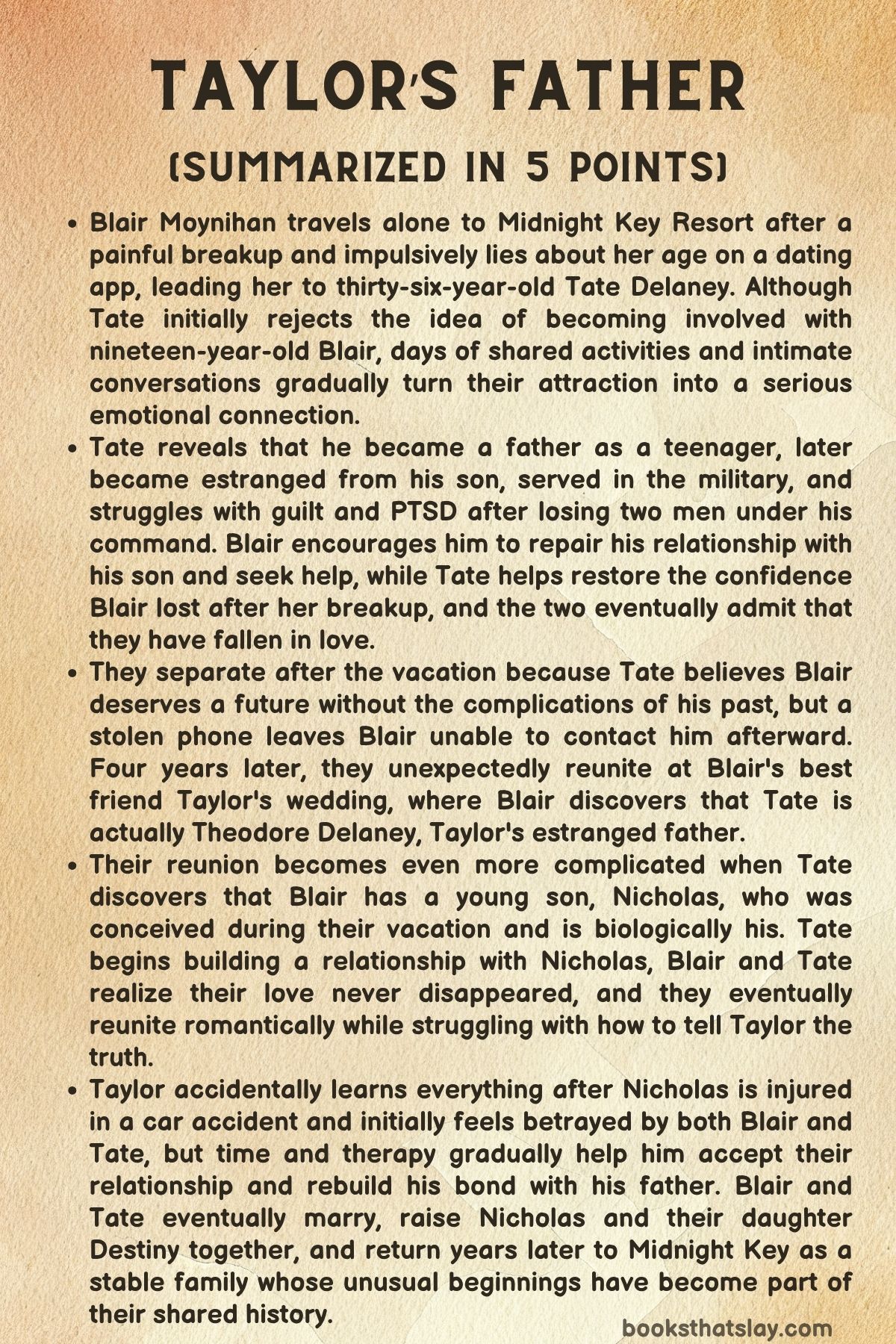
Summary
Blair arrives alone at Midnight Key Resort after her best friend Taylor gives her the vacation to help her recover from the end of her long relationship with Daniel. Having dated Daniel since she was fifteen, Blair sees the trip as a chance to reclaim some independence and prove that she can move forward without the future she once imagined with him.
She downloads a proximity-based dating app and impulsively creates an older identity for herself, calling herself Delores and claiming to be twenty-nine instead of nineteen. She quickly matches with Tate, a thirty-six-year-old man she had already noticed in the hotel lobby, and agrees to meet him at the resort’s kiddie pool because she wants their first meeting to happen somewhere public.
The deception begins falling apart almost immediately. Blair accidentally introduces herself as Doris rather than Delores, admits that the name is false, and finally confesses that she is nineteen when Tate questions whether anything else on her profile is untrue.
Tate is strongly attracted to her but refuses to continue their planned encounter after discovering the seventeen-year age difference. Blair argues that she is legally an adult and capable of deciding whom she wants, but Tate believes they are at completely different stages of life and walks away despite their obvious chemistry.
Their separation does not last. Blair signs up for a helmet-diving excursion and discovers that Tate is the only other participant, forcing them to spend the day together.
The shared activity softens the tension between them. Blair apologizes sincerely for lying, Tate accepts her apology, and both begin revealing more about themselves, including the fact that Tate has a child Blair’s age and has never been married.
Although Tate continues insisting that their relationship should remain limited, he asks Blair to dinner. Their meal becomes a mixture of teasing, attraction, and serious conversation, with Blair even joking to the waitress that Tate is her father and arranging a fake birthday celebration for him.
Blair explains that she invented her older identity because she wanted temporary freedom from the sadness surrounding her breakup. Tate admits that he swiped on her because he found her beautiful, but he continues worrying that nineteen and thirty-six represent very different emotional realities.
As they continue spending time together, Tate reveals the parts of his past that have shaped his self-image. He became a father at seventeen, gradually lost his place in his son’s life after the relationship with the boy’s mother deteriorated, suffered an ACL injury that ended his football prospects, and later joined the military.
During his military service, two men died in a convoy Tate was leading. He has carried guilt and PTSD ever since, and although he later built a successful construction business, he recognizes that professional success never repaired his failures as a father or healed his trauma.
Blair encourages him to reconnect with his son rather than allowing regret to become permanent. Tate is increasingly affected by her maturity and compassion, qualities that challenge his belief that her age automatically means she cannot understand him.
Their days together become increasingly couple-like. They have breakfast, kayak, drink coffee, attend a couples’ massage, walk along the beach, and spend long periods talking about their fears and histories.
Tate repeatedly admits that he wants Blair while continuing to resist acting on that desire. Blair eventually tells him that she will stop deliberately tempting him because she respects his decision, but Tate realizes that her behavior was never the real obstacle; his own feelings are becoming impossible to control.
That control weakens further after Blair sees Tate with Langley, an old family acquaintance and former romantic partner. Tate follows Blair when she walks away and admits that Blair is the only woman occupying his thoughts, then finally kisses her before stopping himself from going further.
Blair finally tells Tate her real first name, although neither learns the other’s surname. Their decision to preserve some anonymity is intended to make the inevitable separation easier, but by this point their emotional attachment has already become much deeper than either expected.
A nighttime swim leads to a humorous jellyfish incident, followed by a serious conversation in which both admit that saying goodbye will hurt. Tate tells Blair that meeting her has made him feel alive again, while Blair realizes that the man she originally approached for temporary excitement has become someone she genuinely loves.
On what appears to be their final full day, Tate finds a letter claiming Blair has checked out early. Devastated, he searches for her and realizes how deeply he regrets refusing opportunities to be closer to her.
Blair then appears and reveals that the letter was an April Fool’s prank designed partly to make Tate confront how losing her would feel. Although Tate is furious, the shock removes the last of his resistance, and they finally allow their relationship to become fully romantic.
They extend Blair’s trip by one day because neither is ready to separate. Tate nevertheless refuses Blair’s suggestion that they continue dating afterward, believing that his age, PTSD, complicated history, and failures as a father make him unsuitable for a young woman still beginning her adult life.
Blair does not share his negative view of himself, but she accepts that she cannot force him to imagine a future. Their final days are therefore filled with affection and sadness as they take photographs, share personal memories, and try to preserve every detail of their time together.
Before leaving, Blair gives Tate a letter. Tate puts his phone number into her phone but deliberately does not ask for hers because he fears that if he had it, he would not be able to maintain the separation he believes is best for her.
After Blair leaves, Tate reads her letter and discovers that she loves him. He finally admits to himself that he loves her too and decides that losing her should at least motivate him to repair his relationship with his son and seek help for his PTSD.
Blair intends to keep Tate’s number, but disaster strikes during her trip home when a thief steals her bag and phone. Because she never learned Tate’s surname, she has no practical way to locate him, turning their planned separation into four years of complete silence.
Four years later, Blair attends Taylor’s wedding. Taylor explains that his relationship with his estranged father has improved considerably, but Blair is stunned during the ceremony when she gradually realizes that Taylor’s father is Tate.
The wedding program identifies him as Theodore Delaney, and the truth becomes unavoidable when Taylor innocently introduces Blair to his father. Neither Blair nor Tate ever understood their connection because Tate was a military nickname, his relatives knew him as Theodore or Teddy, and neither Blair nor Tate exchanged surnames during the vacation.
Their private conversation confirms that neither deliberately deceived the other. Tate learns that Blair never called because her phone was stolen, while Blair learns that Tate had interpreted her silence as a deliberate choice.
Both admit that they never forgot each other. Tate has also moved to Massachusetts partly to remain closer to Taylor, but he is currently dating Leah, making their renewed emotional connection even more complicated.
Two weeks later, Tate becomes impatient with Blair’s request for space and goes to her home. There he sees a young boy named Nicholas and immediately recognizes the resemblance.
Blair confirms that Nicholas is Tate’s son. She became pregnant despite using protection and tried repeatedly to locate Tate, but the nickname, the absence of his surname, and his unusual connection to the resort made finding him nearly impossible.
Tate is devastated that he has missed the first years of another son’s life, yet Blair makes clear that his absence was not intentional. A paternity test later confirms what they already believe, and Tate begins developing a relationship with Nicholas while Blair adjusts to sharing parental responsibility for the child she has raised alone.
Their biggest concern remains Taylor. He already loves Nicholas as Blair’s child and considers himself the boy’s honorary uncle, but he does not know that Nicholas is actually his younger half-brother.
Tate and Blair initially try to restrict themselves to co-parenting. Their attraction has never disappeared, however, and Tate struggles especially when Blair agrees to a date with Adam, a man Taylor hopes she might like.
Tate babysits Nicholas while Blair goes out with Adam, but eventually admits by text that he cannot continue pretending he is comfortable watching her move toward someone else. Blair returns and confesses that the date meant little because she was thinking about Tate the entire time.
They reunite romantically, both recognizing that four years of separation failed to destroy their love. Tate also shows Blair a letter he wrote a year after their original goodbye, revealing that he had continued loving her even when he believed they would never meet again.
Tate soon realizes that Blair and Nicholas represent the family life he wants permanently. He asks Blair to consider living with him after the truth becomes public, and they openly acknowledge that their future now belongs together.
Before they can tell Taylor, Blair and Nicholas are involved in a car accident. Nicholas temporarily loses consciousness, and a terrified Tate rushes to the hospital.
When Nicholas wakes, Tate instinctively tells him that Daddy loves him. Taylor happens to be standing in the doorway and hears everything.
Taylor reacts with shock and anger. Tate explains that he was the older man Blair met four years earlier, that neither of them knew about their connection to Taylor, and that Nicholas is his biological son.
Taylor accuses Tate of taking advantage of Blair when she was nineteen, but Tate explains that he repeatedly resisted the relationship and that Blair pursued him knowingly. Blair later gives Taylor the same explanation, insisting that she never viewed herself as Tate’s victim and still considers their relationship mutual.
Time gradually changes Taylor’s reaction. He preserves his bond with Nicholas, begins therapy, prepares for the birth of his own child with Juliana, and eventually decides that continuing to carry resentment will only damage his future.
Taylor slowly rebuilds his relationship with Tate and finally gives his blessing when Tate admits that he wants to marry Blair. The approval matters because Blair remains one of Taylor’s closest friends and because Tate does not want his happiness to require sacrificing his son again.
Nicholas eventually learns that Tate is his father and accepts the news with uncomplicated affection. Blair and Nicholas move into a new home with Tate, and their separate lives begin becoming a stable family.
After Nicholas’s surname is legally changed to Delaney, Tate proposes to Blair outside the courthouse with Nicholas helping him. Blair accepts, knowing that both her father and Taylor have already given their blessings.
Taylor and Juliana soon welcome a daughter, whom they name Delaney Marie Shea. The choice of Delaney as her first name becomes an especially meaningful sign that Taylor has accepted Tate and reclaimed part of the family identity he once rejected.
Five years later, Blair and Tate are married and return to Midnight Key with Nicholas and their younger daughter, Destiny. Blair has completed her education and works as a labor-and-delivery nurse, while Tate arranges his work schedule so that they can share responsibility for their children.
Taylor served as Tate’s best man, and their relationship has continued to heal. Back at the resort where everything began, Blair and Tate revisit the strange, funny, painful circumstances that eventually produced their family, ending with the revelation that their daughter’s full name is Destiny Doris-Delores Delaney, permanently preserving Blair’s ridiculous fake dating-app identity.
Characters
Blair Moynihan
Blair begins Taylor’s Father at a moment when much of her identity has been destabilized. She has spent years imagining a future with Daniel, so his rejection leaves her not only heartbroken but uncertain about who she is outside the relationship.
Her false dating profile reflects that uncertainty. By pretending to be twenty-nine and calling herself Delores, Blair experiments with becoming someone older, bolder, and less emotionally vulnerable, but the lie also shows how desperate she is to temporarily escape the version of herself that has just been rejected.
What makes Blair more complex than an impulsive young heroine is her willingness to acknowledge when she has behaved unfairly. She apologizes to Tate for lying about her age and understands that attraction does not erase his right to know the truth before deciding whether he wants involvement with her.
Blair also proves emotionally perceptive. She listens carefully when Tate speaks about his estranged son, military trauma, and feelings of failure, and she consistently encourages him to stop treating past mistakes as permanent definitions of his character.
Motherhood transforms her further. When she becomes pregnant and cannot locate Tate, she reorganizes her life around Nicholas, temporarily delaying nursing school and accepting the responsibilities of single parenthood without turning Tate into a villain for an absence he never chose.
Her greatest strength is the combination of emotional honesty and resilience she develops over time. By the end of the novel, Blair is no longer trying to perform maturity through a false age; she has actually built an adult life through difficult choices, parenthood, education, forgiveness, and the courage to reclaim a love that still matters to her.
Tate Delaney
Tate is the emotional center of Taylor’s Father because nearly every major conflict connects to his fear that his past has made him undeserving of happiness. His attraction to Blair is immediate, but his first instinct after learning her true age is restraint rather than pursuit.
His concern about the age difference is tied to his own history as much as social judgment. Having become a father at seventeen and later lost closeness with Taylor, Tate looks at Blair and sees someone standing near the same beginning of adulthood at which his own life became complicated.
Military trauma deepens that self-distrust. Tate believes that his decisions contributed to the deaths of men under his command, and the resulting PTSD reinforces an existing tendency to interpret painful outcomes as proof of personal failure.
His construction success cannot solve these emotional problems. Money gives him stability, but it does not restore his relationship with Taylor, remove his guilt, or convince him that he deserves lasting love.
Blair challenges his habit of deciding what is best for everyone else. Tate repeatedly frames separation as a sacrifice for Blair’s benefit, but his eventual growth requires understanding that respecting another adult also means allowing that person to make choices he would not make for them.
Fatherhood becomes the clearest measure of his development. He repairs his relationship with Taylor, accepts Nicholas immediately, refuses to threaten Blair’s parental security, and learns to participate in family life through patience rather than grand gestures.
By the end, Tate is still someone who regrets his mistakes, but he no longer allows regret to control every future decision. His growth lies in accepting therapy, love, responsibility, and forgiveness without believing that receiving those things somehow excuses the past.
Taylor
Taylor occupies a uniquely complicated position in Taylor’s Father because he unknowingly connects Blair and Tate long before any of them understand the full relationship among them. He gives Blair the resort vacation that leads her to Tate, making him indirectly responsible for the meeting that eventually changes all three lives.
As Blair’s closest friend, Taylor represents safety and familiarity. She trusts him enough to accept the trip from him, relies on his friendship after Daniel’s rejection, and later feels enormous guilt because she knows that revealing the truth about Tate could make Taylor interpret years of friendship as deception.
His relationship with Tate carries old damage. Taylor grew up with an emotionally inconsistent father and has legitimate reasons for resenting the years when Tate allowed shame, military service, work, and distance to weaken their bond.
This history explains why the discovery of Blair and Nicholas affects him so severely. Taylor does not merely discover that his father is in love with his best friend; he learns that his father has another son, that people close to him kept the truth temporarily, and that the friendship he thought he understood contains a history he never imagined.
His initial accusation that Tate exploited nineteen-year-old Blair reflects both protectiveness and unresolved anger. Taylor eventually has to accept Blair’s agency even when her interpretation of the relationship conflicts with his own instincts.
His decision to seek therapy is one of his most important actions. Rather than pretending that forgiveness happens instantly, Taylor recognizes that resentment consumes emotional energy and consciously chooses to work toward a healthier relationship before becoming a father himself.
His eventual acceptance is shown through behavior rather than a sudden change of opinion. He remains close to Nicholas, gives Tate permission to propose to Blair, includes Tate in his daughter’s life, and gives that daughter the name Delaney, demonstrating that forgiveness has become part of how he chooses to build his own family.
Nicholas
Nicholas gives Taylor’s Father its most important connection between the romance and the family story. He is not simply evidence of Blair and Tate’s past relationship; his existence forces both of them to confront what was lost during their four years apart and what can still be recovered.
Blair raises him with considerable care and stability. Nicholas is presented as affectionate, secure, and trusting, suggesting that Blair has worked hard to ensure that the absence of a known father does not become the defining emotional fact of his childhood.
For Tate, meeting Nicholas is both joyful and devastating. Every ordinary experience with the boy reminds him that he missed years he can never recover, yet Nicholas also gives him a rare opportunity to approach fatherhood without repeating the mistakes that damaged his relationship with Taylor.
Their bond develops through simple experiences rather than instant declarations. Nicholas takes Tate’s hand at the aquarium, plays with him, stays at the rented house, enjoys Tate’s attention, and gradually comes to trust the man he initially knows only as “Mr. T.”
The revelation that Tate is his father is handled with a simplicity that contrasts sharply with the adults’ fears. Nicholas sees the physical resemblance between himself and a childhood photograph of Tate, listens to the explanation, confirms that Blair remains his mother, and begins calling Tate “Daddy.”
Nicholas also becomes an unexpected bridge between Tate and Taylor. Taylor’s continuing love for the child survives his anger toward Tate and Blair, and his decision to share childhood toys with Nicholas shows that brotherhood can exist even before every emotional wound among the adults has fully healed.
Daniel
Daniel has limited direct presence, but his impact on Blair’s life is substantial. Because Blair dated him from adolescence into young adulthood, their breakup destabilizes her assumptions about love, desirability, and the future she expected to have.
His rejection indirectly pushes Blair toward the decision to reinvent herself at Midnight Key. Her initial interest in Tate is partly an attempt to prove that Daniel’s departure has not destroyed her attractiveness or ability to choose a different life.
Over time, however, Daniel becomes less important precisely because Blair’s growth no longer depends on him. Her connection with Tate begins as a reaction to the breakup but develops into something independent of Daniel.
His later attempt to return when Blair is heavily pregnant provides Blair with a satisfying reversal. She no longer needs validation from the boy who once defined her romantic life, and his presence mainly emphasizes how far she has moved beyond the person she was when he left.
Leah
Leah represents the life Tate is trying to build before Blair unexpectedly reappears. She is not portrayed as cruel or manipulative, which makes Tate’s emotional withdrawal from their relationship a matter of responsibility rather than simple romantic competition.
Once Blair returns, Tate becomes increasingly unable to give Leah genuine attention. His cancellations and emotional distance reveal that continuing the relationship would be unfair because his unresolved love for Blair has immediately become central again.
Tate eventually ends the relationship rather than maintaining Leah as a convenient alternative. That choice marks an important difference between avoiding loneliness and choosing a specific person.
Leah therefore functions as evidence that Tate can attempt to move forward without ever fully leaving Blair behind. Her presence also forces him to act honestly before pursuing the relationship he actually wants.
Adam
Adam is introduced as a potential romantic partner for Blair through Taylor’s attempts at matchmaking. He is pleasant, attractive, and apparently suitable, but the absence of any strong emotional response from Blair demonstrates how deeply her attachment to Tate has survived.
Blair agrees to date Adam partly because she believes that a future with Tate is morally and practically impossible. The date therefore becomes less about Adam himself than Blair’s attempt to behave according to what she thinks a sensible future should look like.
Tate’s reaction to the date exposes the dishonesty in his own claim that he wants Blair to move on. He genuinely wants her to experience opportunities she may have missed as a young single mother, yet jealousy forces him to admit that watching her build a romantic life with someone else is unbearable.
Adam remains decent throughout, which prevents Blair’s choice from becoming a simple comparison between a good man and a bad one. She returns to Tate because her feelings are already committed, not because Adam gives her a reason to reject him.
Langley
Langley appears briefly but plays an important role in forcing Tate to acknowledge the intensity of his feelings for Blair. As an old acquaintance and former romantic partner, she represents a socially uncomplicated option from Tate’s own age group and background.
Her kiss on Tate’s cheek creates jealousy in Blair, but Tate’s reaction is more revealing than Langley’s behavior. He immediately follows Blair, explains that he has no romantic interest in Langley, and admits that Blair is the woman dominating his thoughts.
Langley also becomes an indirect link between Tate and his family because news of his involvement with a younger woman reaches his mother through social connections. Instead of producing the condemnation Tate expects, the situation gives his mother an opportunity to challenge his assumption that age alone should determine whether two adults belong together.
Tate’s Mother
Tate’s mother provides one of the more balanced adult perspectives in the book. She understands her son’s past failures and the fragility of his relationship with Taylor, yet she refuses to treat lifelong self-punishment as a meaningful form of accountability.
When she learns about Blair, she does not respond with the judgment Tate anticipates. Her position is that age matters but cannot be the only measure of compatibility when two adults have formed a genuine bond.
Her response becomes even more significant after she learns that Nicholas is her grandson. She is overwhelmed by the discovery but quickly focuses on building a relationship with the child rather than assigning blame for circumstances no one deliberately created.
She also challenges Tate’s belief that sacrificing Blair will protect Taylor. Her argument is that Taylor is an adult capable of processing painful truths and that denying everyone else happiness will not undo the years Tate already lost with his older son.
Blair’s Mother
Blair’s mother offers a more protective perspective. She already knows that Nicholas’s father was an older man Blair met during her vacation, but discovering that the man is Taylor’s father dramatically raises the emotional stakes.
Her concerns are reasonable rather than hostile. She worries about the age difference, Tate’s past with Taylor, Blair’s continued feelings, and the possibility that the situation could damage relationships her daughter values.
At the same time, she listens to Blair’s defense of Tate and recognizes the obvious resemblance between Tate and Nicholas. Her willingness to reconsider him shows that parental concern does not have to become permanent opposition.
She also encourages Blair to accept financial support for Nicholas. This advice helps Blair understand that independence does not require carrying every responsibility alone once Tate is available and willing to participate as a father.
Craig
Craig, Blair’s father, has relatively limited presence but represents the parental reaction Tate fears most. Tate understands why a father might resent a thirty-six-year-old man becoming involved with his nineteen-year-old daughter and approaches Craig with humility rather than defensiveness.
Craig admits that he initially wanted to dislike Tate. His eventual acceptance comes from observing Blair’s happiness and Tate’s commitment to Nicholas rather than simply accepting explanations about the past.
When Tate reveals that he intends to marry Blair, Craig gives his blessing. His joking hope that Tate will someday have a daughter of his own adds humor while also recognizing that Tate may one day understand the protective discomfort Craig originally experienced.
Juliana
Juliana is important mainly through her relationship with Taylor and the family future she helps create. Her pregnancy becomes one of the reasons Taylor begins reconsidering his anger because approaching fatherhood forces him to think differently about parents, mistakes, forgiveness, and the emotional inheritance he wants to pass to his own child.
The birth of her daughter marks a major change in the Delaney family. Taylor wants Tate involved in the baby’s life, showing that he no longer intends to punish his father through permanent exclusion.
The name Juliana and Taylor choose, Delaney Marie Shea, carries particular emotional significance. By giving their daughter Delaney as a first name, they create a family connection that Taylor himself had previously resisted, turning the next generation into evidence of reconciliation.
Destiny Delaney
Destiny appears only in the later family future, but she represents the stability Blair and Tate eventually achieve. Her presence proves that their relationship becomes not merely a reunion based on nostalgia but a lasting marriage capable of supporting an expanded family.
Her nickname, Dessy, adds warmth to the domestic picture of Blair and Tate’s later life. More importantly, her full name, Destiny Doris-Delores Delaney, preserves the absurd false identity Blair used when she first met Tate.
The name transforms an early mistake into a family joke. Something that once symbolized Blair’s insecurity and dishonesty is remembered years later with affection because the people involved survived the consequences and built a life from the unlikely encounter it created.
Themes
Age, Maturity, and Personal Agency
Taylor’s Father repeatedly questions whether chronological age can serve as a complete measurement of emotional maturity. Tate initially treats the seventeen-year age difference as an almost automatic reason to reject Blair, while Blair argues that being younger does not eliminate her ability to understand her own choices.
The novel does not pretend that the age difference is meaningless. Tate and Blair genuinely occupy different stages of life, and Tate has decades of experience involving parenthood, military service, trauma, business ownership, and regret that Blair has not yet accumulated.
The conflict comes from Tate turning those differences into a reason to override Blair’s judgment. His protective instinct appears honorable, but it also becomes paternalistic when he repeatedly decides what future is supposedly best for her without fully accepting that she has the right to disagree.
Blair’s development strengthens this theme because she eventually becomes a mother, resumes her education, raises a child alone, and spends four years handling responsibilities far beyond the impulsive behavior she displayed at the resort. Her adulthood is demonstrated through experience rather than simply through the passing of time.
Taylor’s later anger reopens the same question from another perspective. He initially believes Blair was exploited, but Blair firmly refuses that interpretation and insists on being recognized as an active participant in her own history.
The story therefore treats maturity as something influenced by age without being determined entirely by it. Respecting an adult partner requires concern about differences in experience, but it also requires respecting that person’s ability to define the meaning of their own choices.
Guilt, Accountability, and Self-Forgiveness
Tate’s life is shaped by a habit of converting mistakes and tragedies into permanent judgments about himself. His failed early relationship with Taylor, the deaths of fellow soldiers, his PTSD, and years of emotional distance convince him that he is someone whose presence may damage the people he loves.
This mindset appears responsible because Tate openly acknowledges his failures. The problem is that guilt becomes another form of avoidance when he uses it to justify refusing therapy, distancing himself from Blair, and deciding that other people will be safer without him.
Blair repeatedly challenges that logic. She does not excuse the choices that harmed Taylor or pretend Tate’s trauma can disappear through romance, but she argues that acknowledging a mistake should lead to changed behavior rather than endless self-punishment.
Taylor eventually faces a related problem. His resentment toward Tate is understandable, yet therapy helps him recognize that maintaining anger indefinitely will consume emotional energy he wants to give his wife and child.
Forgiveness in the novel therefore does not mean pretending harm never occurred. Tate must repair relationships, become present for Nicholas, accept professional help, and respect the emotional consequences of his past before reconciliation becomes possible.
The story ultimately distinguishes guilt from accountability. Guilt keeps characters emotionally trapped, while accountability requires action, patience, changed behavior, and the willingness to accept that another person may need time before trust can return.
Family as Something Rebuilt
Family in Taylor’s Father is repeatedly damaged, rearranged, and rebuilt rather than presented as a fixed structure. Tate begins with an estranged adult son, later discovers another son he never knew existed, reunites with the woman who raised that child alone, and eventually becomes part of a family containing relationships no one could have anticipated.
Nicholas becomes central to this reconstruction. His existence forces Tate to confront the difference between being biologically connected to a child and being actively present in that child’s daily life.
Tate cannot recover Nicholas’s infancy, just as he cannot recreate Taylor’s childhood. What he can do is become dependable in the present, which is why ordinary moments such as preparing food, building a sandbox, giving baths, throwing a football, or rearranging work schedules matter so much.
Taylor’s role shows that reconciliation is not the same as forgetting. He does not instantly become comfortable with Blair and Tate, but he keeps loving Nicholas, begins therapy, gradually reconnects with his father, and eventually allows his daughter to know Tate as her grandfather.
Blair also has to adapt her understanding of family. Raising Nicholas alone makes her fiercely protective of the stability she created, so accepting Tate as an equal parent requires vulnerability as well as love.
By the end, family is defined through repeated acts of presence. Biological relationships create obligations, but loyalty, forgiveness, shared responsibility, and consistent participation determine whether those relationships actually become emotionally meaningful.
Chance, Timing, and Second Chances
Blair and Tate’s relationship is repeatedly determined by extraordinary timing. A breakup sends Blair to Midnight Key, Taylor unknowingly gives her the vacation, a dating app places Tate near her, an excursion reunites them after Tate initially walks away, and the theft of Blair’s phone later prevents them from contacting each other for years.
Their reunion is equally unlikely. Blair attends Taylor’s wedding believing Tate is somewhere permanently lost in her past, only to discover that the groom’s father is the man she has spent four years trying to find.
These coincidences could make the relationship seem driven entirely by fate, but the novel repeatedly places choices after each accident of circumstance. Meeting again does not automatically create a future; Blair and Tate must decide how to handle Nicholas, Leah, Taylor, parenthood, secrecy, and their continuing attraction.
Second chances also extend beyond the central romance. Tate receives another opportunity to become a better father, Taylor receives the opportunity to reconsider the meaning of forgiveness, Blair resumes the education interrupted by motherhood, and Nicholas gains the father whose absence had previously seemed permanent.
The later family life is therefore not presented as compensation automatically granted by destiny. It exists because characters respond differently when opportunities return.
Chance may bring people together, separate them, or expose truths at unexpected moments, but the lasting outcomes depend on what they choose afterward. The novel’s hopeful view of second chances rests on the idea that lost years cannot be recovered, yet the future does not have to be controlled by them.