Cash by Jessica Peterson Summary, Characters and Themes
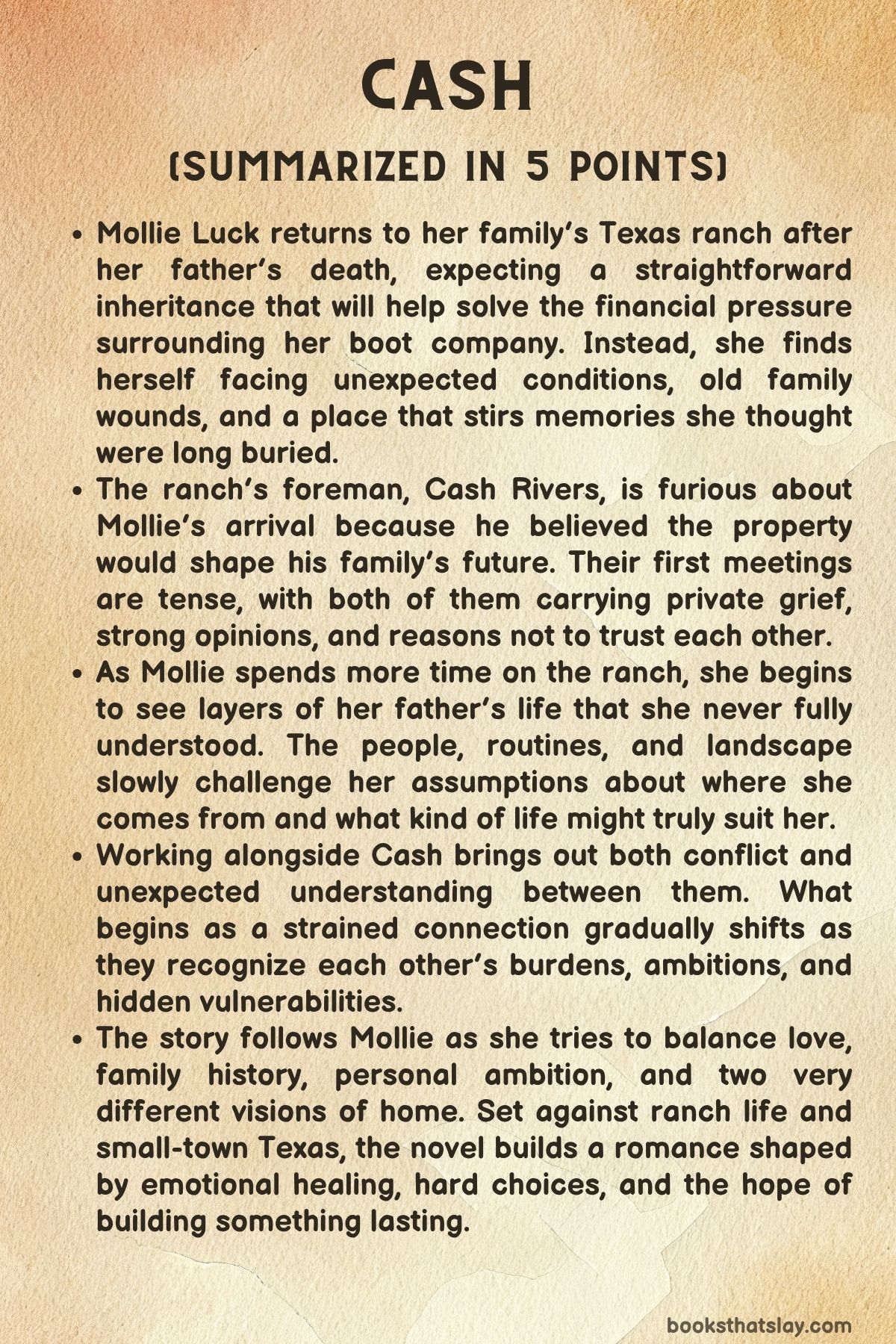
Cash by Jessica Peterson is a contemporary small-town cowboy romance set in Texas, and the first novel in the Lucky River Ranch series. At its center is Mollie Luck, a Dallas entrepreneur who returns to her late father’s ranch expecting a straightforward inheritance, only to find herself pulled into an unfamiliar life filled with hard work, old grief, and unfinished family history.
The story pairs a ranch setting with a strong emotional arc, following Mollie as she reconnects with the land she left behind and with Cash Rivers, the ranch foreman who believes the place should have been his. It is a romance about belonging, second chances, and building a future that makes room for love and ambition.
Summary
Mollie Luck returns to Hartsville, Texas, after the death of her father, Garrett Luck, a man she has been estranged from for most of her life. She expects to settle the estate quickly, sell the family ranch, and use the money to rescue her struggling cowboy boot business in Dallas.
Instead, she learns that Garrett has left her the ranch and its massive holdings, but with one condition: if she wants access to the full trust, she must live on the property for a year and take an active role in managing it. The demand shocks her.
Mollie has spent decades away from the ranch, carrying the hurt of her parents’ divorce and the bitterness that followed. She also discovers that Cash Rivers, the ranch foreman, believed Garrett intended to leave the ranch to him.
Cash is furious. After his parents died, Garrett became the closest thing he had to a father, giving him and his brothers work, housing, and stability.
Cash has spent years pouring himself into the ranch while trying to keep his own family land from falling apart. To him, Mollie is an outsider who abandoned Garrett long ago and has now come back only to sell everything.
Mollie, meanwhile, sees Cash as another painful reminder that her father built a life with other people while failing to repair his bond with her. Their first encounters are tense, shaped by anger, mistrust, and grief that neither fully understands.
Mollie initially plans to treat the ranch as a temporary obligation. Her business is in real trouble, and the monthly stipend tied to the will could keep it alive.
But once she settles into the ranch house, she starts to see pieces of her father that were hidden from her. The home still reflects the life he imagined with her mother.
Longtime ranch staff remember her fondly from childhood and tell her Garrett spoke about her often. These details shake her certainty.
She had built a story in which her father simply stopped caring, yet the ranch is full of signs that he never stopped loving her.
Cash does little to make her stay easy at first. He hopes the physical demands and discomfort of ranch life will send her back to Dallas.
He treats her like a spoiled city woman who cannot last. Yet Mollie surprises him.
She is out of place, inexperienced, and physically unprepared, but she keeps showing up. A difficult horseback ride leads to an unexpectedly vulnerable conversation between them, and for the first time Cash lets her see what Garrett meant to him.
Mollie finally voices the pain she has buried for years: that her father seemed able to show love and loyalty to the Rivers brothers in ways he never managed with her. Cash begins to understand that her distance from Garrett was not indifference but injury.
As the days pass, Mollie gets drawn into ranch life. She bonds with the people around her, including the wider circle that functions like family on the property.
She helps with meals, spends time with children visiting the ranch, and learns more about the rhythms of the work. The landscape, which at first feels alien, begins to feel familiar in a way she cannot explain.
Her long-standing stress symptoms start to ease. Away from the pressures of Dallas and the constant struggle of trying to prove herself through success, she feels healthier and calmer than she has in years.
Cash’s view of Mollie changes just as much. He sees that she is not careless or shallow, but driven, capable, and deeply wounded.
He admires how hard she works for her company and how seriously she takes the ranch once she decides to commit to it. He also sees her tenderness with the people and animals around her.
The hostility between them gives way to attraction, then to emotional intimacy. They begin talking honestly about family, responsibility, regret, and the futures they once imagined for themselves.
Cash, who has spent years taking care of others, lets himself admit that he wants a life that belongs to him too. Mollie, who has always measured her worth through achievement, starts to believe she could be loved without having to earn it through perfection.
Their growing connection becomes harder to deny. Nights out in town, shared workdays, private conversations, and small acts of care pull them closer.
Mollie tries to resist, even inviting a casual boyfriend from Dallas to visit as a distraction, but the plan backfires. The boyfriend behaves badly, Cash steps in to defend her, and the tension between Mollie and Cash finally breaks.
They come together passionately and begin a secret but intense relationship that deepens quickly. Their physical connection is strong, but what matters more is the sense of peace they find with each other.
For Mollie, Cash becomes the person with whom she can finally speak plainly. For Cash, Mollie becomes someone who sees beyond his role as the dependable older brother and ranch foreman.
As they fall in love, practical realities press in. Mollie’s business still needs her.
Cash’s life is rooted in the ranch and in the responsibilities he has carried for years. Then the legal barrier that forced Mollie to stay is removed.
Her mother’s lawyers succeed in overturning the will’s stipulation, meaning Mollie can leave at once and claim her full inheritance. Around the same time, a pregnancy scare forces Mollie and Cash to confront what they mean to each other.
The test is negative, but the emotional impact is large. Cash admits he loves her and says that if she had been pregnant, he would have asked her to marry him.
Mollie tells him she loves him too, but the freedom to leave now stands between them.
Their conflict is no longer about desire or misunderstanding but about how two people with real, deeply rooted lives can build something together. Mollie cannot simply abandon Dallas, her company, and the identity she has built there.
Cash cannot leave the ranch behind. Both know love alone will not solve the problem.
Still, they choose not to walk away from each other. Cash goes with Mollie to Dallas, where he steps into her world and meets the people who matter to her, especially her business partner Wheeler and her mother, Aubrey.
The meeting with Aubrey becomes a turning point. At first she distrusts Cash and assumes he wants access to Mollie’s money.
But Cash responds with calm honesty. He shows Aubrey and Mollie the family photographs Garrett left behind, proof that Garrett treasured the memories of their life together.
He also presents a practical vision for the future: a design studio for Mollie’s company on the ranch, paired with a life that allows them to move between Dallas and Texas Hill Country. His plan is not about limiting Mollie’s world but expanding it.
Aubrey, moved by his sincerity and by the evidence of Garrett’s enduring love, finally lets go of her assumptions and gives her support.
Back at the ranch, Mollie fully claims her place there, but not in the way anyone first expected. She does not want a setup where she is merely the owner and Cash remains only the foreman.
She wants partnership in both love and work. She proposes combining Lucky Ranch and the Rivers family property into a shared future.
Cash agrees, but with one condition: marriage. Mollie accepts, and together they create a new vision for the land and their lives.
By the end, the ranch is no longer just an inheritance or a battleground. It becomes the place where Mollie reconnects with her father’s memory, heals old wounds, strengthens her business, and builds a life with Cash.
For Cash, it becomes more than duty and sacrifice; it becomes home in a fuller sense, shaped by love, mutual respect, and hope. The story closes with both of them looking ahead, ready to build a future that joins their ambitions instead of forcing either one to give something up.
Characters
Mollie Luck
Mollie Luck stands at the emotional center of Cash as a woman caught between ambition, grief, and a longing for belonging that she has never fully admitted to herself. At first, she appears practical, polished, and determined to treat the ranch as a financial solution rather than an emotional inheritance.
She returns to Hartsville thinking in terms of survival: her business is in trouble, bills are mounting, and the inheritance seems like the one thing that can stabilize her life. Yet her confidence is fragile.
Much of her drive comes from a deeply rooted fear that she must prove herself in order to deserve love. That inner pressure shapes nearly everything she does, from the way she runs Bellamy Brooks to the way she manages her emotions.
She has spent years turning pain into productivity, and the result is a woman who looks capable from the outside but is carrying unresolved hurt from childhood.
What makes Mollie compelling is that her arc is not just about falling in love, but about revising the story she has told herself about her father, her past, and her own identity. She has believed for years that Garrett chose the ranch over her, and that belief has hardened into both resentment and regret.
Returning to the property forces her to confront a much more complicated truth. She begins to see that love existed even where repair failed, and that the distance between them was shaped not only by Garrett’s mistakes but by divorce, pride, influence, and time.
This realization does not erase her pain, but it makes her more emotionally honest. She stops performing indifference and allows herself to mourn what she lost.
Her growth is visible in both physical and emotional terms. The ranch initially overwhelms her, but she stays, learns, and gradually becomes stronger.
Her body changes along with her perspective: the stomach pain that has followed her through city life fades as she becomes happier and more grounded. That detail matters because it shows that her unhappiness was never abstract.
It lived in her body, in her routines, and in the frantic life she built around avoiding old wounds. By the end, she is still ambitious and still committed to her work, but she is no longer treating success as the sole proof of her worth.
She becomes someone capable of wanting both career and love, both Dallas and ranch life, both independence and partnership. Her journey is persuasive because she does not lose herself in romance; she becomes more fully herself through it.
Cash Rivers
Cash Rivers is written as a classic ranch hero on the surface, but his deeper function in the story is that of a man whose identity has been shaped almost entirely by duty. He is strong, dependable, hardworking, and deeply respected, yet those qualities come with real emotional cost.
After losing his parents, he gave up his own young adulthood to raise his younger brothers and help keep his family from collapse. Garrett’s support gave him stability, but it also tied his future to the ranch in a way that became nearly sacred.
Because of that history, his anger over the inheritance is not simple greed. For Cash, the ranch represents security, legacy, and the years of sacrifice he has poured into protecting something larger than himself.
When Mollie inherits it, he feels not only betrayed but displaced.
Cash initially judges Mollie harshly because he mistakes her distance for coldness and her polish for selfishness. He sees the expensive car, the Dallas life, and the plan to sell, and he assumes she values money more than people.
That reading reveals a blind spot in him. He is so used to measuring worth through labor, responsibility, and loyalty that he struggles to imagine how pain can take other forms.
His emotional development begins when he understands that Mollie is not careless but wounded. Once he sees the depth of her grief and the complexity of her relationship with Garrett, his hostility starts to look like a defense against his own vulnerability.
What gives Cash emotional force is the contrast between his public hardness and private tenderness. He is gentle with children, protective with family, devoted to animals, and unexpectedly patient when Mollie is frightened or in pain.
Those softer qualities are not sudden changes in character; they are aspects of him that were always present but hidden under anger and exhaustion. His romance with Mollie becomes meaningful because it asks him to imagine a future beyond obligation.
He has spent so long being the one who holds everything together that personal happiness feels almost indulgent. Loving Mollie forces him to ask whether he can have something for himself without failing the people who rely on him.
His greatest strength is steadiness, but his emotional limitation is that he often translates fear into control. He tries to drive Mollie away rather than admit how threatened he feels.
He delays speaking clearly about love because he is bracing for loss. Even so, he grows into a more open version of himself.
By the end, he is not merely the protector of family land but a true partner, willing to make room for another person’s ambitions instead of seeing them as threats. That shift turns him from a possessive figure into a generous one, and it is that generosity that makes him worthy of the ending he gets.
Garrett Luck
Garrett Luck is absent for the entire present-day narrative, yet he remains one of the most important figures because nearly every major conflict grows out of his choices, failures, and acts of love. He exists in the story through memory, testimony, legal arrangements, and the emotional imprint he left on others.
To Mollie, he is first the father who did not try hard enough, the man who let distance harden into estrangement. To Cash, he is the mentor and father figure who gave a grieving family a chance to survive.
These two versions of Garrett seem almost impossible to reconcile at first, and the novel gains much of its emotional power from refusing to flatten that contradiction. Garrett was generous, loving, and loyal, but he was also passive in crucial ways.
He cared deeply, yet he allowed regret to replace action.
His will becomes his final attempt to repair what he failed to repair in life. The stipulation that brings Mollie back to the ranch is controlling in one sense, but it is also deeply personal.
He seems to understand that money alone cannot restore what was broken; only place, memory, and lived experience can do that. By requiring Mollie to stay, he creates the possibility that she will encounter the landscape and community he loved, and through them understand both him and herself more clearly.
His choice is risky and imperfect, much like the man himself, but it is motivated by a desire to give his daughter something larger than wealth.
The photographs he leaves behind are especially revealing. They show that his happiest and most treasured memories remained tied to Aubrey and Mollie, even after the family fractured.
That detail prevents him from being reduced either to a neglectful father or a saintly patriarch. He is instead a man who never stopped loving his family, but who lacked the courage or skill to bridge the damage once it widened.
His role in the narrative is therefore tragic but not hopeless. He becomes the source of pain, reconciliation, and eventual renewal all at once.
By the end, his legacy is no longer only the estrangement he left behind, but the conditions he created for healing, partnership, and a new family structure to emerge.
Aubrey Luck
Aubrey functions as one of the story’s most complicated secondary figures because she represents both maternal care and emotional distortion. She clearly loves Mollie and wants to protect her, but that protectiveness often slips into control.
After her divorce from Garrett, she shaped the emotional environment in which Mollie understood her father, and that influence had lasting consequences. Aubrey is not written as a cartoon villain or a cold social climber.
She is intelligent, successful, and genuinely devoted to her daughter. At the same time, she is someone whose own bitterness colored the way Mollie interpreted childhood pain.
Her skepticism toward ranch life and toward cowboys is not just prejudice; it is the residue of disappointment, loneliness, and old resentment that she never fully put down.
What makes Aubrey interesting is that she is wrong in meaningful ways without being stripped of emotional credibility. She believes she is defending Mollie from a life that once made her deeply unhappy.
She sees Dallas as freedom, sophistication, and opportunity, while the ranch stands for isolation and sacrifice. From her point of view, urging Mollie to return to the city and sell the property is practical, even loving.
The problem is that Aubrey cannot initially imagine that Mollie’s emotional needs might differ from her own. She treats her daughter’s future as if it should confirm the choices she herself made, and in doing so she almost repeats the same dynamic of pressure and misrecognition that damaged Mollie’s relationship with Garrett.
Her later scenes are important because they allow her to evolve rather than remain fixed in suspicion. When she confronts the old photographs and hears Cash present a plan that does not ask Mollie to shrink her life, Aubrey softens.
She is moved not by empty declarations but by evidence that Mollie can be happy without being limited. That shift gives her dignity.
She becomes capable of admitting she misjudged Cash and of making room for a future she did not design. Aubrey’s character adds depth to the novel because she shows how love can become possessive when shaped by fear, and how even a parent with good intentions can leave emotional consequences that take years to understand.
Wyatt Rivers
Wyatt provides energy, humor, and emotional perspective, but he is more than comic relief. Among the Rivers brothers, he often acts as the one most willing to say aloud what others avoid.
He understands Cash well enough to see through his denial, and he serves as an informal commentator on the central romance by recognizing Cash’s feelings long before Cash fully admits them. That perceptiveness makes him an important supporting figure.
He helps translate the emotional atmosphere of the ranch, especially in scenes where pride and tension might otherwise keep things locked down.
At the same time, Wyatt reflects another possible way of living within the same family history. He experienced the same parental loss and economic instability as his brothers, yet he responds with a looser, more openly playful personality.
This difference highlights how responsibility has shaped Cash more heavily. Wyatt’s teasing often has genuine wisdom behind it.
He encourages Cash to consider the possibility of happiness rather than endless sacrifice, and he recognizes that a bond between Mollie and Cash could transform the future of both ranches. In this sense, Wyatt plays a quiet strategic role in the story.
He is not just reacting to events; he is one of the first to imagine a shared future that goes beyond resentment over inheritance.
He also contributes to the novel’s sense of family texture. The Rivers brothers feel lived-in because their dynamic includes affection, mockery, loyalty, and old patterns of dependence.
Wyatt brings much of that atmosphere into focus. He is confident, flirtatious, and occasionally reckless, which also sets up material for later books, but in this story his main purpose is to widen the emotional range of the ranch.
He reminds both Cash and the reader that life there is not only about hardship and grief. It also includes laughter, desire, possibility, and people who know how to keep one another moving when life becomes too heavy.
Wheeler
Wheeler is essential to understanding Mollie because she represents the life Mollie built for herself away from the ranch. As Mollie’s best friend and business partner, Wheeler is tied to her ambition, creativity, and chosen identity.
Their company is not a hobby or a backdrop; it is one of the clearest expressions of Mollie’s self-made adulthood. Wheeler therefore anchors the Dallas side of the story.
Through her conversations with Mollie, the reader sees the intensity of the financial pressure surrounding Bellamy Brooks and the emotional investment both women have in making it succeed. Wheeler knows Mollie well enough to joke with her, challenge her, and spot emotional truths she might rather avoid.
Her presence is especially valuable because she never functions as a rival to the romance or as a friend whose purpose is merely to endorse every decision. She is supportive, but she also sees when Mollie is deflecting.
When Mollie tries to cling to the idea of a casual relationship elsewhere or avoid confronting what Cash means to her, Wheeler responds with impatience and humor that push the truth into the open. She understands the emotional stakes without losing sight of the practical ones.
That balance makes her a believable friend and a strong supporting character.
Wheeler also matters symbolically. She stands for a version of female partnership that is not based on family or romance, but on work, trust, and shared risk.
Mollie’s eventual happiness does not require abandoning that bond. Instead, the ending suggests that love can expand her life rather than replace the parts of it she built herself.
Wheeler’s visit to the ranch later in the story reinforces this idea. She helps bridge the two worlds Mollie loves, and her approval of the life taking shape there signals that Mollie’s future does not have to come at the cost of her former one.
That makes Wheeler a stabilizing figure in a novel built around change.
Goody Gershwin
Goody plays a deceptively important role because she is one of the few people positioned between the legal, emotional, and communal dimensions of the story. As the attorney who delivers Garrett’s will, she is the first person to set the plot into motion, but she is more than a bearer of legal information.
She understands the people involved, the history behind the inheritance, and the tensions that are likely to erupt. Her attitude suggests that Garrett trusted her not just as a professional but as someone capable of carrying out his wishes with discretion and firmness.
Goody’s significance lies in the way she steadies the narrative when emotions run high. She does not indulge Cash’s outrage or Mollie’s panic, but neither does she treat either one without sympathy.
She knows that the ranch is not simply property; it is memory, livelihood, identity, and unfinished family business. Her decision to remain somewhat evasive about certain legal outcomes adds to the tension, but it also suggests that she respects Garrett’s broader intention.
She wants the process to unfold in a way that gives people room to discover what the inheritance really means.
In a story full of emotionally charged people, Goody brings clarity without becoming mechanical. She also connects Mollie to the ranch community in a way that is gentler than Cash’s early hostility.
By preparing the house and helping reintroduce Mollie to the place, she acts almost like a gatekeeper who allows the return to happen. Her role is quiet, but she helps move the story from conflict toward possibility.
Without her, the inheritance would remain a legal dispute; with her, it becomes the beginning of transformation.
Patsy
Patsy helps define the emotional atmosphere of the ranch by embodying nourishment, blunt honesty, and maternal warmth. From Mollie’s first days back, Patsy offers the kind of welcome that cuts through formality and suspicion.
Her food, humor, and easy affection introduce Mollie to a version of community that feels immediate and lived-in rather than ceremonial. In a novel concerned with family in both biological and chosen forms, Patsy is one of the clearest examples of how care is practiced daily rather than merely declared.
She also plays an important balancing role in relation to Cash. Where he is guarded, she is expressive.
Where he is likely to let pride dictate his behavior, she is willing to scold him openly when he is rude or unfair. This matters because it prevents the ranch from feeling like a male space ruled by silent authority.
Patsy’s presence ensures that emotional intelligence and plainspoken correction are part of the household structure. She can be funny and sharp at the same time, and she helps expose the childishness in Cash’s early treatment of Mollie.
Patsy’s role in the broader social world of the ranch also reinforces the story’s emphasis on belonging. She is part of a network of relationships that turns the property into something warmer than a workplace.
Her acceptance matters because Mollie, despite being the legal heir, still has to earn a place emotionally. Patsy does not make that belonging conditional on performance.
Instead, she helps create a space in which Mollie can begin to feel at home before she fully believes she deserves to.
Sally
Sally’s role is relatively secondary in the main romantic plot, but she is important because she adds another dimension to the world of the ranch and to its generational continuity. As a veterinarian and the daughter of John B and Patsy, she represents competence, rootedness, and the future of the local community.
She is capable and self-possessed, and her presence helps show that the ranch is not populated only by cowboys and caretakers in traditional forms. Women here are also professionals, workers, and central participants in ranch life.
Her interactions with the Rivers brothers, especially the concern over Wyatt’s interest in her, create small but effective tensions that deepen the sense of a living community. She is not just there to fill space; she is someone whose choices matter to the families around her.
That makes the ranch feel socially dense rather than isolated. Sally’s eventual importance in the closing pages also signals that the world of the novel extends beyond Mollie and Cash, setting up emotional threads that continue after their central conflict is resolved.
What she contributes most to this story is contrast. Mollie arrives as someone disconnected from the place, while Sally is wholly at ease within it.
That contrast helps show what Mollie gradually grows into. Sally is part of the social model of ranch womanhood that does not erase skill, independence, or authority.
In that sense, she quietly broadens the novel’s imagination of what life in Hartsville can look like.
Themes
Family as Both Wound and Shelter
Family in Cash is never presented as a simple source of comfort. It is the place where the deepest injuries begin, but also the place where healing becomes possible.
Mollie’s relationship with her father is the clearest example. She grows up carrying the pain of his absence and the belief that he chose the ranch over her.
That emotional wound shapes her adult life far beyond what she openly admits. It affects her sense of worth, her need to succeed, and her instinct to keep moving rather than sit with grief.
Yet the story does not stop at that injury. By returning her to the ranch, the narrative places her inside the emotional geography of her father’s life and shows that family bonds can remain active even after years of silence.
Garrett failed her in real ways, but he also loved her deeply. The tension between those truths gives the theme its force.
The same complexity appears in the Rivers family. Cash becomes a parent figure to his younger brothers after their parents die, and that burden defines him.
Family, for him, is not only love but labor, sacrifice, and responsibility that never truly ends. He has built himself around what others need from him.
This creates stability, but it also delays his own happiness. Through Cash, the novel shows that family can give purpose while also narrowing a person’s idea of what they are allowed to want for themselves.
Chosen family is just as important as biological family. Patsy, John B, Goody, Tallulah, the brothers, and the wider ranch circle create a community that functions as emotional shelter.
Mollie is not healed by romance alone. She is changed by being welcomed into meals, routines, teasing, and acts of care that ask nothing immediate from her except presence.
That matters because it expands the theme beyond parent-child reconciliation. Family here is shown as something built through memory, labor, protection, and mutual recognition.
The novel argues that people can inherit emotional belonging as surely as they inherit land. Even when blood ties fail, the need for home remains, and the story imagines family not as a fixed structure but as something that can be repaired, extended, and redefined.
Belonging, Place, and the Meaning of Home
The ranch is far more than a backdrop. It is the material form of memory, identity, conflict, and possibility.
Home in this novel is not reducible to where someone was born or where they currently live. Instead, home becomes the place where a person is able to recognize themselves more fully.
Mollie begins the story believing that Dallas is her real life and Hartsville is an inconvenient detour attached to old pain. That view makes sense given her history, but the longer she stays, the more the ranch works on her in ways she cannot control.
The land is tied to childhood memory, to her father’s unfinished love, and to a slower rhythm of life that allows her to feel present in her own body. Her stomach pain fading is one of the clearest signs that place is affecting her not just emotionally but physically.
The novel suggests that alienation can become so normal that a person forgets what ease feels like until they experience it again.
Cash’s connection to place is different but equally deep. For him, the ranch is not rediscovery but responsibility.
It represents labor, continuity, and the promise he has made to his brothers and to Garrett’s memory. He belongs there so thoroughly that leaving feels almost impossible to imagine.
This difference between Mollie and Cash creates one of the novel’s central tensions. She must learn that Hartsville can still claim her, while he must learn that belonging to a place does not have to mean being trapped by it.
Their relationship becomes a test of whether home can stretch enough to include two different forms of attachment.
The novel refuses the idea that one life must cancel the other. Dallas is not treated as false or empty simply because the ranch is emotionally richer.
Mollie’s work, friendships, and ambitions there are real. The eventual solution matters because it honors that complexity.
Rather than forcing Mollie to choose one world and reject the other, the story imagines home as something that can be expanded through love, planning, and partnership. This is why the design studio matters so much symbolically.
It is not just a business plan. It is a physical answer to an emotional problem: how to build a life where identity does not have to split in two.
In that sense, home becomes not a place of purity or return, but a place remade to fit the truth of who the characters have become.
Love as a Force That Reorders Identity
Romance in Cash is not treated merely as desire or escape. It changes how both central characters understand themselves, what they think they deserve, and what kind of future they can imagine.
Mollie and Cash are drawn together partly through attraction, but the relationship matters because it unsettles the identities they had settled into before meeting each other honestly. Mollie has built herself around striving.
She is polished, driven, and always moving toward the next solution because stillness would mean confronting grief, insecurity, and unmet emotional needs. Cash has built himself around duty.
He is the one who works, provides, protects, and absorbs pressure without asking for very much in return. Love disrupts both of these arrangements.
For Mollie, being with Cash creates a new experience of being seen without performance. He admires her work ethic and intelligence, but he also values her when she is vulnerable, hurting, uncertain, or simply present.
That matters because she has spent years acting as though competence can protect her from rejection. In loving Cash, she begins to imagine a version of herself that is not constantly trying to earn affection through excellence.
Her emotional healing is tied to this shift. She becomes more direct, more honest, and more willing to admit what she wants.
For Cash, love loosens the grip of self-denial. He has lived for so long in service to family and ranch that personal desire feels secondary at best.
Loving Mollie forces him to recognize that wanting joy does not make him selfish. It also teaches him that partnership is not the same as losing control.
At first he responds to fear with hostility and possessiveness, but over time he becomes capable of something more generous: making room for another person’s ambitions and designing a future that does not demand surrender from either side.
This theme works because the love story is not detached from material life. The problem is not whether they care for each other enough, but whether that care can survive distance, class difference, family history, and conflicting obligations.
The answer the novel offers is not fantasy without compromise. It is that love becomes meaningful when it helps people imagine more truthful versions of themselves and then act on them.
In that sense, romance is transformative not because it erases conflict, but because it gives the characters the courage to stop living inside identities built only from pain or duty.
Inheritance, Legacy, and the Question of What Is Truly Passed Down
Inheritance in this novel begins with land, money, and legal control, but it gradually becomes a larger question about emotional legacy. Garrett leaves Mollie a ranch, a trust, and a condition, yet what he is really passing down is unfinished history.
The estate forces Mollie and Cash to confront what Garrett meant to each of them and what parts of his life remain unresolved. This is why the legal setup is so effective as a narrative engine.
It turns inheritance into an emotional trial rather than a simple transfer of wealth. Mollie inherits not just property but the burden of deciding what the ranch means.
Cash inherits not ownership but the pain of feeling overlooked after years of loyalty. Both are left to sort through what Garrett gave, what he withheld, and what he hoped might still be repaired after his death.
The photographs are central to this theme because they reveal that legacy is often preserved in private objects rather than public statements. Garrett’s decision to leave those images behind shows what he valued most, and their existence changes how others interpret him.
They do not erase his failures, but they complicate them. He may not have known how to repair his relationship with Mollie, yet he held onto visible proof of love and memory.
In that sense, inheritance becomes partly interpretive. The people left behind must decide what story to tell about the dead, and the novel insists that such stories are rarely simple.
Legacy also operates through work and place. Cash and his brothers have inherited hardship, responsibility, and a fading family property.
Mollie has inherited ambition, conflict, and a fractured emotional history from both parents. None of these inheritances are chosen, yet the novel’s deeper argument is that inheritance does not have to be destiny.
What matters is what the characters build from what they receive. By the end, the merging of the ranches represents a transformation of legacy rather than a repetition of it.
The old pattern might have been division, resentment, and separate lives. The new one is partnership.
This makes the ending emotionally satisfying because it turns inheritance into an active process. The characters do not merely receive the past; they revise it.
They carry forward memory, land, and family, but in altered form. Garrett’s final gift is not simply wealth or property.
It is the possibility of creating a future that corrects, without denying, the emotional failures that came before.