Tempting Boss Summary, Characters and Themes
Tempting Boss by Lilian Monroe is a contemporary workplace romance about two intensely independent people whose ideas about control, trust, love, and responsibility repeatedly collide.
Deena Brand has built her life around refusing the restrictions placed on her by her traditional family, while venture capitalist Callum Frost manages fear by trying to control every possible outcome. Their professional relationship begins with arguments and reluctant admiration before becoming deeply personal. As romance, family pressure, pregnancy, childhood trauma, and career ambitions complicate their connection, both must learn that commitment does not have to mean domination, and independence does not have to mean facing life alone. It’s the 8th book in the Manhattan Billionaires series.
Summary
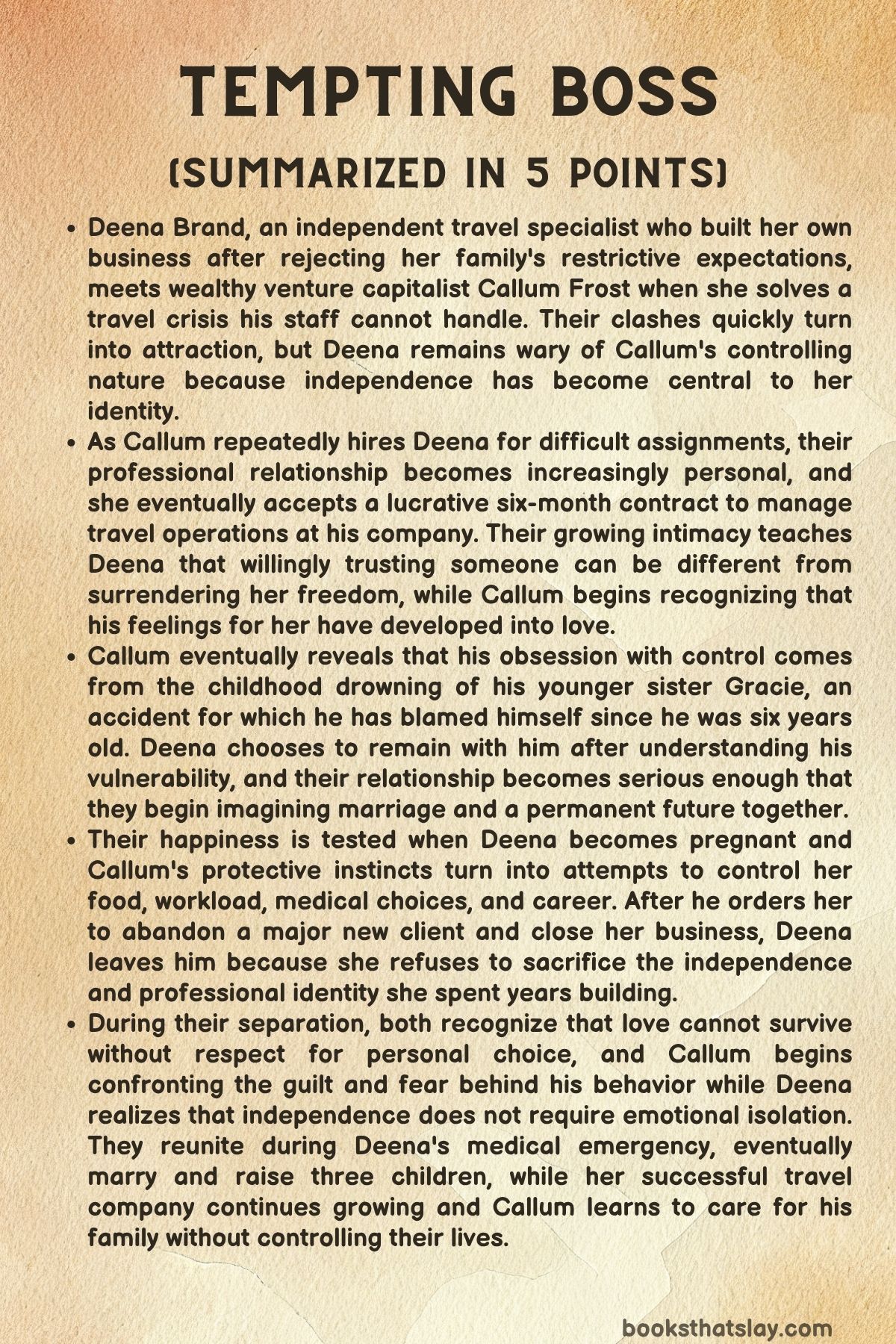
Deena Brand first meets Callum Frost when she is called to his venture-capital office to solve a complicated travel emergency. Callum’s employee Jack Reed is stranded in Bangkok while an important deal depends on his reaching Mexico City, and Deena quickly creates a complicated but workable itinerary after Callum’s own team has failed.
The encounter immediately establishes their opposing personalities. Callum is accustomed to controlling his employees and receiving immediate obedience, whereas Deena has built her career precisely so that she will never have to surrender her independence to a demanding man.
Deena’s resistance is rooted in her upbringing. Her family expected women to serve men, marry, raise children, and organize their lives around male authority, while her brother Brooks received opportunities she was denied simply because he was a boy.
Leaving North Carolina allowed Deena to create her own travel-coordination business and establish an identity separate from those expectations. She is therefore alarmed by her immediate attraction to Callum because his commanding personality resembles exactly the sort of masculine authority she has spent her adult life resisting.
Callum is equally unsettled. Deena is competent enough to expose weaknesses in his company while being completely unimpressed by his status, wealth, temper, or authority, and her refusal to flatter him becomes one of the main reasons he cannot forget her.
Their professional connection continues through emergency travel assignments. Even when Deena increases her prices to discourage him, Callum simply pays whatever she asks, repeatedly insisting that she should work directly for him.
Behind Callum’s professional severity is a frightened and deeply protective man. His sister Erica is undergoing treatment for breast cancer, and Callum has taken Erica and her young daughter Lila into his home while trying to control every detail of Erica’s treatment, diet, appointments, and daily life.
Erica understands that her brother’s behavior comes from fear, but she also knows that his instinct to protect can become suffocating. When she asks him to become Lila’s guardian if she dies, Callum agrees while privately believing he may be incapable of safely caring for someone vulnerable.
Deena gradually becomes one of the few people with whom Callum can lower his defenses. When he tells her about Erica’s illness, she understands that uncertainty is particularly difficult for a man who believes preparation and control can prevent disaster.
Their conversations become increasingly personal until attraction overwhelms the professional boundary between them. Deena discovers that voluntary surrender within a relationship feels completely different from the forced obedience she experienced growing up, especially because Callum repeatedly makes clear that her consent and choices matter.
Frightened by how strongly she reacts to him, Deena blocks his number and returns to North Carolina for her parents’ anniversary. The visit reminds her why she left: her mother Maryanne criticizes her appearance and life choices, while the family still measures female success largely through marriage and motherhood.
At the celebration, Deena impulsively claims that Callum is her boyfriend to avoid questions about her personal life. She describes him as loving, supportive, attractive, and important to her, only to discover that Callum has unexpectedly arrived behind her and heard enough of the story to play along.
Callum publicly kisses Deena and presents himself as her boyfriend. His presence impresses her family, but their sudden approval hurts Deena because it seems that her successful business and years of independence matter less to them than being associated with a wealthy, powerful man.
Away from the party, Callum finally explains how serious his company’s travel problems have become. He offers Deena a six-month contract giving her substantial authority over the company’s travel operations, and she eventually demands an enormous fee partly because she expects him to refuse.
Callum accepts. Their emotional and physical attraction also crosses the boundary they have been trying to preserve, but the experience becomes significant because Deena realizes that trusting someone does not automatically mean losing control over herself.
Callum reaches an equally important realization. Deena’s willingness to trust him touches something much deeper than attraction, and he privately recognizes that his fascination with her has developed into love.
Once Deena begins working at Frost Venture Capital, she immediately changes the company’s travel procedures. She removes unnecessary approval steps, builds employee travel profiles, catches scheduling problems before they create disasters, and proves that Callum’s constant interference had been making the system less efficient.
Callum dislikes losing control but cannot deny that Deena’s methods work. He also becomes even more attracted to her as he sees her intelligence, leadership, and confidence applied inside his company.
Deena’s view of Callum changes when she sees him with Erica and Lila. The severe executive happily rearranges his expensive office so Lila’s drawing can occupy an important place on the wall, allowing Deena to recognize a tenderness in him that exists without calculation or self-interest.
Their emotional intimacy continues developing even while they attempt to remain professional. Callum quietly notices when Deena forgets to eat and begins sending meals to her office, gestures she initially interprets as interference but gradually begins to recognize as his imperfect way of caring.
An accidental company-wide email finally destroys their remaining professional distance when Deena mistakenly tells the entire office that she has a crush on her boss. Instead of humiliating her, Callum responds with unusual honesty and admits that he wants far more than a casual relationship.
Deena voluntarily returns to him, and afterward they begin confronting the fears beneath their behavior. She explains that loving a powerful man frightens her because she fears becoming someone whose accomplishments disappear behind her relationship.
Callum responds by revealing the childhood tragedy that created his obsession with control. When he was six years old, he secretly took his younger sister Gracie into a neighbor’s yard, and while he searched for pool toys, four-year-old Gracie entered the swimming pool and drowned.
Although Callum was only a child, he has blamed himself ever since. The accident taught him to believe that loving someone makes him responsible for preventing every danger, so uncertainty becomes almost unbearable whenever someone important to him is vulnerable.
His confession changes Deena’s understanding of him. Callum then makes an extraordinary choice for someone who fears losing control: he tells Deena that she can leave him without financial or professional consequences.
Deena realizes that commitment can itself be an independent choice. Rather than allowing her parents’ restrictive idea of relationships to dictate what she must reject, she chooses Callum because she wants him.
Their relationship becomes official, and Erica and Lila welcome Deena enthusiastically. Callum even admits that he can imagine marrying her, while Deena begins participating in his family life without immediately seeing closeness as a threat.
Six weeks later, Deena discovers that she is pregnant. The news frightens her because she has always associated motherhood with the loss of freedom she witnessed in the world she escaped, yet imagining a family with Callum feels unexpectedly appealing.
Callum is overjoyed when she tells him. His happiness soon becomes excessive planning about doctors, food, medical tests, living arrangements, and childcare, revealing that his old coping mechanisms remain powerful despite everything he has learned.
Deena moves into his penthouse, and initially his attention feels loving. The conflict becomes serious when he begins monitoring her food and workload and finally tells her that she should stop working altogether.
For Deena, that demand attacks the foundation of her identity. Her travel business gave her financial independence, professional pride, and a life defined by her own decisions, so Callum’s insistence that his wealth makes her career unnecessary sounds disturbingly similar to the beliefs she escaped in childhood.
The breaking point comes when Deena wins a major new corporate client and Callum orders her to cancel the account and close her company. She quietly leaves his penthouse the next morning and returns to her own apartment.
Callum is devastated when he realizes she has truly left. Instead of immediately understanding that his controlling behavior can change, he falls into the old belief that he harms everyone he loves and decides that Deena and their unborn son may be better without him.
Deena experiences a different kind of unhappiness. She regains complete control over her home, body, career, and schedule, but discovers that independence without emotional connection can become another form of loneliness.
Erica eventually forces Callum to reconsider the story he has told himself since childhood. After showing him old family recordings in which he appears as a loving older brother rather than a dangerous child, she reminds him that Gracie’s death was an accident and that he has spent his entire adult life supporting the people he loves.
Callum finally recognizes the difference between protecting people and controlling them. He also understands that Deena’s business is not something competing with their relationship; it is one of the qualities that makes her the woman he loves.
Deena undergoes her own emotional growth. A supportive conversation with Brooks shows her that she sometimes assumes rejection before giving people the opportunity to understand her, while Callum begins sending respectful messages that leave the decision about future contact entirely to her.
Their separation ends during a medical emergency late in Deena’s pregnancy. Severe pre-eclampsia requires immediate induction, destroying the carefully controlled birth plan she had created and leaving her frightened and alone.
For the first time, Deena recognizes that self-sufficiency does not require refusing help when she genuinely wants it. She calls Callum and simply tells him that she needs him.
Callum arrives and demonstrates how much he has changed. Although terrified, he does not interfere with the doctors or attempt to dominate the situation; instead, he concentrates on supporting Deena, encouraging her, and remaining present.
He tells her that he loves her, and when Deena makes clear that she will never give up her business, Callum says her ambition is one of the reasons he loves her. Deena finally tells him she loves him as well, accepting that support and autonomy can exist together.
Nearly seven years later, they have built a marriage and family around that balance. Their son Luke is beginning school, they have daughters named Gracie and Bella, Deena’s travel company has become highly successful, and Callum has learned to manage his protective instincts instead of imposing them on the people he loves.
Deena has also established healthier boundaries with her family while rebuilding relationships she once believed were permanently damaged. Their future demonstrates that neither person needed to abandon a core part of themselves; they needed to separate love from possession, independence from isolation, and care from control.
Characters
Deena Brand
Deena is the emotional and ideological center of Tempting Boss, and nearly every important decision she makes is connected to her determination to control the direction of her own life. Growing up in a family that treated marriage, domesticity, and service to men as the natural destination for women taught her to associate dependence with limitation.
Her travel business therefore represents far more than employment. It is physical evidence that she escaped the future chosen for her, supported herself, developed expertise, and became valuable because of her own intelligence rather than because of the man beside her.
Deena’s greatest contradiction is that she desires emotional and physical surrender with Callum while fiercely protecting her public independence. At first she interprets these impulses as incompatible because she has never been shown a healthy distinction between choosing vulnerability and being forced into obedience.
Her relationship with Callum gradually teaches her that consent changes the meaning of surrender. She can enjoy trusting another person in private without transferring ownership of her career, body, beliefs, or life decisions to him.
However, Deena’s fear is not imaginary, because Callum eventually does begin extending his authority into areas where she has not invited it. Her decision to leave when he tells her to close her business demonstrates that romantic love does not make her abandon the boundaries she spent years learning to defend.
Her eventual development involves recognizing another extreme in her thinking. She has spent so long protecting independence that she sometimes mistakes isolation for strength, and her lonely pregnancy forces her to admit that refusing every form of dependence can become limiting in its own way.
By the end of the novel, Deena does not become less ambitious or less independent. She becomes more secure in the knowledge that accepting love, marriage, children, assistance, and emotional support does not diminish the professional identity she created.
Callum Frost
Callum initially appears in Tempting Boss as an arrogant executive whose controlling personality has become destructive even within his own company. He micromanages employees, interferes with routine procedures, drives assistants away, and reacts badly whenever another person demonstrates that his own methods are ineffective.
Yet his control is rooted less in superiority than in fear. The childhood death of Gracie left him believing that one careless decision can destroy someone he loves and that vigilance is therefore a moral obligation.
This belief explains both his admirable and damaging qualities. Callum is devoted, dependable, observant, generous, and extraordinarily protective, but the same qualities become oppressive when he assumes that loving someone gives him the right to decide what is safest for that person.
Deena attracts him because she refuses to cooperate with that worldview. She repeatedly proves that competence can exist outside his supervision, and the more successfully she operates without him, the more he is forced to recognize that control and responsibility are not identical.
His relationship with Erica shows the same pattern. He sincerely loves his sister and supports her throughout cancer treatment, yet he has difficulty understanding that constant management can make the person receiving his care feel powerless.
Pregnancy intensifies his unresolved fears. Protecting Deena and their unborn child begins to feel like a second chance to prevent the sort of tragedy he associates with Gracie, causing him to monitor food, work, appointments, and eventually Deena’s entire professional future.
His lowest emotional point arrives after Deena leaves. Rather than simply blaming her, Callum returns to the childhood conclusion that he is dangerous to the people he loves, showing how deeply shame has shaped his identity.
Erica’s confrontation finally helps him reinterpret his past. He begins understanding that Gracie’s death was not evidence that his love destroys people and that being a responsible father or partner requires trust rather than constant intervention.
By the final stages of the story, Callum retains his instinct to protect but becomes capable of stopping himself before protection becomes domination. His development is convincing because he does not transform into a completely different personality; instead, he learns healthier ways to express the traits that have always defined him.
Erica Frost
Erica serves as one of the clearest voices of perspective in Tempting Boss because she understands both Callum’s extraordinary capacity for love and the damage his fear can cause. Her cancer diagnosis exposes his instinctive reaction to uncertainty, as he attempts to manage her treatment, food, schedule, and environment rather than accepting that some outcomes remain beyond his control.
She never doubts that her brother loves her. In fact, her criticism carries weight precisely because she recognizes that his controlling behavior comes from devotion rather than cruelty.
Erica also provides important evidence against Callum’s belief that he fails the people he loves. He supported her throughout illness and single motherhood, became an important figure in Lila’s life, and agreed without hesitation to care for Lila if Erica died.
Her return to her own house becomes another lesson for Callum. Erica can appreciate everything he has provided while still needing a home that feels personally hers, demonstrating that the desire for independence does not equal rejection.
She eventually becomes crucial to his recovery from lifelong guilt. By showing him childhood recordings and describing the caring brother she remembers, Erica challenges the distorted identity Callum created after Gracie’s death.
Lila
Lila brings out Callum’s gentlest qualities without effort. His willingness to make pancakes with her, care for her during Erica’s illness, and replace prestigious office decorations with her artwork allows Deena to see that his stern public personality does not represent his entire emotional range.
She also raises the stakes surrounding Callum’s fear of responsibility. Erica’s request that he become Lila’s guardian forces him to confront his belief that he cannot safely care for a vulnerable child.
Lila’s uncomplicated affection becomes an important contradiction to that belief. She trusts Callum naturally and experiences him not as the dangerous person he imagines himself to be, but as a loving uncle who consistently shows up for her.
Her presence also helps Deena enter Callum’s family world. Through Lila, Deena sees that intimacy can include playfulness, ordinary domestic moments, and affection rather than only intense attraction.
Maryanne Brand
Maryanne represents the restrictive expectations Deena has spent much of her life resisting. She judges her daughter’s appearance, relationship status, lifestyle, and reproductive choices according to a traditional model of womanhood that Deena consciously rejected.
Her treatment of Deena also illustrates why family approval feels dangerous rather than comforting. Maryanne seems far more impressed by Callum’s wealth and status than by the company her daughter built independently, reinforcing Deena’s fear that romantic attachment will erase her accomplishments.
Maryanne is not portrayed simply as malicious. Her behavior appears connected to deeply internalized assumptions about gender, respectability, marriage, and success, making her pressure more socially ingrained than personally calculated.
Her later attempts to influence decisions involving Deena’s children show that these habits have not completely disappeared. The important change occurs in Deena, who can finally establish boundaries calmly rather than feeling that every disagreement threatens her independence.
Beau Brand
Beau’s role in Tempting Boss is quieter than Maryanne’s but emotionally significant because Deena has spent years wanting genuine recognition from her father. His praise at the anniversary celebration touches her deeply while simultaneously causing pain because it arrives after Callum publicly validates her professional success.
That moment exposes one of Deena’s oldest wounds. She wants her father to respect the person she became without requiring confirmation from a wealthy man first.
Beau therefore represents the emotional cost of unequal expectations even when those expectations are not expressed through constant confrontation. His approval matters to Deena precisely because she has spent much of her life feeling that her achievements existed outside the definition of success her parents valued.
Brooks Brand
Brooks initially functions as a reminder of the gender inequality in Deena’s childhood. He received educational and extracurricular opportunities she was denied, and Deena consequently assumes that he shares the dismissive attitudes she associates with the rest of the family.
Her later conversation with him complicates that assumption. Brooks responds to her business success with genuine admiration and receives the news of her pregnancy with concern for her happiness rather than judgment.
This moment matters because it forces Deena to acknowledge that protecting herself sometimes caused her to decide what other people believed before giving them an opportunity to speak. Brooks cannot change the unequal childhood they experienced, but their adult relationship offers the possibility of forming something different.
Stacey
Stacey, Brooks’s wife, occupies a comparatively small role but contributes to the family context surrounding Deena. Her pregnancies and family life become occasions through which Maryanne pressures Deena about marriage and children.
Stacey herself is not presented as Deena’s opponent. Instead, her presence highlights Deena’s sensitivity to comparison and the way traditional family milestones have repeatedly been used to judge her choices.
By the later stages of the story, the relationship between Brooks, Stacey, Deena, and their families becomes healthier. This suggests that Deena can remain connected to relatives whose lives follow more conventional patterns without treating those choices as criticism of her own.
Austin
Austin represents the future Deena once refused. Their teenage relationship ended because he expected her eventually to abandon her ambitions and adopt a domestic role centered on him.
When he reappears at the anniversary celebration, his attitude toward her business suggests that his expectations have not fundamentally changed. His interest in restarting their relationship therefore reinforces how much Deena has changed since leaving North Carolina.
Austin also provides a useful contrast with Callum. Although Callum later becomes controlling in serious ways, he is initially fascinated by Deena’s ambition and competence, whereas Austin seems most comfortable imagining her inside a life already designed according to conventional expectations.
Alba
Alba functions as Deena’s independent emotional sounding board. Unlike family members who judge her choices or Callum, whose romantic involvement affects his perspective, Alba offers an outside friendship through which Deena can examine what she actually wants.
Her importance becomes especially clear when she questions whether independence must mean isolation. That idea quietly prepares Deena to recognize that receiving care is not automatically evidence of weakness.
Alba also voices concerns when Callum’s behavior during the pregnancy becomes excessive. She therefore does not merely encourage romance; she helps Deena distinguish between healthy emotional openness and the sacrifice of personal autonomy.
Gracie Frost
Gracie is physically absent from the adult narrative, yet her death influences nearly every important aspect of Callum’s personality. Because she drowned while six-year-old Callum was responsible for watching her, he has interpreted the accident as proof that a moment of selfishness or inattention can destroy someone he loves.
The tragedy becomes the emotional origin of his obsession with prevention. His adult success, discipline, vigilance, and protectiveness can all be understood partly as attempts to ensure that he never again experiences the helplessness associated with losing his sister.
The childhood recordings Erica later shows him are important because they restore a fuller memory of their relationship. Callum had reduced his childhood identity to the single worst event of his life, while the recordings reveal that he had also been affectionate, helpful, and protective.
Naming his later daughter Gracie becomes an important sign of recovery. Rather than viewing the name as an invitation for history to repeat itself, Callum is eventually able to connect his sister’s memory with love instead of permanent punishment.
Luke, Gracie, and Bella
Callum and Deena’s children appear primarily in the later picture of their shared life, but they represent the practical result of everything the couple has learned. Luke’s ordinary first day of school and the presence of younger sisters Gracie and Bella show a family defined by everyday continuity rather than the catastrophe Callum once expected whenever he loved someone deeply.
For Deena, motherhood also proves that becoming a parent did not require abandoning professional ambition. She can raise children, remain married, maintain boundaries with her family, and continue leading a successful company.
For Callum, parenting becomes an opportunity to practice trust repeatedly. He cannot remove every danger from his children’s lives, but he can remain present without interpreting responsibility as total control.
Themes
Independence, Vulnerability, and the Meaning of Freedom
Tempting Boss repeatedly questions whether independence should be defined as complete self-sufficiency or as the ability to make meaningful choices without coercion. Deena initially believes these ideas are essentially identical because her childhood taught her that depending on a man could result in surrendering education, ambition, financial freedom, and personal authority.
Her business becomes the clearest symbol of freedom because it was built through her own ability and gives her financial independence. Consequently, anything that threatens the company feels like a threat to the identity she created after leaving home.
Her relationship with Callum gradually complicates this understanding. Deena discovers that she enjoys moments in which she intentionally gives him authority, but those experiences feel safe because she chooses the boundaries and knows she can withdraw consent.
The conflict becomes serious when Callum fails to respect the difference between chosen vulnerability and imposed control. His demand that she abandon her business transforms care into domination, forcing Deena to leave even though she loves him.
Her months alone then expose the opposite danger. She has regained complete autonomy but feels emotionally isolated, demonstrating that being independent does not necessarily require refusing connection, support, or partnership.
The final resolution does not ask Deena to choose between love and freedom. Instead, she reaches a more mature definition of autonomy in which she can voluntarily accept help, marriage, motherhood, and emotional dependence while retaining authority over the parts of life that belong to her.
Control as a Response to Fear
Callum’s controlling behavior is repeatedly connected to anxiety rather than simple arrogance. The drowning of Gracie convinces him that terrible outcomes occur when vigilance fails, and he responds by trying to anticipate every possible problem before it can happen.
This strategy initially rewards him professionally. His discipline, intensity, and refusal to accept failure contribute to his success, making it easy for him to believe that greater control is always equivalent to greater responsibility.
Personal relationships expose the flaw in that belief. Erica experiences his care during cancer treatment as overwhelming, employees struggle beneath his micromanagement, and Deena eventually leaves because his concern about pregnancy expands into attempts to govern her food, career, medical choices, and daily routine.
His fear becomes particularly destructive because it presents itself to him as love. Callum genuinely believes that allowing Deena to make a choice he considers risky would mean failing her, so he has difficulty recognizing that preventing every possible danger is neither achievable nor respectful.
The story ultimately distinguishes responsibility from control. Responsibility means being available, keeping commitments, offering support, and acting when help is wanted; control means taking another person’s choices away because uncertainty feels intolerable.
Callum’s behavior during Deena’s medical emergency demonstrates his growth. He remains frightened, but he allows trained professionals to make medical decisions and gives Deena the emotional support she asks for instead of trying to dominate the situation.
Family Expectations and Inherited Ideas About Gender
Deena’s conflict with her parents shows how deeply inherited beliefs can shape a person’s understanding of relationships long after leaving home. She grew up learning that women should serve men, prioritize marriage and children, and treat male ambition as more important than their own.
Those expectations help explain why she reacts so strongly to Callum. His naturally commanding personality activates memories of a household in which obedience was demanded rather than negotiated.
Her parents’ reaction when Callum appears at the anniversary celebration makes the problem even clearer. Deena has built a functioning company through years of work, yet their pride becomes much more visible after a wealthy and successful man presents himself as her partner.
That response reinforces her fear that society will treat her accomplishments as secondary once she enters a serious relationship. Pregnancy produces a similar concern because motherhood has always been presented to her as a role that replaces a woman’s independent identity rather than adding another dimension to it.
The story does not ultimately reject marriage, children, or domestic life. It rejects the idea that these choices have value only when they follow one prescribed model.
Deena’s eventual marriage and motherhood therefore represent choice rather than conformity. She enters family life without abandoning her business, establishes boundaries with Maryanne, repairs her connection with Brooks, and creates a household whose expectations are negotiated rather than inherited automatically.
Love Without Erasure
The central relationship in Tempting Boss repeatedly asks whether two strong personalities can form a permanent partnership without one person disappearing inside the other’s needs. Both Deena and Callum begin with distorted assumptions: she expects intimacy to threaten identity, while he believes love gives him responsibility for controlling outcomes.
Their attraction succeeds because each initially offers something the other lacks. Callum gives Deena permission to rest, receive care, and trust another person, while Deena forces Callum to experience uncertainty without immediately taking command.
Their relationship fails temporarily when those lessons stop being mutual. Once Callum decides that his judgment should override Deena’s career ambitions, their partnership begins reproducing precisely the structure she spent her life escaping.
The separation becomes necessary because love alone cannot compensate for the absence of respect. Deena must prove to herself that she will leave rather than accept erasure, while Callum must experience the consequences of confusing devotion with ownership.
Their reconciliation becomes possible only after both reconsider their assumptions. Deena admits that needing someone does not cancel strength, and Callum accepts that loving someone requires allowing that person to make decisions he cannot supervise.
Their later marriage demonstrates the resulting balance. Deena retains her thriving company and personal authority, while Callum continues caring deeply without treating care as permission to take over.
The relationship therefore reaches stability not because either person defeats the other but because both learn how to remain recognizable as themselves inside commitment. Love becomes sustainable when support does not become confinement, closeness does not require self-erasure, and dependence remains something freely chosen rather than demanded.