The Cupid Dilemma Summary, Characters and Themes
The Cupid Dilemma by April Asher is a contemporary paranormal romantic comedy centered on Adalyn “Addie” Whitlock, the skeptical daughter of Aphrodite who has built a career helping other people reach their happily-ever-afters while refusing to believe that lasting romantic love exists.
When professional disaster, public scandal, supernatural changes, and rock musician Phoenix Cross enter her life almost simultaneously, Addie is forced to question the certainty on which she has built her identity. The novel combines divine family complications, fake dating, celebrity culture, wedding chaos, creative ambition, and a romance that gradually challenges Addie’s determination to keep love at an emotional distance.
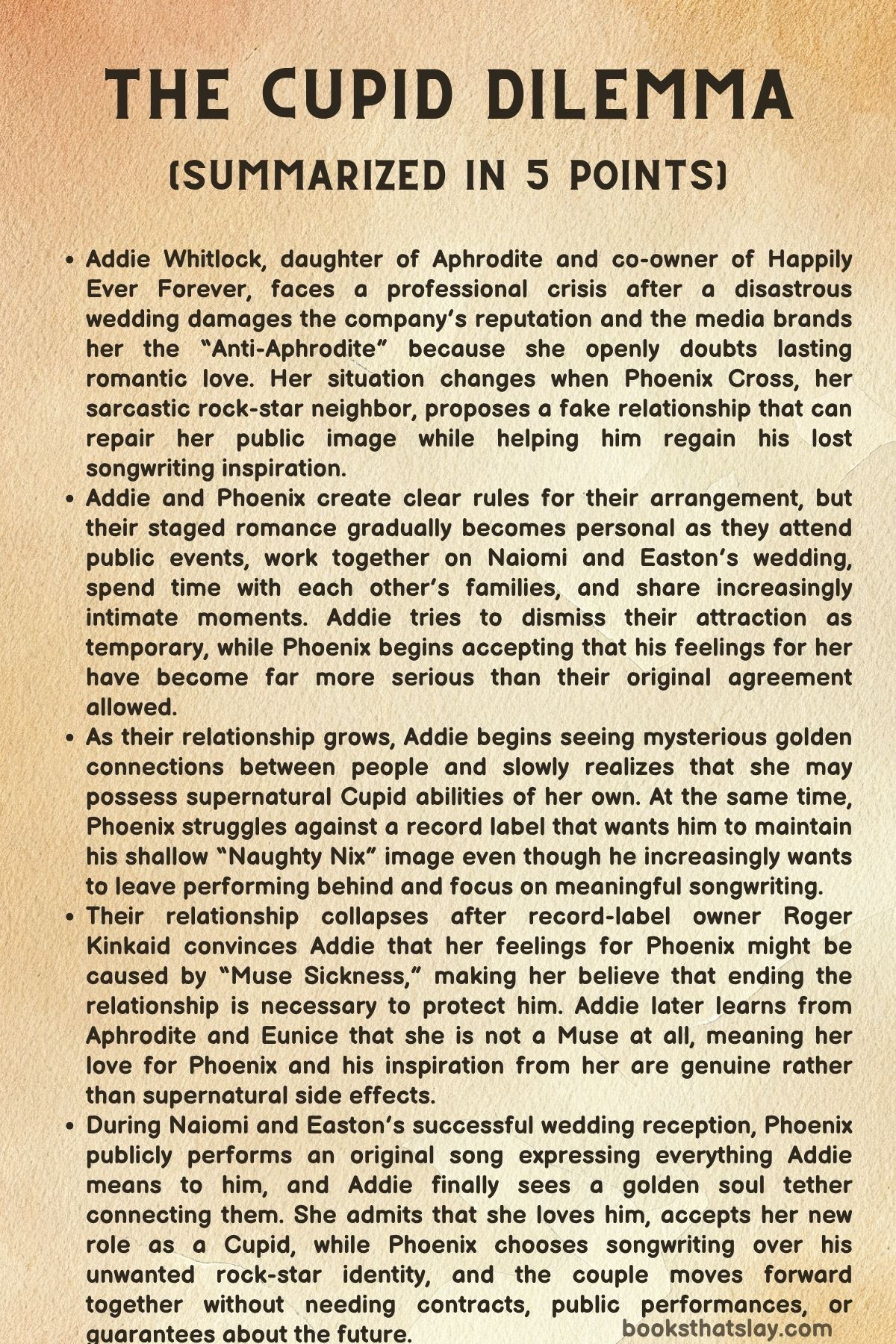
Summary
Adalyn “Addie” Whitlock is determined to help Happily Ever Forever, the matchmaking and wedding-planning company she runs with her sister Maxi and cousin Bailey, recover from a disastrous period. Her latest attempt at restoring the business ends badly when a decorative candle sets a wedding cake on fire, forcing Addie into damage-control mode while the bride’s divorced parents argue and the bride begins questioning whether the accident is a sign that she should not marry.
During the chaos, Addie is helped by a sarcastic but attractive stranger who catches her when she slips and later uses a fire extinguisher on the flames. The wedding venue nevertheless bans HEF permanently, giving Addie yet another professional failure to worry about.
At home, Addie discovers that the same stranger is her irritating next-door neighbor, a man who enjoys loud music, teasing her, and calling her “sparkles.” She later learns that he is Phoenix “Nix” Cross, drummer and songwriter for the successful rock band the Stone Talons, although Addie initially has no idea that he is famous.
Addie’s personal beliefs make her an unusual figure in the romance business. Despite being the daughter of Aphrodite, she does not believe romantic love lasts, and she resists her mother’s repeated attempts to convince her otherwise.
The problems facing HEF become more serious when Karleigh Kinkaid-Fink publicly attacks the company after her disastrous wedding, while journalist Evelyn Sinclair continues criticizing it. Clients begin canceling, and Maxi reveals that her supernatural ability to identify soulmates has also become unreliable, leaving the family business with few obvious ways to repair its reputation.
At the same time, Phoenix faces a creative crisis. His record label expects him to maintain the Stone Talons’ sexually charged party image, but Phoenix wants to write more meaningful material, and the only new inspiration he has found comes from his encounters with Addie.
Their professional lives become connected when Addie, Maxi, and Bailey attend a Stone Talons performance and meet Phoenix’s sister Naiomi and her fiancé Easton. Naiomi reveals that the planner handling their upcoming wedding was a fraud who stole their money and failed to make the necessary arrangements, leaving them with only a month to organize everything.
Bailey quickly recognizes an opportunity. HEF can save Naiomi and Easton’s wedding while benefiting from the publicity surrounding the famous couple, and Phoenix volunteers to handle many of the planning meetings because the bride and groom are so busy.
Before Addie can focus fully on the wedding, her own reputation collapses. Her former boyfriend Hayden Parisi publicly reveals that Addie is Aphrodite’s daughter and explains her belief that romantic love is temporary, leading the media to label her the “Anti-Aphrodite.”
Bailey decides that the easiest way to challenge this image is to make Addie appear publicly and convincingly in love. Phoenix proposes that they fake a romance: Addie gets the public relationship HEF needs, while Phoenix gets access to the woman who has mysteriously become the source of his renewed creativity.
Addie first allows Maxi one attempt at finding her a genuine romantic match. The resulting date with Peter Vanderhorn is disastrous, and Phoenix ends up intervening when Peter becomes aggressive after Addie rejects him.
After spending a more relaxed evening with Phoenix, Naiomi, and Easton, Addie finally accepts Phoenix’s proposal. Their Fauxmance Arrangement and Muse Agreement includes rules governing their public appearances, physical affection, and boundaries, with the word “sparkles” becoming their signal for consensually increasing intimacy.
As wedding planning continues, Addie begins experiencing an unexplained supernatural change. She sees strange connections between certain people, including bright golden cords linking individuals who seem suited to each other, although neither Maxi nor Bailey can see them.
Phoenix also proves unexpectedly useful in planning Naiomi’s wedding. He rejects a prestigious but impersonal venue and instead brings Addie to Emilio Santiago’s farm, a place filled with childhood memories for Naiomi and connected to the history of her relationship with Easton.
Meanwhile, Addie and Phoenix begin performing their fake romance publicly. Their first major outing includes Coney Island and a baseball game, where their Yankees-versus-Mets rivalry turns into playful competition before the stadium’s Cupid Cam focuses on them.
Addie willingly gives Phoenix permission to kiss her. The supposedly staged kiss becomes intense enough to unsettle them both, and Phoenix immediately begins hearing new music in his mind while Addie tries to dismiss her reaction as nothing more than physical chemistry.
The emotional boundaries continue disappearing as Phoenix introduces Addie to his family. She meets his parents, Lani and Judd, whose long marriage challenges her argument that romantic attachment inevitably fades, while Phoenix realizes how naturally Addie fits among the people he loves.
Their conversations also become more personal. When Phoenix questions Addie directly about her disbelief in love, she explains that love is merely a powerful emotional response that eventually weakens, but for the first time she feels uneasy hearing her own philosophy stated aloud.
While restoring Emilio’s barn for the wedding, Addie and Phoenix discover a willow beside a creek that feels ideal for Naiomi and Easton’s ceremony. Alone there, Phoenix tells Addie that he wishes their first kiss had belonged only to them rather than to an audience, and Addie uses “sparkles” to give him permission for a second kiss that has nothing to do with publicity.
Their attraction eventually leads to a consensual physical relationship. Addie insists that there must be no expectations or emotional obligations, yet the intimacy only makes their growing emotional attachment more difficult to deny.
The fake relationship succeeds publicly, with photographs showing the two of them looking genuinely affectionate. Addie becomes disturbed by how real the images appear, while her mysterious ability to see golden connections becomes increasingly obvious, especially when she sees one linking her father Simon with his new romantic partner, Caroline.
Phoenix simultaneously begins resisting the restrictions placed on him by the Stone Talons’ record label. Roger Kinkaid dislikes Phoenix’s emotionally vulnerable new material and considers Addie a damaging influence, but Phoenix insists that she is the reason he has started creating again.
At a music festival, Phoenix abandons a performance after an intoxicated man repeatedly harasses and grabs Addie. The confrontation leaves Addie with a concussion, and Phoenix spends the night caring for her, revealing a protective and patient side that makes it increasingly difficult for her to separate her feelings from the arrangement.
During that night, both admit frustrations with their careers. Phoenix wants to focus on songwriting rather than remaining trapped in his public rock-star persona, while Addie acknowledges that she sometimes feels misplaced in a wedding business founded around an idea she does not believe in.
Their connection grows through ordinary experiences as much as romantic ones. A spontaneous Central Park scavenger hunt makes Addie realize that they no longer need publicity or wedding responsibilities as excuses to spend time together, and the thought of ending their arrangement frightens her.
Shortly before Naiomi’s wedding, Phoenix takes Addie to a secluded childhood swimming spot. Addie finally recognizes that she is falling in love with him, while Phoenix privately accepts that his own feelings have already moved far beyond anything temporary.
At the Indie Rock Awards, Phoenix becomes increasingly determined to tell Addie that their relationship is real to him. His actions throughout the evening show that he values her comfort over publicity, and their gentle kiss after the Stone Talons win an award carries none of the performative quality that defined their original agreement.
Their happiness collapses at the after-party when Roger Kinkaid tells Addie about “Muse Sickness,” supposedly a condition that causes musicians and Muses to develop artificial emotional dependence after prolonged contact. Already frightened by the intensity of her feelings, Addie becomes convinced that the love she feels for Phoenix is supernatural contamination rather than something genuine.
Believing that separation will protect Phoenix, Addie ends their relationship. Phoenix tries to convince her that his emotions are real and had been preparing to tell her exactly that, but Addie allows fear to override what she wants and forces herself to leave him.
Her devastation soon makes it impossible to pretend she feels nothing. Maxi, Bailey, Aphrodite, and Eunice confront her, and Eunice finally explains the truth: Addie cannot have Muse Sickness because she is not a Muse at all.
Addie has inspired Phoenix simply by being herself. Aphrodite also explains that the golden cords Addie has been seeing are soul tethers and that Addie has developed genuine Cupid abilities, although she cannot see her own tether until she accepts the emotional risk of loving someone without supernatural proof.
Phoenix undergoes a similar reckoning with his career. When he tells his bandmates that he wants to move away from performing and concentrate on songwriting, they support him rather than treating his decision as betrayal, freeing him to pursue the creative life he actually wants.
Naiomi and Easton’s wedding finally arrives, giving Addie an opportunity to use her newly understood ability. When Naiomi panics before the ceremony, Addie reveals that she can see the powerful golden tether between Naiomi and Easton and reassures her that their connection is genuine.
The successful wedding also helps Addie recognize a new future for HEF. Maxi is better suited to managing events, while Addie may have discovered her true place in the company through her ability to recognize soulmates.
At the reception, Phoenix makes his final emotional risk publicly. Standing alone with an acoustic guitar, he performs “My Heart & Soul,” a song explaining how Addie restored the music and emotional possibility he thought he had lost.
As Phoenix performs, Addie finally sees the golden soul tether extending from him and wrapping around her. The supernatural confirmation arrives only after both of them have already chosen honesty, vulnerability, and emotional risk.
Phoenix tells Addie that he loves her and wants a genuine future with her. Addie admits that she was wrong, answers him with their familiar “sparkles,” and chooses the relationship without hiding behind contracts, theories, or fear.
Phoenix also confirms that he is leaving the rock-star lifestyle to concentrate on songwriting. Addie, meanwhile, accepts both her ability as a Cupid and the reality that love does not become meaningless merely because it involves uncertainty.
Their new relationship is tested humorously rather than tragically when Phoenix accompanies Addie to Mount Olympus to meet the divine members of her family. Faced with Hades at the portal, Addie openly declares that Phoenix is special because she loves him with her entire heart and soul.
Instead of demanding guarantees about the future, Addie finally accepts uncertainty as part of choosing another person. Phoenix follows her through the portal, and the two enter the next stage of their lives together with no fake agreement left between them.
Characters
Adalyn “Addie” Whitlock
Addie is the emotional and philosophical center of The Cupid Dilemma, and much of her development comes from the contradiction built into her identity. She is Aphrodite’s daughter and works professionally in matchmaking and weddings, yet she has constructed an almost intellectual rejection of lasting romantic love.
Her skepticism initially appears confident, but it gradually becomes clear that her beliefs also function as protection. If love is merely a temporary chemical and emotional state, then she never has to surrender control, trust another person completely, or admit that losing someone could seriously hurt her.
Addie is nevertheless deeply compassionate in ways that challenge her own philosophy. She protects service workers from Karleigh’s cruelty, cares intensely about her family, works hard to save Naiomi’s wedding, defends her father’s right to happiness, and repeatedly places other people’s well-being above her own convenience.
Her relationship with Phoenix exposes the gap between what she argues and how she actually lives. She increasingly trusts him, misses him when he is absent, wants him included in her ordinary life, becomes jealous when others approach him, and eventually realizes that losing him would matter far more than her theories allow.
The golden soul tethers represent another important part of her development. Addie begins the story uncertain about her position within HEF, but discovering that she can recognize soulmates gives her a purpose that belongs specifically to her rather than one inherited from Maxi, Bailey, or Aphrodite.
Her greatest mistake is not loving Phoenix but refusing to trust her own emotional experience when Roger offers a supernatural explanation for it. Ending the relationship through fear forces Addie to confront how much energy she has spent trying to avoid emotional risk.
By the conclusion, Addie does not become naïve about romance. Her growth lies in accepting that uncertainty does not invalidate love and that choosing another person without absolute guarantees can itself be meaningful.
Phoenix “Nix” Cross
Phoenix begins The Cupid Dilemma behind the manufactured identity of “Naughty Nix,” the attractive drummer expected to embody the Stone Talons’ reckless party image. Beneath that persona, however, he is increasingly dissatisfied with performance, celebrity expectations, and the shallow songwriting his label wants him to produce.
His creative frustration reflects a larger identity conflict. Phoenix loves music but no longer feels represented by the version of musical success his label has created for him, and meeting Addie awakens both his creativity and his desire to live more authentically.
Phoenix’s sarcasm and teasing make his early chemistry with Addie entertaining, but his strongest qualities appear through his actions. He protects her from aggressive behavior, supports her during professional crises, respects her consent, cares for her after her concussion, and repeatedly checks whether she is comfortable in situations involving cameras or public attention.
His loyalty also extends far beyond Addie. He sacrifices some of his own career preferences for the Stone Talons, helps Naiomi with her wedding, values his parents and extended family, and worries about abandoning the friends with whom he built the band.
That loyalty initially makes him resistant to changing careers. Phoenix must learn that choosing songwriting does not mean betraying the people who shared his earlier ambitions.
Unlike Addie, Phoenix recognizes his feelings relatively early. Once he understands that the fake romance has become real to him, his challenge is not accepting love but convincing Addie that what exists between them deserves to be trusted.
His performance of “My Heart & Soul” completes both his romantic and artistic journeys. The song allows him to reveal his emotions in the musical form he has wanted to pursue, making his declaration of love inseparable from his decision to become the artist he actually wants to be.
Maxi Whitlock
Maxi plays an important role in The Cupid Dilemma as Addie’s sister, business partner, and supernatural counterpart. Her ability as a Cupid has helped shape HEF’s identity, but the sudden unreliability of her matchmaking powers creates one of the earliest signs that the family’s established roles may need to change.
Maxi is practical enough to admit that something is wrong with her abilities rather than pretending everything is under control. At the same time, she initially struggles with the possibility that Addie may possess the very supernatural gift that has historically defined Maxi’s place within the company.
Their relationship is ultimately supportive rather than competitive. Maxi participates in Addie’s public-relations efforts, worries about her emotional condition after the breakup, and joins Bailey in forcing Addie to confront the reality of what she feels.
The conclusion suggests a productive reversal of responsibilities. Addie realizes that Maxi has the confidence and organizational ability to oversee events, while Addie’s newly emerging soulmate perception may make her better suited to the matchmaking side of the business.
Maxi therefore represents adaptation. She and Addie do not have to remain confined to identities determined by earlier assumptions about their supernatural abilities or professional strengths.
Bailey
Bailey is one of the novel’s most energetic problem-solvers and frequently sees possibilities before Addie or Maxi do. She identifies the need for a major public-relations intervention, recognizes Naiomi and Easton’s wedding as a potentially business-saving opportunity, and pushes the idea that Addie needs a visible romantic narrative to counter the Anti-Aphrodite scandal.
Her approach is often bold and highly strategic. Where Addie tends to react defensively to crisis, Bailey thinks in terms of public perception, branding, opportunities, and how a difficult situation can be redirected.
Bailey is also a loyal cousin rather than simply HEF’s strategist. She participates in Addie’s personal life, helps prepare her for public appearances, notices her growing attraction to Phoenix, and refuses to leave her isolated when the breakup leaves her devastated.
Her presence keeps much of the story moving because she repeatedly turns emotional or professional disaster into action. Without Bailey, the fake-dating arrangement might never become necessary, and Naiomi’s wedding might never become HEF’s chance at redemption.
Aphrodite
Aphrodite provides the strongest supernatural challenge to Addie’s worldview in The Cupid Dilemma. As the Goddess of Love and Addie’s mother, she embodies everything Addie tries to resist, yet she generally avoids forcing her daughter into a predetermined romantic destiny.
Her relationship with Addie contains humor, frustration, affection, and generational disagreement. Aphrodite openly supports romance and quickly approves of Phoenix, while Addie treats her mother’s confidence in love as evidence that divine involvement should be approached cautiously.
Despite her power, Aphrodite understands that Addie must reach her own conclusions. She can recognize that her daughter is changing, but she cannot simply reveal Addie’s future or remove the emotional risk required for genuine growth.
Her explanation of the soul tethers is particularly important. Addie learns that she can see connections between other people but cannot see her own until she is prepared to trust love without supernatural evidence.
Aphrodite therefore becomes less a meddling goddess than a mother waiting for her daughter to discover something she cannot be commanded to believe. Her eventual guidance confirms Addie’s supernatural identity without taking away her responsibility for choosing Phoenix herself.
Simon Whitlock
Simon is Addie and Maxi’s father and one of the gentlest demonstrations that romantic possibility does not belong exclusively to young people or supernatural beings. His relationship with Caroline quietly develops while Addie is publicly insisting that lasting love is essentially an illusion.
He is humorous, affectionate, and protective without becoming controlling. His concern about Phoenix being a Mets fan rather than a dangerous rock star reflects both his personality and the warmth of his relationship with Addie.
Simon also sees through the supposed simplicity of the fake-dating arrangement. His observation that fake relationships in romantic comedies tend to become real sounds like a joke, but it accurately identifies the emotional danger Addie is determined to ignore.
His willingness to date Caroline after previous disappointments offers Addie an important contrast. Simon accepts that relationships can fail without concluding that the possibility of failure makes every future relationship meaningless.
Naiomi Cross
Naiomi is Phoenix’s sister and one of the people whose circumstances bring Phoenix and Addie together professionally. After being cheated by a fraudulent wedding planner, she allows HEF to rebuild her wedding on an extremely limited schedule, placing considerable trust in Addie and her family.
Her relationship with Easton becomes an important example against which Addie measures her anti-love philosophy. Their connection is affectionate and established enough that Addie repeatedly encounters evidence of devotion that does not fit comfortably with her belief that romantic attachment inevitably fades.
Naiomi also becomes a perceptive observer of Addie and Phoenix. By the awards after-party, she openly tells Addie that there is nothing convincing about the claim that their relationship remains fake.
Her brief panic before the wedding is significant because it shows that even strong relationships can contain fear. Addie does not reassure her by pretending uncertainty never exists; instead, she uses her newly understood Cupid ability to confirm the strength of Naiomi and Easton’s bond.
Naiomi’s successful wedding ultimately becomes a symbol of HEF’s recovery, Addie’s professional transformation, Phoenix’s emotional declaration, and Addie’s acceptance of love.
Easton
Easton is Naiomi’s fiancé and Phoenix’s close friend, giving him both personal and professional importance within the group surrounding Addie. His relationship with Naiomi provides a steady contrast to the uncertainty governing Addie and Phoenix.
He is also observant enough to notice Phoenix’s emotional change before Phoenix is prepared to label it openly. When Phoenix insists that the relationship is fake, Easton recognizes that his language and behavior no longer support that claim.
Easton represents a relatively secure form of partnership. His relationship with Naiomi has history, affection, shared memories, and a willingness to work through disruption rather than interpreting every obstacle as evidence that the relationship should end.
Although he receives less individual development than Addie or Phoenix, his presence helps establish the social environment in which their romance grows. He is both friend and example, showing Phoenix that commitment does not require the loss of independence or ambition.
Roger Kinkaid
Roger Kinkaid serves as one of the story’s most important antagonistic forces because he understands how to exploit both professional pressure and personal insecurity. As the record-label owner controlling the Stone Talons’ commercial direction, he wants Phoenix to remain within a carefully constructed image rather than develop as an artist.
Roger treats creativity primarily as a marketable product. Phoenix’s emotional new work threatens him because it suggests that the musician is developing beyond the profitable identity the label expects.
His attempt to remove Addie from Phoenix’s life shows the extent of his controlling attitude. He even offers to replace her with a professionally trained Muse, reducing inspiration and human attachment to business resources that can supposedly be substituted.
His most damaging action is telling Addie about Muse Sickness. Roger recognizes enough about her fear of love to give her a supernatural explanation that allows her to distrust the very emotions she has finally begun to accept.
Roger’s influence ultimately fails because both Phoenix and Addie stop allowing external authorities to define what their experiences mean. Phoenix rejects the label’s control, while Addie eventually learns that her feelings cannot be dismissed as a supernatural side effect.
Marcus
Marcus is Phoenix’s manager and occupies an uneasy position between professional loyalty and the demands of the music industry. His most serious mistake occurs when he shows Roger Kinkaid pages from Phoenix’s private music journal without permission.
The betrayal is important because the journal contains the private creative work through which Phoenix is discovering his changing artistic identity. By giving Roger access to it, Marcus treats Phoenix’s personal expression as industry property rather than something deserving boundaries.
Phoenix’s angry response marks an important step toward independence. He begins setting limits not only with Roger but also with people who have become accustomed to managing every part of his career.
Marcus therefore functions as part of the system Phoenix must learn to resist. He is not presented as emotionally destructive in the same way as Roger, but his actions reveal how easily professional management can become personal intrusion.
Karleigh Kinkaid-Fink
Karleigh is the dissatisfied bride whose disastrous wedding becomes one of the major threats to HEF. Instead of treating the event as an unfortunate accident, she uses her large social-media audience to amplify the incident and contribute to Addie’s rapidly worsening public reputation.
Her behavior toward the boutique employee later reinforces her entitlement. Addie’s willingness to confront her despite already being vulnerable to further public attacks reveals a clear difference between them.
Karleigh is primarily interested in controlling the narrative around herself. Addie, by contrast, gradually learns that reputation matters less than living according to values she can respect.
Karleigh’s continued attacks create pressure that makes the fake-dating arrangement seem professionally necessary. Her antagonism therefore contributes indirectly to bringing Addie and Phoenix together.
Evelyn Sinclair
Evelyn Sinclair is the journalist behind Wedding Woes and helps transform HEF’s private professional failures into a sustained public scandal. Her coverage gives Karleigh’s complaints greater visibility and later allows Hayden’s revelations about Addie’s family and beliefs to become part of a larger media narrative.
Her role demonstrates how quickly a person can lose control over her own identity once the media finds a marketable label. Addie becomes the “Anti-Aphrodite,” a simplified public persona that reduces complicated personal beliefs to an attention-generating controversy.
Evelyn therefore functions less as an individually developed antagonist and more as a representation of media pressure. Her reporting helps create the circumstances under which Addie agrees to perform a romance for public consumption.
That manufactured performance ironically produces something real. The public story Evelyn helps create eventually becomes less important than the private relationship Addie and Phoenix build behind it.
Hayden Parisi
Hayden is Addie’s unfaithful former boyfriend and the person who exposes highly personal information about her to Evelyn. By revealing that Addie is Aphrodite’s daughter and publicly discussing her disbelief in romantic love, he turns private knowledge from a past relationship into material that damages both Addie and HEF.
His actions help explain why Addie is reluctant to trust emotional intimacy. A former partner has already demonstrated that private vulnerability can later be weaponized.
Hayden stands in direct contrast to Phoenix. Where Hayden exploits knowledge gained through intimacy, Phoenix consistently protects Addie’s privacy, boundaries, and emotional comfort.
Although Hayden does not remain central to the later action, the consequences of his betrayal continue shaping Addie’s choices. He is part of the history that makes control feel safer to her than trust.
Peter Vanderhorn
Peter is Maxi’s failed attempt to provide Addie with a genuine romantic match before she commits to Phoenix’s fake-dating proposal. His arrogance, self-absorption, and premature assumptions about marriage make the date uncomfortable almost immediately.
His behavior becomes more troubling when he reacts aggressively to rejection and grabs Addie. Phoenix’s intervention demonstrates the difference between possessiveness and protection: Peter treats Addie’s refusal as something he can challenge, while Phoenix respects her choices even when he wants more from her.
Peter also exposes the limitations of supernatural matchmaking when it is not functioning properly. Maxi’s powers cannot manufacture compatibility where none exists.
His brief appearance therefore serves several purposes at once. It pushes Addie toward the fake-romance plan, provides an early demonstration of Phoenix’s protectiveness, and shows that being technically “matched” with someone is meaningless without respect.
Eunice
Eunice is an experienced Muse and one of Addie’s divine relatives. Addie initially consults her because she assumes that becoming Phoenix’s source of inspiration means she is functioning as a Muse.
Her greatest importance arrives much later when Addie believes she must leave Phoenix because of Muse Sickness. Eunice immediately corrects the misunderstanding by explaining that Addie cannot develop the condition because she was never a true Muse.
That explanation destroys the protective theory Addie has used to deny her feelings. Phoenix’s inspiration came from his genuine emotional response to Addie rather than from supernatural dependence.
Eunice consequently becomes the character who removes Addie’s final excuse. She cannot make Addie choose love, but she can eliminate the false supernatural explanation that has allowed fear to disguise itself as self-sacrifice.
Caroline
Caroline is Simon’s new romantic partner and a relatively quiet but meaningful presence in Addie’s changing understanding of relationships. Addie first learns about her accidentally and is surprised that Simon has been dating without involving Maxi’s matchmaking abilities.
When Addie finally sees them together, she recognizes both their genuine affection and the golden tether connecting them. Their relationship therefore becomes one of the clearest confirmations that her supernatural visions are real.
Caroline is warm and straightforward, and Addie quickly understands why Simon enjoys her company. She represents a relationship that develops naturally without divine arrangement, publicity, or dramatic declarations.
Her presence also reminds Addie that choosing love after previous disappointment is possible. Simon has experienced relationships that failed, yet he has not allowed that history to eliminate future emotional possibility.
Lani and Judd Cross
Lani and Judd are Phoenix and Naiomi’s parents and provide Addie with one of her most direct encounters with enduring romantic partnership. Their long relationship conflicts with her argument that intense romantic attachment inevitably fades into something less meaningful.
They also reveal important aspects of Phoenix’s background. His loyalty, affection, and strong commitment to family make greater sense once Addie experiences the warm and chaotic Cross household.
Lani and Judd recognize Phoenix’s feelings before he fully admits them. Their observation that Addie watches him with the same attention he gives her quietly undermines the claim that the relationship is merely staged.
More broadly, the Cross family allows Addie to experience belonging without having to perform. Her unexpected comfort among Phoenix’s relatives becomes one of the earliest signs that her connection with him could extend into a shared life rather than remain a temporary attraction.
Emilio Santiago
Emilio is closely connected to Phoenix and Naiomi’s childhood and owns the farm that ultimately becomes the setting for Naiomi and Easton’s wedding. His property contains places tied to the couple’s memories, including the barn and willow that Addie transforms into meaningful wedding locations.
He contributes to the story primarily through generosity and practical support. When problems arise during final preparations, such as the broken guest wagon, he helps find solutions rather than allowing complications to become disasters.
His farm is also important symbolically. It offers an alternative to the prestigious Globe venue because it has emotional meaning rather than social status.
Through Emilio’s property, Addie becomes a better wedding planner because she stops thinking merely about visual perfection and begins thinking about the history and identity of the people getting married. The location later becomes so meaningful to Addie that she can imagine returning there for a wedding of her own.
Do-Re-Mi
Do-Re-Mi, Addie’s unusual three-headed dog descended from Cerberus, adds humor and supernatural charm to the story while also revealing a domestic side of Addie that contrasts with her defensive public personality.
The dog is part of Addie’s private world, so Phoenix’s easy willingness to care for Do-Re-Mi becomes another sign that he is moving beyond the boundaries of a staged relationship. He feeds the dog while caring for Addie after her concussion and spends time around him while composing music.
Do-Re-Mi therefore helps make Phoenix part of Addie’s everyday life. The relationship stops being a collection of planned public dates and increasingly includes apartments, pets, food, illness, work, family, and ordinary companionship.
Samantha
Samantha is one of Phoenix’s younger cousins and initially appears difficult to impress. Addie nevertheless wins her over during the Cross family gathering, particularly through the fiercely competitive Mario Kart tournament.
Her quick attachment to Addie matters because children within the Cross family respond to Addie without caring about her Anti-Aphrodite reputation or the supposedly fake nature of her relationship. They simply accept her as someone they enjoy having around.
Samantha consequently helps reinforce the sense that Addie already fits naturally into Phoenix’s family. That ease frightens Addie because it suggests possibilities extending far beyond a temporary agreement.
Themes
Love, Skepticism, and Emotional Risk
Love in The Cupid Dilemma is presented less as unquestioned destiny than as something requiring vulnerability in the absence of guarantees. Addie’s opposition to love is not simply intellectual disbelief; it is a strategy that allows her to avoid giving another person enough emotional importance to seriously hurt her.
Her relationship with Phoenix gradually makes that position impossible to maintain. Their connection develops through attraction, humor, physical intimacy, shared work, family interactions, ordinary companionship, protection, trust, jealousy, conflict, and the simple desire to remain together even after the original reasons for their arrangement disappear.
The supernatural soul tethers initially seem as though they might provide the certainty Addie wants. Yet she can see the connections between other people while remaining unable to see her own, forcing her to make the exact choice she has spent most of her life avoiding.
Aphrodite’s explanation establishes the central paradox: Addie can receive supernatural proof only after she no longer requires proof in order to risk loving Phoenix.
The breakup caused by the supposed Muse Sickness demonstrates what happens when fear disguises itself as rational certainty. Addie convinces herself that leaving Phoenix is selfless, but the decision actually allows her to avoid trusting something she cannot scientifically or magically guarantee.
Her eventual declaration of love therefore represents more than romantic acceptance. She chooses to participate in a relationship knowing that the future remains uncertain, recognizing that uncertainty does not make the present connection false.
Identity Versus Public Image
Nearly every major character faces some conflict between personal identity and the version of that identity recognized by other people. Addie becomes the “Anti-Aphrodite,” Phoenix becomes “Naughty Nix,” HEF becomes publicly associated with disastrous weddings, and the Stone Talons become trapped inside a commercially successful image that increasingly limits Phoenix’s creativity.
These public identities are powerful because they affect careers, relationships, and self-perception. Addie accepts the fake-dating arrangement partly because public opinion has become financially dangerous, while Phoenix remains in an artistic role he increasingly dislikes because the label has built commercial expectations around him.
The story repeatedly separates appearance from reality. Addie and Phoenix begin by manufacturing affection for photographers, yet the supposedly false relationship becomes more authentic than the public identities they are trying to protect.
Phoenix ultimately rejects the idea that professional success requires remaining the person his label wants him to be. Addie similarly learns that being Aphrodite’s daughter does not require copying her mother, but neither does independence require defining herself in opposition to everything Aphrodite represents.
Their growth comes through self-definition rather than rebellion for its own sake. Phoenix chooses songwriting because it expresses who he has become, while Addie accepts her Cupid abilities because they give her a meaningful professional identity that feels genuinely her own.
Creativity, Purpose, and Personal Fulfillment
Creative purpose becomes closely connected to emotional honesty throughout The Cupid Dilemma. Phoenix begins unable to produce work that satisfies him because the Stone Talons’ expected material no longer reflects the person or artist he has become.
Addie does not inspire him through a supernatural Muse power. Her influence comes from awakening emotions and possibilities that give Phoenix something personally meaningful to express.
This distinction becomes crucial when Roger treats inspiration as a commercial resource that can simply be replaced with a professionally trained Muse. Phoenix rejects that idea because his new songs are not products of technique alone; they emerge from experiences that matter to him.
Addie faces a similar problem at HEF. She helped establish the company for people she loves, yet her disbelief in romance makes her question whether she truly belongs in an industry built around relationships and marriage.
Her emerging Cupid ability changes that conflict without requiring her to abandon HEF. Instead, she discovers that she may have been occupying the wrong role within the right organization.
Maxi experiences a parallel adjustment when her matchmaking powers become unreliable but her competence in event management becomes increasingly clear. The sisters’ changing responsibilities suggest that purpose is not always discovered by leaving existing commitments behind.
Phoenix and Addie both move toward fulfillment when they stop treating earlier choices as permanent obligations. He can love his bandmates without remaining a performer forever, just as Addie can love her family business while redefining the contribution she makes to it.
Family, Community, and Different Forms of Commitment
Romantic love is only one form of attachment examined by the story. Addie and Phoenix are both surrounded by families, friends, colleagues, and communities whose loyalty repeatedly influences the choices they make.
Phoenix’s devotion to the Stone Talons demonstrates how commitment can become both sustaining and restrictive. He delays pursuing songwriting because he fears that changing direction would amount to abandoning friends who helped build his career.
His bandmates ultimately prove that genuine loyalty does not demand self-sacrifice without limits. When they support his decision and reveal ambitions of their own, Phoenix learns that relationships can survive change rather than requiring everyone to remain fixed in earlier roles.
Addie experiences similar support from Maxi and Bailey. They challenge her, tease her, involve themselves in her personal problems, and eventually refuse to allow her to isolate herself when she is devastated after leaving Phoenix.
The Cross family offers Addie another version of belonging. Her ease with Lani, Judd, Samantha, and the other relatives shows her that a relationship with Phoenix would connect her to a larger community rather than simply creating an intense bond between two isolated individuals.
Simon and Caroline, Naiomi and Easton, and Lani and Judd additionally demonstrate that commitment can take different shapes at different stages of life. None of these relationships eliminates difficulty or uncertainty, but each challenges Addie’s assumption that impermanence is the only logical conclusion.
By the final trip to Olympus, romantic and familial commitment come together. Addie openly identifies Phoenix as someone she loves before allowing him into the divine world of her family, transforming love from something she once argued against into something she is willing to claim publicly and carry into an uncertain future.