The Ghost Women Summary, Characters and Themes
The Ghost Women by Jennifer Murphy is a supernatural murder mystery set on Waverly Island, where an elite art school occupies the grounds of a former monastery marked by centuries of violence against women.
The story follows Detective Lola Germany and art student Pearl Calhoun as a series of ritualized deaths reproduces images from an ancient tarot deck. What initially appears to be a modern serial-murder investigation gradually exposes institutional abuse, sexual violence, a secret historical ritual, and the legacy of fourteen-year-old Matilda, who was falsely condemned as a witch in 1437. The novel combines police investigation, psychological conflict, art, folklore, and genuine supernatural forces.
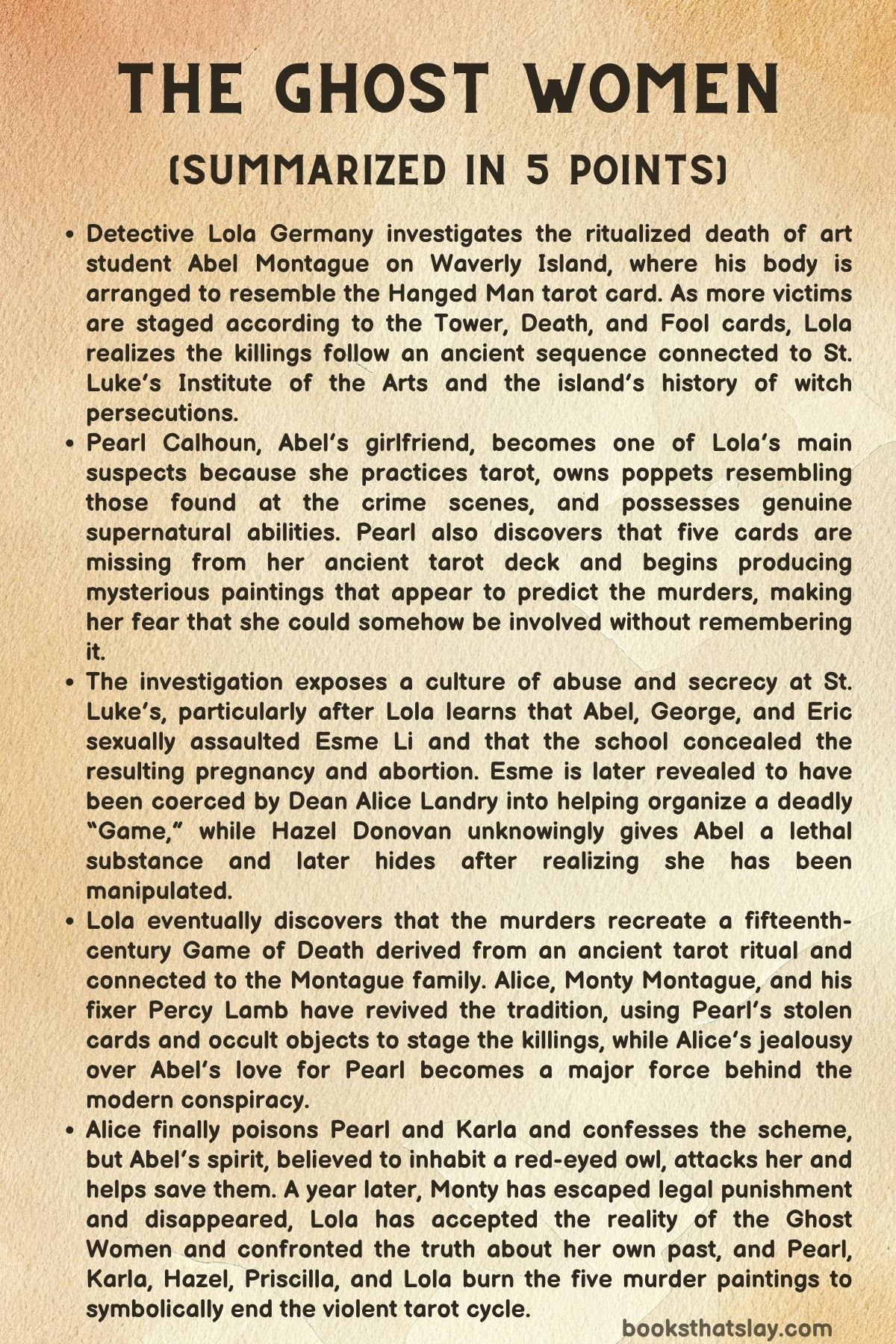
Summary
The story begins in 1437 with fourteen-year-old Matilda imprisoned after being falsely accused of witchcraft. She has been exploited by the abbot, separated from the twin sons she bore, and blamed for crimes she did not commit so that powerful men can protect themselves.
Matilda is burned alive, but at the moment of death she sees three translucent women and follows them into the forest. There she joins generations of murdered women whose spirits gather around a magnificent tree and wait for the day when the violence committed against them will finally be answered.
More than five centuries later, in September 1972, Detective Lola Germany is called to Dead Witch Forest after nineteen-year-old Abel Montague is found hanging upside down from the Ghost Tree. Abel is a gifted but arrogant student at St. Luke’s Institute of the Arts and the son of Monty Montague, one of the institution’s most powerful figures.
The corpse has been deliberately arranged to resemble the Hanged Man tarot card. Black candles, a poppet pierced with a black pearl-tipped pin, false silver coins, and an antique tarot card have been left around the scene, immediately suggesting that Abel’s death has been designed as a symbolic composition rather than an impulsive killing.
Suspicion soon falls on Pearl Calhoun, Abel’s girlfriend. Pearl is a talented painter who practices tarot and folk magic with her friends Karla Gardyn, Esme Li, and Hazel Donovan, collectively known as the Weird Sisters.
Pearl also possesses genuine supernatural abilities. She experiences visions, senses the presence of spirits, and has occasionally produced paintings without remembering creating them, although she has spent much of her life concealing these abilities from others.
The night before Abel died, Pearl discovered that he had been unfaithful with Hazel. She confronted him, begged him to remain with her, and later experienced a vision of his death, although the location in her vision did not match the Ghost Tree.
Lola therefore has several reasons to distrust Pearl. The murder scene contains objects associated with her occult practices, Pearl knows far more about Abel’s betrayals than her friends initially admit, and she offers an interpretation of the Hanged Man that emphasizes sacrifice, repentance, and the correction of old wrongs.
Yet Abel had created enemies throughout St. Luke’s. Karla despised him for his cruelty toward Pearl and for once becoming sexually aggressive toward her, while Esme’s disturbing paintings suggest intense anger toward male sexuality.
Lola also discovers that Abel was poisoned with hemlock before being taken to the Ghost Tree. His death was therefore staged after he was already incapacitated or dead, meaning the killer had planned both the murder and its visual presentation.
The investigation becomes a serial case when the ancient Tower at St. Luke’s burns. Two victims, later identified as George Archambault and Jeannine Hart, are trapped inside after being poisoned, and another antique tarot card—the Tower—is left at the scene.
Lola begins to recognize a method behind the crimes. Each victim is being turned into a three-dimensional version of a tarot image, and the killer appears interested in staging, composition, costume, symbolism, and spectatorship.
At the same time, Pearl discovers that five cards have vanished from an ancient tarot deck hidden inside an antique sideboard she bought from Priscilla, an eccentric local woman known as the Swamp Witch. The missing cards are the Hanged Man, Tower, Death, Fool, and Devil.
Pearl becomes increasingly frightened when mysterious paintings appear in her studio. They are unmistakably in her own style, but she has no memory of producing them, and their subjects correspond to the tarot cards used in the murders.
She begins wondering whether she is being framed or whether some unconscious part of her supernatural ability is participating in events without her knowledge. Her fear is strengthened by memories of childhood, when anger once caused something she imagined happening to a bully to occur in reality.
Meanwhile, Lola investigates the history of St. Luke’s and learns more about Matilda through Karla. Karla is descended from Matilda’s family and explains that the supposed witch was actually a child exploited by the abbot and later condemned to prevent the truth from becoming public.
Karla’s family spent generations trying to return to Waverly Island. Karla believes she was eventually brought to St. Luke’s because her family’s rituals called her back to the place where Matilda had been killed.
The third ritual death is Eric Bernard, another student associated with Abel and George. His body is chemically altered so that his exposed skull resembles the Death card, confirming that the killer is progressing through a fixed tarot sequence.
A larger pattern of abuse then emerges. Lola discovers that Abel, George, and Eric raped Esme together, leaving her pregnant and forcing her to travel secretly to Charleston for an abortion.
Esme’s gruesome miniature paintings of male bodies now acquire a different meaning. They reflect her trauma and suppressed rage, while St. Luke’s administration appears to have responded by hiding the incident rather than holding the men accountable.
The school’s dean, Alice Landry, becomes increasingly suspicious. She has created a student-liaison system that functions partly as surveillance, and Esme has been pressured into reporting information about other students while Alice maintains close control over her private life.
Hazel, meanwhile, disappears into the tunnels beneath the school. Her own account eventually reveals that she had participated in what Esme presented as an exclusive performance-art exercise called the Game.
Hazel had been assigned Abel as her “subject” and given a powder that she believed was a harmless psychedelic. She placed it in Abel’s wine shortly before he told her he was ending their affair because he truly loved Pearl.
Instead of producing a mild altered state, the substance caused Abel to collapse, convulse, strike his head, and die. Hazel fled in terror, believing she had accidentally killed him, but the appearance of Abel’s body at the Ghost Tree the next morning proved that another person had entered his studio and transformed his death into the Hanged Man scene.
Hazel later realizes that the Game was designed to manipulate students into becoming unwitting participants in murder. She was apparently supposed to die in the Tower along with George, but Jeannine took her place.
Hazel also witnesses men in blood-red robes burning what appears to be Abel’s real corpse on a remote beach. She recognizes Monty Montague among them and fears that those controlling the Game intend to silence her.
The murder sequence continues when Esme is found dead in her studio, posed as the Fool. She had been paralyzed while conscious, washed, painted, dressed, and suspended before finally being killed, revealing the murderer’s desire to exercise total control over the victim.
By this point Pearl understands that only one missing card remains: the Devil. Lola simultaneously finds a fifteenth-century black velvet book written by a man named Francesco, whose account explains the historical origins of the ritual.
Francesco had created a tarot deck and proposed a card game intended to save women accused of witchcraft. His idea was corrupted by other monks into the Game of Death, in which participants drawing the Hanged Man, Tower, Death, or Fool were eliminated until the appearance of the Devil ended the game.
Priscilla provides the darker family history behind this ritual. The abbot who abused Matilda was a Montague, and legends claim that he turned the tarot system into a sacrificial tradition involving his own descendants.
The modern Montague family has continued elements of that tradition. Abel, as a firstborn son, existed within a family history in which firstborn males could themselves become sacrifices.
The practical mechanics of the modern crimes finally lead Lola toward Alice Landry. Cigarette evidence matches the Virginia Slims Alice smokes, while Lola also realizes that the dark-haired woman seen secretly meeting Abel may have been Alice rather than Hazel.
Alice eventually reveals everything after poisoning Karla and Pearl with hemlock. She had been Monty’s mistress while simultaneously maintaining a sexual relationship with Abel, and Pearl had originally been recruited partly because she could serve as a respectable girlfriend who concealed Alice’s involvement with him.
The plan collapsed when Abel genuinely fell in love with Pearl and intended to leave Alice. Furious and jealous, Alice told Monty that Abel planned to expose the Game, provoking a new ritual cycle during the autumnal equinox.
Monty supplied the authority and family tradition, while his fixer Percy Lamb carried out much of the physical work. Alice designed the visual scenes, and Esme was coerced into assisting because Alice and Monty threatened to expose her abortion.
Esme stole Pearl’s tarot cards and poppets, allowing the murderers to make Pearl and her friends appear responsible. When Esme became unwilling to continue and began moving toward confession, she was murdered and turned into the Fool.
Alice’s attempt to kill Pearl and Karla is interrupted by the red-eyed owl that has repeatedly appeared during the investigation. Pearl and others believe the owl carries Abel’s spirit, and it attacks Alice as Pearl uses her own dangerous mental power against the dean.
Lola arrives to find Alice severely injured, Pearl unconscious, and Karla close to death. She saves the two students and, when the owl remains nearby, finally speaks to it as though Abel is truly present.
Her resistance to the supernatural ends completely when she sees three translucent Ghost Women accompanying Pearl toward the ambulance. The spirits are no longer folklore or psychological suggestion but visible presences protecting the living women.
Pearl and Karla survive, while Alice later dies from her injuries. Pearl tells Lola most of what she knows, including the truth about the Game, Esme’s coercion, Hazel’s involvement, and the Montague conspiracy, although she keeps certain private truths about Abel’s genuine love for her to herself.
A year later, the legal outcome remains incomplete. Monty is charged but successfully escapes conviction through powerful attorneys, after which he disappears, while St. Luke’s continues operating.
Priscilla later reveals that Percy Lamb was killed by Abel’s owl while searching for Hazel and that Monty probably died after his wife arranged for him to fall from a yacht. Justice has therefore occurred outside the formal legal system even when courts failed to provide it.
The final revelation concerns Lola herself. Priscilla makes her admit that the death of her abusive husband Jeffrey Villanova was not simply an act of immediate self-defense, as Lola had always maintained, but a killing she deliberately prepared and staged.
On the anniversary of Abel’s death, Lola joins Pearl, Karla, Hazel, and Priscilla beneath the circling Ghost Women. They burn Pearl’s five mysterious murder paintings, closing the modern Tarocchi cycle while accepting that the island’s dead women remain present as witnesses, protectors, and reminders of what happens when systems of power refuse to confront violence.
Characters
Lola Germany
Lola Germany is the central investigative consciousness of The Ghost Women, but her importance extends far beyond solving the murders. She initially defines herself through evidence, procedure, skepticism, and the disciplined identity she has created since returning to Waverly Island.
Her former career as a celebrated ballerina complicates that identity. Dance taught her physical control, observation, precision, and awareness of movement, qualities that later become unexpectedly useful when she studies murder scenes designed as carefully arranged visual compositions.
Lola’s marriage to Jeffrey Villanova also shapes her understanding of violence. She survived a relationship in which jealousy, alcohol, public reputation, and physical abuse were hidden beneath the appearance of glamorous artistic success.
For much of the book, Lola allows herself to occupy the moral position of survivor rather than killer by insisting Jeffrey died in self-defense. The final disclosure that she had deliberately prepared his death forces her to acknowledge that she, like several other women in the story, has crossed the boundary between protection and revenge.
Her investigation also becomes a spiritual transformation. Lola begins by rejecting ghosts even while privately worshipping the feminine presence she imagines inside her sacred tree, revealing that her skepticism has always contained an emotional contradiction.
Seeing the Ghost Women finally removes that contradiction. By the end, Lola accepts a world in which evidence and supernatural experience can coexist, and she develops a particularly strong bond with Pearl because each woman recognizes in the other a survivor who has rebuilt herself through secrecy, discipline, and self-invention.
Pearl Calhoun
Pearl is the emotional and supernatural center of The Ghost Women. She is initially presented through other people’s perceptions as a fragile, orphaned young woman devastated by Abel’s infidelity, but the book steadily reveals that she is observant, intelligent, guarded, powerful, and far more self-aware than those around her assume.
Her love for Abel is deliberately complicated. Pearl knows that he betrayed her, harmed other women, used drugs, behaved selfishly, and participated in a culture of male entitlement, yet she cannot simply erase the tenderness and attachment she experienced with him.
That contradiction gives her grief unusual depth. She is not asked to choose between declaring Abel entirely good or entirely monstrous, and her emotional growth comes from accepting that love for a person does not require denial of the harm that person caused.
Pearl’s supernatural abilities are equally complicated. She sees spirits, experiences visions, senses emotional energy, creates prophetic paintings without conscious awareness, and possesses a mental force capable of causing physical harm when driven by anger.
Because she learned early that rage can make her dangerous, much of her personality is built around restraint. Her quietness is therefore not weakness but a survival strategy developed by someone who knows that her emotions may have consequences other people do not face.
Her movement from jealousy toward solidarity is especially important. After learning of Hazel’s affair with Abel, Pearl initially casts revenge spells, but later risks herself to protect Hazel and forgives her after understanding how she had been manipulated.
Pearl also recognizes Esme’s suffering too late and carries guilt for having been too absorbed in Abel to see what her friend endured. That recognition deepens her commitment to the women around her and turns her supernatural sight into an ethical responsibility rather than merely an unusual gift.
Karla Gardyn
Karla is one of the characters most directly connected to the historical foundation of The Ghost Women. She is descended from Matilda’s family and has grown up knowing that the conventional story of Matilda as a dangerous witch was a lie created to conceal sexual exploitation and institutional corruption.
Her identity is therefore inseparable from inherited memory. Generations of Gardyn women have preserved Matilda’s story, practiced healing traditions, and sought a return to Waverly Island, making Karla feel that her arrival at St. Luke’s fulfills a purpose established long before her birth.
Karla speaks openly about revenge and even says that Abel deserved to die. Her poisonous garden, ritual practices, disturbing paintings of male bodies, and knowledge of the Ghost Tree make her an obvious suspect during the early investigation.
Yet the actual murders horrify her. Karla may fantasize about punishing abusive men, but the controlled torture and ceremonial transformation of living people into artworks are not the justice she imagined.
Her loyalty to Pearl is one of her strongest traits. She withholds information from Lola when she believes disclosure could endanger her friend, even though that secrecy makes her appear more suspicious.
Karla also embodies the difference between inherited anger and deliberate cruelty. Her exhibition titled Bad Men suggests that she ultimately channels rage through art rather than murder, preserving the memory of violence without becoming another version of the people responsible for it.
Esme Li
Esme is among the most tragic figures in The Ghost Women because she is simultaneously a victim, reluctant collaborator, informant, friend, and eventual murder victim. Her guarded behavior initially encourages Lola to suspect her, but the reasons for her secrecy prove far more disturbing than simple guilt.
Abel, George, and Eric sexually assault Esme together, leaving her pregnant. She secretly travels to Charleston for an abortion, while the institution that should protect her instead treats the event primarily as a scandal that must be contained.
Her miniature paintings filled with wounded or threatened male genitalia become an artistic expression of trauma. What first appears grotesque or hostile is later understood as one of the few ways she can represent rage that the school gives her no safe means to express directly.
Alice exploits Esme’s vulnerability through the class-liaison system. By making Esme report on other students and threatening exposure of the abortion, Alice turns a traumatized young woman into both a surveillance instrument and an unwilling participant in the Game.
Esme helps recruit Hazel and steals Pearl’s tarot cards and poppets, but her actions take place under coercion. Her moral responsibility is therefore real but severely restricted by the power held over her.
Her eventual desire to withdraw becomes fatal. When she apologizes to Pearl and says she should have been stronger, she is already approaching the point where obedience is no longer possible, and Alice responds by turning her into the Fool.
Esme’s death is especially cruel because the method reproduces the loss of bodily control at the center of her earlier trauma. She is paralyzed while conscious, physically manipulated, dressed, painted, and displayed, making her final murder another act in which powerful people deny her ownership of her own body.
Hazel Donovan
Hazel initially appears to be Pearl’s disloyal friend because of her affair with Abel. Her later perspective reveals a much more vulnerable person whose desire for affection, recognition, and artistic belonging makes her easy to manipulate.
Her participation in the Game begins because Esme presents it as an exclusive performance-art experiment. Hazel is flattered by the suggestion that she has been selected for her promise and accepts instructions without understanding that she is being placed inside a murder conspiracy.
Her greatest burden is Abel’s death. Hazel drugs his wine believing the substance is a psychedelic, then watches him collapse and die, leaving her convinced that she has killed the man with whom she has been having an affair.
The discovery that Abel’s body has been moved and staged makes her realize that her actions were anticipated and exploited. She therefore occupies an uncomfortable moral space: she contributed to Abel’s death, but she lacked the intent and knowledge that would make her equivalent to Alice, Monty, or Percy.
Hazel’s decision to hide in the tunnels reflects fear rather than cowardice. She knows someone tried to lure her to the Tower, later witnesses the burning of Abel’s corpse, and understands that the people directing the Game will probably kill her if they discover what she knows.
Her eventual decision to approach Lola is a major act of courage. By confessing even the facts that may incriminate her, Hazel chooses truth over continued concealment and finally places herself within a community capable of protecting her.
Abel Montague
Abel is dead for almost the entire present-day narrative, yet his personality drives much of the story. He is talented, attractive, confident, privileged, cruel, emotionally unstable, sexually unfaithful, and accustomed to receiving freedoms that other students at St. Luke’s do not enjoy.
His treatment of women is often reprehensible. He repeatedly cheats on Pearl, behaves aggressively toward Karla, participates with George and Eric in Esme’s rape, and benefits from an institutional culture that allows favored young men to avoid consequences.
At the same time, the book refuses to reduce him to those actions alone. Pearl remembers his artistic brilliance, generosity, vulnerabilities, and moments of genuine intimacy, while Hazel reveals that shortly before dying he intended to end their affair because he had finally recognized that he loved Pearl.
Abel is also a victim of his family. As Monty Montague’s firstborn son, he belongs to a lineage associated with ritual sacrifice, secrecy, and a corrupt historical tradition he increasingly appears to fear.
His transformation after death provides one of the story’s strongest reversals. The selfish young man becomes associated with the red-eyed owl that repeatedly protects Pearl, Hazel, Karla, and even Lola.
Whether this represents repentance, love, or both, Abel’s afterlife suggests that moral identity is not fixed. His spirit becomes capable of protecting the women whom his living actions harmed.
Alice Landry
Alice Landry is initially disguised by mannerisms that make her appear scattered, emotional, eccentric, and overly concerned with St. Luke’s reputation. Her internal perspective eventually reveals that much of this apparent harmlessness functions as camouflage for a calculating person accustomed to controlling information.
Her role as dean gives her access to students’ private lives. The liaison system she operates is less a supportive network than a surveillance structure that allows her to collect secrets and identify threats to the institution.
Alice’s treatment of Esme shows how thoroughly she abuses this authority. Instead of helping a student who has survived rape and pregnancy, she uses knowledge of the abortion to control her and later forces her into the Game.
Her relationship with Abel is driven partly by possessiveness. Although she is Monty’s mistress, she also has a secret sexual relationship with Abel and becomes enraged when he decides that he genuinely loves Pearl.
That jealousy becomes the immediate trigger for the modern murder sequence. By convincing Monty that Abel plans to expose the Game, Alice ensures that the family ritual is activated and then helps shape each murder as an artistic event.
Alice is especially disturbing because she is herself a woman operating inside a system built on the exploitation of women. Instead of resisting that system, she gains power by reproducing its methods against younger women.
Her death at the claws of Abel’s owl creates an ironic reversal. The man she helped sacrifice returns, in supernatural form, to prevent her from killing Pearl and Karla.
Monty Montague
Monty represents inherited privilege and institutional power. As Abel’s father and a central authority behind St. Luke’s, he occupies a position from which reputation, money, family history, and influence can be used to make uncomfortable truths disappear.
His connection to the fifteenth-century abbot places him within a family tradition founded on the exploitation of Matilda. The modern Game of Death therefore becomes more than one man’s criminal activity; it reflects a structure of power handed down through generations.
Monty does not need to perform every violent act personally. He has Alice to manage the school and students, Percy Lamb to handle physical tasks, and lawyers capable of protecting him once the authorities finally reach him.
His willingness to sacrifice Abel is particularly revealing. Family loyalty matters less to him than preservation of the Montague system, and the firstborn son becomes disposable when Alice convinces him that Abel threatens the secret.
Even when charged, Monty escapes legal consequences. His exoneration demonstrates how formal justice can fail when wealth and influence are able to manufacture uncertainty.
His later disappearance suggests a different form of punishment. The implication that his own wife arranges his death turns the domestic and patriarchal structures he relied upon against him.
Matilda
Matilda is the historical origin of the novel’s moral conflict. She is only fourteen when the abbot exploits her, impregnates her, removes her children, and then has her accused of witchcraft so that his own wrongdoing remains hidden.
Her supposed crimes are inventions produced by male authority. Ordinary knowledge, sexuality, healing practices, and female vulnerability are transformed into evidence of evil because the accusation protects the institution rather than the girl.
Matilda’s death therefore establishes the story’s recurring pattern: powerful men commit violence, institutions create an explanation that protects them, and women are forced to carry both the suffering and the blame.
Yet Matilda does not disappear when she dies. By joining the Ghost Women, she becomes part of a collective memory that survives beyond official histories and false records.
Her descendants also preserve her story through the Gardyn line. Karla’s return to Waverly Island shows that suppressed history can remain active for centuries even when institutions believe it has been buried.
Priscilla
Priscilla initially exists at the edge of the investigation as the mysterious owner of an antiques shop and the woman locals call the Swamp Witch. She gradually becomes one of the story’s most important custodians of hidden knowledge.
She possesses information about the ancient tarot deck, the blood-red robes, the black velvet book, the monastery tunnels, Matilda, and the Montague family. Unlike the police or St. Luke’s administrators, she treats supernatural history as a practical reality rather than a superstition.
Her decision to give Pearl the antique sideboard is deliberate. She believes Pearl is meant to become the guardian of the deck and therefore places a historically dangerous object in the hands of someone capable of sensing its significance.
Priscilla also acts as a moral challenger to Lola. She does not permit the detective to maintain comforting versions of her own history and ultimately forces her to acknowledge that Jeffrey’s death had been planned.
Her role demonstrates that knowledge can be protective only when someone is willing to preserve it. She functions as a bridge between documented history, oral tradition, supernatural awareness, and the present investigation.
Madame Luna
Madame Luna enters the story as an expert on early Italian tarot, giving the investigation a scholarly route into objects that initially appear merely decorative. She recognizes that the murder-scene cards may belong to an unknown Renaissance deck of extraordinary historical importance.
Her greater importance comes from her supernatural perception. She sees the Ghost Women, recognizes Abel within the red-eyed owl, identifies Pearl as a seer, and knows personal information about Lola that ordinary investigation could not explain.
Madame Luna challenges Lola’s assumptions without demanding simple belief. Her presence gradually makes it harder for Lola to dismiss everything supernatural as coincidence, performance, or folklore.
She also recognizes that the crimes must be viewed as art. By encouraging Lola to study the bodies as compositions rather than merely corpses surrounded by symbols, she helps shift the investigation toward the killer’s mentality.
At the same time, Pearl is cautious about her. Pearl believes genuine seers should respect privacy and feels that Madame Luna sometimes treats other people’s hidden lives too openly.
Percy Lamb
Percy Lamb is Monty’s fixer and the physical agent behind much of the conspiracy. His distinctive green shoes make him memorable even before his full role becomes clear.
While Alice supplies planning, access, costume, and manipulation, Percy appears responsible for much of the practical work required to move bodies, prepare scenes, destroy remains, and silence witnesses. His presence allows powerful people to maintain distance from the most visible evidence of their crimes.
He also represents the anonymous machinery behind institutional violence. Percy does not need the personal emotional motives that drive Alice because his function is obedience and implementation.
His eventual fate at the hands of Abel’s owl is significant. The man sent to eliminate Hazel is himself killed by the spirit of someone whose body he helped transform into part of the Game.
Colin
Colin serves as Lola’s principal investigative partner and provides much of the conventional police work that keeps the case grounded as supernatural evidence accumulates. He follows forensic leads, investigates the tarot cards, identifies victims, researches student histories, and helps uncover Esme’s secret trip to Charleston.
His skepticism also contrasts with the growing spiritual interpretations around Lola. This makes him useful because the investigation never becomes entirely dependent on visions or folklore.
Colin is especially important in the Esme investigation. His comparatively gentle manner during questioning is noticed by Esme and contrasts with the harsher authority she has experienced from others.
He represents reliable institutional service rather than institutional corruption. In a novel filled with organizations that protect themselves, Colin shows that procedure and authority can still be used in the service of truth.
Rebecca
Rebecca, the medical examiner, provides the forensic evidence that repeatedly prevents the murders from being dismissed as accidents or supernatural events alone. She establishes the use of hemlock, identifies chemical manipulation of bodies, and determines that several victims were incapacitated before their deaths.
Her findings are especially important in Esme’s case. Discovering that Esme was paralyzed before being killed confirms the extraordinary level of planning and control involved in the Fool scene.
Rebecca’s work creates a necessary balance within the story. Ghosts may be real, but poison, chemicals, fibers, corpses, and physical wounds remain equally real.
Through her, the investigation shows that accepting supernatural forces does not require abandoning material evidence.
Marcus Jones
Marcus is a supporting character whose observations help Lola understand St. Luke’s social hierarchy. He offers a less idealized view of Pearl and confirms that Abel, George, and Eric belong to a privileged male circle known for trouble.
His testimony also helps connect George to the Tower shortly before the fire. This becomes important in identifying the victims and understanding that the dead men are connected beyond simple friendship.
Marcus later discovers Esme’s body, bringing him into direct contact with the violence he has previously discussed from the position of an observer. His shock emphasizes how much the escalating murders have shattered the school’s carefully maintained appearance of artistic freedom and prestige.
George Archambault
George is one of Abel’s closest associates and one of the three men responsible for raping Esme. His importance is therefore less about an individually developed personality than about the group privilege that surrounds Abel and his male friends.
He dies in the Tower after being poisoned and trapped inside. His death fits the pattern of retaliation against men who harmed women, although the presence of Jeannine complicates any interpretation of the murder sequence as simple moral punishment.
George also participates indirectly in the attempt to lure Hazel into the Tower. That detail connects him to the Game and suggests that some participants may have been manipulated while simultaneously helping place others in danger.
Eric Bernard
Eric is the third member of the group that assaulted Esme. Like George, he belongs to a male culture at St. Luke’s in which status and entitlement make serious misconduct easier to conceal.
His death becomes the visual representation of the Death card. The destruction of his face and exposure of the skull demonstrate the killer’s obsession with turning human bodies into symbolic objects.
Eric’s murder also causes Lola to reconsider earlier assumptions about motive. Once Abel, George, and Eric have all died, revenge for Esme becomes an obvious explanation, but the larger Game ultimately proves more calculated and historically rooted.
Jeannine Hart
Jeannine is Abel’s younger lover and one of the two victims in the Tower. Her death is crucial because she does not fit the emerging pattern of punishment directed toward Abel, George, and Eric.
Lola eventually realizes that Jeannine was probably not the intended female victim. Hazel was supposed to enter the Tower, but her suspicions prevented her from going, leaving Jeannine to die in her place.
Jeannine therefore demonstrates the indiscriminate danger of systems built around punishment and spectacle. Once human beings are treated as pieces in a ritual, innocence does not guarantee survival.
Her death prevents the reader from interpreting the murders as morally clean revenge. Even when some victims have committed terrible acts, the Game itself remains murderous and unjust.
Mr. Smith
Mr. Smith is Pearl’s art instructor and an example of the subtler forms of exploitation normalized at St. Luke’s. He has genuine artistic insight and understands Pearl’s work, which gives him significant influence over her development and future.
That legitimate mentorship is corrupted by his physical and sexual boundary violations. He touches Pearl unnecessarily, invades her personal space, makes suggestive remarks, and relies on the unequal relationship between teacher and student to ensure that she endures the behavior.
Pearl’s response is to detach mentally rather than confront him. Her behavior shows how institutions can train young women to tolerate violations because professional advancement appears dependent on remaining agreeable.
Mr. Smith is not part of the murder conspiracy, but his conduct helps explain why the conspiracy can exist. St. Luke’s already has a culture in which powerful men feel entitled to women’s bodies and younger women learn that silence may be safer than resistance.
Sister Winnifred
Sister Winnifred is one of the few adults from Pearl’s childhood who recognizes that her supernatural experiences are real rather than evidence of instability. Her understanding provides Pearl with an early model for managing abilities that she fears may harm others.
She becomes particularly important when Pearl’s childhood anger causes a bully’s imagined accident to occur. Instead of simply condemning Pearl, Sister Winnifred understands that the girl requires discipline, emotional control, and guidance.
Her later connection to Lola through dance creates an unexpected link between the two central women. Pearl and Lola have spent much of their lives believing their private histories are separate, yet Sister Winnifred shows that their paths were connected before they ever consciously knew one another.
Jeffrey Villanova
Jeffrey never participates directly in the present investigation, but his history explains much of Lola’s guarded personality. As her husband and fellow dancer, he responds to her increasing professional success with jealousy, alcohol abuse, and violence.
The public image of their marriage hides what happens privately. When Jeffrey dies, the resulting murder case destroys Lola’s career even though she presents herself as a battered woman who acted in self-defense.
The final revelation makes his role more morally complicated. Lola did not merely react during an immediate attack; she prepared the circumstances of his death and then constructed a version of events designed to protect herself.
Jeffrey therefore becomes part of the novel’s larger question about what happens when victims conclude that formal systems will not protect them. His abuse does not make Lola’s actions simple, but it explains the fear, anger, and need for control that shaped them.
Themes
Violence Against Women and Institutional Protection
Violence against women in The Ghost Women is shown not as a series of isolated acts but as something repeatedly protected by institutions that value their own authority more than the people harmed within them. Matilda’s execution establishes this pattern centuries earlier when the abbot converts his own sexual exploitation of a child into an accusation of witchcraft against her.
The essential mechanism remains recognizable in the twentieth-century story. A powerful man acts, an institution controls the narrative, and the harmed woman is expected to bear the consequences.
St. Luke’s reproduces this structure in a modern form. Esme is raped by Abel, George, and Eric, becomes pregnant, and undergoes an abortion, yet the institution’s response is centered on secrecy rather than justice.
Alice gains additional control over Esme precisely because she knows what happened. Instead of protecting a traumatized student, she turns private suffering into leverage and uses it to force Esme into surveillance and participation in the Game.
Pearl’s experiences with Mr. Smith reveal a less extreme but related form of institutional entitlement. His professional authority allows him to cross physical and sexual boundaries while Pearl calculates that direct resistance could damage her artistic future.
The novel therefore presents abuse as something sustained by networks of silence, reputation, professional dependency, wealth, and fear. Individual men commit specific acts, but those acts become far more dangerous when organizations teach victims that disclosure may cost them more than silence.
The Ghost Women themselves become an answer to this history. They represent memories that institutions could not permanently erase and women whose stories continue after official authorities have tried to define, punish, or forget them.
Justice, Revenge, and Moral Responsibility
Justice becomes morally unstable when legal institutions repeatedly fail the people who need them. Karla grows up with the knowledge that Matilda was murdered under the authority of men who could determine guilt without truth, while Lola later watches Monty escape conviction despite the enormous body of evidence surrounding the Game.
That failure helps explain why revenge becomes attractive. Karla imagines repayment for Matilda, Pearl casts revenge spells after learning of Abel and Hazel’s affair, and Lola herself eventually admits that Jeffrey’s death was more deliberate than the self-defense account she maintained.
Yet the story consistently refuses to present revenge as automatically righteous. Alice and Monty use the language and symbolism of historical punishment, but their Game kills guilty and innocent people alike and transforms suffering into spectacle.
Jeannine’s death is particularly important because she appears to die simply because Hazel, the intended victim, does not enter the Tower. Her fate exposes the moral emptiness of any system that treats human beings as interchangeable pieces.
Hazel presents a different form of responsibility. She causes Abel’s death by placing the substance in his wine, but she does so without knowing that it is lethal and without understanding the larger plan.
Esme also participates in the Game while being coerced through threats surrounding her rape and abortion. Their actions matter, but the circumstances make simple labels such as guilty or innocent inadequate.
By the end, formal law, supernatural retaliation, self-protection, and personal vengeance all exist beside one another. The novel leaves justice deliberately uncomfortable, asking whether punishment can remain just once secrecy, fear, trauma, and private power determine who gets to act as judge.
Art, Symbolism, and the Transformation of People into Objects
Art functions throughout The Ghost Women as both a means of expression and a potential instrument of domination. St. Luke’s is supposedly devoted to artistic freedom, yet the murders reveal how easily artistic language can be turned into a justification for cruelty.
Each killing is designed as a physical reproduction of a tarot card. Bodies are suspended, burned, chemically altered, painted, dressed, and arranged so that human beings become components inside someone else’s composition.
This is why phrases such as “paintings in space” matter so much to Lola’s investigation. The killer does not merely want victims dead; the killer wants control over how death will be seen and interpreted.
Esme’s murder makes this connection especially disturbing. She is paralyzed while conscious, then washed, painted, dressed, and positioned like a doll before being killed.
The treatment of her body echoes the sexual violence she previously survived. In both cases, other people deny her agency and reduce her body to something they can use.
Against this destructive form of art, the novel presents other forms of creation. Esme’s miniatures allow trauma to become visible, Karla’s Bad Men paintings redirect anger into representation, and Pearl’s mysterious canvases function as supernatural warnings rather than deliberate attacks.
Pearl’s final decision to burn the five murder paintings therefore has special significance. The images may contain truth, but they are also tied to a cycle in which people have repeatedly been transformed into symbols.
Destroying them rejects the idea that violence must be preserved as spectacle. Art remains powerful, but its value depends on whether it restores voice and understanding or strips another person of both.
Female Solidarity, Memory, and Supernatural Inheritance
The Ghost Women embody a form of memory that survives even when written history has been falsified. Matilda dies after men construct an official story in which she becomes a dangerous witch, but her spirit and the women around her preserve another version of what occurred.
That pattern continues through Karla’s family. Generations of Gardyn women remember Matilda not as the monster described by institutional folklore but as an abused child whose death was arranged to protect the man responsible.
Pearl, Karla, Hazel, Esme, Lola, Priscilla, and Madame Luna are not identical in experience or morality, and their relationships are often strained by secrecy, jealousy, suspicion, and different forms of power. Their solidarity therefore matters because it develops despite conflict rather than because the women are automatically united.
Pearl’s relationship with Hazel is the clearest example. Abel’s affair creates genuine betrayal, and Pearl initially wants Hazel punished, but she eventually recognizes that preserving Hazel’s life matters more than preserving her anger.
Her response to Esme is even more painful. Pearl realizes too late how much her friend had endured and must accept that her concentration on Abel prevented her from seeing another woman’s suffering.
Lola undergoes a similar transformation. She begins as an investigator viewing the Weird Sisters primarily as suspects, but the case gradually forces her to recognize parallels between their experiences and her own history with Jeffrey.
The supernatural conclusion turns solidarity into something that crosses generations. The dead women protect the living, the living preserve the truth of the dead, and survival becomes collective rather than purely individual.
The final gathering beneath the Ghost Women therefore represents more than the end of a murder case. It suggests that histories of violence can be challenged when women believe one another, preserve suppressed memories, and refuse to allow institutions to decide whose suffering deserves to be remembered.