Thistlemarsh Summary, Characters and Themes
Thistlemarsh by Moorea Corrigan is a historical fantasy set in post–First World War England, where old Faerie traditions exist beneath the surface of a society struggling with grief, trauma, social prejudice, and rapid change.
Its central figure, Mouse, returns from wartime nursing to inherit a decaying ancestral estate under almost impossible conditions. Her attempt to preserve the house leads her into bargains with Thornwood, a dangerous High Faerie whose motives are far more complicated than they initially appear. The book combines magical bargains, family secrets, romance, inherited injustice, and questions about whether preserving the past is worth the personal cost it demands.
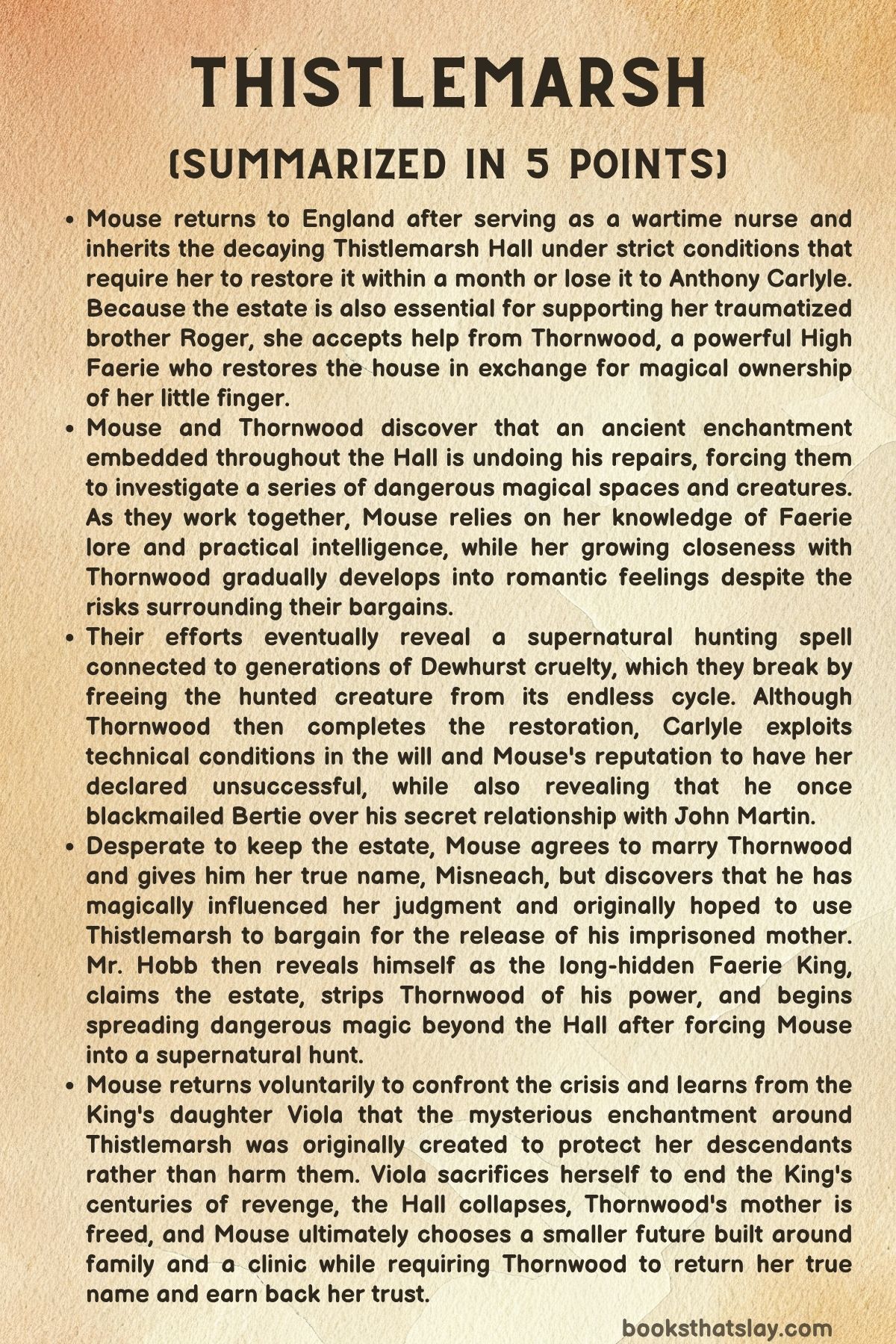
Summary
In April 1919, Mouse returns to England after working as a nurse in France during the Great War. She has survived physically, but the war has altered nearly everything she once imagined for herself: her beloved cousin Bertie was killed at the Somme, while her brother Roger lives with severe shell shock and requires continuing medical care.
Mouse had once dreamed of studying Faerie anthropology, inspired partly by stories about the supernatural beings who disappeared from England generations earlier. On the train toward Tithe, she encounters Charles, Dorothy, and James, and when James experiences a panic attack caused by his own wartime trauma, Mouse immediately recognizes what is happening and helps him.
Conversation turns toward the Dewhurst family and their notorious estate, Thistlemarsh Hall. Mouse explains the old legend that the house was once granted to the Dewhursts by the Faerie King, only for the family to cheat him and supposedly bring a curse upon themselves; she then reveals that she is herself part of the scandalous Dewhurst line.
When Mouse reaches the Hall, she finds it badly neglected. Her late uncle, Lord Dewhurst, has left her the estate because Roger is incapable of inheriting under the supernatural rules governing Faerie-blessed houses, but the inheritance comes with cruel conditions.
She has one month to complete an enormous list of repairs while being forbidden from selling the property, significantly altering it, or disposing of specified belongings. The alternative is marriage within the same period, and failure will transfer the estate to Anthony Carlyle, whom Mouse hates because of his past treatment of Bertie.
The situation becomes more serious because income from the estate is needed for Roger’s medical support. Unable simply to reject the inheritance, Mouse accepts the challenge and begins trying to restore the Hall.
Returning to her childhood home forces Mouse to confront memories of Bertie, Roger, her parents, and the difficult years she spent growing up beneath Lord Dewhurst’s authority. Her old friend John Martin, now the local vicar, becomes one of her main sources of emotional support, while the elderly groundskeeper Mr. Hobb welcomes her with considerably more warmth than most of the remaining household.
Strange signs soon suggest that the Faerie stories Mouse studied as a girl were not merely folklore. A stone figure in the woods changes position and eventually disappears from its pedestal.
Mouse follows the clues and speaks words carved near the statue, releasing a High Faerie named Thornwood from stone. He is powerful, intelligent, dangerous, and governed by a culture in which favors must be paid for through carefully defined exchanges.
At first Mouse refuses to make a deal with him. Circumstances soon remove that luxury when Dawson leaves his position and a letter from Roger’s doctor warns that Roger will need expensive long-term accommodation.
Mouse therefore bargains with Thornwood. He agrees to restore the interior of the house and help her satisfy the inheritance requirements, while she gives him magical ownership of her little finger.
The finger remains physically attached, but its reflection disappears, demonstrating that the agreement has genuine supernatural consequences. Mouse understands that even apparently limited bargains can transfer meaningful control to Faeries.
Thornwood disguises himself as a fashionable foreign architect so that his presence will not alarm the villagers. His magic repairs woodwork, furnishings, walls, heating, and other damaged parts of the estate with astonishing speed, while Mouse and Mr. Hobb work more conventionally on the gardens.
Thornwood is accompanied by Mickelwaithe, a strange servant who eventually reveals that he was once human. Centuries of Faerie service have altered him almost beyond recognition after an ancient bargain cost him his true name.
Their apparent progress soon fails when Thornwood’s repairs begin reversing themselves. They discover that a much older system of magic exists throughout the Hall and is consuming or undoing the new enchantments.
Rather than simply destroying the old spell, which might also destroy the building, Mouse suggests approaching it like an invasive root system. Guided indirectly by Mr. Hobb’s gardening advice, Mouse and Thornwood begin tracing and weakening the supernatural structure section by section.
Their search leads them into hidden magical environments connected to elemental forces. In one, they encounter a giant silk dragon amid fire and heat; in another, they confront a dangerous water creature that manipulates Thornwood and nearly turns Mouse to stone.
Mouse survives through observation and quick judgment rather than superior magical power. After the injured dragon emerges from the first encounter, it transforms into a small black-and-gold creature whom Mouse names Smudge and adopts despite Thornwood’s warnings about becoming attached to enchanted beings.
As Mouse and Thornwood work together, their relationship becomes increasingly personal. They discuss literature, family histories, mortality, grief, and the differences between human and Faerie existence.
Thornwood reads Jane Eyre to Mouse, tends her injuries, and gradually allows a gentler side of himself to appear. Mouse in turn becomes attracted to him despite knowing that affection cannot erase the danger built into their bargain.
A hidden door inside the Hall eventually requires two silver keys. Mouse has one inherited from her mother, while its companion once belonged to Bertie.
She and Thornwood travel to London to retrieve Bertie’s possessions from solicitor Mr. Beckett. Thornwood temporarily gives Mouse magically persuasive speech in exchange for control of one of her eyes, allowing her to force Beckett into admitting that Lord Dewhurst deliberately ordered him to withhold Bertie’s key unless she specifically requested it.
London also exposes Thornwood’s vulnerability. Iron, smoke, lead, underground transport, and separation from wild vegetation weaken him, while an urban common Faerie tells him that lesser Faeries survived industrialization by adapting rather than abandoning the mortal world.
Back at the estate, Mouse and John bury Bertie’s returned belongings because his body was never brought home. Their shared mourning partly repairs a growing strain between them caused by John’s distrust of Thornwood.
Using the two keys, Mouse and Thornwood open the mysterious door and enter an enchanted hunting world created by generations of Dewhurst violence. Animals once killed as trophies are forced to suffer their deaths repeatedly, while spectral members of the family continue an endless hunt.
Instead of accepting the rules, Mouse decides to reverse the outcome. She and Thornwood lead the hunted creature toward its persecutors and allow it to destroy the hunters, breaking the cycle.
Once the magical hunt collapses, Thornwood regains much of his strength and destroys the remaining old magical network. They believe the obstacle preventing the restoration has finally disappeared.
Thornwood completes the restoration with extraordinary speed, but Mouse becomes disturbed by the perfection he creates. The repaired estate has lost many traces of the people who once lived there, including small marks associated with Bertie, Roger, and her parents.
At the same time, Mouse finds herself increasingly unable to maintain certain doubts about Thornwood. Their attraction culminates in a passionate kiss, although Thornwood stops immediately when Mouse becomes overwhelmed.
Everything collapses during Beckett’s final inspection. Carlyle accompanies him and points out that Lord Dewhurst required certain hunting trophies to remain, yet those objects vanished when the magical hunt was destroyed.
Carlyle also attacks Mouse’s reputation because Thornwood has been living in the Hall without a female chaperone. Beckett ultimately decides that she has failed the conditions and awards the estate to Carlyle.
Carlyle then reveals why Lord Dewhurst included him in the will. Bertie had been in love with John, and Carlyle had discovered the relationship when the men were younger.
Carlyle blackmailed Bertie, until Roger learned what was happening and violently defended him. Later Carlyle used knowledge of John’s identity to threaten Lord Dewhurst, giving him continued leverage over the family.
Facing the loss of the estate, Mouse accepts Thornwood’s proposal of marriage because marriage still satisfies Lord Dewhurst’s inheritance conditions. The price Thornwood asks is Mouse’s true name.
Mouse believes that she loves him and that he cares for her, so she agrees. John, however, refuses to perform the ceremony because he believes Thornwood has appeared at exactly the moments when Mouse is most vulnerable and has gradually gained increasing control over her.
Mr. Hobb also senses that something is wrong when Mouse casually invites him to attend. That invitation has disastrous consequences.
At midnight, during a magnificent Faerie wedding, Mouse gives Thornwood her true name: Misneach. Their marriage is magically sealed, but when she kisses him, the mental influence clouding her judgment finally breaks.
Thornwood confesses that he deliberately prevented her from reconsidering the wedding. His original purpose was to gain control of the estate so that he could bargain with the Faerie King for the release of his imprisoned mother.
Mr. Hobb then reveals that he is actually the long-vanished Faerie King. Mouse’s invitation has allowed him to cross protections that had previously kept him outside.
He also reveals that Mouse descends from his daughter Viola, who married into the Dewhurst family, meaning Mouse herself carries Faerie blood. Because her true family identity is Dunne rather than Dewhurst and the inheritance deadline has passed, the King claims the estate after Carlyle is transformed into stone.
The King strips Thornwood of his power and begins a traditional supernatural hunt in which Mouse is the prey. She is given until sunrise to escape the woods.
With Mickelwaithe’s assistance, Mouse reaches John’s garden just before dawn. Once she recovers, she tells John what happened and learns that the King’s magic is spreading beyond the estate, mutating vegetation and threatening the entire village.
Thornwood secretly uses the magical connection to Mouse’s little finger to warn her to flee. Instead, the message convinces her that he is still alive.
Mouse makes a crucial decision: she will no longer permit Lord Dewhurst, Carlyle, Thornwood, John, the Faerie King, or anyone else to decide what she must do. John therefore gives her his father’s military sword, and she returns willingly to the estate.
Inside, she meets Viola, the supposedly dead daughter of the Faerie King. Viola explains that the complicated magical system surrounding the house was never intended as a curse.
Centuries earlier, Viola fell in love with a Dewhurst heir. After they married and had a child, his brothers murdered him and blamed her.
To remain near and protect her descendants, Viola bound herself to the house through an orange tree planted by her husband. Over the generations, her protective magic became unstable, creating the system Mouse and Thornwood mistakenly dismantled.
Viola helps disguise Mouse and tells her that the Faerie King’s power must be anchored in an ordinary object. Mouse enters the transformed Hall, reaches the Faerie court, and finds Thornwood chained before the King.
The King torments Thornwood by presenting jars of moths and claiming his imprisoned mother is among them. Mouse identifies a plain vase of white roses as the likely object containing the King’s power and seizes it.
Viola then enters and confronts her father. Rather than continuing centuries of revenge, she urges him to release his hatred and accept that vengeance cannot restore their lost family.
Because Viola’s existence remains bound to the estate, she releases her magic completely. She and the building begin collapsing together, while Thornwood’s mother, Theodora, is finally restored.
Viola persuades her father to give Mouse the key to Thornwood’s chains. Father and daughter disappear together as the long conflict ends, and Mouse frees Thornwood before the Hall collapses around them.
Mouse awakens beneath the ruins with Thornwood protecting her body from falling debris. Villagers led by John eventually rescue them.
Once everyone is safe, Thornwood confesses the full extent of his deception. From the beginning, he hoped to obtain the estate as a bargaining tool for rescuing his mother, and at one point he even considered exploiting Roger’s condition.
Mouse refuses either immediate forgiveness or immediate rejection. She recognizes that Thornwood loved her while also recognizing that love does not excuse his manipulation.
After recovering, she stands among the ruins and discovers an unexpected sense of release. The ancestral house that controlled generations of her family can no longer control her future.
Thornwood apologizes and tells her he loves her. Mouse admits that she loves him too, but insists that trust must be rebuilt through action.
Her essential demand is the return of her true name. Thornwood immediately gives Misneach back, surrendering the supernatural power he held over her.
Years later, Mouse has built a smaller life on the former estate grounds. She lives with Thornwood and Roger, Smudge remains part of the household, and she establishes the clinic she once imagined creating.
John and Mickelwaithe develop a relationship of their own, while the next generation grows up in a place where human and Faerie lives can meet without the old Hall determining who they must become.
Characters
Mouse / Misneach Dunne-Dewhurst
Mouse is the emotional and moral center of Thistlemarsh, a woman whose return from wartime nursing forces her to confront both inherited family burdens and the personal losses she has never fully processed. Her competence comes from experience rather than social privilege: she understands wounds, trauma, practical work, research, folklore, and human vulnerability, yet she initially has far less confidence in her right to control her own future.
Her nickname reflects this history. Lord Dewhurst called her Mouse partly because he refused to respect her Irish name, turning something associated with childhood humiliation into the identity she later uses strategically when dealing with Faeries.
Mouse’s strongest quality is her ability to observe before acting. She repeatedly survives magical dangers not because she possesses greater power than her opponents but because she notices rules, inconsistencies, environmental clues, emotional weaknesses, and possibilities others overlook.
Her nursing instinct is equally central to her character. She helps James during his panic attack, worries constantly about Roger, cares for the injured magical creature that becomes Smudge, tends those around her almost automatically, and ultimately dreams of creating a clinic rather than preserving aristocratic grandeur.
Her greatest internal conflict concerns control. Lord Dewhurst’s will attempts to control her economically, Carlyle tries to defeat her socially and legally, Thornwood gains supernatural claims over parts of her body and identity, John sometimes attempts to protect her by telling her what she should do, and the Faerie King literally hunts her.
Her decisive development comes when she chooses to return to the estate after escaping. She does so not because anyone commands her but because she has finally decided that acting freely matters more than simply reaching safety.
Her relationship with Thornwood makes that development difficult because genuine love and genuine violation exist beside each other. Mouse refuses the easy conclusion that affection cancels wrongdoing, and her final demand that he return her true name establishes the condition on which their relationship can continue: love without ownership.
Thornwood
Thornwood begins Thistlemarsh as an embodiment of everything Mouse has been taught to fear about High Faeries. He is beautiful, ancient, clever, literal-minded about bargains, comfortable with dangerous displays of power, and unable to understand why mortals might consider some technically valid exchanges morally troubling.
His bargain for Mouse’s little finger demonstrates his worldview. He regards the payment almost artistically, connecting bone and flesh to the structural and decorative restoration of the house, while Mouse experiences the agreement as the unnerving discovery that a part of herself can belong to someone else.
Yet Thornwood is not simply predatory. Working beside Mouse gradually challenges his assumptions about mortals, especially when she solves problems through knowledge, patience, gardening analogies, compassion, and practical intelligence rather than magical force.
His growing affection becomes visible through small acts: reading to Mouse, caring for her injuries, worrying about her safety, respecting her refusal when physical intimacy becomes overwhelming, and eventually using his remaining link to her finger to warn her of danger. These moments prove that his attachment is not entirely fabricated.
That does not erase his betrayal. Thornwood enters Mouse’s life with a concealed objective: he hopes to control the estate so that he can exchange it for his imprisoned mother, and he eventually manipulates Mouse’s mental state during their wedding to prevent her from reconsidering.
His motives make the betrayal understandable without making it acceptable. He loves his mother and has endured punishment, exile, and powerlessness because of the Faerie King’s revenge, but he reproduces the same logic of control that has harmed Mouse throughout her life.
Thornwood’s final development therefore depends on surrender rather than conquest. When Mouse demands her true name back, he returns it immediately, choosing her freedom over the supernatural advantage he possesses and beginning the slower work of earning trust rather than claiming it.
John Martin
John is one of the most important human relationships in Thistlemarsh, functioning simultaneously as Mouse’s old friend, Bertie’s surviving lover, a village clergyman, and a representative of ordinary human skepticism toward Faerie power. His bond with Mouse is grounded in shared history and grief rather than supernatural attraction.
His refusal to believe Mouse when she first explains that Thornwood is genuinely a Faerie creates one of his major failures. Because the story sounds impossible and because village gossip makes Thornwood appear to be Mouse’s secret lover, John interprets her confession through conventional social assumptions rather than trusting her direct testimony.
Nevertheless, John’s distrust of Thornwood is ultimately justified in important ways. He notices that Thornwood enters Mouse’s life during a period of extreme vulnerability, gains access to her home, acquires supernatural ownership over parts of her, and eventually proposes marriage when she is desperate to preserve the estate.
John’s refusal to perform the wedding therefore reflects more than jealousy or moral rigidity. He recognizes that Mouse is behaving unlike herself and refuses to cooperate with a ceremony for which he doubts she is capable of giving fully independent consent.
His history with Bertie adds another dimension to his caution. John has already experienced a society in which love can be weaponized by people such as Carlyle, and he knows how secrets, reputation, and unequal power can destroy lives.
Once Mouse returns after the Faerie King’s hunt, John stops trying to dismiss her experience. He listens, supports her recovery, arms her when she chooses to return, summons Mickelwaithe when necessary, and participates in rescuing those trapped beneath the ruins.
His character ultimately learns that protecting Mouse does not mean deciding for her. That shift allows their friendship to survive disagreement and gives Mouse a human relationship based increasingly on respect rather than paternal authority.
Bertie
Although Bertie dies before the main events, he remains one of the most powerful absent presences in the book. His death at the Somme represents the enormous human cost of the war, while memories of his childhood with Mouse and Roger preserve an image of the family before violence, secrecy, and grief overwhelmed it.
Bertie’s sexuality places him at the center of another form of cruelty. When he confides his love for another young man, Carlyle turns that trust into an opportunity for blackmail.
His relationship with John reveals why the secrecy was so dangerous. The social and legal realities surrounding relationships between men gave Carlyle the power to threaten not only Bertie but also John and eventually Lord Dewhurst.
Bertie’s belongings therefore become emotionally significant. Because his body never returns from the Front, Mouse and John bury his box near the beehives, creating the grave they were previously denied.
His memory also helps explain the difference between preserving a physical building and preserving a life. When Thornwood’s perfect restoration erases the scratches and marks associated with Bertie, Mouse realizes that restoration can become another kind of destruction if it removes evidence that imperfect people once existed there.
Roger
Roger represents the lingering human damage of war more directly than almost anyone else in Thistlemarsh. He survives military service but returns with such severe shell shock that he frequently fails to recognize Mouse and cannot assume the responsibilities traditionally expected of the Dewhurst heir.
His incapacity is also the practical reason Mouse cannot simply abandon the inheritance. The estate provides the financial means she hopes to use for his continued treatment, turning an apparently personal struggle over property into a fight over her brother’s future.
Memories of Roger reveal a very different side of him. Before the war, he was energetic, loyal, and fiercely protective of Bertie.
When Roger discovered that Carlyle was blackmailing Bertie, he physically attacked Carlyle and broke his nose. The incident demonstrates both his anger and his instinct to defend those he loves against social cruelty.
Roger’s condition exposes the inadequacy of conventional ideas about survival. He technically comes home from the war, but the person Mouse remembers has been profoundly changed.
The ending gives Roger a quieter form of hope. Mouse does not attempt to force him back into the aristocratic role he once might have inherited; instead, she imagines bringing him home and building a life structured around care, familiarity, and dignity.
Anthony Carlyle
Carlyle is the most straightforwardly malicious human figure in the story. Unlike many of the supernatural characters, whose actions are shaped by alien rules, grief, or centuries-old obligations, Carlyle repeatedly chooses cruelty for advantage.
His treatment of Bertie establishes his character long before his direct conflict with Mouse. After learning about Bertie’s relationship with another man, Carlyle turns private knowledge into a weapon and extorts money from him.
Years later, he uses knowledge of John’s identity to gain leverage over Lord Dewhurst. This helps explain why he is positioned as the alternative heir and demonstrates how one act of blackmail can continue shaping a family long after its original victim dies.
Carlyle’s attempt to acquire the estate continues the same pattern. He does not merely wait for Mouse to fail; he watches for technical weaknesses, accompanies Beckett during the inspection, attacks Mouse’s reputation, and exploits the disappearance of the hunting trophies.
He also represents the social order Mouse is fighting. His power depends on inheritance rules, gender expectations, reputation, class privilege, and the assumption that a woman can be discredited for living under the same roof as a man without supervision.
His eventual transformation into stone carries deliberate irony. A man who repeatedly tries to reduce other people to secrets, weaknesses, and useful objects is himself reduced to an object beside the road.
Mr. Hobb / The Faerie King
Mr. Hobb initially appears to be one of the gentlest figures in Thistlemarsh. He remembers Mouse’s childhood, treats her kindly, cares deeply for the gardens, understands grief without judging it, and offers practical advice that indirectly helps her solve the magical problem threatening the estate.
That apparent goodness makes the revelation of his true identity especially effective. Hobb is actually the Faerie King who disappeared generations earlier and whose conflict with the Dewhursts lies behind much of the family’s history.
His disguise allows him to remain close to the estate while magical protections prevent him from simply reclaiming it. Mouse unknowingly removes that barrier when she invites him to attend her wedding.
The King’s actions are driven by grief, humiliation, and revenge. He believes his daughter Viola was taken from him through mortal treachery and punishes not merely the people responsible but generations of descendants and Thornwood’s entire family.
His treatment of Thornwood demonstrates how thoroughly grief has become cruelty. He destroys Thornwood’s father, imprisons his mother, banishes Thornwood, and later mocks his desperation before an entire court.
The contrast between Hobb and the King shows how identity can contain genuine contradictions. His kindness toward Mouse and his love of cultivation are not necessarily false, but neither prevents him from becoming destructive when centuries of resentment regain control.
His final encounter with Viola offers the possibility of release rather than victory. He does not defeat his enemies or receive compensation for his suffering; instead, he finally accepts his daughter’s appeal to end a conflict that has consumed far more lives than the original wrong.
Viola
Viola is one of the most important hidden figures in Thistlemarsh, even though Mouse does not meet her directly until late in the story. For much of the narrative, Viola exists as a warning presence speaking through mirrors, walls, and magical disturbances.
She is initially believed to have died after falling in love with a mortal Dewhurst. The truth is more complicated: she married him, had a child, and remained connected to the estate after his brothers murdered him.
Viola’s response to loss sharply contrasts with her father’s. The Faerie King turns grief outward through punishment and revenge, while Viola binds herself to the house so that she can continue protecting her child and later descendants.
The enormous magical system Mouse and Thornwood destroy is therefore based on a tragic misunderstanding. What looks like hostile magic is actually a protective structure that has deteriorated and become unstable over centuries.
Viola’s final decision completes the contrast between protection and possession. She understands that remaining bound to the estate forever is no longer truly saving anyone.
By releasing her spell, she sacrifices her continued existence, destroys the physical center of the old conflict, restores Thornwood’s mother, and gives her father the opportunity to end his revenge. Her choice makes freedom possible for descendants who would otherwise remain trapped inside a family struggle they did not create.
Mickelwaithe
Mickelwaithe occupies an uneasy space between humanity and Faerie. He was once mortal, but an old bargain cost him his true name and centuries of service gradually altered his body until he became something composed as much of enchantment and memory as ordinary flesh.
His condition functions as an important warning for Mouse. Thornwood’s ownership of her finger initially seems strange but limited, whereas Mickelwaithe demonstrates how a bargain can continue changing a person long after its immediate consequences appear manageable.
Despite his servitude, Mickelwaithe retains significant moral independence. He cares for Thornwood, even secretly giving him a sleeping draught when he believes exhaustion has become dangerous, but he does not blindly endorse everything Thornwood does.
His quiet warning before Mouse’s wedding is particularly important. He senses that something has gone wrong and tries to alert her despite the restrictions surrounding him.
Later he helps Mouse flee the Faerie King’s hunt and responds when John summons him. His loyalty is therefore based less on obedience than on relationships developed across centuries.
The ending, which suggests a growing connection between Mickelwaithe and John, also gives him the possibility of becoming something other than a servant defined by an ancient bargain. Like Mouse, he begins moving toward a life in which identity is chosen rather than owned.
Lord Dewhurst
Lord Dewhurst never appears alive, yet his decisions control much of the story. His will creates the impossible restoration deadline, prevents Mouse from freely changing or selling the estate, makes marriage an alternative condition, and gives Carlyle a path toward inheritance.
His treatment of Mouse during childhood reveals deep prejudice. He refuses proper respect for her Irish identity, treats her parentage as a family embarrassment, and imposes the nickname that eventually becomes her everyday name.
Yet his actions surrounding Carlyle show that he cannot be reduced to simple hostility. After Roger attacks Carlyle for blackmailing Bertie, Lord Dewhurst uses his influence against Carlyle, and his later concessions appear partly motivated by the need to protect John’s identity.
This mixture of prejudice, family loyalty, secrecy, and authoritarian control makes him representative of the old Dewhurst system. Even when trying to protect someone, he does so by manipulating circumstances from above rather than trusting others with knowledge and choice.
The conditions of his will continue this behavior after his death. Mouse’s struggle is therefore not only against a building or inheritance problem but against a dead patriarch’s attempt to govern the living.
Dawson
Dawson initially seems to continue Lord Dewhurst’s hostility toward Mouse. His cold reception reminds her of the humiliations she experienced in the house as a child and reinforces her sense that she has inherited a place that never fully accepted her.
His later apology complicates that impression. Before leaving, Dawson admits that his previous treatment of Mouse was cruel and expresses confusion about Lord Dewhurst’s final demands.
The apology matters because it shows that individuals shaped by a rigid household can eventually reconsider their behavior. Dawson cannot undo what he did, but he can acknowledge it rather than pretending the past was harmless.
His departure also removes one of Mouse’s few possible sources of practical assistance. This helps push her toward Thornwood and therefore contributes indirectly to the bargain that changes everything.
Mr. Beckett
Mr. Beckett functions as the administrator of Lord Dewhurst’s continuing authority. He presents Mouse with the inheritance conditions, interprets the legal requirements, controls access to Bertie’s belongings, and eventually decides whether she has fulfilled the will.
He is not as deliberately cruel as Carlyle, but his obedience to formal instructions repeatedly causes harm. He withholds Bertie’s key simply because Lord Dewhurst ordered him not to provide it unless Mouse knew enough to ask for it specifically.
During the final inspection, Beckett again allows technical interpretation to outweigh the spirit of Mouse’s achievement. Although she has accomplished an almost impossible restoration, the missing trophies and Carlyle’s attack on her reputation become sufficient reasons to rule against her.
His character demonstrates how harmful systems can operate through ordinary professional compliance. Beckett does not need personal hatred for Mouse to enforce rules designed by someone who wished to control her.
Theodora
Theodora, Thornwood’s mother, spends most of the story as an unseen motivation rather than an active participant. Her imprisonment explains many of Thornwood’s decisions and gives emotional weight to actions that would otherwise appear purely selfish.
Thornwood’s determination to recover her drives his alliance with Mouse, his desire for control over the estate, and ultimately his betrayal. Theodora therefore represents the person for whom he convinces himself almost any means may be justified.
When she is finally restored, however, she does not become another source of manipulation. She thanks Mouse for rescuing both herself and Thornwood and participates peacefully in the new relationships forming after the destruction of the old order.
Her survival allows Thornwood to face an important moral test. Once the person he has sacrificed so much to save is actually free, he can no longer justify controlling Mouse as part of that rescue.
Smudge
Smudge begins as a huge magical dragon encountered inside one of the hidden enchantments. After being badly burned, the creature emerges into ordinary reality and changes into a small black-and-gold animal with a doglike appearance.
Mouse’s immediate decision to nurse Smudge reveals much about her character. Even after nearly dying in a magical environment, her first instinct is to treat the injured creature rather than regard it only as an enemy.
Smudge later becomes a source of companionship and emotional steadiness. During Mouse’s confused recovery after escaping the Faerie King’s hunt, Smudge’s familiar presence helps reconnect her to ordinary reality.
The creature also challenges Thornwood’s insistence that enchanted beings should not be treated according to human emotional expectations. Mouse becomes attached anyway, and that attachment survives the collapse of the estate.
Lady Blakeney
Lady Blakeney is present primarily through her collection of Faerie stories, but those stories shape Mouse’s understanding of supernatural danger. They teach her that true names matter, bargains must be interpreted literally, appearances cannot establish trust, and clever language may conceal dangerous intentions.
Mouse repeatedly returns to these lessons when dealing with Thornwood. The book therefore gives written folklore a practical function rather than treating it merely as decorative background.
Lady Blakeney’s tales also connect Mouse to her mother, who encouraged her fascination with Faerie history. Preserving the book after the Hall’s destruction becomes symbolically important because knowledge and memory survive even when the ancestral building does not.
Themes
Freedom, Consent, and the Ownership of the Self
Questions of ownership extend far beyond property in Thistlemarsh. Mouse begins with an inheritance that supposedly gives her ownership of an estate, yet nearly every condition attached to it demonstrates that legal possession does not necessarily mean freedom.
Lord Dewhurst controls what she may repair, remove, sell, or alter even after his death. Roger’s dependence on estate income makes refusal difficult, while the marriage provision turns Mouse’s personal relationships into another mechanism through which property determines her choices.
Faerie bargains make the same problem physical. Mouse gives Thornwood ownership of her little finger, later temporarily gives him control over an eye, and finally gives him her true name.
Each exchange raises the question of whether consent remains meaningful when one person possesses overwhelming power or when circumstances make refusal almost impossible. Mouse technically agrees to the bargains, but technical agreement is not always the same as free choice.
The wedding exposes that distinction most severely. Mouse willingly loves Thornwood and initially agrees to marry him, yet his magical interference prevents her from reconsidering, violating the continuing consent on which any meaningful relationship depends.
Her final demand for the return of Misneach is therefore more important than a romantic declaration. Reclaiming her name means reclaiming authority over herself.
The destruction of the Hall completes the same movement on a larger scale. Once the property that everyone has fought to possess disappears, Mouse becomes freer to decide what kind of home, work, family, and marriage she actually wants.
Grief, Memory, and the Difficulty of Letting Go
Nearly every major conflict grows from someone trying to determine what should be done with loss. Mouse mourns Bertie, the healthy Roger she once knew, her wartime experiences, her parents, and the childhood world associated with the estate.
John carries his own grief for Bertie, made more painful because their relationship could not be publicly recognized. Burying Bertie’s belongings becomes an attempt to create the ritual of farewell that war and secrecy denied them.
The Faerie King represents grief transformed into revenge. Unable to accept what he believes happened to Viola, he punishes generations of Dewhursts and destroys Thornwood’s family.
His suffering may explain his rage, but centuries of retaliation do not bring Viola back or repair his original loss. Instead, refusing to release grief creates new victims who eventually inherit conflicts they did not begin.
Viola responds differently. She also refuses to leave at first, binding herself to the house so that she can protect her child and descendants.
Over time, however, protection becomes another form of imprisonment. Her final act recognizes that preserving something forever can prevent both the protector and the protected from moving forward.
Mouse faces the same lesson when Thornwood perfectly restores the estate. The disappearance of Bertie’s marks and other family traces teaches her that memory does not require freezing the past into flawless physical form.
By the end, loss remains real rather than magically repaired. What changes is the characters’ willingness to live without requiring the past to return exactly as it was.
Inheritance, Family, and the Burden of the Past
Inheritance in the story includes far more than land or money. Mouse inherits the Dewhurst estate, but she also inherits social prejudice, supernatural agreements, family secrets, unfinished grief, obligations toward Roger, and consequences created by people who died long before she was born.
The Faerie King similarly treats descendants as extensions of their ancestors. His revenge assumes that later generations can properly be punished for crimes committed centuries earlier.
Viola’s protective magic operates through the opposite intention but creates a related problem. She wants to protect her descendants, yet the magical structure she leaves behind eventually becomes unstable and dangerous.
Bertie and Roger also suffer from inherited expectations about masculinity, class, sexuality, and family reputation. Bertie cannot openly love John, Roger is expected to occupy a particular aristocratic role, and Mouse is treated as socially inferior because of her parentage and Irish connection.
Thistlemarsh itself becomes the physical symbol of this accumulated inheritance. The building contains memories of love and safety alongside prejudice, violence, secrecy, hunting, and domination.
Mouse initially believes saving the house may also mean saving her family. Eventually she discovers that the family can survive precisely because the building does not.
Her final life rejects the idea that honoring previous generations requires reproducing their structures. She keeps relationships, books, memories, gardens, and family connections while replacing the enormous ancestral Hall with a smaller home and clinic designed for the needs of the living.
Tradition, Change, and the Possibility of a Different Future
The story takes place immediately after a war that has made older social certainties difficult to maintain. England is changing technologically, culturally, and socially, while both humans and Faeries must decide whether survival means preserving old systems or adapting to new circumstances.
Thornwood initially represents traditional High Faerie identity. He depends on wild nature, suffers badly in industrial London, observes ancient bargaining customs, and views adaptation with suspicion because he fears losing what makes his kind distinct.
The urban Brownie challenges that assumption. Common Faeries who could not retreat from human civilization learned to survive alongside machines, crowded housing, pollution, and modern cities.
Human society faces similar questions. Lord Dewhurst’s world is built around aristocratic inheritance, rigid gender expectations, class hierarchy, secrecy, and the protection of reputation.
Mouse belongs to a generation forced to recognize the failures of that system. The war has already destroyed the assumption that inherited status or traditional masculine ideals can provide safety or meaning.
The ending rejects both complete abandonment of tradition and blind preservation. Mouse keeps Faerie knowledge, family memory, relationships, and parts of the old gardens, but she refuses to rebuild the Hall exactly as it was.
Thornwood also remains Faerie without needing to preserve every cruel custom associated with Faerie power. Returning Mouse’s name shows that tradition can be rejected when it violates another person’s freedom.
The future shown years later therefore rests on selective continuity. Humans and Faeries still retain differences, history remains remembered, and old stories continue to matter, but the next generation is not required to reproduce the conflicts, hierarchies, and bargains that governed those who came before.