Carnival Fantastico Summary, Characters and Themes
Carnival Fantastico by Angela Montoya is a fantasy romance about magic, ambition, betrayal, and the cost of survival. Set around a night carnival full of dangerous wonders, the story follows Esmeralda Montero, a runaway fortune teller trying to secure her place as the carnival’s next star.
Her plans are disrupted when Ignacio Olivera, the boy she once loved and lost, returns with secrets of his own. As they uncover the truth behind the carnival’s magic, old wounds reopen and larger dangers emerge. The novel blends romance, resistance, spectacle, and mystery into a story about choosing love without losing oneself.
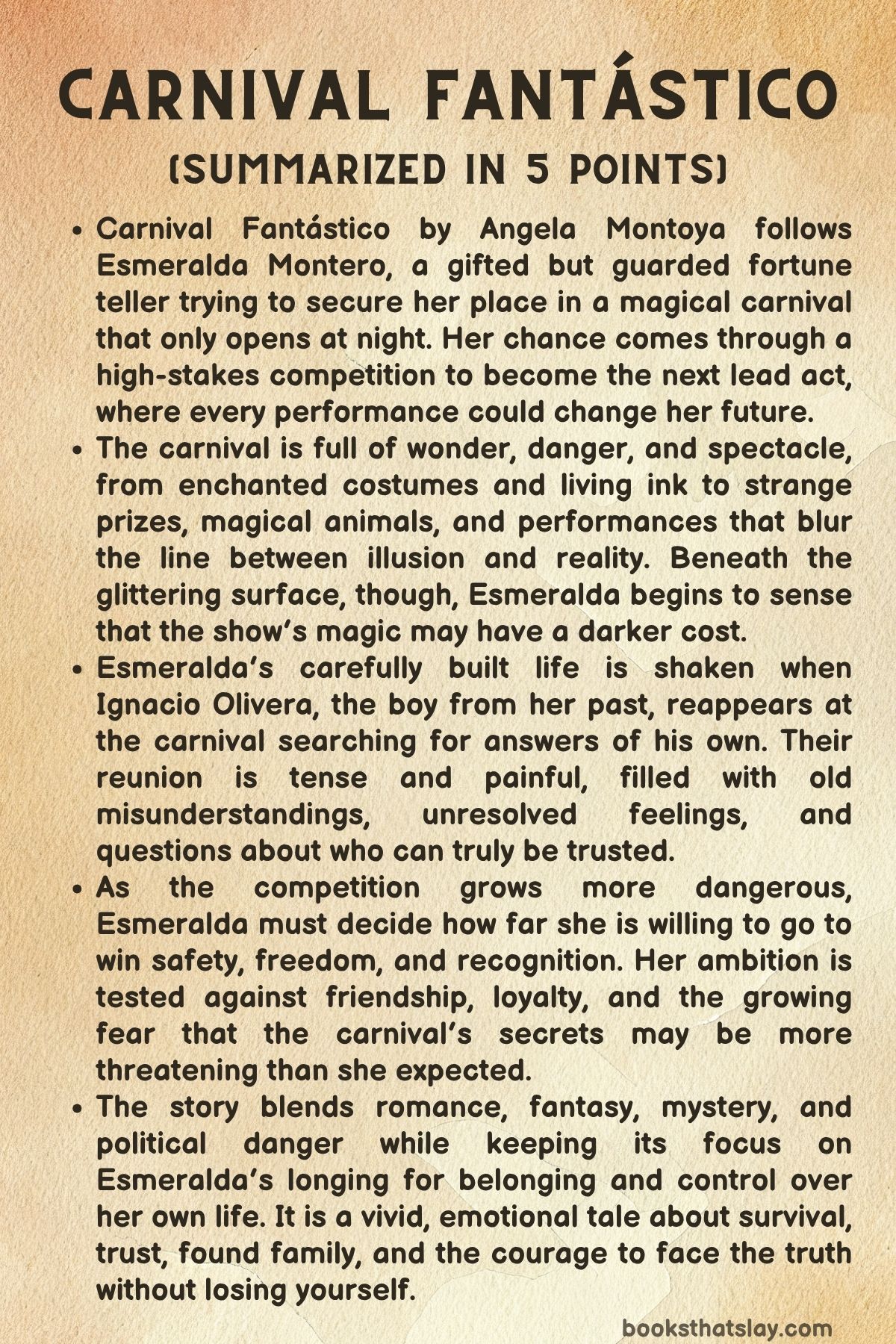
Summary
Carnival Fantastico begins as the magical carnival arrives near Río Norte, the city Esmeralda Montero once called home. The carnival appears only from sunset to sunrise and is filled with strange games, enchanted prizes, costumes, tonics, living ink, music, performers, and tricks that often carry real danger.
Esmeralda works there as La Paloma Blanca, a fortune teller whose show depends on theatrical skill, enchanted cards, and clever effects designed by her friend Gabriel. She has been part of the carnival for ten months, but performers can only stay for a year unless they become important enough to remain.
Esmeralda is desperate to win a permanent place. The carnival gives her income, safety from the law, and the hope of escaping the reach of Costa Mayor.
Her chance comes through the Running, a competition to choose the carnival’s next main act. At first, Esmeralda fears she has been rejected, especially after learning that Camila and Pilar Sánchez, strongwoman performers, have received invitations.
Then a black envelope arrives for her, confirming that she has been chosen. She is thrilled, though Gabriel teases her about relying more on tricks than talent.
That night, her show succeeds with a bootlegger in a wolf mask, who tips her well and reveals that guests are betting on the outcome of the Running.
At the same time, Ignacio Olivera breaks into the manor of his father, Comandante Olivera. Ignacio once trained to become a loyal Blackbird soldier, but he defected after seeing Costa Mayor’s forces murder innocent villagers in Dos Palos while searching for a hidden resource.
He now works with the Defiant, a resistance group trying to expose the truth behind the war. In his father’s office, Ignacio finds maps showing military movement and carnival flyers addressed to his father with threatening messages.
The strange shimmering ink reminds him of Esmeralda, the girl he once loved. When his father returns, Ignacio escapes and heads to Carnival Fantastico.
At the carnival, Ignacio is forced to trade his dagger for a mask and tries to find Ángel Veracruz, the ringmaster. Instead, he crosses paths with Esmeralda.
She does not recognize him at first, but when she realizes who he is, old anger takes over. She believes he has become like his father and has come to arrest her.
Their confrontation turns physical, and she knocks him unconscious with a golden egg before framing him as a thief.
Ignacio wakes in a jail cart and escapes before he can be handed over to the military. Esmeralda, meanwhile, prepares to leave with the carnival train and admits pieces of her past to Camila, Pilar, and Gabriel.
As a child, she was caught stealing from Comandante Olivera and forced to serve as his spy and errand runner. During that time, she and Ignacio grew close through secret notes and paper doves.
Their bond became love, but they were separated by betrayal and lies. Esmeralda later ran away, was imprisoned, and eventually met Gabriel while being transported toward the war.
Ignacio manages to catch the carnival train as it crosses a dangerous bridge. Ángel pulls him aboard and allows him to stay, but only if he works and looks into a mirror of truth.
Ignacio sees an impossible happy future with Esmeralda and his father, leaving him shaken. The carnival’s caboose is far larger inside than outside and full of revelry, performers, and strange magic.
Esmeralda receives enchanted white gloves from Ángel. When she uses them, her cards turn into flying paper doves, giving her act a more dazzling form.
Her wagon is moved to the prestigious first ring, but Ángel also finds her stolen goods and Ignacio’s badge. He warns her about breaking rules, then gives her the first challenge of the Running: prove her versatility in five hours.
When Ignacio reappears, she quickly claims he is helping her. They strike a deal: he will assist with her act, and she will help him investigate the ink and the messages sent to his father.
Esmeralda creates a chaotic parade act using a stolen cage, a troublesome ostrich named Estefan, feathers, costumes, and Ignacio himself. Their forced partnership revives their old chemistry, though both remain guarded.
Soon after, disaster strikes during another act. Pilar is badly injured, Camila collapses, and Ignacio notices a strange face in one of the mirrors.
Ángel refuses to let Pilar leave for a hospital, insisting that the show continue. This cruelty raises Ignacio’s suspicion that something darker is hidden beneath the carnival’s glamour.
As the Running continues, the crowd begins to celebrate Esmeralda and Ignacio as “the palomas,” turning their tension into part of the spectacle. Ángel encourages Esmeralda to use Ignacio and play up a love story for the audience.
Ignacio warns her that the mirrors and enchanted objects are dangerous, but she resists at first because winning feels like her only way to survive. She cannot return to prison or fall back into Comandante Olivera’s hands.
In the next performance, Esmeralda and Ignacio appear together in the Big Top. Her enchanted gloves create flying fortune doves, and the audience loves them.
But the gloves burn her skin, the hoop spins wildly, and both of them see a monstrous cracked face in the dark mirrors above. Ignacio helps her recover without breaking the act.
Moments later, Paco the Fire Breather is consumed by flames, and Ángel continues the show as if death is just another attraction.
Esmeralda finally accepts that Ignacio is right. Together, they sneak into Ángel’s wagon and find betting slips showing that guests are wagering on which performers will be injured.
They also find a letter from Ignacio’s father demanding his release and a jar of sparkling enchanted ink. The ink appears connected to the forged messages, the carnival’s magic, and the letter that once tore Esmeralda and Ignacio apart.
Their past becomes clearer when Esmeralda finds the cruel letter Ignacio believed she left him. Ignacio insists it was in her handwriting, but she denies writing it.
They realize Comandante Olivera manipulated them both. He made Esmeralda believe Ignacio had abandoned her and made Ignacio believe Esmeralda had rejected him.
The enchanted ink likely created the false letter. With the truth exposed, they admit they never stopped loving each other and reconcile.
The danger grows as they learn that the carnival’s mirrors are tied to Tezcán, a godlike being who steals youth, strength, and life essence. Ángel and Comandante Olivera have been feeding people to Tezcán for decades in exchange for magic, power, and stolen youth.
Failed performers, rule-breakers, and powerful acts are sacrificed to maintain Ángel’s beauty and control. Camila becomes one of Tezcán’s victims, aged horribly after her essence is taken.
Esmeralda realizes Ángel wants her as a major sacrifice because she has become the kind of showstopper he needs.
Esmeralda, Ignacio, Gabriel, Camila, and Pilar fight back. To distract the guards, Esmeralda and Ignacio release the animals from the menagerie by breaking the mirrors that hold them.
Estefan and the other creatures charge through the carnival, while Gabriel sets off fireworks. Esmeralda and Ignacio enter the Fun House and destroy mirror after mirror.
Tezcán tries to tempt Esmeralda by offering to make her easier to love, but she rejects him. The Fun House begins to burn and collapse.
In the chaos, Ignacio is taken by his father, and Esmeralda and Gabriel are captured by Jorge the tailor, who has been spying for Olivera. Camila, though weakened and aged, saves them by attacking Jorge.
Elsewhere, Ángel reveals that he is Olivera’s brother, Ángel Valerio. Decades earlier, the brothers made a bargain with Tezcán.
Olivera gained power, Ángel gained youth, and they sacrificed people, including Ignacio’s mother.
The final confrontation takes place in the Big Top. Ignacio is tied up, Ángel prepares another sacrifice, and Esmeralda arrives with Camila in disguise.
The rescue nearly fails, but Gabriel’s explosives begin destroying the tent. Olivera turns against Ángel and helps free Ignacio, though he is wounded.
Ángel tries to give Esmeralda to Tezcán, but Olivera tackles him, and Ignacio smashes Ángel’s final hand mirror. With that last connection broken, the Big Top collapses, the carnival’s magic dies, and Ángel is defeated.
Afterward, Olivera lives long enough to publicly confess his crimes and his brother’s. Ignacio publishes the truth through the Defiant Press.
King Amadeo and Olivera are arrested, the corrupt origins of the war are revealed, and the sacrifices behind Carnival Fantastico are exposed. Three months later, Esmeralda and Ignacio are with Camila, Pilar, Gabriel, and Javier at a countryside home.
Camila is recovering, Estefan watches over the farm, and Esmeralda finally has what she once believed she could never keep: love, family, peace, and a home.
Characters
Esmeralda Montero
Esmeralda Montero is the emotional center of Carnival Fantástico, a young woman shaped by abandonment, poverty, manipulation, imprisonment, and survival. At the carnival, she performs as La Paloma Blanca, a fortune teller whose act depends on theatrical tricks, enchanted cards, showmanship, and Gabriel’s mechanical illusions.
Her desire to become the next lead act is not simple ambition; it is a desperate attempt to secure safety, income, freedom, and control over a life that has repeatedly been controlled by others. Esmeralda’s cleverness is one of her defining traits.
She can read people quickly, improvise under pressure, turn danger into performance, and use charm as both weapon and shield. Yet beneath her confidence lies deep insecurity.
She fears being rejected, replaced, arrested, abandoned, or forced back into the power of Comandante Olivera. This fear often makes her selfish, evasive, and willing to bend the truth, but the book presents these flaws as survival habits rather than simple moral failures.
Her relationship with Ignacio reveals her vulnerability most clearly. At first, she sees him through the pain of their past and assumes he has become an enemy like his father.
She frames him, attacks him, and distrusts his warnings because trusting him would mean reopening an old wound. As the truth emerges, Esmeralda is forced to confront how deeply she was manipulated and how much love she buried under anger.
Her reunion with Ignacio is not just romantic; it restores part of the self she lost when she believed she had been betrayed. At the same time, her friendships with Gabriel, Camila, and Pilar challenge her to become more than a survivor.
Camila especially pushes her to understand that friendship requires presence, discomfort, apology, and loyalty. By the end of the story, Esmeralda’s growth comes from choosing love and family without surrendering her sharpness, courage, or independence.
She rejects Tezcán’s offer to make her “easier to love,” which is one of her most important moments because it shows she has stopped believing she must be remade in order to deserve care.
Ignacio Olivera
Ignacio Olivera is one of the most morally grounded characters in the book, though he begins as someone haunted by shame, family loyalty, and disillusionment. As the son of Comandante Olivera, Ignacio was raised close to power and trained to become part of Costa Mayor’s military system.
His defection after witnessing the massacre in Dos Palos marks a decisive break from the life his father designed for him. Unlike characters who resist authority for personal freedom alone, Ignacio’s rebellion is rooted in conscience.
He cannot ignore what he has seen, and his work with the Defiant shows that he wants truth to replace propaganda. His search for evidence against his father also reveals his courage, but it is a painful courage because every discovery forces him to confront the corruption within his own family.
Ignacio’s emotional conflict is closely tied to Esmeralda. He arrives at the carnival believing she broke his heart, while she believes he abandoned and betrayed her.
Their early interactions are full of suspicion, anger, and physical danger, but Ignacio’s patience and persistence show the depth of his love. He is not perfect; he carries assumptions about Esmeralda, and he struggles to see the full extent of his father’s manipulation at first.
However, he repeatedly chooses to protect her, listen to her, and stand beside her even when doing so places him in danger. His role in the performances also shows his adaptability.
Though he is not a natural performer like Esmeralda, he learns to use spectacle when survival requires it. By the end, Ignacio becomes more than a rebel son or a romantic hero.
He becomes a witness who helps expose the truth publicly, turning private trauma into political accountability.
Gabriel
Gabriel is Esmeralda’s closest friend at the carnival and one of the story’s most inventive and loyal figures. He supports her fortune-telling act through hidden devices, pulleys, sound effects, dry ice, and other illusions, which makes him essential to the image she presents to the public.
His creativity gives the carnival its playful energy, but Gabriel is not merely comic relief or a backstage helper. He is deeply observant, technically skilled, and emotionally loyal.
He understands Esmeralda’s ambition and fear better than most, even when he teases her about the weakness of her act. His friendship gives her a sense of belonging before she is ready to admit how much she needs other people.
Gabriel’s importance grows as the carnival becomes more dangerous. He helps Camila and Pilar when they decide to leave, contacts Javier, hides the injured, creates distractions, and uses fireworks and explosives to fight back against Ángel’s power.
He is practical in crisis and brave without needing the spotlight. His loyalty is also morally significant because he does not enable Esmeralda blindly.
He cares for her, but he also becomes part of the network of people who push her toward responsibility. Gabriel represents chosen family in the story.
He is proof that Esmeralda has already built bonds worth protecting, even before she fully accepts that she deserves them.
Camila Sánchez
Camila Sánchez is a strongwoman performer whose physical strength is matched by emotional honesty. As one of the Sánchez Sisters, she appears at first as a rival to Esmeralda in the Running, but she soon becomes one of Esmeralda’s most important mirrors.
Camila is ambitious, but her ambition is complicated by love for Pilar. She competes partly because Pilar wants the spotlight, which shows that Camila’s strength often expresses itself through protection and sacrifice.
Her injuries during the performance and later aging at Tezcán’s hands reveal the cruelty of a carnival system that consumes performers while pretending to celebrate them.
Camila’s greatest contribution to the book is her moral clarity. She confronts Esmeralda when Esmeralda avoids visiting her and Pilar, making it clear that friendship is not proven through charm or convenience but through showing up when things are painful.
This confrontation helps Esmeralda understand how often she runs from emotional responsibility. Camila’s courage continues even after she is physically weakened and aged.
She ambushes Jorge, helps in the rescue attempt, and remains committed to protecting the people she loves. Her gradual restoration after the mirrors are destroyed carries symbolic weight: once the carnival’s predatory magic is broken, the stolen parts of her life begin returning to her.
Pilar Sánchez
Pilar Sánchez is Camila’s sister and the other half of the strongwoman act. Though she receives less direct focus than Camila, Pilar plays an important role in revealing the emotional stakes of performance and ambition.
She wants recognition, applause, and the chance to shine, which helps explain why the sisters enter the Running. Her desire for the spotlight is not portrayed as foolish; rather, it reflects the understandable hunger of a performer who wants to be seen as extraordinary.
However, the dangers of the competition show how the carnival exploits that hunger.
Pilar’s injury is one of the first major signs that the Running is not merely competitive but predatory. Her broken body forces other characters, especially Ignacio and Esmeralda, to see that the accidents are not ordinary mishaps.
Pilar’s suffering also exposes Ángel’s cruelty, because he refuses to prioritize her medical care over the continuation of the show. Through Pilar, the story shows the cost of spectacle when people in power value entertainment, profit, and magic above human life.
Her survival and later presence at the countryside home help complete the story’s movement from exploitation toward healing.
Ángel Veracruz / Ángel Valerio
Ángel Veracruz, later revealed as Ángel Valerio, is the ringmaster of Carnival Fantástico and the central villain behind the carnival’s glamour. He presents himself as elegant, charismatic, mysterious, and theatrical, but his charm hides a long history of exploitation.
Ángel understands performance deeply, and this makes him dangerous. He can recognize talent, manipulate ambition, and turn personal longing into a trap.
His treatment of Esmeralda is especially revealing. He flatters her, praises her ambition, offers her opportunities, and frames ruthlessness as greatness, all while preparing to use her as a sacrifice.
He does not merely command the carnival; he feeds on the dreams of those who want to belong there.
Ángel’s bargain with Tezcán exposes the rotten foundation beneath his showmanship. His stolen youth and magic depend on the draining of others, including performers who fail, rule-breakers, and powerful people sacrificed for stronger enchantments.
His relationship with Comandante Olivera reveals that his villainy is tied not only to the carnival but also to political violence and war. Ángel’s greatest weapon is his ability to make exploitation look like wonder.
He turns danger into spectacle, suffering into entertainment, and ambition into bait. His death and the fading of the carnival’s magic mark the collapse of a system built on stolen lives.
Comandante Héctor Olivera
Comandante Olivera is Ignacio’s father and one of the most destructive forces in the story. As a military leader, he represents state violence, corruption, secrecy, and control.
He is responsible for manipulating both Ignacio and Esmeralda, separating them through lies and forged messages, and using Esmeralda as a child spy after catching her stealing. His power over her begins when she is young and vulnerable, which makes his treatment of her especially cruel.
He turns her survival into servitude and later allows her to be imprisoned, making him a figure of both political and personal oppression.
Yet Olivera is not written as a flat villain by the end. His connection to Ángel and Tezcán reveals a deeper history of greed, ambition, and sacrifice, including the death of Ignacio’s mother.
He has committed terrible crimes, but his final actions complicate him. He fights Ángel, cuts Ignacio free, saves Esmeralda, and publicly confesses before dying.
This does not erase his crimes, but it gives his character a grim final recognition of guilt. Olivera’s confession is important because it turns hidden corruption into public truth.
He remains a morally ruined man, but his final choice helps dismantle the system he helped build.
Tezcán
Tezcán is the dark supernatural force behind the carnival’s mirrors, enchantments, and stolen vitality. He is less a human character than a predatory presence, but his influence shapes much of the story’s danger.
Through mirrors, he watches, tempts, harms, and consumes. His magic gives the carnival its wonder, but that wonder is parasitic.
The enchanted gloves, cuffs, mirrors, and other objects are connected to a system that drains essence from performers and guests. Tezcán represents the hunger beneath spectacle: the force that takes pieces of people in exchange for beauty, power, youth, or applause.
His temptation of Esmeralda is especially important. By offering to make her easier to love, Tezcán targets her deepest insecurity.
He understands that she fears being too difficult, too damaged, too sharp, or too unworthy of lasting affection. Her rejection of him shows her growth.
She no longer accepts the idea that love requires self-erasure. Destroying Tezcán’s mirrors is therefore both a physical victory and an emotional one.
It breaks the carnival’s supernatural control while also rejecting the lie that people must surrender pieces of themselves to become valuable.
Jorge
Jorge the tailor initially appears as one of the carnival’s strange, transactional figures, someone who creates costumes and demands unusual payments. His work connects him to performance, disguise, and transformation, but he is later revealed to be far more sinister.
He works for Olivera and spies on the carnival, making him a bridge between the military world and the carnival’s hidden corruption. His willingness to trade information, manipulate others, and capture Esmeralda and Gabriel shows that he serves power rather than loyalty or justice.
Jorge’s character also reflects one of the story’s recurring ideas: costumes can reveal as much as they conceal. As a tailor, he helps people become part of the carnival’s fantasy, but his own role is a disguise.
Beneath his practical usefulness is betrayal. His defeat by Camila is satisfying because it reverses his assumed control.
He underestimates the people he helps exploit, and Camila’s attack proves that even weakened characters can resist those who profit from hidden cruelty.
General Keara
General Keara is a dangerous representative of force inside the carnival’s final conflict. She blocks Esmeralda and Ignacio on the catwalk and nearly stops their escape, showing herself to be disciplined, violent, and loyal to the system protecting Ángel and Olivera.
Her presence raises the stakes because she is not an illusionist or performer but a direct physical threat. She brings the brutality of military power into the carnival’s theatrical space.
Her death is also symbolically fitting. Esmeralda defeats her through quick thinking, using a slipper and an electric baton rather than superior strength.
Keara’s fall over the railing shows how the story often allows performance objects, costumes, props, and improvised tools to become weapons of survival. She represents rigid violence, while Esmeralda defeats her through agility, theatrical instinct, and refusal to surrender.
Paco the Fire Breather
Paco the Fire Breather is a performer whose death reveals the full horror of the Running. Before his fatal accident, the competition may still seem dangerous but survivable, a twisted contest where performers risk injury for fame.
Paco’s flames make it clear that the danger is deliberate and escalating. His death becomes one of the moments that forces Esmeralda to accept Ignacio’s warnings about the mirrors and the corrupt magic around them.
Paco also represents the expendability of performers under Ángel’s rule. Ángel’s decision to continue the show immediately after Paco dies is chilling because it shows that human life matters less to him than momentum, spectacle, and control.
Paco’s role is brief but powerful. Through him, the story strips away the carnival’s glamour and reveals a machine that consumes people in public while encouraging the crowd to cheer.
Nicola
Nicola is one of the remaining performers in the Running and becomes another victim of the carnival’s cruelty when she is trapped underwater. Her danger is made worse by the guards’ indifference; instead of saving her, they focus on capturing Esmeralda and Ignacio.
This moment shows how completely the carnival’s priorities have been corrupted. Human survival is secondary to obedience, punishment, and the protection of Ángel’s secrets.
Nicola’s role emphasizes the collective danger faced by the performers. The Running is not only Esmeralda’s personal challenge but a system designed to select, endanger, and potentially sacrifice talented people.
Nicola’s suffering helps widen the story beyond the main romance and shows that many performers are trapped inside the same predatory structure.
Estefan
Estefan the ostrich brings humor, chaos, and unpredictability to the story, but he also becomes surprisingly useful in the resistance against the carnival. Esmeralda first uses him as part of her improvised plan to prove versatility, turning his chaotic energy into spectacle.
Later, he helps draw attention and becomes part of the disruption that allows the characters to fight back. His presence adds comic movement to tense scenes, balancing danger with absurdity.
By the end, Estefan’s role at the countryside home gives him a warm symbolic place in the found family that survives the carnival. He shifts from carnival creature to farm guardian, which mirrors the larger movement from exploitation to refuge.
Like the human characters, he is removed from a place of manipulation and becomes part of a safer home.
Rosco
Rosco the monkey is a minor but memorable figure whose role highlights Esmeralda’s quick thinking. During the escape, she uses the donkey head to trick the guards by placing it over Rosco, turning him into a decoy.
This moment captures the playful, improvised style of the book’s action. Even in danger, Esmeralda survives through misdirection, theatrical instinct, and a willingness to use absurdity as strategy.
Rosco also contributes to the carnival’s atmosphere of living chaos. The animals are not merely background decoration; they become part of the rebellion once the menagerie is released and the mirrors are broken.
Rosco’s small role fits into the larger idea that Ángel’s controlled spectacle collapses when the beings inside it stop obeying the roles assigned to them.
Javier
Javier, connected to the Defiant, represents the world beyond the carnival and the possibility of organized resistance. Though he is not as central on the page as Esmeralda, Ignacio, Gabriel, or Camila, his importance lies in the support network he represents.
Esmeralda asks Camila to have Gabriel contact him because she understands that exposing the carnival’s corruption requires help from outside its enchanted boundaries.
His presence at the countryside home near the end reinforces the theme of chosen family and political repair. Javier belongs to the part of the story concerned with truth, resistance, and rebuilding after corruption is exposed.
Through him, the book suggests that survival is not only personal escape but also connection to wider communities capable of challenging power.
King Amadeo
King Amadeo is not a deeply developed personal presence, but he is important as a symbol of corrupt authority. His arrest after Ignacio publishes the truth shows that the crimes connected to Olivera, Ángel, and the war reach the highest levels of power.
He represents a political order built on lies, violence, and hidden bargains. His downfall expands the consequences of the final revelations beyond the carnival itself.
The king’s role helps connect the magical plot to the political plot. The story is not only about escaping a dangerous carnival; it is also about exposing the corrupt origins of war and dismantling the institutions that benefited from secrecy.
King Amadeo’s arrest gives the ending a sense of public justice, showing that truth can move from private evidence to national consequence.
Themes
Survival and the Cost of Ambition
Esmeralda’s desire to become the lead act is driven less by vanity than by fear. In Carnival Fantastico, success means safety, income, shelter, and distance from the prison and military power that have shaped her life.
Her ambition is therefore complicated: it gives her courage, creativity, and sharpness, but it also tempts her to ignore warning signs and emotional responsibilities. She continues competing even after performers are injured, friendships are strained, and the carnival’s cruelty becomes harder to deny.
This shows how survival can make people accept dangerous systems because those systems seem to offer the only available escape. Esmeralda’s choices are not presented as simple selfishness; they come from a life in which abandonment, poverty, and punishment have taught her to rely on performance and cunning.
The theme becomes powerful because ambition is shown as both a strength and a trap. She wants control over her future, but the carnival uses that desire against her, turning her desperation into entertainment for others.
Love, Trust, and Manipulation
The relationship between Esmeralda and Ignacio carries the emotional weight of betrayal, misunderstanding, and delayed truth. Their separation was not caused by a lack of love but by lies created by people who understood how to exploit fear.
Ignacio believes Esmeralda abandoned him, while Esmeralda believes Ignacio used and rejected her. Their pain shows how easily trust can be damaged when powerful figures control information.
The forged letter becomes more than a plot device; it represents how love can be distorted when people are denied the truth. Their reunion is bitter at first because both are protecting themselves from being hurt again.
As they begin comparing memories, the false story built around them breaks apart. This theme is detailed through small shifts: suspicion becomes argument, argument becomes honesty, and honesty becomes renewed loyalty.
Their love is not idealized as easy or magical. It requires courage, apology, and the willingness to believe that the past may have been shaped by someone else’s cruelty.
Performance, Identity, and Self-Worth
Esmeralda’s role as La Paloma Blanca reveals how performance can be both protection and prison. Her fortune-telling act depends on illusion, timing, costume, enchanted objects, and Gabriel’s inventions, but it also allows her to become someone confident and admired.
The problem is that the carnival encourages performers to measure their value only by applause, spectacle, and profit. Esmeralda begins to believe that if she is impressive enough, she will finally be safe and wanted.
This makes her identity fragile because it depends on pleasing an audience and winning approval from Ángel. The magical gloves and paper doves make her act more beautiful, but they also hurt her, showing the physical and emotional cost of turning oneself into a show.
By the end, Esmeralda must reject the idea that she needs to become easier to love or more dazzling to deserve belonging. Her worth is not proven by becoming the carnival’s star.
It is proven when she chooses truth, loyalty, and freedom over applause.
Corruption, Exploitation, and Hidden Power
The carnival’s wonder hides a brutal system of exploitation. Guests arrive seeking excitement, prizes, music, and magic, but behind the spectacle are betting schemes, injuries, sacrifices, and bargains made for power.
Ángel presents himself as a charming ringmaster who protects the show, yet he treats performers as resources to be used. Comandante Olivera’s crimes mirror this same hunger for control outside the carnival, where war, military violence, and political ambition are built on secrecy.
In Carnival Fantastico, magic is not innocent when it is gained through stolen youth, stolen essence, and the suffering of vulnerable people. This theme shows that corruption often survives because it is hidden beneath beauty, entertainment, authority, or patriotism.
People accept what they see on the surface until someone exposes the cost beneath it. Ignacio’s work with the resistance and Esmeralda’s final rejection of Tezcán both challenge systems that feed on silence.
The collapse of the carnival becomes a symbolic end to power maintained through fear, lies, and sacrifice.