Cleaner by Jess Shannon Summary, Characters and Themes
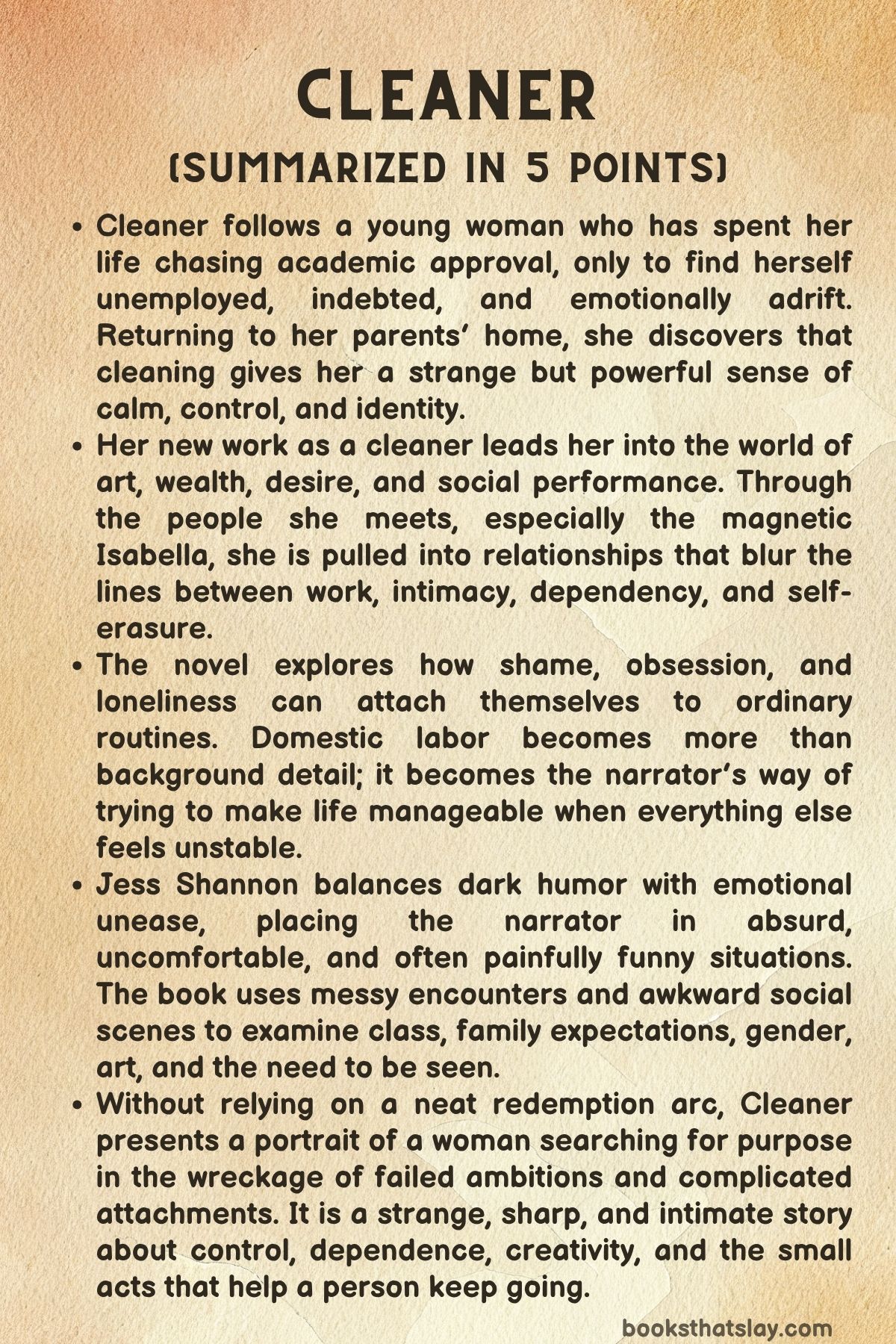
Cleaner by Jess Shannon is a dark, strange, comic novel about a young woman whose life has stalled after years of chasing academic success. Broke, depressed, and unable to turn qualifications into a stable future, she finds an unexpected sense of control in cleaning.
What begins as a practical task becomes a way of managing shame, desire, failure, and loneliness. Her world expands through Isabella, a chaotic artist, and Paul, Isabella’s boyfriend, pulling her into messy relationships and unstable domestic arrangements. Cleaner is about obsession, class, bodies, work, art, and the need to feel useful.
Summary
The narrator of Cleaner has spent much of her life trying to become the kind of person her parents might admire. She believes that if she performs well enough at school and gathers enough qualifications, she will finally receive the attention and approval she wants.
But by her mid-twenties, the promise of achievement has collapsed. She has degrees and certificates, but no job that makes use of them.
She is in debt, unemployed, and depressed, with no clear sense of direction. Instead of feeling accomplished after receiving her final certificate, she feels empty.
Her days and nights lose structure. She walks through the city after dark, passing through streets while other people sleep, then returns to bed during the day.
When her lease ends, she has nowhere better to go, so she moves back in with her parents. The return feels like defeat.
In their house, she feels childish, dependent, and useless. She has done everything she thought she was supposed to do, yet she has ended up back where she began.
A small domestic task changes her mood in an unexpected way. Her mother asks her to do the washing-up, and the narrator discovers that cleaning gives her a calm she has not found anywhere else.
The task has a beginning, a process, and a visible result. Dirt can be removed.
Disorder can be corrected. Unlike academic success, employment, family approval, or love, cleaning gives immediate proof that effort has mattered.
She begins to attach meaning to domestic order and becomes increasingly focused on it.
This new fixation leads her to apply for cleaning work. She is hired at a small nude-art gallery, where she expects to stay in the background, making the space clean and orderly.
Instead, she is drawn into the gallery’s strange social world almost immediately. When the life-drawing model cancels, the narrator is persuaded to pose naked for the artists.
The experience is awkward and exposing, but it also places her body at the center of the room in a way she cannot ignore.
After the session, she goes to dress and accidentally walks in on Isabella, an artist who is doing cocaine in the bathroom. Isabella is using a sketch she made of the narrator, and the moment shifts quickly from embarrassment to intimacy.
They share cocaine, laugh, and have sex against the wall. The encounter gets the narrator fired, but it also leaves her fascinated by Isabella.
Outside, Isabella casually reveals that she has a boyfriend named Paul. Even so, the narrator gets her number and clings to the possibility of seeing her again.
When Isabella does not reply, the narrator forces a reason to re-enter her life. She calls and suggests that Isabella hire her as a cleaner.
Isabella agrees, and the narrator arrives at the expensive flat Isabella shares with Paul. The home is beautiful but filthy, especially the kitchen.
Isabella leaves her to clean, turning the arrangement into something uncomfortable and unequal. The narrator wants the task to be meaningful, but the mess overwhelms her.
She vomits, spills rubbish, and breaks down when Isabella treats the situation as a game of power and humiliation. The two eventually clean together, but the experience leaves the narrator emotionally shattered.
She returns home and spends days in bed, unable to recover quickly from the confusion of desire, shame, and failure.
A month later, the narrator attends her brother’s gender-reveal party, which has a Pride and Prejudice theme. The family event is already strange and theatrical, but it becomes stranger when Isabella appears.
She has been commissioned to paint a portrait predicting what the baby will look like. The narrator and Isabella retreat to the bathroom, do cocaine, and have another sexual encounter.
When they are almost interrupted, the narrator escapes through a window. Isabella’s painting is later unveiled and is shockingly bad, though the guests respond with forced politeness.
The narrator and Isabella run away from the party together. They drink heavily and end up at a bar, where a man approaches the narrator and asks her to read erotic writing from his phone.
His work is terrible, and the encounter becomes one more absurd incident in an already chaotic night. In the confusion, the narrator accidentally keeps his phone.
Later, she takes Isabella home, drunk, to Paul. Paul is kind to her and allows her to stay.
The narrator slowly becomes part of the household, but not in the way she first imagined. Isabella begins to drift away, while Paul becomes more present and reliable.
The narrator starts sleeping with him and moves further into the flat. Isabella eventually disappears entirely, leaving behind a nude sketch of the narrator.
Her absence becomes another obsession. The narrator searches Isabella’s studio, paints obsessively, and tries to make sense of the life she has entered.
She and Paul form a strange domestic partnership shaped by routine, sex, grief, and the missing presence of Isabella.
The outside world intrudes when the narrator and Paul go to brunch with her parents. The restaurant has just been the site of a murder, and the narrator later realizes from the news that the victim is the man from the bar, the one who had asked her to read his erotic writing.
She still has his phone. The police trace the device to Paul’s flat and take her in for questioning.
Her explanation sounds bizarre but is true. After checking the details, they release her, and the murder becomes another surreal event attached to her disordered life.
The narrator continues moving through jobs, plans, and obsessions without finding stability. She works at a daycare and a roller-disco.
She attempts art projects and clings to cleaning rituals. She tries to build a life with Paul, but her behavior remains unstable.
In one of her more misguided attempts to create beauty, she paints a playground white at night, imagining that the children will experience it as magical. Instead, parents see it as vandalism.
What she meant as transformation is judged as damage.
Her relationship with Paul cannot hold. After another breakdown, he asks her to leave.
She returns once again to her parents’ home, but even that space has changed. Her old bedroom is now occupied by a Ukrainian refugee, which makes her feel even less certain of where she belongs.
She gets a smear test and briefly imagines becoming a nurse, drawn again to the idea of useful work and care. But that possible future passes quickly, replaced by another plan: she will stage a solo exhibition at the gallery where she first met Isabella.
The exhibition brings together many parts of her life: Paul, her parents, her brother, his grieving partner, and others connected to the narrator’s failures and attempts at reinvention. Then Isabella appears, heavily pregnant.
Her arrival causes tension because her earlier terrible gender-reveal portrait has become linked in everyone’s mind to the stillbirth of the narrator’s nephew. The narrator pulls Isabella outside before the situation worsens.
At a bus stop, the two women talk. Isabella shows ultrasound images and speaks about becoming a mother.
The conversation is quieter than their earlier encounters, marked less by reckless attraction than by the recognition that their lives have changed. Nearby, they find a pigeon egg abandoned on the pavement.
The egg is fragile and almost certainly doomed. After Isabella leaves, the narrator carries it away in her shirt and places it in a tree.
She knows she cannot save it, but she does the small thing available to her. In the end, that limited act of care becomes a modest answer to the narrator’s longing for purpose.
Characters
The Narrator
The narrator of Cleaner is a young woman whose life begins under the pressure of achievement and gradually becomes a search for usefulness, order, intimacy, and meaning. She has grown up believing that academic success will earn her love or attention from her parents, but this belief collapses when education leaves her not fulfilled but indebted, unemployed, and emotionally exhausted.
Her depression is not presented as a single dramatic event but as a slow draining of purpose: she walks the city at night, sleeps through the day, and returns to her parents’ house feeling like a failed adult. This makes her discovery of cleaning especially important.
A simple household task gives her the kind of peace and certainty that education never did. Cleaning becomes more than work for her; it becomes a language through which she tries to prove her value, control her surroundings, and quiet the chaos inside her mind.
Her relationship with cleaning also reveals her tendency toward obsession. She is drawn to acts that promise transformation: washing dishes, restoring kitchens, painting, caretaking, and even staging an exhibition.
Yet these projects often become unstable because she expects them to repair emotional wounds that they cannot fully fix. When she tries to clean Isabella and Paul’s filthy apartment, her breakdown shows the gap between the fantasy of control and the humiliation of real life.
She wants cleaning to make her powerful, but Isabella turns it into a scene of vulnerability and shame. Later, her attempt to paint a playground white shows the same pattern.
She imagines beauty, renewal, and generosity, but other people see damage and disorder. The narrator’s intentions are often tender, but her actions are impulsive, poorly judged, and shaped by emotional desperation.
Her relationships are intense because she is searching for someone or something that will give her a stable identity. Isabella awakens desire, danger, and artistic fascination in her.
Paul offers comfort, domesticity, and temporary shelter. Her parents represent the old wound of needing approval.
Her brother’s life events remind her of family expectations and the adulthood she feels she has failed to enter properly. The narrator is not simply chaotic; she is deeply sensitive, hungry for significance, and easily absorbed by people who seem to offer escape from herself.
By the end of the story, her act of carrying the abandoned pigeon egg is small but meaningful. She cannot save everything, and perhaps she has finally begun to understand that.
The doomed egg reflects her own painful movement from grand fantasies of transformation toward a humbler kind of care.
Isabella
Isabella is one of the most magnetic, destructive, and unpredictable figures in the book. She enters the narrator’s life through art, sex, drugs, and humiliation, and from the beginning she represents both freedom and danger.
As an artist, she seems to possess the creative life the narrator longs for, but her actual art is often grotesque, chaotic, or absurd. Her portrait for the gender-reveal party is especially revealing because it exposes the gap between her artistic confidence and the unsettling results of her work.
Isabella is not romanticized as a genius; instead, she is shown as someone whose charisma can make failure, cruelty, and disorder appear fascinating.
Her treatment of the narrator is deeply uneven. She can be playful, intimate, and exciting, but she can also be careless and cruel.
In the apartment-cleaning scene, Isabella turns the narrator’s vulnerability into a power game, making the narrator’s work feel degrading rather than purposeful. She uses distance as a form of control, disappearing emotionally and eventually physically.
This makes her a figure of obsession for the narrator. Isabella’s absence becomes almost as powerful as her presence, leaving the narrator to search through her studio, cling to the nude sketch, and try to understand what Isabella meant to her.
Isabella functions as a catalyst: she does not give the narrator stability, but she awakens parts of her that were previously buried, including sexual desire, artistic ambition, jealousy, and rage.
Her pregnancy near the end complicates her character. She returns not as the same reckless figure but as someone standing on the edge of motherhood, carrying ultrasound images and speaking about the future.
Yet she remains connected to chaos because her appearance at the exhibition reopens grief around the stillborn baby and the earlier disastrous portrait. Isabella is not fully redeemed, but she is made more human.
Her conversation with the narrator at the bus stop suggests that she too is moving through uncertainty, fear, and transformation. She remains elusive until the end: a lover, an artist, a manipulator, a muse, and a woman trying to imagine herself as a mother.
Paul
Paul is Isabella’s boyfriend and later the narrator’s lover, but his importance lies in the strange calm he brings into an otherwise unstable emotional world. He first appears as someone attached to Isabella’s more privileged and chaotic life, living with her in an expensive apartment that is outwardly impressive but inwardly filthy and neglected.
This contrast matters because Paul’s home becomes one of the central spaces where disorder hides beneath wealth and style. Unlike Isabella, Paul is not flamboyantly destructive.
He is quieter, kinder, and more grounded, which makes him attractive to the narrator after Isabella’s disappearance.
His kindness, however, does not make him simple. Paul allows the narrator to stay, becomes sexually involved with her, and participates in a domestic arrangement that is emotionally confused from the start.
He offers comfort, but he also benefits from the narrator’s neediness and displacement. Their relationship seems less like a stable romance than a mutual attempt to fill the space Isabella has left behind.
For the narrator, Paul becomes a substitute home, a witness, and a temporary anchor. For Paul, the narrator may be a way of continuing to live near the memory of Isabella while avoiding the full pain of her absence.
Paul’s eventual decision to ask the narrator to leave is significant because it marks the limit of his patience and the collapse of their arrangement. He is not cruel in the same way Isabella can be, but he cannot save the narrator from herself.
His role in Cleaner is to show that gentleness alone is not enough to create healing. He offers shelter, but not resolution.
He gives the narrator a version of domestic life, but it is built on avoidance, grief, desire, and instability. When that structure breaks, the narrator is forced back into the unresolved world of her family and herself.
The Mother
The narrator’s mother is central because she unknowingly initiates the narrator’s transformation through the simple request to do the washing-up. On the surface, this is an ordinary domestic moment, but for the narrator it becomes almost revelatory.
The mother therefore represents both the pressure of family life and the possibility of discovering meaning within ordinary tasks. She is connected to the narrator’s feelings of dependence and failure, because returning to her parents’ home makes the narrator feel useless and childlike.
Yet the mother’s request also gives the narrator her first sense of practical purpose after a long period of depression.
The mother can be understood as part of the emotional system that shaped the narrator’s obsession with achievement. The narrator’s belief that academic success would earn parental attention suggests a home where love may have felt conditional, distant, or difficult to access.
The mother is not necessarily presented as intentionally cruel, but her presence carries the weight of expectation. She belongs to the world of family rituals, appearances, and ordinary respectability, which contrasts sharply with the narrator’s drugs, sexual confusion, unstable jobs, and artistic breakdowns.
At the exhibition, her presence reminds the reader that the narrator still wants to be seen by her family, even when she is trying to reinvent herself through art.
The Father
The narrator’s father is less individually defined than her mother, but he remains important as part of the parental structure the narrator has spent her life trying to impress. He represents the world of approval, judgment, and conventional adulthood.
The narrator’s academic striving is tied to both parents, meaning the father is part of the emotional background against which she measures her success and failure. His presence at family events and later at the exhibition suggests that the narrator still carries a desire to perform competence in front of him, even when her life has become deeply unstable.
His character also helps show the distance between the narrator’s inner life and the family’s surface-level rituals. The brunch with her parents, for instance, takes place in a setting made absurd by the recent murder at the restaurant.
This contrast reflects the narrator’s life more broadly: ordinary family respectability keeps colliding with violence, embarrassment, and emotional chaos. The father’s role may be quiet, but he helps create the pressure against which the narrator’s breakdowns become meaningful.
He is part of the world she wants to return to, reject, impress, and escape all at once.
The Brother
The narrator’s brother represents a more conventional path through adulthood, family, and social belonging. His Pride and Prejudice-themed gender-reveal party is absurdly comic, but it also shows that he is participating in recognizable milestones: partnership, parenthood, celebration, and family continuity.
In contrast, the narrator arrives as someone whose life feels stalled and erratic. The party becomes a stage on which her private chaos collides with family performance.
Meeting Isabella there intensifies this contrast, because the narrator’s desire and recklessness erupt inside an event designed around domestic expectation and future parenthood.
The brother is also connected to one of the story’s deepest emotional wounds: the stillbirth of his child. This loss changes the meaning of the earlier gender-reveal portrait and makes Isabella’s later appearance at the exhibition especially painful.
Through him, the story connects comic absurdity with grief. His life is not simply more stable than the narrator’s; it is also marked by devastating loss.
This prevents him from being merely a symbol of normal adulthood. He becomes part of the book’s larger concern with failed expectations, fragile futures, and the painful gap between what people imagine life will become and what actually happens.
The Brother’s Partner
The brother’s partner is most strongly associated with pregnancy, grief, and the emotional aftermath of loss. At first, she belongs to the social world of the gender-reveal party, where the unborn child is surrounded by performance, prediction, and celebration.
Isabella’s commissioned portrait is meant to imagine the baby’s future appearance, but because the child is later stillborn, that grotesque artwork becomes attached to grief in a disturbing way. The partner’s suffering therefore changes the emotional meaning of earlier comic scenes.
What once seemed merely ridiculous becomes painful in retrospect.
Her presence at the narrator’s exhibition brings unresolved grief into the open. Isabella’s heavily pregnant body is not just surprising; it is emotionally explosive because it appears in front of people still mourning a lost baby.
The brother’s partner does not need extensive dialogue to matter. She embodies the reality of loss that other characters, especially the narrator and Isabella, often circle around through performance, art, sex, and chaos.
Her grief gives the later scenes a seriousness that cuts through the absurdity. She reminds the reader that not all broken things can be cleaned, painted over, or turned into art.
The Erotica Man
The Erotica Man is a bizarre minor character whose role becomes unexpectedly important. At first, he appears comic and unsettling: a man in a bar asking the narrator to read his terrible erotic writing on his phone.
He seems like part of the story’s chaotic nightlife, another strange figure passing through the narrator’s orbit. Yet the narrator accidentally keeping his phone later connects her to his murder, turning a ridiculous encounter into a serious police matter.
This shift from comic absurdity to danger is typical of the story’s tone, where foolish accidents can suddenly acquire frightening consequences.
As a character, The Erotica Man also reflects the narrator’s vulnerability to strange situations. She drifts into encounters without fully controlling them, and objects from those encounters cling to her life in unpredictable ways.
His phone becomes evidence, suspicion, and a reminder that the narrator’s chaotic movements through the city have real consequences. He is not deeply developed psychologically, but his function is sharp.
He brings the outside world of crime, police, and mortality into a story otherwise focused on private breakdowns, domestic spaces, and unstable relationships.
The Ukrainian Refugee
The Ukrainian refugee who occupies the narrator’s old bedroom is a brief but symbolically important character. When the narrator returns to her parents’ home after Paul asks her to leave, she finds that even her former place in the household has been taken by someone else.
This does not make the refugee an antagonist; rather, their presence reveals how displaced the narrator has become. She cannot simply return to childhood, because childhood no longer exists as a space waiting for her.
Her old room has been repurposed, and her family home has moved on without her.
The refugee also introduces a wider reality of suffering and displacement into the narrator’s private crisis. The narrator feels homeless in an emotional sense, but the refugee’s presence quietly gestures toward literal displacement and survival.
This contrast may make the narrator’s self-absorption more visible, but it also deepens the story’s interest in shelter, belonging, and dependence. The character’s role is small, yet effective: they show that homes are unstable spaces, shaped by need, history, generosity, and loss.
The Unborn and Stillborn Nephew
The narrator’s nephew, first imagined through the gender-reveal party and later remembered through grief, is a character defined more by absence than presence. Before birth, he is surrounded by projection.
The party, the theme, and Isabella’s portrait all turn him into an imagined future before he has entered the world. Everyone gathers around the idea of who he might become, what he might look like, and what role he will play in the family.
This makes his stillbirth especially devastating because it destroys not only a life but also a whole set of expectations.
His absence haunts the later parts of the story. Isabella’s pregnant appearance at the exhibition becomes unbearable partly because it stands beside the family’s memory of the lost child.
The stillborn nephew also connects to the abandoned pigeon egg near the end of the book. Both represent fragile life that cannot be saved by desire alone.
The narrator’s final act of placing the egg in a tree echoes the helplessness surrounding her nephew’s death. She cannot undo loss, but she can still perform a small gesture of care.
Through this absent child, Cleaner turns from comic disorder toward a quieter meditation on grief, helplessness, and tenderness.
The Unborn Child of Isabella
Isabella’s unborn child introduces a new version of Isabella and forces the narrator to confront change. Throughout much of the story, Isabella is associated with recklessness, intoxication, erotic power, and artistic chaos.
Her pregnancy complicates that image because it places her in relation to responsibility, futurity, and care. She shows ultrasound images and speaks about motherhood, suggesting that she is trying to understand herself in a new role.
The narrator, who once saw Isabella as a figure of escape and obsession, must now see her as someone moving into a life that may no longer include her.
This unborn child also intensifies the pain surrounding the narrator’s family. Isabella’s pregnancy appears in the same emotional space as the stillborn nephew, making new life feel both hopeful and cruel.
The child is not yet a fully formed character, but its presence changes the atmosphere around Isabella. It makes her less purely a figure of past desire and more a figure of uncertain future.
For the narrator, this is painful because it confirms that Isabella cannot remain frozen as a muse, lover, or fantasy. She is becoming someone else.
The Gallery Staff and Art-World Figures
The people connected to the nude-art gallery represent the unstable boundary between work, art, exposure, and exploitation. The narrator first arrives there as a cleaner, hoping for ordinary employment and purpose, but she is quickly drawn into posing naked when the life-drawing model cancels.
This moment shows how easily her role shifts from worker to object, from invisible cleaner to visible body. The gallery becomes a place where the narrator is seen, but not necessarily understood or protected.
Her firing after the encounter with Isabella also shows how quickly this world discards her when her vulnerability becomes inconvenient.
The gallery later becomes the site of her solo exhibition, which gives the location a circular structure. What begins as a workplace where she loses control becomes a space where she tries to claim artistic identity.
Yet the exhibition is not a simple triumph. It gathers together the unresolved figures of her life: Paul, her parents, her brother, his grieving partner, and Isabella.
The art-world figures around the gallery therefore help frame the narrator’s longing to transform mess into meaning. They also expose the limits of that transformation, because art cannot fully contain the emotional chaos that enters the room.
The Children and Parents at the Playground
The children and parents connected to the painted playground appear collectively, but they play an important role in revealing the difference between the narrator’s intentions and public reality. The narrator paints the playground white at night because she imagines creating something magical for children.
In her mind, the act is generous, beautiful, and transformative. To the parents, however, it is vandalism.
Their reaction exposes how far the narrator has drifted from shared social judgment. She wants to improve the world, but she acts without consent, practicality, or awareness of consequences.
This group also shows that the narrator’s desire to care for others is real but unstable. She is drawn to children through daycare work, the playground project, and later the abandoned egg.
She wants to protect innocence and create wonder, perhaps because she herself feels damaged and unable to enter ordinary adulthood. The parents’ condemnation forces the reader to see both sides: the tenderness of the narrator’s impulse and the destructiveness of her action.
They function as a social mirror, showing that private visions of beauty can become harmful when separated from responsibility.
The Pigeon Egg
The pigeon egg is not a human character, but it functions like a final symbolic presence in the story. Found abandoned on the pavement after the narrator’s conversation with Isabella, it gathers together many of the book’s concerns: motherhood, failed protection, fragile life, and the limits of rescue.
The narrator knows the egg is probably doomed, yet she carries it carefully in her shirt and places it in a tree. This act is small, almost useless, but emotionally significant.
Unlike her earlier grand gestures, such as obsessive cleaning, unstable art-making, or transforming a playground, this gesture does not pretend to fix everything.
The egg shows a quieter version of the narrator’s care. She does not save it, possess it, or turn it into a performance.
She simply does what little she can. That humility marks a subtle change in her.
The egg reflects the stillborn nephew, Isabella’s unborn child, and the narrator’s own damaged hopes for renewal. It suggests that care matters even when success is impossible.
In the end, the narrator’s relationship with the egg becomes one of the most delicate expressions of her character: flawed, impulsive, wounded, but still capable of tenderness.
Themes
Achievement, Validation, and Emotional Neglect
The narrator’s early life is shaped by the belief that success can make her worthy of love. Academic achievement becomes less a personal ambition than a desperate strategy for being seen by her parents.
Yet each qualification only pushes her further into emptiness, debt, and exhaustion. By her mid-twenties, education has not given her stability or identity; instead, it has left her stranded between childhood dependence and adult failure.
Her return to her parents’ home is painful because it confirms the fear that all her effort has produced nothing useful. In Cleaner, this theme exposes how achievement can become damaging when it is tied to emotional hunger.
The narrator does not simply want a career; she wants proof that she matters. Her depression after completing her studies shows the collapse of a life built around external approval.
Without a new certificate to chase, she is forced to face the deeper absence beneath her ambition: the lack of secure love, purpose, and self-worth.
Cleaning, Control, and the Search for Purpose
Cleaning becomes the narrator’s first real experience of calm because it offers clear action in a life that otherwise feels shapeless. Washing dishes, restoring order, and removing dirt give her a sense of usefulness that academic achievement never provided.
The work is physical, immediate, and visible; unlike her education, it produces results she can touch. Her attraction to cleaning is not only practical but emotional.
It allows her to control small spaces when she cannot control her future, relationships, finances, or mental health. However, this search for order also becomes obsessive.
The filthy kitchen in Isabella and Paul’s apartment overwhelms her because it turns cleaning from a peaceful ritual into a test of power, shame, and endurance. The act that once soothed her becomes another way she is exposed and humiliated.
Through this theme, Cleaner shows that control can be healing when it gives structure, but harmful when it becomes a substitute for emotional stability.
Desire, Power, and Humiliation
The narrator’s relationship with Isabella is driven by attraction, fascination, and emotional risk. Isabella appears exciting because she offers escape from the narrator’s dullness and self-disgust, but she also repeatedly places the narrator in unequal situations.
Their first encounter begins with desire but quickly leads to exposure, dismissal, and confusion. Isabella’s silence afterward deepens the narrator’s need for contact, pushing her to invent the cleaning arrangement as a way back into Isabella’s life.
Once inside the apartment, the narrator is no longer simply a lover or worker; she becomes someone Isabella can watch, test, and embarrass. This pattern continues through parties, bathrooms, drinking, and sudden disappearances.
Desire in the narrative rarely feels safe or mutual. It often comes mixed with performance, class difference, intoxication, and emotional imbalance.
The narrator wants closeness, but she often accepts humiliation as the price of access. The theme reveals how longing can make a person vulnerable to people who offer attention without care.
Failure, Care, and Small Acts of Meaning
The narrator repeatedly fails at the roles she imagines might save her: student, cleaner, artist, partner, worker, and even potential nurse. Yet the ending does not treat failure as complete emptiness.
Instead, meaning appears in small, imperfect acts of care. Her attempt to paint the playground white is misguided, but it comes from a genuine wish to create wonder for children.
Her exhibition is chaotic, but it gathers the damaged people in her life into one shared space. The abandoned pigeon egg becomes the clearest symbol of this theme.
She knows she cannot save it, yet she still carries it gently and places it in a tree. That gesture matters because it is not grand, successful, or admired.
It is simply the best she can do in the moment. The novel suggests that purpose may not come from achievement, romance, art, or work, but from fragile acts of responsibility.
Even when rescue is impossible, tenderness can still exist.