When the Forest Breathes Summary, Characters and Themes
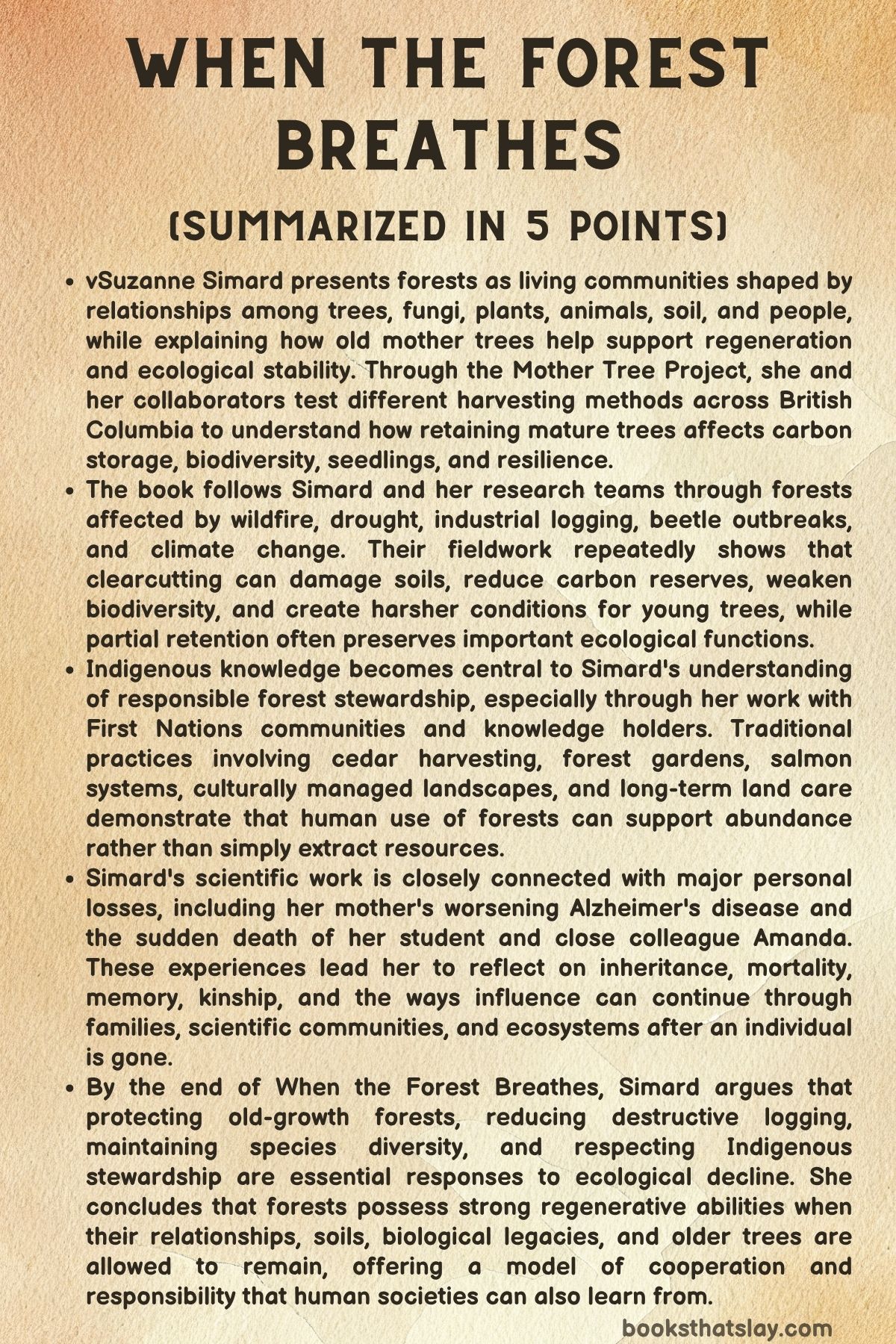
When the Forest Breathes: Renewal and Resilience in the Natural World by Suzanne Simard is a work of ecological science, personal reflection, and environmental advocacy centered on the hidden relationships that allow forests to survive and regenerate.
Simard draws on decades of research into mother trees, mycorrhizal fungi, carbon storage, biodiversity, wildfire, and forest succession while also considering grief, family, Indigenous knowledge, and human responsibility toward the land. Her Mother Tree Project becomes the scientific foundation of the book, testing alternatives to destructive forestry across British Columbia. The result is an argument for protecting old forests, respecting local ecological conditions, and replacing extraction-centered management with stewardship based on diversity, continuity, reciprocity, and long-term care.
Summary
Suzanne Simard begins from the understanding that a forest is never truly static and that death is not an ecological ending. Fallen trees become habitat, carbon-rich soil, nutrients, and food for fungi, microbes, insects, plants, and animals, allowing what has died to remain active within future generations of forest life.
Her research has shown that large old trees can function as important hubs within mycorrhizal networks, connecting with younger trees and influencing the movement of resources through the soil. Having survived cancer and spent decades challenging conventional forestry assumptions, Simard increasingly connects these scientific observations with Indigenous teachings that describe forests through relationships, responsibilities, kinship, and reciprocal care.
These ideas lead to the Mother Tree Project, an ambitious series of experiments across nine forests in British Columbia. Simard, Jean, Brian Pickles, students, Indigenous collaborators, forestry companies, governments, and local communities establish sites where different harvesting methods can be compared, from clearcutting to partial tree retention and untouched forest controls.
At a Cariboo Mountains research site, Simard works with Jean and her daughters Hannah and Nava to record the forest’s condition before logging. They measure trees, fallen wood, vegetation, soil, and carbon, discovering that a relatively small number of very old Douglas firs hold an enormous portion of the aboveground carbon while dense younger trees contribute comparatively little.
The site also reveals another problem created by historical forest management. Fire suppression has allowed dense young conifers to accumulate beneath older trees, intensifying competition for scarce water and creating fuel ladders that can carry fire rapidly from the ground into the canopy.
That danger becomes immediate when a fire erupts during their fieldwork and forces Simard, Jean, Hannah, and Nava to flee while flames move through the experimental forest. The experience strengthens Simard’s determination to understand how drought, climate change, beetle outbreaks, logging, and past management practices have combined to make many forests more vulnerable.
Research into kinship adds another dimension to her understanding of forest communities. Simard’s student Amanda studies Douglas fir seedlings and finds evidence that young trees growing near relatives can perform differently from those growing among unrelated trees, with kin relationships influencing growth and mycorrhizal colonization.
The Mother Tree Project therefore asks not simply whether trees should be harvested, but how much of an existing forest must remain if regeneration is to preserve ecological relationships. The experimental treatments include clearcuts, isolated seed trees, tree clusters, substantial partial retention, and unlogged controls, allowing researchers to compare the consequences of increasingly severe removal.
Simard also confronts the economic and political forces that make ecological reform difficult. Commercial forestry has long favored removing valuable large trees, and British Columbia’s history of sustained-yield policies, industrial harvesting, salvage logging, and plantation management has contributed to forests losing carbon and ecological complexity.
Her collaboration with Nlaka’pamux forester Dave Walkem deepens her awareness of how colonial forestry policies have excluded First Nations from decision-making on their own territories. Working with Dave, Teresa, and Jean, she alters the experimental approach on Nlaka’pamux land so that clearcutting is excluded and old trees remain part of the living forest.
The enormous experiment eventually moves into planting. Crews establish Douglas fir seedlings from several genetic sources, together with species such as western larch, ponderosa pine, and lodgepole pine, so the researchers can examine whether seed sources from warmer, cooler, wetter, or drier climates might help future forests survive rapid environmental change.
Their work repeatedly exposes them to the realities of climatic instability. Wind damages some plots, fire transforms others, difficult soils challenge planting crews, and wildfire smoke becomes an almost constant reminder that seedlings being planted today may spend their lives under conditions very different from those in which their parent trees evolved.
The catastrophic 2017 fire season provides Simard with another lesson about disturbance. Fire itself is not an enemy of forests: under natural conditions it releases nutrients, creates habitat, opens space for regeneration, and contributes to structural diversity, but warming temperatures, drought, insect outbreaks, dense plantations, removal of deciduous species, and decades of suppression can create unnaturally severe fires.
Trees such as aspen and birch demonstrate why diversity matters because their moisture-rich foliage can help slow fire while supporting regenerating conifers. When Simard later returns to a burned experimental site, she finds charred ground but also liverworts, fireweed, surviving trees, young fir and pine seedlings, and morels, showing that severe disturbance does not eliminate the forest’s capacity for renewal when biological legacies remain.
Her scientific work becomes increasingly connected to Indigenous stewardship. Teresa teaches her about the respectful harvesting of cedar bark, in which only what is needed is taken and the living tree is left capable of healing, offering a direct contrast with systems based on maximum extraction.
In Heiltsuk territory, Simard encounters ancient fish traps, salmon systems, berry patches, root gardens, clam gardens, and culturally important cedars. These places challenge the colonial idea that healthy forests must be untouched by people, instead demonstrating that human communities can actively manage ecosystems over thousands of years while sustaining abundance and biodiversity.
The Great Bear Rainforest gives her another example of ecological connection as spawning salmon provide nutrients that move from the ocean into streams and then into terrestrial forests through bears and other animals. Instead of separating humans, animals, plants, soils, and water into independent categories, these systems reveal a continuous exchange in which the survival of one part affects many others.
Personal experience also shapes Simard’s view of forest medicine. As her mother’s Alzheimer’s disease progresses and Mum begins considering medical assistance in dying, Simard works through questions of mortality while Amanda’s research on kin recognition advances and Eva studies relationships among western redcedar, maple, Pacific yew, and Douglas fir.
Pacific yew has particular significance because taxanes derived from the species led to paclitaxel, a cancer drug associated with Simard’s own treatment and with treatment received by people close to her. Its history also illustrates the dangers of separating scientific discovery from ethics, because commercial demand once encouraged destructive bark harvesting even though Indigenous peoples had recognized the tree’s medicinal importance long before modern pharmaceutical use.
On Haida Gwaii, Simard witnesses another landscape shaped by conflict between industrial logging and long-term cultural responsibility. Haida resistance has protected important areas, yet large-scale harvesting continues to threaten old cedar, salmon habitat, wildlife, culturally important plants, and immense stores of carbon held in ancient trees and deep coastal soils.
Lisa White-Kuuyang describes the contradiction of watching valuable timber leave the islands while local communities bear much of the ecological and cultural cost. Attempts by Simard and her collaborators to secure research funding for partial-harvesting alternatives fail, and government authorities maintain a high level of timber extraction despite evidence concerning the rarity and ecological value of remaining productive old growth.
Carbon measurements from the Mother Tree Project then reveal consequences that extend far below the visible forest. Clearcutting removes carbon stored in trunks and branches, but heavy machinery can also damage forest floors containing organic carbon that accumulated over extremely long periods.
The greater the intensity of removal, the greater the potential damage to roots, fungi, decomposers, soil structure, mosses, lichens, liverworts, and the processes that move newly captured carbon into the ground. Simard therefore argues that merely planting new trees after harvesting cannot automatically restore an ecosystem whose biological relationships and ancient soil carbon have already been damaged.
Measurements across the project demonstrate that location must determine management. At Kootenay Lake, untouched forest holds the deepest carbon pools and greatest plant diversity, while partial retention performs substantially better than clearcutting because retained trees provide seed, fungi, shelter, and moderated conditions for young growth.
At hot, dry Jaffray, retaining around 60 percent of the trees protects carbon while supporting seedlings, vegetation, wildlife, and reduced fire danger once excess young firs are removed. Farther north at John Prince, the challenge is almost the opposite because exposed clearcuts can become cold and wet, with frost, high water tables, and competing vegetation killing seedlings that would have benefited from protection by retained overstory trees.
The lesson is that forestry cannot depend on a single universal prescription. Climate, soil, moisture, species composition, disturbance history, and local ecological processes differ from one forest to another, although older trees repeatedly prove valuable as sources of shelter, seed, genetic continuity, and biological connections.
Eva and Amanda’s experiments extend this principle beyond members of the same species. Their work indicates that cedar, maple, and yew can exchange carbon belowground and that the direction and amount of these relationships can change according to environmental conditions, with shaded yews receiving greater subsidies from surrounding plants.
For Simard, such results offer a scientific basis for reciprocity as an ecological process rather than merely a human moral ideal. Mixed forests can capture resources more effectively than monocultures, and relationships among species can adjust dynamically as conditions change.
The political stakes become especially visible at Fairy Creek, or Ada’itsx, where old-growth logging produces enormous clearcuts and activists establish blockades to resist further destruction. Simard and Nava witness a conflict involving Indigenous land defenders, hereditary leaders, scientists, families, forestry workers, activists, police, companies, and governments, demonstrating that the future of old forests is inseparable from questions of economics, sovereignty, employment, governance, and public power.
Temporary deferrals create space for further planning but do not resolve all of these conflicts. Simard comes to understand that scientific evidence alone cannot determine forest policy when communities differ over land rights, economic survival, authority, and the meaning of stewardship.
Her experiences with Indigenous communities increasingly convince her that some of the richest modern examples of sustainable forestry already have ancient foundations. In Kwakwaka’wakw territory, hereditary chief Rande Cook and others work to rebuild ecological health, cultural knowledge, youth education, and sovereignty, while former village sites reveal productive forest gardens containing berries, fruits, nuts, medicines, culturally modified cedars, and fertile soil.
These systems stand against industrial plantations consisting largely of dense conifers, reduced understory diversity, herbicide use, and damaged soils. Simard concludes that Western science can measure ecological processes and contribute to restoration, but it should not assume superiority over systems of knowledge developed through thousands of years of continuous relationship with particular lands.
The book’s ecological argument becomes inseparable from grief when Amanda dies in a skiing accident in January 2022. Simard loses not only a former student but a close collaborator, scientist, athlete, mentor, and friend whose influence had spread throughout their research community.
Soon afterward, Mum receives approval for medical assistance in dying as Alzheimer’s continues to diminish her independence and memory. Family conversations restore memories of wilderness, childhood, courage, and inheritance, while Mum tells Simard that she comes from the forest and carries its knowledge within her.
Before her mother’s death, Simard continues working with Indigenous partners, including at Hiladi, an ancestral Ma’amtagila village where Tsastilqualus Ambers Umbas has returned to live as an assertion of cultural renewal and sovereignty. At the same time, scientific criticism of research on mother trees and common mycorrhizal networks becomes more intense, forcing Simard to defend her methods and conclusions while acknowledging that disagreement and scrutiny are essential parts of science.
Mum eventually dies on the day she has chosen, surrounded by family and friends. Simard’s grief over both Mum and Amanda leads her to think of inheritance not only as something genetic or material but also as the continuation of knowledge, courage, generosity, memory, and responsibility through other people.
A later journey into Achuar territory in the Upper Amazon brings these ideas into a radically different forest. Although tropical ecology differs greatly from British Columbia’s temperate systems, Simard recognizes familiar patterns of diversity, layered vegetation, fungal associations, nutrient cycling, mortality, regeneration, and continuous exchange among organisms.
Achuar understandings of the rainforest as a society of relationships challenge the habit of treating forests as collections of separate resources. Resting against a great kapok tree and carrying memories of Mum and Amanda, Simard reaches a renewed commitment to continue her scientific work, respond to criticism, defend forests, and support forms of stewardship that cooperate with ecological processes rather than overriding them.
The larger conclusion is ultimately hopeful without denying the scale of the crisis. Climate change, logging, wildfire, insect outbreaks, industrial machinery, and fossil-fuel emissions have already caused major damage, yet forests retain remarkable regenerative capacities when enough biological structure, diversity, soil, old trees, and ecological memory remain intact.
Simard argues that primary and old-growth forests deserve the strongest protection, while forests that are harvested should retain more trees, use less destructive equipment, preserve soil, and encourage diverse species appropriate to local conditions. Old, dying, and dead trees continue to matter because they store carbon, produce seed, provide habitat, shelter seedlings, preserve genetic histories, and participate in the biological networks from which future forests emerge.
Her vision also places Indigenous stewardship and decision-making near the center of ecological recovery. When the Forest Breathes ultimately presents survival as a collective process in which forests and human societies alike depend on diversity, memory, adaptation, cooperation, restraint, and the willingness to preserve relationships that extend beyond a single lifetime.
Characters
Suzanne Simard
Suzanne Simard is the central human presence in When the Forest Breathes, serving simultaneously as scientist, narrator, daughter, mother, teacher, collaborator, cancer survivor, environmental advocate, and participant in the ecological systems she studies. Her importance comes from the way her professional and personal experiences gradually become inseparable: the forests are subjects of scientific investigation, but they are also places where she encounters family history, danger, medicine, grief, intellectual conflict, and questions about mortality.
She approaches forestry through evidence gathered over decades, yet the book shows her becoming increasingly dissatisfied with scientific traditions that examine organisms only in isolation. Mother trees, fungal networks, kin recognition, mixed-species relationships, soil carbon, wildfire behavior, and local variation repeatedly lead her toward a view of forests as communities whose functioning depends on relationships rather than on individual trees alone.
Simard is also presented as intellectually persistent. Government rejection, forestry resistance, destructive logging practices, failed funding proposals, and criticism of common mycorrhizal network research do not make her abandon her central questions, although they cause frustration and self-examination.
Her development is equally ethical. Through Teresa, Dave Walkem, Rande Cook, Lisa White-Kuuyang, Tsastilqualus Ambers Umbas, Achuar guides, and other Indigenous knowledge holders, she becomes more conscious of the limits of Western scientific authority and more willing to understand her own work as support for older systems of stewardship rather than as the discovery of principles no one previously understood.
Loss tests this philosophy in intensely personal ways. The deaths of Amanda and Mum force Simard to confront the difference between accepting ecological mortality as a concept and enduring the irreplaceable absence of particular human beings, ultimately leading her to think of legacy as the continuation of influence, knowledge, generosity, and responsibility across generations.
Jean
Jean is one of Simard’s most constant collaborators in When the Forest Breathes, appearing throughout the field research that gives the book much of its practical foundation. Rather than occupying the spotlight, Jean represents the sustained labor necessary to turn ecological ideas into long-running experiments involving measurements, planting, carbon sampling, forest treatments, travel, logistics, and repeated monitoring.
His presence beside Simard in dangerous and exhausting situations also gives their professional relationship a strong element of trust. He is there during the Cariboo wildfire, during difficult planting seasons, while traveling through burned landscapes, and while collecting evidence across forests that differ dramatically in climate and history.
Jean is particularly important because the Mother Tree Project is never portrayed as the achievement of a lone scientist. His continuing participation reinforces one of the book’s larger principles: significant ecological knowledge comes from cooperation among people with different roles, skills, and forms of expertise.
Amanda
Amanda is one of the most important scientists and emotional figures in When the Forest Breathes. Initially presented as Simard’s student and protégé, she develops into an accomplished researcher whose work on Douglas fir kinship helps provide experimental support for the possibility that related trees can recognize or respond differently to one another.
Her research examines how seedlings behave when growing near relatives and strangers, finding differences in vigor and mycorrhizal colonization that contribute to the book’s broader discussion of kinship. Her success is therefore significant not simply for her own career but for the continuing development of ideas Simard has spent years pursuing.
Amanda’s relationship with Simard expands beyond the conventional boundaries of supervisor and student. She becomes a friend, colleague, athlete, mentor to others, and valued member of a scientific community whose members depend upon one another personally as well as professionally.
Her sudden death in a skiing accident is therefore one of the book’s greatest emotional ruptures. Simard initially tries to understand the loss through ecological parallels involving forest gaps and the legacies of fallen trees, but she also recognizes the inadequacy of analogy when confronted with the premature death of a specific person she loved.
Amanda’s influence survives through her research, students, colleagues, teammates, awards, memorials, and personal relationships. In this sense, she becomes a human example of one of the story’s central ideas: death removes a living presence but does not erase the effects that presence has already created within a community.
Eva
Eva represents the next stage in the expansion of Simard’s research questions. Whereas much earlier work focuses on Douglas fir and ectomycorrhizal relationships, Eva examines western redcedar, maple, and Pacific yew, helping the research move toward more diverse communities and different forms of fungal association.
Her Septuplets experiment is especially important because it tests how carbon moves among different species under changing conditions. The eventual finding that cedar, maple, and yew exchange carbon belowground, with shaded yews receiving greater subsidies, strengthens the idea that relationships among plants are responsive rather than mechanically fixed.
Eva also helps demonstrate how scientific knowledge develops through generations of researchers. She does not merely repeat Simard’s previous work but takes its central questions into new species combinations and experimental designs, showing that mentorship can lead to intellectual independence rather than imitation.
Her connection to Pacific yew adds a human dimension because the tree’s medicinal compounds have relevance to cancer treatment in both Simard’s and Eva’s circles. Science, medicine, ecology, and personal experience therefore meet within Eva’s research, reminding the reader that laboratory questions can have consequences far beyond academic publication.
Mum
Simard’s mother is one of the most personally consequential figures in When the Forest Breathes, particularly because her declining health introduces questions of autonomy, memory, dignity, death, and inheritance. Once independent, active, adventurous, and politically engaged, she gradually loses her ability to manage ordinary routines as Alzheimer’s disease progresses.
Her decision to pursue medical assistance in dying gives her storyline considerable moral and emotional complexity. She does not approach death passively but seeks to preserve control over its timing before her illness removes the capacity to make that choice, while Simard must respect a decision she finds emotionally difficult.
Mum’s character also helps explain Simard herself. Family stories reveal a woman whose independence, wilderness experiences, humor, determination, and sense of responsibility shaped her daughter long before the scientific ideas of the Mother Tree Project were fully formed.
Even during physical and cognitive decline, Mum remains interested in environmental questions and joins opposition to old-growth logging. That continuing activism prevents her from being represented solely through illness and instead preserves her identity as a person whose values remain meaningful despite the erosion of memory.
Her final conversations with Simard turn inheritance into something deeper than biology. When she tells her daughter that she comes from the forest and carries its knowledge within her, Mum articulates the book’s idea that lives continue through knowledge, behavior, courage, memory, and responsibility passed to others.
Teresa
Teresa is a vital bridge between Simard’s scientific work and Indigenous approaches to land in When the Forest Breathes. Her importance lies not in simply supplying cultural information to the narrator but in challenging assumptions about what stewardship means, who possesses ecological knowledge, and how humans can participate in ecosystems without reducing them to commodities.
The cedar-bark harvesting lesson captures her role particularly well. Teresa demonstrates a practice in which the tree is approached respectfully, only the required amount is removed, and the organism is left capable of recovery, transforming reciprocity from an abstract idea into a specific method of taking responsibly.
She also challenges colonial interpretations of Indigenous societies as passive occupants of wilderness. Through discussions of forest gardens, food systems, medicines, fisheries, culturally modified trees, and other forms of stewardship, she helps establish that ecological abundance can result from deliberate human management when management is guided by restraint, knowledge, and responsibility.
Teresa therefore influences Simard’s understanding of her own scientific position. The relationship encourages Simard to treat Indigenous ecological knowledge not as supplementary material added to Western science but as a sophisticated body of knowledge with its own history, methods, ethics, and authority.
Nava
Nava, one of Simard’s daughters, connects the scientific work to another generation of the family. She participates in field research, including the dangerous Cariboo experience, and later accompanies her mother to Fairy Creek, allowing her to witness directly both ecological destruction and the political struggle surrounding old-growth protection.
Her presence matters because the book repeatedly asks what one generation leaves for the next. Climate change, soil carbon loss, ancient-tree removal, and biodiversity decline are long-term problems, so Nava embodies the people who will inherit the ecological consequences of decisions made before and during her lifetime.
She also accompanies Simard into the Selkirk Mountains soon after Mum’s death. That journey quietly connects three generations—Mum, Simard, and Nava—and turns the book’s concern with biological inheritance into a family reality shaped by shared memory, landscape, and values.
Hannah
Hannah is another important link between Simard’s family and her scientific world. Along with Nava, she helps establish the Cariboo research site by participating in the demanding work of measuring forest features before harvesting treatments begin.
Her involvement means that Simard’s environmental concerns are not confined to a professional research community. The work is physically shared with her children, and the wildfire that forces the group to escape makes the risks of climate change and altered forest structure an immediate family experience.
Hannah later returns to help with Mother Tree Project measurements during the COVID-19 period. This repeated participation makes her part of the long-term nature of the experiment and reinforces the idea that ecological understanding requires returning to the same places over years rather than drawing conclusions from a single moment.
Dave Walkem
Dave Walkem, a Nlaka’pamux forester and leader, brings questions of sovereignty and colonial history directly into the research. He explains how First Nations were excluded from control over forests within their own territories, exposing the political history hidden beneath seemingly technical forestry decisions.
His collaboration with Simard, Jean, and Teresa materially changes the Mother Tree Project. Rather than simply permitting an outside experiment to proceed unchanged, he participates in creating an approach appropriate for Nlaka’pamux territory, including the decision to eliminate clearcutting and preserve old trees.
Dave’s role therefore demonstrates genuine collaboration rather than symbolic consultation. Scientific design becomes responsive to the values, rights, and ecological knowledge of the people whose land is involved, making him important to the book’s argument that research cannot be separated from questions of authority and responsibility.
Lisa White-Kuuyang
Lisa White-Kuuyang gives the Haida Gwaii sections their strongest local human perspective. As a Haida weaver, she understands cedar and forest plants not merely as ecological organisms or commercial timber but as parts of cultural life, artistic practice, ancestral continuity, and community identity.
She describes the painful imbalance created when huge volumes of valuable timber leave the islands while local communities receive limited lasting benefit. The costs are far broader than the removal of trees because logging also diminishes wildlife habitat, salmon systems, culturally important plants, ancient cedar, and the physical settings in which knowledge and traditions persist.
Lisa’s guidance through old forests helps Simard experience ancient cedars as elders rather than simply as large biological specimens. Her presence therefore reinforces the book’s growing rejection of purely economic definitions of value.
Rande Cook
Rande Cook, a hereditary chief working in Kwakwaka’wakw territory, represents efforts to reconnect ecological restoration with cultural and political renewal. His work is directed not only toward repairing damaged forests but also toward sovereignty, language, youth education, traditional knowledge, and community continuity.
The Nawalakw youth camp associated with this work is especially significant because restoration is shown as a process involving people as well as vegetation. Young people learn that trees, animals, waters, and humans belong to a connected society, ensuring that ecological responsibility is transmitted socially between generations.
Cook’s role also helps reposition Simard’s scientific contribution. Rather than Western researchers arriving to define the problem and prescribe the solution, the story emphasizes Indigenous communities already possessing goals and knowledge, with scientists potentially contributing measurements and restoration techniques in support of those priorities.
Tsastilqualus Ambers Umbas
Tsastilqualus Ambers Umbas appears at a moment when Simard is dealing simultaneously with personal grief, scientific controversy, and questions about the future of forest restoration. Her return to Hiladi, an ancestral Ma’amtagila village site, is an active assertion that living on and caring for ancestral territory can itself be a form of sovereignty and cultural renewal.
Her presence shifts restoration away from the idea of simply returning a damaged ecosystem to some scientifically defined reference condition. The Mother Tree team’s baseline work is intended to support Ma’amtagila goals involving species, law, livelihood, language, culture, and relationships with place.
Tsastilqualus therefore represents a form of restoration in which ecological repair and political self-determination cannot be separated. Her role strengthens the book’s insistence that decisions about damaged Indigenous territories must involve the authority and aspirations of the peoples whose histories are rooted there.
Themes
Connection, Kinship, and Ecological Community
Relationships operate as the organizing principle of When the Forest Breathes, replacing the image of a forest as a collection of competing individual trees with a model in which survival emerges from interactions among plants, fungi, microorganisms, animals, soils, water, climate, and human communities. Mother trees become especially important within this framework because their roots and fungal partners can connect them to younger trees, while their seeds, shade, accumulated genetic history, and physical structure influence future generations.
Amanda’s kinship studies push this idea further by indicating that Douglas fir seedlings can behave differently around relatives, suggesting that biological relatedness can affect growth and mycorrhizal colonization. Eva’s experiments then extend the question beyond kin by examining carbon exchange among cedar, maple, and yew, demonstrating that ecological relationships can cross species boundaries and respond to environmental conditions.
Connection is never presented as a claim that forests exist in perfect harmony. Fire, competition, predation, drought, decomposition, disease, and death all remain part of ecological life, but these forces occur within systems where the outcome for one organism can influence many others.
The same principle gradually becomes a model for human communities. Scientists depend on students and collaborators, Simard depends on her family, Indigenous elders transmit knowledge to younger generations, and communities organize collectively to defend forests, suggesting that resilience arises not from complete independence but from networks of mutual influence and responsibility.
Reciprocity and Responsible Stewardship
Reciprocity changes the meaning of human participation in nature by rejecting the assumption that conservation requires people to stand completely outside ecosystems. Indigenous practices described throughout the book show that people can harvest cedar bark, maintain forest gardens, manage fisheries, cultivate berries and roots, modify trees, and obtain medicines while still preserving the ecological processes that make future abundance possible.
The cedar-bark lesson provides a clear ethical model: take only what is needed, avoid killing the source, respect its ability to heal, and recognize that receiving something from the land creates an obligation rather than an unrestricted entitlement. Such practices contrast strongly with clearcutting systems designed around short-term extraction of maximum commercial value.
Reciprocity also appears scientifically in the movement of resources among plants. Carbon transfer among cedar, maple, and yew changes according to circumstances, suggesting a dynamic system in which relationships shift with shade, availability, and need rather than remaining fixed.
The human application is not that societies should imitate trees literally, but that sustainable systems require attention to consequences extending beyond immediate individual gain. Forestry becomes regenerative when harvesting leaves enough trees, soil, biodiversity, habitat, fungi, seed sources, and ecological structure for the forest to continue functioning rather than merely replacing removed trunks with planted seedlings.
Death, Grief, Renewal, and Legacy
Death appears throughout When the Forest Breathes as both an ecological process and an intensely personal reality. In forests, dead trees continue to store carbon, provide habitat, feed decomposers, support fungi, enrich soil, and contribute to regeneration, making death part of the material foundation from which future life develops.
Wildfire gives this process a dramatic form. Burned landscapes can appear devastated, yet surviving trees, seeds, fungi, liverworts, morels, fireweed, and young conifers can begin rebuilding the ecosystem when enough biological legacies remain.
Simard’s personal losses make the theme far more difficult. Amanda’s sudden skiing death cannot be emotionally resolved by comparing her to a fallen tree, and Mum’s planned death after progressive Alzheimer’s forces Simard to confront autonomy, memory, love, and the pain of allowing someone to choose the terms of her own ending.
The eventual connection between ecology and grief therefore does not erase human suffering. Instead, it emerges through the idea of legacy: Amanda continues through research, mentorship, awards, friendships, and scientific questions, while Mum continues through the independence, courage, stories, wilderness knowledge, and values carried by her children and grandchildren.
Renewal becomes less a replacement for what has died than an acceptance that influence persists in altered forms. Just as an old tree can continue shaping a forest after death, human beings remain active within communities through what they taught, protected, created, and passed forward.
Climate Change, Industrial Forestry, and the Need for Systemic Change
Climate disruption intensifies nearly every ecological problem examined in the book. Heat, drought, wildfire, insect outbreaks, stressed seedlings, changing moisture regimes, and altered disturbance patterns expose the limits of forestry systems designed for relatively stable environmental conditions and short commercial rotations.
Industrial clearcutting magnifies these pressures because its effects extend beyond the removal of merchantable trunks. Heavy machinery can damage carbon-rich forest floors, removal of old trees reduces seed and shelter, simplified plantations diminish biodiversity, and elimination of deciduous species can increase vulnerability to severe fire.
The Mother Tree Project demonstrates why reform cannot consist of replacing one rigid forestry formula with another. Hot, dry forests can benefit from treatments different from those required in cold, wet northern environments, meaning that local climate, soils, vegetation, moisture, and disturbance history must determine management decisions.
Yet several broader principles remain consistent: protect remaining primary and old-growth forests, retain more mature trees when harvesting occurs, reduce soil disturbance, maintain diverse species, respect ecological legacies, and recognize the enormous carbon stores belowground. These changes challenge economic systems focused on immediate timber yield because genuine sustainability requires valuing what remains in the forest as highly as what can be removed from it.
The need for systemic change also includes governance. Indigenous sovereignty, Land Back initiatives, old-growth protests, community stewardship, scientific debate, forestry employment, corporate power, and government policy all shape what happens to forests, so ecological recovery cannot be separated from decisions about who controls land and whose knowledge is treated as authoritative.