What Darkness Brings Summary, Characters and Themes
What Darkness Brings by Jenna Wolfhart is a dark fantasy novel centered on necromancy, lost divinity, political control, and a love buried beneath centuries of stolen memory.
Angharad Morgan begins as a loyal servant of the Order, convinced that its strict control of magic protects the kingdom of Gwalia, but the death and resurrection of her closest friend forces her into a mission that steadily destroys everything she believes about her past. Her encounter with the feared exile Taliesin Wynn exposes secrets surrounding the vanished stars, the dead gods, and the origins of the Order itself, while revealing that Angharad’s own identity is far older and more dangerous than she realizes.
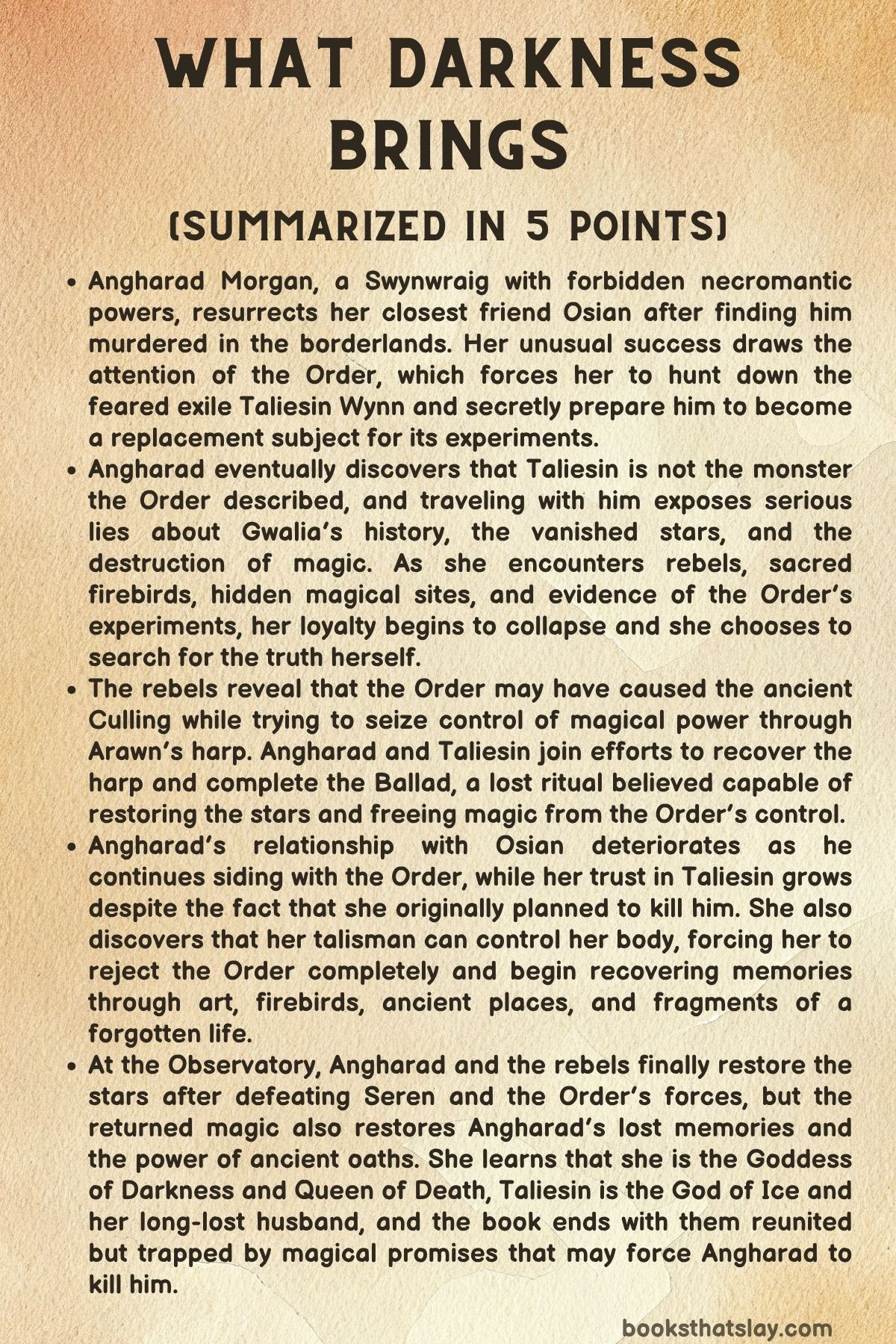
Summary
Angharad Morgan serves the Order as a Swynwraig, working beside her oldest friend and assigned warrior, Osian. When Osian disappears into the borderlands on an unauthorized mission, Angharad follows her talisman to a remote valley and finds him dead beside a fugitive who knows about her forbidden gift for bringing the dead temporarily back to life.
The fugitive prevents her from reaching Osian because he fears what she might learn from a resurrected corpse, then attempts to take her into rebel territory so her unusual abilities can be turned against the Order. Desperate to escape before Osian becomes impossible to revive, Angharad uses an even darker power she has concealed for years: by touching the fugitive and speaking a death spell, she kills him instantly and permanently.
Angharad returns to Osian and resurrects him through the strength of fifteen years of shared memories. Unlike the other dead people she has briefly restored, Osian continues living far beyond the expected limit, but the spell costs Angharad another piece of her own memory, because every use of her natural necromancy erases something from her past.
Back at Caer Draen, High Swynwragedd Seren and Lowri discover both Osian’s extraordinary survival and Angharad’s hidden ability to kill through touch. Rather than punishing her, they decide her powers may provide the answer to Gwalia’s growing military crisis, especially as human forces approach from the western continent and the kingdom lacks sufficient strength to defend itself.
The Order hopes Angharad may eventually resurrect the dead god Arawn the Mighty, but first Seren and Lowri want to understand why Osian has remained alive. They imprison him for experimentation and give Angharad a cruel alternative: she must travel north, gain the trust of the infamous exile Taliesin Wynn, kill him, resurrect him, and return him as a replacement subject if she wants Osian released.
Angharad accepts and travels alone toward Taliesin’s coastal prison. At the Twin Talons Inn, she encounters a mysterious silver-haired man whose knowledge of the Order makes her suspicious, while an unexpected attack by sacred firebirds introduces another mystery because the creatures seem strangely interested in Angharad rather than simply hostile toward her.
The stranger insists on accompanying her north. After they discover a murdered Order member, Angharad secretly resurrects the corpse and learns that Taliesin’s magical prison has already been broken and that someone intends to trap him near the Môrfaen Cliffs, forcing her to acknowledge that her traveling companion may be the very exile she has been ordered to kill.
Her suspicions are confirmed when the stranger reveals the concealed traitor mark on his neck and identifies himself as Taliesin Wynn. More startlingly, he already knows Angharad’s identity and says another version of her has appeared in his dreams for nearly ten years, repeatedly warning him to stay away from her, the Order, and the borderlands because meeting her will bring disaster upon them both.
Taliesin realizes Angharad is still hiding her true purpose and restrains her with iron, which suppresses her natural magic. Their already difficult relationship becomes more dangerous when rogues attack them near the coast and trap Taliesin beneath iron weapons designed specifically to neutralize his power, forcing Angharad to decide whether to abandon the man she intends to betray or save him.
She chooses to free him. Taliesin responds by unleashing devastating winter magic that freezes the attackers, and although Angharad is horrified by the destruction he can cause, she also sees that he deliberately protects her from his power and orders her to escape before the cold can kill her.
Their flight takes them to Taliesin’s isolated tower, where a collapsing rope bridge leaves them trapped above the poisonous northern sea. Inside his home, Angharad discovers art, beauty, music, and personal freedom that the Order has taught her to regard with suspicion, while Taliesin’s affection for his pine marten companion Bryn further contradicts the monstrous image she was given of him.
Taliesin openly questions the Order’s version of the Culling, the catastrophe in which the stars disappeared, most gods died, and ordinary magic vanished. Angharad initially resists his arguments, yet she gradually admits that the institution has controlled almost every part of her existence, including what she may create, what she may believe, where she may go, and how she may use her own abilities.
Their escape from the tower leads them through a dangerous underground route and toward another firebird. When they find one of the sacred creatures dying beside its nest, Taliesin removes Angharad’s iron restraint, allowing her to perform a form of magic she never knew she possessed: instead of resurrecting the dead, she forces death away before it can claim the creature.
The revived firebird guides them to a hidden cave filled with ancient magical signs connected to Angharad’s death spell. A concealed chamber in the floor has already been emptied, suggesting someone else is searching for lost magical knowledge, and soon rebel leader Rhian reveals that her people possess half of an ancient Ballad while Taliesin possesses the other half.
Together, the two pieces describe a ritual that may restore the gods and the vanished stars, but it also requires Arawn’s magical harp. Rhian claims the Order caused the Culling in the first place by trying to seize control of the stars through the harp, and documents shown to Angharad indicate that Osian himself knowingly participated in secret Order operations.
Angharad refuses to become blindly loyal to the rebels, particularly because some of them have committed serious violence, but she can no longer accept the Order’s account of history. She agrees to seek the truth independently and forms an uneasy alliance with Taliesin, whose respect for her forbidden powers stands in sharp contrast to Osian’s repeated rejection of her necromancy.
At the rebel stronghold, Angharad discovers that the people she was taught to regard as enemies preserve art and cultural traditions suppressed by the Order. Taliesin and Angharad agree to investigate a tomb associated with Arawn, where powerful Order wards and an empty sarcophagus reveal that the god’s body has already been removed.
The tomb is soon overrun by rogues who behave as though some hidden force is calling them. During their escape, Angharad discovers another natural power when her injuries heal automatically, while conversations with Taliesin reveal that both of them have enormous gaps in their childhood memories and that Seren personally separated Angharad from her father years earlier.
Among the restless dead in a nearby forest, Angharad experiences a fragment of lost memory in which she sees Taliesin wearing a crown. She begins to suspect that the mysterious version of herself who visited his dreams is connected to a forgotten life rather than an ordinary prophetic vision.
Angharad and Taliesin then discover a military camp containing both the king and Seren. Returning to the rebels, they learn that many supposedly insane rogues were actually former Order members destroyed by magical experiments, leaving Angharad horrified by the realization that she and Osian spent years hunting victims without knowing what had been done to them.
Her bond with Taliesin grows stronger, but she continues concealing the original purpose of her mission. When she finally confesses that she was ordered to gain his trust, murder him, resurrect him, and deliver him to the Order, Taliesin is deeply wounded even though she insists she abandoned the plan.
The rebels capture a soldier who refuses to reveal the location of the harp. Taliesin eventually kills him so Angharad can resurrect him and compel truthful answers, and the restored prisoner reveals that Arawn’s body and the harp are in Order hands and that the army intends to destroy the rebellion before moving the god to Dinas Grym.
Angharad, Brioc, Taliesin, Gwenydd, and the others attempt to steal the harp. The infiltration fails when Angharad and Brioc are captured, but Taliesin attacks the camp with his full winter power after realizing she is in danger, freezing the soldiers while controlling the cold carefully enough to avoid killing her.
During their escape Angharad encounters Osian, who remains alive through her resurrection spell and has chosen to stand with the Order. The contrast becomes impossible to ignore: Osian, once the person she trusted above everyone else, now defends the institution manipulating her, while Taliesin, once described to her as a dangerous traitor, repeatedly risks himself to protect her freedom.
At Brawychus Castle, Angharad discovers that her Order talisman can communicate directly with Osian and can cause severe physical pain. The problem becomes more sinister when she begins losing control of her body and hears the command to “end the exile,” realizing that the oath she made to Seren and Lowri has been embedded into the Order’s ability to control her.
The talisman forces Angharad into Taliesin’s room and compels her hand toward his throat. She manages to resist long enough to warn him, and Taliesin cuts the talisman out of her neck, breaking the Order’s immediate control and allowing her natural healing to close the wound.
Angharad throws the talisman into the poisonous sea and joins the rebels in attempting the Ballad. Music, dancing, and the ancient harp briefly bring points of light back into the sky, but the ritual fails, leading them to conclude that it must be performed at the ancient Observatory high in the Hiraeth Mountains.
Art begins unlocking Angharad’s lost memories. While drawing a firebird, she remembers the name Sionc, and while later sketching Taliesin she unconsciously draws a crown across his forehead, eventually recognizing him as the King of Winter and realizing that he was once one of the gods.
Taliesin points out that Angharad’s powers are equally abnormal. Her immortality, forgotten knowledge, healing abilities, connection with firebirds, ancient memories, and natural command over death all indicate that she too may have existed long before the life she remembers.
The rebels set out for the Observatory with the harp, but at a destroyed river crossing Taliesin must exhaust himself creating a bridge of ice. Osian and hidden Rhyfelwyr ambush them as they cross, Meurig is killed, and Osian escapes with Arawn’s harp despite Angharad’s attempt to stop him.
After mourning their dead, Angharad resurrects one of the enemy warriors she personally killed and turns him into a revenant. Under her command, he reveals that Osian has taken the harp directly to the Observatory and that the Order intends to recover the Ballad and destroy the surviving rebels.
The group makes its final ascent into the mountains. At the Observatory, Angharad’s revenant guides them through the defenses until they recover the harp beneath the sealed dome, but the apparent weakness of the guards proves to be a trap when Seren emerges and holds a blade against Angharad’s throat.
Angharad finally turns the darkest parts of her power against the person who controlled her. She kills Seren with a touch, immediately resurrects her as a revenant, and commands her to order the Rhyfelwyr away and defend the rebels, although the soldiers refuse to submit quietly and a final battle follows.
Arianell dies during the fighting, and Angharad responds with increasingly ruthless death magic until the rebels control the Observatory. Gethin plays the harp, Brioc sings the Ballad, and the voices of countless trapped spirits join the music because the dead themselves have been unable to reach the Otherworld without the stars.
The ritual succeeds. Starlight returns, magical power spreads through the world, and the trapped dead finally pass on, but Seren reveals that the restoration has also revived ancient magical laws that make sworn promises binding.
Angharad’s lost memories then return in full. She remembers that she was once the Goddess of Darkness and Queen of Death, while Taliesin was the God of Ice and King of Winter, and that they fell in love centuries earlier before Arawn married them beneath the stars at the very Observatory where they now stand.
She also remembers the real Culling. The early Order attacked the gathered gods with iron and attempted to strip their magic through Arawn’s harp, intending to place that power under the control of a corrupt king, and Angharad responded by using her death power against the stars themselves.
Her spell stopped the Order from gaining what it wanted, but the consequences were catastrophic. The stars vanished, most gods and magic users died, the northern sea became poisonous, and Angharad fell into a coma lasting centuries.
Seren and Lowri found Angharad after she awakened fifteen years earlier and deliberately exploited her damaged memory. They embedded the talisman, created a false understanding of her identity, and repeatedly made her use necromancy so that her diminishing memories would prevent her from recovering the truth.
Taliesin survived with similar memory loss and was imprisoned behind magical wards. Ten years earlier, some deeper part of Angharad recovered enough awareness to enter his dreams and warn him to avoid her because she knew the Order had already bound her to an oath that could someday force her to destroy him.
The stars now restore both their memories and the ancient power of promises. Angharad finally recognizes Taliesin not merely as the exile she was ordered to kill but as the husband she loved centuries earlier, yet their reunion immediately becomes a trap.
Angharad’s sworn promise requires her to end Taliesin’s exile by her own hand, effectively compelling her to kill him, while Taliesin has made his own promise never to leave her. What Darkness Brings therefore closes with the two gods reunited after centuries of separation but magically bound to remain together while an ancient oath pushes Angharad toward murdering the person she has finally remembered loving.
Characters
Angharad Morgan
Angharad is the central consciousness of What Darkness Brings, and nearly every major revelation depends on the collapse of the identity she has been taught to accept. At the beginning, she sees herself as an unusually gifted but morally troubling Swynwraig whose necromancy separates her from ordinary members of the Order, yet she still assumes that the institution controlling her life ultimately serves Gwalia’s survival.
Her most defining contradiction is that she possesses extraordinary power while having very little control over the circumstances in which that power is used. The Order determines her assignments, Osian judges the morality of her necromancy, iron can suppress her abilities, her talisman gives others access to her body, and even her own magic punishes her by erasing memories.
Angharad’s attachment to Osian initially makes her vulnerable to manipulation because Seren and Lowri understand that threatening him is the simplest way to force her obedience. Her agreement to deceive, kill, and resurrect Taliesin is morally disturbing, but it also demonstrates how completely fear of losing Osian overrides her usual resistance to treating another person as an instrument.
Her journey with Taliesin gradually changes the basis on which she makes decisions. Instead of asking what the Order expects of her, she begins asking whether its rules are just, whether its history is true, and whether loyalty remains meaningful when the institution demanding it has deliberately concealed information.
Art becomes especially important to her recovery because drawing allows memories to return without the destructive cost attached to necromancy. The creativity she was taught to suppress becomes one of the means through which she reconstructs her identity, making personal expression inseparable from freedom.
The final revelation that she is the Goddess of Darkness and Queen of Death does not erase the woman Angharad has become. Rather, it explains the scale of her abilities, the firebirds’ recognition of her, her relationship with the dead, her strange familiarity with ancient places, and the enormous grief that surfaces whenever fragments of her earlier existence return.
Her tragedy lies in recovering her agency and history at the exact moment ancient magic threatens to remove that agency again. She ends the novel knowing who she is and whom she loves, but a promise made while she was being manipulated now carries supernatural authority over her actions.
Taliesin Wynn
Taliesin is introduced in What Darkness Brings through the Order’s reputation of him as a dangerous exile, but his actual behavior repeatedly complicates that judgment. He is secretive, forceful, sarcastic, and willing to use lethal violence, yet he also protects Angharad when he has practical reasons to abandon her and consistently questions systems that deny people control over their own lives.
His winter magic makes him physically formidable, particularly because he can lower temperatures on an enormous scale and freeze enemies almost instantly. The power is not effortless, however, and repeated use leaves him physically weakened, which prevents his abilities from reducing him to an unstoppable figure without vulnerability.
His use of iron against Angharad early in their relationship establishes one of his own moral contradictions. He criticizes the Order for controlling her while temporarily controlling her himself, showing that his fear and distrust can push him toward the same methods he condemns.
Taliesin’s decade of dreams creates an emotional relationship with Angharad before she consciously knows him. He has spent years seeing a version of her who remembers their shared history, and this explains both his inability to walk away when he encounters her and his caution about turning their developing attraction into a physical relationship while she cannot remember what he remembers only indirectly.
He becomes a crucial source of opposition to Angharad’s learned self-hatred. Where Osian treats necromancy as unnatural, Taliesin repeatedly insists that Angharad should distrust anyone who tries to make her ashamed of what she inherently is.
The revelation that he is the God of Ice and King of Winter places his exile in a much larger historical context. His extraordinary magic is not an abnormal gift produced by the modern magical order but the surviving expression of an ancient divine identity that the Order failed to destroy completely.
His relationship with Angharad also gives the ending much of its cruelty. Once he remembers that she is his wife, their years of unexplained attraction and familiarity finally make sense, yet his promise never to leave her prevents him from escaping the magical oath that may force her to kill him.
Osian
Osian is one of the most emotionally complicated figures in What Darkness Brings because he begins as Angharad’s oldest friend, closest companion, and strongest personal connection to the life she understands. His death drives the entire chain of events, since Angharad’s refusal to accept losing him exposes both the exceptional strength of her resurrection magic and the killing ability she has hidden from the Order.
His reaction to resurrection establishes an important difference between him and Angharad. Instead of interpreting her act solely as love or desperation, he regards being brought back as unnatural and dishonorable, revealing that even after fifteen years together he does not truly accept a central part of what she is.
At first his objections can be read as personal beliefs rather than betrayal, but later evidence makes his position harder to separate from the Order’s influence. The documents produced by Rhian indicate that he knowingly participated in secret operations, and his later actions show that he continues supporting the institution after Angharad discovers how badly it has manipulated her.
Osian’s importance lies partly in the contrast between memory and present reality. Angharad repeatedly measures new experiences against the man she believes she has known for fifteen years, yet the more she learns, the less reliable that emotional history becomes as evidence of his loyalty.
His seizure of Arawn’s harp is the clearest symbolic break between them. He does not merely disagree with Angharad; he actively takes the object necessary for the rebels’ attempt to restore the stars and returns it to the organization from which she has escaped.
Even so, Osian is not presented as emotionally meaningless to her once their loyalties divide. The pain of his choices comes precisely from the depth of their former attachment, and his prolonged resurrection also demonstrates the power of the memories Angharad once shared with him.
High Swynwraig Seren
Seren functions as one of the principal human antagonists of What Darkness Brings, but her power depends as much on emotional manipulation and institutional authority as on magic. She presents the Order’s demands as sacrifices required for Gwalia’s safety, allowing coercion to appear respectable because it is framed as duty.
Her treatment of Angharad demonstrates this method clearly. Seren knows that openly threatening Angharad may produce resistance, so she instead makes Osian’s release conditional on an assignment that requires Angharad to gain Taliesin’s trust before killing him.
Seren’s role becomes considerably darker once Angharad’s recovered memories reveal that the manipulation has lasted for much longer than the current mission. Seren and Lowri found her after centuries of unconsciousness, placed the talisman into her body, and repeatedly exploited the memory loss caused by her necromancy.
This means Seren did not merely mislead a subordinate about political history. She participated in constructing the identity through which Angharad understood herself, keeping an ancient goddess dependent by ensuring that every use of power removed more evidence of who she had once been.
Her final confrontation at the Observatory demonstrates how thoroughly she still believes coercion can restore control. Holding Angharad hostage and surrounding Taliesin with iron repeat the Order’s ancient reliance on forced obedience, but Angharad finally reverses the relationship by killing Seren and resurrecting her as a revenant.
That transformation is particularly significant because Seren becomes subject to the same loss of autonomy that she imposed upon others. Angharad’s decision is morally severe, but it turns Seren from commanding authority into magically compelled servant at the moment the Order’s control begins collapsing.
Rhian
Rhian occupies an important middle position in What Darkness Brings because she offers an alternative to the Order without being presented as morally flawless. As a rebel leader, she preserves forbidden knowledge, organizes resistance, pursues the Ballad, and exposes information about the Culling that radically changes Angharad’s understanding of history.
Her strength as a leader comes from her ability to act pragmatically while maintaining a sense of communal responsibility. She organizes evacuations quickly, keeps her people focused after casualties, insists on honoring the dead, and continues pursuing the Observatory even after the harp is taken.
At the same time, Rhian’s faction is willing to imprison people, use iron, consider torture, and employ dangerous methods when survival appears to require them. Angharad’s refusal to become uncritically loyal to Rhian is therefore important because leaving one authoritarian structure should not require immediate submission to another group simply because it opposes the first.
Rhian ultimately proves more willing than the Order to share information and permit disagreement. When Angharad reveals the destructive cost of her necromancy, Rhian and the others react with horror rather than treating the loss as an acceptable expense.
Her intention to destroy Arawn’s harp after restoring the stars also reveals her fundamental political belief. She does not want the rebels to replace the Order as exclusive owners of magical power; she wants to prevent any future institution from obtaining the same monopoly.
Lowri
Lowri shares responsibility with Seren for the Order’s exploitation of Angharad and Osian. She participates in the decision to confine Osian for experimentation and helps present the plan to use Taliesin as a substitute subject.
Her importance extends into Angharad’s recovered past, when it becomes clear that Lowri and Seren found Angharad after she awakened from her centuries-long coma. Rather than helping her recover her identity, they recognized the strategic value of her necromancy and ensured that she remained dependent on the institution.
Lowri represents the collective nature of the Order’s wrongdoing. Seren eventually becomes the more visible antagonist, but the system could not have functioned through one individual alone, and Lowri’s involvement shows that Angharad’s exploitation was organized policy rather than a private scheme.
Arawn the Mighty
Arawn is physically absent through most of the present-day story, yet his name, body, harp, and historical role shape nearly every faction’s plans. The Order initially tells Angharad that her extraordinary resurrection abilities may allow her to restore him so that his power can defend Gwalia.
As more information emerges, Arawn becomes central to the truth about the Culling. His harp is not simply a sacred object but an instrument capable of interacting with divine magic and the stars, making it valuable enough for the ancient Order to attempt an enormous act of magical theft.
Angharad’s recovered memories also reveal a more personal connection. Arawn was present in the ancient divine world and married Angharad and Taliesin beneath the stars at the Observatory, linking him to the relationship that the modern Order has caused them both to forget.
The disappearance of Arawn’s corpse from his tomb keeps the threat surrounding him unresolved. His body has become another object contested by political powers, repeating the larger novel’s concern with what happens when institutions treat living beings, dead bodies, and supernatural power primarily as resources.
Arianell
Arianell helps humanize the rebellion for Angharad through ordinary acts of care rather than grand political arguments. She provides food, welcomes Angharad into rebel life, and responds to her artwork with an attitude completely different from the judgment and restriction she has known within the Order.
Her statement that art does not have to be categorized as good or bad in order to possess value is especially important for Angharad. It gives her permission to create without institutional approval and contributes to the process through which drawing becomes connected to recovering suppressed memories.
Arianell’s death at the Observatory therefore carries more than battlefield significance. She represents one of the people through whom Angharad has begun imagining a freer life, and losing her intensifies the emotional cost of the final confrontation.
Brioc
Brioc is a committed member of the rebellion who becomes directly involved in several of the most dangerous operations. He works beside Angharad during the attempt to steal Arawn’s harp and later carries the Ballad into the final effort to restore the stars.
His close connection with Meurig becomes especially important after Meurig is killed during the river ambush. Brioc’s fury during the later fighting reveals the personal cost hidden beneath the rebellion’s larger political struggle.
At the Observatory, his voice becomes essential rather than merely martial. By singing the ancient Ballad while Gethin plays the harp, Brioc helps perform the ritual that finally restores starlight and allows the dead to reach the Otherworld.
Meurig
Meurig is part of the rebel community that gradually ceases to appear faceless or threatening to Angharad. He helps return weapons before the journey to Arawn’s tomb and participates in the dangerous operations that follow.
His death during the Order’s attack at the river provides one of the clearest reminders that the conflict has consequences beyond Angharad and Taliesin’s personal histories. His loss devastates Brioc and strengthens the survivors’ determination to prevent the Order from controlling the restored magic.
Gwenydd
Gwenydd gives Angharad one of the most disturbing pieces of information about the Order when she explains the origin of many rogues. The people Angharad was trained to hunt were often former Order members whose minds had been destroyed through magical experiments.
This knowledge forces Angharad to reinterpret years of violence in which she believed she was protecting society from dangerous enemies. Gwenydd therefore becomes important not only as a rebel fighter but as someone who helps expose the human cost of institutional secrecy.
Her later request that Angharad resurrect the fallen rebels also shows how desperation can place unfair expectations upon extraordinary power. Angharad’s inability to restore them permanently reinforces the fact that her apparent control over death has serious limitations.
Gethin
Gethin provides Angharad with emotional reassurance at a moment when knowledge about the rogues fills her with guilt. He reminds her that the Order deliberately prevented her from knowing the truth, separating responsibility for her actions from responsibility for the information she was denied.
His role becomes even more important during the rituals involving Arawn’s harp. Gethin is the musician who plays while Brioc sings the Ballad, making him one of the people directly responsible for transforming forbidden art and music into the means through which the stars return.
Bryn
Bryn, Taliesin’s pine marten companion, may not participate in the political conflict in the same way as the human and divine characters, but he reveals important aspects of Taliesin’s personality. His affection for Taliesin immediately conflicts with Angharad’s expectation that the exile will prove to be an unstable monster.
Bryn also performs practical roles by scouting danger and communicating warnings. His presence adds moments of humor and domestic familiarity to a relationship otherwise dominated by mistrust, death, political conspiracy, and forgotten history.
Owen
Owen is a Rhyfelwr whose confrontation with Angharad during the attempt to steal the harp demonstrates how effectively the Order controls its public narrative. He treats Angharad as an ungrateful fugitive who betrayed the organization despite its generosity toward her.
His attitude helps Angharad understand that the Order’s supposed gifts have always been tied to expectations of obedience. The encounter makes it increasingly difficult for her to imagine that successfully completing her original assignment would ever have resulted in genuine freedom.
Maelor
Maelor appears during the confrontation between Taliesin and Osian in the Order camp. Angharad persuades him to pull Osian away before the encounter can become lethal, allowing Taliesin to block them with ice rather than kill the man Angharad once considered the center of her life.
His brief role matters because it prevents a decisive personal tragedy from occurring too early. Osian survives to make his own later choices, including taking the harp, which means the final rupture between him and Angharad results from loyalty and decision rather than an impulsive battlefield death.
Efa
Efa is one of the travelers present during the firebird encounter near the beginning of Angharad’s journey north. She attacks the sacred creature after interpreting its presence as immediate danger and is killed in the resulting violence.
Her death establishes the firebirds as powerful beings rather than decorative symbols. It also emphasizes how fear and misinterpretation can create violence, especially because Angharad’s own interaction with the creature suggests that it had not initially approached her with simple aggression.
Sionc
Sionc enters the story through Angharad’s recovered artistic memory rather than through a complete present-day introduction. While sketching the firebird that repeatedly appears in her fragmented recollections, the name suddenly returns to her consciousness.
The source material does not fully explain Sionc’s identity before the novel ends, but Angharad immediately recognizes the name as deeply important. Sionc therefore functions as evidence that many emotionally significant parts of her ancient existence remain recoverable and that art may continue restoring what necromancy and the Order erased.
The King
The king represents the political authority supporting the Order’s magical ambitions. His appearance alongside Seren in the northern military camp demonstrates that the conflict is not simply a private struggle between rival groups of magic users but is connected to the ruling structure of Gwalia.
Angharad later hears that Brawychus Castle may have been the site of a massacre committed by royal forces and blamed on rebels, strengthening the possibility that manipulation of public history extends beyond the Order itself. The alliance between throne and magical institution suggests that control of magic is closely connected to control of political power.
The Fugitive
The unnamed fugitive Angharad encounters beside Osian’s corpse is important because he forces her hidden death power into the open. He knows about her necromancy, believes it could become a weapon against the Order, and tries to prevent her from resurrecting Osian.
Angharad’s decision to kill him permanently reveals the darkest ability she possesses before she understands its divine origin. His death also becomes the evidence through which Seren and Lowri discover that Angharad has concealed a power far greater than they previously realized.
The Captured Soldier
The soldier taken prisoner by the rebels becomes an important moral test for both Angharad and Taliesin. When ordinary questioning fails, Taliesin kills him so Angharad can resurrect him and compel truthful answers.
The act demonstrates the increasingly difficult ethical territory occupied by the characters. They are resisting an oppressive institution, but their desperation leads them to treat a human life as a means of obtaining information, showing that opposition to the Order does not automatically make every rebel action morally clean.
Themes
Control, Freedom, and the Ownership of Power
Control operates in What Darkness Brings not simply through armies or laws but through the ability to define what kinds of power people are permitted to possess. The Order distributes magical energy through talismans, restricts independent magic, suppresses artistic expression, regulates relationships between Swynwragedd and Rhyfelwyr, and teaches its members that these limitations are necessary for social stability.
Angharad’s experience shows how effectively control can be disguised as protection. She receives praise, purpose, companionship, and material security from the Order, which makes recognizing her exploitation difficult because domination is mixed with apparent care rather than expressed only through cruelty.
Her talisman ultimately transforms that metaphorical control into physical reality. What she thought was a magical tool connecting her to the institution becomes a mechanism capable of inflicting pain, invading her mind, and controlling her body, making visible what the Order has always done psychologically.
The conflict over Arawn’s harp develops the same issue on a larger scale. The Order wants returning magic to pass through structures it controls, while Rhian wants the harp destroyed precisely because no group should be allowed to possess exclusive authority over such power.
Angharad’s development therefore depends upon separating freedom from simple changes of allegiance. She refuses to move from unquestioning obedience to the Order into unquestioning obedience to the rebels, instead insisting on investigating the truth and making decisions according to her own judgment.
Throwing away the talisman marks an important victory because she deliberately rejects the institution’s claim over her body and identity. Yet the ending complicates that freedom when ancient magic makes earlier promises binding, demonstrating that autonomy can still be threatened by words spoken under coercive circumstances long after the immediate oppressor has lost control.
Memory and the Construction of Identity
Angharad’s loss of memory is not merely a side effect of magic; it determines the person she believes herself to be. Every use of necromancy destroys another piece of her past, leaving her increasingly dependent on the Order to explain where she came from, what her powers mean, and what kind of person she is supposed to become.
This creates a powerful connection between memory and authority. Because Angharad cannot independently verify much of her history, Seren and Lowri are able to fill those empty spaces with a constructed identity in which she is an unusual but fundamentally ordinary servant rescued, trained, and protected by the Order.
Taliesin suffers from similar gaps, making their relationship especially significant. Both sense forms of recognition that their conscious minds cannot explain, and his dreams, her familiarity with ancient places, the rowan scent, the firebirds, and the crown appearing in her drawings all become fragments of an identity surviving beneath deliberate or magical forgetting.
Art becomes an alternative form of remembrance. Unlike necromancy, which consumes Angharad’s past, drawing allows buried knowledge to surface, first through the name Sionc and later through the image of Taliesin wearing the crown that identifies him as the King of Winter.
The restoration of the stars eventually returns the complete truth, but the revelation does not suggest that identity consists only of recovered history. Angharad is simultaneously the ancient Queen of Death and the woman shaped by fifteen years of friendship, fear, duty, resistance, and personal choice.
Her recovered memories deepen rather than replace her present self. The novel therefore treats identity as something constructed from memory, experience, relationships, and choice, while showing how dangerous it becomes when another institution gains the authority to determine which parts of a person’s history may be known.
Love, Loyalty, and Betrayal
Love and loyalty repeatedly come into conflict because emotional attachment can support both freedom and manipulation. Angharad’s devotion to Osian initially appears to be the strongest proof of stability in her life, yet that same devotion allows Seren and Lowri to control her by making his safety dependent on her obedience.
Osian complicates the meaning of loyalty further because years of friendship do not guarantee shared values. He objects to Angharad’s necromancy, participates in secret Order operations, attempts to persuade her to return, and finally takes Arawn’s harp from the rebels, proving that emotional history cannot erase genuine political and moral differences.
Taliesin develops as a deliberate contrast. Angharad begins by deceiving him and planning his murder, while he begins by chaining her with iron, meaning their relationship is founded on distrust and competing motives rather than idealized romance.
Their eventual closeness becomes meaningful because each gradually chooses the other after learning uncomfortable truths. Taliesin remains hurt when Angharad admits her original assignment, but he continues protecting her, while Angharad increasingly trusts him not because she is ordered to do so but because his actions repeatedly demonstrate respect for the parts of herself she has been taught to fear.
The revelation that they were once married transforms their attraction without making the present relationship meaningless. Their ancient love explains their strange recognition, but the trust they build during the story remains something they have had to create again without access to those memories.
The ending makes love itself a source of danger through their competing vows. Angharad is magically compelled toward killing the exile, while Taliesin’s promise never to leave her prevents escape, turning devotion and obligation into forces that may destroy the very relationship those promises were meant to honor.
Death, Restoration, and the Cost of Bringing Things Back
Death in What Darkness Brings is both Angharad’s greatest source of power and the force she understands least at the beginning. She can kill with a touch, temporarily restore corpses, sustain Osian far longer than expected, create revenants, communicate indirectly with the dead, heal herself, and eventually prevent death from claiming a living firebird.
Every apparent victory over death carries consequences. Resurrection consumes Angharad’s memories, Osian’s prolonged survival creates emotional and political complications, revenants lose their freedom, and bringing someone back does not repair the circumstances that caused the death in the first place.
The trapped spirits deepen the theme by showing that death itself has been damaged since the Culling. Without the stars, the dead cannot properly reach the Otherworld, leaving countless spirits confined to the living world in pain.
Restoring the stars therefore becomes a form of liberation for the dead rather than merely the return of beautiful lights or magical power. Their voices joining the Ballad makes the final ritual a collective act in which those harmed by the original catastrophe participate in correcting it.
The historical revelation surrounding the Culling adds another layer. Angharad attempted to stop the ancient Order by directing death toward the stars, but her intervention produced devastation far beyond what she intended, showing that even divine power cannot guarantee control over consequences.
The story repeatedly challenges the assumption that restoration automatically means returning something to an earlier state. Angharad cannot simply become the woman she was centuries ago, Taliesin cannot erase the life he lived as an exile, Osian’s resurrection cannot restore the friendship exactly as it existed before his death, and the return of magic cannot undo centuries of suffering.
Bringing something back therefore demands responsibility for what returns with it. The stars restore beauty, magic, memory, and passage to the Otherworld, but they also revive ancient laws that make Angharad’s oath binding, ending the story with the unsettling recognition that restoration can recover both what was loved and what should have remained powerless.