Warning Signs Summary, Characters and Themes
Warning Signs by Tracy Sierra is a psychological survival thriller centered on eleven-year-old Zach Fisher, whose knowledge of the Colorado backcountry becomes essential when a father-son ski trip turns into an avalanche disaster, a murder investigation, and ultimately a fight for his own life.
The story places physical danger beside a more unsettling kind of threat: the difficulty of recognizing cruelty when it comes from someone trusted. Through Zach’s memories of his late mother Grace and his changing understanding of his father Bram, the book examines fear, control, greed, family loyalty, and the difference between genuine protection and possession.
Summary
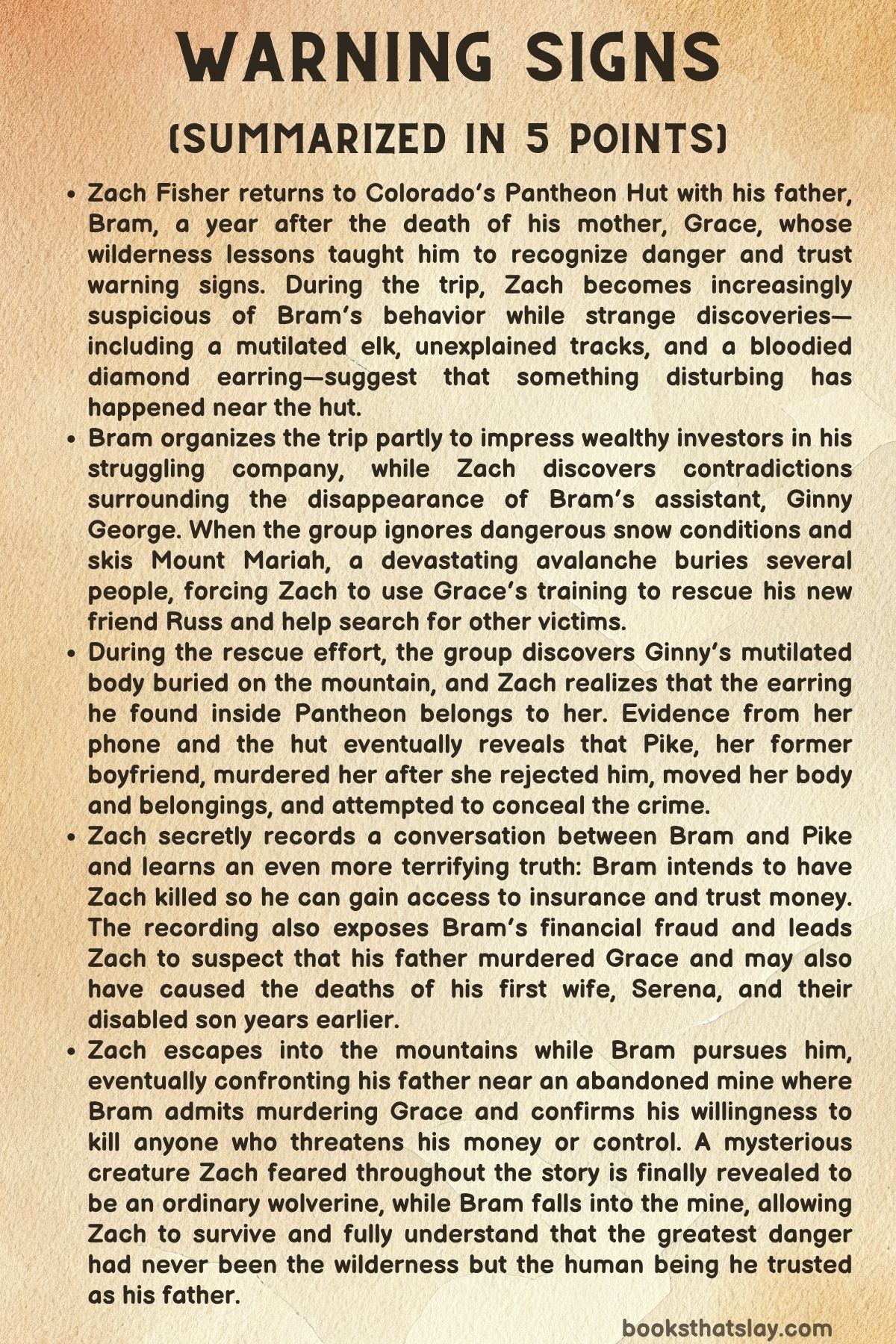
A year before the central events, Grace Fisher takes her children, Zach and Bonnie, toward Pantheon Hut in the Colorado backcountry. When they reach an avalanche path, Grace refuses to assume it is safe simply because another family has crossed it, instead teaching Zach to examine the snow, cornices, slope angle, recent damage, and other warning signs before deciding what risks are acceptable.
Grace’s lesson stays with Zach even after her death. She tells him that knowledge cannot remove every danger and that courage sometimes means abandoning something badly wanted when conditions are uncertain; Zach does not yet understand that she is also speaking about her troubled life with his father.
A year later, Zach returns to Pantheon with Bram, his father. Their journey quickly becomes unsettling when Zach discovers a dead bull elk whose head and neck have been stripped with strange precision, while Bram dismisses the oddity and concentrates instead on the wealthy men he hopes to persuade to invest in his company, Ajax Property Tech.
Zach understands that Bram has two personalities. Around outsiders he is charming, funny, confident, and persuasive, but at home Zach knows another version of him, an intimidating presence he privately calls the Underself.
Pantheon Hut is especially painful for Zach because it was closely associated with Grace and her yearly mountain trips. Bram becomes angry when his assistant Ginny has apparently failed to arrive and orders Zach to prepare the hut, although Zach quickly notices that his father possesses expensive equipment without having much genuine backcountry knowledge.
While cleaning near the stove, Zach discovers a diamond earring caught between the floorboards. Hair and dried tissue remain attached to its post, making the beautiful object disturbing, and Zach secretly hides it before Shane Oliver and his friend Jon arrive.
Shane is the son of Arlo Oliver, one of Bram’s most important investors. Zach learns that Arlo intends to put additional money into Ajax, information that greatly pleases Bram, but he also discovers contradictions concerning Ginny because Shane did not expect her to be present even though Bram claimed she was supposed to prepare the hut.
Dave Dowling arrives with his teenage son Russ, followed by professional guide Steve and, later, Pike Whitlock. Bram presents Ajax to the adults as a successful investment opportunity, but Zach remembers hearing Grace accuse Bram of financial dishonesty shortly before her death.
Away from the adults, Zach develops an unexpected friendship with Russ. Russ sees through much of the wealthy men’s performance of rugged masculinity and encourages Zach to question behavior that he has spent years accepting as normal.
Zach eventually tells Russ about Bram’s previous wife, Serena, and their disabled young son, Abraham Jr., who died in a house fire. Bram has always given Zach a simplified version of the tragedy, but Zach once found reports suggesting Serena’s family questioned Bram’s account and that the circumstances surrounding the fire were more complicated than he admitted.
The mountain meanwhile seems increasingly threatening. Zach and Russ discover strange tracks resembling elongated clawed hands, and Zach remembers Grace explaining that animals generally behave according to instinct while humans can knowingly choose cruelty.
During the night, Zach hears something large moving near the hut and later sees a dark figure traveling uphill toward Mount Mariah. He says nothing because Bram has taught him to distrust his own perceptions and punishes him for interrupting or exaggerating.
Memories of Grace increasingly change how Zach interprets the present. Before her death, Grace told Bram she wanted to separate and revealed that she had taken his financial records to professionals who concluded Ajax did not appear to possess the profitable business Bram claimed.
Instead, investor money seemed to have been moved into risky cryptocurrency investments and short positions, with much of it already lost. Grace warned Bram that his actions might bring serious legal consequences, and his reaction showed that he was especially frightened by the possibility that outsiders had begun examining his affairs.
The next morning the group climbs Mount Mariah despite substantial snowfall. A snow test produces troubling results, and Steve warns that human-triggered avalanches remain possible, but Bram and several others pressure him to continue.
Zach recognizes the danger because Grace taught him how to interpret exactly these signs. Nevertheless, he remains silent because he wants Bram’s approval and fears challenging him, so the group begins skiing.
Shane and Jon disregard Steve’s instructions and continue into steeper terrain. Moments later the slope fractures, and Zach watches Russ disappear beneath an avalanche.
Zach uses his training immediately. After surviving the slide himself, he switches his beacon to search mode, locates Russ, digs him out, clears his airway, and saves his life before the adults reach them.
While Steve, Bram, and Pike search farther below for Shane and Jon, a second and larger avalanche strikes. Zach again takes responsibility when the adults hesitate, descending into the debris with Dave to search for those who have been buried.
They rescue Pike and then Bram. Bram’s beacon is still transmitting rather than searching, despite Zach having specifically reminded him to change modes, meaning his carelessness interfered with attempts to locate other victims.
Shane is eventually found dead. Bram’s response troubles Zach because his attention quickly turns toward Shane’s importance as Arlo Oliver’s son and the financial consequences the death may create.
Steve and Jon remain missing. While the survivors struggle back uphill, they discover what first appears to be another avalanche victim but instead uncover the frozen body of Ginny George.
Ginny’s presence on Mariah immediately creates questions because she supposedly never reached Pantheon. Her clothing is inadequate, important outdoor equipment is missing, and parts of her body have been consumed or damaged in a manner resembling the mutilated elk Zach found earlier.
Then Zach notices that Ginny still has a diamond earring in one ear. The other ear is damaged, and he immediately understands that the earring hidden near Pantheon’s stove is its match.
That discovery proves Ginny had been inside the hut before her death. Someone therefore lied about when she arrived, what happened to her, and why her body later appeared high on the mountain.
Bram examines Ginny’s phone and realizes messages have been deleted and others may have been sent after her death. Instead of thinking primarily about justice, however, he begins considering how evidence against wealthy people might be used for financial leverage.
Zach becomes increasingly alarmed by his father’s priorities. Memories also return of Grace secretly saving money because Bram controlled their finances, and of Aunt Felicity suspecting that Grace’s injuries and eventual death might not have happened as Bram claimed.
That night Zach secretly hides Russ’s phone downstairs with its voice recorder running. When he retrieves it, he discovers that Bram dissolved sleeping pills into drinks given to Dave, Russ, and Zach so that he could confront Pike without witnesses.
The recording reveals Ginny’s killer. Pike had known she would arrive early, followed her to Pantheon after their relationship ended, confronted her when she rejected him, and killed her inside the hut.
He then removed Ginny’s possessions, moved her car, and returned later while pretending he had only just arrived. When circling birds threatened to expose where he had hidden her body, he dragged the corpse up Mariah during the night and left it beyond the ridge, explaining the dark figure Zach had seen.
Bram has reconstructed the murder but does not intend simply to report Pike. He tries to blackmail him into investing money in Ajax, only to learn that Pike is deeply in debt.
Bram then reveals an even more horrifying plan. Grace carried life-insurance policies, one of which had already paid Bram enough to maintain the illusion that Ajax remained financially healthy.
A much larger policy benefits Zach and Bonnie, while control of important trusts had been transferred to Aunt Felicity. Bram believes that Zach’s death could give him access to substantial funds, so he proposes that Pike help kill Zach and make the death appear to be another consequence of the avalanche disaster.
Zach hears his father negotiate the value of his life as though discussing an ordinary financial transaction. He secretly prepares to flee, taking food, survival equipment, Steve’s GPS, Russ’s phone, and other essentials.
Before leaving, Zach hides Ginny’s earring inside the hut with a written message explaining what he knows. He then travels downhill, hoping to reach phone service and protect Bonnie before Bram can target her as well.
At the avalanche clearing, however, Zach confronts the lesson Grace taught him a year earlier. The slope is obviously unsafe, and although crossing it would bring him closer to Bonnie, he refuses to let desperation override what he knows.
Forced to return uphill, he discovers Bram and Pike are already following him. Zach hides below the trail and watches Pike suddenly attack Bram, apparently deciding that killing Bram is safer than continuing their arrangement.
Bram fights back and repeatedly strikes Pike before the two fall down a steep slope. Bram eventually climbs back alone and calmly acknowledges Zach, making it clear that the pursuit will continue.
Zach decides to hide at an abandoned miner’s cabin he once discovered with Grace. After an exhausting journey, he reaches the shelter, lights a fire, changes into dry clothing, and realizes that Grace’s practical teachings were themselves forms of love.
During the night, something enters the cabin and attacks him. Zach initially imagines the mysterious mountain creature, but the attacker beats him, traps him inside Steve’s sleeping bag, ties it shut with a ski strap, and attempts to create a fire before leaving.
Zach narrowly escapes through a second zipper near the bottom of the bag. His injuries are serious, his GPS has disappeared, and the evidence convinces him that the supposed monster was human.
Bram soon finds him and initially pretends to be a worried father. Yet Zach notices that Bram shows no concern about his broken nose or injured ribs, and the lighter fluid and dry wood in Bram’s pack reveal what actually happened.
Bram had attacked him inside the cabin and intended to burn it down, making his death appear accidental. The method causes Zach to reconsider the fire that killed Serena and Abraham Jr., and he also begins to understand what may truly have happened to Grace.
Zach flees toward the old mine and uses the hidden shaft as his only possible advantage. Bram falls partly through the snow covering the opening and accidentally reveals his knowledge of the cabin attack by mentioning an object he could not otherwise know was there.
Zach confronts him about Grace, Serena, Abraham Jr., the insurance policies, and his financial crimes. Bram refuses genuine responsibility and attempts to persuade Zach that the two of them are alike and could still find a way to benefit together.
A rescue helicopter finally appears in the distance. Knowing time is running out, Bram admits that he murdered Grace, revealing that she was conscious when he drowned her and that he wanted her to understand he blamed her for what he was doing.
His words also effectively confirm that Serena and Abraham Jr. died because Bram viewed them as obstacles to money and control. Bram presents himself as someone entitled to ignore ordinary moral rules whenever they interfere with what he wants.
Before he can kill Zach, the mysterious animal appears again. Zach finally recognizes it as a wolverine, explaining the unusual tracks and much of the scavenging that had seemed supernatural.
Bram confronts the animal instead of respecting it. As he backs away, the weakened snow above the old mine collapses beneath him, sending him into the shaft.
The wolverine leaves without attacking Zach. Remembering Grace’s lessons, Zach identifies himself calmly as a human rather than prey and watches it disappear as rescuers approach, finally understanding that the monster he feared on the mountain had never been the animal.
Characters
Zach Fisher
Zach Fisher is the emotional and moral center of Warning Signs, a child forced to distinguish between what adults claim to know and what their actions actually reveal. At eleven years old, he possesses impressive technical knowledge of the backcountry, yet his greatest difficulty is not reading snow conditions but trusting his judgment when it contradicts his father.
His relationship with Bram has conditioned him to doubt himself. Zach watches his words, hides harmless comforts such as Mr. Fantastic, conceals his nighttime problems, and constantly evaluates his father’s mood because he has learned that small mistakes can provoke humiliation or anger.
The avalanche becomes a turning point because it gives Zach undeniable proof that competence and authority are not the same thing. Bram and several other adults dismiss warning signs, while Zach correctly understands the unstable snow and later saves Russ through training, discipline, and quick thinking.
Zach’s growth becomes more profound when he stops viewing obedience as goodness. His decision not to cross the dangerous avalanche clearing during his escape shows that Grace’s teachings have finally become part of his independent judgment rather than rules he follows simply because she once gave them.
The final confrontation with Bram completes this transformation. Zach recognizes that protecting Bonnie may require rejecting the father he desperately wanted to love him, and he accepts that refusing to rescue someone who intends to murder others can be morally different from causing harm out of greed or cruelty.
Grace Fisher
Grace is physically absent from most of Warning Signs, yet she remains one of its strongest presences because Zach understands almost every major event through lessons and memories connected to her. Her teachings about avalanches, wildlife, fear, preparation, and dangerous people become the practical and moral equipment that allows her son to survive.
She is not presented as flawless. Grace drinks heavily during the collapse of her marriage, experiences periods of emotional withdrawal, and sometimes fails to provide the stability her children need, leaving Zach with anger as well as grief after her death.
Her vulnerabilities, however, are inseparable from the coercive environment in which she lives. Bram controls money, discourages her rescue work, intimidates her, reacts aggressively to independence, and repeatedly forces her to calculate how much resistance she can safely show.
Grace gradually begins resisting through practical measures. She hides money, replaces valuable possessions with cheaper ones when necessary, consults outside financial professionals, transfers control of the children’s trusts to Felicity, and finally announces that she intends to leave Bram.
Her most enduring influence is the idea that fear can contain useful information. Grace teaches Zach that uncertainty should be examined rather than denied, giving him an intellectual habit that eventually allows him to recognize the warning signs inside his own family.
Bram Fisher
Bram Fisher is the principal human antagonist of Warning Signs, and his danger comes largely from his ability to appear respectable. He is socially skilled, professionally confident, persuasive with investors, and capable of performing warmth whenever affection serves his interests.
His private behavior reveals a fundamentally different person. Bram uses anger, financial control, criticism, intimidation, secrecy, and emotional manipulation to maintain authority over Grace and the children, making those closest to him continually adjust themselves around his expectations.
Money and ownership dominate his worldview. Ajax Property Tech becomes an extension of this mentality because Bram appears willing to misrepresent investments, misuse other people’s money, manipulate relationships, and exploit tragedy to keep his financial structure alive.
His understanding of family is similarly transactional. He treats Grace’s independence as betrayal, regards Zach’s knowledge as a financial threat, and eventually calculates that his son’s death could unlock insurance money and preserve his failing schemes.
Bram’s most disturbing characteristic is his ability to convert wrongdoing into justification. Even when admitting murder, he constructs explanations in which other people supposedly forced his choices, revealing a man who does not merely break moral boundaries but believes his desires exempt him from them.
Bonnie Fisher
Bonnie is younger than Zach and spends most of the central action away from Pantheon, but her importance steadily increases as Zach understands the true scale of the danger surrounding his family. She represents both what remains of his bond with Grace and the future Zach must protect.
Her nightmares and tendency to seek Zach after Grace’s death show how deeply the loss has affected her. Zach responds by becoming unusually protective, assuming responsibilities that would normally belong to adults and worrying about Bonnie even while facing immediate physical danger himself.
Once Bram’s insurance scheme becomes clear, Bonnie changes from an emotional concern into a potential target. Zach realizes that escaping is not enough because if Bram can benefit financially from the children’s deaths, Bonnie may eventually face the same danger.
Bonnie therefore gives Zach a purpose greater than self-preservation. His determination to survive is inseparable from his refusal to leave his sister alone with the man he now understands his father to be.
Russ Dowling
Russ is one of the most important secondary characters in Warning Signs because he gives Zach an outside perspective on behavior that Zach has normalized. Older, sarcastic, and openly skeptical, Russ recognizes the vanity behind the supposedly rugged adult expedition almost immediately.
His bluntness contrasts with Zach’s cautious habit of monitoring every word. By mocking the fathers’ entitlement and questioning their decisions, Russ creates a space in which Zach can begin speaking honestly about Bram, Grace, and the contradictions surrounding his family.
The avalanche changes their relationship from casual companionship into genuine trust. Zach saves Russ from burial, while Russ later repays him emotionally by affirming that Zach understood the mountain better than the adults responsible for them.
Russ also encourages Zach to trust his perception of danger. His warning not to remain alone with Bram or Pike becomes especially significant because it comes before Zach knows the full extent of the murder conspiracy.
Dave Dowling
Dave Dowling initially participates in the culture of confidence and masculine performance surrounding Bram’s trip. He is one of the wealthy men drawn into the investment discussion and appears comfortable with an expedition in which business, social status, skiing, and fatherhood have all been combined.
The avalanches strip away much of that certainty. Faced with Russ’s injuries and several buried companions, Dave becomes frightened and hesitant, revealing the gap between recreational confidence and the ability to act effectively during a real crisis.
Nevertheless, Dave is not depicted as morally equivalent to Bram. He follows Zach into the debris field, helps dig out victims, cares for Russ, and responds to emergencies without turning them into opportunities for personal advantage.
His role helps establish an important distinction among flawed adults. Poor judgment, vanity, and fear can have terrible consequences, but they remain different from Bram’s calculated exploitation and Pike’s violence.
Pike Whitlock
Pike is a complicated secondary antagonist whose actions expose the destructive consequences of entitlement combined with emotional obsession. His initial portrayal is filtered through Bram, who describes him as a foolish man with an unwanted crush on Ginny, but later information reveals that Pike and Ginny actually had a relationship that she ended.
Pike cannot accept Ginny’s right to define their relationship independently. He follows her to Pantheon, confronts her after she rejects him again, and ultimately kills her when she refuses the identity and future he wants to impose upon her.
His attempts to conceal the crime reveal both planning and panic. Pike moves Ginny’s body, removes evidence, relocates her car, returns to the hut under false pretenses, and later drags her corpse higher on the mountain when scavenging birds threaten to expose it.
Yet Pike remains capable of recognizing certain moral boundaries that Bram has already abandoned. He is initially horrified by Bram’s proposal to kill Zach, although his financial desperation gradually weakens that resistance and shows how self-interest can erode principles when someone has already committed serious wrongdoing.
Ginny George
Ginny is dead before Zach understands what happened to her, but the investigation into her fate becomes one of the book’s central mysteries. Much of her characterization must therefore be reconstructed from other people’s accounts, deleted messages, physical evidence, and the circumstances surrounding her final confrontation with Pike.
She appears to have been increasingly unwilling to tolerate controlling relationships. Ginny ends her relationship with Pike, refuses his claim that they are fundamentally alike, criticizes his behavior, and challenges the financial choices that have contributed to his problems.
Her connections with Bram, Shane, and Pike make her vulnerable because several men attempt to define or use her according to their own interests. Even after her death, Bram immediately considers how information about her murder might become bargaining power rather than treating her as a person entitled to justice.
The recovered earring restores something of Ginny’s voice by turning her body into evidence that cannot easily be manipulated. It proves she reached Pantheon and ultimately helps Zach uncover the sequence of lies surrounding her death.
Shane Oliver
Shane Oliver enters as the privileged son of one of Bram’s major investors and initially appears to be another component of Bram’s business strategy. His presence matters to Bram largely because Arlo Oliver’s money may keep Ajax functioning.
Shane nevertheless contributes important information simply by contradicting Bram’s version of events. His surprise regarding Ginny’s supposed attendance alerts Zach to inconsistencies long before Ginny’s body is discovered.
His decision to continue skiing into steeper terrain despite Steve’s instructions also reflects the broader culture of overconfidence governing the trip. Shane and Jon treat untouched powder and freedom as more important than conservative risk assessment, and that decision helps trigger the disastrous sequence of events.
Shane’s death is especially revealing because Bram immediately evaluates it partly through money and status. The tragedy therefore becomes another moment in which Zach sees that his father instinctively converts human relationships into calculations.
Jon
Jon is a professional skier whose ability gives the less experienced members of the group additional confidence. His presence contributes to the belief that expertise in one area of mountain recreation can somehow neutralize conditions that remain objectively dangerous.
He joins Shane in continuing beyond the area Steve has identified as appropriate. That choice reinforces the book’s repeated distinction between being highly skilled and making sound decisions.
Jon subsequently disappears in the avalanche and is not recovered during the portion of events witnessed by Zach. His fate adds urgency to the rescue effort while demonstrating how rapidly confidence can become irrelevant when the mountain’s physical conditions change.
Steve
Steve is the professional guide and the adult whose knowledge most closely resembles the caution Grace taught Zach. He tests the snow, recognizes the significance of the weak layer, explains the avalanche forecast, and raises concerns about continuing with children under unstable conditions.
His authority, however, is compromised by social pressure. Although he understands the danger better than Bram and several others, he allows the group to continue rather than firmly ending the outing.
This failure makes Steve an important contrast with Grace. Both possess technical expertise, but Grace’s remembered example emphasizes that knowledge only protects people when someone is willing to act on it despite disappointment or criticism.
Steve later responds responsibly during the emergency, attempting rescues and sending an emergency signal. His disappearance during the second avalanche underscores the fact that even competent people cannot always undo the consequences of earlier decisions.
Ximena
Ximena, the Fisher family’s nanny, appears mainly through Zach’s memories of home. Her careful behavior around Bram provides indirect evidence that Zach is not imagining his father’s volatility, because another adult has also learned to avoid provoking him.
She quietly accommodates Zach’s exhaustion and nighttime difficulties rather than shaming him. This small kindness contrasts sharply with the humiliation Zach expects from Bram and demonstrates how ordinary care can create emotional safety.
Ximena’s presence also highlights the hidden nature of domestic intimidation. Outsiders may see Bram’s charm, but people who spend sustained time inside the household develop behaviors designed around managing his anger.
Aunt Felicity
Felicity is one of the few adults who directly questions the official story surrounding Grace’s deterioration and death. She suspects that Bram may have caused Grace’s broken fingers and later wonders whether the bathtub death was truly accidental or self-inflicted.
Her willingness to ask difficult questions threatens Bram because it challenges his control over the family narrative. After Zach, overwhelmed by questioning, indicates that suicide seems possible, Bram uses the official conclusions to sever the children’s relationship with Felicity.
Grace’s decision to place financial control of the children’s trusts with Felicity proves that she trusted her sister to protect Zach and Bonnie. That choice becomes crucial because it limits Bram’s access to the money and ultimately exposes the financial motive behind his plan for Zach.
Serena Fisher
Serena, Bram’s first wife, is known almost entirely through conflicting accounts of her death. Bram portrays her as troubled by substance use and describes the fatal house fire as a tragedy that occurred while he was away.
Zach’s research reveals reasons to question that account. Serena’s relatives disputed parts of Bram’s version, medication was found in her body, and the origin of the fire raises disturbing questions once Zach learns that Bram is willing to manufacture fatal accidents.
Serena therefore functions as part of a pattern Zach can understand only near the end of the story. Her death, once treated as distant family history, becomes evidence that Bram’s violence may have begun long before Grace.
Abraham Jr.
Abraham Jr., Bram and Serena’s young son, is one of the story’s most disturbing absent figures. He had a disability that limited his ability to escape danger independently, making his death in the house fire especially troubling.
Bram minimizes and alters details about him when speaking to Zach, even misrepresenting aspects of the child’s physical abilities. Zach becomes disturbed not only by the possibility that his half brother was murdered but also by Bram’s effort to reduce the boy’s existence within the family story.
Abraham Jr. represents the complete vulnerability of a child dependent upon an adult for protection. Once Zach realizes that Bram may have deliberately left him to die, his own danger becomes part of a frightening repetition rather than an isolated scheme.
Arlo Oliver
Arlo Oliver never becomes a major physical presence in the mountain events, yet his money exerts considerable influence over Bram. As Shane’s father and an important investor, Arlo represents the financial approval Bram desperately needs to preserve Ajax.
Bram’s behavior toward Shane is consequently shaped by Arlo’s potential investment. Even Shane’s death is processed partly through the question of what it will mean for Bram’s relationship with Arlo.
Arlo therefore illustrates how thoroughly financial dependence has distorted Bram’s understanding of relationships. People connected to money become useful, threatening, or disposable according to whether they support his ambitions.
The Wolverine
The wolverine functions both as a real animal and as a corrective to Zach’s fear of an imagined monster. Its unfamiliar tracks, movements, scavenging behavior, and nocturnal presence cause Zach to interpret ordinary wilderness activity as something supernatural.
Once identified, however, the animal becomes much less frightening than the human beings Zach has encountered. It behaves according to instinct and responds defensively when Bram confronts it, precisely matching Grace’s earlier distinction between animal behavior and deliberate human cruelty.
The final encounter reverses Zach’s assumptions from the beginning of the story. The creature he feared does not hunt or murder him, while the father who repeatedly claimed to protect him proves willing to do both.
Themes
Recognizing Warning Signs
Danger repeatedly announces itself before catastrophe occurs, but recognition matters only when people are willing to act on what they see. Warning Signs develops this idea through avalanche science, relationships, financial fraud, murder evidence, and Zach’s own instincts, making observation a moral responsibility rather than merely a survival skill.
Grace teaches Zach to study snow layers, cornices, recent slides, slope angles, animal behavior, and changes in weather rather than relying on appearances. Her central lesson is that uncertainty itself can justify turning around, because a person does not need absolute proof of disaster before choosing safety.
The adults on Mount Mariah demonstrate the opposite attitude. Steve’s snow pit produces troubling evidence, Zach recognizes conditions Grace would have rejected, and the new snowfall adds obvious risk, yet ambition, pride, excitement, and social pressure encourage everyone to interpret uncertainty as permission.
The same pattern governs Zach’s family. Bram’s anger, financial control, contradictory stories, manipulative charm, Grace’s fear, unexplained injuries, hidden money, suspicious deaths, and changing narratives have existed for years, but Zach lacks enough perspective to understand what they mean together.
His maturation therefore involves learning that warning signs do not always arrive as certainty. By the end, Zach no longer waits for an authority figure to validate his perceptions, and that independence becomes essential to saving both himself and potentially Bonnie.
Control, Possession, and the Abuse of Love
Bram repeatedly interprets love through ownership. His relationships become healthy only when other people support his ambitions, protect his reputation, follow his rules, and remain dependent upon him; resistance is interpreted not as another person exercising autonomy but as an attack on something he believes belongs to him.
Grace experiences this most clearly. Bram pressures her away from dangerous rescue work, controls financial resources, uses the prenuptial agreement as a threat, reacts aggressively when she seeks outside advice, and becomes most dangerous when she finally attempts to separate herself from him.
His behavior toward Zach follows the same structure in subtler form. Praise appears when Zach provides useful information, affection appears when Bram needs cooperation, and fatherly protection appears whenever Bram can publicly perform the role of a devoted parent.
Zach consequently spends much of the story confusing obedience with safety. Because Bram sometimes protects him from outsiders and can occasionally behave warmly, Zach struggles to reconcile those moments with fear, criticism, humiliation, and intimidation.
Grace offers a different model of love. Her care appears through teaching, preparation, hidden savings, replacement mittens, practical safety advice, protection of the children’s trusts, and efforts to create a future outside Bram’s control.
Zach ultimately understands that genuine love allows another person to exist independently. Bram’s version demands possession, while Grace’s imperfect but persistent care prepares Zach to survive even after she is gone.
Greed, Entitlement, and Moral Corruption
Money repeatedly changes the meaning Bram assigns to people. Investors become sources of survival, Shane becomes valuable because of Arlo, Ginny’s murder becomes potential leverage, Grace’s death becomes insurance capital, and eventually Zach himself becomes an asset whose death can produce financial relief.
The progression is disturbing because Bram rarely presents himself as greedy in a crude sense. He frames his choices as intelligence, ambition, necessity, business strategy, or the natural behavior of successful people, allowing him to transform exploitation into evidence of his own superiority.
The abandoned mine provides a historical counterpart to this mentality. Grace and Zach discover warnings left by people who understood how the pursuit of wealth can continue beyond the point at which someone is capable of retreating safely.
Pike represents another version of the same corruption. Financial problems do not cause him to murder Ginny, but debt helps weaken his resistance when Bram later proposes another crime, showing how desperation can become an excuse once someone has already trained himself to disregard another person’s autonomy.
The mountain repeatedly punishes this assumption that desire creates entitlement. Untouched powder does not become safe because the men want it, an investment does not become legitimate because Bram needs returns, and another person does not become property because someone fears losing them.
Greed therefore functions as more than a desire for money. It is the belief that wanting something badly enough justifies ignoring every warning that obtaining it will harm someone else.
Fear, Courage, and Trusting One’s Judgment
Fear initially seems like something Zach needs to overcome. He is frightened of Bram’s anger, embarrassed by his dependence on childhood comforts, afraid of strange tracks and noises, uneasy about questioning adults, and ashamed whenever his emotions make him feel younger than he wants to appear.
Warning Signs gradually rejects the assumption that courage requires suppressing those reactions. Grace teaches Zach that fear can provide information, and the book repeatedly demonstrates that ignoring fear simply because it is uncomfortable can be far more dangerous than admitting uncertainty.
Zach’s silence before the avalanche shows the cost of mistrusting himself. He understands the weak snow layer and remembers Grace abandoning a similar run, yet social pressure and the desire for Bram’s approval persuade him to remain quiet.
After the avalanche, that relationship changes. Zach trusts his training enough to search for Russ, takes action when adults hesitate, questions inconsistencies surrounding Ginny, secretly records Bram and Pike, and finally refuses to cross an avalanche clearing even though doing so appears to offer his fastest route to Bonnie.
His greatest act of courage is psychological rather than physical. Zach has to accept that his father intends to kill him and that no amount of obedience, achievement, loyalty, or love will transform Bram into the person Zach wishes he were.
Trusting his own judgment ultimately means accepting painful knowledge without allowing that knowledge to destroy his ability to act. Zach survives because he learns that courage is not the absence of fear but the willingness to listen carefully to what fear is trying to tell him.