A Bargain So Bloody Summary, Characters and Themes
A Bargain So Bloody by Vasilisa Drake is a dark fantasy romance centered on Samara Koisemi, a magicless woman who has spent twelve years trapped in Greymere prison, and Raphael, the powerful vampire whose arrival gives her an unexpected chance at freedom.
What begins as a desperate bargain between two people who do not trust each other gradually becomes a complicated relationship shaped by protection, attraction, secrecy, political power, and conflicting ideas about morality. The story follows Samara as she moves from imprisonment into a wider supernatural world, only to discover that freedom is far more complicated than simply escaping a cell.
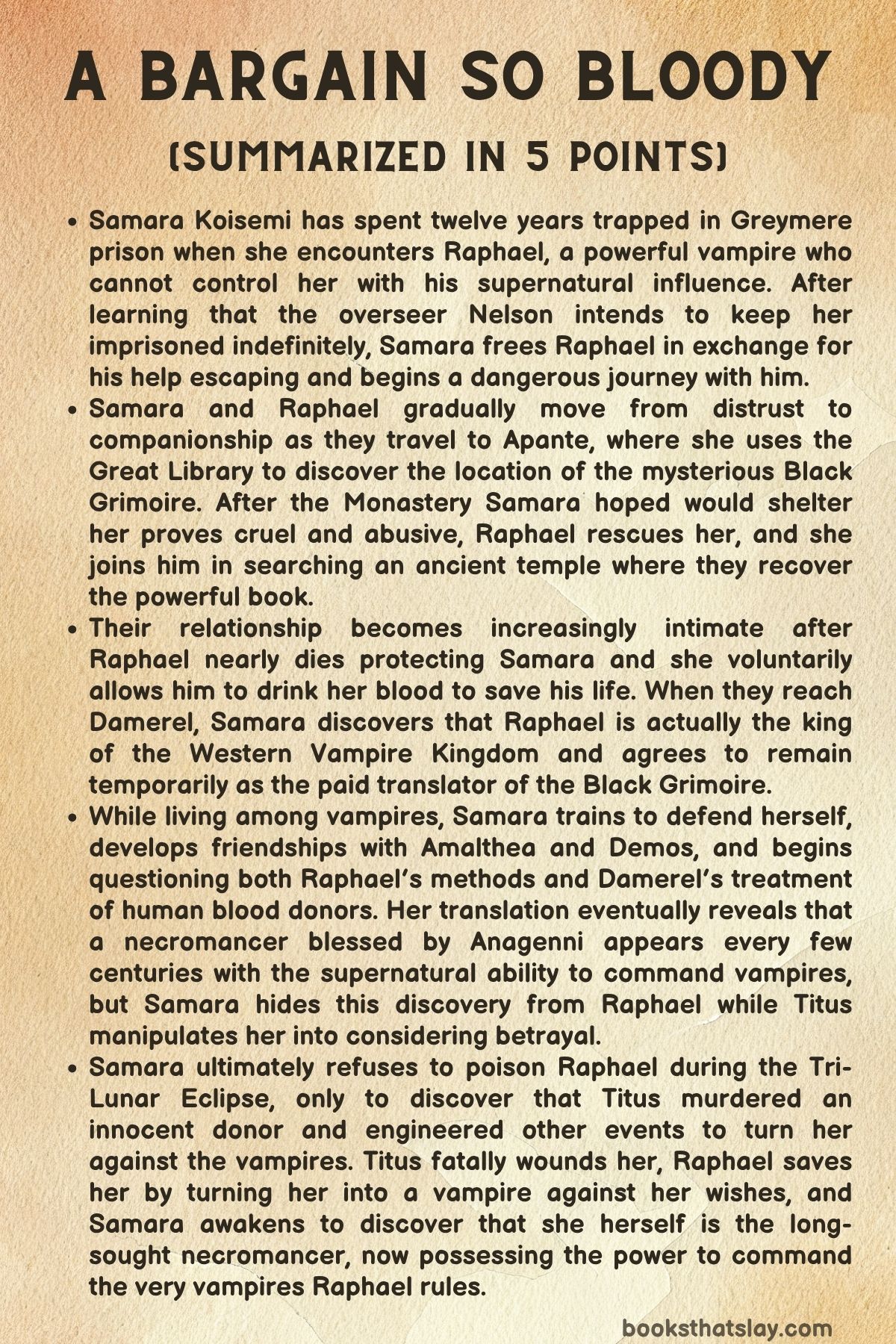
Summary
Samara Koisemi has spent twelve years serving inside Greymere, a prison designed to suppress magic. Because she is a void, someone born without magical abilities, she is not confined like the witches around her but instead forced to perform endless labor under the authority of the cruel overseer Nelson.
She survives by catching rats for stew, cleaning, avoiding punishment, and counting down the remaining years of her fifteen-year sentence. Her only hope is that once she is released, she can seek sanctuary at the Monastery and build some kind of peaceful life beyond Greymere.
Everything changes when a new prisoner is brought into the most dangerous part of the prison. Samara is ordered to treat his wounds and discovers that he is not a witch but a vampire with white hair, glowing red eyes, and a back nearly destroyed by repeated whippings.
The vampire attempts to command Samara into removing his restraints, but his supernatural influence has no effect on her. Neither understands why, and although he offers to help her if she releases him, she initially refuses.
Soon afterward, Nelson destroys the hope that has kept Samara alive by admitting that her sentence means nothing. He controls the paperwork, no one outside the prison is keeping track of her years, and he can make sure she remains there indefinitely.
Realizing that Greymere may become her permanent grave, Samara changes her mind. She steals Nelson’s keys, approaches the vampire, and offers him a bargain: she will free him if he gets her safely out of the prison.
The vampire agrees, and Samara releases him from the cursed copper restraints. Their escape becomes violent almost immediately when Nelson discovers them and the vampire kills him, followed by several guards who attempt to stop them.
Outside Greymere, Samara experiences open sky and fresh air for the first time in twelve years. She expects their arrangement to end there, but the vampire tells her that traveling alone would almost certainly lead to her recapture or death.
He proposes another bargain. He will continue protecting her if she travels with him to Apante and asks a question at its Great Library, since the oracle magic there will not answer a vampire directly.
Samara agrees, and their journey slowly changes the way she sees him. She learns that sunlight weakens rather than destroys vampires, that animal blood can sustain them, and that the creature she has been taught to regard as a monster is capable of patience, humor, protection, and unexpected generosity.
The two eventually exchange names, and Samara learns that her companion is Raphael. He begins calling her “dove,” while she gradually becomes comfortable enough to walk beside him rather than constantly keeping her distance.
Their journey also exposes how deeply Greymere has shaped Samara. Ordinary food feels extravagant, bathing becomes an emotional rediscovery of her own body, and attention from strangers leaves her uncertain because she has spent so long thinking of herself only as a prisoner.
A man named Thomas initially appears kind and flirtatious toward her, but his behavior becomes increasingly aggressive. Raphael ultimately kills him after Thomas corners Samara, an action that protects her while also revealing Raphael’s possessive and violent understanding of protection.
In Apante, Raphael finally tells Samara the question she must ask the Great Library. He wants to know how to obtain the legendary Black Grimoire, a book associated with death, undeath, and dangerous ancient magic.
The oracle reveals that the book lies within an abandoned temple dedicated to the goddess Anagenni. With her obligation to Raphael apparently completed, Samara separates from him and enters the Monastery she has dreamed of reaching for years.
The refuge quickly becomes another form of imprisonment. During her initiation, the priest Devoin forces Samara to whip herself and then continues the punishment himself, presenting suffering and submission as proof of religious devotion.
Her ordeal ends when Raphael suddenly arrives and kills Devoin and the other leaders responsible for allowing the abuse. He carries Samara away, remains beside her during several days of fever, tends her wounds, and respects her refusal when she declines the healing benefits of vampire blood.
With the Monastery no longer a viable future, Samara agrees to accompany Raphael to the temple. Inside, they confront magical traps and puzzles, and Samara discovers that the place seems to respond strangely to her despite her supposed lack of magic.
They eventually reach the Black Grimoire, which Raphael cannot touch because its protections reject vampires. Samara lifts the book instead and immediately experiences overwhelming magical power, but her reaction triggers a trap that fires cursed copper arrows.
Raphael throws himself between Samara and the attack, taking the arrows into his own body. Because cursed copper prevents him from healing properly, Samara must remove the projectiles and then make a terrifying choice when she realizes he will die without living blood.
She allows Raphael to drink from her voluntarily. Instead of the pain and brutality she expects, the bite produces intense pleasure, further complicating everything she believes about him and his species.
After recovering, Raphael agrees to take Samara through the Western Vampire Kingdom. Their journey becomes increasingly intimate, especially when a snowstorm traps them together and forces them to acknowledge the attraction that has grown between them.
When they arrive in Damerel, Samara discovers the greatest secret Raphael has hidden from her. The vampire she believed to be a dangerous wanderer is actually the king of the Western Vampire Kingdom.
Raphael publicly declares Samara to be his protected human after another vampire attacks her. He then offers her a paid position translating the Black Grimoire, and Samara bargains her compensation upward to one thousand gold pieces before accepting.
Life in Damerel introduces her to Amalthea, a human oracle living among vampires, and Demos, Raphael’s trusted general. Both gradually become important parts of Samara’s life, while Demos begins teaching her how to defend herself rather than relying entirely on Raphael.
Samara also discovers that Raphael’s bite created a permanent emotional bond between them, allowing him to sense her feelings. The revelation troubles her because emotional privacy is something she has rarely possessed, and she eventually insists that Raphael teach her how to shield herself from him.
At the same time, she begins questioning the society around her. Human blood donors live in Damerel and provide blood to vampires in exchange for money, shelter, or other benefits, but Samara becomes increasingly disturbed by the possibility that pleasurable vampire bites can create dependence and make supposed consent more complicated.
Her growing stability is further disrupted by the appearance of Titus, King Stormblood’s spymaster from the Witch Kingdom. Titus offers Samara a pardon and restoration of her old legal status if she helps undermine Raphael’s kingdom.
Samara initially refuses, insisting that she has built a new life. Yet her loyalties become less certain after she discovers the real meaning of the Black Grimoire.
The ancient text reveals that every few centuries Anagenni blesses a necromancer with dominion over bone, blood, spirits, souls, and the undead. Vampires are compelled to obey this figure, making the necromancer their natural enemy and explaining why Raphael and his people fear Anagenni even while respecting her.
Samara hides the discovery from Raphael and gives him a false translation. Her distrust increases after visiting a blood den and seeing a weakened human donor who appears to be suffering despite claiming that she willingly accepts the work.
When that same donor is later found brutally murdered, Samara’s worst fears seem confirmed. She confronts Raphael over a society in which human safety appears to depend upon whether powerful vampires personally value them.
Their argument becomes emotionally charged and culminates in a kiss, but Samara remains convinced that vampires need an external force capable of limiting their power. She secretly decides to steal the Grimoire and deliver it to the necromancer.
The approaching Tri-Lunar Eclipse creates another crisis. Tradition requires Raphael to drink publicly from his Chosen, the role his court believes Samara now occupies.
Raphael has promised never to bite Samara without permission, but Samara discovers that his alternative would normally be to use another living donor and kill that person afterward to prevent another permanent emotional bond. Horrified by the choice, she tells him to feed from her instead while condemning the moral system that makes such violence normal.
Titus reappears with a plan designed to exploit the eclipse ceremony. He gives Samara a magical toxin capable of entering Raphael’s body through her poisoned blood and promises that completing the assassination will restore her freedom in the Witch Kingdom.
Samara activates the poison but intends to escape with the Grimoire afterward rather than surrender it to Titus. During the eclipse celebration, however, Raphael’s behavior forces her to reconsider the image of him she has constructed.
He has gathered musicians because he knows she loves music, arranged an investigation into the murdered donor, and admits that his values are capable of changing because her objections matter to him. When the moment arrives for him to drink from her, Samara cannot knowingly poison him and refuses.
She retreats to her chambers and prepares to leave Damerel anyway, still determined to find the necromancer. Titus confronts her there and finally reveals that nearly everything pushing her toward betrayal was deliberately engineered by him.
He told the hostile librarian about Samara’s research so that the vampire would attack her. More devastatingly, Titus admits that he murdered the young donor himself and arranged the body specifically to make Samara believe the vampires were responsible.
Samara realizes that Titus has used her trauma, prejudices, and fears as weapons against her. She attacks him, demonstrating how far her combat training has taken her, but Titus uses hidden poison magic to paralyze her before stabbing her through the chest.
Raphael arrives while Samara is dying and turns his fury on Titus. He then faces an impossible choice: respect Samara’s repeated insistence that she never wants to become a vampire or allow her to die.
Raphael chooses to save her. Despite her desperate objections, he turns her.
When Samara awakens, she immediately recognizes the transformation. She has no heartbeat, can see in complete darkness, and is burned by cursed copper.
She is furious that Raphael took the choice from her, but Demos reveals that Raphael is unconscious because he swallowed the poison still present in Samara’s blood while turning her. Demos considers Samara a traitor and imprisons her behind copper bars.
Then something extraordinary happens. In anger, Samara commands Demos to move away and forget what happened.
The ancient vampire obeys immediately.
Samara finally understands the truth that has been hidden behind her strange immunity to vampire enthrallment, the temple’s reaction to her, and the Black Grimoire’s attraction to her. She was never an ordinary void.
She is the necromancer blessed by Anagenni, the very being Raphael has spent centuries hunting.
Now Samara has become something even more dangerous: a vampire who still possesses the supernatural authority to command vampires. Furious at Raphael for transforming her against her will, she ends the story determined to use that power against the kingdom he rules.
Characters
Samara Koisemi
Samara is the central character of A Bargain So Bloody, and nearly every major conflict in the book grows from her struggle to determine who has the right to control her life. Twelve years in Greymere have trained her to survive through obedience, caution, silence, and the suppression of almost every personal desire.
Her apparent weakness, however, hides extraordinary adaptability. Samara survives hunger, violence, imprisonment, religious abuse, supernatural danger, political manipulation, and repeated encounters with people who believe they can decide what is best for her.
Freedom initially means nothing more than leaving Greymere, but Samara gradually learns that physical escape is not enough. The Monastery demands submission, Raphael’s protection can become possessive, Titus manipulates her choices, and even apparently voluntary systems inside Damerel force her to think about whether people can genuinely consent when powerful beings control the conditions around them.
Her growth becomes clearest through her increasing willingness to act. The woman who once accepts Nelson’s cruelty because resistance seems pointless eventually bargains with a vampire king, fights trained opponents, kills an attacking vampire, challenges royal customs, investigates blood dens against orders, rejects Titus’s plan, and physically attacks a royal spymaster.
Samara’s compassion also remains central to her identity. Her concern for donors, her refusal to let Josephine be brutally punished for an accident, and her willingness to give Raphael her blood when he is dying all show that suffering has not made her indifferent to the suffering of others.
The revelation that she is the necromancer transforms everything previously understood about her. Her supposed emptiness was never proof that she lacked importance; the power inside her was simply different from the magic recognized by the society that judged her.
Her transformation into a vampire creates the cruelest contradiction in her story. Samara gains enormous supernatural authority at the exact moment Raphael violates her most clearly stated boundary, leaving her more powerful than ever while also feeling that her deepest choice has been stolen.
Raphael
Raphael is the dangerous, protective, secretive, and morally complicated vampire at the center of A Bargain So Bloody. He begins as a terrifying prisoner whose supernatural authority fails against Samara, but he gradually becomes her protector, traveling companion, employer, emotional partner, and eventually the person whose decision most radically changes her existence.
His treatment of Samara frequently reveals genuine care. He gives her food, protects her from Thomas, returns to rescue her from the Monastery, nurses her through illness, buys her the belt she admired, adapts her sleeping space to accommodate her trauma, encourages her love of music, arranges an orchestra for her, and eventually gives her tools for shielding her emotions even though doing so makes protecting her more difficult.
Yet Raphael’s affection exists beside a deeply ingrained belief in force. He kills without hesitation, publicly mutilates Lucas, executes punishment in ways Samara finds cruel, accepts a social order in which humans provide blood to vampires, and initially believes his position as protector entitles him to make decisions on Samara’s behalf.
His possessiveness is therefore both romantic and threatening. Calling Samara his Chosen protects her within vampire society, but it also places her within a cultural structure she does not fully understand and creates assumptions about intimacy, ownership, and feeding that she never knowingly accepted.
Raphael’s relationship with morality is not static. Samara forces him to consider people he would otherwise dismiss as irrelevant, and his decision to investigate the donor’s murder demonstrates that her perspective can influence how he uses royal power.
His final decision to transform Samara nevertheless exposes the limit of that growth. Faced with her death, Raphael chooses his need to keep her alive over her repeatedly stated refusal to become a vampire, saving her body by violating her autonomy.
That choice prevents him from being reduced either to a monster or an ideal romantic protector. Raphael is capable of extraordinary tenderness and extraordinary coercion, and the book deliberately places both qualities inside the same man.
Amalthea
Amalthea becomes one of Samara’s most important relationships in A Bargain So Bloody because she offers something Samara has almost never possessed: friendship without immediate demands. As a human oracle living within vampire society, she also complicates Samara’s assumption that humans and vampires must always exist only as victims and predators.
Her background gives her a personal understanding of persecution. Oracle abilities made her dangerous in the eyes of the Witch Kingdom, forcing her family to flee the society Samara once considered the safer side of the human-vampire divide.
Amalthea is confident around Raphael in ways that initially astonish Samara. She jokes with him, challenges him, advises him, and refuses to behave as though his royal status makes disagreement impossible.
Her treatment of Samara is similarly important. Rather than viewing Samara as broken or incapable, Amalthea expects her to become socially active, form opinions, wear what she wants, train, attend court functions, and occupy space without apologizing for existing.
At times, however, Amalthea participates in withholding information. She knows more about Raphael’s mission, Samara’s status as his Chosen, vampire customs, and prophetic possibilities than Samara initially realizes.
Even with those limitations, Amalthea becomes a bridge between Samara and life beyond trauma. Their conversations, humor, training, clothing preparations, and growing trust allow Samara to experience ordinary female friendship after years in which relationships were defined almost entirely by survival.
Demos
Demos serves as Raphael’s general and closest long-term companion in A Bargain So Bloody, but his greatest importance to Samara comes through his role as her combat instructor. Where Raphael often protects Samara by destroying threats himself, Demos teaches her how to protect herself.
His training respects both her limitations and her potential. He begins carefully, maintains physical boundaries, allows her strength to develop gradually, and encourages her to exploit opponents who underestimate her.
That relationship gives Samara visible proof of change. Her later ability to defeat Amalthea during training, fight the vampire in the blood den, kill the librarian, and resist Titus all reflects skills developed under Demos’s instruction.
Demos also demonstrates the limits of loyalty. His allegiance to Raphael is absolute enough that when Samara awakens after her transformation, he regards her first as someone who endangered his king rather than as the woman he trained and knew personally.
The epilogue gives his character an additional purpose because he becomes the first vampire directly compelled by Samara’s necromantic authority. His involuntary obedience proves that her power is real and immediately alters the balance between her and Raphael’s kingdom.
Titus
Titus represents manipulation in its most calculated form in A Bargain So Bloody. Unlike Nelson, whose cruelty is direct, Titus tries to control Samara by making her believe that his preferred decisions are entirely her own.
He understands her history well enough to know which fears will influence her most strongly. He presents vampires as inevitable predators, offers restoration to the Witch Kingdom, and repeatedly encourages her to interpret every disturbing event in Damerel as evidence that Raphael’s society is fundamentally incapable of change.
His most disturbing actions involve manufacturing proof. By provoking the librarian and murdering the vulnerable donor, Titus does not merely lie to Samara; he constructs experiences designed to reactivate her trauma and guide her toward assassination.
The royal pardon further demonstrates his methods. He understands that Samara has spent years believing she is a criminal and therefore offers legal restoration as though King Stormblood’s recognition could return the identity Greymere destroyed.
Titus ultimately underestimates how much Samara has changed. When his deception is exposed, she no longer freezes or accepts his authority automatically but attacks him, forcing him to use poison and physical violence to regain control.
His stabbing of Samara becomes the event that triggers her transformation. By attempting to use her as a disposable weapon against Raphael, Titus unintentionally helps create the vampire necromancer who may become far more dangerous to both kingdoms than either side anticipated.
Nelson
Nelson embodies the institutional cruelty that defines Samara’s years in Greymere. His authority allows him to humiliate, starve, threaten, and exploit her while presenting his actions as ordinary parts of prison life.
His most damaging act is not physical violence but the destruction of Samara’s belief in release. By revealing that no meaningful authority is tracking her sentence and that he can simply refuse to process her freedom, he shows her that obedience will never earn the future she expects.
That revelation indirectly causes his death. Once Samara understands that waiting patiently cannot save her, freeing Raphael becomes a rational risk rather than an unthinkable act.
Nelson continues influencing Samara long after Raphael kills him. Her fear of alcohol, instinctive submission, discomfort with pleasure, difficulty trusting kindness, and constant expectation of punishment all show that Greymere survives inside her even after she leaves its walls.
Devoin
Devoin is the priest whose treatment of Samara destroys her idealized belief in the Monastery. He uses religious language to convert cruelty into supposed spiritual discipline, insisting that suffering proves devotion and that submission is necessary for acceptance.
His power depends upon Samara’s desperation. She wants sanctuary so intensely that she initially agrees to hurt herself rather than risk being rejected.
When Devoin takes the scourge and continues the beating, his resemblance to Nelson becomes impossible for Samara to ignore. Both men operate inside institutions that claim authority over her and both exploit her belief that endurance will eventually be rewarded.
His death at Raphael’s hands permanently changes Samara’s relationship with institutional safety. After Greymere and the Monastery, she can no longer assume that an organization calling itself lawful, sacred, or protective is therefore morally trustworthy.
Thomas
Thomas initially represents ordinary social attention, something almost completely unfamiliar to Samara after twelve years in prison. His friendliness and flirting briefly suggest that the outside world may contain uncomplicated human connection.
His behavior gradually becomes more threatening. He pressures Samara to drink something she does not want, ignores signs of discomfort, continues pursuing her after interacting romantically with another woman, and eventually physically corners her.
Thomas is important because Samara’s survival habits make confrontation difficult. She has been conditioned to avoid angering men with power, so she initially tries to remain polite even when she feels unsafe.
Raphael’s killing of Thomas protects Samara but also introduces a recurring conflict. He recognizes danger faster than she does, yet his solution is always overwhelming force, leaving Samara caught between gratitude for protection and fear of what protection allows Raphael to justify.
Slyne
Slyne is one of the first Monastery devotees to welcome Samara and therefore helps create the initial impression that the institution may genuinely offer refuge. His kindness contrasts sharply with the violence that later occurs during her initiation.
His presence illustrates how abusive institutions can contain individuals who appear warm or sincere. Personal friendliness does not necessarily prevent a system from tolerating cruelty when authority is concentrated in people such as Devoin.
Slyne also shows why Samara finds the Monastery attractive. After years of hostility, even basic welcome feels extraordinary enough that she wants to overlook warning signs.
Vora
Vora represents the more judgmental side of Monastery culture before its full violence becomes visible. She criticizes Samara’s use of magical cards and treats rejection of magic as an important measure of spiritual legitimacy.
Her attitude matters because Samara has always loved magic despite being unable to use it naturally. The expectation that she must reject something she values in order to belong immediately places acceptance on conditional terms.
Vora therefore contributes to Samara’s gradual realization that sanctuary based on self-erasure is not genuine freedom. The Monastery promises protection only if Samara reshapes herself into the person its leaders consider acceptable.
Cook
Cook is a minor but meaningful presence in Samara’s Greymere life because he occasionally provides food and small acts of practical kindness. In an environment where nearly everything is controlled through punishment and scarcity, even quiet generosity carries considerable emotional value.
Cook cannot free Samara or confront the institution controlling her, which limits what his kindness can accomplish. His character nevertheless shows that Samara’s imprisonment is not defined exclusively by openly cruel people, but by a system in which decent individuals have little power to protect the vulnerable.
Prince Marcel
Prince Marcel represents Samara’s connection to the Witch Kingdom she remembers from before Greymere. Seeing him during the pilgrimage in Apante reminds her that the outside political world continued developing while her own life remained almost frozen inside prison.
He has grown into a popular young heir while Samara has lost twelve years. That contrast reinforces the enormous amount of time taken from her and emphasizes how disconnected she has become from the society that once defined her identity.
Marcel also belongs to the royal structure that later offers Samara supposed restoration through Titus. His presence therefore quietly connects her memories of home with the political power that eventually attempts to use her against Raphael.
King Vaughn Stormblood
King Vaughn Stormblood remains mostly distant from the direct action, but his authority shapes Samara’s choices. He represents the Witch Kingdom, its laws, its political legitimacy, and the possibility that Samara might once again be officially accepted by the society that condemned her.
The royal pardon offered through Titus is powerful precisely because it carries the king’s authority. For someone treated as a criminal for much of her life, official forgiveness promises not only legal safety but the restoration of social identity.
The story nevertheless raises doubts about what that acceptance is worth. If the kingdom requires Samara to become an assassin before recognizing her as worthy of freedom, its definition of justice is hardly uncomplicated.
Charlotte
Charlotte is the human healer called when Samara experiences her first menstrual cycle. Her explanation reveals that years of starvation delayed Samara’s physical development, turning what initially seems like a frightening medical crisis into evidence of the long-term damage caused by Greymere.
Charlotte’s presence is also important because her interaction with Samara is calm and practical. She treats a bodily experience Samara finds terrifying as something understandable rather than shameful.
Through Charlotte, Samara learns that improved nutrition is allowing her body to recover. The scene therefore marks physical healing alongside the emotional and social recovery occurring during her time in Damerel.
Lazarus
Lazarus is a vampire noble whose conversation at the royal ball exposes gaps in Raphael’s story. His reference to Raphael’s hunt for an “abomination” alerts Samara to the fact that the mission near Greymere involved far more than the search for the Black Grimoire.
Although his role is brief, Lazarus functions as an accidental source of political information. His comments contribute to Samara’s growing awareness that Raphael selectively reveals information even when he is technically unable to lie directly.
Lucas
Lucas is the vampire who lunges at Samara after smelling her blood when she first arrives in Damerel. His attack confirms that her fear of being surrounded by vampires is not irrational, even if many residents later prove more controlled than she expects.
Raphael’s response is deliberately extreme. By tearing off Lucas’s hands and threatening even worse consequences for anyone who touches Samara, he establishes her protected status while demonstrating the brutality through which his authority is enforced.
Lucas therefore becomes one of Samara’s earliest lessons about Damerel. Protection is real there, but it often operates through fear and disproportionate punishment.
The Ancient Librarian
The ancient vampire librarian openly resents Samara’s access to knowledge and becomes dangerous after discovering her work on the Black Grimoire. Convinced that she serves Anagenni, he attempts to use enthrallment before attacking her physically.
His failure is significant because Samara’s immunity once again protects her from supernatural control. More importantly, she does not simply wait for Raphael or Demos to save her.
Samara distracts him, draws her cursed-copper dagger, and kills him herself. The confrontation therefore marks one of the clearest transitions from dependent survivor to active defender.
The later revelation that Titus deliberately fed the librarian information makes his attack even more important. What Samara interprets as evidence of vampire hostility was partly manufactured by someone trying to influence her political loyalties.
Crowley
Crowley is a human who petitions Raphael for transformation after many years of service. His request initially appears to demonstrate that some humans genuinely desire vampire immortality.
The truth behind his request is darker because he and Janessa manipulated a violent incident involving her nephew in order to create the appearance that Crowley deserved reward for heroism. Their deception turns the ceremony into a public judgment rather than a celebration.
Crowley’s fate shows Raphael’s uncompromising approach to betrayal. Even when Samara can understand why punishment is necessary, she is disturbed by a justice system in which the king personally designs brutal consequences.
Janessa
Janessa is the vampire lover involved in Crowley’s deception. Her willingness to endanger her own young relative so Crowley could appear heroic demonstrates the destructive extremes to which personal desire can lead.
Raphael’s punishment forces her to participate in Crowley’s transformation and then kill him. The sentence is psychologically cruel because it turns the thing they desired most into the mechanism of their destruction.
Through Janessa, Samara gains another reason to question Raphael’s methods. His judgments may have logic behind them, but justice under his rule can deliberately inflict emotional devastation rather than merely prevent future harm.
Josephine
Josephine is a vampire seamstress whose accidental mistake becomes an important test of Samara’s developing confidence. When she pricks Samara with a pin, the possibility of severe punishment immediately arises because Samara’s blood carries unusual significance.
Samara refuses to allow Josephine to be beaten or mutilated for an accident. Her intervention demonstrates that she is no longer willing to watch someone else experience arbitrary punishment merely because authority considers violence convenient.
Josephine’s fear reminds Samara of her own experiences under Nelson. By protecting her, Samara begins using whatever status she possesses not simply for personal survival but to prevent the repetition of abuses she recognizes.
Latia
Latia manages the blood den Samara secretly visits while investigating the treatment of human donors. She explains that donors are paid and that human residents contribute to vampire society rather than being formally enslaved.
Her explanation presents the strongest practical defense of the system Samara distrusts. People enter willingly, receive compensation, and often experience pleasure rather than pain while being fed upon.
At the same time, Latia cannot resolve Samara’s deeper concern about dependency. If vampire bites are powerfully pleasurable and humans have limited social or economic alternatives, the existence of consent does not automatically eliminate every form of exploitation.
The Young Blood Donor
The weakened donor becomes one of the most emotionally important minor figures because Samara sees in her the possibility of a human being gradually consumed by a system she cannot fully control. The young woman insists that she likes the work because feeding removes pain and provides pleasure, but her physical condition alarms Samara.
Her later corpse becomes the apparent confirmation of everything Samara fears about vampire society. Seeing her dead pushes Samara closer to stealing the Grimoire and cooperating with Titus.
The eventual revelation that Titus murdered her radically changes the meaning of her death. She was victimized not by the vampires Samara suspects but by a human political agent who considered her life useful as propaganda.
Her death therefore demonstrates how vulnerable people can be reduced to tools by opposing sides. Samara’s outrage remains justified even after she learns who killed the woman, because the event proves how easily the powerless can become expendable in conflicts between stronger groups.
Samara’s Mother
Samara’s mother exists primarily through memory, but her influence on Samara is substantial. Samara remembers losing ordinary childhood pleasures and being taught that practical survival mattered more than interests such as music.
The memory of her mother throwing Samara’s improvised carrot flute into the stew becomes especially revealing. Samara has normalized the incident as practical necessity, while Raphael recognizes that the dismissal of something she loved caused genuine emotional harm.
Her mother’s death at the hands of a vampire also helps explain Samara’s fear and hatred of Raphael’s species. That trauma gives Titus a powerful vulnerability to exploit when he tries to persuade her that vampires are incapable of seeing humans as anything more than prey.
Samara’s Father
Samara reveals that her father may still be alive, but the possibility remains uncertain throughout the book. His absence represents the life from which she was removed and the unresolved question of whether anyone from that earlier existence still remembers her.
Her fear of being forgotten is one of Samara’s deepest emotional wounds. Raphael’s promise that his long life means he will remember her therefore carries unusual meaning because it directly addresses the possibility that everyone else from her past has disappeared.
The father’s unresolved status also leaves Samara’s family history open. Her true identity as the necromancer suggests that the circumstances of her birth and apparent lack of witch magic may contain more secrets than she currently understands.
Themes
Freedom, Control, and the Meaning of Choice
Freedom in A Bargain So Bloody is repeatedly separated from the simple act of leaving captivity. Samara escapes Greymere early in the story, yet almost every major relationship or institution she encounters afterward raises a new question about who has the authority to make decisions over another person’s body, future, beliefs, or identity.
Nelson represents obvious coercion because he openly controls Samara through prison authority and deliberately prevents her release. The Monastery appears different because Samara enters voluntarily, yet Devoin uses her need for sanctuary to demand physical suffering and submission, showing that desperate circumstances can make supposed consent deeply unequal.
Raphael creates the most complicated version of this conflict. He repeatedly gives Samara opportunities she never had before, including protection, wealth, training, privacy, friendship, comfort, and the possibility of choosing where she eventually lives.
At the same time, he repeatedly assumes that protecting her gives him authority to override her wishes. His public declaration that she belongs to him, his resistance to teaching her emotional shielding, and ultimately his decision to turn her into a vampire demonstrate that affection does not automatically make control acceptable.
Titus represents another form of coercion by manipulating information rather than openly issuing commands. He arranges events so that Samara will believe betrayal is her own moral decision.
The final transformation brings the theme into its sharpest form. Samara becomes immensely powerful at the same moment that her most explicit choice is violated, leaving the story with a central unresolved question: what does freedom mean when survival itself has been imposed?
Trauma, Survival, and Relearning Ordinary Life
Samara’s trauma is expressed less through abstract reflection than through the ordinary behaviors she carries out of Greymere. Food, beds, alcohol, music, bathing, physical contact, privacy, and even wanting something for herself have all been reshaped by years of deprivation and fear.
Her habit of sleeping under beds is especially revealing. The behavior would appear irrational to someone who sees only the present, but for Samara it is a survival response connected to the night her family was taken from her.
Raphael’s decision to rebuild the space beneath her bed rather than forcing her to sleep normally becomes important because it accepts where she currently feels safe. Healing is presented not as instant recovery but as the gradual creation of circumstances in which old defenses are no longer always necessary.
Food serves a similar purpose. Samara initially struggles to accept abundance because Greymere trained her to expect scarcity, and even something as simple as wanting pie feels dangerous.
Music gradually becomes another path back toward herself. Hearing musicians, remembering childhood attempts at making instruments, and discovering that Raphael has brought performers to Damerel all reconnect her with desires that imprisonment could suppress but never completely destroy.
Her physical recovery mirrors the emotional process. The return of normal bodily development after months of adequate food reveals how completely imprisonment affected her, while combat training allows her to experience her body as a source of strength rather than merely something others can punish.
Survival begins as endurance, but over time it becomes the ability to want, choose, enjoy, refuse, fight, and imagine a future.
Morality, Power, and Unequal Systems
Power throughout the novel is rarely presented as morally simple. People and institutions often justify harmful behavior by pointing to order, tradition, religion, protection, national loyalty, or voluntary agreement, forcing Samara to examine whether acceptable intentions can excuse systems that leave weaker people vulnerable.
Damerel becomes the most sustained example. Raphael can sincerely believe that the blood-donor system is fair because humans voluntarily enter the kingdom, receive compensation, and often enjoy feeding.
Samara focuses instead on the imbalance beneath that arrangement. Vampires are physically stronger, bites can be intensely pleasurable, and humans who lack attractive alternatives may technically consent while still operating under economic or psychological pressure.
The same conflict appears in Raphael’s justice. He protects his people and punishes genuine wrongdoing, but punishments such as Lucas’s mutilation or Janessa’s forced participation in Crowley’s death show that justice can become cruelty when one ruler possesses overwhelming authority.
The Witch Kingdom offers no uncomplicated moral alternative. Titus presents himself as an agent resisting vampire oppression, yet he murders an innocent donor and engineers attacks because human lives are acceptable sacrifices if they help achieve a political objective.
The Monastery similarly uses spiritual authority to excuse physical abuse. Greymere uses law and imprisonment.
By placing Samara inside several competing systems, the story refuses to equate official legitimacy with moral legitimacy. Her developing ethical identity depends on judging actions by what they actually do to vulnerable people rather than by the institution, species, religion, or kingdom claiming the right to perform them.
Identity, Transformation, and Hidden Power
Samara spends most of A Bargain So Bloody believing that one word explains her place in the world: void. She has been taught that she possesses no magic, and that supposed absence shapes how others evaluate her as well as how she evaluates herself.
Yet the story repeatedly provides evidence that her identity is incomplete. Raphael cannot enthrall her, the temple responds to her presence, the Black Grimoire allows her to touch it when vampires cannot, and its power feels strangely natural despite everything Samara believes about herself.
Her identity also changes socially long before the supernatural revelation. She moves from prisoner to fugitive, companion, protected human, translator, friend, trainee, royal Chosen, suspected traitor, vampire, and finally necromancer.
Each new role is partly assigned by others, but Samara increasingly questions whether labels have the right to define her choices. Being called criminal does not make Greymere just, being called Chosen does not give Raphael ownership of her, and being called void does not mean she lacks power.
Raphael undergoes a parallel challenge to identity. Samara first sees him only as a monster, then as a companion, protector, king, potential lover, morally compromised ruler, and finally the man who violates her autonomy in order to save her life.
The final revelation unites transformation and contradiction. Samara becomes one of the undead while simultaneously discovering that she possesses authority over the undead.
The identity she feared most and the power Raphael’s people fear most now exist inside the same person, creating a new version of Samara that neither vampires nor witches have a category capable of containing.