A Date with Death Summary, Characters and Themes
A Date with Death by Kelly Creagh is a supernatural romance that turns the familiar figure of the Grim Reaper into a reluctant protector, romantic hero, and man burdened by centuries of forgotten pain.
The story follows Helena Hart, a cheerful children’s librarian who survives a death she was never meant to escape after Grim unexpectedly saves her. What begins as a strange encounter soon becomes a conflict involving fate, immortal beings, magical conspiracies, and forbidden love. Beneath its dark supernatural setting, the novel is also about learning to live without apology, confronting buried guilt, accepting love, and choosing connection even when the future seems impossible.
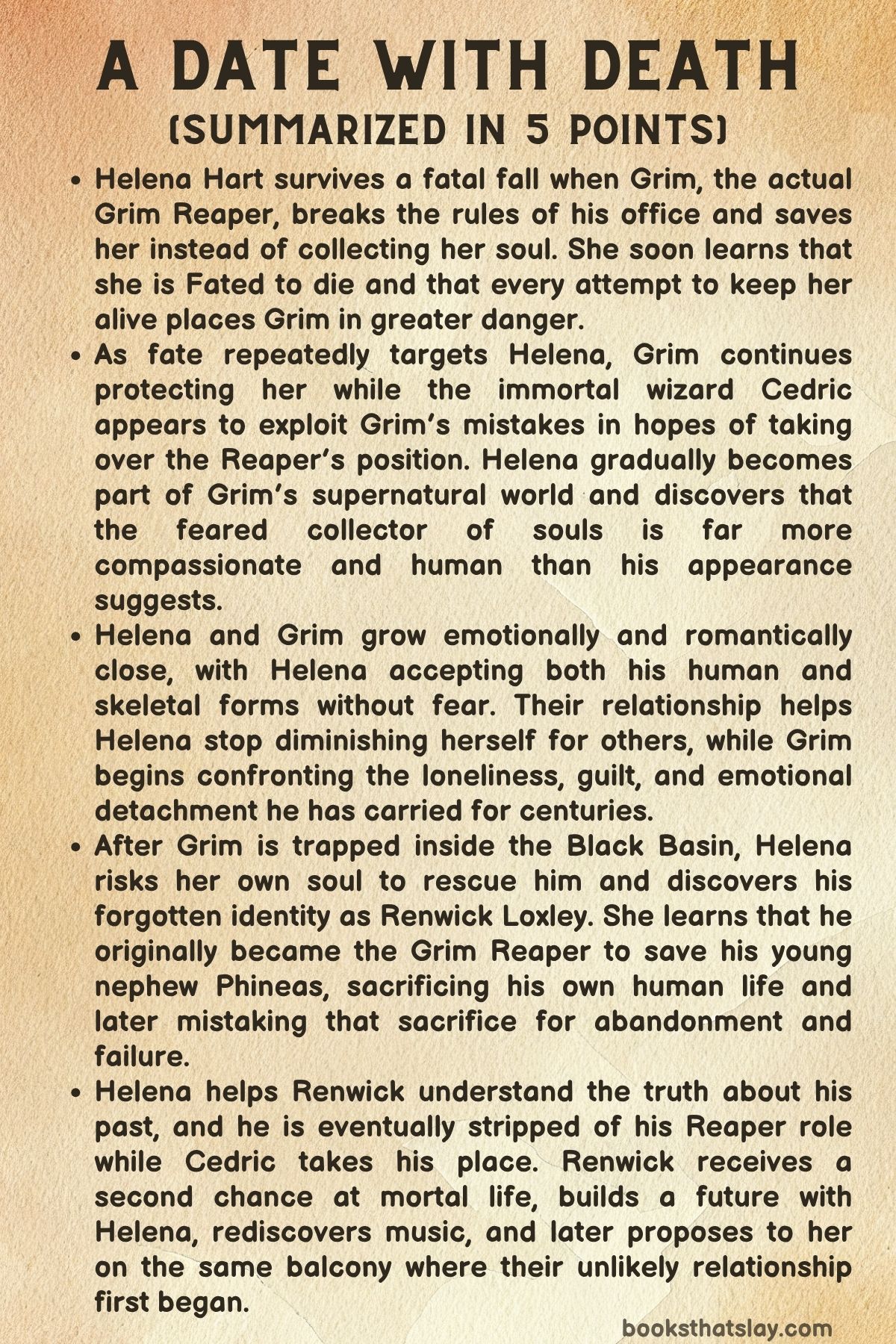
Summary
Helena Hart, a twenty-nine-year-old children’s librarian, attends a Halloween party at the Gothic Anatole Manor dressed as sunshine and rainbows. After her disappointing date abandons her, she wanders onto a balcony and begins talking to a silent figure dressed as the Grim Reaper, joking that people misunderstand death and that the Reaper should be viewed as a guide for souls rather than their killer.
Helena impulsively asks the stranger to leave the party with her, but before anything can happen, the balcony railing collapses beneath her. The mysterious figure catches her with an icy skeletal hand and saves her from a fall that should have killed her, then disappears before she can understand what she has seen.
The being really is Grim, an ancient collector of souls who has just committed an extraordinary violation of his duty. Helena was supposed to be his final collection of the night, yet for reasons he cannot explain, he chose to save her instead of taking her soul.
Grim lives in the Hallowed Halls of the Netherworld with Johann, an ancient scholar; Flora, a fairy who collects the souls of children; and Pluto, Johann’s sarcastic raven. Souls are delivered into five mysterious Basins, each associated with one of The Few, and Grim particularly fears the Black Basin because its darkness seems unnaturally attracted to him.
Soon Grim learns that Helena is not an ordinary missed soul. She is Fated, meaning her death was ordained as part of a larger supernatural design, and interfering with that death places Grim’s position and possibly his own soul at risk.
Helena, meanwhile, begins investigating what happened. A book about the Grim Reaper mysteriously appears at her library after an unknown man requests it, and inside she finds a handwritten message confirming that the being she encountered is real.
Fate soon attempts to claim Helena again when an elevator carrying her malfunctions. Grim appears inside it, forces open the doors, and gets her to safety moments before the car crashes, giving Helena another clear sign that the supposed embodiment of death is repeatedly preventing her from dying.
Near the wreckage, Helena sees a white-haired stranger whom Grim identifies as dangerous. Grim attacks the man with his scythe and removes his soul, yet Helena later learns that the stranger is Cedric, an immortal wizard whose soul cannot permanently remain separated from his body.
Cedric has spent years wanting Grim’s position because his immortality has become a curse. Becoming the next Reaper offers him a possible path toward finally escaping his endless existence, and Helena’s missing Fated soul appears to provide evidence that Grim is no longer fit for his role.
Grim begins secretly checking on Helena each night. He watches her apartment, makes silent supernatural phone calls to ensure she is home, repairs her broken ukulele without telling her, and gradually realizes that his concern has moved far beyond correcting a professional mistake.
Helena also begins losing interest in her former boyfriend Peter Winston after discovering that he ended their secret relationship by claiming workplace romances were inappropriate, only to become involved with their coworker Cleo. Her experiences with death make Helena less willing to accept relationships that require her to diminish herself.
Cedric soon attacks Helena directly by magically controlling vehicles around her. Grim arrives before she can be killed, carries her out of danger, and eventually escapes with her in his black muscle car, The Judge.
To avoid police suspicion, Grim reveals that he can assume a living human form. Helena discovers a tattooed, dark-haired man with a white streak in his hair beneath the skeletal appearance, creating an entirely new dimension to the attraction already forming between them.
They stop at McDonald’s, where Grim finally explains Helena’s situation. Her original death was supposed to happen at Anatole Manor, fate will continue attempting to correct his interference, and every time he saves her he risks punishment from The Few.
Cedric attacks them again, using magical copies and mirror wraiths that reflect Grim’s own hidden fears. The creatures expose his self-hatred and repeatedly mention an unknown name, Phineas, even though Grim insists that he remembers nothing about the person.
After defeating Cedric temporarily, Grim takes Helena into the Hallowed Halls because he believes the mortal world is no longer safe for her. Helena meets Flora, Johann, and Pluto and realizes that despite Grim’s claims of emotional isolation, these strange beings function as the family he has accumulated across centuries.
With Cedric’s soul temporarily trapped by Flora, Helena suggests that they stop resisting fate. She does not want to die, but she also refuses to let Grim and his companions destroy themselves endlessly saving her.
Grim cannot accept the idea as easily as she can. The possibility that another Reaper might collect Helena disturbs him even more than his own punishment, forcing him to recognize that she has become personally important to him.
Their attraction becomes increasingly intimate as Grim carries Helena between worlds by partially loosening her soul from her body. Unlike ordinary souls, Helena does not resist him; her spirit reaches toward his, creating a supernatural closeness that reveals desires neither has openly expressed.
Helena eventually kisses Grim while he is still in skeletal form, and he responds through the connection between their souls. Frightened by how deeply he wants her, Grim attempts to stay away, but his emotional distance repeatedly fails.
The two begin openly spending time together. Grim confronts Peter after Helena jokingly identifies him as her boyfriend, encourages Helena to stop believing she is too loud or too emotional, and tells her that she should stop reducing herself merely because other people cannot appreciate her intensity.
Their relationship soon becomes physical as well as emotional. Helena accepts Grim in both his human and Reaper forms, challenging his deeply rooted belief that his supernatural nature makes him monstrous or unworthy of ordinary affection.
Their investigation also uncovers a larger mystery. Hunter, Helena’s goth coworker, reveals that the stranger who placed the Reaper book in the library was an elderly man who said he was going to die in Idaho.
Grim realizes the man was Cielo Bluford, a Fated soul he recently collected from an Idaho hospital. Since Cielo could not have organized everything himself, Grim becomes convinced that forces more powerful than Cedric are manipulating events around Helena.
Afraid that his presence places Helena in danger, Grim disappears for several weeks. During that absence, however, he finally admits to Flora that he loves Helena and discovers that staying away has done nothing to change her fate.
When Helena’s car stalls on railroad tracks with a train approaching, Grim saves her once more. Helena confronts him for disappearing, forcing him to acknowledge how deeply his attempt to protect her through abandonment has hurt them both.
Grim takes Helena to a cemetery and tells her about rare souls that have affected him deeply enough to leave tattoos on his human body. He reveals a new tattoo directly over his heart: a bright yellow sun representing Helena.
He finally tells Helena he loves her and promises that he will continue saving her regardless of the consequences. Helena returns his declaration, and they choose to remain together for whatever time fate allows them.
Their happiness is interrupted when Grim returns to the Hallowed Halls and finds Cedric alongside Sir Black. Cedric has escaped Flora’s imprisonment, and Grim learns that powerful members of The Few are involved in what has been happening.
Desperate to save Helena, Grim offers Cedric his scythe and position if Cedric will use the new Reaper’s one life-granting privilege on her. Cedric refuses, and Sir Black drags Grim into the Black Basin, stripping Helena of the protector who has repeatedly crossed worlds for her.
When Grim fails to appear for their promised date, Helena quickly realizes something is wrong. Flora eventually comes to the library and confirms that Grim has vanished, prompting Helena to remember the magical painting in his quarters that always shows his location.
Helena returns to the Netherworld with Flora and discovers that the painting has turned completely black. Johann and Flora conclude that Grim has been trapped inside the Black Basin, a realm from which no ordinary soul returns.
Rather than accept his loss, Helena drinks water from the Black Basin and allows her soul to be drawn inside. Her naturally brilliant spirit is temporarily disguised by darkness, enabling her to enter a realm that should have no rightful claim over her.
Inside, Grim is trapped within the memory he spent centuries trying to erase. His original name was Renwick Loxley, and long before becoming the Reaper he cared for his six-year-old nephew, Phineas, after the death of the boy’s mother.
When Phineas became Fated to die, the previous Grim Reaper came to collect him. Renwick desperately offered his own life instead, but the Reaper explained that death could not simply be exchanged.
There was, however, one exception. Every Reaper could grant one life, and Phineas could be saved if Renwick agreed to inherit the scythe and become the next Grim Reaper.
Renwick accepted. He surrendered his human life, his relationship with Phineas, and his future so that the child could survive, but the pain of leaving his nephew eventually transformed into overwhelming guilt.
Helena reaches Grim inside the memory and makes him confront what he has misunderstood for centuries. He did not selfishly abandon Phineas; he sacrificed everything he possessed so that the boy could live.
By accepting that truth, Grim finally begins freeing himself from the psychological prison represented by the Black Basin. Helena pulls him out with her, and together they return to the Hallowed Halls, where The Few are waiting.
The Few strip Grim of his Reaper powers and restore him permanently to human form as Renwick. His title and scythe are transferred to Cedric, apparently giving their enemy everything he has wanted.
Cedric then reveals the truth. Much of the apparent conspiracy was designed to force Renwick back toward emotional life after centuries of treating himself as little more than an instrument of death.
Cedric had played the villain while members of The Few secretly manipulated several events, including the mysterious book, some of Helena’s near-death experiences, and the circumstances that pushed Grim toward confronting his buried memories. Their methods were dangerous, but their objective was to make him face his past and accept a second chance.
Now the new Grim Reaper, Cedric uses his one life-granting privilege on Renwick. Helena remains connected to fate, but her destiny has been altered so that Renwick and Helena are now described as one another’s fate rather than being separated through death.
About a year later, Helena and Renwick return to Anatole Manor for another Halloween party. Renwick has adapted to human life, rediscovered his musical ability, joined Hunter in a metal band, and built a life near Helena.
On the repaired balcony where Helena was once supposed to die, Renwick proposes with a sun-shaped diamond ring surrounded by rainbow-colored stones. Helena accepts, and the place where their story nearly ended becomes the place where they formally choose their future together.
Characters
Helena Hart
Helena is the emotional center of A Date with Death, and her defining quality is not simply optimism but her refusal to respond to darkness in the expected way. She meets a literal skeletal Reaper and talks to him with curiosity, humor, and compassion instead of terror, establishing immediately that she instinctively searches for the person behind an intimidating exterior.
Her brightness does not mean she lacks insecurity. Helena has spent years worrying that she talks too much, feels too strongly, or occupies too much emotional space, and relationships such as the one with Peter have encouraged her to reduce herself to remain acceptable.
Her repeated confrontations with death gradually change that habit. Once Helena understands that her time may be limited, she becomes far less interested in performing a smaller version of herself for people who cannot appreciate her.
Her relationship with Grim strengthens this development because he values the exact qualities Helena has been taught to suppress. His acceptance gives her confidence, but Helena does not merely depend on him for emotional validation; by the later part of the book, she begins making independent choices based on what she believes is worth risking.
That development reaches its clearest point when Grim disappears into the Black Basin. Helena changes from the person repeatedly rescued by Grim into the person willing to cross worlds and risk her own soul to rescue him.
Her courage is therefore rooted in love rather than fearlessness. Helena understands the danger and repeatedly chooses action anyway, making her final role in Grim’s recovery a natural conclusion to her growth.
Grim / Renwick Loxley
Grim is the central contradiction within A Date with Death. He looks like the traditional embodiment of death, yet he does not cause death at all; he is a courier of souls whose greatest emotional conflict begins when he refuses to allow one particular woman to die.
Centuries of service have reduced his existence to rules, collections, Basins, and emotional distance. Grim insists that he prefers this emptiness, but his anger, protectiveness, jealousy, music, possessions, friendships, tattoos, and attachment to The Judge all reveal that his humanity has never disappeared as completely as he believes.
Helena awakens those buried qualities because she does not treat him as an object of horror. Her willingness to touch his skeletal form, speak honestly with him, enter his home, desire both versions of his body, and interact directly with his soul forces him to reconsider the identity he has constructed.
His forgotten history as Renwick explains why emotional numbness became necessary. He accepted the Reaper’s position to save Phineas, but the unavoidable separation from his nephew became psychologically rewritten as abandonment and personal failure.
The Black Basin finally exposes that self-punishment. Grim’s real prison is not supernatural authority but his conviction that he deserves isolation because he failed someone he loved.
Helena helps him recognize that becoming the Reaper was actually an act of extreme sacrifice. Once he accepts that truth, recovering the name Renwick becomes more than remembering his past; it marks his ability to imagine himself as a person with a future again.
Cedric
Cedric initially functions as Grim’s rival and apparent antagonist. His immortality has become unbearable, and his desire for the Grim Reaper’s position seems motivated by a belief that gaining the office may finally provide an escape from endless existence.
His confrontations with Grim are deliberately provocative. He threatens Helena, attacks Grim psychologically through mirror wraiths, uses magic recklessly, and repeatedly places himself in positions where Grim has every reason to distrust him.
The later revelation transforms much of Cedric’s role without completely erasing the cruelty of his methods. He has been participating in a larger attempt to break Grim out of centuries of emotional stagnation, and Helena becomes the person Cedric believes can reach a part of Grim that authority or punishment never could.
Cedric therefore occupies an unusual moral position. His ultimate purpose is constructive, but he frequently behaves in ways that are manipulative, dangerous, and emotionally destructive.
His mirror wraiths are particularly important because they expose truths that even Cedric does not fully understand. By forcing the name Phineas to the surface, Cedric accidentally opens the path toward Grim’s forgotten identity.
When Cedric finally becomes the new Reaper, the apparent triumph of the villain is reversed. His succession allows Renwick to return to human life, completing a plan that has required Cedric to make himself look like Grim’s enemy for much of the story.
Flora
Flora is one of Grim’s oldest companions and an important bridge between his isolated self-image and the reality that he already belongs to a family. As an eight-hundred-year-old fairy responsible for collecting children’s souls, she understands both supernatural duty and the emotional burden attached to death.
Her relationship with Grim combines affection, suspicion, irritation, and loyalty. She notices his unusual behavior early, recognizes that Helena must be the missing Fated soul, and worries that his attachment is creating consequences that could affect everyone in the Hallowed Halls.
Despite those fears, Flora repeatedly helps him. She investigates alternative routes into the White realm, captures Cedric’s wandering soul, assists Helena in crossing into the Netherworld, and ultimately supports the rescue attempt involving the Black Basin.
Her willingness to participate shows that Flora values personal loyalty alongside supernatural law. She does not blindly agree with Grim, but she also refuses to abandon him when his choices become dangerous.
Flora additionally serves as one of Helena’s first connections to Grim’s larger world. Through her, Helena begins understanding that Grim is not the solitary creature he pretends to be and that his life already contains relationships built across centuries.
Johann Georg Faust
Johann is the scholarly, stabilizing presence within the Hallowed Halls. His immense knowledge of souls, Basins, magical rules, and supernatural history makes him the character others frequently rely upon when unusual events challenge the established order.
He also understands moral compromise better than most because his own history involves forbidden knowledge and supernatural consequences. That background allows him to recognize that rules matter, but also that individuals cannot always be reduced to the mistakes that brought them into supernatural judgment.
Johann treats Grim with a mixture of professional responsibility and paternal concern. He warns him against reckless decisions, stops him from throwing Cedric into the Black Basin unnecessarily, and understands that Grim’s growing emotional involvement with Helena could destroy the protections surrounding their strange household.
Yet Johann ultimately supports both Grim and Helena. He allows Helena into Grim’s quarters, helps determine that Grim has been taken into the Black Basin, and assists with Helena’s dangerous plan to enter it.
His loyalty is therefore thoughtful rather than automatic. Johann usually understands the risks better than everyone else, but once he decides a person is worth protecting, he is willing to challenge the boundaries of supernatural law.
Pluto
Pluto, Johann’s raven, provides much of the lighter commentary within the Hallowed Halls. His talkative and observant personality breaks the severity of scenes involving death, cosmic judgment, and Grim’s increasingly obvious emotional crisis.
Although he does not control major events, Pluto helps establish the Hallowed Halls as a home rather than merely a supernatural workplace. His presence contributes to the teasing, familiarity, and domestic rhythm that reveal how deeply connected Grim actually is to the beings around him.
Pluto also represents the kind of companionship Grim takes for granted. Grim describes himself as detached and alone, yet even a seemingly minor figure such as Pluto reacts to his moods and participates in the social environment surrounding him.
His role is therefore small but useful. By making the Netherworld household feel lived-in, Pluto helps the reader recognize the difference between Grim’s perception of himself as isolated and the more complicated reality of his life.
Hunter
Hunter is Helena’s young goth coworker and one of her most dependable human allies. His sarcastic personality contrasts with Helena’s cheerful temperament, but their relationship works because neither seems interested in forcing the other to behave differently.
His importance increases because he becomes an accidental witness to the supernatural conspiracy surrounding Helena. He remembers the mysterious elderly man who requested the Grim Reaper book and later provides the information that connects that stranger to Cielo’s death in Idaho.
Hunter also serves as a useful judge of Grim’s intentions. When Grim approaches him demanding information, Hunter refuses to cooperate until he can verify Grim’s connection to Helena, showing genuine protectiveness toward his friend.
His involvement in Renwick’s later life is equally meaningful. After the supernatural crisis ends, Hunter and Renwick form the metal band Death’s Obsession, helping Renwick transform his centuries-old relationship with music into something creative and social.
Hunter therefore becomes part of Renwick’s transition from Reaper to ordinary man. Through him, Renwick gains not merely freedom from supernatural duty but a practical friendship and a new form of human belonging.
Peter Winston
Peter represents a quieter kind of harm than the supernatural dangers surrounding Helena. He is attractive, intelligent, and capable of showing concern, yet his relationship with Helena is undermined by inconsistency and hypocrisy.
He ends their secret romance by claiming that workplace relationships create professional complications, but later becomes involved with Cleo despite working within the same environment. The contradiction reveals that the explanation he gave Helena was never as principled as he presented it.
Peter also contributes to Helena’s habit of questioning her own worth. His mixed signals encourage her to wonder whether she is expecting too much or misunderstanding what others feel about her.
Grim’s reaction to Peter is partly jealousy, but the contrast between the two men has a larger purpose. Peter makes Helena feel that she must interpret signals carefully and reduce herself, while Grim repeatedly tells her that her intensity is not a defect.
Peter therefore helps Helena recognize what she no longer wants. By finally confronting his hypocrisy, she demonstrates that surviving death has changed her standards for how she expects to be treated while alive.
Cleo
Cleo has a relatively small role, but her relationship with Peter exposes information Helena needs in order to reassess her former romance. By casually revealing that she and Peter have been involved since July, Cleo unintentionally proves that Peter’s explanation for ending things with Helena was dishonest or, at minimum, selectively applied.
The importance of Cleo therefore lies less in her personal development than in what her presence reveals about Helena’s emotional progress. Earlier, Helena might have treated Peter’s rejection as evidence that she was somehow difficult or unsuitable.
Once the truth becomes clear, Helena begins directing responsibility away from herself. Cleo’s involvement helps Helena understand that Peter’s inconsistency belongs to Peter and is not proof of some failure in her personality.
Nothing in the provided material suggests that Cleo deliberately attempts to hurt Helena. She functions more as the person whose existence causes a false explanation to collapse.
Sir White
Sir White represents order, fate, and institutional judgment. As the figure connected to the White Basin, he investigates Helena’s missing Fated soul and becomes one of the clearest reminders that Grim’s decision to save her has consequences beyond personal desire.
His authority initially appears rigid. Helena’s fate has been assigned, Grim has violated his oath, and Sir White approaches the situation from the perspective of preserving a larger system rather than protecting individual happiness.
Yet later revelations make his position more complicated. Members of The Few have participated in events designed to force Grim toward emotional recovery, meaning their apparent neutrality is partly an illusion.
Sir White ultimately strips Grim of his office but does not simply condemn him to destruction. The outcome allows Renwick to regain mortal life, suggesting that judgment and second chances are not as separate within the supernatural order as they initially appear.
Sir Black
Sir Black is associated with the realm Grim fears most, but his role ultimately reveals that the Black Basin is less about external punishment than internal imprisonment. When Helena reaches his domain, he tells her that she does not belong there because her soul carries no darkness that gives the realm a permanent claim over her.
His riddle about a force that can become a person’s greatest ally or greatest enemy leads Helena to recognize the answer as the self. When she removes Sir Black’s mask and sees her own face, the symbolism becomes explicit: despair and self-condemnation can become prisons maintained from within.
Sir Black therefore acts as both judge and psychological symbol. He does not simply torture Grim; his realm forces Grim to remain inside the memory his own guilt has made unbearable.
Lady Red
Lady Red appears only briefly within the supplied material, but her connection with Cedric significantly expands the apparent conspiracy. Her close relationship with him explains how Cedric is able to escape captivity and reveals that his efforts have support from within The Few.
The later disclosure that multiple members of The Few have participated in guiding Renwick toward a second chance suggests that Lady Red’s cooperation cannot be understood only as betrayal. Her alliance with Cedric is part of a larger plan operating beyond Grim’s awareness.
Because the supplied material gives relatively little independent information about her personality, her strongest narrative function is to demonstrate that Cedric has never been acting entirely alone.
Lady Green
Lady Green is another member of The Few whose importance becomes clear only during the final explanation. She is identified as responsible for arranging the railroad incident that nearly kills Helena after Grim’s weeks of absence.
This act initially looks like another cruel attempt by fate to claim Helena. Once the conspiracy is revealed, however, the incident becomes part of the pressure designed to force Grim to stop withdrawing emotionally and confront the fact that separation cannot solve his attachment to Helena.
Lady Green therefore represents the morally troubling methods used by The Few. Their desired outcome may involve Renwick’s recovery, but they are willing to place Helena in genuine terror to produce it.
Sir Blue
Sir Blue has the smallest individualized role among The Few in the provided material, yet he is linked to one of the story’s earliest mysteries. He uses another Fated soul to place the Reaper book and message where Helena will find them.
That intervention gives Helena confirmation that Grim is real and begins turning her private supernatural encounter into an active investigation. It also quietly shapes her relationship with Grim by encouraging her to continue asking questions rather than dismissing what happened.
Sir Blue’s involvement demonstrates how carefully events have been arranged around both Helena and Grim. Even apparently accidental discoveries have been influenced by beings who understand much more than either protagonist realizes.
Phineas
Phineas is physically absent from most of the story, yet he is one of the most important people in Grim’s entire existence. As Renwick’s six-year-old nephew, he is the child whose impending death causes Renwick to accept the office of Grim Reaper.
Renwick loves Phineas deeply enough to surrender his identity, ordinary life, and future in exchange for the child receiving additional years. The tragedy is that saving Phineas requires Renwick to leave immediately, preventing him from explaining why he disappears.
Over centuries, that sacrifice becomes distorted inside Renwick’s memory. Instead of remembering that he saved Phineas, Grim carries an emotional conviction that he abandoned him.
Phineas therefore represents both the origin of Grim’s greatest act of love and the origin of his deepest self-hatred. Recovering the truth about what happened to the child allows Renwick to reinterpret his entire identity.
Cielo Bluford
Cielo is an elderly Fated soul whom Grim encounters shortly before uncovering the larger conspiracy. Their conversation is unusual because Cielo is conscious enough to reflect on his life, including creative ambitions he never fulfilled because ordinary responsibilities continually took priority.
His regrets affect Grim strongly because Helena has already changed the way he thinks about limited time. Cielo becomes evidence that postponing meaningful experiences can leave people reaching death with parts of themselves unexplored.
Cielo also plays an important practical role in the mystery. Hunter’s description reveals that Cielo was the elderly man who arranged for Helena to discover the book about the Grim Reaper before his own death in Idaho.
He is therefore both a thematic reminder of wasted time and an instrument used by supernatural powers to bring Helena closer to the truth.
The Previous Grim Reaper
The Reaper who appears during Phineas’s illness is crucial to understanding Renwick’s origin. Like Grim later tells Helena, this earlier Reaper explains that he does not cause death and cannot simply exchange one person’s life for another.
He offers Renwick the only available alternative: use the Reaper’s single power to grant a life to Phineas in exchange for Renwick accepting the office, scythe, oath, and separation from ordinary human existence.
The offer is severe, but it preserves genuine choice. Renwick understands the cost and still accepts because saving Phineas matters more to him than preserving his own future.
This previous Reaper therefore establishes the pattern that eventually repeats through Cedric. The office of death passes from one person to another through sacrifice, choice, and the possibility of granting someone else a life.
Rose
Rose is a nineteen-year-old soul from Grim’s distant past whose brief story reveals that Helena is not the first soul capable of affecting him emotionally. Rose refuses to move on until she is allowed to say goodbye to the man she loves, believing that their connection can survive even if he cannot see her spirit.
Her devotion leaves such an impression on Grim that a rose tattoo later appears on his human body. This establishes the significance of the tattoos before he reveals the yellow sun representing Helena.
Rose also provides Grim with a language for understanding love beyond physical presence. Her belief that attachment can survive death eventually influences his willingness to love Helena even when he assumes supernatural punishment may separate them.
Ramsey
Ramsey is a child who speaks with Helena during storytime after Grim disappears. His role is brief, but his simple observation about frightening monsters becomes unexpectedly meaningful to Helena.
When Ramsey notes that the monsters in stories can still turn out all right, Helena recognizes the parallel with Grim. His appearance has always made him resemble the kind of creature people are taught to fear, yet everything Helena knows about him contradicts that assumption.
Ramsey’s innocent perspective helps restore Helena’s confidence at a moment when she feels powerless. His comment reminds her that appearance and moral character are not the same thing.
Ms. Lynn
Ms. Lynn is Helena’s suspicious neighbor and a minor source of ordinary humor within the supernatural romance. When she sees Grim carrying Helena into the apartment, her questions force him to invent a mundane explanation rather than reveal what actually happened.
Her presence helps emphasize the absurd distance between Helena’s supernatural reality and the ordinary world surrounding her. Grim can collect souls and travel between realms, yet he still has to explain himself to a curious neighbor in an apartment building.
Dale
Dale appears primarily at the beginning as Helena’s disappointing Halloween date. By effectively abandoning her attention for another woman, he creates the immediate circumstances that send Helena away from the ballroom and onto the balcony where she meets Grim.
His limited role also establishes Helena’s existing pattern of disappointing romantic experiences. The contrast is deliberately ironic: the ordinary man who is supposed to be her date ignores her, while the literal Grim Reaper becomes the person who notices, protects, listens to, and eventually loves her.
Themes
Fate, Choice, and the Right to Resist
Fate operates as an external force throughout A Date with Death, but the story repeatedly questions whether knowing an outcome makes resistance meaningless. Helena is identified as Fated, and the supernatural order initially treats her death almost administratively: her soul has a destination, her death has a purpose, and Grim’s responsibility is simply to obey.
Grim’s first decision to save her challenges that framework. He does not know why he acts, cannot justify the decision according to his oath, and understands immediately that he has disrupted something larger than himself.
Each later rescue strengthens the conflict between predetermined order and personal choice. Helena eventually becomes willing to accept her assigned death because she does not want Grim, Flora, or Johann destroyed on her behalf, while Grim becomes increasingly unwilling to accept any system that requires him to surrender someone he loves.
The final resolution changes the meaning of fate rather than simply defeating it. Helena is not declared completely separate from destiny; instead, her fate is rewritten so that Renwick becomes part of it.
This shift suggests that destiny need not function only as an inflexible sentence. The story ultimately allows choice, love, sacrifice, and supernatural order to exist together, proposing that individuals may not control every circumstance but can still shape the meaning and direction of the lives placed before them.
Love as Recognition and Restoration
Helena’s love changes Grim because she recognizes qualities in him that he has spent centuries refusing to recognize in himself. She never requires him to become conventionally human before she can care about him, and her attraction does not disappear when his skeletal form, shadowy essence, or work with the dead becomes impossible to ignore.
That acceptance matters because Grim’s deepest belief is that he exists outside ordinary intimacy. He thinks of his Reaper identity as proof that he is no longer properly human, even though his music, friendships, possessions, jealousy, humor, tattoos, and protectiveness continually contradict that idea.
Helena does not create his humanity from nothing. She notices what was already there and gives him a relationship in which those neglected parts of himself can become visible again.
The supernatural connection between their souls makes this recognition literal. Helena responds to Grim at a level deeper than appearance, while Grim experiences her spirit as something that reaches willingly toward his own rather than recoiling from it.
Their relationship also becomes reciprocal. Grim repeatedly saves Helena physically, but Helena eventually becomes the person who saves him from the Black Basin and from the emotional logic keeping him imprisoned there.
Love therefore functions less as rescue by one perfect person and more as mutual recognition. Each character gives the other permission to live more fully: Helena stops reducing herself, while Renwick stops treating himself as someone whose life ended centuries ago.
Identity, Memory, and Self-Forgiveness
Grim’s forgotten name reveals how completely identity can be shaped by the stories people tell themselves about their past. For centuries, he avoids his human memories and eventually forgets almost everything about Renwick Loxley, including the event that led him to take up the scythe.
The disappearance of those memories does not eliminate their emotional consequences. His guilt remains active even when he no longer knows what created it, appearing through his fear of the Black Basin, his hostility toward weakness, his emotional isolation, and the accusations spoken by Cedric’s mirror wraiths.
The Black Basin gives physical form to this psychological condition. Grim is trapped inside a memory because he has already been trapped by his interpretation of that memory for centuries.
Remembering Phineas initially appears likely to confirm Grim’s worst beliefs about himself. Instead, Helena helps him examine the same event from another perspective and recognize that leaving his nephew was not abandonment but the unavoidable price of saving the child’s life.
Nothing about the past itself changes. Phineas was still left without Renwick, and Renwick still lost the life he might have lived with him.
What changes is the judgment Grim places upon himself. Recovering his human name therefore represents more than recovering information; it marks the moment he becomes capable of integrating sacrifice, pain, love, and regret without reducing himself to a single supposed failure.
Mortality and the Decision to Live Fully
Death surrounds Helena from the beginning, yet the story uses mortality to focus attention on living rather than dying. Once Helena understands that another fatal event could occur at almost any moment, she becomes increasingly unwilling to waste time maintaining relationships, habits, and insecurities that make her life smaller.
Her changed attitude toward Peter is one example. Before encountering Grim, Helena remains emotionally attached to the possibility that Peter might reconsider their relationship, but repeated brushes with death make his indecision and hypocrisy feel increasingly unworthy of her limited time.
Grim undergoes the opposite version of the same transformation. He is effectively timeless, but centuries of existence have not made him more alive; they have allowed him to retreat from emotional risk until his existence becomes little more than the repetition of duty.
Cielo’s regrets reinforce this contrast. His reflections on creative ambitions postponed by ordinary responsibilities remind Grim that a long life does not automatically become a fully experienced one.
Helena and Renwick therefore approach the same lesson from opposite directions. Helena may have very little time, while Grim has had more time than an ordinary person could imagine, yet both discover that duration matters less than participation.
Their decision to love despite uncertainty becomes an affirmation of experience over avoidance. By the ending, survival matters, but the deeper victory is that both characters have stopped treating fear of loss as a reason not to live.