A Fate Worse Than Drowning Summary, Characters and Themes
A Fate Worse Than Drowning by Sarah L. Hawthorn is a dark historical fantasy centered on two sisters living in isolation at a remote lighthouse on Devils Island.
At its core, the novel examines the dangerous forms love can take when protection becomes control, sacrifice becomes violence, and fear begins to determine every choice. Supernatural bargains, ghosts, hidden crimes, family abuse, and forbidden desires shape a story in which both sisters must question the people and forces claiming to know what is best for them. The book also explores agency, guilt, freedom, identity, and the difficult possibility of becoming better after causing irreversible harm.
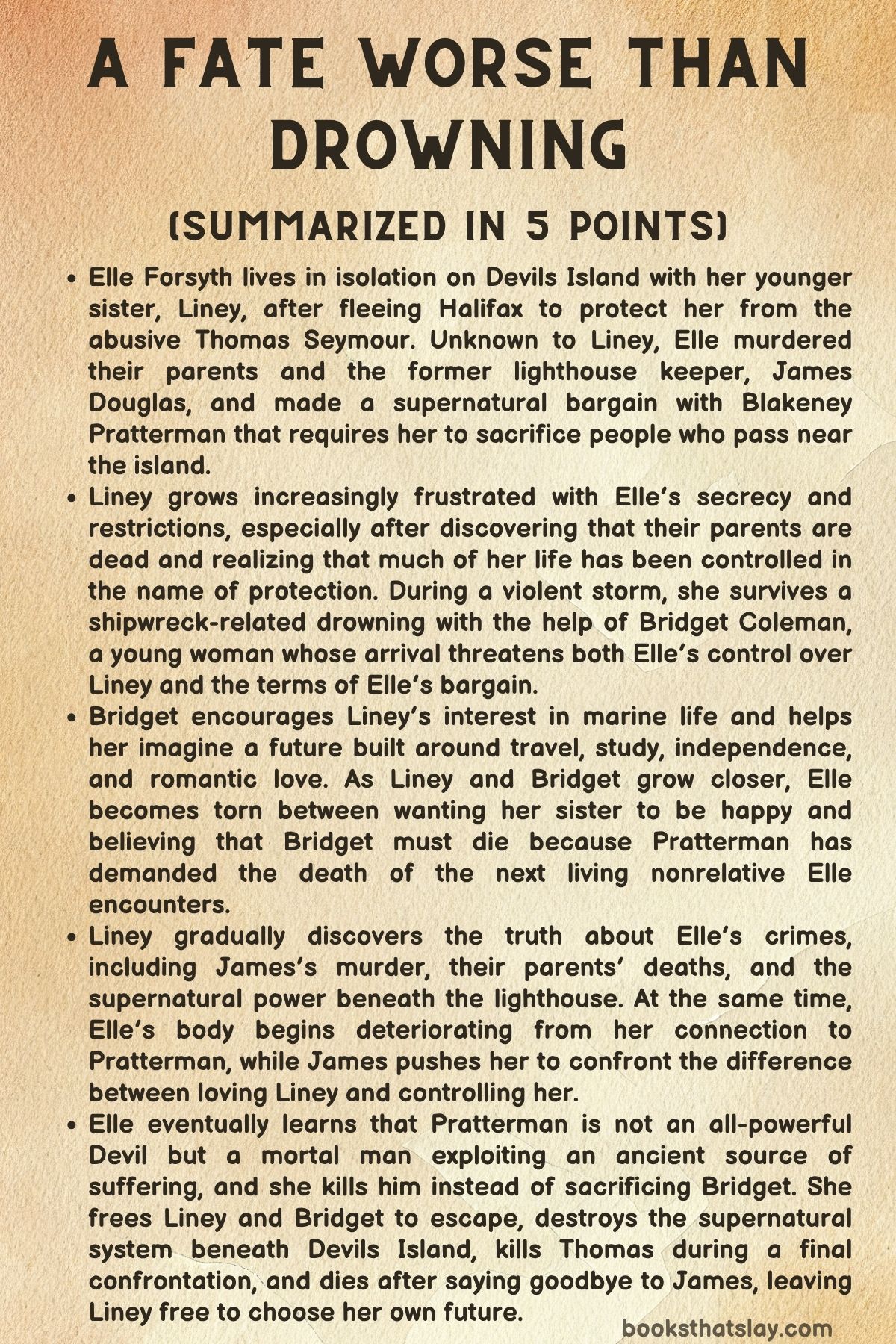
Summary
Mary Eleanor “Elle” Forsyth has spent a year living on Devils Island with her younger sister Caroline, known as Liney, while posing as the lighthouse keeper. Their secluded existence is built upon secrets that Liney does not understand, including the fact that Elle murdered the former lighthouse keeper, James Douglas, whose ghost now remains attached to her.
Elle believes every terrible act she has committed has been necessary to protect Liney. Their former life in Halifax had become unbearable after Thomas Seymour, Elle’s controlling fiancé, abandoned his engagement to her and became engaged to Liney instead, while both families treated the arrangement as socially and financially advantageous.
Liney knows that Elle rescued her from Thomas, but she does not know the full price of that escape. Lonely and restless on the island, she spends much of her time speaking with Chamomile, an apparently imaginary young woman who encourages her to resist Elle’s restrictions and seek independence.
Their fragile routine begins to collapse when Hugh Croxton from the Society for Harbour Safety arrives to investigate why the lighthouse keeper has neither collected wages nor requested repairs. Elle disguises herself as Liney and invents a false identity as Jane Douglas, supposedly the absent keeper’s daughter, managing to convince Croxton to leave.
The visit has consequences because Liney discovers a newspaper notice revealing that her parents are dead. Elle admits that she knew but claims they died accidentally, intensifying Liney’s suspicion that her sister has hidden far more from her than she realizes.
An argument between the sisters ends with Liney suffering a severe asthma attack behind a locked door. Desperate to reach her, Elle uses the unnatural force beneath the lighthouse to break through and then channels its heat carefully enough to help Liney breathe.
Their reconciliation exposes the difference between their ideas of love. Liney wants to become Elle’s equal, while Elle sees her younger sister as someone precious whom she must protect at any cost, even if doing so means controlling her choices.
That obsession is connected to an infernal bargain Elle made with Blakeney Pratterman before fleeing Halifax. Pratterman gave Elle supernatural power, helped her murder her parents through gas poisoning, and enabled the sisters to escape to Devils Island, but Elle was required to sacrifice passing sailors to the strange reservoir beneath the lighthouse.
During a violent storm, Pratterman demands another ship full of victims. He also exploits ambiguous language in their original agreement to suggest that Liney herself might become part of the payment, forcing Elle into a new bargain in which she must destroy the ship and then kill the next living person outside her family whom she sees.
Elle uses the lighthouse’s supernatural power to lure the vessel toward destruction. Liney discovers her sister in the lightroom during the ritual and realizes that whatever is happening is far more disturbing than mechanical failure or ordinary secrecy.
At the same time, Liney finally rejects Chamomile after recognizing that her supposed friend uses the same arguments as Elle: Liney is weak, vulnerable, and incapable of deciding what is best for herself. Chamomile becomes physically violent, forcing Liney to stab her with Elle’s knife before leaving the lighthouse to search for survivors.
Liney is swept into the ocean during the storm and nearly drowns. A dark-haired woman finds her underwater, gives her air, and helps her toward shore, where Elle soon discovers them together.
The survivor is Bridget Coleman. For Elle, Bridget’s arrival is horrifying because she is the first living nonrelative Elle has seen since making her latest bargain, which means Pratterman’s contract appears to require Bridget’s death.
Elle removes Bridget and tells Liney that no survivor ever existed, claiming that oxygen deprivation caused her to hallucinate the entire encounter. Because Liney has recently discovered that Chamomile may not have been what she seemed, she initially doubts herself.
Bridget soon returns, proving Elle lied. Liney secretly helps her and begins forming a close bond with her, discovering that Bridget grew up traveling with her cartographer father and dreams of continuing his work despite the restrictions placed on women.
Bridget treats Liney’s fascination with marine life as a serious intellectual interest rather than a childish hobby. Their conversations allow Liney to imagine a future involving travel, study, curiosity, and personal choice rather than illness and dependence.
Meanwhile, Elle searches for ways to avoid killing Bridget. She briefly decides that she can leave the contract unresolved simply by never personally seeing another stranger, but that plan ends when Liney brings Bridget openly to the lighthouse.
Elle’s body also begins deteriorating because of her connection with Pratterman’s power. Her senses become unreliable, food tastes rotten, she coughs blood, and parts of her own body begin failing, convincing her that the supernatural corruption inside her is becoming fatal.
James increasingly forces Elle to confront the moral consequences of her actions. Although she murdered him, their hostile relationship gradually develops into something more complicated, and Elle finally apologizes for taking his life rather than treating him merely as another necessary casualty.
Liney and Bridget become romantically involved after openly acknowledging their feelings. Bridget offers Liney a vision of life beyond Devils Island in which the two might travel together, with Bridget mapping coastlines and Liney studying marine creatures.
When Elle secretly witnesses them kissing and hears them discussing their future, jealousy and fear overwhelm the progress she has made. She attacks Bridget and attempts to kill her, stopping only when Liney declares that she will no longer consider Elle her sister if Bridget dies.
Elle leaves for Halifax, where she discovers wanted notices accusing her of murdering her parents and kidnapping Liney. She also finds evidence connecting Hugh Croxton to financial misconduct and later encounters both Croxton and Thomas Seymour, confirming that the dangers surrounding the sisters are drawing closer.
Elle summons Pratterman and tries to renegotiate, but he refuses to release Bridget from the bargain. She accepts a supernatural stiletto designed to give her enough power to complete the required killing, even while becoming less certain that she truly wants to do it.
While Elle is gone, Liney and Bridget investigate the lighthouse basement. They discover James Douglas’s skeleton and meet his ghost, who reveals that Elle murdered him shortly after arriving on the island and later concealed his remains.
Liney then finds evidence confirming that Elle deliberately killed their parents. These discoveries destroy her ability to believe that Elle’s violence can always be explained as protection, and she resolves to leave the island with Bridget.
After Elle returns, she still cannot fully confess the truth. She instead descends into the supernatural reservoir beneath the lighthouse, where the souls of the people she has sacrificed remain trapped.
Liney attempts to honor James by carrying his skull back to the lightroom, but supernatural forces drag his ghost away. Chamomile then returns in a more openly monstrous form, kidnaps Bridget, and carries her into the underground realm controlled by Pratterman.
There Elle finally encounters the souls of her parents and recognizes the similarity between her own behavior and that of her mother. Both harmed Liney while claiming necessity and protection as justification.
Pratterman reveals that Bridget has become especially valuable because killing her would cause multiple forms of suffering. His explanation exposes him not as an all-powerful Devil but as a mortal man exploiting an ancient supernatural source of pain for influence and control.
Elle realizes that Pratterman himself was actually the first living nonrelative she saw after making the bargain. Instead of killing Bridget, she sends her back to Liney through a supernatural opening and drives the enchanted stiletto into Pratterman, killing him.
After his death, the trapped souls help Elle destroy the system beneath Devils Island. She returns to the surface, admits her crimes to Liney and Bridget, gives Liney what she needs to leave, and for the first time allows her sister to choose her own future without interference.
Thomas Seymour and Hugh Croxton arrive with armed men. Liney and Bridget escape through the forest while Elle remains behind to destroy the supernatural reservoir and ensure that no one else can inherit Pratterman’s machinery of suffering.
Elle sets the island ablaze by igniting the strange substance beneath the lighthouse. Thomas confronts her, still determined to possess and control her, and she kills him with James’s ordinary kitchen knife rather than relying on Pratterman’s cursed weapon.
Thomas mortally wounds Elle before dying. Elle climbs to the lightroom, where she reveals to James that he was never bound to the lighthouse itself; because she murdered him without sacrificing him, he has always been bound to her.
As Elle dies, she and James are finally able to touch. They confess their love, James passes on, and Elle watches Liney and Bridget escape across the harbor before awakening into an afterlife of her own as the lighthouse’s final ghost, determined that the cycle of exploitation on Devils Island will end with her.
Characters
Mary Eleanor “Elle” Forsyth
Elle is the central moral contradiction of A Fate Worse Than Drowning because she is simultaneously a devoted sister, a murderer, a victim of abuse, a perpetrator of abuse, and a woman desperate to create agency within a society designed to deny it to her. Her strongest quality is her love for Liney, yet that same love becomes the excuse through which she justifies acts that range from deception and isolation to murder.
Her history with Thomas Seymour explains much of her psychology. Thomas controlled, threatened, and humiliated her while the adults around her treated his behavior as an acceptable price for financial security, teaching Elle that conventional authority would never protect either sister when protection conflicted with wealth or reputation.
The proposed asylum commitment deepens this understanding. Elle learns that even her sanity and freedom can be legally redefined when she becomes inconvenient, so she begins to see control as something she must seize before someone else uses it against her.
Her decision to accept Pratterman’s bargain grows from that fear. Elle does not pursue supernatural power simply because she desires power itself; she believes ordinary morality has already failed her, leaving her to choose between submitting to cruelty and becoming capable of greater cruelty herself.
The tragedy is that Elle reproduces the same structure she hates. She lies to Liney, determines where she may go, hides information from her, dismisses her judgment, and repeatedly insists that dangerous decisions are justified because Elle understands the world better.
Her relationship with James gradually breaks down this belief. Because James is literally the man she murdered, his continuing presence prevents her from permanently turning her crimes into abstractions, and his demand for genuine remorse forces her to distinguish regret over consequences from remorse for the person she harmed.
Bridget creates another test because killing her would satisfy Elle’s bargain and preserve the protective system around Liney. Elle initially treats Bridget as a problem to be solved, but Bridget’s kindness toward Liney increasingly forces Elle to see that allowing someone else to love her sister may be part of truly loving her.
Elle’s eventual rebellion against Pratterman therefore represents more than defeating an antagonist. She finally rejects the belief that she must always be the person who decides who should suffer, who should be saved, and what sacrifices other people should make.
Her final decision to let Liney escape is the clearest evidence of change. Elle cannot undo the people she murdered, but she can stop making love synonymous with possession and can give Liney the freedom she once claimed to be protecting.
Caroline “Liney” Forsyth
Liney provides the emotional and philosophical counterweight to Elle throughout A Fate Worse Than Drowning. She begins as someone whose identity has largely been constructed by other people: a sickly younger daughter, an asthma sufferer, a near-drowning victim, a socially acceptable bride, and finally a sister who must remain hidden for her own protection.
Her desire for independence is therefore more complicated than simply wanting to leave an island. Liney wants the authority to interpret her own experiences, make mistakes, decide whom to trust, and determine what kind of future she wants without having every possibility filtered through Elle’s fear.
Chamomile initially appears to represent that independence. She encourages Liney to challenge restrictions and imagine a broader life, but Liney eventually recognizes that Chamomile is also attempting to control her by insisting that obedience to her guidance is the path toward freedom.
That discovery becomes important because Liney realizes that control does not become acceptable merely because the controller claims to oppose someone else’s authority. Her struggle is ultimately about gaining judgment rather than simply changing the person who tells her what to do.
Liney’s relationship with Bridget expands that growth. Bridget listens to her interest in marine life, takes her curiosity seriously, and imagines a future in which Liney is a participant rather than someone who must be supervised.
Her attraction to Bridget also gives Liney a form of intimacy based on mutual choice. This contrasts sharply with Thomas’s assault and with the family’s attempt to treat marriage as an arrangement that could be transferred from one sister to another regardless of either woman’s wishes.
Liney nevertheless makes mistakes while gaining independence. She withholds information about Chamomile, delays escaping because she wants to honor James, and eventually understands that secrecy can endanger loved ones even when the intention behind it appears noble.
This realization brings her closer to understanding Elle without excusing her. Liney recognizes that fear and love can lead someone toward terrible decisions, but she refuses to accept good intentions as sufficient justification for violating another person’s freedom.
Her eventual escape with Bridget is therefore not a rejection of her sister’s existence or love. It is the result of finally accepting the freedom Elle herself struggled to give her: the right to walk toward an uncertain future rather than remain inside a supposedly safe cage.
James Douglas
James Douglas begins the novel as the ghost of Elle’s first known victim on Devils Island, but he gradually becomes one of the story’s strongest moral voices. His presence ensures that murder cannot remain merely a past event because Elle must live daily beside the person whose future she deliberately ended.
He initially appears bitter, sarcastic, and critical, which is understandable given the circumstances of his death. Yet he repeatedly helps Liney and even assists Elle in moments of danger, revealing that he has resisted allowing his murder to define every part of his character.
James’s relationship with Elle develops through an unusual combination of anger, familiarity, pity, and eventual affection. He understands her motives more completely than almost anyone because he witnesses both her cruelty and the ordinary tenderness with which she cares for Liney.
His demand for an apology is especially significant. James does not want Elle merely to regret being haunted or feel sorry about the inconvenience her crime caused; he wants her to acknowledge that he possessed a life, relationships, hopes, work, and a future she had no right to take.
His refusal of Pratterman’s earlier supernatural offer also establishes James as a contrast to Elle. Both experienced loss and vulnerability, but James refused to surrender moral responsibility to the promise of unnatural power.
At the same time, James does not treat morality as a simple division between good and evil. He eventually recognizes that Elle is frightened and damaged rather than incapable of change, while still refusing to pretend that suffering excuses what she did.
His growing love for Elle is intentionally uncomfortable because it never erases the fact that she murdered him. Instead, the relationship develops around recognition, remorse, and the possibility that a victim can choose what emotional relationship to have with the person who harmed him without that choice retroactively absolving the harm.
By the end, James becomes essential to Elle’s transformation. His willingness to believe that she can become better gives her something very different from Pratterman’s bargains: hope without coercion.
Bridget Coleman
Bridget enters the story as an apparent impossibility, surviving a shipwreck that should almost certainly have killed her and then rescuing Liney from drowning. Her mysterious survival initially makes Elle suspect that she is a supernatural trap, but Bridget’s importance ultimately comes from what she represents in Liney’s emotional development.
Bridget has already experienced a wider world than Liney. Raised by a cartographer father who traveled with her, she possesses ambitions, practical skills, intellectual curiosity, and a belief that a woman may build a life beyond the roles society has prepared for her.
Her interest in Liney is notable because she does not approach her primarily as someone fragile. Bridget asks about her interests, dreams, childhood, and scientific curiosity, allowing Liney to experience attention that is not organized around illness or protection.
Their romance is therefore connected to identity as much as attraction. Bridget creates room for Liney to imagine herself as a researcher, traveler, partner, and decision-maker rather than simply someone rescued by her older sister.
Bridget also possesses a strong ethical independence. She refuses to steal the sisters’ boat even when stranded, refuses to abandon Liney when escape becomes possible, and continues trying to understand Elle even after Elle becomes threatening.
Her confrontation with Elle exposes the difference between possessive and nonpossessive love. Bridget wants Liney to come with her, but she repeatedly makes clear that the decision must belong to Liney.
Even after Elle tries to kill her, Bridget does not demand that Liney sever every feeling for her sister. She instead supports Liney while allowing her to reach conclusions through evidence and personal judgment.
Bridget thus becomes both a romantic partner and evidence that care does not require ownership. Her relationship with Liney offers the possibility of companionship in which protection, affection, and freedom can exist together.
Blakeney Pratterman
Blakeney Pratterman is frightening precisely because he initially presents himself as reasonable. Rather than confronting Elle as an obvious monster, he behaves like a courteous gentleman who listens carefully to her suffering and offers a practical solution when every legitimate authority has failed her.
His method is psychological exploitation. He identifies what Elle values most, recognizes that she considers her own life expendable beside Liney’s safety, and designs bargains whose ambiguous wording turns that devotion into a permanent source of leverage.
Pratterman therefore represents coercion disguised as consent. Elle technically agrees to his terms, but he controls the information, defines the available choices, exploits her desperation, and repeatedly changes the practical meaning of their arrangement once she is trapped inside it.
His power also depends heavily on belief. Elle assumes he possesses nearly divine authority and structures years of murder around that assumption, only to discover that he is a mortal man using an ancient reservoir of suffering.
That revelation changes the meaning of his villainy. Pratterman is not an unavoidable embodiment of cosmic evil but a person who has built influence by convincing vulnerable people that his authority is greater and more permanent than it really is.
His ambition to create expanding networks of suffering further reveals his view of human pain as a resource. Death, grief, guilt, fear, and betrayal matter to him only because they can be converted into greater control.
Pratterman’s eventual defeat occurs when Elle finally interprets his rules for herself rather than accepting his interpretation of them. Once his appearance as an absolute authority collapses, so does much of the structure that allowed him to dominate her.
Thomas Seymour
Thomas Seymour represents the ordinary human violence that drives Elle toward extraordinary violence. Long before supernatural forces enter her life, Thomas demonstrates how easily charm, wealth, gender, and social respectability can conceal coercion.
His treatment of Elle is controlling and humiliating, yet her family continues supporting the marriage because of the advantages attached to the Seymour name. This teaches Elle that public respectability offers no guarantee of private decency.
Thomas’s assault on Liney reveals an even darker level of entitlement. When witnesses create the possibility of scandal, responsibility is transferred onto Liney, and the solution becomes changing the engagement rather than holding Thomas accountable.
He therefore benefits from a social structure that repeatedly interprets male aggression as something women must accommodate. Both sisters are expected to reorganize their lives around his behavior while he experiences few meaningful consequences.
Thomas also mirrors Pratterman in important ways. Both men treat vulnerability as opportunity, assume that other people can be controlled through fear, and attempt to convert personal suffering into greater authority.
His final confrontation with Elle demonstrates that he has learned almost nothing. Even as the island burns and Pratterman’s influence collapses, Thomas continues imagining possession and control as natural relationships between himself and Elle.
Elle’s decision to kill him with an ordinary kitchen knife rather than the supernatural weapon matters symbolically. Thomas does not require infernal power to become dangerous, and defeating him does not require Elle to remain inside Pratterman’s system.
Chamomile
Chamomile initially functions as Liney’s imagined friend, offering companionship during the isolation of Devils Island and encouraging her to resist Elle’s control. Because her advice often corresponds with Liney’s legitimate frustrations, she initially appears to be a liberating influence.
Gradually, however, Chamomile reveals the same paternalistic logic that Liney resents in Elle. She insists that Liney should trust her judgment, remain passive when convenient, and accept that someone else understands her limitations better than she does.
This similarity becomes the clue that allows Liney to question her. Chamomile demonstrates that language about independence can itself become manipulative when it is used to pressure someone toward choices they have not freely made.
Her later physical transformation confirms that she is connected to the supernatural machinery surrounding Devils Island. The companion Liney believed she created from loneliness was actually part of a larger effort to influence her emotions and decisions.
Chamomile also exploits Liney’s fear of abandonment. She reacts possessively when Bridget becomes important, making her relationship with Liney resemble the controlling forms of attachment that the novel repeatedly criticizes.
Her final role in abducting Bridget removes the last appearance of friendship. She becomes an instrument used to deliver suffering to Pratterman, showing how carefully emotional manipulation has been embedded in the supernatural system.
Hugh Croxton
Hugh Croxton first appears as a relatively ordinary bureaucratic threat because his investigation risks exposing Elle’s false identity and the truth about James Douglas. His questions force Elle to improvise a believable explanation for why the lighthouse keeper has disappeared.
Later discoveries reveal that Croxton is far from an innocent official. Elle learns that wages associated with James have already been collected with Croxton’s approval, suggesting that his visit to the island is partly motivated by the need to conceal his own wrongdoing.
His association with Thomas and Pratterman broadens his importance. Croxton belongs to the network of respectable institutions, commercial interests, and private corruption that have helped powerful men use suffering for their own advantage.
Unlike Pratterman, he does not require supernatural abilities to participate in exploitation. His usefulness lies in paperwork, professional access, deception, and the authority granted by an official position.
Croxton therefore reinforces one of the story’s darker ideas: corrupt systems survive not only because of obvious villains but also because ordinary people find ways to profit from them. His role connects the supernatural crimes on Devils Island to the financial and institutional corruption of the mainland.
Mary Forsyth
Mary Forsyth, Elle and Liney’s mother, is largely known through memory and the consequences of her choices. She represents a woman who has adapted so thoroughly to a patriarchal social order that she begins enforcing its cruelties against her own daughters.
Her response to Elle’s fear of Thomas is especially revealing. Rather than treating abuse as evidence that the marriage should end, she communicates the belief that husbands inevitably hurt wives and that women must accept this as part of respectable life.
Mary is therefore both victim and participant. She has likely learned submission through her own experiences, yet instead of using that knowledge to protect her daughters, she teaches them to survive by surrendering.
Elle eventually recognizes an uncomfortable similarity between them. Mary hurt her children while claiming social necessity demanded it, while Elle later hurts Liney while claiming safety demands the same thing.
This parallel does not make their actions identical, but it demonstrates how abusive patterns can survive by changing their justification. The language may shift from marriage and duty to protection and survival while the underlying denial of another person’s agency remains.
Mary’s presence among the trapped souls also complicates Elle’s hatred. Elle is forced to acknowledge that her mother helped preserve a cruel system while also being constrained by it herself, making simple condemnation impossible.
Charles Forsyth
Charles Forsyth embodies the financial and patriarchal interests that shape the sisters’ early lives. His priorities are connected to family status, shipbuilding wealth, and alliances with the Seymour family, making his daughters’ personal safety secondary to economic and social advantage.
His willingness to consider committing Elle to an asylum is one of the clearest examples of this worldview. When Elle threatens the family’s plans, institutional confinement becomes an acceptable method for removing her resistance.
Charles also helps establish the larger connection between private family decisions and wider systems of exploitation. His business interests are linked to wartime profit, shipping, coal, and eventually the network surrounding Pratterman.
Through him, the book suggests that the Forsyth family’s domestic cruelty cannot be separated completely from the economic structures that sustain its power. The same confidence that permits men to treat women as assets also permits them to treat workers, ships, wars, and suffering as opportunities for profit.
Elle later recognizes that she has inherited some of her father’s arrogance. Her assumption that she alone can calculate acceptable losses resembles Charles’s belief that his plans justify controlling the people whose lives depend upon him.
Themes
Protection, Possession, and the Loss of Agency
Protection repeatedly becomes dangerous when one person claims the right to define another person’s needs. Elle genuinely loves Liney and has real reasons to fear what may happen to her, yet she gradually turns that fear into an argument for restricting information, movement, relationships, and personal choice.
The danger lies not in caring about someone’s safety but in assuming that love grants authority over that person. Elle believes Liney’s vulnerability justifies secrecy because she interprets independence primarily as exposure to danger rather than as an essential part of adulthood.
Chamomile strengthens this theme by using similar reasoning from the opposite direction. Although she encourages rebellion, she also tells Liney what she should believe and attempts to keep her dependent on a single guiding voice.
Bridget provides a different model. She offers possibilities, expresses her desires, and imagines a future with Liney, but repeatedly leaves the final decision to her.
That distinction becomes central to Liney’s maturation. She does not simply need protection from dangerous people; she needs the freedom to evaluate danger herself.
By the conclusion of A Fate Worse Than Drowning, Elle’s greatest act of love is no longer rescuing Liney physically. It is allowing her to leave, accepting that genuine care sometimes requires surrendering the power to determine what another person will do.
Cycles of Abuse and the Reproduction of Control
People who suffer under controlling systems can resist those systems while unconsciously reproducing their methods. Elle spends much of her life fighting adults who dismiss her fears, Thomas who treats women as possessions, and Pratterman who turns desperation into obedience.
Yet Elle eventually adopts many of the same habits. She withholds information, manipulates circumstances, decides which truths Liney can tolerate, and assumes that good intentions make unilateral decisions acceptable.
Her eventual recognition of the similarity between herself and her mother is crucial. Mary accepts that women will suffer within marriage and demands that her daughters accommodate that reality, while Elle accepts that danger is unavoidable and demands that Liney accommodate isolation.
Their justifications differ, but both deny Liney the authority to determine what risks she is willing to accept. The parallel demonstrates how damaging behavior can survive even when the person repeating it sincerely believes she is rejecting the previous generation’s values.
Pratterman operates according to the same cycle on a larger scale. He exploits victims until some of them become participants in producing suffering for others.
Breaking the cycle therefore requires more than defeating an individual enemy. Elle must recognize the pattern within herself, accept responsibility without hiding behind her own victimhood, and stop requiring new victims to pay for the injuries that shaped her.
Guilt, Responsibility, and the Possibility of Redemption
The story distinguishes carefully between having understandable motives and being morally innocent. Elle’s history explains why she becomes desperate enough to murder, bargain with Pratterman, and control Liney, but the narrative repeatedly refuses to treat explanation as absolution.
James is essential to this theme because he gives Elle’s guilt a human face. She cannot describe his murder merely as a necessary step toward safety when the dead man remains present to remind her that he possessed a life completely independent of her needs.
Her apology to James becomes meaningful only when she acknowledges what she took from him. Regretting that a murder causes emotional pain is different from recognizing that the victim had a future the killer had no right to destroy.
The same principle applies to her relationship with Liney. Redemption does not come when Liney instantly forgives everything, nor does Elle’s final sacrifice erase the people she killed.
Instead, moral change begins when Elle stops demanding that other people suffer so that she can preserve the identity of protector. She releases Bridget, turns against Pratterman, tells Liney the truth, frees the trapped souls, and allows her sister to leave.
The ending therefore presents redemption as action rather than cancellation. Elle cannot become innocent again, but she can become someone who finally refuses to continue the harm she once believed was necessary.
Freedom, Identity, and the Right to Choose a Future
Nearly every major character confronts some version of a predetermined identity. Elle is expected to become Thomas’s wife, Liney is treated as a fragile daughter who must eventually marry appropriately, Bridget faces resistance to becoming an independent cartographer, and James is reduced by death to the identity of Elle’s victim.
Liney’s development most clearly expresses the struggle against these assigned roles. Her asthma, childhood drowning, gender, sexuality, and family history are repeatedly used by others to explain what she cannot do.
Her interest in marine life becomes especially important because it represents a desire that belongs entirely to her. It is not connected to marriage, family duty, social standing, or Elle’s protection.
Bridget’s willingness to take that interest seriously gives Liney permission to imagine a life organized around curiosity rather than fear. Their possible future of traveling coastlines together therefore represents much more than romance.
Elle experiences a related uncertainty when wearing masculine disguises. She discovers that freedom from conventional femininity feels comfortable without necessarily meaning that she wishes to become a man, revealing her desire for an identity that does not require fitting neatly into prescribed categories.
The conclusion preserves uncertainty rather than replacing one fixed destiny with another. Liney and Bridget do not know exactly where they are going, and that uncertainty is the point: for the first time, the future belongs to them to choose.