A Dawn of Onyx Summary, Characters and Themes
A Dawn of Onyx by Kate Golden introduces readers to a world where kingdoms teeter on the edge of war, and a young woman’s hidden power becomes the key to survival. The story follows Arwen, a gifted healer whose life is shattered when she is torn from her home and thrust into the clutches of the Onyx Kingdom.
Facing betrayal, grief, and dangerous new alliances, she must navigate a path between loyalty and survival. As truths about her heritage emerge, Arwen discovers that her destiny is entwined with forces far greater than her own, setting her on a journey of courage and sacrifice.
Summary
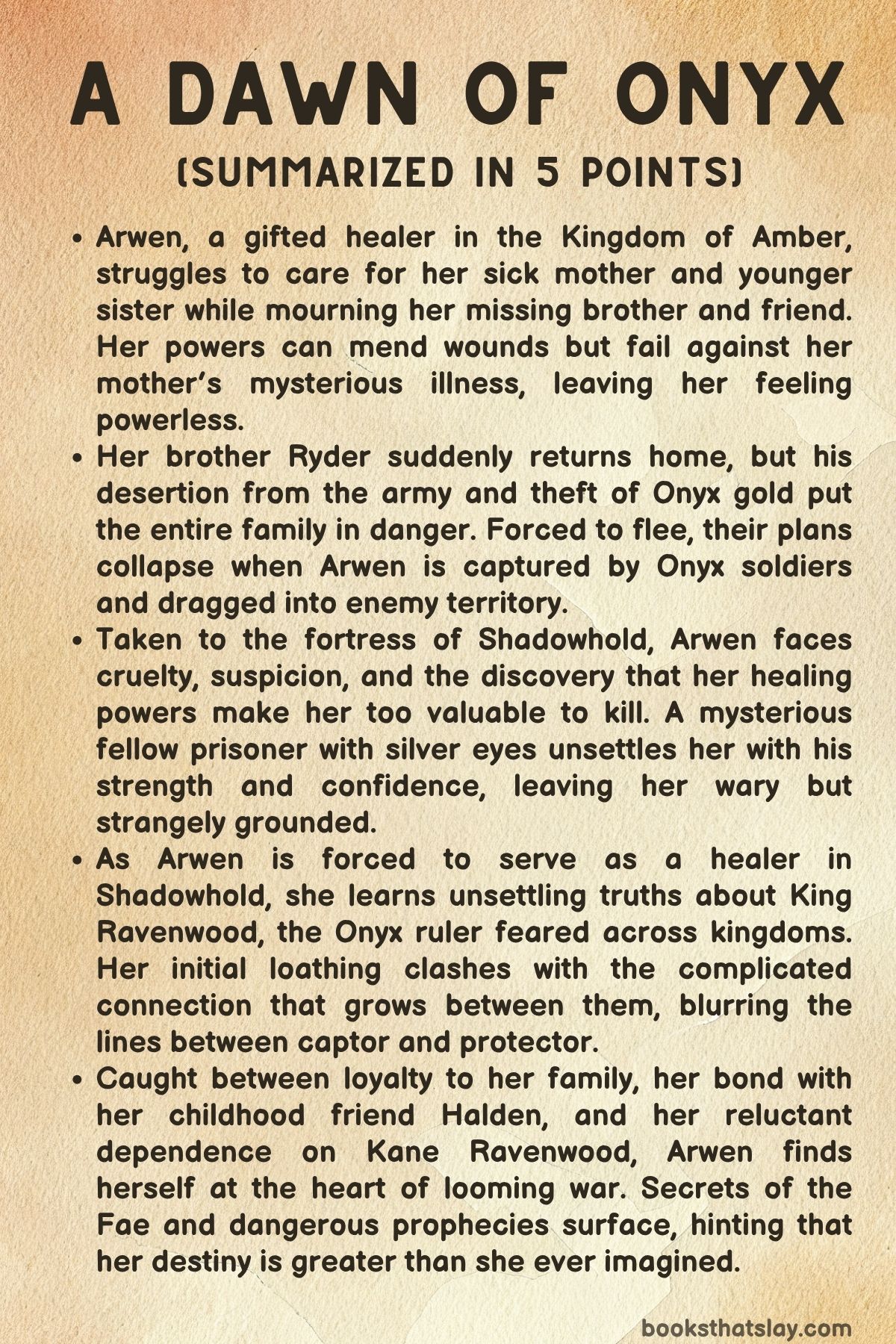
Arwen, a young healer from the Kingdom of Amber, lives under the shadow of war. Her days are consumed with tending to patients, caring for her sick mother, and looking after her younger sister Leigh.
She struggles with the presumed loss of her brother Ryder and her friend Halden, both taken by the army. Despite her rare powers, Arwen cannot cure her mother’s illness, and poverty and fear weigh heavily on her family.
One evening, Ryder returns—wounded, bloodied, and desperate. He reveals that he deserted after an Onyx ambush destroyed his battalion and that he stole a bag of Onyx gold.
Certain he has led enemy soldiers to their door, Ryder urges the family to flee toward the Garnet Kingdom.
As they prepare to escape, Arwen runs back to fetch her mother’s medicine and finds their house overrun by Onyx soldiers. Captured by Lieutenant Bert, she saves herself by exposing her healing gift.
Instead of killing her, the soldiers take her prisoner, transporting her to the fortress of Shadowhold on the back of a dragon. There she is nearly claimed by Bert but is spared when she is thrown into the dungeon.
In her cell, she meets a mysterious prisoner with piercing silver eyes who unsettles her with both his arrogance and his strange kindness. Though he disappears, she later encounters him again when he arrives gravely injured, leaving her with cryptic words before vanishing once more.
Arwen’s forced service as a healer in Shadowhold deepens her dread, but she also gains fragments of information about the Onyx king and the war. Her attempts to escape nearly succeed until Bert intercepts her.
Just as she faces assault, the stranger reappears, only to be revealed as Kane Ravenwood, the feared king of Onyx. Furious at Bert’s actions, he punishes him and spares Arwen.
Though she feels betrayed by Kane’s deception, she strikes a bargain for her family’s safety and agrees to remain as healer in the keep.
Her captivity continues as she navigates a tense relationship with Kane. He oscillates between cruelty and unexpected tenderness, leaving her conflicted.
Meanwhile, Arwen learns more about the shifting alliances and prophecies driving the war. During a council meeting, she proposes a strategy to minimize bloodshed, surprising the nobles.
But her world collapses again when Amber infiltrators are captured, among them Halden. He claims Arwen as his betrothed to save his life, provoking Kane’s fury.
Though Halden later admits he exaggerated their bond, he convinces Arwen to aid his escape during a banquet. That night, she discovers Kane’s hidden vulnerability when an explosion traps them together.
In the intimacy of confinement, Kane reveals truths about the Fae, their ruined realm, and his father Lazarus. He insists Halden is not who he seems and exposes the deeper forces at play in the war.
Conflicted and overwhelmed, Arwen wrestles with her loyalty to Halden and her dangerous attraction to Kane. Their connection deepens, culminating in confessions of love.
Yet before their bond can solidify, the fortress is attacked by Amber and Garnet forces allied with Lazarus. Amid chaos, Arwen searches desperately for her sister.
Kane joins her, and together they face betrayal from Halden, who reappears with soldiers. Kane’s brutal power overcomes them, and he unleashes terrifying shadow magic.
As the battle rages, Kane reveals his true form—a dragon. He clashes with Lazarus, who transforms into a wyvern, while Arwen discovers her own protective light powers.
Lazarus exposes her as the last full-blooded Fae, destined to destroy him at the cost of her life. Before he can kill her, Kane intervenes but suffers devastating wounds.
In the desperate retreat, Arwen and her family escape to a ship with allies, but tragedy strikes when her mother is fatally shot. Despite her healing powers, Arwen cannot save her, and grief drives her to release a catastrophic surge of light that destroys enemy forces.
Exhausted, she collapses, awakening later aboard the ship with Leigh, Ryder, and Mari. Kane survives his battle with Lazarus and admits he knew of her destiny all along.
Though he begs her forgiveness, Arwen feels betrayed and resolves to fulfill the prophecy. She vows to find the Blade of the Sun and face Lazarus, even if it means her death, severing her fragile bond with Kane.
As the ship sails toward Citrine, Arwen embraces the truth of her identity and her role in the war. She steels herself to fight for her family and the future of the kingdoms, determined to face the prophecy head-on, no matter the cost.
The journey ahead promises sacrifice, betrayal, and love tested against the weight of destiny.
Characters
Arwen
Arwen is the central figure in A Dawn of Onyx, a young healer burdened by responsibility and grief. Defined by her selflessness, she dedicates herself to caring for her ailing mother, protecting her younger sister Leigh, and aiding her war-torn community.
Despite her formidable healing powers, she constantly struggles with their limits, particularly her inability to save her mother from a mysterious illness. Her journey is one of resilience—thrust from her familiar life into captivity, she confronts both external threats and the unraveling truth of her own identity.
Throughout her imprisonment and reluctant alliance with Kane Ravenwood, Arwen’s character balances defiance and vulnerability. She evolves from a frightened girl desperate to protect her family into a determined young woman who accepts the prophecy of her destiny as the last full-blooded Fae.
Her strength lies not only in her magic but in her moral compass, her empathy, and her ability to adapt even as her heart is torn between loyalty, love, and survival.
Kane Ravenwood
Kane Ravenwood, king of the Onyx Kingdom, is both a ruthless ruler and a man shaped by burdens heavier than his crown. Initially disguised as a fellow prisoner, he reveals his duplicity only when necessity forces him to step into his true role.
His character is complex—at times cruel and commanding, at others unexpectedly tender. Kane’s relationship with Arwen highlights his dual nature: he manipulates and coerces her into service, yet simultaneously protects and confides in her.
Beneath his harsh exterior lies a man deeply scarred by his lineage as Lazarus’ son, cursed with shadow magic and the monstrous ability to transform into a dragon. His motivations extend beyond conquest; he fights to shield his people from his father’s wrath while carrying the weight of prophecy.
Kane embodies contradiction: a feared king who inspires both terror and loyalty, and a man who cannot deny his growing love for Arwen even as fate sets them on opposing paths.
Ryder
Ryder, Arwen’s elder brother, serves as both a catalyst and a cautionary figure. His return from the battlefield sets the entire chain of events in motion, as his desertion and theft of Onyx gold bring danger directly to their doorstep.
Despite his flawed choices, Ryder’s actions spring from desperation to protect his family and escape the horrors of war. He is haunted by survivor’s guilt and torn between his love for his sisters and the consequences of his recklessness.
Ryder’s character represents the toll of war on ordinary soldiers—loyal, brave, but often forced into impossible decisions. While not as central as Arwen or Kane, his presence continually underscores the fragility of family bonds under the shadow of conflict.
Leigh
Leigh, the youngest in Arwen’s family, symbolizes innocence and hope amidst devastation. As a child caught in the midst of war and loss, she embodies what Arwen fights hardest to protect.
Leigh’s vulnerability highlights Arwen’s nurturing role, yet she is not without her own quiet resilience. Her disappearance during the siege of Siren’s Cove underscores the peril faced by the powerless, but her survival offers Arwen a reason to endure and continue her fight.
Leigh’s character is a reminder of the cost of war on the young and the way familial love can anchor those caught in chaos.
Halden
Halden, once Arwen’s childhood friend and romantic companion, complicates her loyalties and emotions. His reappearance as a prisoner rekindles old bonds but also exposes his manipulative tendencies.
While he appeals to Arwen’s memories and trust, his desperation for survival often overrides his sincerity. His willingness to use their past relationship as leverage for escape paints him as pragmatic but untrustworthy.
Halden represents the pull of the familiar, a tie to Arwen’s old life before captivity and prophecy, yet his darker choices reveal him as both a victim of war and a man shaped by opportunism. His rivalry with Kane becomes more than political—it is deeply personal, with Arwen caught between the two men’s competing truths.
Lieutenant Bert
Lieutenant Bert embodies the cruelty of unchecked power within the Onyx army. From the moment of Arwen’s capture, his leering menace and abusive intentions make him a stark contrast to Kane’s calculated restraint.
Bert is a predator whose authority allows him to exploit others without consequence—until Kane asserts his dominance. His brutality emphasizes the dangers Arwen faces in captivity and the fragility of her position as a prisoner.
Though ultimately punished, Bert serves as a reminder of the human monstrosities within war, ones as threatening as any dragon or prophecy.
Mari
Mari brings light into the grim atmosphere of Shadowhold. Talkative, curious, and friendly, she becomes an unexpected source of companionship for Arwen.
Her role as a confidante and provider of gossip offers Arwen much-needed grounding and glimpses into the human side of life within the Onyx stronghold. Mari represents the ordinary people caught in the politics of kingdoms, neither wholly villainous nor heroic but trying to survive.
Her warmth and courage in aiding Arwen’s secret meetings reflect her loyalty and underline the possibility of friendship even in the unlikeliest places.
Lazarus
Lazarus, the last true Fae and Kane’s father, looms as the ultimate antagonist in A Dawn of Onyx. His immense power, ability to transform into a monstrous wyvern, and manipulation of kingdoms mark him as nearly unstoppable.
Yet his greatest cruelty lies in his control over fate—his existence ties directly to Arwen’s destiny, forcing her into a prophecy where her victory means her death. As a father, he is abusive and domineering, shaping Kane into the weapon he never wanted to be.
As a villain, he is both terrifyingly supernatural and chillingly personal, embodying generational tyranny, greed, and corruption. Lazarus represents the devastating legacy of power unchecked, setting the stage for the central conflict of the prophecy and Arwen’s ultimate choice.
Themes
Grief and Loss
In A Dawn of Onyx, grief is not presented as a fleeting emotional state but as a constant force shaping Arwen’s existence. The weight of losing her brother Ryder and friend Halden to war, combined with her mother’s slow decline, creates a suffocating sense of inevitability that dominates her worldview.
The act of healing others becomes her attempt to resist helplessness, but it also drains her further, forcing her to confront the limits of her power. This tension between her extraordinary gift and its inability to save those closest to her intensifies her despair.
When her mother ultimately dies, that moment crystallizes the reality that grief is not something she can overcome through strength or skill—it is a condition of her life. Arwen’s relationship with grief evolves from denial and clinging to hope, into bitter acceptance and the channeling of pain into resilience.
The theme of loss extends beyond personal bereavement into a broader portrayal of war’s brutality—villages are devastated, families fractured, and entire kingdoms scarred. Through Arwen’s journey, the novel presents grief as both an intimate wound and a collective burden, one that cannot be avoided but must be carried forward.
Her suffering becomes a transformative force, pushing her toward acceptance of her identity and destiny, even when those truths threaten to destroy her.
Power and Corruption
The narrative constantly questions the nature of power, showing how it both protects and corrupts. Kane Ravenwood epitomizes this contradiction: outwardly ruthless, feared by his kingdom and enemies alike, yet privately vulnerable in his interactions with Arwen.
His use of deception—hiding his identity and manipulating her through threats against her family—exposes the darker edges of power as a tool of control. At the same time, Arwen’s own healing gift demonstrates how power can be both a blessing and a curse.
Though it saves lives, it condemns her to captivity when exposed to the Onyx soldiers. Later, her discovery of light-based Fae powers elevates the stakes further, shifting her from a passive victim of power structures to their center.
What makes this theme particularly compelling is how power is never static. It is constantly negotiated through fear, loyalty, love, and betrayal.
Kane is both protector and oppressor; Arwen is both prisoner and prophesied savior. The corruption lies not only in tyrannical rulers or violent battles but also in the small compromises characters make to survive, whether Halden exaggerating ties to Arwen to escape execution or Arwen feigning submission to secure her family’s safety.
Ultimately, the book presents power as inescapably double-edged—it can forge bonds of protection but just as easily breed manipulation and cruelty.
Identity and Destiny
Arwen’s journey is deeply tied to the discovery of her true self, a progression from ordinary healer to the last full-blooded Fae, burdened by a prophecy. This transformation is less about sudden revelation and more about the gradual peeling back of layers—her fears, loyalties, and love are constantly tested until she is forced to confront the truth of who she is.
The question of destiny versus choice permeates her interactions with Kane, Halden, and her family. At every stage, she resists being reduced to a role—whether as prisoner, pawn, or prophesied savior—yet her fate pulls her forward regardless.
The prophecy does not simply assign her a task but becomes a reflection of the internal conflict between duty and desire. Her powers, once a source of exhaustion and limitation, become the very marker of her unique identity, redefining her sense of worth.
The theme is sharpened by her ultimate vow to embrace the prophecy even at the cost of her life, marking destiny as something simultaneously imposed and accepted. By the end, Arwen’s identity is not a fixed state but a hard-won realization that the person she becomes is inseparable from the sacrifices she must endure.
War and Survival
The shadow of war saturates every aspect of A Dawn of Onyx, not only in the battlefield clashes but in the day-to-day existence of the characters. The war with the Onyx Kingdom reduces villages to poverty, drains families of their children, and poisons every relationship with suspicion and fear.
For Arwen, survival is as much about enduring grief and captivity as it is about physical escape from soldiers and dragons. The political strategies debated at Shadowhold, such as blockading the Midnight Pass, highlight how war is waged not only with weapons but with cunning, resources, and exploitation of the land.
The soldiers embody survival at its most brutal—driven by loyalty, coercion, or greed—while civilians like Arwen’s family experience survival as desperate attempts to cling to normalcy despite looming destruction. The climax at Siren’s Cove magnifies the theme, turning survival into chaos as castles burn, dragons clash, and families are torn apart.
Importantly, survival here is never just individual but collective. Arwen’s choices are always tethered to her responsibility for her family and her people, underlining how war demands sacrifices that extend far beyond the battlefield.
Love, Betrayal, and Trust
The relationships in the book are riddled with contradictions, making love as dangerous as it is necessary. Arwen’s bond with Kane is a study in tension—her captor becomes her protector, her tormentor becomes her confidant, and her enemy becomes the man she both despises and desires.
Their growing intimacy blurs boundaries of loyalty, leaving her torn between her hatred of his manipulation and her recognition of his vulnerability. Betrayal sharpens this tension further: Halden’s false declaration of betrothal, Kane’s initial deception of his identity, and even Arwen’s own near-betrayal by plotting escape with Halden.
Trust becomes a currency more valuable than gold, constantly given and withdrawn. What elevates this theme is its refusal to paint love as redemptive or betrayal as wholly destructive.
Instead, both coexist, creating a fragile space where relationships are tested under the pressure of war and prophecy. Love, whether for family, friends, or even an enemy-turned-ally, is the force that both drives Arwen forward and leaves her most vulnerable.
In the end, the theme highlights how trust is never absolute; it is provisional, fragile, and always bound to the possibility of loss.