A Devious Brother Summary, Characters and Themes
A Devious Brother by Day Leitao is a fantasy novel filled with fae courts, dangerous magic, shifting loyalties, and a growing threat that refuses to stay buried. The story follows Astra, a powerful young woman bound to shadow and blood magic, as she faces the return of the Witch King—an ancient force believed long dead.
Alongside Marlak, the troubled Crystal Court king, and Azur, a mysterious transcender with hidden ties to darkness, Astra must survive political betrayal, cursed servitude, and brutal battles while trying to stop a rising evil from reclaiming the world. It’s the 3rd book in the Remnants of the Fallen Kingdom series.
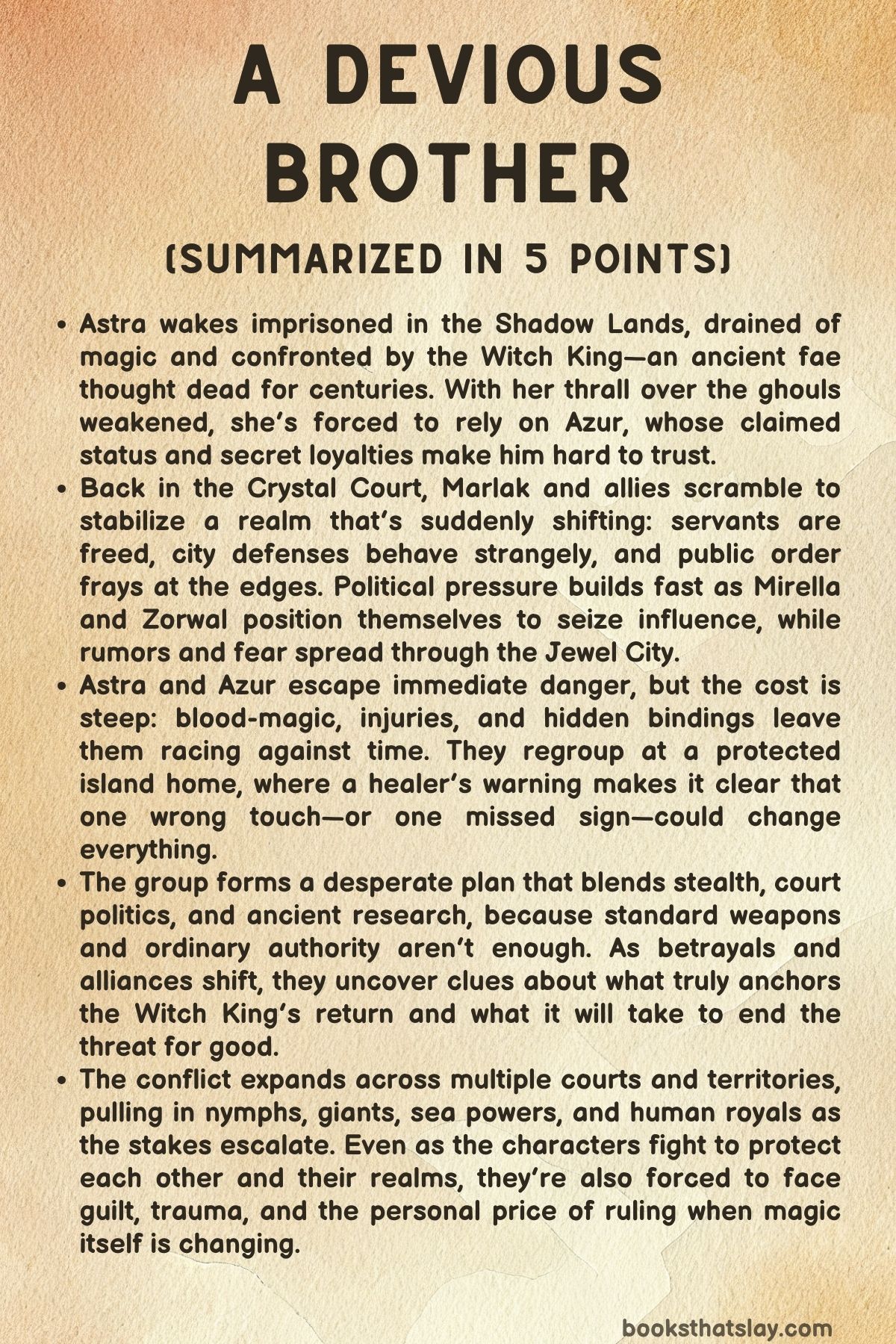
Summary
Astra awakens imprisoned inside a Tiurian-built cave, drained from overusing her magic. The space is crowded with mud-bodied ghouls, yet Astra realizes she can no longer reach their minds the way she once could.
Something about the presence nearby suppresses her power. Standing before her is the Witch King, an ancient fae ruler thought to have been killed three hundred years ago.
His survival changes everything.
Azur is beside her, calm in a way that unsettles Astra. He claims to be the king of the Nether Court and admits his family once served the Witch King.
Even worse, he believes the Crystal Court must be destroyed. Astra cannot decide whether Azur is an ally or a threat.
The Witch King toys with them, promising that whoever frees him first will live. Azur insists they need time to recover their strength before breaking the enchantment binding the Witch King to the cave.
Astra and Azur are led deeper into the tunnels, where a glowing barrier of thin filaments restrains the Witch King’s true freedom. Astra pretends the barrier burns her, buying time.
Azur hints at another way out—his rare ability to transcend through space.
The Witch King recognizes Azur’s gift immediately. Azur bows and offers service, terrifying Astra because Azur cannot lie.
Astra begins to suspect Azur may be trapped by something deeper than choice.
Back at the Crystal Castle, Marlak panics when Astra vanishes. His uncontrolled ice magic spreads through the halls as Lidiane tries to sense Astra’s location.
She concludes Astra and Azur are likely in the Shadow Lands and may be forced to wait until sunrise to travel safely.
Elsewhere, Mirella—the missing Crystal Court princess—travels with Zorwal, a dangerous figure who encourages her ambition. Mirella is shaken by guilt over her father’s death, yet Zorwal pushes her toward claiming power.
He binds Tarlia into servitude and prepares to use chaos in the Jewel City to shift the balance of rule.
Renel, stripped of authority and separated from his guards, arrives at the Jewel City gates and finds the situation near collapse. Lower fae are trapped inside, guards refuse his orders, and violence is moments away.
Renel prepares to rely on Ferer’s help despite his pride.
In the cave prison, Astra and Azur attempt a desperate plan. Azur hopes Astra can escape while he distracts the Witch King, because the Witch King is slowly absorbing Azur’s magic through an inherited binding oath.
Azur attacks first, but the Witch King counters instantly and stabs him through the chest.
Astra refuses to run. She summons Downshadow, the blade that once beheaded the Witch King, and decapitates him again.
In panic and instinct, she drinks blood from the severed neck and also tastes Azur’s blood from the dagger. Power floods her, and she transcends them away, landing on a small river island where she once camped with Marlak.
Azur survives, furious. He explains that dying was meant to prevent the Witch King from using him as a puppet.
Astra argues she bought them time, but Azur warns that beheading does not truly kill the Witch King.
At the Jewel City, Marlak arrives in time to stop disaster. He freezes guards, shields escaping lower fae, and declares himself the rightful king.
Mirella confronts him publicly, threatening him with bloodpuppets hunting his life. Marlak retreats using illusions, then senses Astra calling through their bond.
He rushes to her river island and finds Astra shaken, Azur wounded, and the Witch King’s head nearby.
They bring Azur to safety, but Astra grows sick from foreign blood magic inside her. A nymph healer warns that Azur suffers magical poisoning and will soon become a bloodpuppet bound to whoever stabbed him.
His hands will turn white as the curse spreads, marking the time running out.
The group regathers and shares what they know. Astra admits the Witch King claimed she is his descendant.
Azur reveals his ancestral deal binds him to the Witch King. Renel believes the Witch King can only be destroyed by powerful fire, amplified through the Crystal Court king’s authority—meaning Marlak may be the only one capable.
They attempt to retrieve hidden royal notes from the Crystal Castle, but Mirella warns them it is a trap. Zorwal appears, harming Lidiane to force surrender.
Azur rescues them by transcending everyone away, but Marlak slips from his grasp and is left behind.
Marlak travels alone into the Shadow Lands, entering a sanctuary filled with ghouls. A figure wearing Crisine’s face confronts him, but Marlak realizes it is the Witch King in disguise.
Forced into terror, Marlak awakens his fire magic, burning through the chamber. The Witch King appears in his true form and begins siphoning Marlak’s strength until Marlak collapses.
Astra feels Marlak’s pain through their bond and demands Azur’s blood to borrow transcending power. She arrives in the sanctuary weakened but fights through ghouls, tasting Marlak’s blood for strength.
In desperation, she burns the Witch King into ash. Marlak escapes with Astra, racing against nightfall.
Meanwhile, Ziven and Tarlia escape Zorwal’s castle. Ziven shatters Zorwal’s body with ice, though they cannot be sure he is truly gone.
Renel leads them toward Queen Berta’s library, where they learn Zorwal and Otavio are anchors tied to the Witch King’s return.
Azur seeks a legendary Pearl of Healing from the Sea Court but is imprisoned and nearly executed. Marlak and Astra are captured by giants, then escape with the help of allies and a unicorn named Cherry Cake.
Astra uses her last granted magic to cut Azur’s bond to the Witch King, freeing him from control.
The group relocates to a hidden beach house, knowing nowhere is truly safe. Azur reveals his true identity as Nether Court king and becomes engaged to Lidiane.
Mirella begins changing through her bond with Ziven, slowly seeking redemption.
Astra, Azur, and Ziven strike first. They infiltrate the Crystal Castle, find Zorwal hiding in prison cells, and burn him until he dissolves into dark smoke.
Then they travel to the human castle, where Astra uses the Shadow Ring to block Otavio’s wind magic and burns him as well.
The final confrontation comes when the Witch King attacks from above, using Cherry Cake once again enslaved. Astra sends the Shadow Ring to Marlak, who faces his fear and unleashes a sustained blast of fire.
This time, the Witch King is burned into smoke, defeated at last, and Cherry Cake is freed.
In the aftermath, the courts rebuild. Ten months later, magic has changed, the Crystal Court is reformed into a fairer realm, alliances strengthen, and survivors begin new lives.
Lidiane marries Azur, Ziven claims his throne, and Mirella is offered a future beyond ambition and war.
Characters
Astra
Astra stands at the emotional and magical center of the story. She begins the narrative exhausted and imprisoned after pushing her magic beyond its limits, yet her instinct for survival remains sharp.
What defines her most is the constant tension between morality and necessity. To defeat her enemies she often must drink their blood or absorb their magic, acts that blur the boundary between hero and monster.
Her connection with Marlak reveals her capacity for deep loyalty and love, but her adaptability also makes her dangerous. Astra is willing to make terrifying choices if they protect those she cares about.
As the story progresses, she struggles with the unsettling possibility that her own bloodline may be tied to the very darkness she is trying to destroy.
Azur
Azur is one of the most mysterious and tragic figures in the narrative. Calm, analytical, and guarded, he lives under the shadow of an inherited oath that binds him to the Witch King.
This magical obligation means that his loyalty can be demanded against his will, creating a constant threat that he could become an unwilling puppet.
His strength lies not in raw power but in strategy and sacrifice. Azur repeatedly places himself in danger to delay the Witch King or protect others.
His inability to lie makes his actions even more unsettling, because when he appears to submit it is often the result of magical compulsion rather than choice. Beneath the restraint is someone desperate to reclaim autonomy and build a life free from ancestral chains.
Marlak
Marlak embodies the burden of leadership shaped by trauma. As king of the Crystal Court, he possesses immense magical power, particularly over fire, but this power is tied to painful memories of destruction and loss.
Each time he uses it, he must confront the fear that he may repeat the devastation that once scarred him.
His relationship with Astra anchors him emotionally, but it also makes him vulnerable. Marlak repeatedly risks everything for her safety.
His journey is less about gaining power and more about accepting the responsibility that comes with it. When he finally unleashes his fire against the Witch King, the act represents not only a battle victory but also a personal confrontation with the past he has tried to avoid.
Mirella
Mirella represents ambition pushed to dangerous extremes. Initially introduced as a princess shaken by guilt over her father’s death, she quickly reveals a fierce desire for authority and recognition.
Her partnership with Zorwal shows how easily ambition can be manipulated by those who promise power.
Yet Mirella is not a simple antagonist. She displays moments of courage and vulnerability, especially when confronted with the consequences of her actions.
Her relationship with Ziven becomes a catalyst for change, challenging her to confront her own selfishness and consider a different path.
Zorwal
Zorwal thrives on manipulation and control. Unlike the ancient and mythic threat posed by the Witch King, Zorwal’s cruelty is immediate and political.
He binds others into servitude, creates bloodpuppets, and encourages instability wherever it benefits him.
His ability to survive apparent death and dissolve into smoke reinforces the unnatural nature of his power. Zorwal represents the type of villain who exploits chaos rather than ruling through ancient authority.
Through alliances and manipulation, he spreads corruption across courts and kingdoms.
Renel
Renel is a complex figure shaped by resentment and survival. Living in the shadow of Marlak has left him bitter, and his motives often appear questionable.
Yet his knowledge and determination repeatedly prove valuable.
Renel’s willingness to endure humiliation and negotiate with rivals reveals someone who understands that survival often requires compromise. His eventual emotional reconciliation with Marlak suggests that much of his bitterness stems from feeling overlooked and undervalued rather than simple ambition.
Lidiane
Lidiane brings empathy and emotional clarity into a world dominated by violence and political tension. She is perceptive and often understands the emotional struggles of others before they speak them aloud.
Her acceptance of Azur’s secrets demonstrates her strength. She does not judge him by his title or magical obligations but sees the person behind them.
Lidiane’s magic focuses more on protection and glamour than destruction, reinforcing her role as someone who preserves connections and helps others endure hardship.
Ziven
Ziven represents resilience and discipline. His magic, centered on ice, reflects both power and control.
Unlike many characters driven by ambition or fear, Ziven maintains a strong moral compass.
He challenges Mirella to take responsibility for her actions rather than seeking easy forgiveness. This firmness reveals his maturity and sense of justice.
Through both battle and leadership, Ziven becomes a symbol of restoration and stability in a fractured world.
Tarlia
Tarlia’s story highlights the tragedy of forced servitude. Bound unwillingly to Zorwal, she is treated as a tool rather than a person.
Despite this, she survives through patience, observation, and quiet resilience.
Her role emphasizes that not all forms of strength are loud or violent. By gathering information and enduring oppression, Tarlia ultimately contributes to the defeat of greater threats.
Ferer
Ferer acts as a stabilizing presence among the group. His calm practicality often contrasts with the emotional turmoil surrounding him.
As a water mage, his abilities symbolize balance and restoration in opposition to destructive forces.
Over time he grows from a supportive companion into a figure of leadership within the Sea Court. His arc shows how individuals who begin in the background can evolve into influential protectors of their realms.
Otavio
Otavio represents corruption hidden within legitimate power structures. As an anchor connected to the Witch King, he demonstrates how ancient evil can infiltrate royal institutions and human politics.
His wind magic and alliances make him a formidable opponent, but his true significance lies in what he symbolizes: the spread of darkness through positions of authority.
Sayanne
Sayanne is a brief but striking presence. Her actions are driven by desperation and loyalty to dark alliances.
Rather than confronting enemies directly, she relies on poison and subtle attacks.
Her eventual self-poisoning underscores the destructive fate awaiting those who bind themselves to corrupt powers.
Cherry Cake
Cherry Cake, the unicorn, represents purity and hope in a world overshadowed by manipulation and violence. Though enslaved at times by dark magic, the creature repeatedly aids the protagonists.
The unicorn’s captivity and eventual liberation mirror the broader struggle of the realm itself: magic can be corrupted, but it can also be reclaimed.
King Sonrad
King Sonrad symbolizes renewal and the possibility of more compassionate leadership. His actions against the ghouls and his willingness to provide protection demonstrate a form of authority based on responsibility rather than fear.
He stands in contrast to the oppressive rule that once dominated the courts.
Queen Berta
Queen Berta represents harsh pragmatism. Her decisions often appear cruel, but they stem from a ruler’s instinct to preserve stability and control.
Over time she recognizes that the larger threat requires cooperation, revealing that even severe leaders can adapt when survival of the realm is at stake.
Nelsin
Nelsin embodies quiet courage. As a healer among prisoners, he risks his safety to help others despite having little power himself.
His compassion highlights the importance of ordinary individuals in resisting tyranny. While warriors and rulers fight battles, figures like Nelsin ensure that hope and humanity endure in desperate circumstances.
Themes
Power, Legitimacy, and the Burden of Rule
Authority in A Devious Brother is presented as something unstable, constantly challenged, and often tied to violence or fear rather than simple inheritance. Marlak’s position as king is not secure because leadership in this world is not only a title but also a magical and political force that others can contest.
Mirella’s ambition highlights how power can become an obsession, something valued above loyalty or affection. Her willingness to align with Zorwal shows how the desire for control can lead people to accept manipulation, even when the cost is chaos for an entire court.
The Council, the guards, and the shifting allegiances across the realm suggest that legitimacy is fragile, dependent on perception as much as law.
The Witch King’s return also reshapes the meaning of rule. He represents a form of domination rooted in ancient terror, where leadership is enforced through supernatural suppression and the ability to consume others’ strength.
His presence weakens Astra’s thrall over the ghouls, symbolizing how oppressive power erases the agency of everyone nearby. Marlak’s struggle to declare himself the true king in the Jewel City shows that authority must sometimes be actively asserted, not simply assumed.
His crown becomes more than an object; it is proof of identity, responsibility, and the right to protect rather than exploit.
Power is also shown as morally complicated. Astra gains strength through blood, Azur carries the burden of an inherited oath, and rulers are forced into choices that blur the line between protection and harm.
By the end, the courts are reformed into fairer systems, suggesting that real legitimacy is not built through fear or domination but through accountability and the willingness to reshape power into something less oppressive.
Bonds, Control, and the Fight for Autonomy
Magical and emotional bonds in A Devious Brother are never simple connections of trust; they are often chains that determine who has freedom and who becomes a tool. Azur’s inherited binding oath to the Witch King is one of the clearest examples of autonomy being stolen across generations.
His servitude is not chosen, and even his honesty becomes a trap because he cannot lie when submission is demanded. This makes loyalty in the story deeply unsettling, because characters may appear devoted while actually being magically compelled.
The concept of bloodpuppets takes this theme further, showing control in its most horrifying form: a body that moves without true selfhood. The poisoning that threatens Azur represents the fear of losing identity entirely, of becoming an extension of someone else’s will.
Astra’s repeated borrowing of blood magic adds another layer, because her strength often comes through consuming parts of others, raising questions about whether power gained this way can ever be free of consequence.
Political bonds mirror magical ones. Tarlia’s forced servitude to Zorwal reflects how bargains made under desperation become prisons.
Mirella’s relationship with Zorwal is another form of bondage disguised as ambition, where her choices narrow until she is acting within his design. Even treaties like the River of Tears show that entire societies can be bound by old agreements that restrict freedom.
Yet the story also offers resistance. Astra cutting bonds, Azur attempting sacrifice to deny the Witch King control, and the group’s constant efforts to reclaim agency suggest that autonomy is worth immense risk.
Liberation is not clean or easy, but it remains central to survival and to any hope of a future not ruled by coercion.
Trauma, Fear, and the Cost of Survival
Survival in A Devious Brother carries a heavy psychological cost, and the narrative repeatedly shows how trauma shapes decisions long after physical wounds close. Marlak’s relationship with fire magic is the strongest example.
His power is tied directly to painful memories of destruction and loss, making every use of fire a return to terror rather than triumph. When he burns enemies, the act is not empowering but destabilizing, forcing him to confront what his magic has done before.
Leadership becomes harder because the very strength he needs is also what haunts him.
Astra’s experience reflects another side of trauma: the erosion of boundaries. Her exhaustion from magic overuse, her nausea after consuming blood, and her constant urgency to protect others show someone pushed beyond normal limits.
She makes choices out of panic and love, even when those choices frighten her. Her bond with Marlak transmits pain and fear directly, showing how trauma is shared, not isolated.
The world itself is shaped by collective trauma. Ghouls, prisons, and magical suppression create an atmosphere where safety is temporary.
Characters rarely rest without threat. Even victories feel uncertain because enemies regenerate, anchors remain, and magic carries lingering consequences.
The theme also appears in redemption arcs. Mirella’s guilt over her role in her father’s death and her eventual apology suggest that trauma can lead either to further cruelty or to change.
Healing is not portrayed as forgetting, but as learning to live with scars while choosing something better. The ending, with courts reformed and alliances rebuilt, suggests that survival alone is not enough; rebuilding after fear requires accountability, tenderness, and the courage to face what was endured.
Identity, Inheritance, and the Possibility of Change
Questions of identity in A Devious Brother are deeply tied to bloodlines, magic, and the shadows of the past. Astra’s discovery that she may be descended from the Witch King forces her to confront the terrifying idea that evil is not only an external enemy but something connected to her own origin.
Her dark purple hair becomes a symbol of inheritance that cannot be ignored, raising the question of whether lineage determines destiny or whether choices can break that pattern.
Azur embodies hidden identity through secrecy and restraint. His true role as king of the Nether Court is concealed, suggesting that identity can be both protection and burden.
His life is shaped by ancestral deals, showing how the past reaches forward, binding descendants into conflicts they never chose. His engagement to Lidiane later represents a shift toward openness, a step into a self not defined only by servitude.
Mirella’s journey also reflects this theme. She begins as someone hungry for power, shaped by entitlement and resentment, but over time she is forced to face consequences, vulnerability, and the need to make amends.
Her relationship with Ziven becomes a space where she is challenged to grow beyond her worst impulses.
Even Marlak’s identity evolves. He is not simply a king or a weapon but someone trying to reconcile fear with responsibility.
By the end, leadership is no longer about dominance but about reform and fairness.
The story suggests that identity is never fixed. Blood and history may shape the battlefield, but characters are repeatedly shown making defining choices: cutting bonds, refusing manipulation, seeking redemption, and building new alliances.
Change is possible, but only through confronting what one has inherited and deciding what kind of future to create from it.