A Fate so Dark and Delicate Summary, Characters and Themes
A Fate So Dark and Delicate by Sophia St Germain is a high-stakes fantasy about a young woman who returns from death carrying a power no one understands—and a title she never asked for. Lessia is caught between human and Fae factions that fear her, need her, and blame her for old crimes tied to her bloodline
As political negotiations collapse and an enemy force that can bend nature closes in, Lessia and her allies must choose between personal survival and the brutal responsibility of protecting whole kingdoms. It’s a story of uneasy alliances, love under pressure, and the cost of changing fate. It’s the 4th book in the Compelling Fates Saga series.
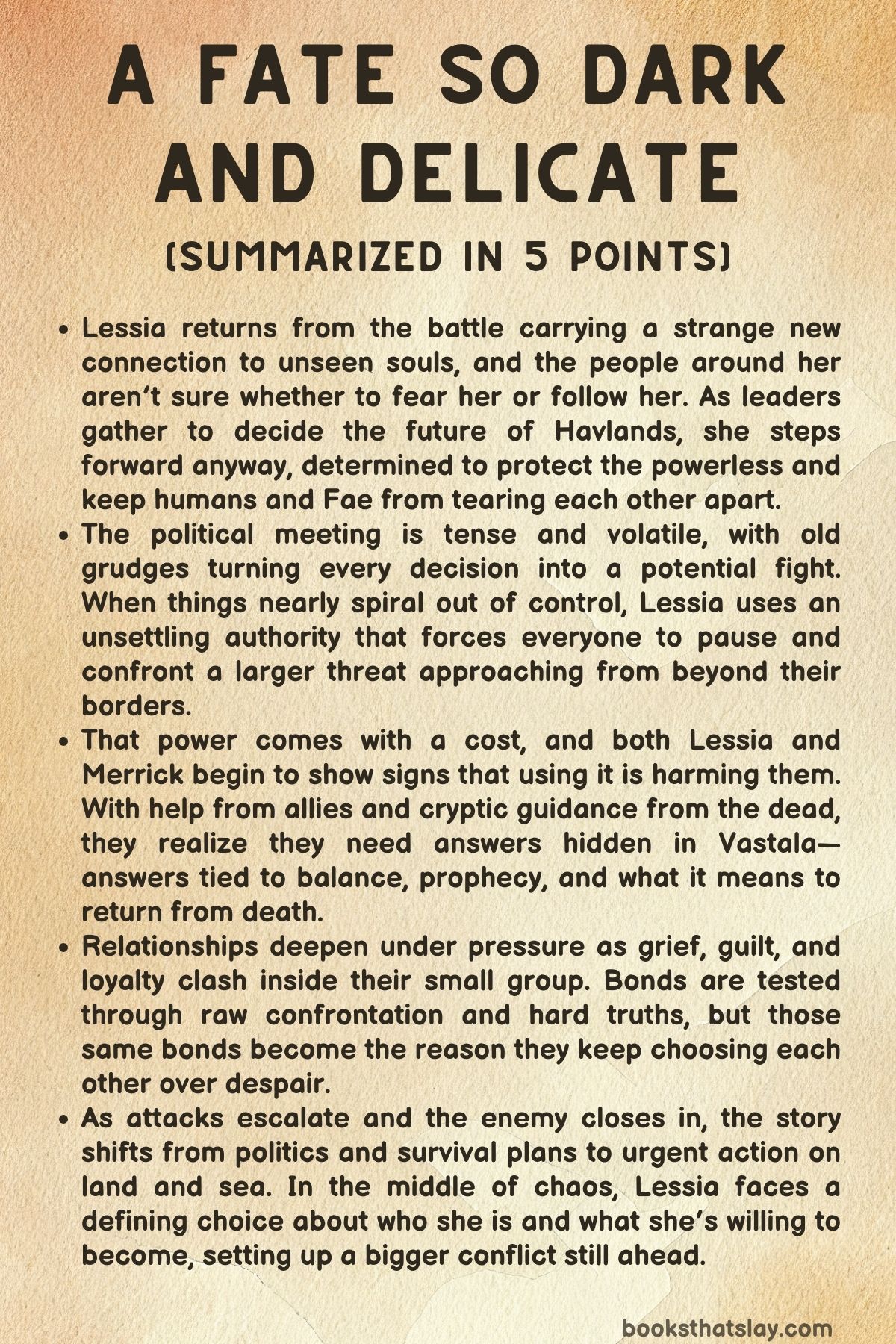
Summary
After a brutal battle, Lessia shelters with Merrick and their friends on Korina, trying to recover while the wider world recoils from what she has become. Since dying and returning, she’s been treated like a threat.
People whisper, keep their distance, and watch her as if she might snap. Worse, Lessia can still sense unseen presences around her—souls that once appeared and bowed in the aftermath of her return.
Night after night she wakes from dreams where a single word follows her like a command: “Queen.” She doesn’t want a crown, but she can’t deny that something has changed in her, and that change is pulling the attention of both allies and enemies.
A major meeting is called to decide the future of the Havlands: who rules Ellow and Vastala, what becomes of prisoners taken in the uprising, and how the fractured peoples can survive what’s coming next. Lessia is determined to attend, even though Merrick urges her to hide from the staring and the hatred.
She refuses to abandon Loche and Iviry, the leaders trying to hold a fragile peace together. She also refuses to ignore the prisoners rotting in flooded cellars—rebels, loyalists, and captured Oakgards Fae—chained like animals.
Lessia asks the wyverns, Ydren and Auphore, to stay near, convinced an Oakgards assault is already on its way.
On the march to the meeting, Raine struggles with guilt over his past drinking, grief for his dead mate Solana, and feelings he can no longer deny for Frelina. He has avoided her since the battle, but the fear of losing her has made it impossible to pretend he feels nothing.
Kerym, still raw from Thissian’s death, moves through the day like a man carrying a wound that won’t close. The group arrives at a cliffside house guarded by both human soldiers and Vastala Fae, who stand in hostile lines as if ready to spark another war at a single insult.
Inside, the gathering immediately begins to fracture. Lessia argues that the prisoners must be treated humanely, but a Fae noble attacks her right to speak, calling her an unwanted halfling tied to the crimes of her bloodline.
Lessia answers with fury and clarity: she reminds them she died in defense of this world, and she claims her place not as a ruler, but as a voice for those both sides discard—halflings, shunned people, and shifters. She publicly rejects the old Rantzier name and vows she and her sister will never chase a throne.
Even so, Loche and Iviry confirm they want her on a shared council, which triggers panic and rage across the room. Accusations fly.
Humans and Fae reach for steel and magic. The peace they fought for starts collapsing right there in the ruined ballroom.
As the threat of violence peaks, Lessia loses control in a different way: her eyes turn bright gold, firelight dies, and the air turns cold and still. Souls appear in large numbers and force everyone back into orderly lines, separating the factions and shielding the leaders from assassination.
Lessia warns them that their division is a gift to the enemy, because a new force is approaching—ships full of earth-linked Fae whose power doesn’t run out the way others’ magic does. She insists she doesn’t want authority, but she will not allow more internal bloodshed.
She orders both sides to separate, argue, and return later with decisions made. When she leaves, the power drains her so badly that Merrick has to carry her.
In the aftermath, the leaders try to salvage unity. Iviry confirms she has seen the incoming fleet and the unnatural endurance of its magic.
Distrust remains, so Dedrick Reinsdor proposes a binding solution: Loche and Iviry should marry, forcing an oath-backed alliance that makes it harder for Vastala Fae to turn on humans. The crowd pressures them into accepting.
Iviry agrees aloud for the sake of peace, then storms out into the rain, shaken by how quickly her life is being decided by other people’s fear.
Back at the cabin, the cost of Lessia’s power becomes undeniable. Both she and Merrick stagger, bleed, and nearly collapse after the soul-force surges through them.
The witch sisters speak of old stories—“veiled queens,” guardians, and the need for balance in magic. They test Lessia and confirm something impossible: she still has her earlier gift in addition to this new one.
Their conclusion is grim. The power may be killing her.
Merrick admits the gods warned him there would be consequences if he brought her back, but he broke their rules anyway. Lessia reveals she met Solana in death, and Solana hinted that larger forces are moving and that Merrick was always meant to defy divine limits.
Lessia decides they need answers that only the dead can provide.
She speaks with Raine outside and relays a message that cracks him open: Solana is proud of him for stopping drinking, she doesn’t blame him, and she wants him to love again. Raine can barely hold himself together.
When Merrick joins them, Raine’s grief turns into rage and he beats Merrick while Merrick refuses to fight back. Kerym holds Lessia back and lets it happen, believing they need the release.
When Raine finally stops, the three of them are bruised, shaking, and still bound together by war and loss.
Kerym’s own grief sharpens when he returns inside and instinctively reaches for Thissian, finding only absence. Pellie comforts him, and their long tension finally breaks into honest desire.
Kerym pushes for a kiss and makes it clear he wants more than distraction. Pellie fears he’s clinging to her to avoid mourning, but Kerym promises he knows what he’s choosing—and he intends to prove it.
Lessia and Merrick go to the sea cliffs to ask the wyverns for help contacting the souls again. Auphore reveals a startling change: Merrick’s bond is now tied into the wider wyvern network.
Merrick realizes the act of saving Lessia bound him to death in a way too—he bargained with souls and, in a sense, crossed the same line. Together they draw on the bond and summon the dead, and two figures appear: Merrick’s parents.
They warn him not to repeat the attempt yet, explain that the gods have grown too strong and nature is pushing back, and insist that those who rose from death must restore balance. Their instruction is clear: go to Vastala, consult old knowledge, and find “the one who clings to life.” The effort leaves Lessia and Merrick collapsed in a cave while the wyverns guard them.
News arrives fast: stone itself has turned violent. Ellow’s castle is destroyed with people trapped inside, and villages in both territories suffer collapses as if the earth has decided to kill.
The Oakgards are escalating their nature-control attacks. Lessia proposes a desperate strategy: rally harbors, warn allies, move fighters onto ships, hide reserves, and force a decisive sea confrontation.
Loche and Iviry agree they must act immediately—and they must also question the prisoners for any useful knowledge.
In the dungeon, Loche and Iviry offer a choice: join the alliance or remain locked away. Insults spark violence, and Merrick nearly kills a prisoner who mocks Lessia until she steadies him through their bond.
Then Lessia steps forward and strips away protection and pride, showing her scars and brands and speaking plainly about the abuse, betrayal, and cruelty she has survived from both sides. She demands the cycle end, because unity is now the only path to survival.
Many prisoners waver. An older Oakgards half-witch delivers a prophecy: for “the one who clings to life,” there must be “one who rises from death.” The implication lands hard, and Loche orders the man taken for interrogation.
A team sails toward Vastala through a forced-current passage. On deck, Kerym and Pellie finally kiss, and the half-witch hints that Kerym resembles a long-dead queen tied to the Oakgards’ curse.
Before answers can settle, arrows fall from the sky and the ship is attacked as they near their destination.
Elsewhere, Lessia faces a different kind of battle: the decision to keep sacrificing herself or choose her own life. Letters from Loche, Kalia, Frelina, and Raine all say the same thing in different voices—leave, live, stop paying for everyone else’s fate.
Merrick asks her to come with him to find the key to her survival. Lessia finally says yes.
Overwhelmed, Merrick asks her to marry him, and she accepts without hesitation. For the first time, they allow themselves a night that feels like a future.
But war doesn’t pause. Frelina trains aboard Loche’s ship with Raine, their attraction and jealousy openly flaring.
Then dark stone rises from the sea, trapping their vessel, and Oakgards forces capture the crew. Raine and Frelina confess their love through their mental bond while their captors plan to use Frelina as leverage against Lessia and the wyverns.
As the alliance gathers for conflict, Kerym receives a shocking truth: Pellie believes his magic has changed, and she proves he can influence earth and leaves without trying. He appears to be an earth wielder—an Oakgards trait carried in his blood.
The revelation threatens his identity at the exact moment the world needs every weapon it can get.
A celebration becomes a needed pause before battle. Merrick and Lessia marry in front of a mixed crowd, completing a blood-sharing ritual that seals their bond.
Loche and Iviry, forced toward their own union by politics and fear, finally admit their love privately and choose to face what comes together.
Then the Oakgards strike at sea with overwhelming force. Ships splinter.
Masts snap under earth magic. Friends fall in brutal flashes.
Kerym fights like a man determined to matter, using new earth power to turn enchanted wood against an attacker and save Pellie and others. Raine shields Frelina, takes an arrow, and keeps killing to hold the line.
Death comes fast: Zaddock is murdered, grief shatters Amalise, and wyverns begin to fall.
Loche loses fighters around him, and betrayal erupts when his mother, Meyah, reveals herself as an enemy. In animal form she tears into Iviry, and Loche answers with lethal fury, killing Meyah and charging back into the battle with Iviry clinging to him, bleeding but unbroken.
Lessia searches for Merrick in the chaos and finds him alive, but surrounded by traps meant to cut her off. The wyverns hold her back, admitting Merrick made them promise to save her if forced to choose.
Confronted by the souls of the fallen, Lessia accepts what she has resisted since her return. She claims her destined role and becomes the Queen of Shadows.
The surge renews the wyverns, and her summoned souls bind enemies across the battlefield, stopping the slaughter by force of will and death-magic.
With control seized, Lessia does what seems impossible: she revives those who were strongly bonded to her—bringing back key friends who fell in the fighting, including Raine and others. She captures the Oakgards leaders and decides they must die, because she cannot trust their nature-breaking power.
Another leader, Marlow, arrives bearing a similar mark and claims his wife is a veiled queen, validating that this conflict is tied to something larger than kingdoms. He leaves determined to reclaim his wife and face what the gods have been hiding.
In the end, survivors return to Lessia’s childhood island to regroup and begin rebuilding. Love and friendship remain, but so does the pressure of what Lessia has awakened.
She can still feel the dead nearby, even when she can’t see them. Merrick stays close, grounding her, reminding her she has time—something she never expected to have again.
Yet the closing truth is clear: the next war may not be against the Oakgards alone. It may be against the gods themselves, and the day may come when five queens must stand together.
Characters
Lessia
Lessia stands at the center of A Fate so Dark and Delicate as a heroine shaped by suffering, survival, and an unwanted destiny. After dying and returning, she becomes something more than halfling, more than mortal, carrying a terrifying soul-linked power that forces others to see her as a figure of prophecy rather than simply a person.
What makes Lessia compelling is her constant resistance to authority and thrones, even as fate pushes her toward them. She fights fiercely for compassion, especially for prisoners and outcasts, because she knows what it means to be abused and discarded by both humans and Fae.
Her journey is not only about war, but about identity—learning that her strength does not come from ruling, but from choosing unity over vengeance. By the time she accepts the mantle of Queen of Shadows, it is not a triumph of ambition, but a surrender to responsibility, proving that her power is inseparable from sacrifice.
Merrick
Merrick is defined by devotion, loyalty, and the quiet torment of breaking divine rules for love. His decision to bring Lessia back from death is the most important act of his life, but it also binds him to consequences beyond his control, tying him into the wyvern network and the dangerous balance of souls.
Merrick’s character carries the weight of someone who would rather endure pain himself than allow harm to reach those he loves, shown in how he lets Raine beat him without defending himself. He is both warrior and protector, but his tenderness is what truly anchors Lessia, offering her the first real sense of safety and choice.
His love is not possessive, but deeply reverent—he wants her to live, even if living means leaving everything behind. Merrick represents the story’s most human form of heroism: enduring guilt, fear, and fate, yet still choosing hope.
Raine
Raine is one of the most emotionally raw characters, driven by grief, guilt, and longing. Haunted by the death of his mate Solana, he struggles with drinking, self-blame, and the belief that he does not deserve happiness again.
His growing bond with Frelina terrifies him because it feels like betrayal, yet it also becomes his chance at healing. Raine’s rage, especially toward Merrick, reveals how grief can distort love into violence, but his eventual vulnerability shows his capacity for growth.
He is also deeply protective, willing to throw himself into death to save others, proving that beneath his brokenness is a fierce loyalty. Raine embodies the painful truth that moving forward does not erase the past, but it can still be an act of love.
Frelina
Frelina’s arc is shaped by transformation from wounded sisterhood into fierce independence. Her relationship with Lessia is layered with regret, apology, and deep love, as she finally recognizes how much Lessia has sacrificed.
Frelina’s strength emerges most clearly when she trains, fights, and stands amid chaos without being overshadowed by her sister’s power. Her bond with Raine is charged with tension, jealousy, and desire, but also mutual understanding, since both carry grief and fear.
Frelina becomes a symbol of resilience, proving she is not merely Lessia’s sister, but her own warrior, capable of love and courage even in captivity and war.
Kerym
Kerym is a character torn between loss and the need to keep living. The death of Thissian leaves him hollow, and his grief feels restless, sharper than the pain he carried for Mishah, suggesting that love has repeatedly been taken from him.
Yet Kerym does not collapse entirely—he pushes forward with humor, sarcasm, and reckless determination. His growing relationship with Pellie shows his desperate hunger for connection, though it is complicated by fear of using her as a replacement for sorrow.
The revelation that his magic is changing, tying him to Oakgards earth-wielding power, places him at the center of prophecy and identity crisis. Kerym’s journey is about learning that grief does not end love, and that even broken people may still have a future worth fighting for.
Pellie
Pellie represents warmth, hesitation, and emotional grounding in a world unraveling. She approaches Kerym with care, sensing how close he is to falling apart, yet she refuses to become merely an escape for his pain.
Her strength lies in her boundaries—she demands honesty and real commitment rather than being consumed by someone else’s grief. Pellie’s fear when she realizes Kerym’s magic is changing highlights her vulnerability, but her confession of love during battle shows her courage.
She becomes not just a romantic figure, but a reminder that tenderness can survive even in war.
Loche
Loche is a ruler burdened by impossible choices, embodying the strain of leadership when unity feels unattainable. He is pragmatic, often harsh, but his harshness is rooted in desperation to protect his people against overwhelming threats.
His forced engagement to Iviry reveals how politics can weaponize intimacy, yet over time his feelings become real, proving that duty and love can intertwine. Loche’s vulnerability emerges most clearly in his fear, drinking, and eventual confession that he loves Iviry.
He is not an idealized king, but a man trying to hold civilization together while everything collapses.
Iviry
Iviry is one of the strongest political figures in the narrative, caught between her people’s distrust and the necessity of alliance. As interim leader of Vastala, she must protect Lessia despite immense pressure, showing both courage and strategic wisdom.
Her agreement to marry Loche is not romance at first, but sacrifice—an oath meant to bind two hostile peoples together. Yet beneath her controlled exterior is exhaustion, fear, and longing for something genuine.
Her eventual love for Loche becomes a rare softness in her life, but she remains fiercely determined, willing to bleed for survival. Iviry symbolizes leadership as endurance rather than glory.
Ydren and Auphore
The wyverns Ydren and Auphore are more than beasts; they are ancient forces of loyalty, connection, and fate. Their bond with Lessia and Merrick reflects the larger web of souls and magic that transcends politics.
They serve as protectors, guides, and living symbols of nature’s power, choosing allegiance not through command but through sacrifice and balance. Their presence reinforces the idea that the war is not only human versus Fae, but existence versus corruption itself.
Solana
Solana’s influence lingers long after death, shaping Raine’s grief and Lessia’s understanding of destiny. She becomes a voice of forgiveness, urging Raine to live again rather than drown in guilt.
Solana represents the story’s spiritual dimension, where death does not end love, but transforms it into guidance. Her presence reminds the characters that moving forward is not betrayal, but survival.
Thissian
Thissian’s death is one of the deepest wounds in the group, especially for Kerym. Though absent, he remains emotionally present, a symbol of love lost too soon.
His appearance among the souls, smiling, offers Kerym the smallest comfort—that death may not be emptiness, but transition. Thissian represents the cost of war, the way absence reshapes the living.
Dedrick Reinsdor
Dedrick functions as a political catalyst, proposing the “true joining” between Loche and Iviry. He represents the power of noble influence and the way alliances are often forged through calculated pressure rather than idealism.
Though not deeply explored emotionally, his role highlights how survival sometimes demands uncomfortable compromises.
Meyah
Meyah is betrayal incarnate, revealing herself as both mother and monster. Her arrival as a traitor during the battle embodies the horror of corrupted loyalty, showing that threats come not only from outside enemies but from within bloodlines.
Her death at Loche’s hands is both tragic and necessary, symbolizing the painful severing of poisoned roots.
Marlow
Marlow introduces the widening scope of prophecy, revealing that Lessia is not alone—other veiled queens exist. He serves as a bridge to the future conflicts, particularly against the gods themselves.
Marlow represents belief awakened too late, a man realizing the truth only after devastation, and his vow to reclaim his wife suggests the coming expansion of the story’s mythic struggle.
Sandir and Ewiline Morshold
Merrick’s parents appear as echoes of sacrifice and warning. They embody the cost of defying death and the necessity of balance in magic.
Their guidance pushes Merrick and Lessia toward Vastala and deeper truths, reinforcing that resurrection is never free. They symbolize ancestry not as comfort, but as responsibility.
Venko, Zaddock, and Amalise
These characters embody the brutal losses of war and the fragile hope of restoration. Their deaths underscore how hopeless the battle becomes, while Lessia’s ability to revive them reveals the terrifying scope of her power.
Amalise’s grief, Venko’s fall, and Zaddock’s sudden death remind the reader that even secondary lives carry weight, and survival often comes with unbearable cost.
Frecco
Frecco provides rare levity through teasing and humor, but his brutal injury highlights how quickly war destroys innocence and light. He represents the ordinary soldier caught in forces far beyond control, making his suffering feel especially cruel.
Soria and Kalia
Soria and Kalia represent the quieter emotional stakes of Lessia’s world—the found family she has protected. Kalia’s letter, filled with affection, reinforces that Lessia is loved not for prophecy, but for kindness.
They symbolize what the war is truly about: not crowns or power, but the fragile lives worth saving.
Themes
Power, Authority, and the Fear of What One Becomes
Lessia’s journey in A Fate so Dark and Delicate constantly places her in the uncomfortable space between responsibility and dread. Her return from death does not bring relief or celebration, but suspicion, avoidance, and the unsettling sense that something unnatural now surrounds her.
The moment when souls appear to bow before her becomes more than a mysterious event—it becomes a symbol of authority she never asked for. Lessia does not pursue rule, yet power keeps finding her, attaching itself to her existence like a shadow she cannot escape.
What makes this theme especially striking is that authority here is not portrayed as glorious, but as isolating and dangerous.
The political gathering shows how fragile leadership becomes when people are driven by fear. Humans and Fae are prepared to turn on one another instantly, and Lessia is forced into the role of mediator, even though she herself is barely holding together.
Her voice becomes the only thing stopping violence, yet the cost is steep. Her magic is tied to death, souls, and something beyond normal life, making her both a protector and a potential threat.
This creates tension between what she wants—to simply live and love—and what others project onto her, calling her “Queen.”
The theme also explores the burden of power that comes without consent. Lessia’s abilities are not a gift but a consequence, one that harms her physically and mentally.
The story repeatedly questions whether power can ever remain purely protective, or whether it always demands sacrifice. Lessia’s eventual acceptance of her role as Queen of Shadows is not triumph, but surrender to the truth that fate has already shaped her into something larger than herself.
Authority in this world is not chosen freely; it is forced through suffering, and survival often means becoming what others fear.
Unity, Division, and the Cost of Hatred Between Peoples
The conflict between humans and Fae forms a central tension throughout A Fate so Dark and Delicate, showing how quickly distrust can turn into violence. Even after shared battles and mutual loss, both sides remain ready to accuse, threaten, and strike.
The meeting in Korina demonstrates this perfectly: the room is split physically and emotionally, with guards glaring and leaders struggling to hold fragile peace together. The division is not simply political—it is rooted in history, prejudice, and the inability to see beyond old wounds.
Lessia stands at the center of this hostility because her very identity challenges the boundaries both sides rely on. As a halfling, she represents what the world refuses to categorize neatly, and that makes her a target.
Her insistence on humane treatment of prisoners becomes a moral stance against cruelty, but also a reminder that cycles of oppression never end unless someone interrupts them. The chained prisoners in flooded cellars symbolize what happens when hatred becomes policy.
The threat of Oakgards forces a harsh truth into the open: division is more dangerous than any outside enemy. Lessia’s warning that their infighting will destroy them carries weight because it is proven again and again.
Even alliances, such as the forced marriage between Loche and Iviry, show how unity is often built through pressure rather than trust. Yet the story also suggests that real joining is possible through shared sacrifice, shared grief, and moments of compassion.
The wedding celebration later becomes a rare image of what unity could look like, where humans, Fae, and shifters stand together as one people. But the sudden attack reminds everyone how fragile peace is.
This theme insists that survival depends not only on strength, but on the willingness to stop seeing each other as enemies before it is too late.
Love as Refuge, Motivation, and Risk
Love is never simple comfort; it is both shelter and vulnerability. Relationships in the story are shaped by war, grief, and the constant possibility of loss.
Lessia and Merrick’s bond is built through sacrifice, as Merrick breaks divine rules to bring her back, binding their lives together in ways neither fully understands. Their love becomes a reason to keep going, but also a source of fear, because caring deeply means having more to lose.
Lessia’s exhaustion and despair often ease only in Merrick’s presence. He grounds her when her identity begins slipping into something mythic and terrifying.
Yet even this love is not safe. Their connection is tied to soul power, consequences, and the looming reality that Lessia may not survive the magic within her.
The urgency of their marriage proposal reflects this truth: love becomes something they grasp tightly because tomorrow is uncertain.
Raine and Frelina’s growing attachment adds another layer, showing love emerging even when guilt and sorrow remain unresolved. Raine’s grief for Solana does not vanish, but love offers him a path forward, not by erasing the past but by allowing him to live beside it.
Kerym and Pellie’s relationship similarly reveals longing mixed with instability, as grief pushes him toward connection even while Pellie questions whether sorrow is shaping his choices.
The theme highlights love as motivation in battle, as characters fight hardest when protecting those they care about. Yet love is also what makes war crueler, because every bond becomes a potential wound.
The battlefield sacrifices, especially Raine’s act of shielding Lessia, prove that love in this story is inseparable from risk. It is the one thing that gives life meaning, and the one thing that makes loss unbearable.
Fate, Prophecy, and the Struggle for Choice
Lessia’s life is shaped by forces far beyond ordinary control, and A Fate so Dark and Delicate repeatedly confronts the tension between destiny and personal agency. Prophecies about veiled queens, guardians, and the balance of life and death hang over every decision.
Lessia is not simply fighting enemies—she is fighting the sense that her path has already been written. The whispers of “Queen” in her dreams reflect how fate presses into her mind, claiming her identity before she is ready.
The story shows how prophecy can become a cage. Others see Lessia not as a person, but as a symbol or weapon.
Even her survival feels conditional, tied to cosmic rules that punish those who break them. Merrick’s choice to save her is framed as something he was always meant to do, raising unsettling questions about whether love itself is freely chosen or part of a larger design.
Yet the narrative also insists that choice still matters, even under destiny’s weight. The letters Lessia receives become one of the most powerful moments of agency in the story.
For once, she is not being commanded by politics, magic, or fear. Her friends give her permission to choose herself, to want life, peace, and happiness.
This transforms her decision to leave into an act of selfhood rather than escape.
The theme ultimately suggests that fate may set the stage, but individuals still decide how to stand within it. Lessia’s acceptance of her role as Queen of Shadows is not blind submission, but recognition that running will not erase what she is.
The struggle is not about avoiding destiny, but about claiming the right to shape what destiny means.
Death, Resurrection, and the Moral Weight of Survival
Death is not an ending, but a presence that never truly leaves. Lessia’s resurrection creates ripples through the world, altering how others see her and how she sees herself.
Survival becomes complicated when it breaks the natural order, and the souls that follow her are constant reminders that life and death are no longer separate boundaries.
The theme explores the cost of returning. Lessia is alive, but not untouched.
Her new power is slowly killing her, turning survival into a ticking question rather than a victory. Merrick, too, carries consequences, as saving her binds him into the same web of death magic.
Their love exists under the shadow of what was broken to keep her breathing.
Resurrection also forces moral dilemmas. Lessia’s ability to revive the strongly bonded challenges the finality of loss, but it also raises fear about what kind of authority she now holds.
If she can return people from death, then she stands outside ordinary limits, closer to something divine or monstrous. This is why others fear her, and why she fears herself.
The battlefield becomes the ultimate stage for this theme, where death comes brutally and suddenly, and Lessia’s power halts destruction in a way no army could. Bringing back fallen friends feels miraculous, yet it also confirms that she is no longer just a girl caught in war—she is something tied to the afterlife itself.
By the end, death remains near, not only as grief but as destiny. Lessia may have gained time, but the story makes clear that survival is never free.
To live after death is to carry its weight forever, and the line between blessing and burden is painfully thin.