A Kiss of Hammer and Flame Summary, Characters and Themes
A Kiss of Hammer and Flame by Amy de la Force is a fantasy story about a young blacksmith who accidentally forges herself into the center of a forbidden prophecy. Cahra has survived poverty, prison, and a brutal regime in Kolyath by keeping her head down and her hands busy at the forge.
That changes when a nobleman commissions a blade that carries an ancient sigil no one should be able to recreate. Hunted by soldiers and pulled toward secrets older than any kingdom, Cahra is forced to run, to question who she really is, and to decide what kind of ruler she might become when power finally finds her.
Summary
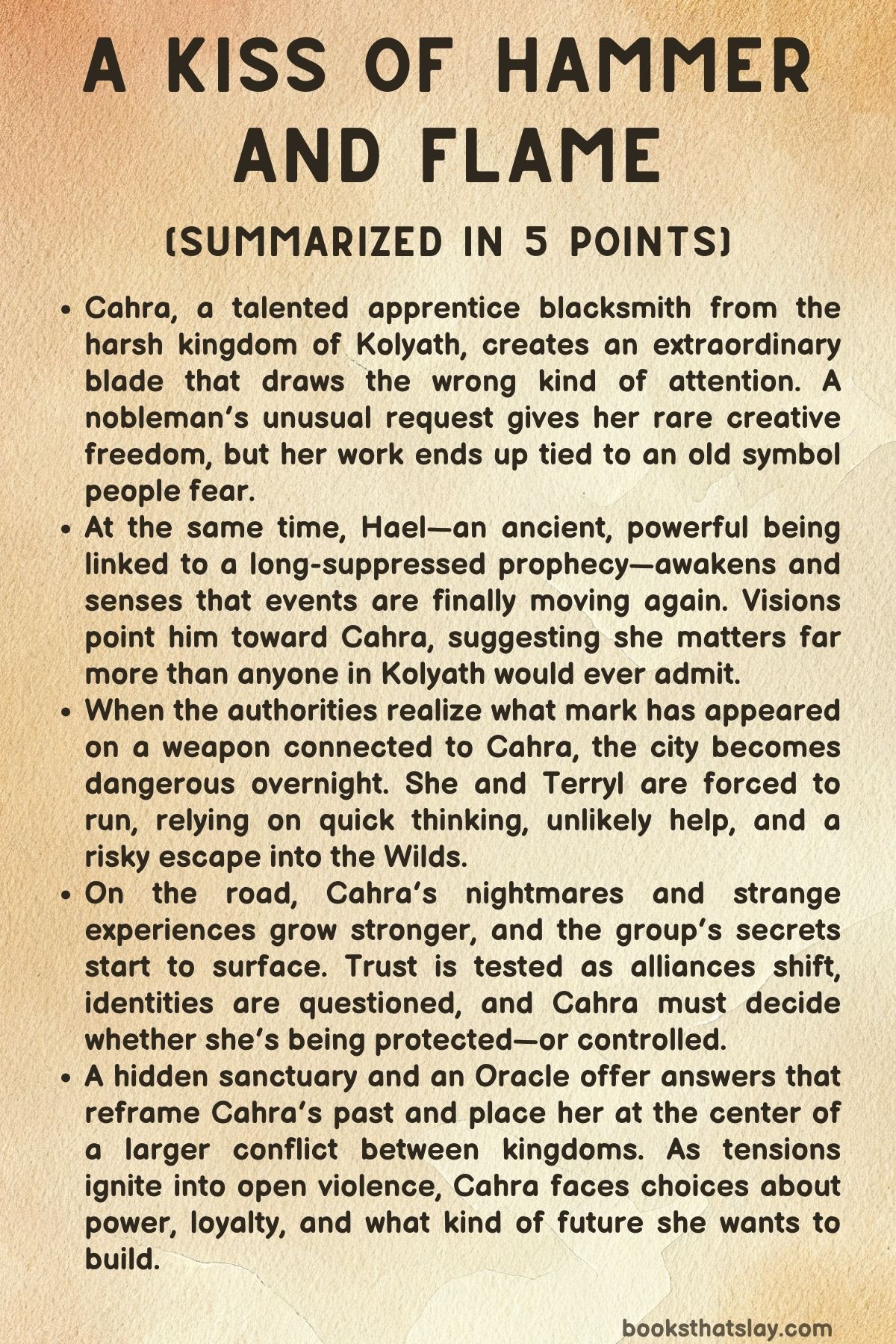
Cahra is a low-born apprentice blacksmith in Kolyath, a kingdom ruled by the Steward Atriposte, whose control is maintained through fear, public executions, and the constant threat of the dungeons. After completing a jewel-studded rapier made from rare Haellium ore for the Steward, she endures the contempt of Commander Jarett, leader of the Kingdom Guards.
Only one person in the room offers her respect: Lord Terryl, a young nobleman who notices her skill rather than her status. Terryl commissions a new weapon from Cahra—a longsword designed by her alone—and gives her unusual creative freedom.
Wary of nobles but drawn to the chance to make something truly her own, Cahra works late into the night sketching ideas. Without understanding why, she draws an ancient mark tied to banned Seer lore: the Eye of the All-Seeing.
Far away, in the ruined black pyramid capital of Hael’stromia, an immortal weapon-being named Hael wakes after centuries of silence. Bound to prophecy and trapped behind sealed doors, he senses the first movement of fate and sees a vision of a woman connected to the sigil Cahra has drawn.
To him, this is the beginning: the Seers returning, the omens starting, and a new Scion rising.
Cahra pours herself into the longsword, choosing cobalt tones and sapphires, shaping it into the finest work she has ever made. On an errand through the slums for gemstones, she is attacked by a starving boy.
Cahra disarms him easily, recognizes her own past in his desperation, and instead of punishing him she gives him a sapphire and sends him away. Even as she works, her nights fill with strange nightmares—fire, darkness, and a sense of something watching.
When the sword is done, she tries to celebrate with ale, but a panic attack hits hard, triggered by memories of the dungeons and what was done to her there. Terryl finds her outside and refuses to leave her alone.
He feeds her, speaks gently, and admits he secretly trades with the outlawed nomads of the Wilds, smuggling supplies to people Kolyath has chosen to starve. He also mentions seeing Hael’stromia’s ominous shape from afar.
Before they part, he promises to return the next day for his sword.
The next morning does not bring an appreciative customer. Commander Jarett storms into the smithy demanding to know who made the longsword.
Cahra hides while he threatens her master, Lumsden, and reveals the reason for his fury: the sword’s pommel bears the Eye of the All-Seeing, a mark Jarett insists has not appeared outside the Steward’s inner holdings in centuries. Jarett believes it signals the first omen of an old prophecy and orders Terryl arrested and Cahra found.
Lumsden urges Cahra to flee immediately, warning that Atriposte will never forgive her—especially because she once tried to kill him. Cahra hesitates, unwilling to abandon the man who saved her from the streets and taught her to live again, but realizes staying will only doom him.
Lumsden arms her with Terryl’s sword and supplies, and they part with the kind of goodbye that says neither expects mercy from Kolyath.
Cahra finds Terryl and warns him the Guards are coming because of the sigil. Terryl surprises her by reciting the prophecy and identifying the mark as a symbol connected to Hael’stromia and its “ultimate weapon.” He decides they must run together.
Using his authorization as a merchant lord, he arranges an escape through the city with a small, loyal group: Raiden, Siarl, Piet, and Queran. Alarms rise behind them.
They dodge patrols and pass the terrifying Red Square, where Kolyath displays its cruelty in plain view. In the chaos of the marketplace, the boy Cahra spared returns.
He distracts guards by shattering a window and buying them seconds they badly need. He names himself Ellian, and Cahra tells him to find Lumsden for work.
With stolen cloth and quick disguises, Cahra and Terryl reach the caravan at the gatehouse. Terryl hides her in a goods wagon with a secret compartment, and she slips inside just as the wagons roll forward.
In the tight darkness, panic climbs. Cahra’s fear spikes into a waking vision: she seems to stand in a vast tomb filled with bones, heat, and the stink of molten ore.
Massive doors loom. Strange flames flicker.
She snaps back as the wagon halts at the gate. Outside, Raiden bluffs the guards with a false story about official business, and the caravan is allowed through Kolyath’s black gates into the Wilds.
Once they are beyond reach, arrows fall from behind, forcing a desperate sprint into the forest until the attack fades under the canopy. Terryl opens the wagon doors and tells Cahra she is free, though freedom feels uncertain when she is surrounded by armed strangers.
As they travel, Cahra notices Wildspeople quietly aiding the caravan, confirming Terryl’s secret ties. Raiden remains suspicious, treating her like a liability.
In Terryl’s private coach, Raiden interrogates her about the sigil. Cahra insists she never meant to carve it and describes how Jarett discovered the mark.
Terryl admits a larger truth: his home is not Kolyath at all, but Luminaux, a sister kingdom. He promises Cahra protection and a choice once they arrive, though he wants her to speak with Luminaux’s rulers.
Cahra’s visions intensify. In another nightmare, a flaming-eyed presence calls her “Scion” and speaks as if he has been waiting for her.
The figure claims he means no harm, but his power is unmistakable. On the road, Kolyath scouts ambush the group.
Cahra reacts on instinct and courage, leaping from a tree to disable a hidden attacker, saving Raiden’s life. Her bravery earns her guarded respect, and a healer tends both her injuries and Raiden’s wounds.
Around the campfire, Terryl’s companions become more real to her—Queran’s watchful aim, Siarl’s readiness, Piet’s steady strength, Langera’s practical warmth. Cahra admits pieces of her past: hunger, homelessness, and the small safety Lumsden gave her.
Terryl tells her she is not defined by what Kolyath named her.
Terryl receives a letter that tightens the trap around him: his parents have arranged his marriage to Lady Delicia. Raiden’s words make the truth impossible to avoid—Terryl is not simply a lord.
He is Thierre, Crown Prince of Luminaux, traveling in disguise. While Cahra wrestles with the betrayal and the ache of caring for someone who cannot be free, the flaming-eyed being in her visions reveals himself more clearly: Hael, the Reliquus, sworn to her.
In Luminaux, Cahra briefly escapes palace tension by finding a smithy in the Artisanal Emporium. The work steadies her hands and mind.
The local blacksmith, Quillon, is impressed enough to invite her to return someday, but Cahra knows her life has shifted too far. Wyldaern, a Seer, meets her and answers what she can: Hael is not a simple weapon but a Netherworldly being of terrible ability, and the kingdoms have long reduced him to a story because the truth would provoke war.
Wyldaern admits she knew parts of Thierre’s identity through vision and kept quiet for safety. Cahra returns to her room to find travel gear rebuilt for her—a fitted breastplate, reinforced clothing, and boots—sent by Thierre with a note wishing her safe travels.
She accepts the gift as her own decision, not his ownership.
Cahra leaves Luminaux with Wyldaern, Piet, Siarl, and Queran, heading through mountain caves to a hidden meadow where an Oracle lives behind ancient veiling. The Oracle, Thelaema, reveals herself as High Oraculine and Keeper of the Reliquus.
Then she delivers the truth that breaks Cahra’s sense of self: Cahra was born in the Wilds, her bloodline hidden for generations. Thelaema arranged for her to be placed in Kolyath “hidden in plain sight,” believing hardship would make her strong enough to survive what was coming.
Cahra’s rage erupts—at the manipulation, at the years stolen, at the suffering shaped into a plan. Thelaema gives her the Key to Hael’stromia, a Haellium device, and declares Cahra the rightful heir of Kolyath: Princess Cahraelia, the Scion named in prophecy.
When Cahra takes the Key, it flares, triggering another omen. She falls into a vision of Hael’s tomb where Hael catches her and confirms what the Key means: she is destined to free him, and more than that, to claim the throne of Hael’stromia as Empress.
Hael offers a rite that shares emotion and power between them, allowing her to access his strength while he draws away some of her pain. Through it, Cahra experiences fragments of Hael’s long history—his creation, his chaining, and the atrocities demanded of him by rulers who treated him like property.
Cahra wakes changed, eyes glowing and senses sharpened, determined not to repeat the cruelty that shaped him.
Danger arrives quickly. Forces from multiple kingdoms close in, and battle erupts in the caves.
Cahra fights with a newly gifted Haellium great-hammer, her strength amplified, her anger near the surface. When she sees Ozumbre soldiers, something in her snaps and she becomes frighteningly violent until Wyldaern pulls her back from losing herself to power.
Thelaema intervenes with overwhelming force, but the cost is high, and the conflict escalates toward Hael’stromia itself—where Cahra’s choices will decide whether the Reliquus becomes a guardian, a conqueror, or something neither the prophecy nor the kingdoms expected.
Characters
Cahra (Cahraelia)
Cahra is the emotional and narrative heart of A Kiss of Hammer and Flame, beginning as a low-born apprentice blacksmith and transforming into the rightful heir of a broken kingdom. Her character is defined by resilience forged through suffering—poverty, imprisonment, and survival under tyranny have made her fiercely independent, suspicious of nobles, and deeply guarded.
Yet beneath her hardened exterior lies a profound compassion, shown when she spares Ellian and gives him a gemstone instead of punishment. Cahra’s journey is not simply about discovering royal blood, but about confronting the cost of power and deciding what kind of ruler she will become.
Her struggle against prophecy is just as intense as her struggle against her own rage, especially when Hael’s strength amplifies her violence. Ultimately, Cahra’s growth comes from choosing humanity over destiny, refusing to become another tyrant even as she rises into the role of Empress.
Hael (The Reliquus)
Hael is one of the most complex figures in A Kiss of Hammer and Flame, existing as both weapon and immortal being. Awakened after centuries of dormancy, he embodies the terrifying consequences of power stripped of autonomy—created, chained, and used by rulers as an instrument of slaughter.
His devotion to Cahra is rooted in prophecy, but it evolves into something far more intimate and emotionally charged. Hael’s struggle is deeply tragic: he is capable of monstrous brutality, yet he longs for meaning beyond violence.
His bond with Cahra offers him both freedom and purpose, but it also risks entangling love with domination, as he is sworn to serve her while possessing near-apocalyptic power. Hael represents the dangerous allure of vengeance and strength, and his arc raises the central question of whether something made for destruction can ever truly become whole.
Thierre (Lord Terryl)
Thierre begins as the seemingly gentle nobleman who recognizes Cahra’s talent, but his character quickly expands into one shaped by duty, secrecy, and sacrifice. As Crown Prince of Luminaux, he lives between two identities: the kind, curious Terryl who treats Cahra as an equal, and the political figure trapped in obligations such as an arranged marriage.
Thierre’s compassion is genuine, shown through his consistent protection of Cahra and his quiet rebellion in aiding the outlawed Wildspeople. However, his tragedy lies in being too late—his affection for Cahra cannot compete with the inevitability of prophecy and the supernatural bond forming between her and Hael.
Thierre ultimately becomes a symbol of the life Cahra might have had, a future of human love and normalcy that slips beyond her reach.
Raiden
Raiden serves as both protector and interrogator, embodying the harsh realism of survival in a world of political danger. Suspicious and controlling at first, he views Cahra as a potential threat rather than a person, reflecting his deep loyalty to Thierre and his instinct to eliminate risks.
Yet Raiden’s character develops through earned respect—Cahra saves his life, and he begins to recognize her courage. He is not cruel, but pragmatic, shaped by violence and responsibility.
Raiden represents the grounded side of Thierre’s world: the soldier who understands that kindness alone cannot keep anyone alive. His eventual willingness to train Cahra shows that trust, for him, must be forged through action rather than words.
Wyldaern
Wyldaern is a quietly powerful presence, functioning as guide, Seer, and eventual successor to Thelaema. Her character is defined by restraint—she knows more than she can safely reveal, burdened by visions and the weight of secrecy.
Wyldaern’s loyalty to Cahra is genuine, but it is complicated by her awareness of prophecy’s dangers, particularly the risk of Cahra becoming consumed by Hael’s power. After Thelaema’s death, Wyldaern inherits immense responsibility, stepping into the role of High Oraculine.
She represents the bridge between fate and choice, constantly trying to steer Cahra toward survival without surrendering her soul to destiny.
Thelaema
Thelaema is one of the most morally complicated characters in A Kiss of Hammer and Flame, embodying both ruthless manipulation and profound devotion to the realm’s future. As the last Keeper of the Reliquus, she has orchestrated Cahra’s entire life, placing her into hardship to harden her into the Scion she must become.
This makes Thelaema both savior and architect of suffering. Her bluntness and calm authority conceal deep grief for what was lost when Hael’stromia fell.
Ultimately, Thelaema sacrifices herself to stop Grauwynn and ensure Wyldaern can continue her work, making her a tragic figure who chose cruelty as a tool of survival for the greater good.
Commander Jarett
Jarett represents the brutal enforcement arm of tyranny, a man who wields authority through intimidation and cruelty. His contempt for Cahra’s low birth reflects the rigid class oppression of Kolyath, and his obsession with the Seer sigil reveals his fear of prophecy disrupting the established order.
Jarett is dangerous not because he is visionary, but because he is loyal to power and eager to crush anything that threatens it. His eventual betrayal and death underscore how disposable such men are within greater political games.
Steward Atriposte
Atriposte is the embodiment of corruption and oppression in Kolyath, a tyrant whose rule is built on fear, executions, and exploitation. Though he looms over the story more as a shadow than a deeply personal character, his impact is enormous—he is responsible for Cahra’s imprisonment, suffering, and the kingdom’s decay.
Atriposte symbolizes the rot that occurs when leadership becomes self-serving, making Cahra’s rise not only a personal transformation but a necessary overthrow of tyranny.
King Decimus of Ozumbre
Decimus is a calculating opportunist, driven by conquest rather than honor. His betrayal of Jarett shows his willingness to discard alliances the moment they stop serving him.
Decimus represents the external threat of imperial ambition, a ruler who sees Hael’stromia’s prophecy not as sacred, but as a weapon to seize. His death at Hael’s hands is not just vengeance, but the collapse of one more tyrant who believed power could be taken without consequence.
High Oracle Grauwynn
Grauwynn is the dark mirror of Thelaema, a figure consumed by ambition and hunger for forbidden Nether-magicks. Unlike Thelaema, who manipulates for what she believes is survival, Grauwynn manipulates for dominance.
His desire to control or destroy Hael reveals his fear of power he cannot own. Grauwynn’s betrayal stretches back centuries, making him a symbol of corruption within sacred institutions.
His death does not end danger, however, because his legacy continues through the disciple he claims to have chosen.
Piet
Piet is the group’s steady physical guardian, defined less by political complexity and more by unwavering loyalty. His strength provides stability amid chaos, and his presence reflects the importance of chosen bonds rather than bloodline.
Piet’s role highlights that Cahra’s rise is not achieved alone—she survives because others stand with her.
Siarl
Siarl brings sharpness and skill to the companion circle, embodying the disciplined warrior who supports Thierre’s cause. Though less explored internally, Siarl represents the reality that rebellion and escape require fighters as much as dreamers.
His loyalty reinforces the sense that Thierre has built a found family around him.
Queran
Queran, the archer, symbolizes distance and vigilance—always watching, always ready. His role in the escape from Kolyath emphasizes the constant danger surrounding Cahra.
Queran is part of the protective web that allows Cahra to reach her destiny, even when she feels trapped among strangers.
Ellian
Ellian begins as a desperate beggar boy and becomes a small but meaningful symbol of Cahra’s compassion. His return to help her escape shows the ripple effect of mercy in a brutal world.
Ellian represents the life Cahra might have continued living—hungry, invisible, and struggling—making him a reminder of where she came from and who she refuses to abandon.
Lumsden
Lumsden is Cahra’s true father figure, the one who gave her dignity through craft when the world gave her nothing. His smithy is her first sanctuary, and his sacrifice in sending her away is one of the story’s most emotional losses.
Lumsden represents home, love, and the ordinary goodness Cahra carries with her even into empire.
Quillon and Leon
Quillon and his apprentice Leon briefly offer Cahra a glimpse of an alternate future—one where she could simply be a smith, valued for skill rather than bloodline. Their warmth contrasts sharply with the manipulation of prophecy, emphasizing what Cahra has lost: the possibility of a simple life.
Commander Diabolus
Diabolus is violence given form, Ozumbre’s commander who kills King Royce and embodies the cruelty of war. His death at Hael’s hands reinforces Hael’s role as divine punishment as much as protector, showing how quickly human brutality collapses under supernatural wrath.
King Royce of Luminaux
Royce serves as the symbol of legitimate rule within Luminaux, and his death marks a turning point that forces Thierre into kingship. Royce’s fall emphasizes the cost of the conflict and the fragility of even the most stable kingdoms.
Sullian
Sullian is the last surviving thread of Kolyath’s old guard, spared not out of mercy but as a political choice. His imprisonment suggests that Cahra’s reign will not be free of unfinished enemies.
Sullian represents the lingering danger of those who survive the collapse of tyrants.
Nektro
Nektro arrives as a chilling promise of future catastrophe. Unlike the overt tyrants who fall, Nektro is mysterious, controlled, and ideological, offering downfall rather than conquest.
His appearance signals that even with Cahra crowned, the story’s darkness is not fully defeated—only waiting in a new form.
Themes
Power, Class, and the Weight of Social Hierarchy
From the opening moments of A Kiss of Hammer and Flame, Cahra’s life is shaped by the rigid structure of class and power in Kolyath. She is a low-born apprentice blacksmith, yet her skill produces objects of immense value, weapons that end up in the hands of rulers and commanders who look down on her.
The contrast between her craftsmanship and her social standing highlights how deeply unfair the kingdom’s hierarchy is. Commander Jarett’s insults are not simply personal cruelty; they represent an entire system that believes worth is inherited rather than earned.
Cahra’s daily existence shows how the poor are kept powerless even when their labor supports the elite.
Terryl’s entrance complicates this theme, because he offers kindness and opportunity, yet even his generosity carries the imbalance of privilege. Cahra struggles to trust him not only because of personal caution but because the world has taught her that high-born support often comes with hidden costs.
The story repeatedly shows how power operates through control: the Steward’s tyranny, the guards’ violence, and the way prophecy itself becomes another structure that threatens to claim Cahra’s autonomy.
As Cahra learns she is not merely a smith but the lost heir of Kolyath, the theme shifts into an exploration of authority and legitimacy. Her birthright places her at the center of political struggle, forcing her to confront what it means to rule differently from those who oppressed her.
The narrative suggests that power is not only about titles or armies, but about choices: whether to repeat cycles of domination or to rebuild something fairer. Cahra’s journey from invisibility to sovereignty becomes a direct challenge to the belief that only the privileged deserve to shape history.
Identity, Self-Discovery, and Chosen Purpose
Cahra’s arc is driven by questions of identity long before she learns the truth of her lineage. She begins as someone defined by others: a low-born girl, an apprentice, a survivor of poverty and imprisonment.
Much of her internal struggle comes from the tension between how the world labels her and what she senses within herself. Her forging of the Seer sigil without understanding it becomes symbolic of this deeper truth: she carries meaning and power she has not yet named.
As visions intensify and prophecy closes in, Cahra is forced to confront the possibility that her life has always been part of a larger design. This creates an emotional conflict, because destiny offers importance but also threatens freedom.
Cahra does not immediately embrace the role of Scion or heir; she resists it with anger and grief, especially when she learns that her suffering was, in part, engineered to harden her. The revelation that she was hidden “in plain sight” transforms her pain into something political, raising difficult questions about whether hardship can ever be justified by future outcomes.
Her growth is not simply accepting a crown, but deciding what kind of person she will become with knowledge of her past. Cahra’s identity evolves through choice: helping Ellian instead of punishing him, refusing to become a tyrant like those before her, and questioning the narratives imposed by Oracles and Seers.
By the end, she is no longer only reacting to the world’s definitions. She begins shaping her own purpose, balancing inheritance with agency, and turning survival into leadership on her own terms.
Trauma, Fear, and the Long Shadow of Survival
Cahra’s story is deeply marked by trauma, and the narrative does not treat her strength as effortless. Her panic attacks, nightmares, and visions reveal that survival leaves scars that cannot be ignored.
The tavern scene, where memories of the dungeons overwhelm her, shows how trauma can surface unexpectedly, even in moments meant for rest. Fear is not portrayed as weakness but as a lived reality that follows her beyond the walls of Kolyath.
Her flight from the kingdom intensifies this theme. Hiding in the wagon’s secret compartment becomes more than a physical escape; it mirrors the emotional confinement she has endured for years.
Even when she reaches the Wilds, freedom feels uncertain because her body and mind remain conditioned by captivity. Cahra’s guilt over leaving Lumsden behind further demonstrates how trauma binds people to the past, making escape emotionally complicated.
The introduction of Hael adds another layer, because his existence embodies collective trauma on a grand scale. He is a being created for violence, chained by rulers, forced into slaughter.
Through the abreption rite, Cahra experiences his memories, and the reader sees how cycles of suffering are passed between individuals and systems. Trauma becomes both personal and historical, shaping not only Cahra’s fears but the entire political landscape.
What makes this theme powerful is that healing is not simple. Cahra does not “get over” her past; instead, she carries it into her decisions as Empress.
Prophecy, Fate, and the Struggle for Control
Prophecy is not presented as a comforting guide, but as a force that disrupts lives and fuels conflict. Cahra’s accidental drawing of the Eye of the All-Seeing sets events in motion, suggesting that fate can begin without consent or understanding.
From that moment, her life becomes subject to interpretations by commanders, Oracles, and immortal beings who see her not as a person but as an omen.
The kingdoms’ obsession with the Seers’ return reveals how prophecy becomes political currency. Jarett views the sigil as a threat, Terryl as a sign of upheaval, and Thelaema as confirmation of a long-awaited plan.
Each faction seeks control over what the prophecy means, showing that destiny is often shaped by those in power rather than by divine certainty.
Cahra’s anger at Thelaema highlights the moral cost of prophetic thinking. If the future is sacred, individuals can be treated as tools.
Cahra’s suffering is justified as preparation, and her humanity risks being erased beneath the title of Scion. The story challenges the idea that fate is inherently righteous, instead presenting it as something that can be manipulated and weaponized.
Hael’s bond with Cahra also complicates destiny. He is sworn to serve her, yet his devotion carries danger, because power tied to prophecy can become consuming.
Wyldaern’s warning that they must not grow too close reflects fear that fate may demand sacrifice beyond politics.
Ultimately, the theme asks whether prophecy is a path or a prison. Cahra’s journey suggests that even when destiny is real, meaning comes from how one chooses to respond.
Fate may open the door, but control over what lies beyond remains a struggle of will, morality, and love.
Love, Loyalty, and Relationships as Forces of Change
Relationships in A Kiss of Hammer and Flame are not secondary to the plot; they shape Cahra’s transformation as much as prophecy does. Her bond with Lumsden represents chosen family and loyalty built through care rather than blood.
His decision to help her escape is an act of love that costs him dearly, and Cahra’s guilt and grief show how deeply she values that connection.
Terryl’s relationship with Cahra begins with kindness across class lines, offering her a glimpse of trust in a world defined by exploitation. Yet his hidden identity as Crown Prince complicates their closeness, revealing how politics can distort intimacy.
Cahra’s sense of betrayal is not only romantic disappointment but the realization that truth is often withheld from those without power.
Hael’s connection with Cahra introduces a different form of love, one tied to devotion, darkness, and shared suffering. Their bond is intense because it is rooted in recognition: both have been used as weapons by others.
Cahra’s choice to reach for Hael at the River Tenebri vision, answering that she wants love rather than duty, marks a turning point. It suggests that emotional truth matters as much as imperial destiny.
Loyalty also appears through companionship: Raiden’s reluctant respect, Wyldaern’s guidance, and the group’s willingness to protect Cahra despite fear of what she represents. These relationships show that change is never achieved alone.
Political transformation requires human connection, trust, and the courage to stand beside someone marked by danger.
By the end, love is framed not as softness but as a force that challenges cycles of tyranny. Cahra’s reign begins not only with conquest, but with the hope that loyalty and care can build a different future than the one prophecy demanded.
Violence, Justice, and the Challenge of Building Peace
The world of A Kiss of Hammer and Flame is steeped in violence, from executions in Red Square to the brutal wars at Hael’stromia. Weapons are central symbols, forged objects that carry both artistry and destruction.
Cahra’s skill as a smith places her at the heart of this paradox: she creates tools that can uphold tyranny or protect freedom.
Justice in the novel is complicated. Revenge is tempting, especially for someone who has suffered as Cahra has.
Her rage against Ozumbre soldiers and her near-loss of control with the great-hammer show how easily justice can become bloodlust. Hael’s slaughter of enemy forces further blurs the line between liberation and terror.
His power ends war quickly, but at the cost of horrific destruction.
Cahra’s choices as Empress reflect the difficulty of building peace after violence. Her decision to imprison rather than execute Sullian suggests restraint, but the looming presence of new threats like Nektro reminds readers that peace is fragile.
The narrative does not offer simple resolutions; it presents leadership as the ongoing challenge of preventing power from becoming cruelty.
Violence may secure a throne, but the story insists that true justice requires something harder: breaking cycles, resisting vengeance, and creating structures where rulers no longer rely on fear. Cahra’s future is uncertain, but her struggle represents the central question of the theme: how does one rebuild a realm shaped by centuries of blood without becoming another tyrant?