A Prince Among Pirates Summary, Characters and Themes
A Prince Among Pirates by Katie Abdou is a historical adventure and queer romance centred on a privileged young nobleman who abandons an arranged marriage and accidentally joins a pirate crew.
Through Kit Davenport’s journey from sheltered aristocrat to capable sailor, the novel examines freedom, identity, privilege, loyalty, and the difference between genuine love and possessive control. His attraction to Captain Sharpe gives the story its emotional centre, while betrayals, naval pursuits, political secrets, and Kit’s hidden parentage steadily raise the danger. Beneath the humour and maritime excitement lies a serious account of abuse, colonial power, racism, and the family a person chooses for himself.
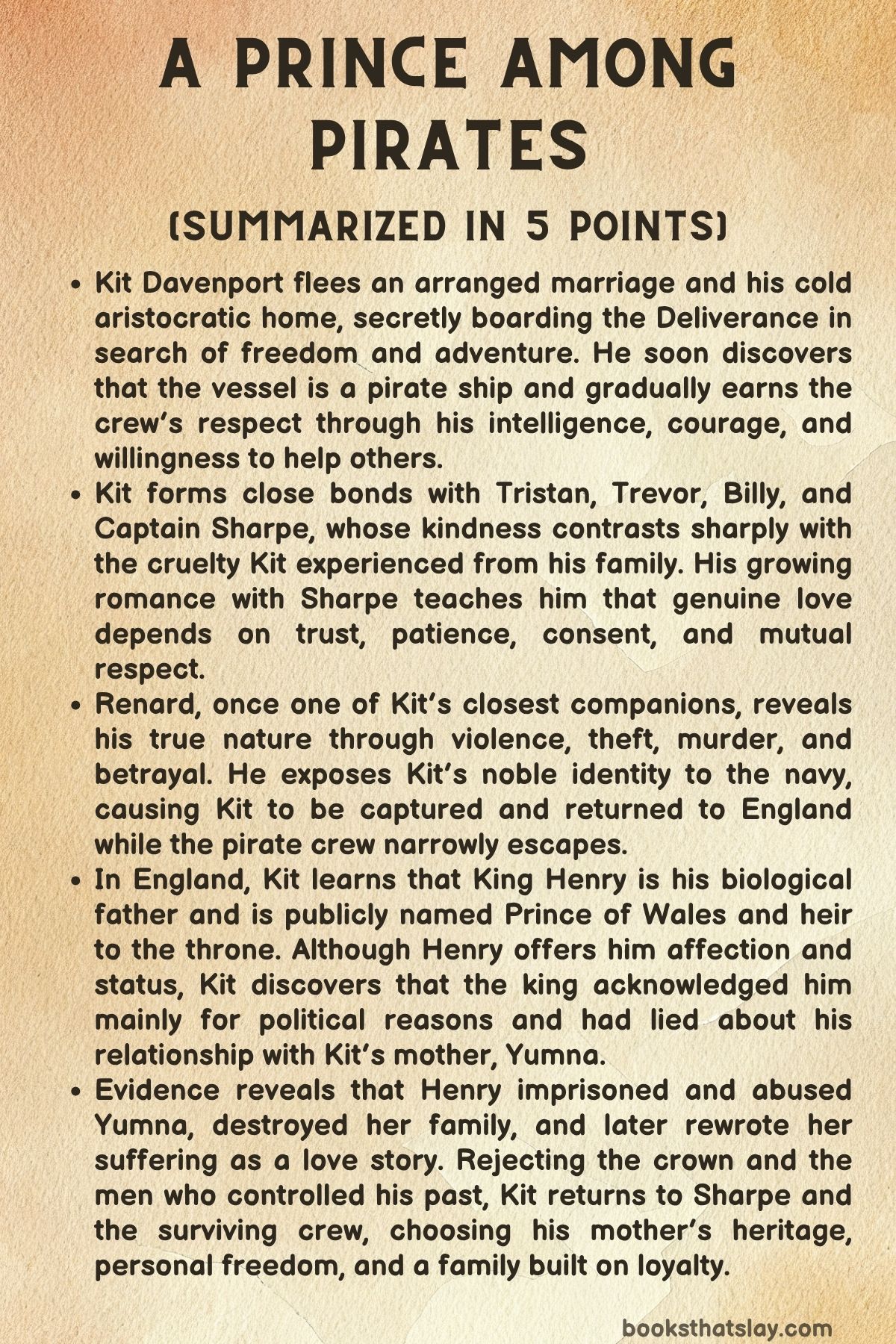
Summary
In August 1700, Kit wakes in Captain Sharpe’s bed aboard the Deliverance as cannon fire shakes the ship. Naval officers have boarded, and Kit realizes that the crew may be arrested or executed once their identity as pirates is discovered.
Although no one aboard knows his true background, Kit retrieves his family’s signet ring and steps onto the deck with the commanding manner of an aristocrat. Claiming to be Lord Davenport, the son of a viscount, he attempts to save the crew by pretending that the Deliverance is his personal vessel.
Several months earlier, seventeen-year-old Christopher-Henry Davenport is celebrating his engagement to Katherine Stuart. He has no desire to marry her, enter the House of Lords, or spend his life obeying his severe father, the Viscount of Falmouth.
Kit remains haunted by the mystery of his deceased mother, whose portraits and possessions have been removed from the family home. His father refuses to discuss her and has spent years telling Kit that he caused her death during childbirth and brought a curse upon the family.
On the night before the wedding, Crown Prince Henry reveals that Kit’s mother came from the Ottoman Empire and that Kit strongly resembles her. Desperate to know more and terrified of losing his freedom, Kit steals money, his family’s signet ring, and an unopened letter addressed to him before fleeing to the docks.
With no destination in mind, Kit boards the Deliverance after meeting an older sailor named Tydes. Captain Sharpe offers him work as the ship’s accountant because he can read, write, and perform calculations, and Kit introduces himself as Kit Mortimer to conceal his noble identity.
Sharpe immediately begins calling him Kitten. Kit is embarrassed by the nickname but is also drawn to the captain’s confidence, appearance, and amused attention.
Life aboard the ship is far harsher than Kit expected. He must sleep in a filthy hammock among ordinary sailors, follow orders from the young boatswain Renard, and prove that he deserves a place among men who have little respect for titles or expensive clothing.
Kit gradually becomes close to Renard, the twins Tristan and Trevor, and Billy, the ship’s gentle quartermaster. Although Tydes distrusts him and Rodriguez mocks his aristocratic behaviour, Kit begins learning how cooperation and practical ability matter more aboard a ship than social rank.
His work as accountant gives him his first real sense of usefulness. After discovering that the previous ledgers are confusing and poorly organized, he creates a new system for recording supplies, money, cargo, and daily activity.
A violent storm exposes how unprepared Kit remains. Ignoring orders, he ventures onto the deck, nearly falls overboard, and must be rescued by Renard and Billy.
Sharpe does not humiliate him afterward. He explains that Kit’s recklessness endangered the men who had to save him, showing concern that feels protective rather than controlling and causing Kit to trust him more deeply.
Kit begins using his education for the crew’s benefit. When he notices their ruined bedding, he proposes purchasing hundreds of clean blankets and pillows, personally negotiates with merchants in the Canary Islands, and distributes the supplies.
The crew’s gratitude changes Kit’s position aboard the Deliverance. For the first time, people value him because he has improved their lives rather than because of his wealth, name, or ability to obey.
Kit continues maintaining the accounts and teaches Tristan and Trevor to read. His relationship with Sharpe develops into constant flirtation, although neither of them openly admits the seriousness of their attraction.
Kit remains unaware that he is serving on a pirate ship until the crew prepares to attack another vessel. Sharpe orders him below and finally explains that the Deliverance is not a merchant ship but a pirate vessel whose cargo has been taken through raids.
During the battle, Kit hears cannon fire, gunshots, and screams. Seeing a dead body fall past a porthole destroys the romantic image of adventure he once carried and forces him to confront the violence committed by men he now considers friends.
Kit initially decides to leave at the next port because staying would make him a willing participant. However, Sharpe urges him to judge the crew as individuals and explains that many pirates were driven to sea by poverty, coercion, slavery, or abuse.
Billy then tells Kit that he was enslaved as a child. Sharpe later attacked the slave ship transporting him, killed the enslavers, freed the captives, and gave them control of the captured vessel.
The story forces Kit to recognize how little he understands about lives outside the aristocracy. Sharpe’s actions do not erase the moral dangers of piracy, but they reveal that his crew follows a code and frequently uses violence against slave traders and other abusers.
Kit decides to remain and symbolically dresses in black and white as an accidental gentleman pirate. Billy affectionately calls him a prince among pirates, marking his growing acceptance by the crew.
Returning to the old accounts, Kit discovers that Jeffrey Reuter, the former accountant, had deliberately altered the figures and stolen a fortune. Sharpe then admits that he cannot read, and Kit responds without ridicule, offering evidence and support rather than using the confession against him.
On Kit’s eighteenth birthday, he becomes drunk and reveals that he fled on his wedding day. He also tells Sharpe about his father’s cruelty and his fear that he is cursed, unwanted, and incapable of being loved.
Sharpe treats him with tenderness and refuses to take advantage of his intoxication. Their conversation is interrupted when French naval forces attack, returning the story to the opening confrontation.
Kit successfully deceives the French officers by claiming ownership of the Deliverance and presenting the pirates as his innocent crew. The French commander accepts the performance but takes Sharpe aboard his frigate for questioning and leaves guards behind.
Kit organizes a rescue involving Renard, Trevor, and Tristan. The plan requires stolen uniforms, Kit’s fluent French, and his ability to imitate aristocratic authority.
During the operation, Trevor kills one guard, while Renard executes another man whom Kit believed he had merely knocked unconscious. The killing reminds Kit that the friendly boatswain remains capable of ruthless violence.
Kit, Renard, and Trevor board the French ship and free Sharpe through a mixture of deception and force. After returning safely, Sharpe confirms that Kit’s noble birth changes nothing and that he remains one of the crew.
The Deliverance next travels toward Nassau and Port Royal while searching for Reuter. Sharpe assigns Kit to pose as a foolish nobleman seeking an accountant because Reuter will not recognize him.
In Nassau, Renard invites Kit to drink privately. Their flirtation leads to a kiss, but Renard becomes aggressive, bites Kit, pulls his hair, strikes him, and takes money from his purse after Kit pushes him away.
Kit hides the truth from the twins and feels ashamed despite having done nothing wrong. The incident also makes him understand that his feelings for Sharpe are far deeper than the playful attraction he once imagined.
While exploring Nassau, Kit meets a Turkish merchant who reminds him of his unknown mother and affectionately calls him a son of his sister. Kit treasures the brief connection to the heritage his father erased.
He also buys plantains for Billy, food supplies for the crew, and a blue ribbon for Sharpe. Unknown to Kit, Renard enters his trunk and steals the old letter he took from his father’s desk.
In Port Royal, Kit locates Reuter’s home and finds him freshly murdered with his throat cut. A second drinking cup suggests that the killer had been sitting with him only moments before Kit arrived.
Covered in blood, Kit flees until Tristan and Trevor find him. Sharpe comforts him, admits that sending him alone was a mistake, and smuggles him back aboard before authorities can accuse him of the murder.
The Deliverance later becomes trapped in windless water, but the crew’s anxiety gives way to a playful water fight. That evening, Sharpe invites Kit into his bed and waits for clear permission before kissing him, treating him with patience and care that directly contrasts with Renard’s violence.
In Port-au-Prince, the crew learns that King William has died and Henry has become king. A wanted poster offers ten thousand guineas for Kit’s safe return, confirming that his father and the Crown are searching for him.
Kit nevertheless continues sailing with the pirates, helping raid merchant vessels and free captives from slave ships. He and Sharpe openly share the captain’s cabin, while Renard grows increasingly resentful and distant.
During a foggy morning, the Deliverance is attacked by English naval forces accompanied by the French Captain LaBarre. Renard betrays the crew by revealing Kit’s identity, presenting the wanted poster, and producing the stolen letter from Kit’s trunk.
After Kit is taken aboard the English frigate Prince Henry, Renard confesses that he murdered Reuter. Reuter knew that Renard had helped steal the missing fortune and could have exposed him.
Captain Hale, Digby’s uncle, takes Kit back to England while Renard expects payment for the betrayal. The navy treats Renard as a criminal informant rather than an ally, leaving his fate uncertain.
Kit spends the return voyage imprisoned and tormented by nightmares about Sharpe and the crew. In England, he is taken not to his family home but to luxurious apartments in Kensington Palace.
Katherine visits and reveals that she married her cousin Francis after Henry allowed her to choose her own husband. She is pregnant and happy, and Kit sincerely apologizes for abandoning her without explanation.
King Henry then gives Kit a miniature portrait of his mother, Yumna. He claims that Yumna was the daughter of an Ottoman coffee merchant and that Kit was conceived during a loving affair while Henry was married to Queen Eleanor.
According to Henry, the future Viscount of Falmouth agreed to marry Yumna and raise Kit to prevent a scandal. Henry embraces Kit and announces that he is Kit’s biological father, giving Kit the paternal affection he has wanted throughout his life.
Kit is soon presented at court and publicly acknowledged as Christopher-Henry Mortimer Stuart, Prince of Wales and heir to the throne. Although uneasy about the wealth and political power surrounding him, he is strongly tempted by Henry’s approval.
Sharpe secretly enters Kit’s palace apartments and reveals that the Deliverance survived. He urges Kit to escape, warning that Henry recognized him only because the king needs a male heir.
When Sharpe questions whether Yumna could have freely consented to a relationship with a married English prince, Kit becomes furious. Unable to bear the possibility that Henry’s romantic account is false, he orders Sharpe to leave.
Kit soon begins questioning Henry himself. The king’s answers about Yumna’s religion, language, family, and supposed conversion are vague, dismissive, and contradictory.
The Viscount of Falmouth accidentally reveals that Yumna spoke neither English nor French. Kit realizes that she was isolated among people who controlled every part of her life and could not have meaningfully consented to the arrangements made for her.
A chest containing Yumna’s scarf, pearl earrings, kohl, and decorated Quran strengthens Kit’s connection to her. He chooses to wear her earrings and cosmetics openly, rejecting the English identity that Henry constructed for him and honouring the heritage his mother was denied.
With help from his new valet, Thomas, Kit secretly leaves Kensington Palace and returns to the docks. Tydes, Tristan, and Trevor are waiting beside a newly purchased ship, while Thomas unexpectedly insists on joining them.
Sharpe appears aboard the vessel wearing Kit’s blue ribbon. Kit apologizes, and they reunite before sailing to Portsmouth to collect the surviving members of the Deliverance.
Thomas then reveals that he stole the old letter from Henry’s chambers before it could be destroyed. The letter proves that Henry imprisoned and repeatedly raped Yumna, arranged the deaths of her father and sister, and handed her to the future viscount in exchange for political rewards.
The truth destroys Kit’s remaining illusions about Henry but also frees him from the belief that he must accept cruelty in exchange for paternal affection. He keeps the letter as protection against the king and leaves England with the family that accepted him by choice.
Sharpe finally reveals that his given name is Regulus, chosen by a mother who called him her prince. As Kit and Sharpe debate names for their new ship, their laughter shows that Kit has escaped the identities forced upon him and found freedom, love, and belonging at sea.
Characters
Christopher-Henry “Kit” Davenport
Kit is the protagonist of A Prince Among Pirates, beginning as a sheltered, dramatic, and deeply unhappy aristocrat who has been trained to perform confidence while privately believing himself cursed. His humour, vanity, expensive clothing, and exaggerated complaints often hide severe emotional neglect and an intense fear that nobody could love him without demanding obedience in return.
His development depends on learning that freedom carries responsibility. At first, he treats the sea as an escape from marriage and social duty, but storms, battles, murder, and betrayal force him to understand the real dangers faced by the crew.
Kit gradually transforms his privilege into something useful. His education allows him to organize the accounts, expose Reuter’s theft, negotiate for supplies, teach the twins, deceive naval officers, and organize Sharpe’s rescue.
His greatest struggle concerns emotional dependence. Henry’s affection appeals to the neglected child within him, yet Kit eventually understands that praise offered for political usefulness is not the same as unconditional love.
By choosing Yumna’s heritage, rejecting the throne, and returning to the pirates, Kit defines himself rather than accepting identities created by his fathers. He ends the book neither as Lord Davenport nor Prince of Wales, but as a young man capable of choosing love, loyalty, and freedom on his own terms.
Captain Regulus Sharpe
Sharpe is a young but highly experienced pirate captain whose authority rests on loyalty, courage, and personal example rather than inherited status. Although initially presented as intimidating and theatrical, he quickly reveals humour, patience, intelligence, and a strong protective instinct.
His inability to read introduces an important vulnerability. Rather than allowing shame to make him defensive, he trusts Kit with the truth and accepts help, creating a relationship built upon mutual strengths instead of unequal power.
Sharpe follows a moral code that distinguishes him from pirates motivated solely by wealth. He raids merchant vessels but shows mercy to ordinary sailors, while slave traders receive no such protection because he views their actions as beyond forgiveness.
His treatment of Kit is especially significant after Renard’s assault. Sharpe waits for consent, refuses to exploit Kit’s intoxication, listens to his fears, and consistently makes physical affection feel safe.
Sharpe also understands political power more clearly than Kit. His suspicions about Henry and Yumna initially cause conflict, but they arise from his awareness that rulers often disguise exploitation as romance or duty.
Within A Prince Among Pirates, Sharpe represents a form of leadership based on chosen loyalty. He does not attempt to possess Kit, and even when hurt, he leaves when ordered, later returning only after Kit freely chooses him.
Renard
Renard initially appears to be one of Kit’s most dependable friends. He teaches Kit about shipboard life, warns him that respect must be earned, rescues him during the storm, and helps him understand how to survive among the crew.
His betrayal is effective because it grows from qualities that have always been present. Renard is intelligent, observant, secretive, and capable of violence, but Kit repeatedly overlooks warning signs because he associates friendship with safety.
His assault on Kit reveals his belief that attention and kindness entitle him to physical access. When Kit withdraws consent, Renard reacts with anger, violence, and theft, showing that his affection depends upon control rather than respect.
Renard’s connection to Reuter exposes an even deeper corruption. He participated in the stolen fortune, murdered Reuter to prevent exposure, searched Kit’s belongings, and ultimately sold Kit to the navy.
Jealousy toward Sharpe contributes to his actions, but it does not excuse them. Renard’s fate demonstrates that charm, companionship, and shared hardship do not automatically make someone trustworthy.
Tristan
Tristan is one of the twins who have spent most of their lives aboard the Deliverance. He is sociable, playful, emotionally perceptive, and among the first crew members to offer Kit uncomplicated companionship.
His humour gives Kit relief during frightening situations, but Tristan is also highly dependable. He helps Kit navigate the ship, notices injuries Kit attempts to conceal, protects him during attacks, and assists him after the discovery of Reuter’s body.
Tristan’s willingness to dress as a woman during the plan to distract the French guards reflects his confidence and theatrical imagination. He treats danger with humour without failing to understand its seriousness.
His loyalty remains steady even after Kit’s aristocratic identity is revealed. By welcoming him back at the London docks with teasing and affection, Tristan confirms that their friendship was never dependent upon Kit’s social position.
Trevor
Trevor shares Tristan’s humour and loyalty but often displays a more direct and practical response to danger. He participates in the rescue of Sharpe, wears a stolen French uniform, and acts quickly when violence becomes necessary.
His killing of the French guard shocks Kit, yet it reflects the reality of Trevor’s upbringing. Having lived among pirates since childhood, he understands survival through a moral framework very different from Kit’s sheltered assumptions.
Trevor also values Kit’s lessons in reading and writing. Their relationship shows how education can be shared as a form of friendship rather than used to establish superiority.
Alongside Tristan, Trevor gives Kit the experience of brotherly affection that was missing from his aristocratic home. The twins tease him constantly, but their teasing is never designed to shame or control him.
Billy
Billy is the Deliverance’s large, gentle quartermaster and one of the clearest examples of the difference between appearance and character. His size and strength can be intimidating, yet his behaviour toward Kit is patient, kind, and protective.
His account of being enslaved provides Kit with a new understanding of piracy, power, and survival. Billy does not portray Sharpe as morally perfect, but he explains how the captain attacked his enslavers, freed the captives, and allowed them to decide their futures.
Billy’s friendship encourages Kit to examine his own privilege without becoming defensive. His description of Kit as a prince among pirates is affectionate because it recognizes the young man Kit is becoming rather than the title into which he was born.
His joy over the plantains also reflects Kit’s increasing attentiveness. Their relationship develops through small acts of care, mutual respect, and gratitude.
Tydes
Tydes is an older sailor who initially leads Kit aboard the Deliverance. He remains suspicious of the newcomer for much of the story, particularly because Kit’s expensive clothes, ignorance, and secretive behaviour create potential danger.
His distrust is practical rather than needlessly cruel. Tydes has survived by recognizing threats, and Kit’s true identity eventually proves capable of attracting both French and English naval forces.
Although he rarely offers open affection, Tydes gradually accepts Kit as part of the crew. His presence at the London docks demonstrates that his loyalty survives the loss of the Deliverance and the revelation of Kit’s royal connections.
Tydes also provides a useful contrast to the more openly friendly crew members. His respect must be earned slowly, making his eventual support particularly meaningful.
Thomas
Thomas enters the story as a palace footman assigned to serve Kit after his return to England. His intelligence, wit, competence, and willingness to challenge aristocratic expectations remind Kit of the direct relationships he formed aboard the Deliverance.
He quickly becomes more than a servant. Thomas quietly supports Kit’s grief, arranges contact with the pirates, assists his escape, and refuses to remain behind even when given the opportunity.
His decision to become Kit’s valet at sea is humorous but also courageous. He understands that following Kit may mean becoming associated with pirates and opposing the king, yet he chooses loyalty over safety.
Thomas’s most important action is rescuing Yumna’s letter from Henry’s chambers. By preserving the evidence Henry intended to destroy, he allows Kit to learn the truth and gives him protection against future royal retaliation.
King Henry
Henry initially appears charming, affectionate, and unusually accepting. He gives Kit information about Yumna, acknowledges him as his biological son, embraces him, and offers the paternal approval Kit has desired all his life.
His affection, however, is tied to political need. He waits until Queen Eleanor can no longer provide an heir before recognizing Kit and presents him as Prince of Wales without respecting his wishes.
Henry controls information through selective storytelling. He transforms Yumna’s imprisonment and sexual abuse into a romantic affair, erases her religion and family, and describes her supposed conversion as willing.
His behaviour demonstrates how powerful people create acceptable versions of their crimes. He expects Kit’s emotional hunger to prevent him from asking difficult questions and treats love as something that should purchase obedience.
Henry is therefore dangerous not because he lacks charm, but because charm allows him to disguise exploitation. His cruelty is supported by monarchy, wealth, racism, and the ability to silence anyone who challenges him.
Yumna
Yumna never appears alive, yet her presence shapes Kit’s entire identity. The removal of her portraits, possessions, language, faith, and history leaves Kit vulnerable to the lies told by the men who controlled both of them.
Henry initially describes her as an exotic beauty who willingly entered a forbidden romance. Her possessions and surviving letter expose a very different reality involving imprisonment, rape, racial dehumanization, and the destruction of her family.
The Quran, kohl, pearls, and Turkish silk restore dimensions of Yumna that Henry’s story attempted to erase. Through these objects, Kit recognizes her as a woman with a culture, religion, family, and identity rather than merely the beautiful mother of a royal son.
Kit’s decision to wear her earrings and kohl becomes an act of remembrance and resistance. He cannot rescue Yumna, but he can refuse to allow the English court to define or conceal her.
The Viscount of Falmouth
The viscount raises Kit while resenting him for being another man’s child. His emotional abuse includes withholding affection, erasing Yumna’s existence, calling Kit cursed, and allowing him to believe that he caused his mother’s death.
His actions show how cruelty can be performed through coldness as effectively as through physical violence. Kit grows up constantly seeking approval from someone who has already decided to reject him.
The viscount also benefits from Henry’s abuse of Yumna. He receives political advancement in exchange for marrying an isolated woman and raising the king’s child, making him a participant in the system that imprisoned her.
His insistence upon formal respect after Kit becomes a prince exposes his hypocrisy. He demands obedience when he believes himself powerful, then expects deference to royal rank when Kit gains greater authority.
Katherine Stuart
Katherine is first presented as the woman Kit is expected to marry, but she is also trapped by the arrangement. Her beauty and social suitability cannot create love between two people whose futures have been decided by their families.
Kit initially convinces himself that abandoning her will benefit them both, but he later recognizes that leaving without explanation was cruel. His apology represents a new willingness to take responsibility for the damage caused by his escape.
Katherine’s marriage to Francis proves that she desired freedom as much as Kit did. Once allowed to choose, she becomes happier, more confident, and capable of rebuilding a genuine friendship with him.
Her forgiveness does not erase Kit’s mistake. Instead, it demonstrates maturity and confirms that neither of them was the true enemy; the real problem was the system that attempted to use their marriage for status and control.
Francis Stuart
Francis is Katherine’s cousin and chosen husband. His presence demonstrates what becomes possible once Katherine is released from her engagement to Kit and allowed to make decisions about her own future.
He is generally supportive and friendly toward Kit, although his suggestion that Kit should be satisfied with a crown, a father, and political power reveals the limits of his understanding. Francis sees the advantages of royal recognition more clearly than its emotional manipulation.
Nevertheless, he and Katherine provide Kit with companionship during his isolation at court. Their relationship represents a successful alternative to the loveless marriage that had originally been planned.
Elizabeth
Elizabeth is the viscount’s young second wife and the mother of Kit’s half sister, Victoria. Kit resents her position and refuses to call her Mother, but he does not view her as personally responsible for his father’s cruelty.
Her limited role reflects the emotional distance within the Falmouth household. Although she occupies the social position once held by Yumna, she cannot answer Kit’s questions or repair the deliberate erasure of his mother.
When Kit encounters her at court, the viscount’s demand that he address her formally becomes another attempt to enforce obedience. Elizabeth remains caught within a family structure controlled by her husband’s authority.
Digby Hale
Digby is Kit’s former schoolmate and secret companion at the beginning of the story. Their encounter suggests physical familiarity, but it lacks the emotional safety and mutual trust Kit later experiences with Sharpe.
Digby is connected to the aristocratic world Kit wants to escape. Although their conversations about sailors and pirates help inspire Kit’s departure, Digby himself does not offer a genuine alternative life.
Kit’s memories of him become increasingly uncomfortable after Renard’s roughness reminds him of their previous encounter. This association suggests that Kit once accepted unpleasant treatment because he had no healthier model of intimacy.
Rodriguez
Rodriguez initially mocks Kit as a princeling and publicly humiliates him. His treatment reflects the crew’s suspicion that Kit expects special privileges without having earned them.
Over time, Rodriguez becomes more accepting as Kit contributes to the ship’s welfare. He accompanies Kit during the bedding purchases and later assures him that the crew would protect him despite the enormous reward offered for his return.
His declaration that Kit belongs to the sea shows how completely Kit’s status has changed. The man who once saw him as an arrogant outsider eventually recognizes him as a fellow sailor.
Jeffrey Reuter
Reuter is the Deliverance’s missing former accountant. Although absent for most of the story, his altered ledgers initiate the mystery that exposes Renard’s corruption.
He stole money and valuables from the crew, but his actions cannot justify his murder. His freshly killed body becomes one of Kit’s most traumatic encounters with violence because Kit finds him before the blood has cooled.
Reuter’s death also demonstrates the danger of concealed knowledge. He becomes a threat to Renard because he knows the truth about the missing fortune, and his murder is intended to prevent that secret from reaching Sharpe.
Captain Hale
Captain Hale is Digby’s uncle and the English naval officer responsible for returning Kit to England. His family connection reinforces how thoroughly Kit’s old world has pursued him across the Atlantic.
He assists Renard’s betrayal but does not treat the boatswain as an equal. Once Renard has provided the information needed to capture Kit, the navy views him as a criminal whose usefulness has ended.
Hale’s priority is the royal reward and Kit’s return rather than justice. His behaviour shows how lawful authority can be driven by profit and political obedience just as piracy can.
Captain LaBarre
LaBarre is the French officer humiliated by Kit’s deception aboard the Deliverance. Although he initially accepts Kit’s performance, he remains suspicious and later assists the English navy in identifying him.
His return demonstrates that Kit’s clever improvisations have lasting consequences. Kit can deceive powerful men temporarily, but those men possess ships, soldiers, and political networks capable of pursuing him.
LaBarre also contributes to Kit’s panic responses. Encounters with French uniforms remind Kit of the danger he faced while rescuing Sharpe and the possibility that a failed performance could have killed the entire crew.
Queen Eleanor
Queen Eleanor is Henry’s wife and the official queen of England. Her coldness toward Kit suggests that she understands his parentage and views his recognition as a public reminder of Henry’s infidelity.
She has little direct control over Kit’s fate, but her inability to produce a surviving heir creates the political situation that makes him suddenly valuable. Henry’s decision to legitimize Kit is therefore connected less to paternal devotion than to the monarchy’s need for succession.
Eleanor’s presence also complicates Henry’s supposed love story. His willingness to betray his wife, exploit Yumna, and manipulate Kit demonstrates that his relationships are organized around personal entitlement.
Themes
Chosen Family and Belonging
A Prince Among Pirates contrasts biological relationships built upon control with chosen relationships built upon loyalty. Kit begins life surrounded by wealth and status, yet his father denies him affection, erases his mother, and treats his existence as a source of shame.
The Deliverance initially appears dirty, dangerous, and socially inferior to his aristocratic home. Nevertheless, its crew feeds Kit, rescues him, teaches him, celebrates his achievements, and values the work he performs rather than the name he carries.
Chosen family does not mean that every pirate is automatically good. Renard’s betrayal proves that closeness can be false, while the crew’s violence sometimes disturbs Kit and forces him to reconsider the people he loves.
The difference lies in the freedom to judge, trust, forgive, or leave. Sharpe, Billy, Tydes, Tristan, and Trevor do not demand that Kit surrender his identity before they accept him.
Henry offers Kit blood, a title, and royal recognition, but his affection depends upon Kit becoming a useful heir. Sharpe offers no throne, yet he allows Kit to choose his own direction and respects his decisions even when they cause pain.
Kit’s final return to the pirates confirms that family is defined by sustained care rather than biology. The crew becomes his home because its members know his flaws, history, and true name without using any of them to imprison him.
Freedom and Responsibility
Kit’s early understanding of freedom is largely negative: he wants freedom from marriage, his father, political expectations, and a future in the House of Lords. Running away appears to offer immediate liberation, but he initially gives little thought to Katherine, the stolen money, or the dangers of joining an unknown ship.
Life at sea teaches him that freedom cannot survive without responsibility. His recklessness during the storm endangers rescuers, his ignorance of piracy does not erase his participation, and his noble performance against the French creates consequences that follow the crew across several ports.
Kit becomes genuinely independent only when he begins accepting responsibility for others. He improves the bedding, organizes supplies, teaches the twins, rescues Sharpe, protects the crew with his identity, and acknowledges the pain he caused Katherine.
The pirates themselves occupy a morally complicated space between freedom and violence. Many escaped enslavement, forced naval service, poverty, or abuse, yet their liberation sometimes depends upon taking property and lives from others.
The novel therefore avoids presenting freedom as simple lawlessness. Meaningful freedom requires informed choices, accountability, and respect for the autonomy of other people.
Kit’s final departure differs from his first escape because he now understands what he is choosing and what he is rejecting. He leaves not as a frightened boy avoiding duty, but as a young man willing to face the consequences of defining his own life.
Love, Consent, and Possession
Different relationships reveal the boundary between love and possession. The viscount demands obedience without giving affection, Renard interprets Kit’s interest as permission to control his body, and Henry expects royal recognition to purchase lifelong loyalty.
Sharpe provides the clearest alternative. He refuses to exploit Kit while he is drunk, waits for verbal and physical permission before kissing him, and stops treating desire as a contest that must be won.
Renard’s assault is important because it exposes Kit’s limited experience with respectful intimacy. His shame afterward reflects years of being taught that mistreatment must somehow be his fault, while his silence shows how easily victims can fear disrupting a community they depend upon.
Henry’s treatment of Yumna expands the theme beyond Kit’s personal relationships. He describes imprisonment and rape as romance because admitting the truth would threaten the benevolent image he has created for himself.
Possessive people repeatedly rename exploitation as duty, affection, passion, or protection. Their language asks victims to doubt their own perceptions and accept abuse as the price of being valued.
Kit’s development allows him to recognize that genuine love does not require surrender. By returning to Sharpe, he chooses a relationship in which affection is freely given, consent remains necessary, and neither person must become smaller for the other to feel powerful.
Identity, Heritage, and the Control of History
Kit’s identity is initially constructed by other men. The viscount calls him cursed, Henry calls him a prince, society calls him a nobleman, and the crew jokingly calls him a gentleman pirate.
Each label contains part of the truth but becomes dangerous when treated as a complete definition. Kit’s growth depends upon deciding which parts of his history he will accept and which identities were imposed to control him.
Yumna’s erased heritage is central to this conflict. Her portraits disappear, her language is forgotten, her religion is dismissed, and her abuse is rewritten as a willing romance between an exotic woman and an English prince.
Henry controls history because he possesses political power, educated servants, guarded chambers, and the authority to destroy letters. His version of events survives until physical evidence contradicts it.
The Quran, pearls, scarf, kohl, portrait, and stolen letter allow Kit to recover fragments of his mother’s life. Wearing her belongings publicly turns remembrance into resistance because he displays the culture Henry attempted to remove from both mother and son.
Kit cannot reconstruct every part of Yumna’s identity, but he can refuse the history created by her abusers. His final self is not determined solely by English nobility, Ottoman ancestry, royal blood, sexuality, or piracy.
By claiming these elements on his own terms, Kit transforms identity from an inherited prison into a continuing act of choice.