A Pair of Aces Summary, Characters and Themes
A Pair of Aces by Heather Terrell and Victoria Christopher Murray is a historical novel set amid the corruption, organized crime, racial discrimination, and gender restrictions of 1930s New York. It follows Eunice Carter, a pioneering Black prosecutor, and Polly Adler, a famous Jewish madam whose brothel serves politicians, entertainers, and gangsters.
Although they stand on opposite sides of the law, both women confront institutions controlled by powerful men. Their secret alliance becomes essential to exposing Lucky Luciano’s prostitution racket. Through their experiences, the book examines ambition, exploitation, social hypocrisy, motherhood, survival, and the difficult choices women make when legitimate systems refuse to protect them.
Summary
Polly Adler attends an elegant gathering at the Algonquin Hotel with four women from her exclusive brothel, expecting to entertain theatrical businessmen. Her instincts warn her that something is wrong when she notices rough guests, an armed guard, and a cache of machine guns hidden in a pantry.
The host admits that one of the guests is Dutch Schultz, the violent mobster whose criminal empire reaches across New York. Dutch demands the address of Polly’s secret establishment and later authorizes the murder of rival gangster Vincent “Mad Dog” Coll while Polly listens from the powder room.
Polly understands that reporting what she heard would place her and her women in mortal danger. Before she can safely return home, police surround the group outside the hotel and arrest her as New York’s most famous madam.
Assistant District Attorney Eunice Carter learns about Polly’s arrest while working on Thomas Dewey’s special prosecution team. Eunice is the only Black person and the only woman among twenty prosecutors assigned to investigate organized crime, yet she has been given the supposedly minor task of answering citizens’ complaints.
Those complaints lead her to examine the city’s prostitution trade. She notices that the same expensive lawyers and bondsmen repeatedly appear in Women’s Court, helping prostitutes avoid serious punishment even when they have been arrested several times.
Eunice suspects that these cases are not isolated. She visits Polly in jail, hoping the madam can explain how the business operates, but Polly refuses to cooperate because anyone considered an informer may be murdered.
Despite her silence, Polly reveals that women do not enter prostitution because it is their childhood ambition. Her remark suggests that poverty, coercion, abuse, and abandonment often push them into a life society later condemns.
Eunice’s investigation creates tension at home. Her husband, Lisle, fears that prosecuting gangsters will endanger their son, Junior, and urges her to leave Dewey’s office, but Eunice refuses to surrender the first professional achievement she has claimed entirely for herself.
Polly returns to the Majestic, where her brothel is concealed behind secret passages and disguised rooms. She has built an exclusive private club that attracts wealthy businessmen, artists, politicians, entertainers, and gangsters, allowing her to maintain more control than she had during her own years as a prostitute.
Her influence cannot save her from a short prison sentence. While waiting for court, she is approached by a recruiter for an organization called the Combination, which promises bail, lawyers, and protection in exchange for weekly payments from every prostitute.
Polly rejects the offer because she considers the Combination another form of pimping. She has created her establishment around independence, secrecy, and selective protection, while the organization intends to control the women, the madams, and the money.
Eunice continues tracing repeated names, forged signatures, protected brothels, and cooperative police officers. She becomes convinced that a centralized organization controls prostitution, although Dewey dismisses the trade as a collection of minor offenses committed by women who are themselves regarded as criminals.
Dutch Schultz soon takes possession of Polly’s establishment and uses it as an office. His men frighten customers, damage her property, and force her to accept their presence, leaving Polly responsible for dangers she cannot control.
During a conversation, Polly casually says that Dewey suffered a beating when his earlier tax case against Dutch failed. Dutch interprets the phrase literally and begins considering an attack on the prosecutor, making Polly fear that her careless language may have encouraged violence.
Dutch is eventually shot in Newark and dies from his wounds. Eunice learns that other organized-crime leaders ordered his death because he intended to assassinate Dewey against their wishes, revealing that the criminal syndicate will kill even one of its own members to protect its larger interests.
Polly initially hopes Dutch’s death will restore her independence. Instead, representatives of the Combination invade her home, threaten her household, search for money supposedly hidden by Dutch, and inform her that the organization will now control her women.
Lucky Luciano emerges as Dewey’s next target and begins using Polly’s house as freely as Dutch once did. Unlike Dutch’s unpredictable brutality, Luciano’s power is disciplined and systematic, supported by bookers, enforcers, lawyers, bondsmen, corrupt officers, and cooperative madams.
Eunice finally persuades Dewey that the prostitution trade is a genuine racket. She receives authorization to wiretap important figures, hoping their conversations will reveal a chain connecting the women and brothels to Luciano.
The danger becomes personal when someone leaves a mutilated doll painted Black outside Eunice’s home. She hides the threat from Lisle because their marriage has only begun to recover, but the secrecy increases her isolation.
Luciano demonstrates his authority by ordering one of Polly’s women, Virginia, to be transferred to a dangerous New Jersey brothel. When Polly objects, he strikes her unconscious and has Virginia dragged away.
The assault destroys Polly’s belief that her influence can protect the women living under her roof. She remembers being raped by a factory foreman as a teenager, losing her job after becoming pregnant, being expelled from her relatives’ home, and entering prostitution because poverty left her with almost no alternatives.
Virginia later escapes and is arrested in a dangerous district. Eunice recognizes her as one of Polly’s women and nearly persuades her to identify Luciano, but Virginia becomes terrified when Mob lawyer Abe Karp arrives and falsely claims to represent her.
Realizing that Karp may arrange Virginia’s release only so the organization can kill her, Eunice secretly helps the young woman escape. She sacrifices a potentially valuable witness because protecting Virginia’s life matters more than using her testimony.
Meanwhile, Polly searches through cheap hotels, brothels, and prostitution districts, discovering that the Combination transports women between houses and forces them to serve large numbers of men. Armed enforcers prevent resistance while bookers control the women’s locations, hours, earnings, and clients.
Recognizing that she cannot defeat Luciano alone, Polly secretly contacts Eunice. The two meet in a restaurant where a Black prosecutor and a white madam can sit together without attracting as much attention as they would elsewhere.
Polly gives Eunice the names and functions of important Combination members. In exchange, she demands advance warning of raids so she can remove her women and prevent them from being arrested.
Their agreement is based on necessity rather than trust. Eunice needs access to Polly’s knowledge of the criminal world, while Polly needs the government’s power to dismantle an organization that has taken away her authority.
Wiretaps identify enforcers, bookers, fixers, bondsmen, and operational managers. When a newspaper exposes the investigation and Luciano leaves New York, Eunice proposes arresting the Combination’s protectors before conducting simultaneous raids on dozens of brothels.
The operation targets eighty houses, but another leak allows many suspects to escape. More than one hundred women are detained, yet most refuse to cooperate because they believe the Mob will kill them if they testify.
Polly receives Eunice’s warning and leaves New York before the raids. She travels to Chicago, California, and Hawaii while questioning whether her establishment is truly different from the houses she condemns, since she also profits from women whose choices have been limited.
Eunice is placed in charge of questioning the female witnesses after she criticizes the male prosecutors for treating them with disgust. She focuses on the madams, reasoning that they stand close enough to the Combination’s leadership to identify its true controller.
Using information supplied by Polly, Eunice pressures Red Sadie into testifying. Sadie describes the organization’s control of brothels, profits, drugs, corrupt officials, and violence before identifying Luciano as the Boss.
Polly returns to New York, where financial pressures force her to abandon the Majestic and move her household into a smaller apartment. She continues meeting Eunice and supplies information about Mildred Balitzer, Pete Harris, Nancy Presser, and other people who can connect Luciano to daily operations.
Luciano is arrested and returned to New York. Although Eunice has built the theory, developed the witnesses, and created the structure of the case, Dewey initially excludes her from the trial team because he fears that the presence of a Black woman at the prosecution table will distract or prejudice white jurors.
Humiliated, Eunice considers leaving the case. During an angry meeting at Grand Central Station, she and Polly accuse each other of acting selfishly, but their argument changes when they realize they both protected Virginia rather than using her.
Polly promises to find evidence strong enough to force Dewey to include Eunice. She learns that Nancy Presser heard Luciano personally discuss prices, punishments, the movement of women, and the destruction of brothels that refused to cooperate.
Eunice uses this information as leverage and demands a place at the trial. Dewey reluctantly agrees, acknowledging that Nancy’s testimony, combined with the statements of Red Sadie and Mildred, can establish Luciano’s direct involvement.
The trial begins under enormous public attention. Prostitutes, madams, bookers, and former Combination members testify, but defense attorneys attack them as addicts, criminals, and beneficiaries of immunity agreements.
Polly recognizes that the prosecution needs witnesses whom the jury will consider respectable. She suggests questioning employees at the Waldorf-Astoria, where Luciano lived under the name Charles Ross and regularly met his criminal associates.
Hotel manager Henry Woelfle, waiter Joseph Weinman, and chambermaid Marjorie Brown agree to cooperate. Marjorie provides particularly powerful evidence because she saw Luciano’s associates inside his rooms and witnessed women who appeared drugged, beaten, unconscious, or bloodied.
Their testimony confirms that Luciano knew the defendants he claims never to have met. Telephone records and hotel evidence also support the accounts given by the prostitutes and bookers, preventing the defense from dismissing every witness as unreliable.
Luciano takes the stand and portrays himself as a respectable businessman. Dewey exposes contradictions in his story, proves that he communicated with people he denies knowing, and makes his repeated claims of forgetfulness appear increasingly absurd.
Lisle attends the trial and recognizes Eunice’s ideas within Dewey’s questioning. He tells her that he finally understands the importance of the case she created and expresses pride in her as an attorney.
Polly secretly attends the final day. Dewey argues that criminal organizations can rarely be proven through respectable outsiders alone, because only participants can explain their internal operations, but the Waldorf employees independently confirm the essential details.
Luciano is found guilty on sixty-one counts of compulsory prostitution. Polly and Eunice exchange quiet smiles across the courtroom, knowing their hidden partnership made the conviction possible.
Polly begins considering a book that might explain how abuse, poverty, abandonment, and social hypocrisy drive women into prostitution. She and Eunice will never become conventional friends, but they emerge as equals who challenged a criminal system and the respectable institutions that allowed it to flourish.
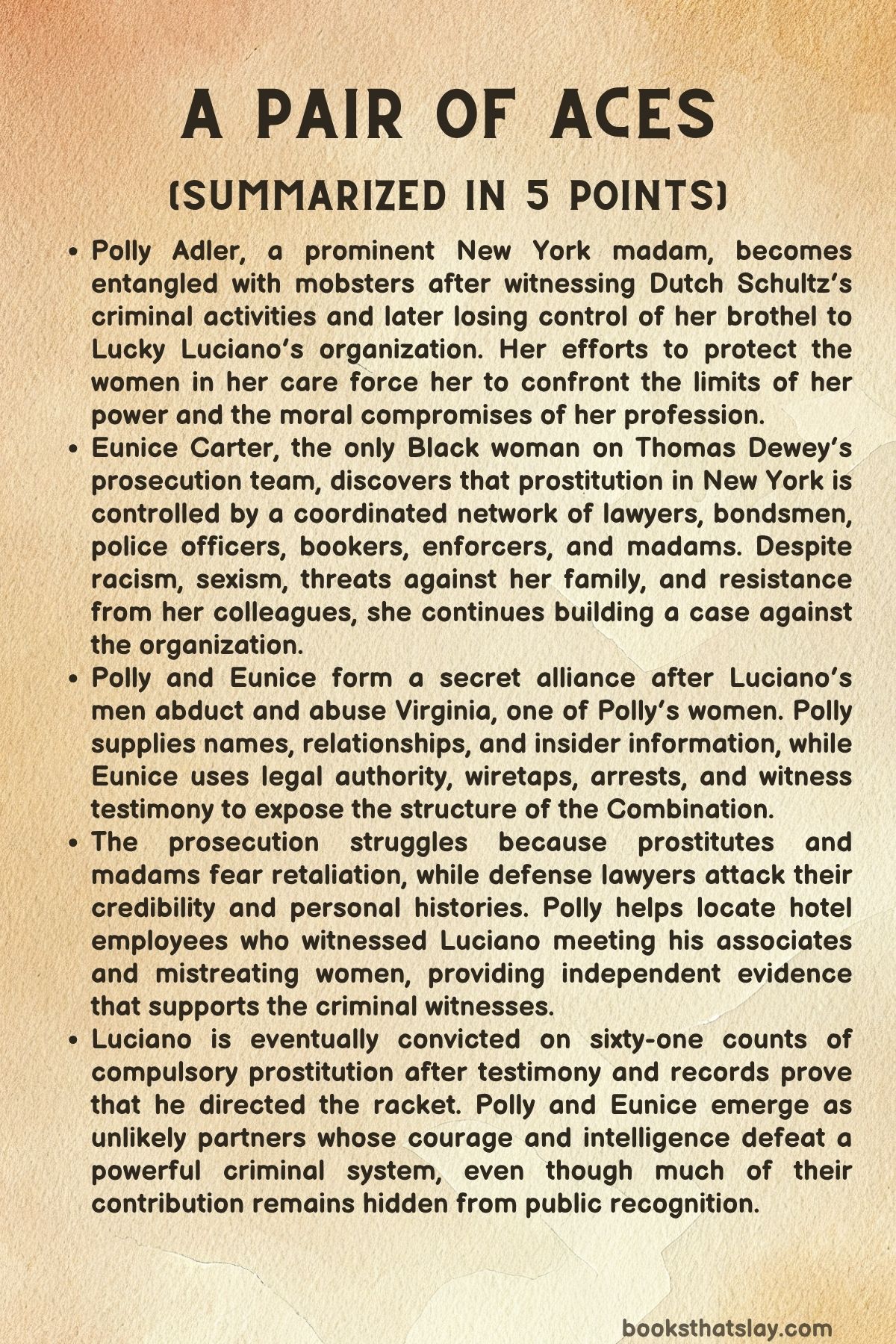
Characters
Eunice Carter
Eunice Carter is the intellectual and moral center of A Pair of Aces, combining legal discipline with a fierce determination to make invisible women visible. As the only Black woman on Dewey’s team, she must prove herself in an environment where colleagues often see her appointment as symbolic rather than evidence of her ability.
Her investigation begins with complaints and court records that other prosecutors consider insignificant. Eunice recognizes patterns among lawyers, bondsmen, brothels, police officers, and repeated arrests, showing that her greatest professional strength is her ability to perceive an organized system where others see unrelated events.
Eunice’s ambition is never presented as simple personal advancement. She believes her work can protect Harlem, challenge public corruption, and expose the men who profit from women while respectable society blames the women themselves.
Her determination also produces painful consequences. Junior interprets being sent to Barbados as another sign that his mother values work more than him, while Lisle increasingly feels displaced within their marriage.
Eunice sometimes conceals threats and professional crises because she fears Lisle will use them as reasons for her to resign. This secrecy protects her independence but prevents genuine partnership, demonstrating how discrimination forces her to manage danger privately.
Her compassion distinguishes her from many male prosecutors. She protects Virginia even when doing so costs the case a witness, and she wins cooperation by treating imprisoned women as frightened human beings rather than morally inferior criminals.
Eunice is also capable of pride and anger. Her argument with Polly reveals that professional exclusion can briefly make her forget the larger purpose of the case, but she accepts criticism and returns with a clearer understanding of whom the prosecution should serve.
By demanding a seat at the trial, she refuses to let Dewey benefit from her labor while hiding her from public view. Her victory lies not only in Luciano’s conviction but also in forcing powerful men to acknowledge that she belongs in the legal arena.
Polly Adler
Polly Adler is the survivor, informant, businesswoman, and morally complicated second lead of A Pair of Aces. She operates a brothel and profits from prostitution, yet she also understands more clearly than most officials how violence, poverty, immigration, sexual abuse, and family abandonment restrict women’s choices.
Her establishment represents an attempt to create control inside an exploitative profession. Polly chooses clients carefully, provides an elegant environment, pays attention to the women’s safety, and rejects pimps who would treat them as transferable property.
That control remains limited because her livelihood depends on corrupt officials, wealthy customers, and gangsters. Dutch Schultz and Lucky Luciano can enter her home, threaten her employees, destroy her property, and claim authority over her women despite everything she has built.
Polly’s abduction, rape, pregnancy, homelessness, and abandonment as a young immigrant explain both her toughness and her resistance to moral judgment. She understands that respectable people often condemn women only after contributing to the circumstances that leave them vulnerable.
Her self-image as a protective madam is shattered when Virginia is taken. Polly can tolerate attacks on her reputation and property, but she cannot accept proof that her influence is no longer sufficient to keep the women safe.
Her decision to contact Eunice requires tremendous courage because cooperation with prosecutors can lead to death. She continues supplying names, relationships, and possible witnesses even when she receives no legal immunity and cannot expect public recognition.
Polly is resourceful in ways formal investigators are not. She understands gossip, personal loyalties, hotel routines, romantic attachments, criminal vanity, and the importance of employees whom powerful men treat as invisible.
Her encounter with Virginia at Saks reveals genuine growth. Polly refuses to expose Virginia’s new identity or ask her to testify, accepting that protection sometimes means allowing a person to leave without demanding gratitude or service.
Polly remains morally compromised because she continues to profit from prostitution and initially protects only her household. Nevertheless, her actions broaden as she witnesses the Combination’s treatment of women throughout the city, and she begins imagining a legacy based on telling their stories rather than managing their labor.
Thomas Dewey
Thomas Dewey is an ambitious prosecutor whose campaign against organized crime depends heavily on Eunice’s work. He is disciplined, politically aware, and willing to pursue dangerous criminals, but his vision is constrained by his assumptions about which offenses and which people deserve institutional attention.
Dewey initially dismisses prostitution as a collection of minor cases involving women already considered immoral. His reaction reveals how the legal system overlooks organized exploitation when the victims occupy a socially condemned position.
Once Eunice presents strong evidence, Dewey provides wiretaps, officers, and authority for the raids. He can recognize an effective strategy, but he generally does so only after Eunice has overcome the prejudice surrounding her assignment.
His exclusion of Eunice from the trial team exposes the limits of his progressivism. Rather than openly expressing racial prejudice, he frames the decision as concern about juries, publicity, and presentation, allowing discrimination to appear practical.
Dewey ultimately gives Eunice a place at the prosecution table after she forces the issue and produces decisive evidence. He is therefore capable of change, but that change depends on pressure from the very people his institution marginalizes.
Lucky Luciano
Lucky Luciano represents organized exploitation disguised as modern business management. He rarely displays Dutch Schultz’s emotional unpredictability, but his controlled manner makes him more dangerous because he converts violence into an efficient and repeatable system.
Luciano treats prostitutes as units of labor that can be transported, scheduled, priced, punished, and replaced. His Combination removes even the small degree of independence some women and madams previously possessed.
His assault on Polly and abduction of Virginia reveal the force supporting his administrative structure. Lawyers, bondsmen, enforcers, corrupt officers, and bookers may perform different functions, but all ultimately protect Luciano’s authority.
At trial, Luciano relies on respectability, expensive clothing, false identities, and blanket denials. His downfall occurs when witnesses from different social positions confirm the same pattern and expose the businessman’s appearance as another criminal disguise.
Dutch Schultz
Dutch Schultz is a volatile and openly violent mobster who pulls Polly into organized crime before she understands the consequences. His arrival at the Algonquin and later occupation of her house demonstrate how easily criminal power enters spaces that appear respectable.
Dutch does not treat Polly as an equal business owner. He expects access, obedience, entertainment, secrecy, and loyalty, turning her establishment into an extension of his criminal operations.
His reaction to Polly’s phrase about Dewey receiving a beating shows his dangerous literalism and readiness to solve opposition through physical violence. His intention to kill Dewey eventually leads other mob leaders to authorize his murder, proving that individual power remains subordinate to the syndicate’s survival.
Dutch’s warning that a known criminal can never become respectable also predicts Polly’s failed attempts to enter legitimate business. Although his conclusion is cynical, society’s rejection of Polly repeatedly proves that criminal identity can become a permanent social sentence.
Lisle Carter
Lisle Carter is Eunice’s husband, a respected dentist and community figure whose fear for his family gradually mixes with insecurity about his wife’s growing prominence. His concerns are not entirely unreasonable, since gangsters threaten Junior and leave warnings outside their home.
However, Lisle repeatedly presents Eunice’s resignation as the only acceptable solution. He struggles to imagine a marriage in which her professional calling deserves the same respect his career has always received.
His wounded pride becomes clearer when Eunice attracts public admiration and his friends joke that she is doing a man’s work. Lisle misses being the more prominent partner, even though he loves her and understands her abilities.
Eunice’s absence from his award ceremony deepens the conflict because it confirms that her work can consume every other obligation. His later attendance at the Luciano trial marks an important change, as he finally sees how thoroughly her ideas shaped the prosecution.
Lisle’s pride in “Attorney Eunice Carter” signals movement toward a more equal marriage. Their problems are not magically resolved, but he begins to support her identity rather than asking her to reduce it.
Addie Hunton
Addie Hunton is Eunice’s mother, a fearless civil rights activist whose example shapes her daughter’s ambition. She represents a generation of Black women who accepted personal sacrifice as part of the struggle for social change.
Her long absences during Eunice’s childhood created emotional wounds that reappear when Junior feels abandoned. Addie therefore embodies both the inspiration and the cost of living for a public cause.
She does not dismiss Eunice’s fear or pretend that ambition is painless. Instead, she reminds her daughter that meaningful work carries consequences and that courage is part of their family inheritance.
Addie’s refusal to flee from mob threats reflects her defiance. By traveling to Barbados to protect Junior, she also allows Eunice to continue the prosecution while taking direct responsibility for the family’s safety.
Murray Gurfein
Murray Gurfein is Eunice’s closest professional ally within Dewey’s office. He listens to her theories, supports her conclusions, and treats her as a capable colleague when many others view her through race and gender.
His support is valuable because it does not require Eunice to minimize her intelligence or ambition. Murray helps persuade Dewey that the prostitution investigation deserves resources and recommends placing Eunice in charge of the female witnesses.
He also recognizes that the prosecution cannot succeed without women who understand the operation from inside. His willingness to respect Eunice’s methods distinguishes him from prosecutors who rely primarily on intimidation and moral judgment.
Murray does not rescue Eunice from discrimination, but he uses his position to validate work that should have been recognized on its own merits. He represents the importance of professional allies who listen, credit, and advocate without attempting to take ownership.
Virginia
Virginia is one of Polly’s most valued women and the person whose suffering transforms the conflict into a personal mission. Her abduction proves that Luciano considers every prostitute the property of the Combination.
After escaping, Virginia nearly identifies Luciano but becomes terrified when Abe Karp arrives. Her fear demonstrates how the organization controls women through lawyers who appear to offer protection while actually monitoring their silence.
Virginia’s survival depends on Eunice choosing compassion over immediate legal advantage. Eunice helps her disappear, and Polly later protects her new identity rather than asking her to return as a witness.
Her reappearance as a Saks employee provides one of the story’s clearest images of freedom. Virginia does not defeat Luciano in court, but she defeats the identity imposed on her by building a life beyond prostitution.
The Lion
The Lion is Polly’s housekeeper, confidante, and fierce protector. Her loyalty began after Polly helped her reach an injured daughter, creating a bond based on personal kindness rather than payment alone.
She understands the prostitution trade without sharing Polly’s illusions about it. After Virginia’s abduction, the Lion directly condemns the Combination for industrializing abuse and treating women as merchandise.
Her presence gives Polly emotional stability and a form of family that her biological relatives failed to provide. She remains beside Polly through financial decline, relocation, threats, and disgrace.
The Lion also functions as Polly’s conscience. She does not deny Polly’s responsibility as a madam, but she helps distinguish between the limited protection Polly attempted to offer and the complete ownership imposed by Luciano.
Junior Carter
Junior Carter represents the private cost of Eunice’s public mission. Although sending him to Barbados is intended to save his life, he interprets the decision through earlier memories of being sent away while his mother pursued her law examinations.
His anger forces Eunice to confront the similarity between her own choices and Addie’s absences during her childhood. Through Junior, the novel asks whether children can understand sacrifices made in the name of justice when those sacrifices feel like rejection.
Junior is not simply an obstacle to Eunice’s ambition. He is a reminder that worthy work can still cause pain and that good intentions do not erase a child’s emotional experience.
Mabel
Mabel is a Columbia graduate student who works at Polly’s house only one night each week. Her presence challenges stereotypes about prostitutes by showing that women may enter the trade temporarily for education or financial survival rather than because of a fixed identity.
Polly’s concern for Mabel reveals her desire to help at least some women leave. She offers financial support and encourages Mabel to finish her education before the Combination can seize control of her life.
Mabel also demonstrates how close respectable institutions and the underground economy exist beside one another. A woman can be a university student and a prostitute at the same time, even though society insists on treating those identities as mutually exclusive.
Red Sadie
Red Sadie is a madam who cooperates with the Combination and allows bookers to control the women in her establishment. Unlike Polly, she initially appears willing to accept the organization’s authority when it offers financial and legal protection.
Her silence in custody comes from fear rather than devotion. She understands that imprisonment may be temporary, while retaliation from the Mob could follow her for the rest of her life.
Eunice breaks her resistance by presenting specific information and offering protection. Once Sadie names Luciano as the Boss, she provides the first clear accusation connecting the prostitution system to its highest leader.
Red Sadie remains morally compromised, but her testimony illustrates why criminal witnesses cannot be divided neatly into innocent victims and willing perpetrators. She has benefited from the system while also living under its threats.
Mildred Balitzer
Mildred Balitzer becomes a vital witness because of her relationship with Pete Harris. Her emotional attachment gives prosecutors leverage, but it also provides direct evidence about Luciano’s authority over his bookers.
She testifies that Luciano referred to Pete as one of his best men and refused to release him from the operation. This conversation shows that Luciano personally understood and controlled the employment structure supporting the Combination.
Mildred’s addiction gives the defense an easy means of attacking her credibility. Her importance therefore lies not only in what she knows but also in the need for independent witnesses who can confirm parts of her account.
Nancy Presser
Nancy Presser is a former prostitute who spent time close to Luciano and overheard conversations he believed would remain private. She can describe his instructions about prices, punishment, expansion, payments, and the movement of women.
Her testimony exposes the gap between Luciano’s public image and his private authority. He does not merely associate with members of the Combination; he gives operational commands and discusses the women as sources of profit.
The defense attacks Nancy’s addiction and sexual history, using social prejudice to imply that a prostitute cannot be truthful. Her physical distress on the witness stand shows how legal proceedings can reproduce the humiliation imposed by the criminal system.
Marjorie Brown
Marjorie Brown is a young Waldorf chambermaid whose testimony gives the prosecution independent credibility. Luciano and his associates treat her as invisible, never imagining that a hotel worker might remember their faces, conversations, and treatment of women.
Marjorie has no criminal record, immunity agreement, or financial motive. She agrees to testify because she cannot ignore what she witnessed, even after Eunice warns her about the danger.
Her courage embarrasses older male employees who initially refuse to cooperate. By accepting responsibility, she encourages them to reconsider and demonstrates that social change often depends on ordinary people refusing to remain silent.
Walter Winchell
Walter Winchell is a famous gossip columnist and one of Polly’s trusted regulars. Their shared Russian Jewish background creates a sense of kinship because both have risen within professions where powerful people still treat them as outsiders.
Winchell represents the connection between crime, celebrity, journalism, and elite entertainment. His presence helps protect Polly’s reputation, but it also contributes to the public fascination surrounding her identity.
He cares about Polly without fully understanding her danger. Like many of her respectable clients, he can move in and out of her world while she must live permanently with the consequences.
Regina Anderson
Regina Anderson is Eunice’s friend and confidante within Harlem’s cultural and civic community. She helps Eunice examine whether Lisle’s opposition comes entirely from fear or partly from discomfort with her public success.
Regina initially questions whether any professional achievement is worth risking a marriage and family. After listening to Eunice describe the importance of choosing her own identity, she better understands why resignation would feel like surrender.
Her conversations provide Eunice with a space to speak honestly outside the prosecutor’s office and home. Regina’s role demonstrates the value of women who challenge one another without demanding conformity.
Abe Karp
Abe Karp is a disbarred lawyer who serves the Combination while pretending to protect arrested women. His professional knowledge allows the organization to monitor prostitutes, control testimony, arrange releases, and maintain fear.
His arrival after Virginia’s arrest reveals the true function of Mob legal assistance. The lawyer is not there to defend Virginia’s rights but to determine what she has said and return her to the organization’s control.
Karp demonstrates how corruption can transform legitimate institutions into instruments of coercion. The Combination’s power depends not only on physical violence but also on professionals willing to misuse the law.
Polly’s Parents
Polly’s father sends her to America at twelve with the expectation that she will earn money for the family. He later uses her financial support without fulfilling his promise to bring her mother and brothers to safety.
When he finally learns how she earned the money, he condemns and disowns her. His reaction allows him to claim moral superiority without accepting responsibility for the abandonment that left her vulnerable.
Polly’s mother responds with sorrow but offers a brief gesture of affection before leaving. Her silence reflects limited power within the family, although it cannot undo the pain caused by decades of absence.
Together, Polly’s parents represent the hypocrisy of benefiting from a woman’s survival while rejecting the choices she made to survive. Their judgment deepens Polly’s understanding that the Lion and the women in her household have become her true family.
Themes
Women Claiming Authority in Male-Controlled Worlds
Professional and criminal institutions repeatedly insist that women may participate only under male supervision. Eunice is permitted to join Dewey’s office, but her colleagues expect her to handle minor complaints rather than develop a major prosecution.
Polly has built a successful enterprise, yet Dutch and Luciano can enter it and behave as though her ownership does not exist. Both women therefore occupy positions that appear powerful while remaining vulnerable to men who control law, violence, money, and public legitimacy.
Their response is not simply to imitate male authority. Eunice builds her case through careful attention to women whom other prosecutors dismiss, while Polly uses personal relationships, observation, gossip, and knowledge of hidden social spaces.
A Pair of Aces shows that authority must be claimed repeatedly because formal titles alone do not guarantee respect. Eunice must force Dewey to give her a seat at the trial, and Polly must risk her life to challenge criminals who treat her home as their property.
Their alliance allows each woman to compensate for the other’s limitations. Eunice has legal power but lacks access to the underworld, while Polly has information but lacks institutional protection.
Together, they demonstrate that women can change systems when they stop accepting the boundaries imposed on them. Their victory does not erase discrimination, but it proves that exclusion can be confronted through strategy, solidarity, and refusal.
Exploitation Hidden Beneath Social Respectability
The Combination survives because its violence is concealed behind respectable professions and institutions. Lawyers arrange releases, bondsmen provide bail, police officers forget arrests, politicians accept bribes, and businessmen use brothels while publicly condemning prostitutes.
Luciano strengthens this disguise by presenting himself as a polished businessman. His expensive clothes, luxury residence, false name, and disciplined behavior separate him from the disorder associated with street crime, even as he profits from compulsory prostitution.
The trial exposes how respectability shapes credibility. Defense attorneys portray prostitutes and addicts as natural liars, although these women possess the closest knowledge of the criminal operation.
Marjorie Brown and the Waldorf employees become valuable partly because jurors are more likely to believe hotel workers than women who sell sex. Their testimony is important, but the difference in how society receives them reveals a serious moral imbalance.
Polly’s clients also participate in this hypocrisy. Wealthy men enjoy her hospitality in private while preserving public reputations that depend on keeping women like her socially disgraced.
The book argues that exploitation continues when respectable people benefit from it without acknowledging their involvement. Organized crime is not isolated from lawful society; it is supported by professionals, institutions, customers, and prejudices that make certain victims easy to ignore.
Survival, Choice, and Moral Compromise
Polly’s history challenges the idea that survival choices can be judged without considering the conditions surrounding them. She enters prostitution after rape, pregnancy, dismissal, homelessness, family rejection, and a lack of educational opportunities.
Her later success gives her money and influence, but it does not erase the coercion that shaped her path. She becomes both a victim of exploitation and a person who profits from a system that exploits others.
Eunice faces a different set of choices. She possesses education and family support, yet racism and sexism restrict how her abilities are recognized, while threats against Junior and Lisle turn professional commitment into a moral risk.
Neither woman remains morally pure. Polly protects her own establishment before considering women elsewhere, and Eunice participates in raids that imprison frightened prostitutes to pressure them into testifying.
Their decisions become more ethical as they accept responsibility for consequences beyond their immediate interests. Polly risks herself for women outside her household, while Eunice insists that witnesses be treated as people rather than disposable tools.
Virginia’s escape becomes the clearest test of their values. Both women refuse to use her for personal or professional gain, allowing her to build a new identity even though her testimony might strengthen the case.
The story presents morality as a series of choices made under pressure rather than a simple division between lawful and criminal people. Survival may require compromise, but compassion determines whether those compromises become permanent excuses.
Alliance Across Race, Class, and Social Division
Eunice and Polly begin with strong reasons to distrust each other. Eunice sees Polly as a criminal profiting from prostitution, while Polly sees Eunice as a prosecutor who could destroy her livelihood and expose her to Mob retaliation.
Their racial, religious, educational, and economic experiences also differ. Eunice cannot hide her Blackness in a racist society, while Polly can sometimes pass through respectable spaces until her criminal history or Jewish immigrant background becomes known.
Their argument over whose life has been more difficult reveals the danger of turning suffering into a competition. Eunice has faced racial discrimination and violence, while Polly has endured abandonment, rape, poverty, and social exclusion.
Neither woman can fully inhabit the other’s experience. Their relationship becomes stronger when they acknowledge those differences without ranking them.
Shared action gradually replaces suspicion. Polly provides information Eunice cannot obtain through official channels, and Eunice gives Polly a path to resist Luciano that does not depend on another gangster.
Their partnership also changes the purpose of the prosecution. What begins as an investigation into organized crime becomes an effort to expose the machinery that treats vulnerable women as property.
They never become conventional friends because their values and positions remain too different. Their achievement comes from creating trust without demanding complete agreement, proving that solidarity can exist across deep social divisions when people recognize a common injustice and accept the risks of confronting it.