But Won’t I Miss Me Summary, Characters and Themes
But Won’t I Miss Me by Tiffany Tsao is a speculative novel that turns motherhood into a question of identity, bodily ownership, memory, and survival.
Its world accepts “rebirth” as an ordinary biological part of childbirth: a new maternal self emerges, grows rapidly, kills and consumes the previous woman, and continues her life with enhanced abilities. Against that accepted system, the story follows two versions of the same woman and the son claimed by both. What begins as one mother’s fear of losing herself gradually becomes a much larger examination of who has the right to define personhood, motherhood, sacrifice, and choice.
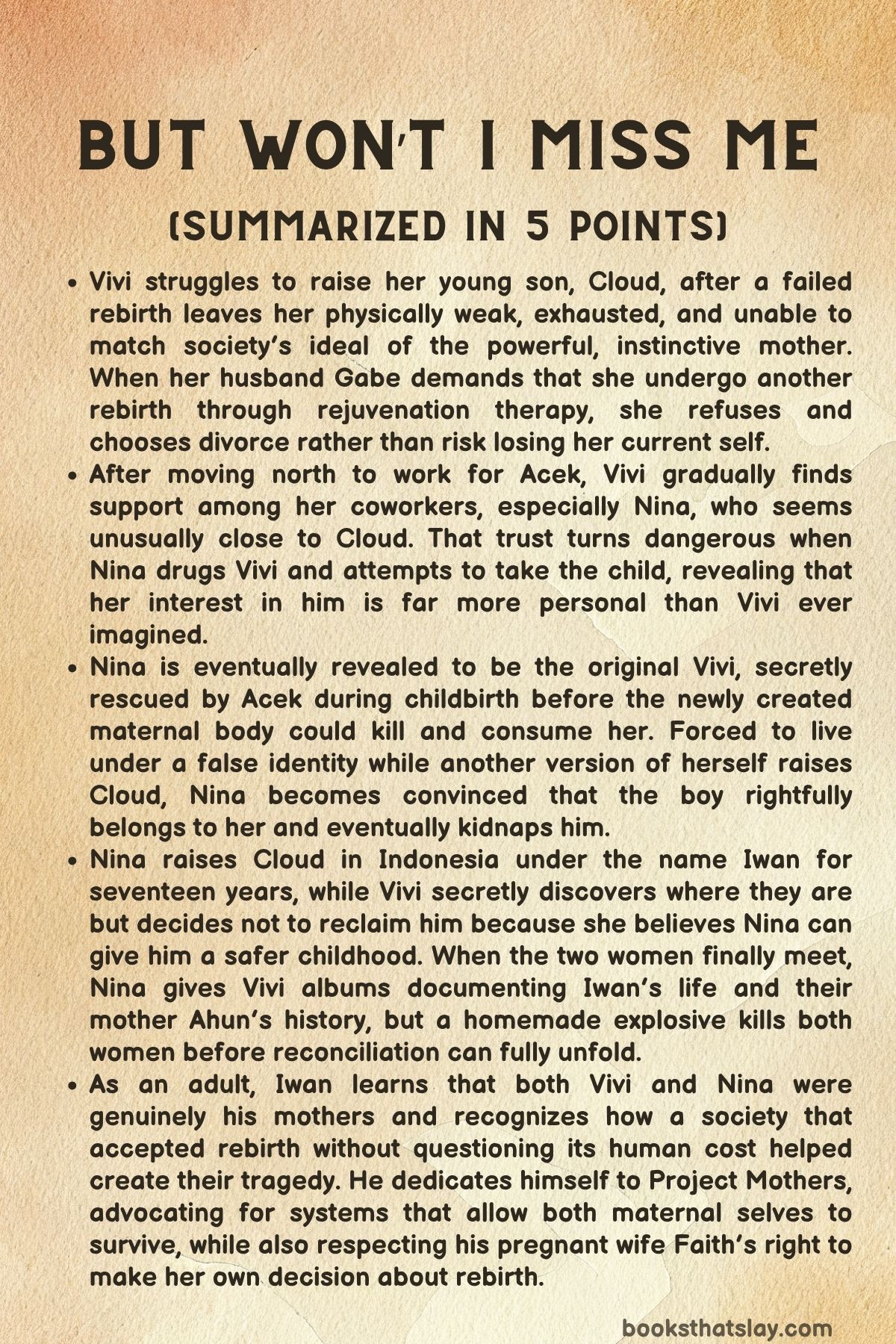
Summary
Vivi lives with her almost two-year-old son, Cloud, in a neglected country rental after separating from her husband, Gabe. She has returned to work for Acek, the older family friend who once taught her electronics, but her damaged shoulder, chronic weakness, poor memory, and exhaustion make both employment and childcare difficult.
Her physical problems are connected to what happened after Cloud’s birth. In Vivi’s society, childbirth is normally followed by rebirth, during which a second version of the mother emerges from her body, rapidly matures, consumes the original body, and inherits both her identity and the biological advantages believed necessary for motherhood.
Vivi remembers awakening after Cloud’s delivery feeling remarkably healthy. While feeding him, however, she discovers bone and flesh between her teeth and dried blood under her nails, physical evidence of the death and consumption that society treats as an unremarkable part of becoming a mother.
Long before Cloud was born, Vivi had been terrified of this process. Although she and Gabe wanted a child, pregnancy forced her to confront the knowledge that the woman entering the delivery room would technically die and that another being, however similar, would walk away carrying her memories and name.
Medical literature describes rebirth as beneficial and natural, but Vivi finds a recording by Greta Wilde showing the violence of the process. The images make it impossible for her to accept society’s comforting language, because she sees that continuity of memory does not necessarily mean continuity of the physical person who feared death in the first place.
Gabe cannot fully understand her terror. He approaches life with an optimistic belief in moving forward, while Vera, Vivi’s older sister, treats rebirth as routine and assumes childbirth itself should be Vivi’s main concern; Acek is one of the few people willing to hear Vivi say plainly that she wants her baby but does not want to die.
At first, the rebirth appears successful. Vivi experiences extraordinary energy, physical power, mental clarity, abundant milk production, and an instinctive understanding of Cloud, exactly the advantages society promises to new mothers.
Within days, those abilities begin disappearing. Vivi becomes weaker than before, struggles to remember things, produces too little milk, develops persistent pain, and finds ordinary childcare exhausting; doctors eventually diagnose malabsorption, believing that her new body somehow failed to absorb enough nutrients during the consumption of her former self.
The medical explanation does little to repair the damage to her life. Gabe initially takes on more household work, but concern gradually becomes frustration as Vivi continues missing appointments, forgetting tasks, struggling to maintain the house, and failing to perform motherhood according to the standards created by healthy reborn women.
A specialist recommends rejuvenation therapy, which would subject Vivi to another induced rebirth. Although Gabe initially claims the choice belongs to her, he increasingly invokes the treatment whenever something goes wrong until he finally tells Vivi that she must undergo rejuvenation or accept the end of their marriage.
Vivi chooses divorce. Whatever benefits another rebirth might offer, she refuses to submit to a process that she understands as her own death and replacement, even when Vera calls the decision selfish and Gabe believes treatment would make her a more capable mother.
She takes Cloud north and returns to the hobbling trade she once practiced with Acek. At Arvin’s Hobbling Services she works with Nina, Zoe, Lina, and Libby, repairing older appliances so that they can function on the modern RDC electrical system, while Cloud often accompanies her and interrupts her work with the demands and unpredictability of toddlerhood.
The workplace gradually becomes a substitute community. Zoe helps without making Vivi feel judged, Lina irritates her with unwanted parenting advice but later reveals unhappiness in her own family life, and an elaborate Lunar New Year celebration briefly gives Vivi the sense that she and Cloud may have found somewhere they belong.
Nina becomes especially important. During a trip to buy secondhand parts, she shows an unexpected ease with Cloud, takes Vivi and the child to the beach, and protects Vivi when encounters with physically powerful reborn mothers worsen her insecurity.
When Nina says she cannot have children, Vivi begins to understand that her difficult, imperfect life with Cloud may still appear precious to someone else. The moment gives Vivi a temporary sense of perspective, although she remains troubled by Acek’s emotional distance.
Acek soon suffers a serious arterial blockage and requires emergency surgery. While waiting at the hospital, Vivi remembers how deeply he shaped her childhood after her family moved from Indonesia, supporting the household when her grieving father withdrew and recognizing Vivi’s technical talent when she dismantled a broken television.
At the hospital, Vivi tells Nina the full story of Gabe’s rejuvenation ultimatum. Nina responds that Vivi’s fear was never ridiculous, offering the recognition she has rarely received, yet afterward Nina unexpectedly becomes cold and begins avoiding her.
Acek survives, but his continued distance and Nina’s withdrawal leave Vivi increasingly isolated. She slips further into what she calls “machine mode,” a state in which she performs parenting and work tasks automatically while emotionally separating herself from what she is doing.
One evening Cloud has a violent tantrum, and Vivi grips his arms harder and harder while demanding that he stop. A knock at the door breaks the moment, and Vivi is horrified by the realization that without the interruption she might have seriously injured her own son.
The visitor is Nina, who apologizes for her recent behavior and brings beer. After helping clean the house, she drinks with Vivi, but Vivi soon realizes that she has been drugged; as consciousness disappears, Nina promises that she will take good care of “our son.”
Nearly twenty years later, Nina is living in Medan, Indonesia, and Cloud is now a teenager named Iwan. He believes his father died when he was a baby and has no knowledge of the secret on which his life with Nina has been built.
Acek calls Nina from Australia after someone breaks into his house and opens a locked drawer containing her address. Nothing has been stolen, making the intrusion unmistakable: Vivi has finally discovered where Nina and Iwan live.
The story then reveals that Nina is not simply another woman who wanted Vivi’s child. Nina is the original Vivi, the woman who entered the hospital to give birth and should have been killed and consumed during rebirth.
Acek secretly entered the rebirth room through the hospital sewer system and removed the unconscious original before the newly generated Vivi could consume her. He left pig organs behind as substitute nourishment, allowing the new Vivi to awaken believing that her rebirth had occurred normally.
Acek believed he was rescuing the girl he regarded almost as a daughter. His decision was influenced by his experiences working beneath rebirth rooms, where he had seen remains of women flushed away, and by his promise to protect Vivi after the death of her mother, Ahun, who had been his closest childhood friend.
The rescued original awakens to discover that society considers the newly reborn woman the legitimate Vivi. Returning openly would expose Acek’s crime and leave the original woman vulnerable to being treated as a biological remnant rather than as a person.
Acek creates a new identity for her as his supposedly orphaned niece, Nina. She undergoes cosmetic surgery and moves with him to the country, where she gradually establishes a new existence but remains unable to accept that Cloud, whom she carried and delivered, now belongs to another version of herself.
Nina secretly watches Acek meet the reborn Vivi and baby Cloud. Her initial sympathy for Vivi’s illness becomes mixed with possessiveness, while Acek realizes that his rescue caused the replacement Vivi’s malabsorption because she never received the nourishment she was biologically expected to obtain from consuming the original body.
When Vivi later decides to divorce Gabe and move near Acek with Cloud, Nina suddenly has access to the child she considers hers. Nina and Acek begin planning to take Cloud permanently, even though doing so may require Vivi’s death.
For roughly a year they prepare false documents, create a soundproofed room for Cloud, and choose Medan as Nina’s destination. Nina is supposed to earn Vivi’s trust, sedate her, drown her, and disappear with the boy.
Living beside Vivi complicates that plan. Nina sees how hard Vivi works, watches other employees support her, recognizes her suffering among healthy mothers, and realizes that the woman she has tried to regard as a fraudulent replacement experiences many of the same fears that once belonged to her.
Nevertheless, Nina eventually carries out the kidnapping. She puts one of Acek’s sedatives in Vivi’s drink, gathers the necessary belongings and documents, creates a false trail suggesting that Vivi has headed toward Darwin, and prepares to drown her.
Nina cannot kill Vivi while Cloud is nearby, so she takes him to Acek’s house first. When she returns, Vivi has disappeared, leaving Nina to flee with Cloud, rename him Iwan, and build a new life in Indonesia.
Seventeen years later, Vivi finally confronts Nina in Medan. Nina expects revenge, but Vivi reveals that she had discovered Cloud’s location years earlier by tapping Acek’s telephone line and had deliberately chosen not to reclaim him.
The night of the kidnapping changed Vivi’s understanding of herself as a mother. After realizing how close she had come to hurting Cloud during his tantrum, she concluded that Nina might offer him a safer childhood and allowed him to remain with her until he was old enough to live independently.
Nina gives Vivi two albums she has spent years creating. One records the childhood and adolescence that Vivi missed, while the other preserves memories of Ahun and the family history Nina reconstructed through people such as the elderly Ing Lan.
Nina nevertheless assumes that Vivi’s arrival means the time she borrowed has ended. She activates a homemade explosive intending to kill herself, but Vivi unexpectedly opens the bedroom door before Nina can stop the device, and both women die in the explosion.
Years afterward, Iwan lives in Singapore with his pregnant wife, Faith. The albums and Acek’s later explanation have taught him that he was once Cloud and that two women, each with a legitimate claim to being his mother, died carrying the consequences of a system that insisted only one version could continue living.
Iwan dedicates himself to Project Mothers, arguing that women who exist before rebirth should be recognized as human beings with their own right to continued life. His research uncovers historical societies in which both maternal selves were preserved, providing evidence that the violent modern system is neither biologically nor socially inevitable.
Yet the question becomes personal again because Faith intends to undergo ordinary rebirth. Iwan fears what that means, but after everything he has learned from the lives of Vivi and Nina, he understands that the decision must ultimately remain Faith’s rather than becoming another choice imposed on a woman in the name of motherhood.
Characters
Vivi
Vivi, the reborn mother, is one of the central figures in But Won’t I Miss Me, and her existence challenges the assumption that continuity of memory automatically proves continuity of identity. She awakens after Cloud’s birth believing herself to be the same woman who entered the hospital, yet her body was created during rebirth and only survives because the original Vivi was secretly removed.
Her physical weakness is crucial to her characterization because it leaves her unable to satisfy the standards imposed on reborn mothers. She lacks the strength, stamina, milk production, memory, and intuitive parenting abilities that society has taught everyone to expect, so even routine mistakes become evidence others use against her.
Vivi nevertheless possesses a powerful sense of personal autonomy. Her refusal of rejuvenation is not simple stubbornness; she regards another rebirth as death followed by the continuation of somebody else, making Gabe’s proposed cure unacceptable regardless of the benefits it might bring.
Her relationship with Cloud reveals both devotion and frightening limitation. She loves him enough to endure poverty, divorce, physical pain, and social judgment, but the moment in which she nearly hurts him forces her to accept that love alone does not guarantee that she is currently the safest person to raise him.
Her final decision not to reclaim Cloud is therefore an extreme expression of maternal responsibility as she understands it. By allowing Nina to keep him, Vivi sacrifices the role she fought to preserve because she comes to believe that protecting her son may require accepting a life from which she herself is absent.
Nina / Original Vivi
Nina is the original Vivi, making her both the hidden foundation of But Won’t I Miss Me and one of its most morally difficult characters. Everything she does after being rescued by Acek is shaped by the fact that she has survived a death society had already decided was necessary and has then been forced to watch another person legally inherit her name, husband, family, and child.
Her claim to Cloud feels absolute because she carried and delivered him before being removed from the rebirth room. That biological connection gradually hardens into possessiveness, allowing her to persuade herself that taking him from Vivi is the restoration of something stolen rather than another act of theft.
At the same time, Nina never becomes emotionally simple enough to function merely as an antagonist. Living close to Vivi forces her to recognize the replacement as a suffering person rather than as an artificial intruder, and her compassion repeatedly threatens the kidnapping plan.
Her inability to drown Vivi confirms that her moral instincts survive even after years of preparation. She can drug and deceive the other woman and can take Cloud, but direct murder remains a boundary she cannot finally cross.
The seventeen years she spends raising Iwan are marked by genuine love and continuing guilt. Her albums show her need to return something to Vivi: the record of the son she lost and the history of the mother both versions of Vivi barely knew.
Nina’s final act is tragic because she continues to believe her life is borrowed. Even after building a family and independent existence, she cannot fully escape the cultural belief that only one Vivi should have survived.
Iwan / Cloud
Cloud begins the novel as a demanding toddler whose needs constantly expose Vivi’s physical and emotional limitations. His tantrums, changing appetites, dependence, and ordinary childhood unpredictability make motherhood concrete rather than idealized.
As Iwan, he grows up believing Nina is his only mother and that his father died when he was an infant. His stable childhood is therefore built upon deception, although that deception also reflects the genuine care with which Nina raises him.
Discovering the albums after Nina and Vivi die destroys his simple understanding of family. He learns that he was born as Cloud, that Gabe is his biological father, and that two women existed simultaneously with equally powerful reasons to regard themselves as his mother.
His early inability to understand why either woman feared rebirth shows how thoroughly society has normalized the process. Acek’s challenge that he become worthy of what the women endured eventually pushes him toward a deeper moral understanding.
Project Mothers becomes Iwan’s attempt to transform personal inheritance into social reform. Instead of choosing which mother was authentic, he rejects the system that required such a choice and argues for conditions in which both maternal selves can survive.
His treatment of Faith also demonstrates his growth. He fears her planned rebirth intensely, but he refuses to convert that fear into control, recognizing that respecting a woman’s autonomy must include decisions he personally wishes she would not make.
Acek
Acek functions as protector, mentor, surrogate parent, conspirator, and ultimately one of the principal causes of the tragedy. His affection for Vivi began long before her pregnancy, when he supported her family and recognized the young girl’s technical talent after she dismantled a television.
His decision to rescue the original Vivi comes from genuine love combined with horror at the rebirth system. Having worked beneath hospital rebirth rooms and witnessed the discarded remains of women, he cannot emotionally accept that the child of his beloved friend Ahun should suffer the same fate.
Yet Acek’s compassion becomes destructive because he acts without understanding the consequences. Removing the original prevents the new Vivi from receiving the expected nourishment, causing the illness and weakness that damage her marriage, confidence, and ability to care for Cloud.
Once the deception begins, he repeatedly chooses further deception rather than confession. He creates Nina’s false identity, assists her relocation, considers kidnapping Cloud, and eventually helps prepare a plan that may require Vivi’s death.
His heart attack and increasing emotional distance reveal his accumulating guilt. Seeing both versions of Vivi together makes it impossible for him to maintain the belief that he simply saved one innocent person, because he must confront the suffering inflicted on another.
Acek represents the danger of deciding for someone else in the name of protection. His original motive is loving, but his refusal to respect the consequences of other people’s autonomy creates years of suffering.
Gabe
Gabe begins as charming, sociable, optimistic, and deeply excited by Vivi’s pregnancy. His general philosophy is to acknowledge painful things and then keep moving, an outlook Vivi once finds reassuring because it makes life appear manageable.
Pregnancy exposes the limitations of that philosophy. Gabe cannot understand why Vivi remains frightened by something society describes as ordinary, so his reassurance gradually becomes a refusal to take her fear seriously.
After Vivi’s health deteriorates, he initially responds responsibly by taking on more domestic work. Over time, however, his exhaustion turns into resentment, and he increasingly sees rejuvenation as a solution that should restore not merely Vivi’s health but the efficient wife and mother he expects.
His ultimatum becomes his defining failure. By demanding that Vivi undergo another potentially fatal transformation or lose her marriage, Gabe treats bodily autonomy as negotiable when it conflicts with family convenience.
He is not presented simply as cruel, because he is also overwhelmed by the practical reality of their household. His failure lies in allowing those pressures to convince him that another person’s body can become the price of preserving the family he wants.
Vera
Vera is Vivi’s older sister and a figure associated with capability, responsibility, and conventional expectations. After their family migrates from Indonesia and their father withdraws into grief, Vera assumes a substantial burden within the household.
Her successful rebirth makes her an intimidating comparison for Vivi. Vera possesses the enhanced strength and efficiency that Vivi lacks, reinforcing the cultural expectation that motherhood should transform women into more capable versions of themselves.
Vera loves her sister, but that love does not make her emotionally perceptive about Vivi’s fear. She dismisses Vivi’s anxiety about rebirth and later calls her selfish for refusing rejuvenation, revealing how deeply she has accepted the idea that maternal duty can justify surrendering bodily autonomy.
At the same time, Vera repeatedly helps Vivi after Cloud’s birth by bringing meals and restoring order to the home. She therefore represents a form of care that can be practically generous while remaining limited by an inability to understand another person’s experience.
Ahun
Ahun, Vivi and Vera’s mother, is dead before the central events, but her history influences almost every major decision Acek makes. She was Acek’s childhood best friend, and his lasting attachment to her becomes part of the reason he considers himself responsible for protecting her daughters.
Her own experiences with rebirth complicate the idea that resistance begins only with Vivi. Ahun had struggled emotionally with the knowledge that previous versions of herself had died, suggesting that the cultural celebration of rebirth has always concealed private discomfort.
Her death also ties the family story to racial hostility and displacement. Ing Lan recounts that Ahun was cycling home after delivering medicine when somebody threw a rock that struck her head, and the surrounding anti-Chinese hostility prevents Nina from treating the event as merely accidental.
Ahun consequently survives through memory rather than physical continuity. Nina’s attempt to reconstruct her life becomes an effort to give both versions of Vivi access to a mother whose story had been fragmented by death, migration, and silence.
Faith
Faith is Iwan’s wife and a meteorologist living with him in Singapore. Although she appears only in the final stage of the story, her pregnancy makes the central ethical problem immediate again rather than allowing it to remain safely confined to Iwan’s family history.
Faith intends to undergo conventional rebirth. Her willingness to accept the process shows that women do not all interpret it in the same way and prevents Iwan’s campaign from becoming an argument that one personal response should be imposed on everyone.
Her role is especially important because Iwan fears losing her. He has learned exactly what rebirth can mean, yet he also understands that using fear to control Faith would repeat the same denial of autonomy that harmed Vivi.
Faith therefore represents the future possibility of informed choice. The social system may change, but meaningful change requires allowing women themselves to decide what should happen to their bodies.
Zoe
Zoe is one of Vivi’s coworkers at Arvin’s Hobbling Services and provides an important form of practical kindness. Unlike people who give Vivi advice about how she should parent, Zoe notices when assistance is needed and helps without turning that help into judgment.
Her presence contributes to the workplace becoming a community for Vivi and Cloud. In a society where Vivi constantly feels evaluated against stronger and more efficient reborn mothers, Zoe offers support that does not require Vivi to prove she deserves it.
Zoe may not control the main plot, but she demonstrates what ordinary solidarity looks like. Her behavior stands in contrast to the larger social tendency to respond to struggling mothers with correction rather than care.
Lina
Lina initially appears irritating to Vivi because she gives unsolicited parenting advice. Since Vivi already feels inadequate beside healthy reborn mothers, Lina’s comments intensify the sense that everyone can see her failures.
Her characterization becomes more complicated during the Lunar New Year celebration. She unexpectedly confronts the abusive Jerome and later reveals unhappiness involving her former husband and estranged son, showing that apparent confidence does not mean her own family life is secure.
Lina helps broaden the novel’s portrayal of motherhood and family. People who seem competent from the outside may still carry private losses, regrets, and fractured relationships.
Libby
Libby works alongside Vivi, Nina, Zoe, and Lina in the hobbling business. She receives less individual development than several of the other employees, but her presence matters because the workplace operates collectively rather than as a relationship between Vivi and Acek alone.
Along with the others, Libby helps create the social environment in which Vivi and Cloud receive toys, childcare, food, and companionship. That communal support challenges the assumption that successful motherhood must depend solely on the extraordinary abilities of an individual mother.
Libby is therefore part of the story’s quieter alternative to the rebirth ideal. Instead of transforming one woman into someone capable of doing everything, the workplace shows people sharing responsibility.
Jerome
Jerome is a rival hobbler whose anger over losing a contract to Acek erupts into racist abuse directed at the employees. His appearance is brief, but it connects the workplace’s everyday tensions to the wider history of racial prejudice that affects several characters.
Lina’s decision to confront him is significant precisely because his aggression depends on expecting others to tolerate it. Jerome represents the persistence of open hostility in a society that may be technologically advanced but has not eliminated prejudice.
His behavior also echoes the historical violence associated with Vivi’s family. The story repeatedly shows that technological progress does not automatically produce moral progress.
Greta Wilde
Greta Wilde is the blogger whose recorded rebirth profoundly affects Vivi during pregnancy. Official medical descriptions present the process in sanitized clinical terms, but Greta’s recording shows a new maternal body violently destroying and consuming the woman who existed before it.
For Vivi, Greta provides visual confirmation that her terror has a rational foundation. The video removes the protective language surrounding rebirth and forces her to see the physical destruction that must occur for society’s preferred version of motherhood to continue.
Although Greta does not participate directly in the later events, her influence is substantial. She gives Vivi access to knowledge that society has normalized to the point of making its violence almost invisible.
Ing Lan
Ing Lan is an elderly woman in Medan who remembers Ahun’s family and becomes one of Nina’s links to a history that migration and death have obscured. Nina approaches her for years while pretending to be a relative researching the past on behalf of an Australian cousin.
Ing Lan eventually provides a childhood photograph of Ahun with Acek and recounts the circumstances of Ahun’s death. Her memories allow Nina to reconstruct a family story that neither version of Vivi had been able to preserve independently.
Her observation that strong memory can be both gift and burden captures much of the novel’s emotional structure. Remembering preserves people from disappearance, but it also prevents survivors from escaping the pain attached to what they know.
Leona
Leona is the woman Gabe plans to marry after his separation from Vivi. She is not developed extensively as an independent figure, and most of her importance comes from what the wedding invitation represents to Vivi.
The invitation confirms that Gabe has moved into another life while Vivi continues living with the consequences of their failed marriage and her damaged rebirth. Vivi destroys it in anger but still recognizes that leaving Gabe was a decision she would make again.
Leona therefore functions less as a rival than as evidence of irreversible change. Her presence marks the life Vivi gave up when she refused to surrender her bodily autonomy for the sake of remaining married.
Themes
Identity and the Continuity of the Self
The central identity problem in But Won’t I Miss Me comes from the gap between memory and physical continuity. Rebirth culture assumes that because the new woman possesses the memories, personality, relationships, and social identity of the old one, nothing meaningful has been lost.
The simultaneous survival of Vivi and Nina destroys that assumption. Both remember the same childhood, the same marriage, the same pregnancy, Acek’s influence, Ahun’s death, and carrying Cloud, yet they become separate human beings as soon as they begin accumulating different experiences.
Neither woman can easily be dismissed as false. Nina has physical continuity with the woman who became pregnant and gave birth, while Vivi has the social and psychological continuity recognized by everyone around her.
Their conflict shows that identity cannot be reduced to a single test. Body, memory, relationship, legal recognition, personal experience, and continued consciousness all contribute to how a person understands herself.
The tragedy arises partly because society insists that only one version is entitled to exist. Nina must hide because the culture has no conceptual place for two continuations of one woman, while Vivi unknowingly occupies an identity that the original still experiences as her own.
Iwan eventually reaches the conclusion the earlier generation could not. Instead of determining which woman was the authentic mother, he begins from the premise that both were people and that a moral system should protect both lives.
Motherhood, Bodily Autonomy, and Choice
Motherhood in the story is surrounded by expectations that transform sacrifice from a personal decision into a social obligation. Rebirth is described as natural, useful, and necessary because the new maternal body supposedly receives the strength, energy, milk production, organizational ability, and intuition needed to care for a child.
Vivi’s fear exposes what that language conceals. She wants Cloud intensely but does not believe wanting a child should require accepting the destruction of the person she currently is.
Her refusal of rejuvenation becomes an especially clear assertion of bodily autonomy. Gabe believes another transformation could repair their household, while Vera sees refusal as selfish, but Vivi insists that nobody else can decide that her current existence should end for the benefit of her family.
The story also refuses to idealize maternal choice by showing how difficult choices can become. Vivi eventually allows Nina to keep Cloud because she fears that her emotional collapse could make her dangerous to him, while Nina commits kidnapping because she believes giving birth establishes a superior claim to the child.
The ending with Faith prevents autonomy from becoming merely a slogan against rebirth. Iwan opposes the system and fears Faith’s decision, yet he recognizes that respecting women means allowing Faith to choose differently from Vivi.
The ethical goal is therefore not replacing one compulsory rule with another. It is creating conditions in which motherhood does not erase a woman’s authority over her own continued existence.
Memory, Guilt, and Inheritance
Memory gives the characters continuity, but it also traps them inside consequences that cannot be undone. Vivi repeatedly returns to pregnancy, childbirth, her marriage, and the decline that followed rebirth, while Nina spends years remembering the son she lost and the woman whose life she indirectly damaged by surviving.
Acek is similarly controlled by memory. His recollection of discarded bodies beneath hospital rebirth rooms, his love for Ahun, and his promise to protect her daughters lead him to rescue the original Vivi, but the consequences of that rescue become another burden he cannot escape.
Nina’s albums transform memory from private suffering into something that can be transferred. One album gives Vivi access to the childhood she missed with Cloud, while the other reconstructs Ahun’s history from surviving witnesses.
The albums are acts of restitution because Nina knows that keeping Cloud deprived Vivi of years that can never be returned. She cannot undo the kidnapping, so she preserves as much of the missing life as possible.
Iwan ultimately inherits far more than family information. He receives the fears, errors, ethical questions, and unfinished work of both mothers, and that inheritance becomes the foundation for Project Mothers.
Memory therefore becomes socially productive only when later generations do something different with it. Iwan cannot save Vivi or Nina, but he can challenge the system that made their conflict possible.
Prejudice, Migration, and Belonging
Vivi’s family history places the conflict over rebirth inside a broader experience of displacement. Her family leaves Indonesia following her mother’s death and a period of anti-Chinese violence, while Vivi grows up uncertain about what it means to possess Chinese ancestry without feeling connected to an ancestral China she has never known.
Ahun’s death makes that history especially painful. Ing Lan describes how she was struck by a rock while cycling home after delivering medicine, and although the event can be called an accident, the context of hostility toward Chinese Indonesians makes such a neutral description feel insufficient.
The family’s repeated migrations also complicate belonging. Vivi moves from Indonesia to Australia, later relocates north after her divorce, while Nina eventually returns to Medan under a false identity and raises Iwan there as though this invented life were ordinary.
Iwan continues the pattern by eventually living in Singapore. Each generation carries family history across geographical boundaries while trying to decide which parts of identity come from ancestry, memory, language, place, or personal choice.
Jerome’s racist abuse demonstrates that relocation does not eliminate prejudice. The characters may move between countries and communities, but social hostility can follow them in different forms.
Belonging therefore emerges less as possession of one permanent homeland than as something created through relationships and shared responsibility. The hobbling workplace, Nina’s home with Iwan, and Iwan’s later family all show people constructing forms of home even when inherited identities remain unsettled.