Burn Down Master’s House Summary, Characters and Themes
Burn Down Master’s House by Clay Cane is a historical novel about resistance, survival, and the inheritance of freedom across generations of Black Americans living under slavery.
Beginning on a Virginia plantation and moving through the decades surrounding the Civil War, the story follows people who refuse to accept the identities and limits imposed on them by enslavers, courts, and social systems. Acts of rebellion take many forms: escape, education, love, poisoning, legal claims, armed resistance, and the destruction of the houses that symbolize ownership. The novel also asks a difficult question about power: what happens when someone once oppressed chooses to become an oppressor?
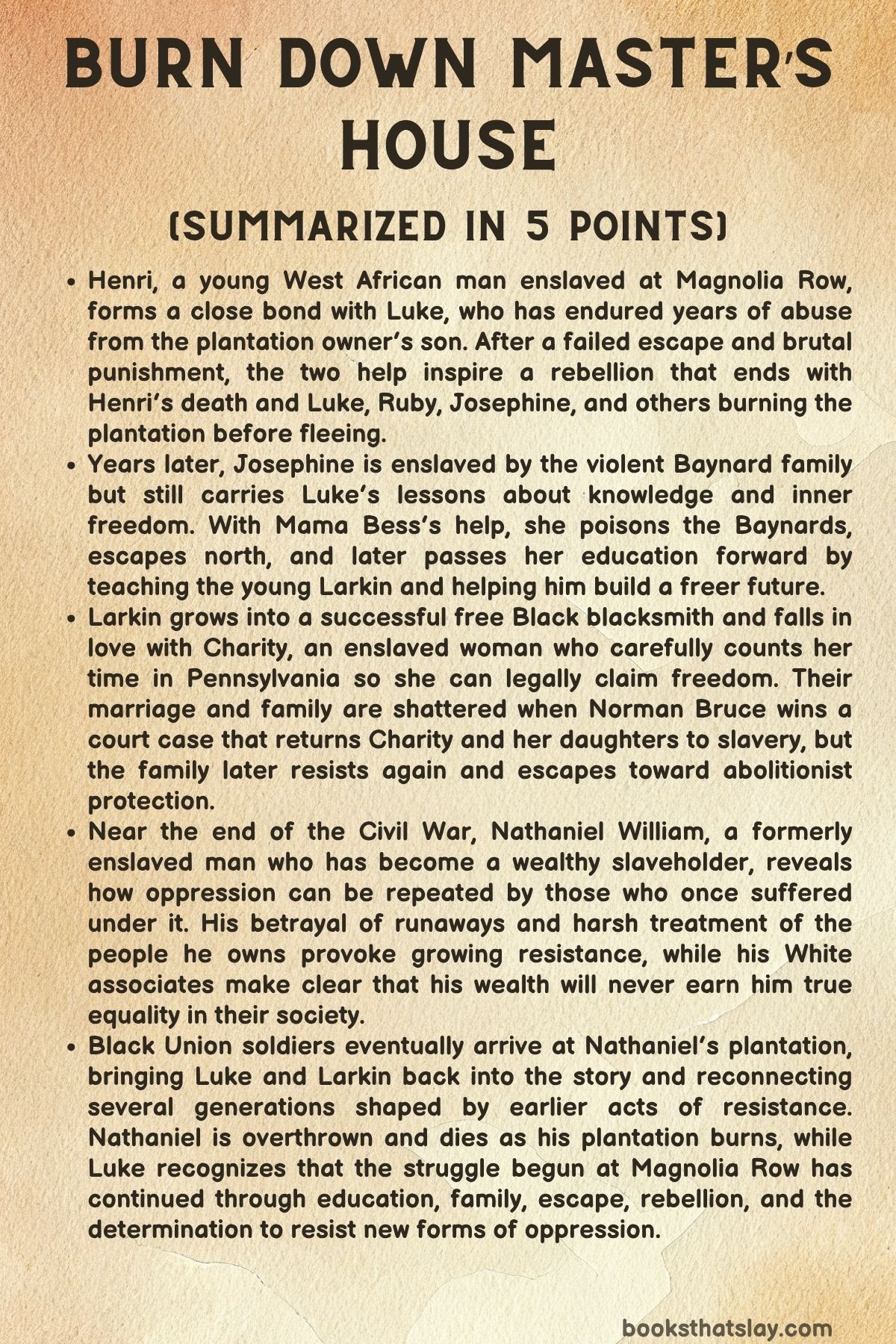
Summary
Henri arrives at Magnolia Row carrying memories that slavery has failed to erase. Taken from West Africa after the destruction of his village and the murder of his mother, he has already learned that obedience cannot restore what has been stolen from him, and his refusal to participate in forced breeding leads to his sale to Montgomery Ragland’s Virginia plantation.
At Magnolia Row, Henri encounters a community surviving different forms of exploitation. Ruby is subjected to Montgomery’s sexual abuse, young Josephine is growing up inside a system designed to control every possibility in her life, and Luke serves Montgomery’s son Junior while enduring years of sexual violence that have left him deeply wounded but still capable of love, intelligence, and resistance.
Henri and Luke gradually form an intimate relationship that belongs to them rather than to the people who legally claim ownership of their bodies. Their bond becomes an assertion of personhood because it allows them to choose affection, loyalty, and desire for themselves in a world where nearly every other choice is restricted.
The brutal punishment of Solomon, who is captured after attempting to run away, reinforces what will happen to anyone who openly rejects the plantation’s authority. Luke is also confronted with another devastating decision when his dying mother, Miss Emily, asks him to help end her suffering, and he fulfills her request with Henri beside him.
Henri and Luke eventually attempt to escape together, believing even enormous danger is preferable to continued enslavement. They are captured, mutilated, and returned to Magnolia Row, yet the violence meant to destroy their will instead convinces them that simply surviving under the Raglands is no longer enough.
As they recover, they secretly prepare to retaliate against the family responsible for so much suffering. Their plan is tied to August 21, a date Luke has shared with Henri, turning something personal between them into the setting for a larger act of defiance.
The attack on the Raglands does not unfold without loss. Montgomery shoots Henri, and as Henri realizes that he will die, his final concern is not preserving the plantation but destroying the physical symbol of the system that controlled them; he tells Luke to burn the master’s house.
Luke, Ruby, Josephine, and other enslaved people set Magnolia Row on fire before scattering toward uncertain futures. Henri dies, but the destruction he helps inspire becomes a memory that survives him, carried by people whose later choices show that resistance can continue long after the person who first encouraged it is gone.
Years later, Josephine is eighteen and enslaved by the Baynard family. Separation from Luke and Ruby has not erased what she learned from them, particularly Luke’s insistence that enslavers cannot own everything inside another human being, but Josephine must repeatedly draw on that belief while facing sexual violence from Lafayette Baynard and physical cruelty from his wife, Lila Anne.
After Lila Anne subjects Josephine to a vicious beating, Mama Bess decides that waiting for mercy is useless. She reveals that she has secretly kept arsenic inside the kitchen clock for years and explains that poisoning has already served as a hidden weapon against people who depended on enslaved labor while assuming those around them would remain powerless.
Josephine accepts the terrible responsibility Mama Bess places before her. She prepares a large meal and poisons the Baynards’ food and tea, killing Lafayette, Lila Anne, and their children while the enslaved community gathers to witness the destruction of the household that has controlled their lives.
With the Baynards dead, Josephine and the others leave before authorities can respond. Their journey north is difficult and dangerous, but reaching free territory allows the group to separate and pursue lives that were previously impossible.
Josephine settles in Pennsylvania with Mama Bess and the young Larkin. She passes forward the knowledge Luke once gave her by teaching Larkin numbers and making certain that he gains access to education, turning learning into something that survives separation, violence, and time.
Mama Bess eventually dies peacefully after experiencing freedom. Her death contrasts strongly with the violence that shaped much of her existence because she has lived long enough to see Josephine and Larkin beginning lives in which their futures are no longer formally owned by another person.
Larkin grows into a successful free Black blacksmith and eventually meets Charity, an enslaved young woman repeatedly rented by Norman Bruce to Clara Petterson. Because Clara travels between Maryland and Gettysburg, Charity spends substantial periods in Pennsylvania, where Larkin explains that state law may recognize her freedom after six months of residence.
Larkin teaches Charity reading and arithmetic, giving her practical tools with which to understand the law governing her own status. Charity carefully counts every day she spends in Pennsylvania, and when her accumulated residence reaches 183 days, she declares herself free rather than waiting for Norman Bruce to acknowledge a freedom he has every incentive to deny.
Charity and Larkin fall in love, marry, and build a family after she becomes pregnant. Their daughters, Harriet and Sophia, represent the future they hoped freedom would protect, yet Norman Bruce refuses to accept Charity’s claim and uses the legal system to challenge both her liberty and the security of her children.
Bruce begins a prolonged campaign to reclaim Charity and her daughters as property. Thaddeus Stevens represents Bruce despite knowing Larkin, and the dispute ultimately reaches Pennsylvania’s highest court, where Charity’s accumulated residence is rejected as a valid basis for permanent freedom.
The legal ruling destroys the safety Larkin and Charity believed they had created. Charity and her daughters are returned to Bruce, demonstrating that laws operating in supposedly freer territory can still serve the interests of slaveholders and dismantle Black families through official authority rather than plantation violence alone.
Back on Bruce’s property, Charity sinks into despair because everything she built with Larkin has been taken from her. Her daughters, however, have inherited the same refusal to submit that shaped the generations before them, and that refusal becomes decisive when Bruce attempts to assault fifteen-year-old Harriet.
Sophia intervenes to protect her sister, and together the girls kill Bruce in the blacksmith shed. Instead of destroying Charity, the crisis revives her determination, and a secret letter from Clara provides instructions that may help mother and daughters reach safety.
Charity leads Harriet and Sophia through storms and dangerous terrain toward an abolitionist refuge identified by a white chimney with a black top. Their arrival there does not erase what they have endured, but it restores their ability to pursue freedom on their own terms and creates another link between resistance and the survival of the next generation.
Decades later, the story turns to Nathaniel William, a South Carolina plantation owner near the end of the Civil War. Nathaniel was once enslaved and bought his own freedom, yet rather than rejecting the institution that oppressed him, he embraces it and becomes a slaveholder and trader who measures his success through money, ownership, and proximity to powerful White men.
Solomon, now older and still carrying the physical marks of Magnolia Row, is among the people Nathaniel enslaves. Nathaniel also pretends to assist fugitives, only to betray them for profit, and his treatment of Evalina and her young son exposes how completely he has transformed personal escape from slavery into participation in the captivity of others.
His actions provoke mounting resistance. Abram attempts unsuccessfully to poison him, while Emma Jane, Solomon, and others consider how to challenge his authority, and even Nathaniel’s White associates eventually make clear that wealth and cooperation will never grant him the racial equality he imagines he has purchased.
Black Union soldiers finally arrive at the plantation, bringing Luke and Larkin back into the story. Luke reunites with Solomon and reveals that Ruby escaped and created a free life, while Larkin explains that Josephine helped him gain freedom and education and that he eventually reunited with Charity and their daughters through abolitionist assistance before joining the Union cause.
These reunions reveal how many lives have been shaped by choices made decades earlier. Henri’s defiance influenced Luke, Luke helped Josephine understand the importance of knowledge and inner freedom, Josephine passed those lessons to Larkin, and Larkin carried them into his relationship with Charity and their children.
Nathaniel’s enslaved workers eventually expose his betrayals and seize control of the plantation. They fasten him to the door of his own house, punish Minister Woodward for supporting the slave trade, and burn the property that Nathaniel regarded as proof of his achievement and authority.
As Nathaniel dies with the plantation, Luke remembers Henri and recognizes the continuity between Magnolia Row and the uprising before him. Burning the house is no longer only one man’s final request but an idea that has survived across decades: institutions built upon ownership and degradation must sometimes be actively destroyed before those trapped within them can imagine another life.
Two months later, the Confederacy falls, but political defeat does not guarantee permanent justice. The ending therefore joins liberation with vigilance, suggesting that slavery may end as a formal institution while domination can return through different laws, customs, economic arrangements, and social hierarchies unless succeeding generations remain willing to recognize and resist it.
Characters
Henri
Henri is the first great force of open rebellion in Burn Down Master’s House, shaped by memories of West Africa and by an understanding that slavery is not his natural condition but a violent system imposed upon him. The murder of his mother and destruction of his village leave him with grief, but they also preserve his knowledge that another way of living existed before captivity.
His relationship with Luke reveals another side of him because resistance is not limited to violence or escape. Henri chooses love in a world that attempts to regulate even intimacy, and his final instruction to burn the house turns his death into an action that influences people he will never live to meet.
Luke
Luke combines intellectual resistance with profound personal trauma. Literate and observant, he understands that knowledge can create a private territory beyond an enslaver’s control, which is why the lessons he gives Josephine remain significant many years later.
His abuse by Junior and the death of Miss Emily expose the enormous emotional burdens he carries. Yet Luke survives long enough to join the Union forces, reunite with Solomon, and witness another plantation fall, making him the clearest living connection between the earliest rebellion and the later collapse of slavery.
Ruby
Ruby represents survival under sexual exploitation and the possibility of rebuilding a life beyond the plantation. Montgomery abuses the power granted to him by slavery to exploit her, placing Ruby among the people whose bodies are treated as possessions rather than their own.
Her participation in burning Magnolia Row shows that she is not defined solely by what Montgomery does to her. Luke’s later revelation that Ruby escaped and established a free life gives her story an important continuation, suggesting that survival itself can become a refusal to let an enslaver determine the final meaning of a person’s life.
Josephine
Josephine grows from a vulnerable girl at Magnolia Row into a woman capable of making one of the novel’s most consequential decisions. The lessons she receives from Luke remain central to her development because they teach her that intellectual identity and self-knowledge can survive even when physical freedom has been taken away.
Her poisoning of the Baynards marks a decisive transformation from endurance to direct resistance. Just as importantly, she later teaches Larkin and protects his access to education, meaning her greatest legacy lies not only in destroying an abusive household but in passing knowledge forward.
Montgomery Ragland
Montgomery represents the plantation master who assumes control over other people is both legitimate and permanent. His sexual exploitation of Ruby and violence against those who resist demonstrate how slavery gives private cruelty the protection of social and legal authority.
His shooting of Henri reveals that violence remains his ultimate answer whenever ownership is challenged. Yet the burning of Magnolia Row proves the limits of his power, because the people he considers property destroy the house meant to symbolize his authority.
Junior Ragland
Junior embodies a form of abuse that operates through proximity and secrecy. Luke’s position as his personal servant gives Junior sustained access to him, and he uses that power for years of sexual violence.
His role also broadens the novel’s portrayal of slavery by showing that domination was not confined to labor or physical punishment. The system enabled enslavers to violate boundaries of body, privacy, and sexuality while leaving the victim almost no recognized means of protection.
Miss Emily
Miss Emily appears briefly but carries enormous emotional importance for Luke. Her final request that he end her suffering places him in an impossible position in which love requires an action that will permanently burden him.
Her death also illustrates how slavery denies people control over even the final moments of life. Luke’s decision to honor her request becomes an intimate act of mercy within a system that offers neither dignity nor relief.
Solomon
Solomon is one of the strongest symbols of endurance in the novel. His punishment after attempting escape from Magnolia Row leaves permanent physical marks, allowing his body to carry visible evidence of what slavery does to those who reject its authority.
Decades later, he remains capable of resistance despite everything he has experienced. His reunion with Luke is especially significant because two men who survived Magnolia Row live long enough to see armed Black soldiers approaching a plantation and the institution that once appeared permanent nearing defeat.
Mama Bess
Mama Bess represents concealed resistance developed through patience, observation, and experience. She has survived long enough to understand the habits and assumptions of enslavers, and the arsenic hidden inside the kitchen clock symbolizes a form of power that exists precisely because the Baynards never imagine she could possess it.
Her decision to entrust Josephine with the poison is also an act of judgment. Mama Bess recognizes that Josephine has reached a point where survival requires action, and her peaceful death in Pennsylvania gives her an ending defined by freedom rather than the household she helped destroy.
Lafayette Baynard
Lafayette embodies sexual entitlement supported by enslavement. His abuse of Josephine depends on the belief that his ownership grants him access to her body and removes any meaningful possibility of refusal.
His death by poisoning reverses the household hierarchy on which he depends. The food prepared by someone he regards as subordinate becomes the means of his destruction, exposing how dependence on enslaved labor can also create vulnerabilities that enslavers fail to recognize.
Lila Anne Baynard
Lila Anne demonstrates that White women within slaveholding households can participate directly in sustaining racial violence. Her cruelty toward Josephine is physical and deliberate, culminating in a beating severe enough to convince Mama Bess that the household must be brought down.
Her actions also complicate any idea that women in patriarchal societies were automatically aligned with enslaved women. Lila Anne may possess less social power than her husband in some respects, but she uses the racial power available to her against Josephine rather than questioning the system that gives it to her.
The Baynard Children
The Baynard children are not independently developed to the same extent as the adults, yet their deaths add moral difficulty to Josephine’s decision. They are members of the household benefiting from slavery, but they have not been shown exercising the same deliberate cruelty as Lafayette and Lila Anne.
Their presence therefore prevents the poisoning from becoming a simple act of uncomplicated revenge. The episode forces the reader to confront how resistance within violent systems can carry consequences that extend beyond the people most directly responsible for oppression.
Larkin Butler
Larkin is one of the clearest examples of knowledge being passed successfully from one generation to another. Josephine teaches him numbers and supports his education, and he later uses what he has learned to explain Pennsylvania law to Charity and help her count the days required for a freedom claim.
He also becomes a loving partner, father, skilled blacksmith, and eventually a Union soldier. His life demonstrates how education changes more than one individual because the opportunities Josephine helped create for him eventually influence Charity, Harriet, Sophia, and the struggle against slavery itself.
Charity
Charity combines patience, intelligence, hope, and fierce maternal determination. Her careful counting of every day spent in Pennsylvania transforms arithmetic into a tool of liberation, while her relationship with Larkin gives her a vision of family life beyond Norman Bruce’s ownership.
Her greatest crisis comes when the legal system strips that freedom away and returns her and her daughters to Bruce. Although despair initially overwhelms her, Harriet and Sophia’s resistance restores her determination, and leading them toward the abolitionist safe house establishes Charity as a mother willing to risk everything to prevent another generation from remaining enslaved.
Norman Bruce
Norman Bruce represents the slaveholder’s belief that ownership should survive distance, time, personal relationships, and even another state’s laws. Charity’s life in Pennsylvania and marriage to Larkin mean nothing to him because he sees her primarily as property whose absence represents a financial and social loss.
His legal campaign demonstrates that slavery depends on institutions as much as individual violence. When he later attempts to assault Harriet, the personal brutality behind his legal claims becomes unmistakable, and his death at the hands of the sisters ends both an immediate threat and the authority he sought to impose over their family.
Clara Petterson
Clara occupies a complicated position because she benefits from a society structured around slavery while also helping Charity at critical moments. Her movements between Maryland and Pennsylvania unintentionally create the circumstances through which Charity accumulates enough time to claim freedom.
Her secret letter later becomes essential to Charity’s second escape. Clara cannot undo the wider system from which she comes, but her assistance demonstrates how individual choices within oppressive structures can either reinforce control or create openings through which other people may survive.
Thaddeus Stevens
Thaddeus Stevens represents one of the novel’s most uncomfortable examples of legal contradiction. Despite knowing Larkin, he represents Norman Bruce in the case that ultimately results in Charity and her daughters being returned to slavery.
His role emphasizes that personal acquaintance and abstract principle mean little when professional and legal institutions continue to validate ownership. Through him, the story shows how injustice can be administered through formal arguments and court decisions without appearing outwardly similar to plantation brutality.
Harriet
Harriet grows up as the daughter of Charity and Larkin, making her life a direct product of the freedom her parents believed they had secured. When that freedom is overturned, she becomes vulnerable to the same system from which her mother tried to escape.
Bruce’s attempt to assault her forces the family into a decisive confrontation. Harriet’s survival and subsequent escape with Charity and Sophia demonstrate how the next generation does not simply inherit trauma but can also inherit resistance and the expectation that captivity should be challenged.
Sophia
Sophia is defined most clearly by her immediate defense of Harriet. When Bruce threatens her sister, Sophia intervenes rather than remaining passive, and the sisters together kill the man who has reclaimed their family through law and now seeks to exercise sexual power over them.
Her action changes Charity as well as protecting Harriet. By refusing to submit, Sophia helps break her mother’s despair and becomes one of the younger characters through whom resistance is shown as an inheritance strengthened by family loyalty.
Nathaniel William
Nathaniel is the sharpest internal contradiction in Burn Down Master’s House because he understands enslavement through personal experience and nevertheless chooses to enslave others. Having purchased his own freedom, he measures success by his ability to imitate the same class of men who once possessed legal power over him.
His downfall exposes the emptiness of that ambition. White slaveholders never truly accept him as an equal, the people he owns despise his betrayals, and the plantation he views as proof of advancement becomes the site of his death.
Evalina
Evalina exposes the cruelty behind Nathaniel’s false claims of helping fugitives. By presenting himself as a source of protection and then betraying her and her young son for profit, Nathaniel turns hope itself into a mechanism for capture.
Her experience is important because it demonstrates that exploitation can become especially destructive when it disguises itself as solidarity. Nathaniel understands exactly why a runaway would trust someone who had once been enslaved, and he deliberately uses that trust for personal gain.
Abram
Abram represents resistance that emerges after betrayal becomes intolerable. Nathaniel’s treatment of Evalina and her child pushes him toward an attempt to poison the man who claims ownership over the plantation community.
Although the attempt does not succeed, Abram’s willingness to act demonstrates that Nathaniel cannot secure loyalty simply because he is Black or formerly enslaved. Shared racial experience does not excuse oppression when Nathaniel has chosen to reproduce the same structure for his own benefit.
Emma Jane
Emma Jane belongs to the group that begins preparing to overthrow Nathaniel from within his plantation. Her participation establishes that resentment against him is not isolated but collective, built from repeated evidence that he values profit and status above the humanity of those he controls.
Through Emma Jane, rebellion appears as organized community action rather than the work of one exceptional individual. Her presence helps prepare the transition from individual anger to the collective seizure of authority that eventually destroys Nathaniel’s plantation.
Minister Woodward
Minister Woodward represents moral and religious complicity with slavery. His support for the slave trade demonstrates how institutions associated with faith can be used to defend economic exploitation instead of challenging it.
His punishment during the uprising shows that the rebels hold enablers responsible as well as owners. The novel thereby expands accountability beyond those who physically possess enslaved people to include figures who provide ideological approval for the system.
Themes
Resistance as an Inheritance
Across Burn Down Master’s House, resistance survives because one person’s refusal becomes another person’s knowledge. Henri does not live to see the distant consequences of burning Magnolia Row, yet his determination affects Luke, whose teachings shape Josephine, whose education of Larkin later influences Charity and their daughters.
The novel therefore presents rebellion as something larger than isolated heroic acts. A person can be killed, separated from loved ones, returned to bondage, or denied justice by a court, but the idea that captivity is illegitimate can continue moving through memory and example.
Fire becomes especially important within this pattern because it destroys the architecture through which enslavers display permanence. Magnolia Row burns after Henri’s death, and Nathaniel’s plantation burns decades later, making the destruction of houses a recurring rejection of the belief that ownership creates lasting authority.
Resistance also changes form according to circumstance. Escape serves one person, literacy another, poison another, law another, family defense another, and military service another, so freedom is never reduced to a single method.
The final warning about oppression returning under different names strengthens this theme. Victory is meaningful, but the story refuses to treat the fall of the Confederacy as proof that future generations can stop paying attention to how power is rebuilt.
Knowledge, Literacy, and Inner Freedom
Education repeatedly gives characters access to possibilities that physical strength alone cannot provide. Luke understands that enslavers can control movement, labor, and possessions while still failing to govern every thought inside the people they enslave, and he passes that principle to Josephine.
Josephine later makes the lesson practical by teaching Larkin numbers and ensuring that he receives education. Larkin then uses reading and arithmetic to help Charity understand Pennsylvania law and calculate exactly how long she has lived in the state.
This progression turns education into a form of inherited power. The knowledge given to one child eventually becomes part of another woman’s attempt to claim legal freedom, showing how teaching can influence people far beyond the original teacher’s lifetime or immediate surroundings.
The theme is especially important because slave systems historically depend upon controlling information as well as controlling bodies. A person who can read laws, count days, interpret documents, or communicate across distance possesses tools that complicate the enslaver’s ability to define reality.
Yet the novel also shows that knowledge cannot automatically defeat unjust institutions. Charity correctly understands her situation and carefully fulfills what she believes the law requires, but a court still rules against her, demonstrating that education creates agency without guaranteeing justice when the system itself protects oppression.
Love, Family, and Chosen Bonds
Relationships provide characters with reasons to resist when the surrounding system attempts to reduce them to isolated property. Henri and Luke’s intimacy matters because choosing one another becomes an assertion that their emotional and physical lives belong to themselves rather than entirely to those who claim ownership over them.
Family connections carry similar force even when separation repeatedly threatens them. Luke’s relationship with Miss Emily shapes one of his most painful decisions, while Josephine’s care for Larkin gives him opportunities that affect the family he later creates with Charity.
Charity and Larkin represent the hope that freedom can make stable family life possible. Their marriage and daughters create a future built on choice, only for Norman Bruce and the courts to demonstrate how slavery attacks family bonds whenever they interfere with property claims.
Harriet and Sophia ultimately turn family loyalty into direct resistance when Bruce threatens Harriet. Sophia’s intervention protects her sister, but it also awakens Charity from despair and reminds her that motherhood requires continuing the struggle even after the law has betrayed them.
These relationships make survival collective rather than purely individual. Characters repeatedly gain strength because someone teaches, protects, loves, remembers, or risks something for another person, making connection itself one of the strongest challenges to a system that profits from separation.
Power, Complicity, and the Reproduction of Oppression
Nathaniel’s transformation from an enslaved man into a slaveholder raises one of the story’s hardest questions about what freedom means when it is understood only as personal advancement. He escapes the position of the oppressed but does not reject the hierarchy that created that position, choosing instead to occupy a more powerful place within it.
His character demonstrates that suffering does not automatically create moral wisdom. A person who has experienced injustice may still reproduce injustice when wealth, status, fear, or ambition becomes more important than solidarity with people facing the same system.
The novel extends this criticism beyond Nathaniel. Lila Anne exercises racial power despite her own position within a patriarchal household, Minister Woodward gives slavery moral support, and legal professionals and courts help Norman Bruce reclaim Charity without needing to use plantation violence themselves.
Power therefore survives partly because many different people perform different functions within the same structure. Owners provide economic control, courts supply legitimacy, social hierarchies encourage compliance, religious figures offer justification, and beneficiaries learn not to question arrangements that advantage them.
Nathaniel’s rejection by White slaveholders finally exposes the illusion behind his choices. He can copy their behavior, accumulate wealth, and own other human beings, but the hierarchy he serves never promises genuine equality, showing how oppressive systems can reward collaboration while still preserving the boundaries on which their power depends.